
Analogy is a rhetorical device in which a writer explains an unfamiliar thing by showing how it works like a familiar one, as when a teacher calls the heart a pump. Strong analogy examples in sentences link a new process to an everyday object, so the reader grasps the logic through a known picture.
What Is Analogy?
Analogy is a comparison that maps the structure of a familiar case onto an unfamiliar one, so the reader reasons from what they know toward what they don’t. Unlike a simile, which compares one quality for a vivid image, an analogy argues that two processes work the same way.
Explaining the office firewall, Omar said that a firewall is to a network what a bouncer is to a nightclub.
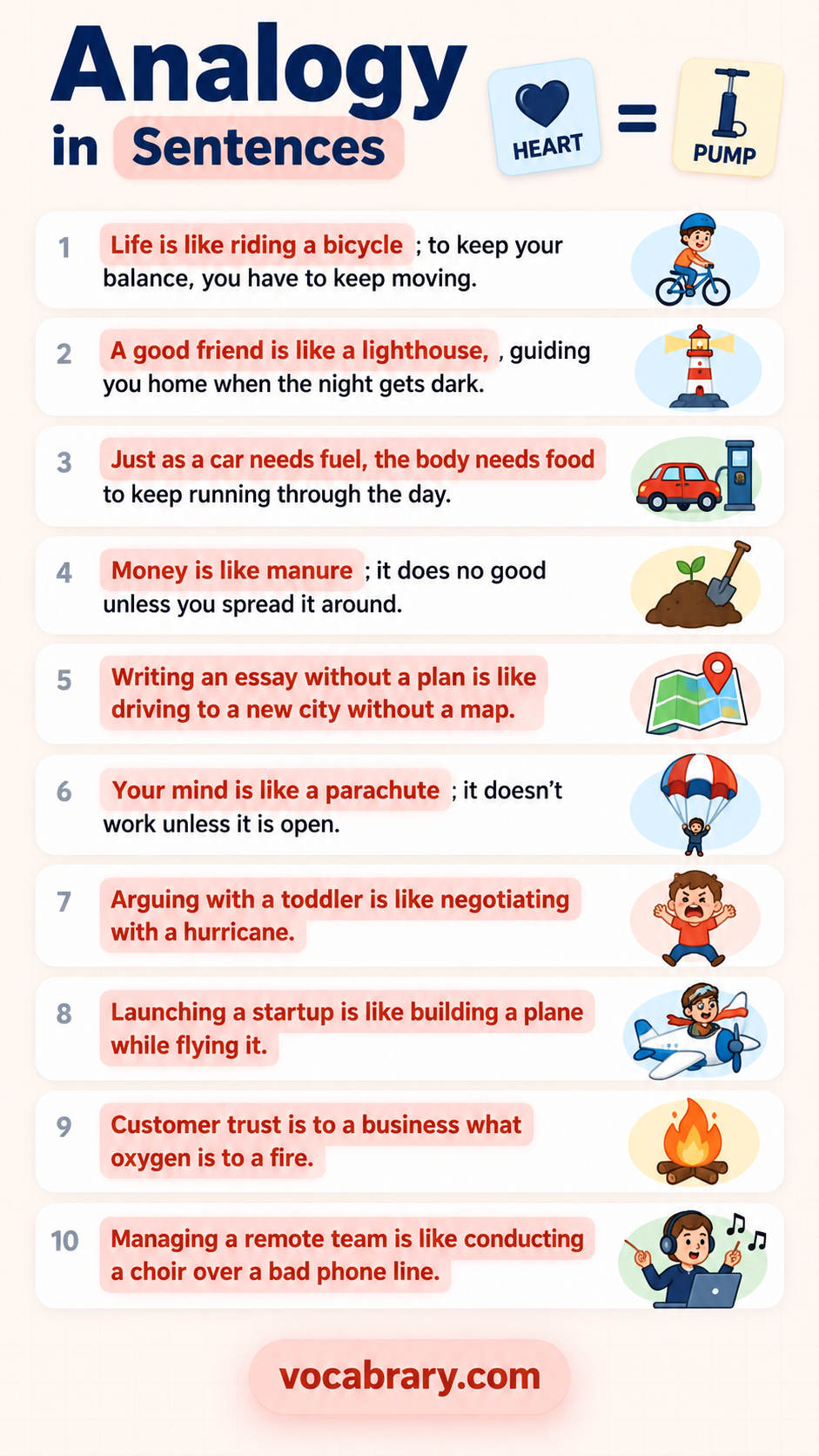
Common Analogy Examples in Sentences
A heart compared to a pump, a brain compared to a computer, and a school compared to a garden are textbook analogy examples in sentences, each explaining the unfamiliar through the familiar.
- The heart is like a pump, pushing blood through every vein and artery in the body.
- Our teacher told us that the brain works like a computer, storing memories and processing new facts every second.
- A school is like a garden: the teachers plant seeds, and the students grow at their own pace.
- Life is like riding a bicycle; to keep your balance, you have to keep moving.
- Grandma always said that raising children is like baking bread, since both need patience, warmth, and time to rise.
- Learning a language is like building a house, because grammar lays the foundation and vocabulary adds the walls.
- A good friend is like a lighthouse, guiding you home when the night gets dark.
- Just as a car needs fuel, the body needs food to keep running through the day.
- Why do people say that finding a good job is like finding a needle in a haystack?
- Reading without focus is like pouring water into a sieve; almost nothing stays.
- Money is like manure: it does no good unless you spread it around.
- Time is like a river, and no one steps into the same moment twice.
- Sleep is to the body what charging is to a phone; skip it, and everything shuts down by evening.
- The coach explained that a team is like a chain, only as strong as its weakest link.
- Trust is like a mirror: once it cracks, you never see the same reflection again.
- Writing an essay without a plan is like driving to a new city without a map.
- A library is to knowledge what a bank is to money, a place where people store and borrow value.
- Your mind is like a parachute; it doesn’t work unless it is open.
- Worry is like a rocking chair: it gives you something to do but gets you nowhere.
- Dad never forgets that a family is like a tree, with roots in the past and branches reaching toward the future.
Analogy Examples in Everyday Life
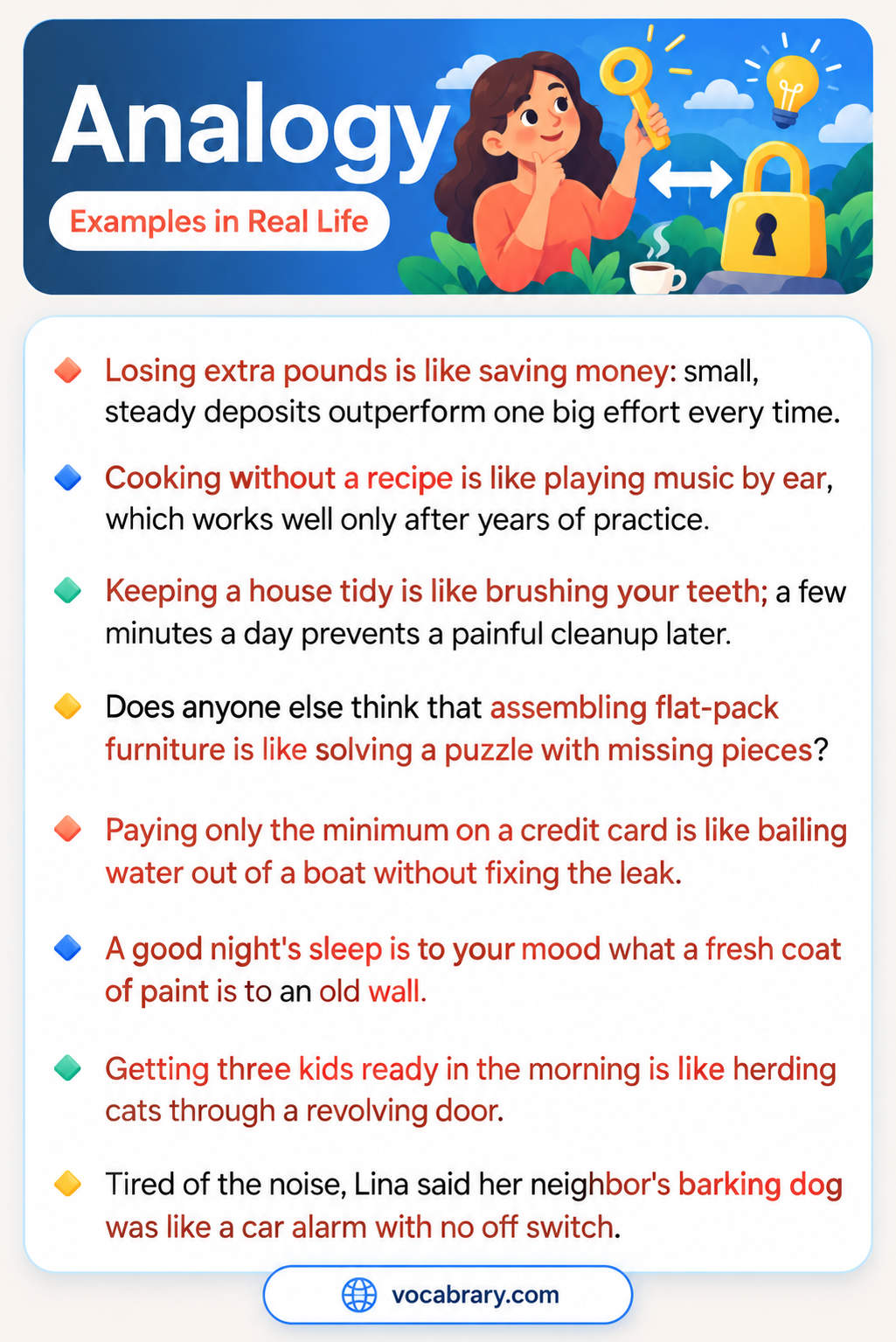
Dieting compared to saving money, a messy inbox compared to a cluttered closet, and rush-hour traffic compared to a clogged drain show how people explain daily frustrations in familiar terms.
- Losing extra pounds is like saving money: small, steady deposits outperform one big effort every time.
- Maria says her email inbox is like a cluttered closet; the longer she ignores it, the harder it is to find anything.
- Rush-hour traffic is like water in a clogged drain, moving in slow trickles until the pipe clears.
- Cooking without a recipe is like playing music by ear, which works well only after years of practice.
- Arguing with a toddler is like negotiating with a hurricane.
- After the move, Ken realized that unpacking is like peeling an onion, with a new layer of mess under every carton.
- Keeping a house tidy is like brushing your teeth; a few minutes a day prevents a painful cleanup later.
- A budget is to your wallet what a fence is to a garden, keeping out the costs you never invited.
- Does anyone else think that assembling flat-pack furniture is like solving a puzzle with missing pieces?
- Neglecting car maintenance is like skipping doctor visits; the repair bill grows every month you wait.
- Paying only the minimum on a credit card is like bailing water out of a boat without fixing the leak.
- Rosa compared her morning coffee to a car’s ignition, since nothing starts until she has had a cup.
- A good night’s sleep is to your mood what a fresh coat of paint is to an old wall.
- Friendship is like a houseplant: forget to water it for months, and it wilts.
- Uncle Ray never tires of saying that gossip is like a feather pillow torn open in the wind, impossible to gather back once it scatters.
- Getting three kids ready in the morning is like herding cats through a revolving door.
- Renting an apartment is like dating; you learn the flaws only after you move in.
- Tired of the noise, Lina said her neighbor’s barking dog was like a car alarm with no off switch.
Analogy Examples at Work
A company compared to an orchestra, a startup compared to a plane built mid-flight, and technical debt compared to credit card debt help coworkers explain office pressure through pictures they already know.
- A company is like an orchestra; every department plays its own part, and the manager keeps them in time.
- Launching a startup is like building a plane while flying it.
- Our manager said that a missed deadline is like a missed flight: you pay for it twice.
- Customer trust is to a business what oxygen is to a fire.
- Onboarding a new hire without training is like handing someone a map in a language they never learned.
- Priya compared the quarterly report to a medical checkup, since it shows the company’s health before symptoms get worse.
- Technical debt is like credit card debt; the interest keeps growing until someone pays it off.
- Managing a remote team is like conducting a choir over a bad phone line.
- Why is a meeting without an agenda like a road trip without a destination?
- Networking is like planting trees: the shade arrives years after the work.
- The CEO told investors that the company’s cash reserve is like a spare tire, never exciting until the day you need it.
- Hiring the wrong person is like buying shoes a size too small, painful every single day.
Analogy Examples for Students
Studying compared to marathon training, an essay outline compared to a skeleton, and cramming compared to eating a week of meals at once are analogy examples students recognize from their own school year.
- Studying for finals is like training for a marathon; nobody wins by sprinting the night before.
- An essay outline is like a skeleton, and the paragraphs add the muscles.
- Cramming for a test is like eating a week of meals in one sitting.
- Our history teacher said that footnotes are to an essay what receipts are to a purchase.
- A thesis statement is like a GPS destination: without it, the essay drives in circles.
- Taking notes without reviewing them is like pouring water into a cracked jug.
- Jamal told his friend that group projects are like three-legged races, where one slow partner trips everyone.
- Learning math is like climbing a ladder; skip a rung, and the next step gets harder.
- A textbook is to a student what a toolbox is to a carpenter.
- Would you agree that procrastination is like a credit card, fun until the bill arrives?
- Proofreading your own essay is like searching for your glasses while wearing them.
- Your library card is like a passport to every country ever written about.
- Memorizing formulas without understanding them is like learning a song in a language you never studied.
- Ms. Park reminds her class that a first draft is to a final essay what clay is to a sculpture.
- Choosing a college major is like choosing a trail at the bottom of a mountain: every path climbs, but each one opens a different view.
Analogy Examples for Kids
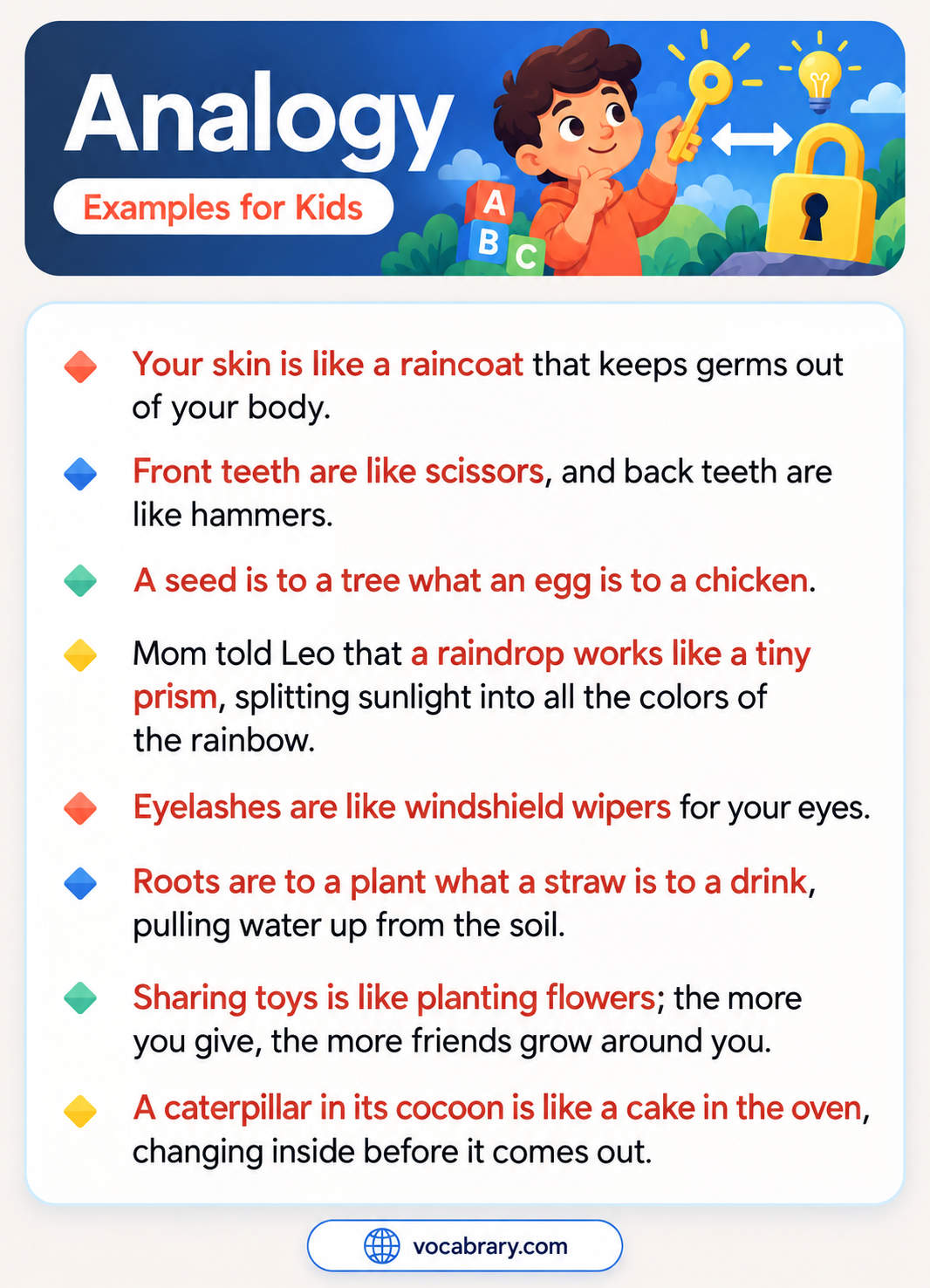
Skin compared to a raincoat, the stomach compared to a blender, and front teeth compared to scissors give children short analogy examples built from objects they see every day.
- Your skin is like a raincoat that keeps germs out of your body.
- The stomach works like a blender, mashing food into mush.
- Front teeth are like scissors, and back teeth are like hammers.
- A seed is to a tree what an egg is to a chicken.
- Bees are like tiny delivery trucks that bring pollen from flower to flower.
- Mom told Leo that a raindrop works like a tiny prism, splitting sunlight into all the colors of the rainbow.
- Eyelashes are like windshield wipers for your eyes.
- Why is a turtle’s shell like a house it never leaves?
- Roots are to a plant what a straw is to a drink, pulling water up from the soil.
- Sharing toys is like planting flowers; the more you give, the more friends grow around you.
- Grandpa says a snail is like a camper van, since it takes its home everywhere.
- A caterpillar in its cocoon is like a cake in the oven, changing inside before it comes out.
Analogy Examples in Science
Mitochondria called the powerhouse of the cell, electricity compared to water in pipes, and DNA compared to a recipe book are standard science analogies that turn invisible processes into familiar machines.
- Biology teachers describe mitochondria as the powerhouse of the cell, since they turn food into usable energy.
- Electric current is like water flowing through a pipe: voltage is the pressure, and resistance is a narrow stretch of pipe.
- DNA is like a recipe book, with each gene giving the instructions for one protein.
- The cell membrane works like a security guard, letting nutrients in and keeping harmful substances out.
- White blood cells are the army of the immune system, attacking invaders before they spread.
- Early models by Rutherford and Bohr pictured the atom as a tiny solar system, with electrons orbiting the nucleus like planets.
- Your kidneys act like a coffee filter, straining waste out of the blood.
- Astronomers compare the expanding universe to a loaf of raisin bread rising in the oven, since every raisin moves away from every other one.
- Neurons are like electrical wires, sending signals from the brain to the muscles.
- The eye works like a camera: the lens focuses light, and the retina captures the image.
- Ozone in the upper atmosphere is like sunscreen for the planet, absorbing much of the sun’s ultraviolet radiation.
- Earth’s layers are like a peach, with a thin skin of crust, a thick fleshy mantle, and a hard core at the center.
- Carl Sagan’s Cosmic Calendar, from The Dragons of Eden (1977), squeezes the history of the universe into a single year, so all recorded human history falls in the last seconds of December 31.
- Does the greenhouse effect work like a blanket that traps the planet’s heat at night?
- Enzymes are to chemical reactions what matchmakers are to couples; they bring the right partners together faster and walk away unchanged.
- Tectonic plates are like pieces of a cracked eggshell, drifting slowly over the hot mantle beneath them.
Literal and Figurative Analogy Examples
Comparing two cities or two viruses is literal analogy, while comparing a city to a beehive or a virus to a wildfire is figurative, because the second picture comes from an unrelated field.
Literal Analogy Examples
Two cities with bike lanes, two strains of a virus, and two high schools with the same schedule make literal analogies, where both sides come from the same real category.
- City planners argued that if bike lanes reduced traffic in Copenhagen, they will reduce traffic in Denver too.
- Because the new virus shares most of its genes with last year’s strain, doctors expect the same vaccine to work against it.
- If a four-day week raised attendance at Lincoln High, it should raise attendance at Jefferson High, the principal argued.
- Mice share many genes with humans, so researchers test new medicines on mice before trying them on people.
- The new phone runs the same processor as last year’s laptop, so it should handle video editing just as smoothly.
- Rome weakened after it overstretched its borders, and some historians warn that modern empires face the same risk.
- A lemon tree grows well in Seville’s hot, dry summers, so the gardener expected it to thrive in Phoenix too.
- Is a bakery in Paris a fair comparison for a bakery in Tokyo when the customers eat such different breakfasts?
Figurative Analogy Examples
A city compared to a beehive, a virus compared to a wildfire, and a rumor compared to a snowball are figurative analogies, borrowing an image from an unrelated field to explain how something behaves.
- Downtown at rush hour is like a beehive, with every worker rushing toward a different task.
- Spreading through a crowded city, a virus behaves like a wildfire in dry grass.
- A rumor is like a snowball rolling downhill, growing bigger with every turn.
- Democracy is like a garden; neglect it for a season, and the weeds take over.
- Memory is like a library with a careless librarian, who shelves some books in the wrong room.
- The internet is to gossip what gasoline is to a campfire.
- Would a marriage without honesty be like a house built on sand?
- Grief is like the ocean: it comes in waves, some days gentle and some days overwhelming.
Word Analogy Examples
Hand is to glove as foot is to sock, and wolf is to pack as fish is to school, are word-pair analogies from vocabulary tests, where the second pair repeats the first pair’s relationship.
Synonym Analogies
Happy and joyful, begin and start, and shout and yell are synonym pairs, so each analogy links two words with the same meaning.
- Happy is to joyful as sad is to gloomy.
- Big is to huge as small is to tiny.
- Begin is to start as end is to finish.
- Brave is to courageous as smart is to intelligent.
- Quick is to fast as slow is to sluggish.
- Wealthy is to rich as poor is to needy.
- Shout is to yell as whisper is to murmur.
- Mistake is to error as gift is to present.
- Silent is to quiet as noisy is to loud.
Antonym Analogies
Hot and cold, push and pull, and arrive and depart are opposite pairs, so each analogy matches one pair of antonyms with another.
- Hot is to cold as wet is to dry.
- Night is to day as dark is to light.
- Up is to down as left is to right.
- Friend is to enemy as love is to hate.
- Push is to pull as give is to take.
- Victory is to defeat as success is to failure.
- Generous is to stingy as brave is to cowardly.
- Arrive is to depart as enter is to exit.
Part-to-Whole Analogies
A finger on a hand, a petal on a flower, and a chapter in a book show the part-to-whole relationship, where the first word is one part of the second.
- Finger is to hand as toe is to foot.
- Petal is to flower as leaf is to tree.
- Wheel is to car as wing is to airplane.
- Chapter is to book as scene is to play.
- Brick is to wall as tile is to roof.
- Room is to house as cabin is to ship.
- Spoke is to wheel as rung is to ladder.
- Stanza is to poem as paragraph is to essay.
Cause-and-Effect Analogies
Rain causing a flood, exercise building fitness, and a joke producing laughter show the cause-and-effect relationship, where the first word leads to the second.
- Rain is to flood as drought is to famine.
- Exercise is to fitness as study is to knowledge.
- Fire is to smoke as wind is to waves.
- Germ is to infection as spark is to explosion.
- Practice is to skill as neglect is to decay.
- Joke is to laughter as insult is to anger.
- Heat is to melting as cold is to freezing.
- Overeating is to indigestion as overwork is to burnout.
Object-and-Context Analogies
A hand in a glove, a fish in water, and a doctor in a hospital pair each word with the place or covering it goes with.
- Hand is to glove as foot is to sock.
- Fish is to water as bird is to sky.
- Bear is to den as bee is to hive.
- Doctor is to hospital as teacher is to classroom.
- Car is to garage as plane is to hangar.
- Pilot is to cockpit as chef is to kitchen.
- Painting is to museum as book is to library.
- Head is to hat as finger is to ring.
- Actor is to stage as athlete is to stadium.
Object-and-Function Analogies
A pen that writes, a shovel that digs, and an oven that bakes link each object to its job, so the analogy tests whether the reader knows what a tool does.
- Pen is to write as knife is to cut.
- Shovel is to dig as broom is to sweep.
- Oven is to bake as freezer is to chill.
- Eyes are to see as ears are to hear.
- Thermometer is to temperature as clock is to time.
- Ladder is to climb as bridge is to cross.
- Needle is to sew as hammer is to pound.
- Microscope is to magnify as loudspeaker is to amplify.
Characteristic Analogies
Snow that is cold, lemons that are sour, and glass that is fragile pair a noun with its defining quality, and the second pair repeats that link.
- Snow is to cold as fire is to hot.
- Feather is to light as lead is to heavy.
- Lemon is to sour as honey is to sweet.
- Glass is to fragile as steel is to strong.
- Cheetah is to fast as sloth is to slow.
- Desert is to dry as rainforest is to humid.
- Silk is to smooth as sandpaper is to rough.
- Diamond is to hard as cotton is to soft.
Degree Analogies
Drizzle and downpour, hill and mountain, and tired and exhausted move from a mild word to a strong one, so each analogy tests a sense of intensity.
- Warm is to hot as chilly is to freezing.
- Drizzle is to downpour as breeze is to gale.
- Like is to love as dislike is to hate.
- Tired is to exhausted as hungry is to starving.
- Giggle is to guffaw as sniffle is to sob.
- Annoyed is to furious as pleased is to ecstatic.
- Hill is to mountain as pond is to lake.
- Walk is to sprint as nibble is to devour.
Member-and-Group Analogies
A wolf in a pack, a cow in a herd, and a player on a team pair a single member with the collective noun for its group.
- Wolf is to pack as fish is to school.
- Cow is to herd as sheep is to flock.
- Bee is to swarm as ant is to colony.
- Player is to team as musician is to band.
- Soldier is to army as sailor is to navy.
- Star is to galaxy as island is to archipelago.
- Lion is to pride as crow is to murder.
- Juror is to jury as student is to class.
Producer-and-Product Analogies
Bees making honey, authors writing novels, and bakers making bread link a maker with what it makes, whether the maker is an animal or a person.
- Bee is to honey as cow is to milk.
- Author is to novel as composer is to symphony.
- Baker is to bread as brewer is to beer.
- Spider is to web as bird is to nest.
- Hen is to egg as silkworm is to silk.
- Vine is to grape as tree is to apple.
- Architect is to blueprint as tailor is to suit.
- Poet is to poem as playwright is to play.
Example-and-Category Analogies
A rose as a flower, a salmon as a fish, and a hammer as a tool pair a specific case with its larger class.
- Rose is to flower as oak is to tree.
- Salmon is to fish as eagle is to bird.
- Hammer is to tool as violin is to instrument.
- Mars is to planet as Sun is to star.
- Soccer is to sport as chess is to game.
- Apple is to fruit as carrot is to vegetable.
- Iron is to metal as granite is to rock.
- Poodle is to dog as Siamese is to cat.
Word Analogy Examples With Answers
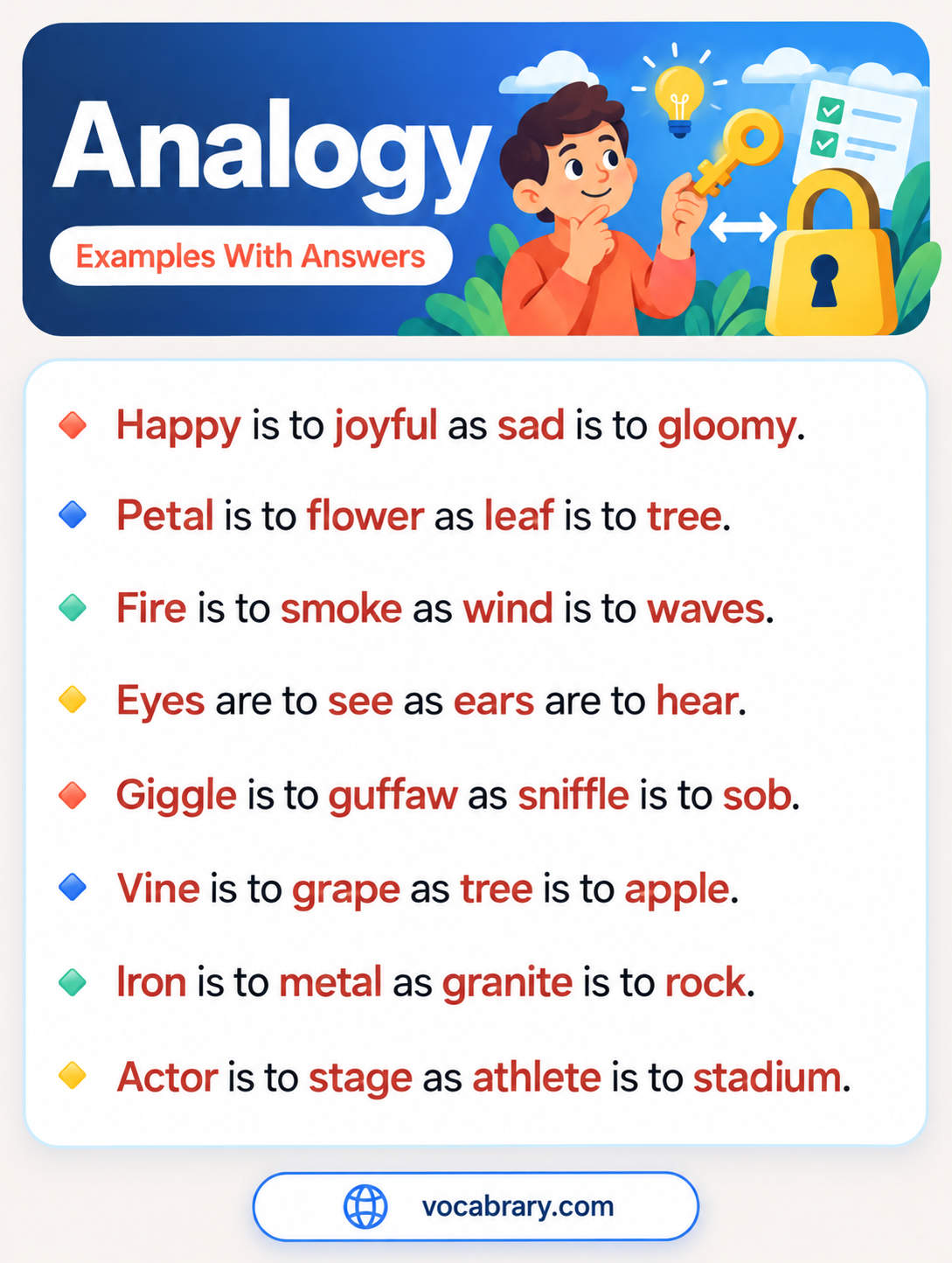
Puppy is to dog as kitten is to cat, and pen is to writer as brush is to painter, are practice analogies with the missing word solved and the relationship named.
- Puppy is to dog as kitten is to ___. Answer: cat, because each pair links a young animal to its adult form.
- Pen is to writer as brush is to ___. Answer: painter, since each tool matches the person who works with it.
- Bird is to nest as bee is to ___. Answer: hive.
- Hungry is to eat as thirsty is to ___. Answer: drink, the action that satisfies each need.
- Ice is to water as water is to ___. Answer: steam, the next state of matter when each one is heated.
- Author is to book as chef is to ___. Answer: meal.
- Tall is to short as wide is to ___. Answer: narrow, because both pairs are opposites.
- Letter is to word as word is to ___. Answer: sentence, since each one builds the next larger part of language.
- Calf is to cow as foal is to ___. Answer: horse.
- Eye is to see as nose is to ___. Answer: smell, the sense each organ provides.
Analogy Examples in Arguments and Persuasion
Franklin Roosevelt’s garden hose, William Paley’s watch on a heath, and a lawyer comparing faulty wiring to a roof leak show analogy used as evidence, so accepting one case means accepting the other.
- At a December 1940 press conference, Franklin Roosevelt compared lending weapons to Britain with lending a garden hose to a neighbor whose house is on fire.
- In Natural Theology (1802), William Paley argued that just as a watch found on a heath implies a watchmaker, the design of plants and animals implies a designer.
- Banning books to protect students is like closing hospitals to stop disease, the librarian told the school board.
- Letting a teenager drive without lessons is like letting a child swim in the ocean without a life jacket, one parent argued.
- The lawyer said ignoring the faulty wiring was like ignoring a leak in the roof; the damage grew every week the landlord waited.
- A country without a savings plan is like a family without an emergency fund, the economist warned.
- “If we insure our cars against accidents, why not insure our crops against drought?” the senator asked.
- Skipping vaccines because a disease is rare is like removing smoke alarms because the house has never burned.
- The activist argued that cutting park funding to save money is like selling your umbrella on a sunny day.
- Just as we require pilots to pass safety tests, we should require drone operators to pass them too, the mayor said.
- Training employees is like maintaining machines: skip it to save money today, and a machine failure costs more tomorrow.
- In June 1864, Abraham Lincoln argued against replacing him mid-war by saying it was unwise to swap horses while crossing a river.
False Analogy Examples
Employees compared to nails, a country compared to a household, and students compared to computers are false analogies, since the two sides match on one surface trait and differ on the traits the argument needs.
- Employees are like nails, so the harder you hit them, the better they work.
- Running a country is like running a household, so the government should never borrow money.
- Students are like computers: copy the data in once, and they will remember it forever.
- A cat is like a dog, so it should learn to fetch on command.
- Since a teacher is like a parent, the principal claimed that teachers should decide what students eat at home.
- Buying a lottery ticket is like investing in stocks, since both involve risk.
- A marriage is like a car, so you trade it in when it gets old.
- Reading a novel is like watching its film, so the book adds nothing new.
- Should a mayor run a city the way a CEO runs a company, when citizens never chose to be customers?
- Taking medicine is like eating candy; both taste sweet, so kids should have as much as they want.
Analogy Examples in Literature
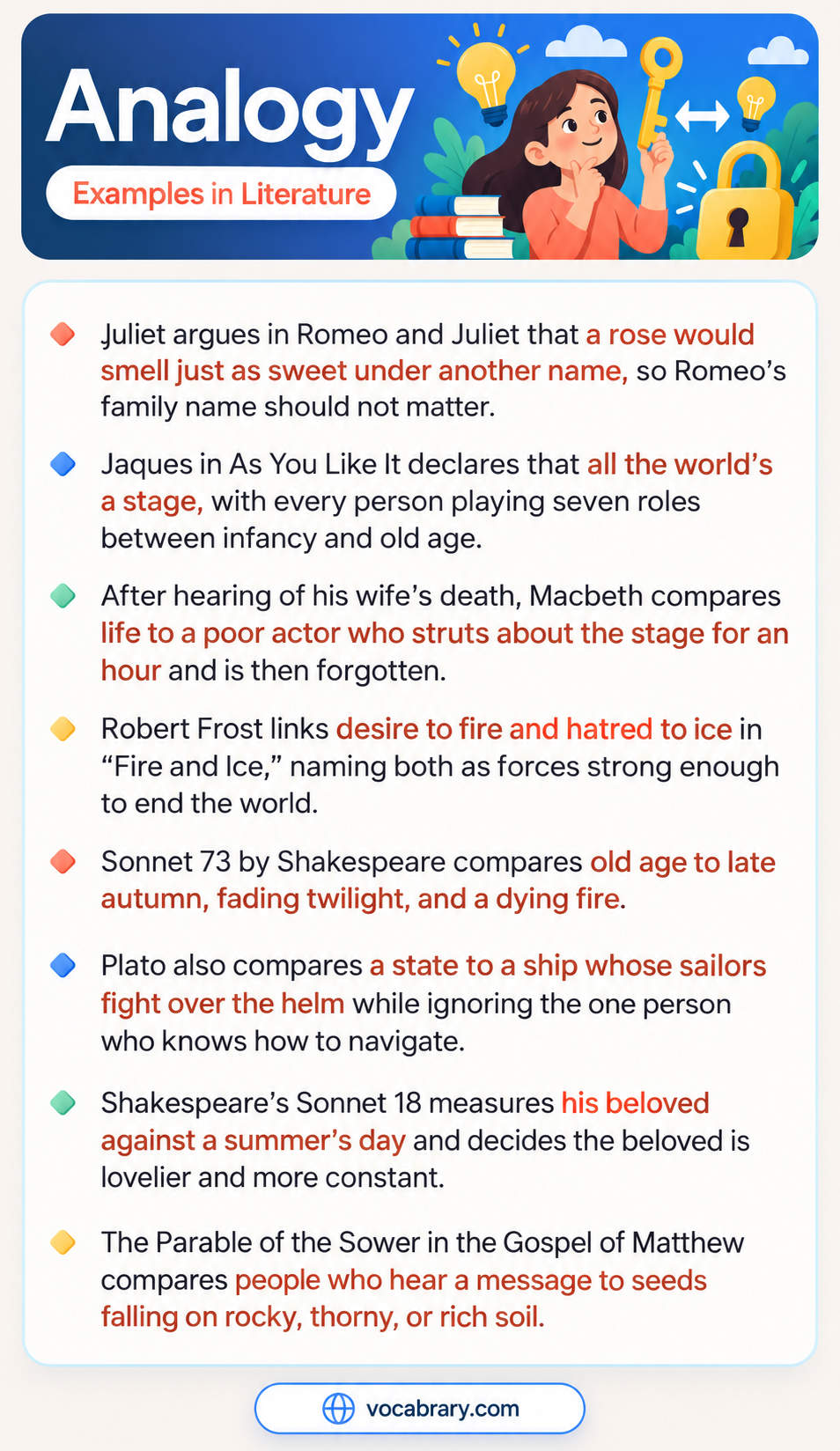
Juliet’s rose, Plato’s cave, and John Donne’s compass are among the most studied analogy examples in literature, each explaining love, knowledge, or life through one familiar object.
Analogy in Novels, Plays, and Philosophy
Plato’s cave, Macbeth’s poor actor, and Scout Finch’s mockingbird show writers building a whole argument about knowledge, life, or innocence on one comparison.
- Juliet argues in Romeo and Juliet that a rose would smell just as sweet under another name, so Romeo’s family name should not matter.
- Jaques in As You Like It declares that all the world’s a stage, with every person playing seven roles between infancy and old age.
- After hearing of his wife’s death, Macbeth compares life to a poor actor who struts about the stage for an hour and is then forgotten.
- In Plato’s Republic, prisoners chained in a cave mistake shadows on the wall for reality, an analogy for people who have never been educated.
- Plato also compares a state to a ship whose sailors fight over the helm while ignoring the one person who knows how to navigate.
- Scout decides at the end of To Kill a Mockingbird that exposing Boo Radley would be like shooting a mockingbird, harming someone who has done only good.
- George Orwell’s Animal Farm turns a farm rebellion into an analogy for the Russian Revolution, with the pig Napoleon representing Stalin.
- The Parable of the Sower in the Gospel of Matthew compares people who hear a message to seeds falling on rocky, thorny, or rich soil.
- Ernest Hemingway compares good writing to an iceberg in Death in the Afternoon (1932), with only one-eighth of it visible over the water.
Analogy in Poems
John Donne’s compass, Emily Dickinson’s frigate, and Robert Frost’s fire and ice show poets explaining love, reading, and the end of the world through one familiar object.
- John Donne’s “A Valediction: Forbidding Mourning” compares two lovers to the legs of a drawing compass, one fixed at the center while the other roams and always returns.
- Emily Dickinson’s “There is no Frigate like a Book” compares a book to a ship that takes readers to faraway lands.
- Robert Frost links desire to fire and hatred to ice in “Fire and Ice,” naming both as forces strong enough to end the world.
- Sonnet 73 by Shakespeare compares old age to late autumn, fading twilight, and a dying fire.
- Langston Hughes’s “Harlem” asks whether a deferred dream dries up like a raisin in the sun.
- Shakespeare’s Sonnet 18 measures his beloved against a summer’s day and decides the beloved is lovelier and more constant.
- Dickinson’s “Hope is the thing with feathers” pictures hope as a small bird that keeps singing through storms and never asks for a crumb in return.
Analogy Examples in Famous Speeches
Lincoln’s house divided, Martin Luther King Jr.’s bad check, and John F. Kennedy’s tiger ride show speakers using analogy to make a national problem feel personal.
- In June 1858, Abraham Lincoln warned that a house divided against itself cannot stand, comparing a nation split over slavery to a home at war with itself.
- Martin Luther King Jr.’s “I Have a Dream” speech of August 28, 1963, compared America’s promise of equality to a bad check returned for insufficient funds.
- At Rice University in September 1962, John F. Kennedy compressed 50,000 years of human history into half a century, so penicillin arrived only last week.
- Winston Churchill described an iron curtain descending across Europe at Fulton, Missouri, in March 1946, dividing the East from the West.
- Dwight Eisenhower explained the “falling domino” principle in April 1954: if one country in Southeast Asia fell to communism, its neighbors would topple in turn.
- Steve Jobs told Stanford graduates in 2005 that life choices are like dots you connect only when you look back.
- Franklin Roosevelt’s first inaugural address, in March 1933, compared the Great Depression to a foreign invasion and asked for powers as broad as a wartime president’s.
- John F. Kennedy’s 1961 inaugural address warned that those who ride the back of the tiger to gain power end up inside.
Analogy Examples in Movies and TV
Forrest Gump’s chocolates, Shrek’s onion, and Master Oogway’s peach tree are film analogies that audiences still repeat, each explaining a character’s view of life through an ordinary object.
- Forrest Gump repeats his mother’s saying in the 1994 film that life is like a box of chocolates, since you never know what you’re going to get.
- Shrek tells Donkey in Shrek (2001) that ogres are like onions because both have layers.
- Master Oogway uses a peach tree that nobody forces to blossom early in Kung Fu Panda (2008), teaching Shifu patience with Po.
- Mufasa teaches Simba in The Lion King (1994) that lions eat antelope, antelope eat grass, and lions become grass after death, all parts of the circle of life.
- Ian Malcolm drips water on Ellie Sattler’s hand in Jurassic Park (1993) to show how chaos theory makes the path of each drop unpredictable.
- Agent Smith tells Morpheus in The Matrix (1999) that humans behave like a virus, multiplying until every resource is gone.
- Cobb calls an idea the most resilient parasite in Inception (2010), since it refuses to leave once it takes root in a mind.
- In The Big Short (2015), Jared Vennett pulls pieces from a Jenga tower to show how weak mortgage bonds bring down the whole stack.
- Ted Lasso tells a nervous player in the first season of Ted Lasso that the happiest animal is a goldfish because it forgets everything in ten seconds.
Related
FAQs
Two analogy examples in sentences are "The heart is like a pump" and "A school is like a garden." Each explains a new case through a familiar one, and the sentences add matching parts.
Everyday analogies explain a frustration through a familiar object, as in "Rush-hour traffic is like water in a clogged drain" and "Keeping a house tidy is like brushing your teeth." The second adds that a few minutes a day prevents a painful cleanup.
Office analogies explain pressure and teamwork through familiar pictures, as in "A company is like an orchestra" and "Launching a startup is like building a plane while flying it." Both sentences give a manager a role or a risk to picture.
Student analogies make study habits memorable, as in "Studying for finals is like training for a marathon" and "An essay outline is like a skeleton." The first adds that nobody wins by sprinting the night before.
Children follow analogies built from objects they see daily, as in "Your skin is like a raincoat" and "Eyelashes are like windshield wipers for your eyes." Each sentence ties a body part to a familiar tool.
Science teachers explain invisible processes with machines, as in "DNA is like a recipe book" and "The eye works like a camera." Another analogy pictures the expanding universe as a loaf of raisin bread rising in the oven.
A word analogy matches one pair with another, as in "Happy is to joyful as sad is to gloomy" and "Wolf is to pack as fish is to school." The first pair links synonyms, and the second links a member with its group.
Speakers use analogy to make a national problem personal, as when Franklin Roosevelt compared lending weapons to Britain with lending a garden hose to a neighbor whose house is on fire. Lincoln pictured "a house divided against itself" that "cannot stand."
Films give characters short analogies about life, as in "life is like a box of chocolates" from Forrest Gump and "ogres are like onions" from Shrek. Both lines explain a view of the world through an ordinary object.
A false analogy matches two cases on one surface trait and ignores the traits the argument needs, as in "Employees are like nails" and "Running a country is like running a household." Each sentence draws a conclusion that the comparison does not support.