
Alliteration is a sound device in which the same first consonant sound repeats across nearby words, as when a busy bumblebee buzzes beside a big brown bear. Most animal alliteration examples pair one creature with verbs and adjectives that share its opening sound, and the best-known of them name pets, farm animals, and zoo favorites.
What Is Alliteration?
Alliteration repeats the opening consonant sound of two or more words placed close together, such as “lazy lions lounging.” Unlike assonance, which repeats vowel sounds inside words, alliteration depends on the sound that begins each word. Animal names suit the device because creature words start on every letter of the alphabet.
Two wet weasels wriggled under the wooden wall at dawn.
Common Animal Alliteration Examples in Sentences
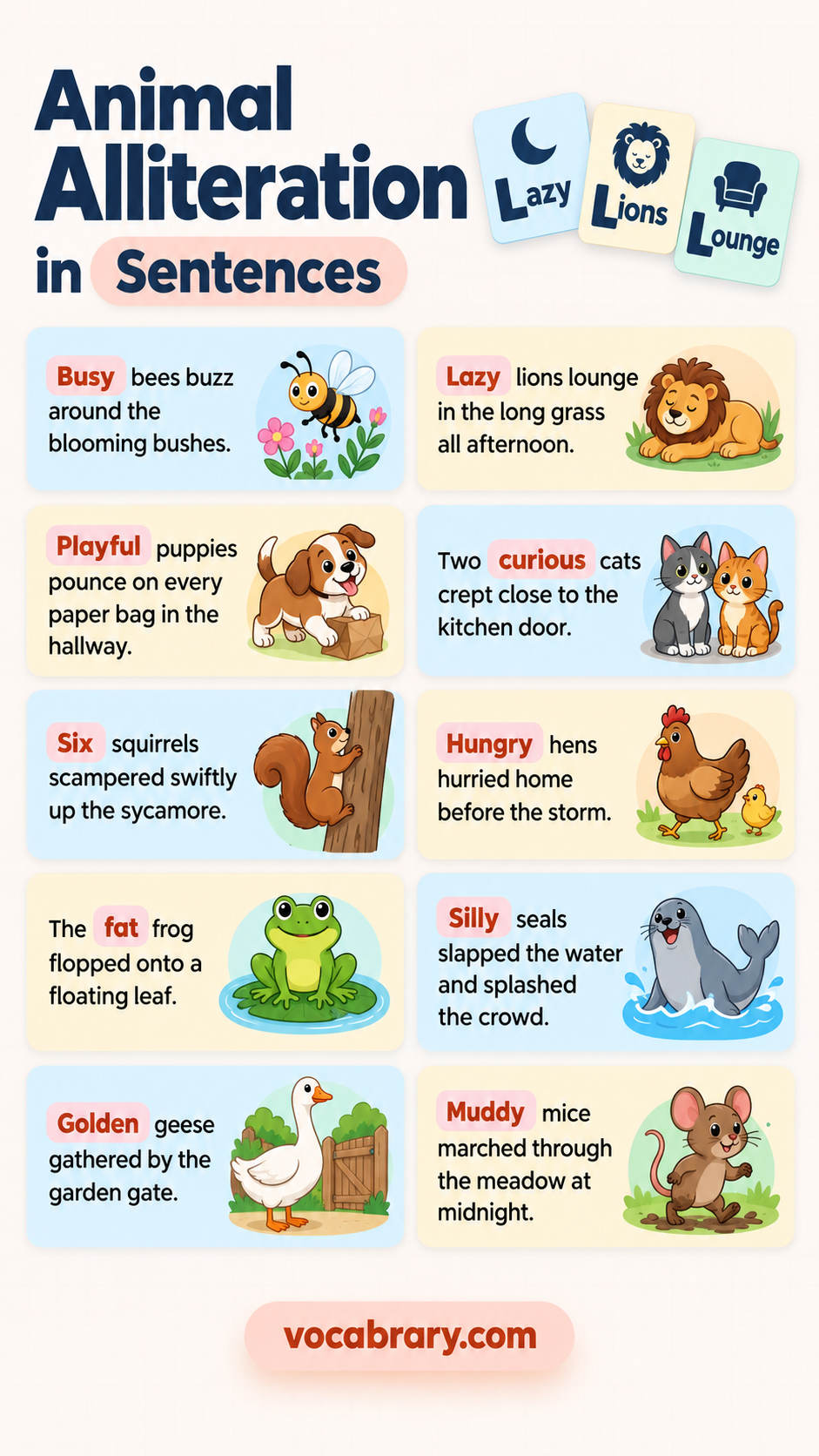
Busy bees, lazy lions, and playful puppies are the animal alliteration examples most readers meet first, where the creature and the words around it share one opening sound.
- Busy bees buzz around the blooming bushes.
- Lazy lions lounge in the long grass all afternoon.
- Playful puppies pounce on every paper bag in the hallway.
- Two curious cats crept close to the kitchen door.
- Six squirrels scampered swiftly up the sycamore.
- Hungry hens hurried home before the storm.
- The fat frog flopped onto a floating leaf.
- Silly seals slapped the water and splashed the crowd.
- Did the wild wolves wander west again?
- Golden geese gathered by the garden gate.
- Muddy mice marched through the meadow at midnight.
- Ten turtles took turns on the tiny log.
- Dozens of dragonflies darted over the dark pond.
- No rabbit races round the rose bushes faster than mine.
- Brave badgers burrow beneath the broken barn boards.
- Nine noisy nightingales nested near the narrow river and sang until the new moon rose over the hills.
Pet Animal Alliteration Examples
Dogs digging, cats curled on cushions, and rabbits nibbling in a hutch give pet owners the friendliest alliteration, since pet names and pet habits begin on so many strong consonants.
Dog Alliteration Examples
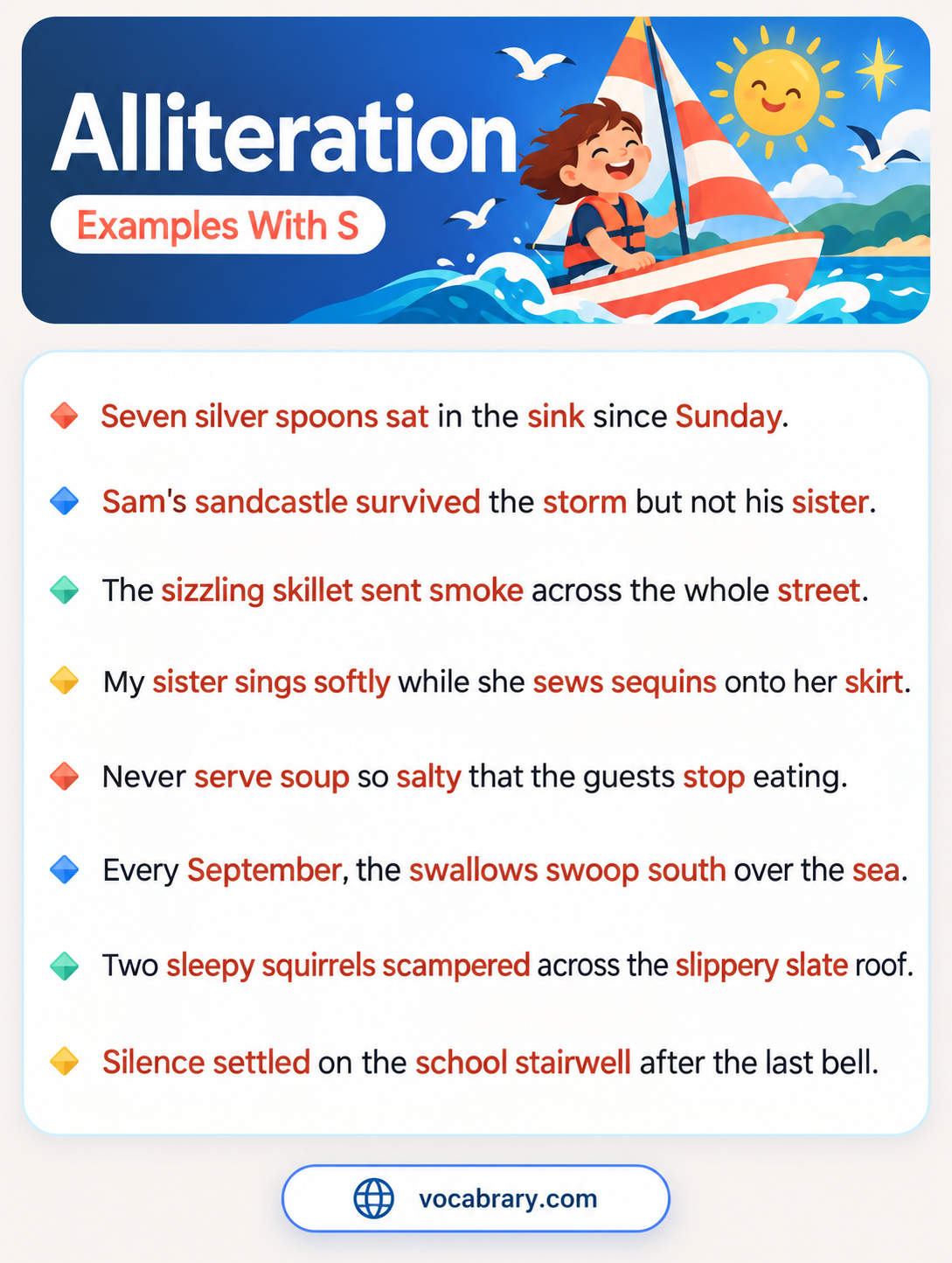
Digging in the dirt, dashing across a backyard, and tugging a tattered towel are the dog habits that alliterate most naturally, mostly on the d, b, and t sounds.
- Daisy the dachshund dug deep into the daisies.
- Barking beagles bounded across the backyard.
- My puppy paws at the porch door every morning.
- Rowdy retrievers raced round the rainy park.
- Growling greyhounds guarded the gate all night.
- Ten terriers tugged at the same tattered towel.
- Shaggy sheepdogs shuffled into the shade.
- Never let a lively labrador lick the lunch plates.
- Chewing a chair leg, the cheerful chihuahua ignored every warning.
- Fluffy French bulldogs flopped in front of the fan after a full hour of fetch in the field.
Cat Alliteration Examples
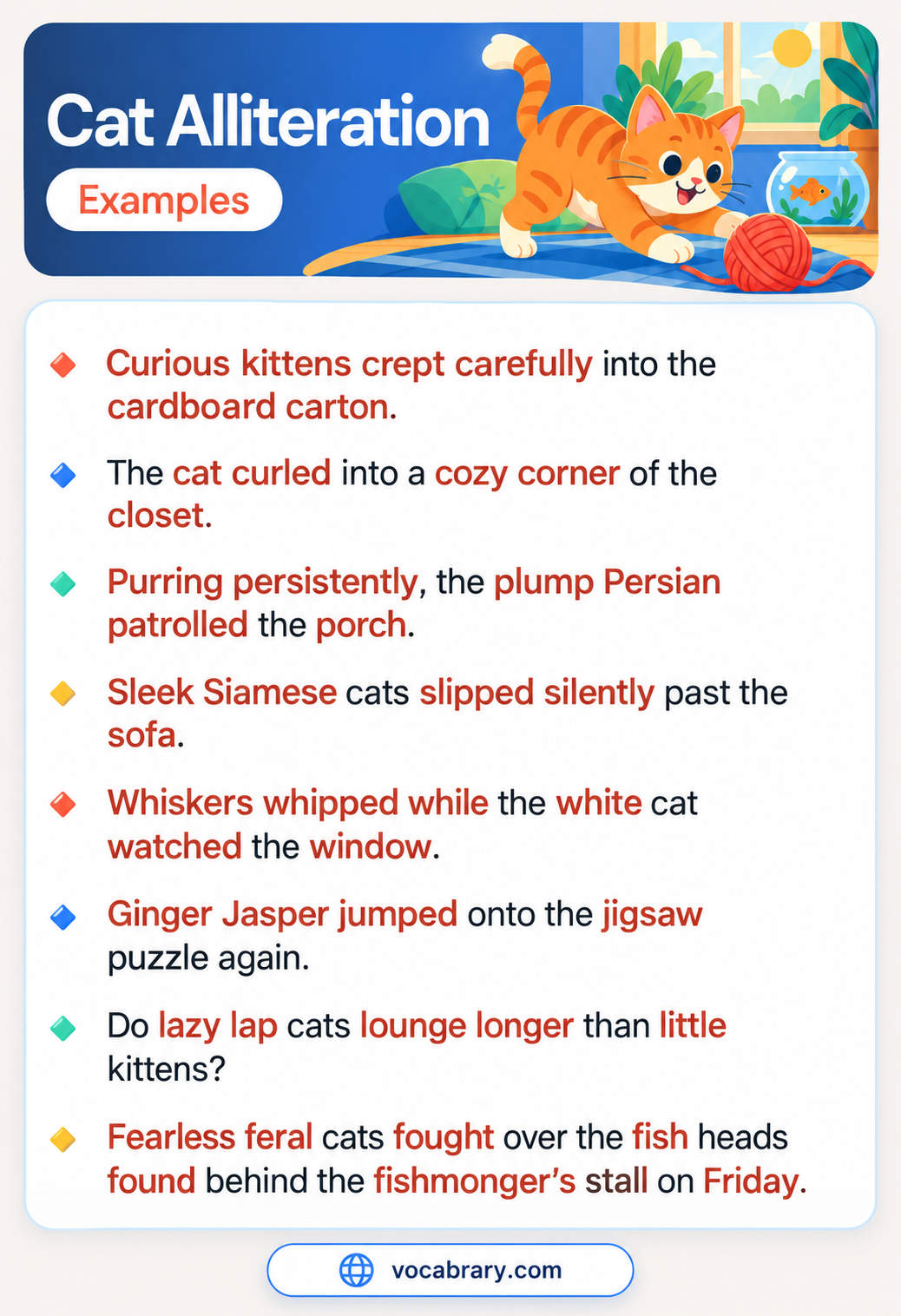
Kittens creeping into a cardboard carton, a cat curled in a closet corner, and a Persian patrolling the porch make up the cat sentences, with the hard c sound repeating in most of them.
- Curious kittens crept carefully into the cardboard carton.
- The cat curled into a cozy corner of the closet.
- Mittens the moggy meowed for milk at midnight.
- Purring persistently, the plump Persian patrolled the porch.
- Sleek Siamese cats slipped silently past the sofa.
- Whiskers whipped while the white cat watched the window.
- Ginger Jasper jumped onto the jigsaw puzzle again.
- Two tomcats tangled over a torn toy.
- Do lazy lap cats lounge longer than little kittens?
- Fearless feral cats fought over the fish heads found behind the fishmonger’s stall on Friday.
Rabbit and Small Pet Alliteration Examples
Rabbits racing round a run, hamsters hoarding seeds in the hay, and guinea pigs gobbling greens make up the small-pet sentences, where quick consonants match quick creatures.
- Rabbits raced round the rickety run.
- Hamsters hid in the hay and hoarded half a handful of seeds.
- Guinea pigs gobbled the green grass in greedy gulps.
- Frisky ferrets frolicked from one flowerpot to the next.
- Tiny tortoises trudged toward the tomato slices.
- My parrot pecks the plastic perch whenever the postman passes.
- Gerbils jostled for the juiciest jumbo seed in the jar.
- Chubby chinchillas chattered and chewed all chilly evening.
- Ruby the rabbit refused every radish we offered her.
- Hedgehogs huddled in the hutch behind the house while the heavy hailstorm hammered the henhouse roof.
Farm Animal Alliteration Examples
Pigs in the puddles, hens in the henhouse, and goats gobbling the greens give barnyard sentences their repeated sounds, since farm names begin on hard consonants such as p, g, and b.
- Pink pigs plodded through the puddles by the pen.
- Cows crowded the cool corner of the calving shed.
- Goats galloped past the garden gate and gobbled the greens.
- Hens huddled in the henhouse when the hawk hovered overhead.
- Ducks dabbled in the ditch beside the dairy.
- Sheep shuffled into the shearing shed.
- Ten turkeys trotted toward the trough.
- Lambs leapt over the low stone wall in the lane.
- Our rooster roused the whole ranch at first light.
- Black bulls bellowed beyond the broken barn.
- Did the farmer feed the four foals first?
- Muddy mares and moody mules milled about the meadow until the midday bell marked the end of milking.
Jungle and Safari Animal Alliteration Examples
Monkeys munching mangoes, lions lazing on a ledge, and gazelles grazing near a waterhole are the safari scenes that alliterate, mostly on the m, l, and g sounds.
- Mischievous monkeys munched mangoes in the morning mist.
- Lean lions lazed on the long limestone ledge.
- Grey gazelles grazed gracefully near the green waterhole.
- Jaguars jumped from the jungle branch onto the jeep track.
- Two tigers tracked the trail through the tangled trees.
- Cheetahs charged at the chattering chimps.
- Rhinos rumbled over the rocky ridge at dusk.
- Hippos hauled their heavy hides out of the hot river.
- Parrots perched on pale palm leaves over the path.
- Do baboons bicker beside the baobab tree every evening?
- Wild wildebeest wandered west across the wide plain.
- Crocodiles crept closer to the crossing while the cautious kudu kept back from the current.
Sea Creature Alliteration Examples
Silver sardines, slippery seals, and crabs crawling over cold coral make up the ocean sentences, where the s, c, and w sounds repeat most.
- Silver sardines swam in swift, silent circles.
- Whales wallowed in the warm western waters.
- Crabs crawled cautiously over the cold coral.
- Dolphins dived deep and darted past the drifting boat.
- Slippery seals slid off the sunny stone.
- Jellyfish jiggled just beneath the jetty.
- Tiny tuna turned together in the tide.
- Playful porpoises patrolled the pier at pale dawn.
- Mackerel massed near the muddy mouth of the river.
- Did the lobster lurk longer under the ledge than the eel?
- Sharks shot through the shallows and shook the shoal apart.
- Beneath the bright blue bay, barnacles bristled on the battered boat while a bold barracuda basked beside them.
Bird Alliteration Examples
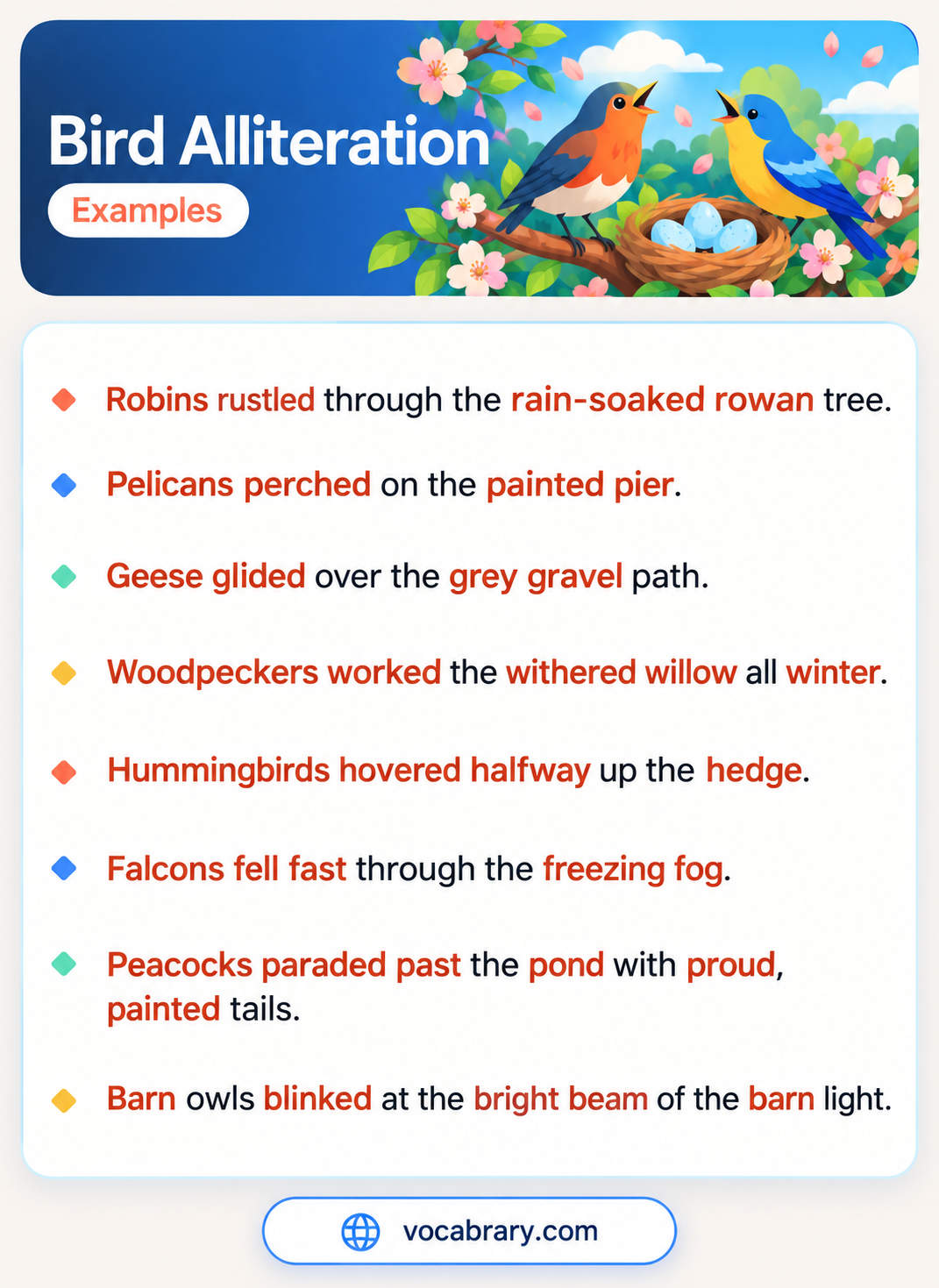
Robins in the rain, pelicans on a pier, and woodpeckers working a willow give bird sentences their alliteration, with wings, whistles, and warbles adding more repeats.
- Robins rustled through the rain-soaked rowan tree.
- Pelicans perched on the painted pier.
- Sparrows scattered from the snowy sill.
- Geese glided over the grey gravel path.
- Woodpeckers worked the withered willow all winter.
- Crows cawed from the crooked cottage roof.
- Hummingbirds hovered halfway up the hedge.
- Falcons fell fast through the freezing fog.
- Did the magpie mimic the mower and the milkman?
- Peacocks paraded past the pond with proud, painted tails.
- Barn owls blinked at the bright beam of the barn light.
- Swallows swooped and soared over the still stream while six starlings settled on the slender signpost nearby.
Insect and Bug Alliteration Examples
Bumblebees between the bellflowers, caterpillars crunching cabbage, and moths around a motel sign make the insect sentences, where short bug names pair with quick verbs.
- Bumblebees bumped between the blue bellflowers.
- Caterpillars crunched the crisp cabbage leaves.
- Flies flitted over the fallen figs.
- Grasshoppers gathered in the golden grass.
- Ladybugs landed on the lilac leaves.
- Moths massed around the moonlit motel sign.
- Wasps whined wildly around the watermelon slices.
- Do dragonflies dance over the damp ditch every dusk?
- Crickets clicked constantly in the cool corn rows.
- Spiders spun silver strands across the stems.
- Ten termites tunneled through the timber.
- Beetles burrowed beneath the bark while busy bees built a bulging brown hive in the battered birch stump.
Reptile and Amphibian Alliteration Examples
Snakes sliding over sand, toads tumbling into a tin bath, and lizards lying low on a wall give reptile sentences their repeated sounds, mostly s, t, and l.
- Slippery snakes slid silently over the sand.
- Ten toads tumbled into the tin bath.
- Lazy lizards lay low on the limestone wall.
- Green geckos gripped the glass beside the lamp.
- Frogs flopped from the fern into the fountain.
- Patient tortoises plodded past the pumpkin patch.
- A chameleon chose the cherry branch and changed shade.
- Do newts nap near the narrow notch in the log?
- Bold basilisks bolted over the brown bank.
- Massive monitor lizards marched through the marsh and muscled past the muddy mangroves at midday.
Zoo Animal Alliteration Examples
Pandas plodding past bamboo, penguins paddling by a pool, and a zookeeper zipping an enclosure shut turn a zoo trip into alliteration, since so many zoo names share the p, k, and z sounds.
- Pandas plodded past the pile of pale bamboo.
- Two penguins paddled past the pool’s plastic ramp.
- A zookeeper zipped the zebra enclosure shut at dusk.
- Kangaroos kicked up clouds of copper dust.
- Meerkats mounted the mound and monitored the midday sky.
- Gorillas gripped the grey girders and grunted.
- Lemurs leapt lightly from one long limb to another.
- Camels crossed the crowded courtyard calmly.
- Did the hyenas howl at the helicopter hovering high overhead?
- Tourists tiptoed toward the tiger terrace, where a tired tigress twitched her tail at the tapping cameras.
Baby Animal Alliteration Examples
Cubs clambering over a mother, kittens creeping under a cupboard, and cygnets swimming behind a swan are the baby-animal sentences, where soft verbs match small creatures.
- Cuddly cubs clambered over their calm mother.
- Kittens crept under the crooked kitchen cupboard.
- Piglets pushed past each other to the pail.
- Ducklings dived down beside the dozing drake.
- Foals found their feet on the frosty field.
- Baby bats bunched beneath the bridge.
- Joeys jostled for room in the jumbled pouch.
- Cygnets swam in a slow, straight line behind the swan.
- Tiny tadpoles twitched in the tepid tank.
- Nine newborn nestlings nudged nearer the nest, needing nothing more than a nibble of worm from their mother.
Animal Sound Alliteration Examples
Bees buzzing, snakes hissing, and wolves wailing are the animal noises that alliterate with their own names, so each line repeats the sound of the creature it names.
- Bees buzzed busily between the beanpoles.
- A snake’s slow hiss silenced the startled scouts.
- Howling, hooting, and hissing filled the humid hedgerow.
- Cattle called constantly close to the creek.
- Wolves wailed in the windy woods all winter.
- Croaking frogs kept the camp awake until cockcrow.
- Parrots piped and prattled on the porch.
- Did the donkey’s deep drone drift down the dale?
- Geese gabbled greedily by the gate.
- Mooing, mewing, and murmuring mingled in the morning mist as the market moved its motley herd toward the meadow.
Alliterative Animal Names and Nicknames
Bella the beagle, Percy the parrot, and Tilly the tortoise show how owners match a pet’s first name to its species, the quickest animal alliteration of all.
- Bella the beagle barks at every bicycle on the street.
- Percy the parrot prefers pears to peanuts.
- Coco the cockatoo copies every call in the kitchen.
- Monty the macaw mutters at the mailman each morning.
- Freddy the ferret found the fridge door open again.
- Gus the guinea pig grunts for greens at breakfast.
- Whiskers the whippet won the weekend race.
- Tilly the tortoise took ten minutes to turn around.
- Did Dora the donkey drag her dinner down the drive?
- Sammy the snake slipped into Sara’s slipper.
- Nelly the newt nibbles near the net.
- Harry the hamster hid half his hoard of hazelnuts behind the heater and hunted for it all Halloween.
Animal Alliteration in Children’s Books and Cartoons
Mickey Mouse, Donald Duck, and Bugs Bunny made alliterative animal names a studio habit, and picture-book authors from Beatrix Potter to Julia Donaldson kept the same trick going.
- Disney’s Mickey Mouse, first drawn in 1928, gave cartoons their most famous alliterative animal name.
- Donald Duck joined the Disney cast in 1934 with the same doubled d sound.
- Warner Bros. answered with Porky Pig in 1935 and Daffy Duck in 1937.
- Bugs Bunny reached his final form in the Warner Bros. short “A Wild Hare” in 1940.
- The Road Runner raced through Warner Bros. cartoons from 1949 onward.
- Mighty Mouse starred in Terrytoons shorts from 1942.
- Peppa Pig, a British preschool series that began in 2004, repeats the p sound in its title.
- Beatrix Potter named Benjamin Bunny in her 1904 tale about the rabbit who rescues his cousin.
- Julia Donaldson’s The Gruffalo, published in 1999, warns of terrible tusks and terrible teeth.
- Bill Martin Jr. and Eric Carle opened their 1967 picture book with Brown Bear, Brown Bear.
- Graeme Base’s alphabet book Animalia, from 1986, gives each letter an animal scene such as lazy lions lounging in a local library.
- SpongeBob SquarePants, a Nickelodeon sea creature since 1999, repeats the s sound across both halves of his name.
Funny Animal Alliteration Examples
A hippo in a hammock, penguins in purple pajamas, and pigs in parachutes make the silliest sentences, where the repeated sound makes an absurd scene sillier.
- A hippo in a hammock hummed happily all afternoon.
- Penguins in purple pajamas paraded around the pool.
- Llamas in lime leggings line up for lunch.
- Six snails sprinted, and the stunned spectators screamed.
- Grumpy goats grumbled about the gluten-free grain.
- Wombats wearing woolly waistcoats waddled westward.
- Did a crocodile really crochet a cozy cap?
- Tapirs tap-danced ten times on the tiled floor.
- Baboons borrowed the bus driver’s blue beret.
- Frogs in flip-flops flapped from fence to fence.
- Never trust a mouse that mops the marble mantel at midnight.
- Pigs in pink parachutes plummeted past the puzzled pilot, who promptly parked his plane and poured himself tea.
Animal Alliteration Examples A to Z
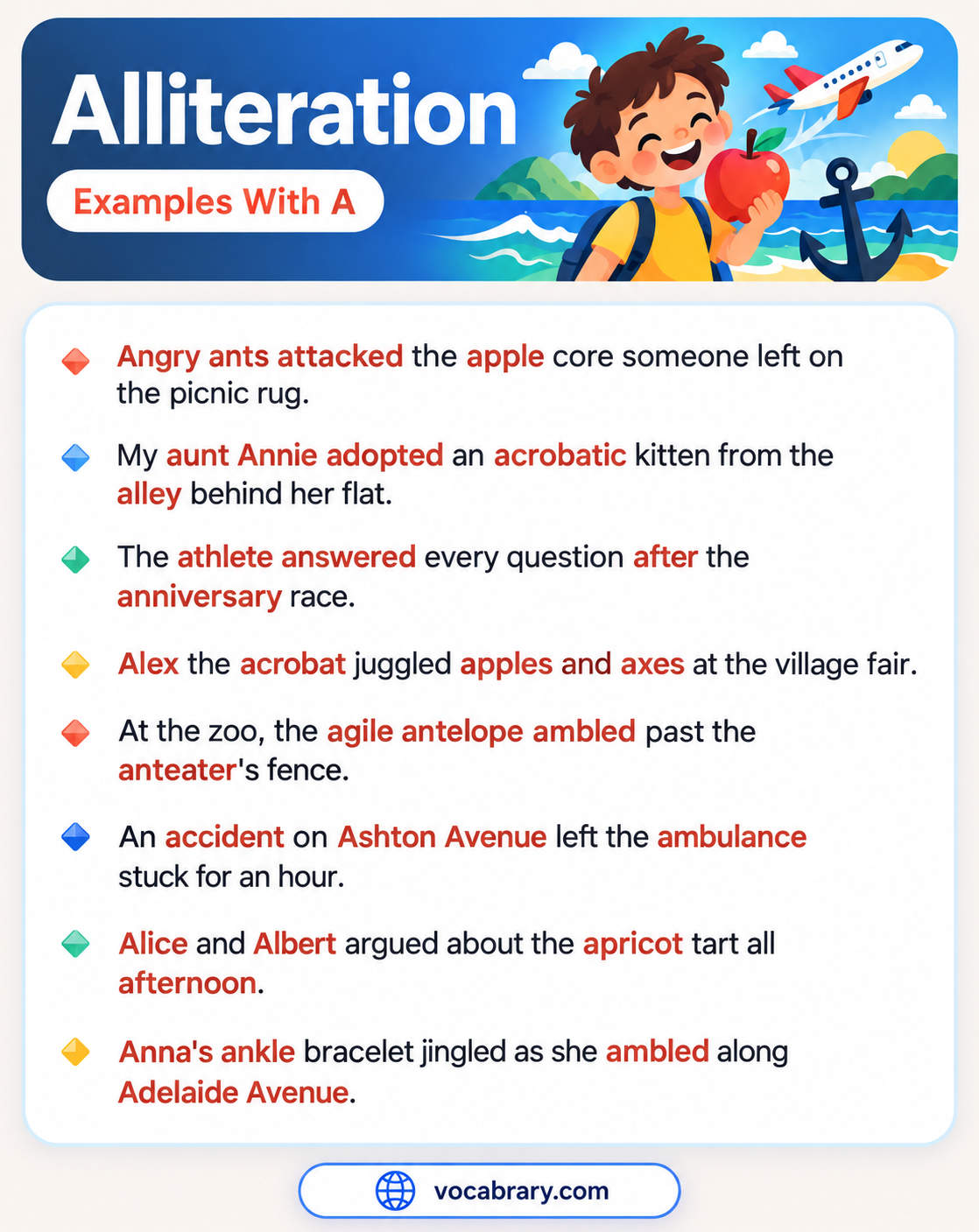
Angry alligators, jumpy jaguars, and zigzagging zebras take the alphabet one letter at a time, with sound rather than spelling deciding each line, as in the fuller alliteration examples A to Z collection.
- Angry alligators ambushed an antelope at the water’s edge.
- Big brown bears battled over the best berries.
- Curious camels crossed the cracked canyon floor.
- Dozy donkeys dozed during the downpour.
- Eager egrets eat eels in the shallows.
- Four foxes followed the farmer’s footprints.
- Greedy gophers grabbed the garden greens.
- Happy horses hurried home through the hail.
- Itchy iguanas inched in and investigated the insects.
- Jumpy jaguars jogged past the jeep.
- Keen kangaroos kept kicking the corral gate.
- Lonely llamas lingered by the lake.
- Mighty moose marched through the melting marsh.
- Nimble newts nosed nearer the net.
- Otters on the opposite rock opted to nap.
- Prickly porcupines poked past the pine stumps.
- Quiet quails quivered in the quarry.
- Restless raccoons raided the red rubbish bins.
- Seven seals swam south past the sandbar.
- Twelve tigers tracked the tiny tapir.
- Unusual umbrella birds uttered one ugly call.
- Vigilant vultures veered over the volcano’s rim.
- Wet walruses wobbled westward.
- A xerus zipped into its burrow seconds before the zealous hawk zoomed over the dusty plain.
- Yawning yaks yanked at the yellow grass.
- Zebras zigzagged past the zookeeper at the zoo.
Animal Tongue Twisters With Alliteration
Six slippery snails, three grey geese, and a big black bug are the traditional animal twisters, and the rest repeat one sound fast enough to trip the tongue.
- Six slippery snails slid slowly seaward.
- Three grey geese grazed in a green field.
- The woodchuck wondered whether wet wood would work.
- A big black bug bit a big black bear.
- Fred’s four ferrets found fifty fresh figs.
- Charlie’s chimp chewed cheerful chunks of cheddar.
- Pete’s parrot packed plenty of purple plums.
- Ten tired toads tried tasting toasted treats.
- Nine nervous newts nibbled nettles nightly.
- Gwen’s grey goose gobbled golden grain while Greg’s green gecko grabbed the greasy grapes by the garden gate.
Animal Alliteration for Kids, Students, and Classroom Writing
Young children practice on short pet lines, older pupils write longer sentences about habitat and behavior, and writing tasks turn both into poems and posters.
Animal Alliteration Examples for Kids
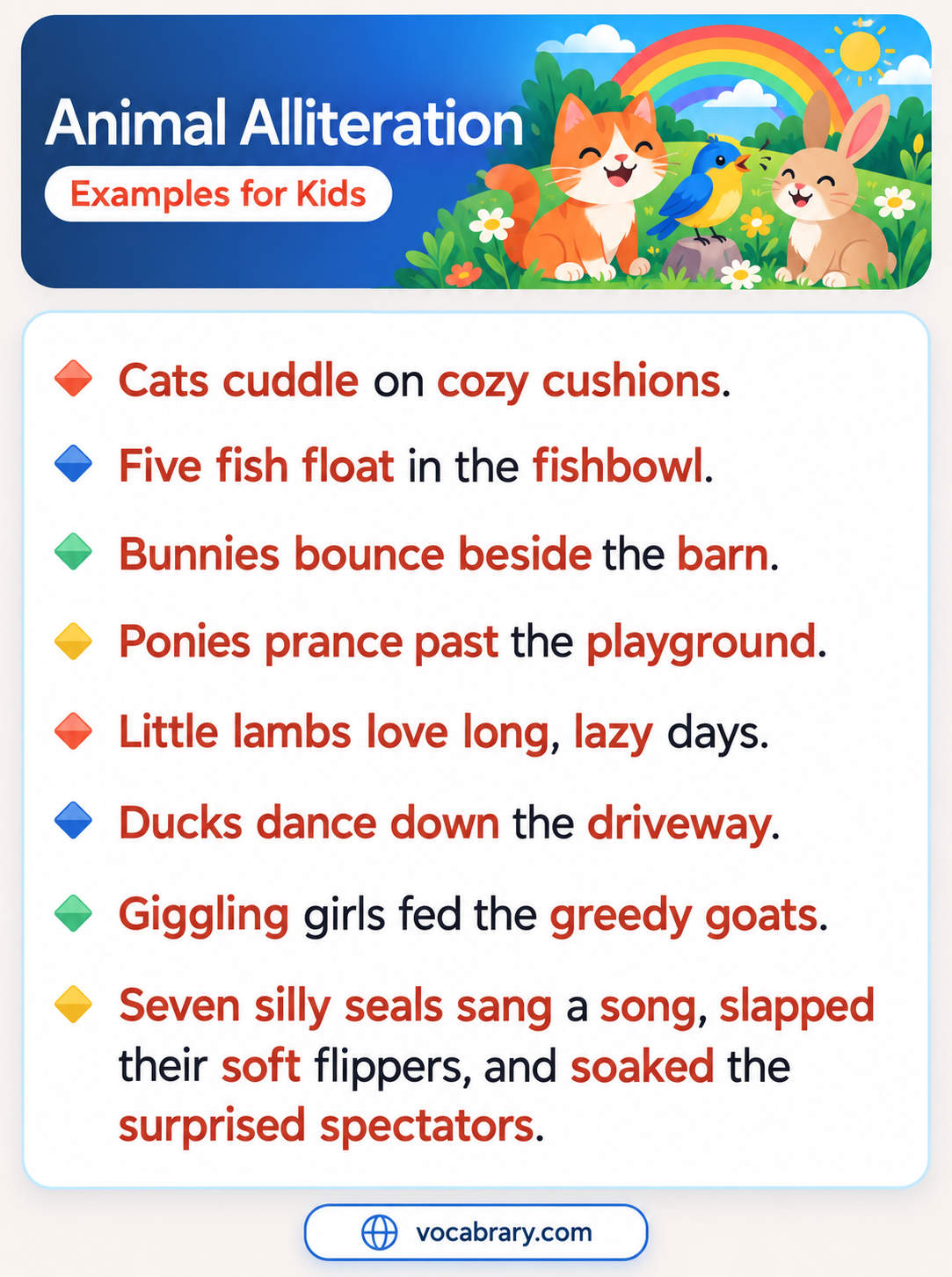
Cats on cushions, dogs digging in the dirt, and tigers taking turns on a trampoline keep the sentences short, with four or five repeated sounds at most.
- Cats cuddle on cozy cushions.
- Dogs dig deep in the dirt.
- Five fish float in the fishbowl.
- Bunnies bounce beside the barn.
- Monkeys make messy mud pies.
- Ponies prance past the playground.
- Little lambs love long, lazy days.
- Ten tigers take turns on the trampoline.
- Ducks dance down the driveway.
- Giggling girls fed the greedy goats.
- Do worms wiggle when the weather turns wet?
- Seven silly seals sang a song, slapped their soft flippers, and soaked the surprised spectators.
Animal Alliteration Examples for Students
Monarch butterflies bound for Mexico, peregrines pursuing pigeons, and sloths spending silent hours in one tree give older pupils alliteration with real biology behind it.
- Migrating monarch butterflies made their way to Mexico by mid-November.
- Predatory peregrines plummet at precise angles to pursue pigeons.
- Cuttlefish camouflage themselves completely in cloudy coastal water.
- Solitary sloths spend several silent hours in a single tree.
- Burrowing badgers build broad networks of tunnels beneath beech roots.
- Wolves work in well-ordered packs while wintering in wooded valleys.
- Do dolphins develop distinct whistles that differ from pod to pod?
- Hibernating hedgehogs have a heartbeat that slows through the harshest months.
- Termites transform tough timber into tunnels that ventilate the mound.
- Students studying sea snails sketched every spiral in their science notebooks, then stacked the specimens by size before sunset.
Animal Alliteration for Classroom Writing Tasks
A poster line about pandas, an opening line for an owl poem, and a label for a lagoon model are the tasks that turn these sentences into pupil writing.
- Perfect pandas prefer plump bamboo plants.
- Wise, white owls watch the wood at midnight.
- Slow snails slide across the school sandpit.
- Bold bison brave the bitter blizzard.
- Clever crows collect coins and crumbs.
- Dazzling dragonflies dart over the duck pond.
- Lively lobsters lurk low in the lagoon.
- Fierce falcons fly far over the fields.
- A gentle giraffe journeyed past the jeep at dusk.
- Marvelous manatees meander through murky mangrove channels, munching meadows of sea grass all morning long.
Related
FAQs
Two examples are "Busy bees buzz around the blooming bushes" and "Lazy lions lounge in the long grass all afternoon." Each pairs a creature with verbs and adjectives that share its opening sound.
Pet lines include "Daisy the dachshund dug deep into the daisies" and "Curious kittens crept carefully into the cardboard carton." Both sentences repeat the opening sound of the pet’s name.
On the farm, "Pink pigs plodded through the puddles by the pen" and "Hens huddled in the henhouse when the hawk hovered overhead" repeat the P and H sounds. The second sentence adds a hawk to the barnyard.
Safari lines include "Mischievous monkeys munched mangoes in the morning mist" and "Lean lions lazed on the long limestone ledge." Each sentence repeats one sound across the creature and its surroundings.
Ocean lines include "Silver sardines swam in swift, silent circles" and "Crabs crawled cautiously over the cold coral." Both sentences repeat the hissing S or the hard C sound.
Bella the beagle, Percy the parrot, Tilly the tortoise, and Monty the macaw pair a first name with a species on one opening sound. Each name repeats the first consonant of its animal.
The alphabet begins and ends with "Angry alligators ambushed an antelope at the water’s edge" and "Zebras zigzagged past the zookeeper at the zoo." Every letter between them has its own animal sentence.
Funny lines include "A hippo in a hammock hummed happily all afternoon" and "Wombats wearing woolly waistcoats waddled westward." Each one pairs a repeated sound with an unlikely scene.
Traditional twisters include "Six slippery snails slid slowly seaward" and "Three grey geese grazed in a green field." Each one packs a single sound into a short line.
Short lines for kids include "Cats cuddle on cozy cushions" and "Dogs dig deep in the dirt." Each line has only four or five words, so a young child repeats it in one breath.