
Antithesis is a rhetorical device in which two opposite claims appear side by side in matching grammatical form, as in “Speech is silver, silence is golden.” The best antithesis examples in sentences balance opposite pairs such as love and hate or give and take inside one line.
What Is Antithesis?
Antithesis is the pairing of contrasting words, phrases, or clauses built on the same grammatical pattern, so the contrast is stronger than either half alone. Unlike juxtaposition, which only places two unlike people, objects, or scenes near each other, antithesis demands both a real opposite and a parallel structure.
The new manager praised in public and corrected in private.
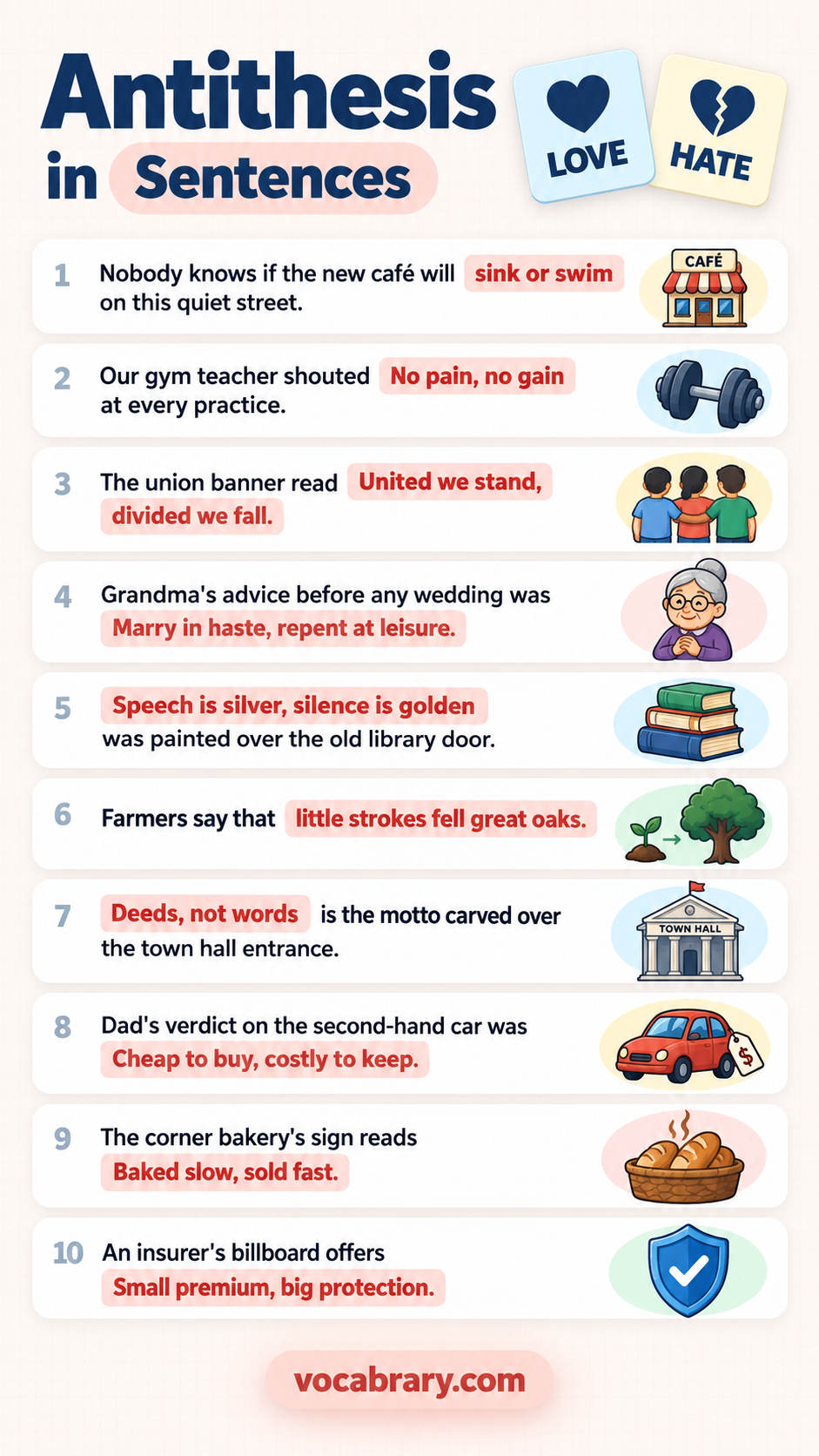
Common Antithesis Examples in Sentences
“Speech is silver, silence is golden,” a job that pays little but teaches much, and a lost match with a won crowd are textbook antithesis examples in sentences.
- My grandfather liked to remind us that speech is silver, but silence is golden.
- Kindness costs nothing yet means everything to a lonely neighbor.
- The rich man wanted more, while the poor man wanted enough.
- A fool talks to be heard, and a wise woman listens to understand.
- Winter took the leaves away, and spring gave them back.
- Jonah forgets birthdays but remembers every football score since 1998.
- Is it better to lose with honor or to win by cheating?
- Her words were warm, but her eyes were cold.
- This job pays little but teaches much.
- Prices go up by the stairs and come down by the elevator.
- Kofi arrived as a stranger and left as a friend.
- Some people dream of success, while others wake up and work for it.
- Maya lost the match but won the crowd.
- Is the glass half full or half empty?
- We laughed at the start of the film and cried at the end.
- That hotel had a grand lobby and tiny rooms.
- Everyone remembers the winner; nobody remembers the runner-up.
- Hard work wins over talent when talent refuses to work.
- The proud man fell quickly, and the humble man rose slowly.
- Nadia’s plan was bold on paper but timid in practice.
- A lie runs a mile while the truth is still tying its shoes.
- Our town is quiet by day and loud by night.
- Old friends forgive fast; new friends judge fast.
- To the tourists, the island was a paradise; to the fishermen, it was a prison.
- Money buys a house but never buys a home.
Antithesis Examples in Everyday Life
Daily antithesis turns up in kitchens, buses, and shops, as when Mom cooks for an hour and the family eats in five minutes, or Lucas saves ten dollars on shoes and wastes twenty on socks.
- Mom cooked for an hour, and we ate in five minutes.
- The bus was late in the morning and early in the evening, so I missed it both times.
- Lucas saved ten dollars on shoes and wasted twenty on socks he never needed.
- Sunday is for rest; Monday is for work.
- The house was full of noise at dinner and empty of it by midnight.
- Grandpa reads the news slowly and forgets it quickly.
- Our cat ignores us all day and adores us at feeding time.
- Your phone connects you to the world but disconnects you from the dinner guests.
- Ana bought the dress in a hurry and returned it at leisure.
- The laundry basket is empty on Friday and full again by Sunday.
- Mornings start in a rush, and evenings end in a crawl.
- My brother eats like a king and cleans like a guest.
- The café was crowded inside and deserted outside in the rain.
- A good neighbor lends a ladder; a bad neighbor borrows one and keeps it.
- Tired parents wake up early and go to bed late.
- Why is the supermarket fast to raise prices and slow to lower them?
- In January the garden looked dead, and in June it bloomed.
- We packed for a week and stayed for a weekend.
- Rosa talks all the way to the beach and sleeps all the way home.
- Every evening the dog barks at strangers and wags at friends.
Short Antithesis Examples
Quick pairs like “Go big or go home,” “Love it or leave it,” and “Now or never” put antithesis into a handful of words for captions, posters, and quick replies.
- Go big or go home.
- Love it or leave it.
- It is now or never.
- Rise or fall, we do it together.
- Short on money, long on hope.
- You win some, you lose some.
- Here today, gone tomorrow.
- Our coach says it is do or die.
- Friend or foe, everyone gets a seat at the party.
- Ali is small in size but huge in heart.
- Nobody knows if the new café will sink or swim on this quiet street.
- The film is long on action and short on plot.
- Laugh at the joke or leave the room.
- Is the answer yes or no?
- Mila’s letter was short in words but deep in feeling.
- Win or lose, we celebrate tonight.
Antithesis Examples in Proverbs and Sayings
Proverbs such as “Penny wise, pound foolish,” “No pain, no gain,” and “United we stand, divided we fall” survive for centuries because their balanced opposites are quick to remember.
- Aunt June refused to fix her leaking roof, and her neighbor muttered, “Penny wise, pound foolish.”
- Our gym teacher shouted “No pain, no gain” at every practice.
- Man proposes, God disposes, Rosa sighed when the storm cancelled her garden party.
- The union banner read “United we stand, divided we fall.”
- Grandma’s advice before any wedding was “Marry in haste, repent at leisure.”
- When Leo lost the same bet a second time, his friend said, “Fool me once, shame on you; fool me twice, shame on me.”
- Money is a good servant but a bad master.
- Better late than never, the teacher told the student who handed in homework a week after the deadline.
- Give a man a fish and you feed him for a day; teach a man to fish and you feed him for a lifetime.
- Hate the sin, love the sinner, the priest reminded the congregation.
- “Speech is silver, silence is golden” was painted over the old library door.
- My mother swears by “Hope for the best, prepare for the worst” and keeps a flashlight in every drawer.
- Feed a cold, starve a fever, Grandpa insisted, handing me a bowl of soup.
- Farmers say that little strokes fell great oaks.
- “Out with the old, in with the new,” Hana announced as she threw out her worn trainers.
- Some are born to lead, others are born to follow, as the old saying goes.
- Sailors trust the rhyme “Red sky at night, shepherd’s delight; red sky in the morning, shepherd’s warning.”
- “Deeds, not words” is the motto carved over the town hall entrance.
- “Cold hands, warm heart,” Nora joked as she shook her new colleague’s icy fingers.
- Dad’s verdict on the second-hand car was “Cheap to buy, costly to keep.”
Antithesis Examples for Kids
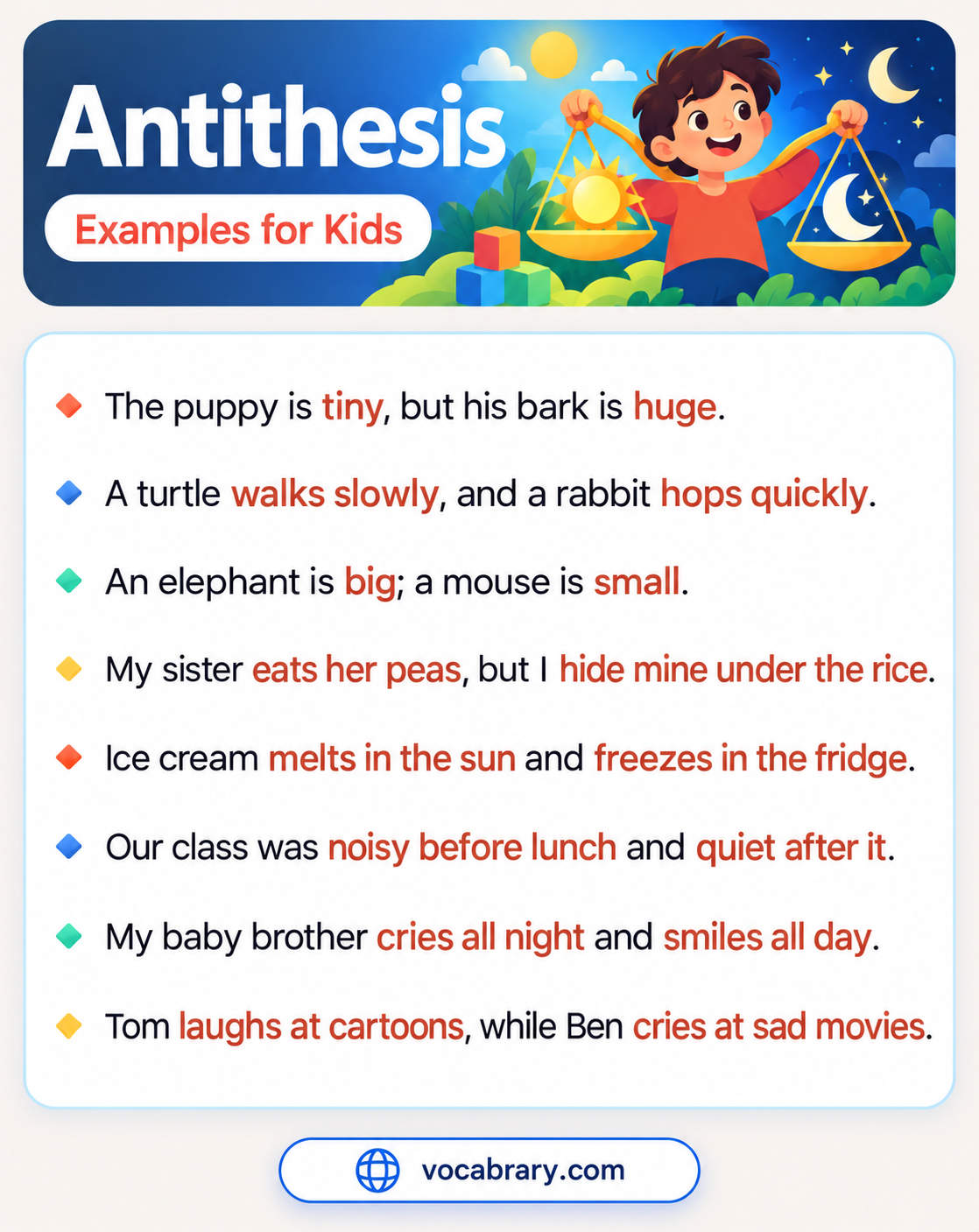
A tiny puppy with a huge bark, a turtle that walks slowly beside a rabbit that hops quickly, and owls that sleep by day and hunt by night give children short, familiar opposites.
- The puppy is tiny, but his bark is huge.
- Summer is hot, and winter is cold.
- A turtle walks slowly, and a rabbit hops quickly.
- I lost my tooth but found a coin under my pillow.
- An elephant is big; a mouse is small.
- Sam likes the day for its sunshine, and Sara likes the night for its stars.
- My sister eats her peas, but I hide mine under the rice.
- The kite went up, and the rain came down.
- Dad snores loudly, and Mom sleeps quietly.
- Ice cream melts in the sun and freezes in the fridge.
- Are you happy today or sad today?
- Our class was noisy before lunch and quiet after it.
- School bags are heavy in the morning and light in the afternoon.
- My baby brother cries all night and smiles all day.
- Owls sleep by day and hunt by night.
- Tom laughs at cartoons, while Ben cries at sad movies with a tub of popcorn on his lap.
Antithesis Examples for Students
Essays long in pages but short on evidence, teachers who grade hard but explain kindly, and freshmen who arrive nervous and leave confident give students antithesis drawn from school life.
- Leila studied all week and relaxed on test day.
- The essay was long in pages but short on evidence.
- Our history teacher grades hard but explains kindly.
- Omar raised his hand for every question and answered none of them correctly.
- Cramming works for a night; revision works for a year.
- Good students ask questions; lazy students copy answers.
- At nine the library is silent, and at noon it is packed.
- In the debate, Priya argued that homework teaches discipline, while Jake argued that it steals free time.
- Exams test what you memorize, but projects test what you understand.
- Why did Ms. Tan praise the effort but question the conclusion?
- Maths was my worst class in September and my best class in June.
- The school trip was short on sleep and long on memories.
- Freshmen arrive nervous and leave confident.
- Tomas reads to pass, while Mei reads to learn.
- Group projects divide the work but multiply the arguments.
- “Talk less in class and write more in your notebooks,” the teacher said.
Antithesis Examples About Love
Lovers who met as strangers and parted as lovers, a promise of forever that lasted a month, and a heart given in return for excuses show how antithesis sharpens romance and heartbreak.
- Love gives freely; jealousy takes greedily.
- She said goodbye with her lips but asked him to stay with her eyes.
- Real love forgives mistakes, and false love counts them.
- They met as strangers at the airport and parted as lovers at the gate.
- Distance kept their bodies apart but brought their hearts closer.
- Is it better to love and lose or to never love at all?
- He promised forever and delivered a month.
- Their first date was short on words and long on smiles.
- Hana fell in love slowly and out of love suddenly.
- A crush burns bright for a week; true love glows softly for a lifetime.
- My grandparents argue every morning and walk arm in arm every night.
- Love opens doors, and pride slams them shut.
- Your absence made the house quieter and my heart louder.
- Sara gave him her heart, and he gave her excuses.
Antithesis Examples About Work and Success
A boss who takes the blame and shares the credit, an intern who became a director, and a job that promised freedom but delivered overtime are workplace cases of antithesis.
- A good boss takes the blame and shares the credit.
- Priya came in as an intern and left as a director.
- The job promised freedom but delivered overtime.
- Monday starts with coffee; Friday ends with relief.
- Carlos earns a lot but enjoys little.
- Our client wanted the report fast and paid for it slowly.
- Leaders go first into danger and last to the lunch line.
- The office is busy in December and empty in August.
- Why does the printer work perfectly for the boss and jam for everyone else?
- Hire for attitude, train for skill.
- That meeting was long on talk and short on decisions.
- Success needs a hundred small wins; failure needs one careless mistake.
- Our startup was rich in plans but poor in cash during its first year.
- Night-shift nurses start work at sunset and finish at sunrise.
Antithesis Examples in Literature
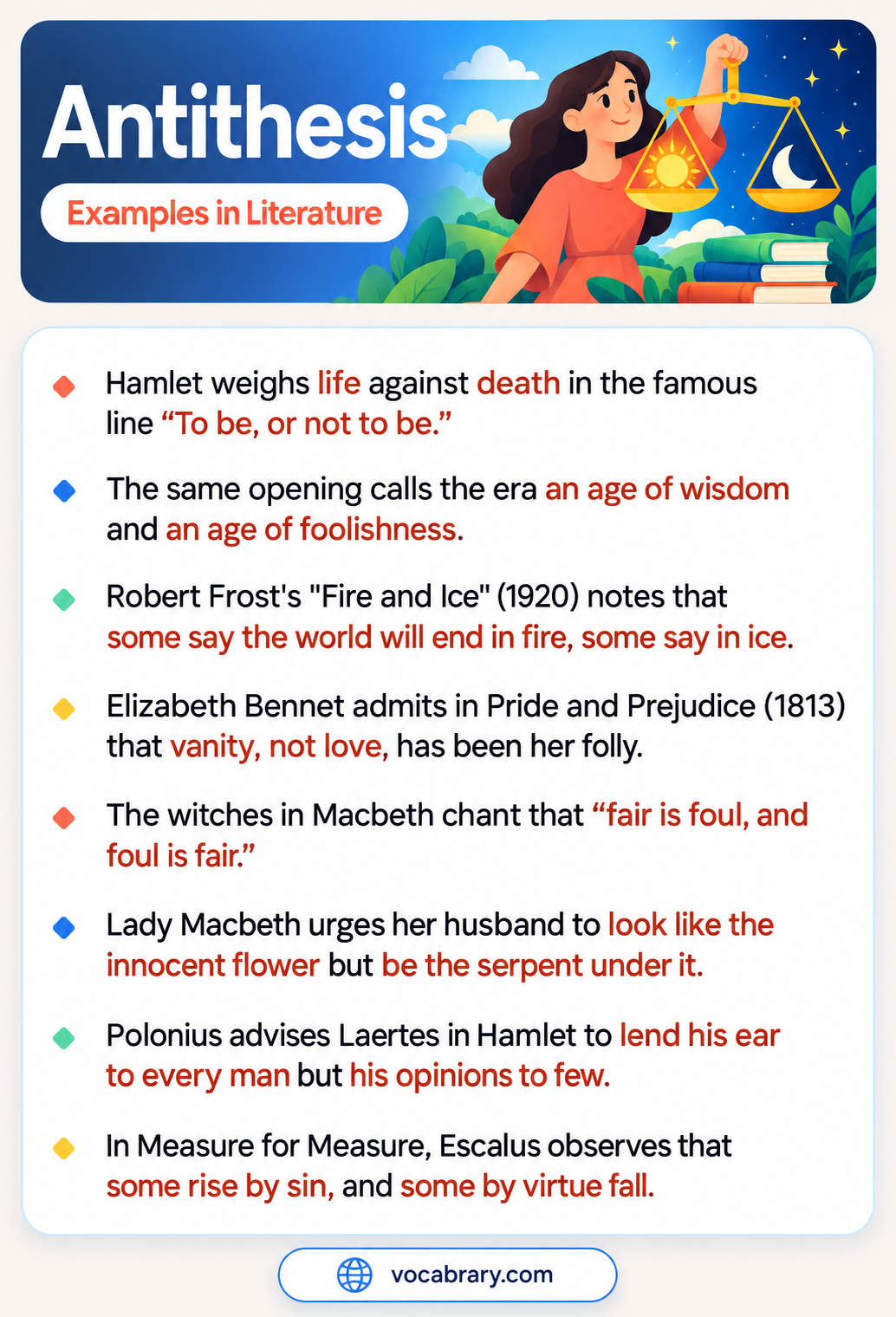
Dickens’ best and worst of times, Satan choosing Hell over Heaven in Paradise Lost, and Hamlet’s “To be, or not to be” are the most quoted antithesis examples in literature.
Antithesis in Shakespeare
Brutus loving Rome more than Caesar, Juliet’s only love springing from her only hate, and Hamlet weighing life against death show Shakespeare building whole speeches on a single pair of opposites.
- Hamlet weighs life against death in the famous line “To be, or not to be.”
- Juliet cries that her only love has sprung from her only hate when she learns Romeo is a Montague.
- Brutus tells the Roman crowd in Julius Caesar that he acted not because he loved Caesar less but because he loved Rome more.
- Mark Antony replies that the evil men do outlasts them, while the good is buried with their bones.
- The witches in Macbeth chant that “fair is foul, and foul is fair.”
- Lady Macbeth urges her husband to look like the innocent flower but be the serpent under it.
- Polonius advises Laertes in Hamlet to lend his ear to every man but his opinions to few.
- Caesar tells Calpurnia that cowards die many times before their deaths, while the brave taste death only once.
- In Measure for Measure, Escalus observes that some rise by sin, and some by virtue fall.
Antithesis in Novels
Dickens’ best and worst of times, Elizabeth Bennet’s confession of vanity, not love, and Gandalf’s warning that some who die deserve life show novelists using antithesis at turning moments.
- Charles Dickens opens A Tale of Two Cities (1859) with “It was the best of times, it was the worst of times.”
- The same opening calls the era an age of wisdom and an age of foolishness.
- Dickens goes on to describe a spring of hope and a winter of despair in the years before the French Revolution.
- Elizabeth Bennet admits in Pride and Prejudice (1813) that vanity, not love, has been her folly.
- Dr. Jekyll concludes in Robert Louis Stevenson’s 1886 novella that man is not truly one, but truly two.
- Gandalf tells Frodo in The Fellowship of the Ring (1954) that many who live deserve death, and some who die deserve life.
- Santiago, the fisherman in Ernest Hemingway’s The Old Man and the Sea (1952), believes a man is open to destruction but never to defeat.
- In George Orwell’s Animal Farm (1945), the sheep bleat “Four legs good, two legs bad” for hours.
- Dumbledore tells Harry in Harry Potter and the Chamber of Secrets (1998) that our choices, far more than our abilities, show who we truly are.
Antithesis in Poetry
Milton’s Satan, Pope’s line on error and forgiveness, and Frost’s world ending in fire or ice show poets setting opposites side by side in a single balanced line.
- Satan declares in John Milton’s Paradise Lost (1667) that it is better to reign in Hell than to serve in Heaven.
- Alexander Pope wrote in An Essay on Criticism (1711) that to err is human, to forgive divine.
- Robert Frost’s “Fire and Ice” (1920) notes that some say the world will end in fire, some say in ice.
- Tennyson’s In Memoriam (1850) argues that it is better to have loved and lost than never to have loved at all.
- John Keats writes in “Ode on a Grecian Urn” (1819) that heard melodies are sweet, but those unheard are sweeter.
- Near the end of Tennyson’s “Ulysses” (1842), the aging king admits that much is taken, yet much abides.
- Ella Wheeler Wilcox’s poem “Solitude” (1883) says that if you laugh, the world laughs with you, but if you weep, you weep alone.
- William Blake set innocence against experience in Songs of Innocence and of Experience (1794), pairing the gentle lamb with the fierce tiger.
Antithesis Examples in the Bible
The Bible pairs a time to be born with a time to die in Ecclesiastes and many who are called with few who are chosen in Matthew. The King James text keeps both halves in matching form.
- Ecclesiastes 3 names a time to be born and a time to die.
- The same chapter pairs a time to weep with a time to laugh, and a time to mourn with a time to dance.
- According to Ecclesiastes 3:7, there is a time to keep silence and a time to speak.
- Proverbs 15:1 teaches that a soft answer turneth away wrath, but grievous words stir up anger.
- Jesus tells his sleeping disciples in Matthew 26:41 that the spirit is willing, but the flesh is weak.
- At the end of a parable in Matthew 22:14, Jesus says that many are called, but few are chosen.
- Welcoming home the prodigal son in Luke 15, the father says his boy was lost and is found.
- A wise son makes a glad father, but a foolish son is the heaviness of his mother, according to Proverbs 10:1.
- Paul reminds listeners in Acts 20:35 that it is more blessed to give than to receive.
- Matthew 7 describes a wide gate that leads to destruction and a narrow gate that leads to life.
Antithesis Examples in Famous Speeches
Neil Armstrong’s small step and giant leap, Patrick Henry’s choice between liberty and death, and Churchill’s so much owed by so many to so few are speech lines that audiences repeated for generations.
- Neil Armstrong called his first step on the Moon in July 1969 one small step for a man and one giant leap for mankind.
- In his 1961 inaugural address, John F. Kennedy urged Americans to stop asking what their country would do for them and ask what they would do for their country.
- Kennedy also warned in that speech that a free society unable to help the many who are poor would be unable to save the few who are rich.
- At Rice University in 1962, Kennedy said America chose to go to the Moon not because it was effortless but because it was hard.
- Abraham Lincoln said at Gettysburg in 1863 that the world would little note what was said there but would never forget what the soldiers did there.
- Winston Churchill told the House of Commons in August 1940 that never had so much been owed by so many to so few.
- Patrick Henry ended his 1775 speech in Virginia with the cry “Give me liberty, or give me death!“
- On the steps of the Lincoln Memorial in 1963, Martin Luther King Jr. dreamed of a nation that would judge his children by their character, not by the color of their skin.
- Martin Luther King Jr. also warned that people must learn to live together as brothers or perish together as fools.
- Barack Obama told the crowd at his 2009 inauguration that Americans had chosen hope over fear.
- Franklin D. Roosevelt said in his 1937 inaugural address that the test of progress was not adding more for those who have much but providing enough for those who have too little.
- Queen Elizabeth I told her troops at Tilbury in 1588 that she had the body of a weak and feeble woman but the heart and stomach of a king.
Antithesis Examples in Politics
Campaigns won with slogans and lost with scandals, a minister who promised jobs and delivered excuses, and Obama’s one United States of America show antithesis in political argument.
- In his 2004 Democratic National Convention speech, Barack Obama said there is not a liberal America and a conservative America but the United States of America.
- Ronald Reagan said in his 1981 inaugural address that government is not the solution to the country’s problem; government is the problem.
- Mayor Chen promised lower taxes for families and higher fines for polluters.
- Senator Ruiz voted for the bill in spring and against it in autumn.
- Our candidate listens to voters, while her rival lectures them.
- Campaigns are won with slogans and lost with scandals.
- The minister promised jobs before the election and delivered excuses after it.
- Protesters outside parliament chanted, “Their profits, our losses!“
- Why do politicians speak loudly in debates and act quietly in office?
- Opposition leaders called the budget generous to banks and stingy to schools.
- Voters wanted more action and fewer speeches from the new council.
- A good leader builds bridges; a bad leader builds walls.
Antithesis Examples in Advertising Slogans
M&M’s candies that melt in your mouth, not in your hands, and Persil detergent that is tough on stains, gentle on skin are famous slogans built on antithesis, and small businesses copy the same pattern.
- Since 1954, M&M’s has promised candies that melt in your mouth, not in your hands.
- Persil ads describe the detergent as tough on stains, gentle on skin.
- A famous Sara Lee jingle ran, “Everybody doesn’t like something, but nobody doesn’t like Sara Lee.”
- Diesel’s “Be Stupid” campaign declared that smart listens to the head, while stupid listens to the heart.
- A local gym poster promises, “Sweat today, smile tomorrow.”
- The corner bakery’s sign reads “Baked slow, sold fast.”
- An insurer’s billboard offers “Small premium, big protection.”
- “Less sugar, more flavor,” says the new cereal packet.
- Our coffee shop prints “Strong coffee, gentle price” on every cup.
- Why would anyone ignore a car dealer’s ad promising “more miles, fewer stops“?
Antithesis Examples in Movies and TV
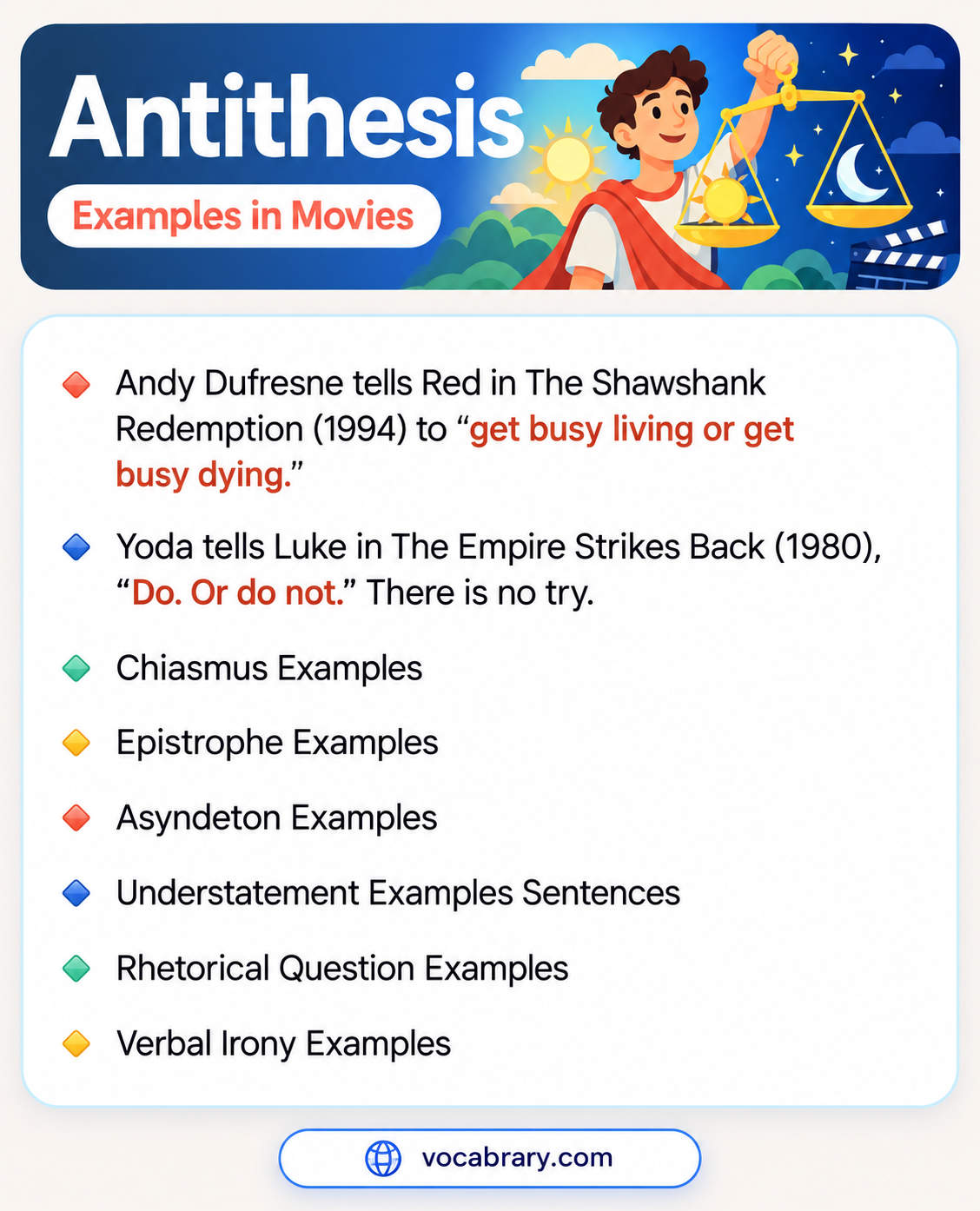
Harvey Dent’s hero or villain, Andy Dufresne’s living or dying, and Cersei Lannister’s win or die in Game of Thrones are screen lines built on a stark either-or choice.
- In The Dark Knight (2008), Harvey Dent says you either die a hero or live long enough to see yourself become the villain.
- Andy Dufresne tells Red in The Shawshank Redemption (1994) to “get busy living or get busy dying.”
- Michael Corleone advises keeping your friends close but your enemies closer in The Godfather Part II (1974).
- Yoda tells Luke in The Empire Strikes Back (1980), “Do. Or do not. There is no try.”
- Morpheus offers Neo a choice in The Matrix (1999): the blue pill ends the story, while the red pill keeps him in Wonderland.
- William Wallace says in Braveheart (1995) that death comes to every man, but real life comes to only a few.
- Rocky tells his son in Rocky Balboa (2006) that winning is not about how hard you hit but about how hard you get hit and keep moving forward.
- Cersei Lannister warns Ned Stark in the first season of Game of Thrones (2011) that in the game of thrones, you win or you die.
Related
FAQs
Antithesis examples in a sentence include "Her words were warm, but her eyes were cold" and "Kindness costs nothing yet means everything to a lonely neighbor." Another is "Hard work wins over talent when talent refuses to work." Each sentence places two opposites in matching grammar, as warm against cold, costs nothing against means everything, and hard work against idle talent.
You write antithesis by choosing two opposites and giving both the same grammatical form. "Mom cooked for an hour, and we ate in five minutes" sets two time spans against each other, and "Winter took the leaves away, and spring gave them back" sets two seasons against each other. The second half repeats the grammar of the first half, so the opposite meaning stands out.
Famous antithesis examples in speeches include Neil Armstrong’s "one small step" for a man and "one giant leap" for mankind, and Patrick Henry’s "Give me liberty, or give me death!" Churchill’s August 1940 line about "so much" owed "by so many to so few" sets a large debt against a small number of airmen.
Charles Dickens opens A Tale of Two Cities with "It was the best of times, it was the worst of times." Alexander Pope wrote in An Essay on Criticism that "to err is human, to forgive divine." Satan declares in Paradise Lost that it is "better to reign in Hell than to serve in Heaven."
Ecclesiastes 3 gives the best-known Bible antithesis examples, such as "a time to be born" and "a time to die." Matthew 22:14 states that "many are called, but few are chosen." In Matthew 26:41, Jesus tells his disciples that "the spirit is willing, but the flesh is weak."
M&M’s promises candies that "melt in your mouth, not in your hands," and Persil describes its detergent as "tough on stains, gentle on skin." Local businesses use the same form, as in "Sweat today, smile tomorrow" on a gym poster and "Less sugar, more flavor" on a cereal packet.
Antithesis examples for kids use familiar opposites, such as "The puppy is tiny, but his bark is huge" and "Summer is hot, and winter is cold." Another sentence for young readers is "Owls sleep by day and hunt by night." Each pair uses words that a child already knows.
Speakers and writers use antithesis to put a choice or a contrast into one line that listeners repeat. President Kennedy’s inaugural address asked Americans to stop asking "what their country would do for them" and to ask "what they would do for their country." Martin Luther King Jr. warned that people must "live together as brothers or perish together as fools."
Yes, antithesis suits formal writing such as essays, reports, speeches, and legal arguments. Franklin D. Roosevelt used it in his 1937 inaugural address, saying the test of progress was "not adding more for those who have much" but "providing enough for those who have too little." One antithesis in a conclusion has more force than several in a row.
Antithesis is classed as a figure of speech built on contrast and matching grammatical form. Classroom lists group it with chiasmus, parallelism, and oxymoron among the figures of speech that depend on word order instead of imagery. The witches in Macbeth chant "fair is foul, and foul is fair," a short case of the form.