
Tautology is a rhetorical device in which a speaker says the same thing twice in different words, as when a company calls its product "a new innovation." The most common tautology examples are two-word phrases such as "free gift" and "past history," where the second word repeats the meaning of the first.
What Is Tautology?
Tautology is the restating of a meaning that a sentence has already given, either through a second word with the same sense or through a statement that defines itself. Pleonasm names any word a sentence has no need for, as in "burning fire," while tautology restates the meaning outright.
After the team’s third straight loss, the coach shrugged and said, "We are where we are."
Common Tautology Examples in Sentences
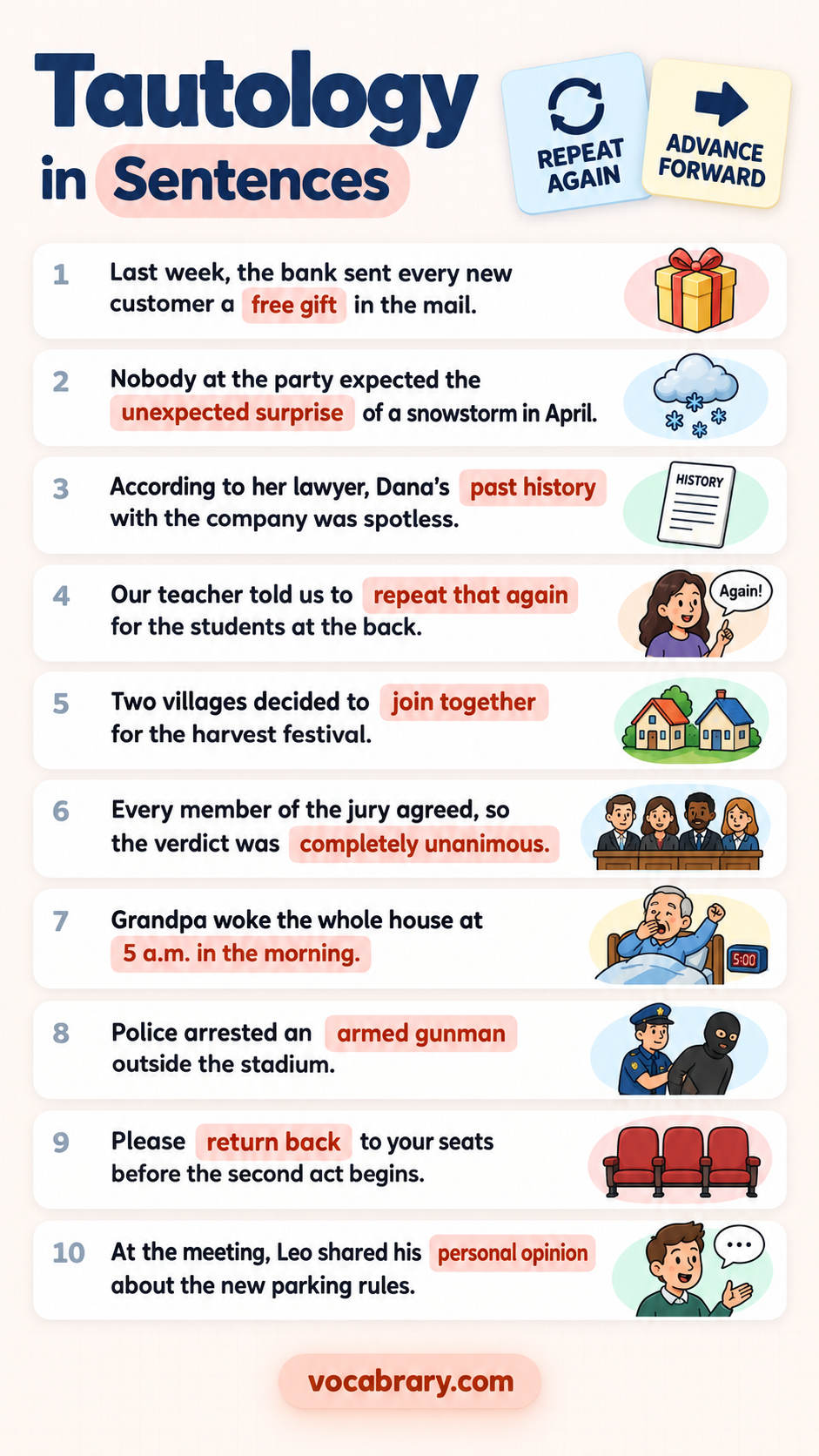
A "free gift," an "unexpected surprise," and "past history" are the textbook cases of tautology, because the second word repeats a meaning the first word already gave.
- Last week, the bank sent every new customer a free gift in the mail.
- Nobody at the party expected the unexpected surprise of a snowstorm in April.
- According to her lawyer, Dana’s past history with the company was spotless.
- Our teacher told us to repeat that again for the students at the back.
- Two villages decided to join together for the harvest festival.
- Every member of the jury agreed, so the verdict was completely unanimous.
- Grandpa woke the whole house at 5 a.m. in the morning.
- Police arrested an armed gunman outside the stadium.
- Is it true that your brother is an unmarried bachelor?
- Please return back to your seats before the second act begins.
- At the meeting, Leo shared his personal opinion about the new parking rules.
- The startup promised investors a new innovation in solar panels.
- Rosa keeps her spare keys in close proximity to the front door.
- In spring, the melting snow and frozen ice made the path dangerous.
- My uncle swears he saw it with his own eyes.
- The final bill was the sum total of three months of repairs.
- Reporters gave the mayor advance warning about the tough questions.
- Every buyer got an added bonus of free delivery.
- Liam’s future plans involve moving to Lisbon.
- We watched the evening sunset from the pier.
- Overnight, the price fell down by half.
- To prove his claims, the scientist relied on true facts alone.
- After the storm, the old barn still remains standing.
- Both lawyers met together for lunch on Friday.
- Never over-exaggerate the size of the fish you caught.
Tautology Examples in Everyday Sayings
Sayings like "It is what it is," "Boys will be boys," and "A deal is a deal" repeat the opening noun as the answer. Speakers use them to end an argument or accept a situation.
- When the flight was canceled, Maya sighed, "It is what it is."
- "Boys will be boys," Grandma said as the twins tracked mud across the kitchen.
- You shook my hand on the price, and a deal is a deal.
- "Rules are rules," the librarian said, pointing at the no-food sign.
- After his third warning, the manager said, "Enough is enough."
- "What’s done is done," Dad said about the dented car, "so let’s fix it."
- Sorry, but business is business, and I am unable to lower the rent.
- "A promise is a promise," Ana told her son, and she took him to the zoo.
- Once the concert tickets sell out, when they’re gone, they’re gone.
- Kids will be kids, so expect some noise at the birthday party.
- "The law is the law," said the officer, handing Omar the ticket.
- My aunt believes that family is family, even after an argument.
- Why did Carlos say "a job is a job" about the night shift at the warehouse?
- "Whatever will be, will be," Nana said as she mailed her college application.
- "A bargain is a bargain," Mom said, carrying home three umbrellas she didn’t need.
- "It’s not over till it’s over," Ruth told her friends as the quiz entered its final round.
- Love is love, Lena wrote on the wedding card for her two friends.
- The old farmer shrugged at the hailstorm and said, "Weather is weather."
- Men will be men, my grandmother joked as her sons argued over the barbecue.
- "We’ll either win or we won’t," the captain told his nervous team before the final.
Tautology Examples in Everyday Life
Shoppers entering a "PIN number," travelers who "return back" home, and cooks who "mix together" flour and eggs show everyday tautology, where people add a word nobody needs.
- At the store, the cashier asked Ben to enter his PIN number.
- After three weeks abroad, the Rossis returned back home on Sunday.
- First, mix together the flour and the eggs.
- The ATM machine outside the station ate my card again.
- After the divorce, my neighbor called his move to Spain a new beginning.
- Please circle around the neighborhood once more while I look for parking.
- "Revert back to the old settings," Priya told her brother after he broke the TV menu.
- Tom walked in and asked the question everybody was afraid to ask.
- Our dog follows after Mom from room to room.
- Did you plan ahead for the long drive to your grandparents’ farm?
- The two rivers merge together just north of the town.
- At dinner, the cousins gathered together around Nina to hear about her trip.
- Our landlord finally replaced the broken hot water heater.
- The recipe told us to combine together all the dry ingredients.
- In the hospital, the nurse warned in advance that the shot would sting.
Tautology Examples in Sports Interviews and Commentary
Yogi Berra’s "It ain’t over till it’s over," a coach’s "A win is a win," and a commentator’s call to "score more goals than the other team" are familiar sports tautology.
- Yogi Berra is credited with "It ain’t over till it’s over," a line tied to his 1973 Mets pennant race (attributed; Berra’s own 1973 words were a looser version).
- Berra is also credited with "It’s déjà vu all over again" (attributed).
- After a scrappy one-nil victory, Coach Hale told reporters, "A win is a win."
- "To win this match, they need to score more goals than the other team," the commentator told viewers.
- Asked about the missed penalty, the striker said, "It is what it is."
- According to one pundit, the team lost because they didn’t win enough games.
- "The game isn’t over until the final whistle blows," the goalkeeper said at halftime.
- After a record-breaking run, the sprinter said, "Fast is fast."
- Our coach says a loss is a loss, whether we lose by one run or ten.
- "If we score more than them, we win," the captain said before kickoff.
- Why did the manager insist that football is football after his team lost on artificial turf?
- Viewers learned from the commentator that the leading team was ahead on the scoreboard.
- "They have to make more baskets than the other team," the analyst said during the timeout.
- Nobody on the bench disagreed when Coach Diaz said, "Winning is winning."
- Asked about the playoffs, the rookie said his team needs to win more games than it loses.
- "The team that finishes first will be the winner," the race host told the crowd.
- "A goal is a goal," the midfielder said about his lucky deflected shot.
- Standing on the podium, the skier said that second is second, whatever the margin.
Tautology Examples at Work and in Business
Office email about "past experience," a boss who wants a "final deadline," and a pitch deck promising "new innovations" show workplace tautology, where extra words make a short message longer.
- Please send your CV and a short note about your past experience.
- Our manager set a final deadline of Friday at noon.
- Our sales deck promised investors three new innovations this year.
- "Let’s circle back again on this tomorrow," Mark wrote at the end of the email.
- Under the lease, tenants must to prepay in advance for the first month.
- Board members voted to postpone until later the decision on new offices.
- As the CEO put it, "Our plan is to deliver on our plan."
- Sofia asked the team to collaborate together on the budget.
- HR sent a memo about the end product of the hiring review.
- Each and every employee must sign the new safety form by Monday.
- Our consultant recommended a joint collaboration with the supplier.
- In every region, sales figures rose upward for the third quarter in a row.
- "We are who we are as a company," the founder told new hires.
- Why does the handbook tell staff to first begin each call with a greeting?
- Janet asked her assistant for an exact replica of last year’s budget file.
- Ravi scheduled a brief moment at the start of the call for questions.
- A new policy bans and prohibits personal calls at the front desk.
- In her speech, the director thanked the team for their mutual cooperation with each other.
Tautology Examples in Politics and Speeches
"Brexit means Brexit," a senator urging parties to "unite together," and a warning about "the risk of failure" show politicians using tautology. The slogans sound firm and commit to nothing.
- In July 2016, Theresa May told the country that "Brexit means Brexit."
- George W. Bush is credited with the line "Our nation must come together to unite" (attributed).
- Dan Quayle is widely quoted as saying "If we don’t succeed, we run the risk of failure" (attributed).
- The spokesman insisted that the facts are the facts, and he refused to say more.
- The senator urged both parties to unite together behind the bill.
- "We will do what we said we would do," the mayor promised the crowd.
- Our candidate told voters, "The future is ahead of us."
- One minister called the new law "a fresh new start" for farmers.
- "Change is change," the governor said when reporters asked about the tax plan.
- Why did the campaign poster promise "real reforms that reform the system"?
- At the rally, the speaker called the winner "the people’s choice, chosen by the people."
- By Friday, the press secretary said the talks had reached a final conclusion.
- According to the prime minister, the deal was a good deal because it was the right deal.
- "Our values are our values," the party leader said on the evening news.
- A councilor warned about the free handouts in the rival budget.
Tautology Examples in Advertising
Stores offering "free gifts," menus promising "hot, warm, and freshly baked" bread, and brands selling "new and improved" formulas show advertising tautology, where the repeated benefit makes the claim louder.
- Buy two jars of coffee and receive a free gift at the checkout.
- Every customer gets an added bonus of ten percent off.
- Our bakery sells bread that is hot, warm, and freshly baked every morning.
- A billboard called the phone new and improved just six months after launch.
- "Prepay in advance and save," read the gym poster.
- Why would anyone advertise "the world’s best pizza in the world"?
- This dishwasher promises a totally complete wash in half an hour.
- This weekend, the store is giving away free complimentary tote bags.
- A car dealer announced a limited-time offer for a limited time only.
- Our mattress comes with a lifetime guarantee that lasts a lifetime.
- Shop now for genuine, authentic leather boots.
- Every skincare jar promised safe and harmless ingredients.
- A radio ad for the new game called it "the latest and newest release of the year."
- This juice is one hundred percent pure fruit with nothing added.
- Visit our showroom to see the brand-new, never-used models.
Tautology Examples in Literature and Song Titles
Gertrude Stein’s rose, Lady Macbeth’s "what’s done is done," and Doris Day’s "Whatever will be, will be" show writers and songwriters using tautology on purpose, for emphasis and rhythm.
Tautology in Poems, Plays, and Books
Stein, Shakespeare, and Kipling repeat a word as its own definition, insisting that the rose, the deed, or the region needs no further description.
- Gertrude Stein’s 1913 poem "Sacred Emily" declares that a rose is a rose is a rose is a rose.
- Lady Macbeth tells her husband in Macbeth that what’s done is done, and later that it cannot be undone.
- Polonius in Hamlet defines true madness as nothing else but being mad.
- Rudyard Kipling’s "The Ballad of East and West" (1889) opens with the claim that East is East, and West is West.
- Jacob accepts his fate in Genesis 43:14 with the words "if I be bereaved of my children, I am bereaved."
- Queen Esther agrees to face the king uninvited, saying "if I perish, I perish" (Esther 4:16).
- Joseph Heller’s Catch-22 (1961) describes a rule under which any pilot who asks to be grounded for insanity proves he is sane.
- In the 1994 film Forrest Gump, Forrest repeats his mother’s saying that stupid is as stupid does.
- Popeye the Sailor’s catchphrase, "I yam what I yam," has the sailor define himself by himself.
Tautology in Song Titles
Doris Day’s "Que Sera, Sera," Gloria Gaynor’s "I Am What I Am," and Lenny Kravitz’s "It Ain’t Over ’til It’s Over" put a tautology in the title, where it works as a motto.
- Doris Day sang "Que Sera, Sera (Whatever Will Be, Will Be)" in Alfred Hitchcock’s The Man Who Knew Too Much (1956).
- Barbra Streisand and Donna Summer recorded "Enough Is Enough (No More Tears)" as a duet in 1979.
- Gloria Gaynor’s 1983 recording of "I Am What I Am" came from the stage musical La Cage aux Folles.
- Lenny Kravitz released "It Ain’t Over ’til It’s Over" in 1991, echoing Yogi Berra’s famous line.
- Aretha Franklin’s 1998 single "A Rose Is Still a Rose" echoes Gertrude Stein’s rose.
- The Ordinary Boys released "Boys Will Be Boys" as a single in 2005.
- Dua Lipa closed her 2020 album Future Nostalgia with a different song called "Boys Will Be Boys."
- Robert Altman’s 1980 film Popeye gave Robin Williams a song called "I Yam What I Yam," written by Harry Nilsson.
Redundant Acronym Examples
An "ATM machine," a "PIN number," and an "HIV virus" repeat the last word of the acronym, a habit known jokingly as RAS syndrome. These short cases overlap with the pleonasm examples that add one unneeded word.
- Ella withdrew fifty dollars from the ATM machine at the mall.
- Never share your PIN number with anyone who calls you.
- Our rental car came with a GPS system that spoke three languages.
- Doctors explained how the HIV virus attacks the immune system.
- Every published book has an ISBN number on the back cover.
- Mom’s old laptop has a cracked LCD display.
- The mechanic read the VIN number off the dashboard.
- Scan the UPC code at the self-checkout.
- Jokers call the whole habit RAS syndrome, short for "redundant acronym syndrome syndrome."
Logical Tautology Examples
Statements like "Either it will rain or it won’t" and "If the shop is open, then the shop is open" are logical tautologies. Their form, written as P or not P, makes them true in every case.
- Either it will rain tomorrow, or it will not rain tomorrow.
- If the shop is open, then the shop is open.
- Ana either passed the exam or did not pass it.
- It is not the case that the light is both on and off at the same moment.
- If Ben and Omar both came, then Ben came.
- All bachelors are unmarried men.
- Is the claim "Tom is at home or Tom is not at home" ever false?
- Any even number is an even number.
- Every triangle has three sides.
- The train will leave on time, or it will not leave on time.
- Whoever wins the race will be the winner.
- Whenever today is Monday, today is Monday.
- A square with four equal sides has four equal sides.
- No cat is both a cat and not a cat.
- If it is true that Priya is tall, then Priya is tall.
Tautology Examples for Students
Essay drafts with "revert back," "the reason why is because," and "in my opinion, I think" show the tautology teachers mark most, and each sentence names the word a student cut.
- In her history essay, Mia wrote that the empire reverted back to its old borders, and her teacher cut "back."
- Jake’s draft said that the reason why is because the soil was poor, so he deleted "why" and "because."
- "In my opinion, I think" became "I think" in Hana’s final draft.
- Leo changed "each and every student" to "every student."
- The editor crossed out "at this moment in time" and wrote "now."
- Why did the tutor cut "totally unanimous" to "unanimous" in Sam’s report?
- Nina replaced "completely surrounded on all sides" with "surrounded."
- The phrase "true facts" lost its first word in Omar’s lab report.
- Our teacher circled "a three-way love triangle" in Ruth’s essay on the novel.
- Kim’s conclusion changed "final outcome" to "outcome."
- Removing "in advance" from "plan in advance" saved Carlos two words.
- Dev’s essay described the ending as an "unexpected surprise," and his tutor cut the adjective.
- In the first draft, the author "repeated the same point twice," and Zoe trimmed it to "repeated the point."
- The spell checker missed "past memories," but Lara’s teacher did not.
- Priya fixed "the plot repeats itself again" by cutting "again."
Funny Tautology Examples
A dog called "a dog’s dog," a nap that is "a nap," and soup that is "the soup we are serving today" show comic tautology. The joke is saying nothing twice with a straight face.
- "My dog is a dog’s dog," Uncle Ray said proudly.
- Dad announced after lunch that a nap is a nap, and he went to lie down.
- Our cat does what cats do, which is nothing.
- The waiter explained that the soup of the day was the soup we are serving today.
- "I’ll be there when I get there," Tom texted, forty minutes after the bell.
- Asked where she was going, my little sister answered, "Out to the outside."
- Why did the chef insist that cold ice cream tastes better?
- "If I don’t eat, I’ll be hungry," Jake announced, opening the fridge at midnight.
- The weather forecaster promised that tomorrow will be the day after today.
- "When I’m asleep, I’m not awake," Grandpa explained about missing the phone call.
- My roommate says Mondays are Mondays, and every one of them is a Monday.
- The tourist pointed at the tower and said, "That is the tallest building of all the buildings."
- Nobody laughed when Leo said his exam was as hard as a hard exam.
- According to Zoe, her messy room is messy because it isn’t tidy.
- "Tomorrow is another tomorrow," Dan wrote on the fridge.
Related
FAQs
Pleonasm and tautology overlap, but pleonasm names any unneeded word, as in "burning fire," while tautology restates a meaning already given, as in "free gift" or "Boys will be boys." Many writers treat tautology as one type of pleonasm. More pleonasm examples show the wider habit of using extra words.
Five common tautology examples are "free gift," "new innovation," "past history," "It is what it is," and "Boys will be boys." The first three add a word with the same meaning, and the last two define a noun by itself.
A logical tautology is a statement that is true in every possible case because of its form, such as "Either it will rain or it won’t." Logicians write the pattern as P or not P, and checking every true-false combination shows the statement holding true each time.
A rhetorical tautology is a phrase or sentence that says the same thing twice in different words, such as "unexpected surprise" or "a deal is a deal." Speakers use it by accident in wordy speech and on purpose in sayings and slogans.
Yes, tautology counts as a figure of speech when a writer repeats a meaning on purpose for emphasis, as Gertrude Stein does with her rose. Accidental repetition, such as "ATM machine," counts as a writing fault instead. Most school textbooks on figures of speech name it beside pleonasm and repetition.
Tautology is bad in formal writing when it adds words without adding meaning, as in "past history" or "final outcome." In speech, songs, and poems, a deliberate tautology such as "Enough is enough" gives a line force, so editors cut the accidental kind and keep the chosen kind.
A logical tautology is always true, because its form makes every case true, as in "The shop is open or it is not open." A rhetorical tautology is true only in a trivial sense, since "It is what it is" states nothing new about the situation.
Tautology and redundancy differ in range, because redundancy names any word or phrase a sentence has no need for, while tautology repeats one meaning in a second word or clause. "Very unique" is redundant, and "free gift" is both redundant and tautological.
Tautology and contradiction are opposites in logic, because a tautology is true in every case and a contradiction is false in every case. "It is raining or it is not raining" is a tautology, while "It is raining and it is not raining" is a contradiction.
Tautology and circular reasoning are related but not the same, since a tautology is a single statement that repeats itself. Circular reasoning is an argument whose conclusion is already hidden in its premise, as in "He tells the truth because he never lies."
Authors use tautology for emphasis, rhythm, and a sense of finality, as when Lady Macbeth says "what’s done is done." The repeated word shuts down further argument, which is why the device suits sayings, slogans, and song titles.
You use tautology in a sentence by defining a noun with itself, as in "Rules are rules," or by pairing two words with one meaning, as in "added bonus." Save the first kind for emphasis in speech, and cut the second kind from essays and reports.

Leave a Comment