
Pleonasm is a figure of speech in which a speaker uses more words than the meaning needs, as when a store promises a "free gift." Most pleonasm examples pair a word with a second word it already implies, such as ATM machine and past history, and the common doubles come first.
What Is Pleonasm?
Pleonasm is redundancy at the level of the phrase: an added word repeats a meaning that another word in the same phrase already expresses in full. Unlike tautology, which says one idea twice in two equal halves ("it is what it is"), pleonasm adds a single surplus word to a word that is complete on its own.
Before the storm hit, the mayor gave every family an advance warning to leave the coast.
Common Pleonasm Examples in Sentences
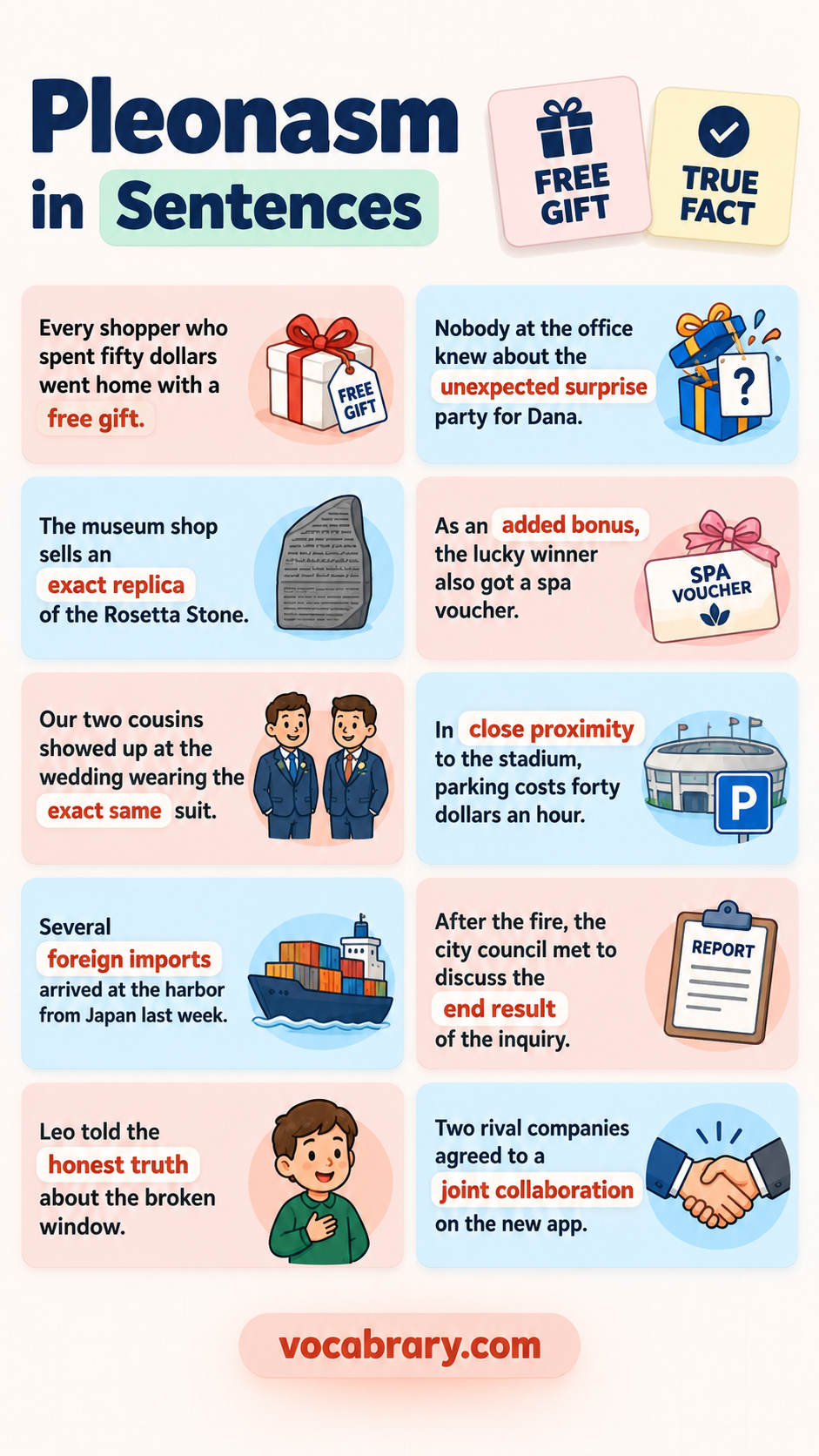
Free gifts, unexpected surprises, and an exact replica of the Rosetta Stone are the textbook pleonasm examples, where the second word repeats what the first word already says.
- Every shopper who spent fifty dollars went home with a free gift (lean: gift).
- Nobody at the office knew about the unexpected surprise party for Dana.
- The museum shop sells an exact replica of the Rosetta Stone (lean: replica).
- "That’s a true fact," Grandpa insisted, tapping the newspaper.
- As an added bonus, the lucky winner also got a spa voucher.
- Our two cousins showed up at the wedding wearing the exact same suit.
- Do you really need to repeat the joke again?
- In close proximity to the stadium, parking costs forty dollars an hour.
- Several foreign imports arrived at the harbor from Japan last week.
- After the fire, the city council met to discuss the end result of the inquiry.
- Leo told the honest truth about the broken window.
- Two rival companies agreed to a joint collaboration on the new app.
- Mia keeps a jar of frozen ice cubes for her lemonade.
- The villagers found a safe haven from the flood in the old church.
- My neighbor tells me his past history every time we meet at the mailbox.
- The startup claims its phone charger is a new innovation (lean: innovation).
- Hikers huddled around the burning fire after sunset.
- Please revert back to the old password if the new one fails.
- The jury reached a final conclusion after three days of debate.
- We stared into the empty void of the canyon from the lookout.
- Priya wants to return back to Lisbon next summer.
- What is the sum total of the bill after tax?
- His future plans involve a food truck and a small farm (lean: plans).
- A smooth-talking swindler got the job under false pretenses.
- Tom and Rafa shared together a pizza during the match.
- After weeks of arguing about the budget, the committee finally reached a general consensus of opinion that nobody fully liked.
Pleonasm Examples in Everyday Life
Kitchen chats, bus stops, and group texts are full of doubles such as "each and every," "my own personal opinion," and "join together," which people use in casual speech without noticing.
- In my own personal opinion, the new bakery is overrated.
- Each and every morning, the dog waits by the door for the mail carrier.
- Let’s all join together for a photo before the cake is gone.
- Julia personally thinks the movie ran too long (lean: thinks).
- My brother added extra salt to the soup as well.
- The whole family decided to gather together at Grandma’s house for Easter.
- "The reason why I’m late is the traffic," Omar explained.
- Guests began to mingle together in the garden after dinner.
- Aunt Rosa climbed up the ladder to fetch the holiday lights.
- Ben fell down the last two stairs and laughed it off.
- Our landlord insists that a working smoke alarm is a necessary requirement.
- Whole entire weekends vanish when Nina starts a new video game.
- Please cooperate together and put the toys away before bedtime.
- Before the party, Dad had to circle around the stadium three times to park.
- Every Friday, the neighbors meet together on the porch for tea.
- I heard the thunder with my own ears from inside the tent.
- At the ice cream truck, the kids formed a straight line in seconds.
- Our cat is afraid of the tiny little mouse under the stove.
- "Don’t exit out of the app yet," Chen told his mother.
- Sara found a handwritten manuscript of her great-grandmother’s recipes in the attic.
- Let’s meet up together later.
Time Pleonasm Examples
Past history, future plans, and "9 a.m. in the morning" show how time words pick up a second time word that says nothing new.
- Monday’s meeting starts at 9 a.m. in the morning (lean: 9 a.m.).
- Every hospital asks new patients about their past history of allergies.
- Lena shared her future plans for a year abroad in Peru.
- At our school, the lunch bell rings at 12 noon sharp (lean: noon).
- A brief moment of silence followed the principal’s speech.
- At this point in time, the store has no more umbrellas (lean: now).
- Next Monday, the bakery’s annual yearly sale begins.
- My past experience with that airline was a nightmare (lean: experience).
- Paolo first began painting when he was six years old.
- After four hours, the protest still remains peaceful.
- The concert was postponed until later because of the heat wave.
- Our new beginning in Denver started with a leaky roof.
- Students planned ahead for the science fair in September.
- Lightning knocked out power at 3 a.m. in the morning.
- During the course of the flight, the baby slept soundly (lean: during).
- Grandpa likes to repeat the old adage about early birds.
- The town received a temporary reprieve from the drought when rain fell.
- Will the bus continue on to the airport after the last stop?
- Past memories of summer camp still make Grandma laugh out loud whenever the family looks through the old photo albums at Thanksgiving.
Place and Size Pleonasm Examples
Tiny little puppies, a big giant pumpkin, and a round circle of chairs pair a size or place word with a second word that repeats it.
- A tiny little puppy slept in the shoebox by the heater.
- The farmer grew a big giant pumpkin for the county fair.
- Mrs. Lopez set out the chairs in a round circle for story time.
- Please enter in through the side door during the repairs (lean: enter).
- When the ball hit the net, the crowd rose up to cheer.
- Before dark, the hikers descended down the trail.
- Pedro’s new apartment is small in size but bright.
- Our backyard oak tree is large in size compared with the house.
- Rebels had surrounded the fort on all sides by dawn.
- Only a tiny speck of dust ruined the photo.
- Volunteers in the town were few in number that winter.
- Jamal bought a rope ten feet long in length (lean: ten feet long).
- Kids merged together into one long line at the gate.
- The hotel is in close proximity to the Eiffel Tower.
- We connected together the two garden hoses to reach the roses.
- The balloon floated up into the sky and vanished (lean: floated).
- From the top of the tower, the tourists looked down at the tiny miniature cars crawling along the bridge like toys in a shop window.
Acronym Pleonasm Examples
ATM machine, PIN number, and HIV virus belong to RAS syndrome, the "redundant acronym syndrome syndrome," in which the last letter of an acronym gets repeated as a full word.
- I need cash, so let’s stop at the ATM machine on the corner (lean: ATM).
- Never share your PIN number with a stranger (lean: PIN).
- The clinic offers free testing for the HIV virus (lean: HIV).
- Rosa’s old laptop has a cracked LCD display.
- At checkout, the cashier scanned the UPC code on the cereal (lean: UPC).
- Our car’s GPS system sent us down a dirt road.
- Write the ISBN number of the textbook on the form.
- Dad found the VIN number under the windshield.
- Save the report as a PDF format file before sending it.
- How much RAM memory does the new tablet have?
- "Please RSVP please by Friday," read the party invitation.
- The plumber gave us an ETA time of noon (lean: ETA).
- Ben installed a new NIC card in his desktop.
- Soldiers patrolled the DMZ zone between the two countries.
- Hana still owns a stack of DVD discs from the early 2000s.
- My home office uses a LAN network and one printer.
- The PC computer in the library is older than the students using it.
- Grandpa watches CNN news network every evening.
Types of Pleonasm With Examples
Syntactic, semantic, and bilingual pleonasm differ in where the surplus comes from: grammar, meaning, or a second language.
Syntactic Pleonasm
Extra "that," "of," and "at" words form syntactic pleonasm, where the sentence stays grammatical and complete without the extra word.
- I know that you were right about the weather (lean: I know you were right).
- A tennis ball rolled off of the desk and under the couch.
- Where is the charger at?
- My sister, she works nights at the hospital.
- Kids jumped inside of the bouncy castle.
- The reason is because the train broke down (lean: the reason is that).
- Both teams are equally as strong this season.
- We walked outside of the gym for some fresh air.
- Where did Mateo go to after lunch?
- Pens, paper, glue, and etc. are on the supply shelf.
- I myself never believed the rumor.
- The both of us agreed to split the rent.
Semantic Pleonasm
A "burning fire," a "true fact," and "wet water" show pleonasm of meaning, where the extra word repeats what the noun already says.
- Girl Scouts sang songs around a burning fire.
- Our science teacher called it a true fact that sound moves faster in water.
- A toddler splashed happily in the wet water of the lake.
- Rafa bought a new innovation in coffee makers.
- A frozen ice sculpture melted at the wedding reception.
- Nobody believed the witness, who told a false lie under oath.
- The judge ordered an exact replica of the missing painting.
- Careful, the kettle is full of hot boiling water.
- Every miner found free gratis tickets to the fair in his pay envelope.
- She took a brief moment to breathe before the exam.
- Nora hates cold ice.
Bilingual Pleonasm
The Sahara Desert, Mount Fujiyama, and the River Avon form bilingual pleonasm, where an English word repeats a word from another language that means the same thing.
- Camels have crossed the Sahara Desert for centuries (Sahara means "deserts" in Arabic).
- Climbers reach the peak of Mount Fujiyama before sunrise (yama means "mountain").
- Shakespeare grew up near the River Avon (Avon comes from a Celtic word for "river").
- The Rio Grande River marks part of the border between Texas and Mexico.
- Fossils from the La Brea Tar Pits fill a whole museum (La Brea means "the tar").
- Nomads still herd sheep across the Gobi Desert (Gobi is Mongolian for "desert").
- Snow covered the Sierra Nevada Mountains in early October (sierra means "mountain range").
- Astronomers built telescopes on Mount Mauna Kea in Hawaii (mauna means "mountain").
- The poet sneered at the hoi polloi (hoi already means "the").
- Every season, fans cheer for the Los Angeles Angels (Los Angeles means "the angels").
- Hikers climb Pendle Hill in Lancashire (pen was a Celtic word for "hill").
- Each summer, thousands of families from across the Midwest drive to the banks of the Mississippi River (Mississippi comes from an Ojibwe phrase meaning "great river").
Pleonasm Examples in Business and Advertising
Free gifts, added bonuses, and "new innovations" appear in shop windows and marketing emails, because an extra word makes a promise sound bigger.
- Sign up today and receive a complimentary free gift (lean: gift).
- Our loyalty card comes with an added bonus of free delivery.
- Last night’s keynote promised a new innovation in battery design.
- Management asked every team for advance planning on the budget.
- The board reached a general consensus on the merger (lean: consensus).
- Staff approved the new logo in a completely unanimous vote.
- Our joint collaboration with a Seoul studio launches in June.
- Both firms signed a promise of mutual cooperation.
- Customers get the exact same price online and in store.
- Why does the CEO want to revert back to the old pricing plan?
- The ad called the phone case an absolutely essential accessory.
- In her personal opinion, the slogan needs work.
- Staff received advance warning about the office move.
- Is the final outcome of the pilot program ready for the investors?
- Buy one lamp and get a second one free of charge at no cost.
- The end result of the rebrand was a thirty percent jump in sales.
- Our marketing team spent three whole weeks writing an email that promised customers a brand new innovation and an added bonus in the very same line.
Pleonasm Examples in Cooking and Food
Chai tea, naan bread, and salsa sauce show a food pleonasm, where a borrowed dish name already means the English word added after it.
- Priya ordered a cup of chai tea with extra cinnamon (chai means "tea").
- Warm naan bread came with the curry (naan already means "bread").
- Pour the salsa sauce over the tacos (salsa is Spanish for "sauce").
- The restaurant serves nachos with queso cheese dip (queso means "cheese").
- Grandma’s shrimp scampi is the family’s favorite Friday dinner.
- Our roast beef comes with au jus on the side (au jus means "with juice").
- My son refuses to eat tuna fish sandwiches.
- Mix together the flour and sugar in a large bowl (lean: mix).
- Combine together the eggs and milk before adding them.
- Fill the cooler with frozen ice before the picnic.
- The hot water heater in the café broke during the lunch rush.
- Kenji sprinkled shiitake mushrooms into the ramen (take means "mushroom").
- Brush away the tiny little crumbs before the guests arrive.
- Leo ate the whole entire cake by himself?
- Blend together the fruit.
Pleonasm Examples in News and TV
Armed gunmen, "breaking news just in," and "11 p.m. tonight" are common in broadcasts, where newsreaders add extra words to sound urgent.
- Police say an armed gunman robbed the pharmacy on Fifth Street.
- "We have breaking news just in from the courthouse," the newsreader announced.
- The fire completely destroyed the warehouse overnight (lean: destroyed).
- Tune in at 11 p.m. tonight for the full story.
- A fatal accident on Route 9 killed two drivers.
- Rescue crews say the ongoing investigation is still continuing.
- Last night’s storm totally annihilated the old town pier.
- Officials promised to share the true facts at a press conference.
- The mayor’s resignation came as an unexpected surprise to reporters.
- Channel 5 sent an advance warning about the hailstorm.
- Tonight’s advance preview of the new season airs at eight.
- Protesters joined together outside the capitol building.
- Our reporter is live on the scene right now.
- According to the county sheriff, floodwaters completely surrounded the farmhouse on all sides before the rescue helicopter arrived just after midnight.
Pleonasm Examples for Emphasis
Speakers add a surplus word on purpose in "each and every one," "I saw it with my own eyes," and legal pairs like "null and void," because the repetition stresses the claim.
Emphatic Pleonasm in Speech
"I saw it with my own eyes," "first and foremost," and "never, ever" are emphatic pleonasms, where the extra words add force instead of new meaning.
- I saw the comet with my own eyes from the rooftop.
- First and foremost, thank you all for coming tonight.
- "I will never, ever eat oysters again," Kim declared.
- The coach thanked each and every one of the players.
- Grandpa built the cabin with his own two hands.
- After two weeks at camp, the kids came home safe and sound.
- The teacher explained the rule over and over again.
- She is the one and only champion in the club’s history.
- Frankly, I’m sick and tired of waiting for the landlord to call.
- Our debt is finally over and done with.
- At the reunion, Grandpa insisted on thanking the doctor who saved his life in person, face to face, after forty long years.
Legal Doublets
Contracts pair "null and void," "cease and desist," and "any and all," legal doublets in which two words with one meaning appear side by side.
- The judge declared the old contract null and void.
- Their lawyer sent a cease and desist letter to the copycat brand.
- Grandma signed her last will and testament in 1998.
- Prosecutors charged the getaway driver with aiding and abetting.
- Please read the terms and conditions before you tap Accept.
- By signing, the tenant agreed to pay any and all repair costs.
- A bank officer asked whether the new manager was fit and proper for the job.
- I swear the statement is true and correct.
- Each monthly loan payment is due and payable on the first.
- Our firm owns the sole and exclusive rights to the song.
- In her will, Aunt Joan wrote that she gives, devises, and bequeaths her farm to her niece.
- Security checks are part and parcel of air travel.
Pleonasm Examples in Literature
Shakespeare, Samuel Beckett, and the King James Bible use pleonasm on purpose, where a double word slows the reader and marks a line for emphasis.
- In Shakespeare’s Julius Caesar, Mark Antony calls Brutus’s stab "the most unkindest cut of all," a double superlative.
- Polonius in Hamlet promises to be brief, then says Hamlet is mad, calls it mad, and defines madness as being nothing else but mad.
- Shylock in The Merchant of Venice praises the young judge as more elder than his looks.
- In Richard II, the king gives up his crown with mine own tears, with mine own hands, and with mine own tongue.
- A narrator in Samuel Beckett’s Molloy sneers at help offered free, gratis and for nothing.
- Robert Burns warns "ilk man and mother’s son" in his 1790 poem Tam o’ Shanter.
- The King James Bible says Jesus opened his mouth, and taught them, saying, before the Sermon on the Mount (Matthew 5:2).
- "What therefore God hath joined together, let no man put asunder," reads Matthew 19:6 in the King James Bible.
- Genesis 22:13 tells how Abraham lifted up his eyes, and looked, and saw a ram.
- Throughout the King James Bible, speech opens with answered and said, as when Jesus replies to the tempter in Matthew 4:4.
Pleonasm Examples for Students
Main protagonists, "in today’s modern society," and "various different" reasons are essay pleonasms that teachers circle in red, and each one reduces to a single word.
- The main protagonist of the novel is a lonely lighthouse keeper (lean: protagonist).
- In today’s modern society, most teens own a phone (lean: today).
- Chapter two gives various different reasons for the war (lean: various).
- In my personal opinion, I think the ending is rushed (lean: I think).
- The reason why is because the colonists wanted self-rule (lean: the reason is that).
- Each individual student presented a poem to the class.
- Our group had to collaborate together on the lab report.
- Throughout the whole entire novel, the narrator never gives his name.
- Scientists first discovered penicillin by accident in 1928.
- In conclusion, to sum up, the evidence favors the defense.
- My essay describes my future prospects after college.
- A total of twelve in all students joined the debate team (lean: twelve students).
- As an actual fact, the treaty was never signed.
- Don’t repeat again your thesis word for word in the last paragraph (lean: repeat).
- Ms. Patel asked us to completely finish the reading by Monday.
- Kofi’s poem compares two twin brothers who never meet.
- My first draft used past history, final outcome, and true facts in one sentence, so my teacher returned it covered in red circles and a single note.
Funny Pleonasm Examples
Yogi Berra’s "déjà vu all over again," a baby elephant called "tiny little," and a hot water heater that heats cold water turn redundancy into a joke.
- Yogi Berra famously described a repeat moment as "déjà vu all over again."
- The zookeeper called the two-ton newborn a tiny little baby elephant.
- Dad says our hot water heater is the laziest machine in the house, since the water is already hot.
- Visitors to the La Brea Tar Pits are really visiting "the the tar tar pits."
- "I’ll repeat that again one more time for the people in the back," the comedian shouted.
- My brother paid for a free gift at the fair and still doesn’t see the problem.
- A sign at the bank read, "Enter your PIN number at the ATM machine."
- Nobody told the unexpected surprise guest that we planned it for months.
- Everyone agreed the cat’s hatred of baths was completely unanimous, and she was the only voter.
- The magician promised a new innovation: the same trick, twice.
- Uncle Sal swears he saw a wet puddle of water on the kitchen floor.
- Outside the café, a chalkboard offered "Frozen ice cold drinks."
- Would you like chai tea or naan bread with that?
Related
FAQs
Pleonasm and tautology overlap, but a pleonasm adds one surplus word to a phrase ("free gift"), while a tautology repeats the same idea in a second, equal part ("it is what it is"). Many linguists treat tautology as a subtype of pleonasm. More cases of the second type appear in these tautology examples.
The adjective pleonastic describes any phrase or sentence that uses more words than its meaning needs, as in "a pleonastic phrase like ATM machine." The noun and adjective come from the Greek pleonasmos, from pleon, meaning "more."
The two main types of pleonasm are syntactic and semantic. Syntactic pleonasm adds a grammatical word that the sentence does not need, such as "that" in "I know that you’re right." Semantic pleonasm adds a word whose meaning another word already expresses, such as "burning" in "burning fire."
Pleonasm is a fault in formal writing when it adds words and nothing else, as in "past history" or "true facts." It works well on purpose, as in "I saw it with my own eyes," where the extra words add emphasis. Editors cut the accidental kind and keep the deliberate kind.
Yes, pleonasm is a figure of speech when a writer uses the extra words on purpose for emphasis or rhythm, as Shakespeare does with "the most unkindest cut of all." Accidental redundancy is a style error, not a figure. Other deliberate devices appear in these figures of speech sentences.
Yes, pleonasm is a literary device when an author uses it by design, as Shakespeare, Beckett, and the King James Bible translators did. In fiction it also marks a character’s speech, so a long-winded talker like Polonius sounds pompous through his doubled words.
Writers and speakers use pleonasm for emphasis, rhythm, humor, and clarity in noisy settings. "Each and every one of you" stresses that nobody is left out, and a pilot who says "nine a.m. in the morning" guards against a mishearing.
Five common examples of pleonasm are "free gift," "ATM machine," "past history," "tiny little," and "end result." In each phrase, one word repeats a meaning that the other word already expresses, so the shorter form says the same thing.
You use pleonasm in a sentence by adding a word whose meaning is already present, as in "The mayor gave an advance warning about the storm." To use it well, save it for emphasis, as in "I heard it with my own ears," and cut it from reports and essays.
The opposite of pleonasm is ellipsis, the omission of words that the reader supplies from context, as in "She ordered tea, and he coffee." Brevity and concision are the style goals on the same side. Its wordy relative, circumlocution, uses a long roundabout phrase instead of a short one, as these circumlocution examples show.
You pronounce pleonasm as PLEE-uh-naz-um, with the stress on the first syllable. The adjective pleonastic is pronounced plee-uh-NAS-tik, with the stress moving to the third syllable.

Leave a Comment