
Personification is a figure of speech in which human qualities are given to something that is not human, as when rain taps at a closed window. Personification sentences about rain turn drizzle, downpours, and thunder into characters with moods, and the most common ones give rain a whisper, a step, and a temper.
What Is Personification?
Personification gives human speech, feeling, and movement to objects, weather, and abstract nouns such as time or hope. Unlike a simile, which compares rain to a person with like or as, personification states the human action outright and drops the comparison.
All night the rain argued with the gutters and refused to let the street sleep.
Common Personification Sentences About Rain
Rain knocking on a window, whispering to a garden, and drumming on a tin roof are the three cases that run through most rain personification, where ordinary weather takes on human manners.
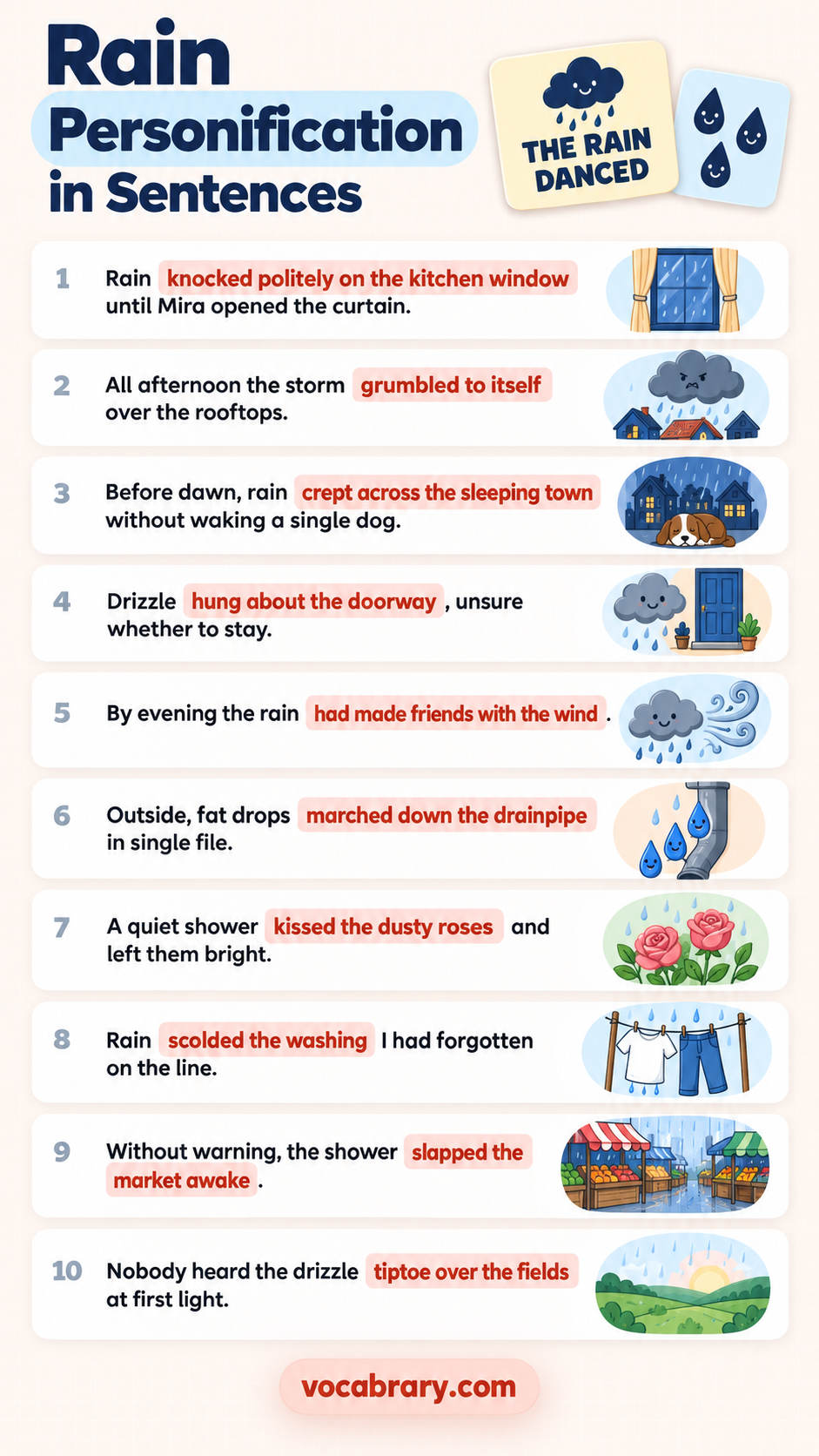
- Rain knocked politely on the kitchen window until Mira opened the curtain.
- All afternoon the storm grumbled to itself over the rooftops.
- Soft rain whispered to the garden, and every leaf turned to listen.
- Before dawn, rain crept across the sleeping town without waking a single dog.
- Thunder cleared its throat.
- Late at night, rain argued with the tin roof until both of them gave up and the house went quiet.
- Drizzle hung about the doorway, unsure whether to stay.
- Rain chased the children indoors and then sulked against the glass.
- By evening the rain had made friends with the wind.
- Outside, fat drops marched down the drainpipe in single file.
- Every gutter complained loudly as the rain shoved more water into it.
- A quiet shower kissed the dusty roses and left them bright.
- Clouds held their breath for an hour, then let the rain go.
- Rain scolded the washing I had forgotten on the line.
- Without warning, the shower slapped the market awake.
- Warm rain danced on the swimming pool while the lifeguard shouted at everyone to climb out.
- Nobody heard the drizzle tiptoe over the fields at first light.
- Our old umbrella surrendered the moment the rain decided to get serious.
- Rain washed the tired streets and sent the dust running.
- For three days the rain refused to leave the valley.
- Heavy rain pushed against the door, asking to come inside.
- That morning a shower combed the grass flat and moved on.
- Grey clouds gossiped all morning before the rain finally spoke.
- When the match began, rain strolled onto the pitch and stopped play.
- Rain kept its promise at four o’clock.
Light Rain and Drizzle Personification Examples
Bus stops, windscreens, and rose beds are where drizzle turns human in writing, and these sentences give light rain the manners of a shy guest who never quite commits to arriving.
- Drizzle loitered at the bus stop with the rest of us.
- A fine mist breathed on the windscreen and blurred the road ahead.
- Light rain patted the roses on the head and moved along.
- Since breakfast the drizzle had been muttering in the hedges.
- Barely awake, the rain yawned over the rooftops and went back to sleep.
- Mist tucked the hills into bed.
- Thin rain tickled my neck all the way home.
- Somewhere near the river, drizzle hummed to the reeds while the ferry waited for passengers who had chosen to stay dry.
- That grey shower refused to make up its mind about falling.
- Drizzle hesitated on the windowpane, then slid down.
- Outside the cafe, small drops played hopscotch across the awning.
- By four o’clock the rain had lost interest and wandered off.
- Cold mizzle crept under my collar and settled there for the afternoon.
- Gentle rain apologised to the picnickers and stopped within minutes.
Heavy Rain and Downpour Personification Examples
A downpour hammering a roof, drowning a football match, and bullying a queue of commuters gives heavy rain a temper, and every sentence names the damage it chooses to do.
- The downpour hammered the roof and dared anyone to complain.
- Rain bullied the queue outside the stadium until the gates opened.
- All evening the storm threw buckets at the windows.
- Heavy rain drowned the second half of the match and sent the crowd home.
- At two o’clock the sky emptied its pockets over the high street.
- Furious rain stamped on the flowerbeds Dad had planted that weekend.
- Water charged down the hillside, shouldering rocks aside as it went.
- A cloudburst grabbed the roof tiles and shook them loose.
- Overnight the river swallowed the footpath after the rain fed it for hours.
- Rain flattened the corn and walked away without a word.
- Sheets of water slammed the shutters shut.
- Traffic crawled while the downpour wrestled with the wipers of every car on the motorway, winning most of the arguments.
- The storm kicked the dustbins over and laughed down the alley.
- By midnight the rain had beaten the old roof into surrender.
Thunderstorm and Lightning Personification Examples
Thunder, lightning, and wind-driven rain arrive as a cast of three, and each force takes its own human role inside a single storm.
Thunder and Lightning Sentences
Grumbling thunder, lightning that shows off before vanishing, and a sky that growls a warning are the storm lines students meet first, where noise and light behave like a pair of performers.
- Thunder grumbled about the heat long before the first drop fell.
- Lightning showed off for the whole street, then vanished backstage.
- At nine o’clock the storm announced itself with one enormous clap.
- The sky growled a warning, and the picnic broke up.
- Lightning tore the darkness open, and thunder came running after it.
- Somewhere over the hills, thunder practised its lines.
- Rain arrived with the thunder, and the two of them took over the night.
- A single flash winked at the sleeping village.
- Thunder shouted at the dog, who hid under the bed until morning.
- All night the storm paced the roof, muttering whenever the lightning interrupted it.
- Between the flashes, rain drummed impatiently on the car bonnet while the children counted the seconds and their mother watched the road.
- The storm lost its temper at last.
- Overhead, thunder rolled its shoulders and settled in for the night.
- Hail joined the argument uninvited.
Rain and Wind Together
Bus shelters, washing lines, and orchards set the scene for wind and rain as partners, with one force shoving and the other following in sentences that hand both a shared quarrel.
- Wind dragged the rain across the field and refused to let it settle.
- At the bus shelter, rain and wind took turns pushing the waiting passengers.
- Gusts flung handfuls of water at the washing on the line.
- Rain leaned on the wind for support and arrived sideways.
- Outside, the wind shouted while the rain answered from the rooftops.
- All night the pair quarrelled in the chimney.
- Wet gusts wrestled the umbrella out of Grandad’s hands and ran off with it towards the harbour wall.
- Storm winds hurled rain at the lighthouse, which ignored them.
- Rain followed the wind through the orchard, knocking apples down as it passed.
- The wind held the door open so the rain walked straight in.
Rain on Windows and Roofs Personification Examples
Window glass and roof tiles are the two surfaces rain touches most in descriptive writing, where tapping, scratching, and drumming turn weather into a caller with a purpose.
Rain on a Window
Fingers on the glass, drops racing each other downward, and hail rapping at a skylight are the standard window lines, where rain acts like a caller waiting to be let in.
- Rain tapped on the window with one impatient finger.
- All through the lesson, drops raced each other down the glass.
- Fat raindrops pressed their faces to the pane and stared into the kitchen.
- Somebody outside seemed to be crying, but it was only the rain weeping down the window.
- Sleet scratched at the bedroom glass until Nadia pulled the blind.
- Rain knocked twice, then let itself in through the loose corner of the window.
- On the train, small drops crawled sideways across the window and abandoned their journey at the edge.
- Quiet rain breathed on the glass and wrote nothing.
- Each drop clung to the pane for a moment before giving up.
- During the exam, rain whispered questions against the classroom window while thirty pens kept moving.
- Hail rapped hard on the skylight, demanding attention.
- By dawn the rain had smeared the window with its fingerprints.
Rain on a Roof
Tin roofs, slate tiles, and old shingles turn rain into a musician or a heavy-footed visitor, and these sentences name the sound before they name the mood.
- Rain drummed on the tin roof all night and sang nobody to sleep.
- Water danced across the slates over Grandma’s attic.
- Heavy drops stamped on the shed roof and woke the hens.
- All night the roof listened patiently while the rain told the same story.
- Somewhere overhead, rain tapped out a rhythm the baby recognised.
- Monsoon rain pounded the corrugated roof until the whole house hummed along.
- Old shingles groaned each time the rain pushed harder.
- At three in the morning, rain marched up and down the roof with muddy boots and no thought for the family trying to sleep.
- Light rain brushed the tiles and left.
- The roof took the rain’s punishment without a word.
Rain in the City and the Countryside Personification Examples
Pavements and ploughed fields pull rain personification in two directions, with city rain acting like a rude stranger and country rain like a labourer who arrives to work.
Rain in the City Streets
Taxis, neon signs, blocked drains, and crowded pavements make the city sentences, where rain behaves like a stranger pushing through traffic and apologising to nobody.
- Rain swept down the avenue, herding shoppers into doorways.
- Neon signs bled into the puddles as the rain stirred them.
- By six o’clock the storm owned the city.
- Taxis vanished the moment the rain decided to make its entrance.
- Water hunted for the drains and found every one of them blocked.
- Along the high street, rain rattled the shop awnings and scattered the traders who had set out their stalls at dawn.
- The gutter gulped down the rain and choked on a plastic bag.
- Cold rain elbowed commuters off the pavement.
- Puddles waited patiently at the kerb for the next passing bus.
- At the crossing, rain spat at the windscreens of waiting cars.
- Drizzle wandered between the office towers without direction.
- Within four minutes the rain had emptied the park.
Rain in the Countryside and on Crops
Farmers, wheat fields, orchards, and cattle sheds fill the rural sentences, where rain works as a labourer who feeds the soil or ruins a harvest in one afternoon.
- Rain fed the thirsty wheat, and the farmer finally slept.
- Across the valley, the shower blessed every field it passed.
- Heavy rain trampled the barley flat two days before harvest.
- Soft rain coaxed the seedlings out of the soil.
- For a week the sky withheld its water from the orchard.
- Cattle stood still while the rain combed their backs.
- At last the clouds kept their word, and the rice paddies filled.
- Rain wandered over the hills, stopping to talk to every stream it met on the way down to the lower farms.
- Young vines drank greedily as the rain poured itself out over the slope.
- Overnight the storm robbed the orchard of half its apples.
- Morning drizzle kissed the hay, and the meadow steamed.
- The river swelled with gratitude after the rain.
Monsoon Rain and Rain After a Drought Personification Examples
Monsoon season and the first storm after a drought produce the most dramatic rain sentences, both handing the rain the role of a long-awaited visitor with a reputation.
Monsoon Rain
Market stalls, flooded lanes, and children running outdoors put monsoon rain in the position of a ruler who arrives on schedule and takes charge of a whole city for weeks.
- Monsoon rain arrived on time and took charge of the whole city.
- Every June the clouds keep their appointment with the coast.
- Children ran outside as the first monsoon shower called them by name.
- For nine weeks the rain refused to hand the sky back to the sun.
- Market stalls folded early because the rain announced a longer visit than usual.
- Warm monsoon water climbed the steps of the temple and made itself comfortable.
- By July the rain had learned the name of every street in the old quarter and visited each one twice a day.
- Rain hammered the rickshaw hoods and argued with the traffic.
- The first monsoon burst shook hands with the dust and settled it.
- Overhead, black clouds promised a flood and delivered one.
The First Rain After a Drought
Cracked riverbeds, dying maize, and empty village wells surround the first storm after a long drought, where rain is written as a rescuer who kept everyone waiting for months.
- After eleven dry months, the rain finally kept its promise.
- Cracked earth swallowed the first drops greedily.
- Rain came home to the village after a two-year absence.
- Dying maize lifted its head the moment the shower touched it.
- Everyone in the valley wept when the sky remembered them at last.
- That first storm apologised for its long absence and stayed for three days.
- Wells opened their mouths, and the rain poured in.
- For months the clouds had teased the farmers, and now they paid every debt in one night.
- The river woke up.
- Dust surrendered to the rain before noon.
Rain at Night Personification Examples
Streetlamps, sleeping houses, tents, and hospital windows set the night scenes, where rain is given the quiet habits of somebody moving through a house while everyone else sleeps.
- All night the rain wandered around the house, trying every window.
- Rain sang the whole street to sleep.
- Under the streetlamp, drops gathered to gossip before moving on.
- At two in the morning the storm rang every doorbell in the lane and ran away laughing.
- Soft rain stroked the tent while the campers pretended to be brave.
- Nobody slept, because the downpour kept telling the same loud story until sunrise.
- From the hospital window, rain kept the night nurse company.
- The darkness and the rain kept each other’s secrets until morning.
- Midnight rain whispered to the empty playground.
- By three o’clock the shower had grown tired and lay down on the roofs.
- Rain crept past the sleeping dogs and let the garden drink in peace while the moon stayed hidden.
- Gentle rain hushed the last car alarm.
The Sound of Rain Personification Examples
Whispering, muttering, humming, and applause name what rain does to the ear, and these sentences keep every human action inside the sound itself.
- Rain whispered secrets to the leaves outside my room.
- On the greenhouse glass, water applauded for an hour.
- Steady rain hummed the same three notes all evening.
- Somewhere behind the shed, drops muttered complaints into the water tank.
- Hail shouted; drizzle only murmured.
- The downpour roared at the mountain, and the mountain answered.
- At midnight rain tapped out a message on the caravan roof that nobody in the family knew how to read.
- Light rain gossiped with the gutter about the neighbours.
- Every leaf listened while the rain spoke.
- Falling on the lake, rain giggled without stopping.
- Thunder interrupted the rain mid-sentence.
- Outside the cinema, the storm kept up its applause long after the film ended.
Gentle Rain and Cruel Rain Personification Examples
Mood splits rain personification in two, with kind rain that comforts a garden and cruel rain that ruins a wedding, and the verb alone decides which of the two a reader hears.
Gentle and Friendly Rain
Grandmothers, flower pots, and sleeping gardens fill the kind sentences, where rain has the manners of a nurse or an old friend paying a short visit.
- Friendly rain tucked the garden in for the night.
- Warm drops greeted every walker on the towpath.
- Rain held the dust down, so the children played in peace.
- Kind rain watered the flower pots Mrs Alvi had planted in April.
- Softly, the shower forgave the long hot week.
- Spring rain woke the daffodils gently and asked nothing in return.
- Evening drizzle cooled the tired city and wiped its face.
- Rain sat with my grandmother on the veranda and kept her company the whole afternoon while she shelled peas.
- The shower smiled over the school field.
- Quiet rain thanked the earth and stopped.
Angry and Cruel Rain
Ruined weddings, flooded kitchens, and washed-out marches supply the hostile sentences, where rain is written as a bully or a thief with a grudge against the people in its way.
- Cruel rain ruined the wedding and enjoyed every minute of it.
- The storm broke its promise and turned on the coast.
- Rain hunted the last dry corner of the tent and found it.
- All week the sky punished the village for nothing at all.
- Bitter rain stole the heat from every room in the house.
- Flood water kicked the kitchen door in and made itself at home while the family carried furniture upstairs.
- Sleet whipped the marchers and sent half of them home.
- That night the storm held the town hostage.
- Rain laughed at the umbrella sellers who had sold out by noon.
- Merciless rain battered the roses to pieces.
Rain Personification in Poems and Stories
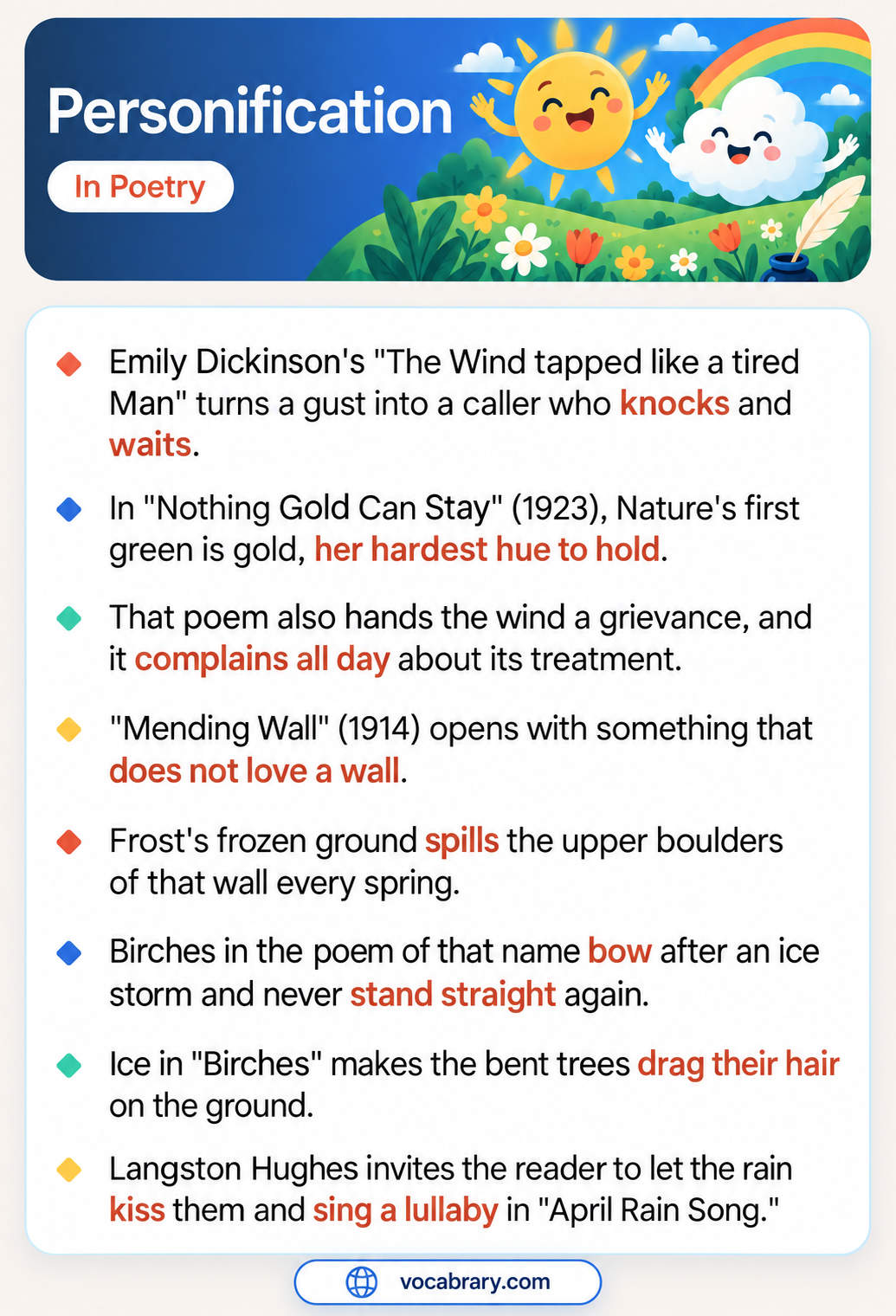
Walt Whitman, Sara Teasdale, and Langston Hughes each hand rain a human role, and every line names the writer and the work before describing what the rain says or does.
- In Walt Whitman’s 1885 poem “The Voice of the Rain,” the rain answers the poet’s question and names itself the poem of the earth.
- Coates Kinney’s “Rain on the Roof” (1849) describes rain drumming a lullaby on the shingles while the melancholy darkness weeps.
- Sara Teasdale imagines in “There Will Come Soft Rains” (1918) that spring would scarcely notice that humanity had gone.
- Langston Hughes invites the reader, in “April Rain Song,” to let the rain kiss them and sing them a lullaby.
- Henry Wadsworth Longfellow writes in “The Rainy Day” (1842) that the wind is never weary while the rain keeps falling.
- Shakespeare has King Lear order the rain to drench the steeples during the storm of Act 3, Scene 2.
- Percy Bysshe Shelley lets the cloud speak for itself in “The Cloud” (1820), bringing fresh showers to the thirsting flowers.
- Ray Bradbury’s story “The Long Rain” pictures a Venus where the rain never pauses and drives a crashed rocket crew mad.
- Edward Thomas’s 1916 poem “Rain” pictures midnight rain that washes the speaker cleaner than he has ever been and blesses the dead it falls upon.
Rain Personification Sentences for Kids and Students
Young learners need short rain lines built on one human verb, while secondary students need longer sentences with a human action they must identify and justify.
Short Rain Sentences for Young Learners
Singing rain, crying clouds, and puddles waiting for small boots suit a Grade 2 or Year 2 class, where one human verb per sentence is enough for a child to name.
- The rain sings on the roof.
- Raindrops play in the puddles.
- Little drops run down the glass.
- Clouds cry when they are sad.
- Rain taps on my window.
- Thunder shouts at the rain.
- Sunshine hides when the rain comes to visit our garden in the morning.
- Water washes the sleepy street.
- Puddles wait for small boots at the school gate every rainy morning.
- The storm stamps its feet.
- Big drops race to the ground.
- Rain kisses my umbrella.
- Wind pushes the rain along.
- Every flower drinks the rain and says thank you.
Rain Personification Examples for Students
A storm that interrupts a history lesson, rain that scolds a late bus, and clouds that refuse to share water give secondary students lines they must name and explain in an exam answer.
- The storm interrupted our history lesson with a single loud clap.
- Rain scolded the late bus as it pulled into the station.
- Clouds refused to share their water with the dry playing field.
- During revision week, the rain sympathised with every tired student in the library.
- Heavy showers bullied the athletics team off the track.
- Outside the exam hall, drizzle paced up and down with the waiting parents and nobody spoke.
- Rain announced the end of summer on the first day of term.
- At break time the downpour stole the football and rolled it into the ditch.
- Wet weather argued with the timetable and won.
- The sky frowned over the sports day, and the head teacher cancelled everything before lunch.
- Thunder sent the whole year group back indoors in thirty seconds.
- Morning rain encouraged the new gardeners in Year 7 to plant early.
Rain Personification Sentences for Descriptive Writing
Story openings, diary writing, and a description of a flooded town suit longer rain sentences, where one personified verb sets scene and mood at the same time.
- Rain stalked the valley all afternoon, pausing at each farmhouse as though counting the people inside.
- By the time the ferry docked, the storm had taken possession of the harbour.
- Thin drizzle wrapped itself around the station lamps and refused to let go.
- Somewhere beyond the moor, thunder rehearsed its entrance.
- Rain wrote long grey sentences down the windows of the empty hotel.
- Every street in the flooded town listened while the water decided where to go next.
- Cold rain followed Daniel from the bus stop to the front door, breathing on his neck the whole way.
- For six hours the sky held its grief in and then let it fall on the funeral party.
- Softly at first, the shower introduced itself to the orchard.
- The storm shouldered its way inland and flattened everything that argued.
- Autumn rain undressed the trees one afternoon at a time.
- As the last train left, rain settled into the platform seats and waited for morning.
Related
- Figures of Speech with Examples
- Personification Examples About Nature
- Personification Examples About School
FAQs
Two examples are "Rain knocked politely on the kitchen window until Mira opened the curtain." and "Soft rain whispered to the garden, and every leaf turned to listen." Each sentence gives the rain a human voice or a human manner.
Drizzle examples include "Drizzle loitered at the bus stop with the rest of us." and "Mist tucked the hills into bed." Each one gives gentle weather a quiet human habit.
Thunderstorm examples include "Thunder grumbled about the heat long before the first drop fell." and "Lightning showed off for the whole street, then vanished backstage." Each one gives the storm a human mood or a human performance.
Heavy rain examples include "The downpour hammered the roof and dared anyone to complain." and "Rain bullied the queue outside the stadium until the gates opened." Both sentences give the rain a temper.
Window examples include "Rain tapped on the window with one impatient finger." and "Fat raindrops pressed their faces to the pane and stared into the kitchen." Both sentences give the rain a body and a wish to come inside.
Monsoon examples include "Monsoon rain arrived on time and took charge of the whole city." and "Every June the clouds keep their appointment with the coast." The monsoon is given authority and punctuality.
Night examples include "All night the rain wandered around the house, trying every window." and "Midnight rain whispered to the empty playground." Both sentences give the rain the quiet habits of a person awake in the dark.
Countryside examples include "Rain fed the thirsty wheat, and the farmer finally slept." and "Soft rain coaxed the seedlings out of the soil." Both sentences give the rain a caring job.
Short lines for young children include "The rain sings on the roof." and "Raindrops play in the puddles." Each one gives a plain human action to the rain.
Poems give rain a human voice, as when Walt Whitman lets the rain answer the poet and name itself the poem of the earth. Langston Hughes asks the rain to kiss the reader and sing a lullaby in "April Rain Song."