
Personification is a figure of speech in which a writer gives human qualities to something that is not human, as when the sun smiles down on a garden. The best personification examples about nature let the wind, rain, trees, and sea act like people, and the most common ones describe everyday weather.
What Is Personification?
Personification gives a thing, an animal, or an idea the verbs and adjectives of a human being, so a storm argues and a river runs away. Unlike a simile, which links two subjects with “like” or “as”, personification grants the human action straight to the nonhuman noun.
The old oak stretched its arms over the fence and refused to move.
Common Personification Examples About Nature
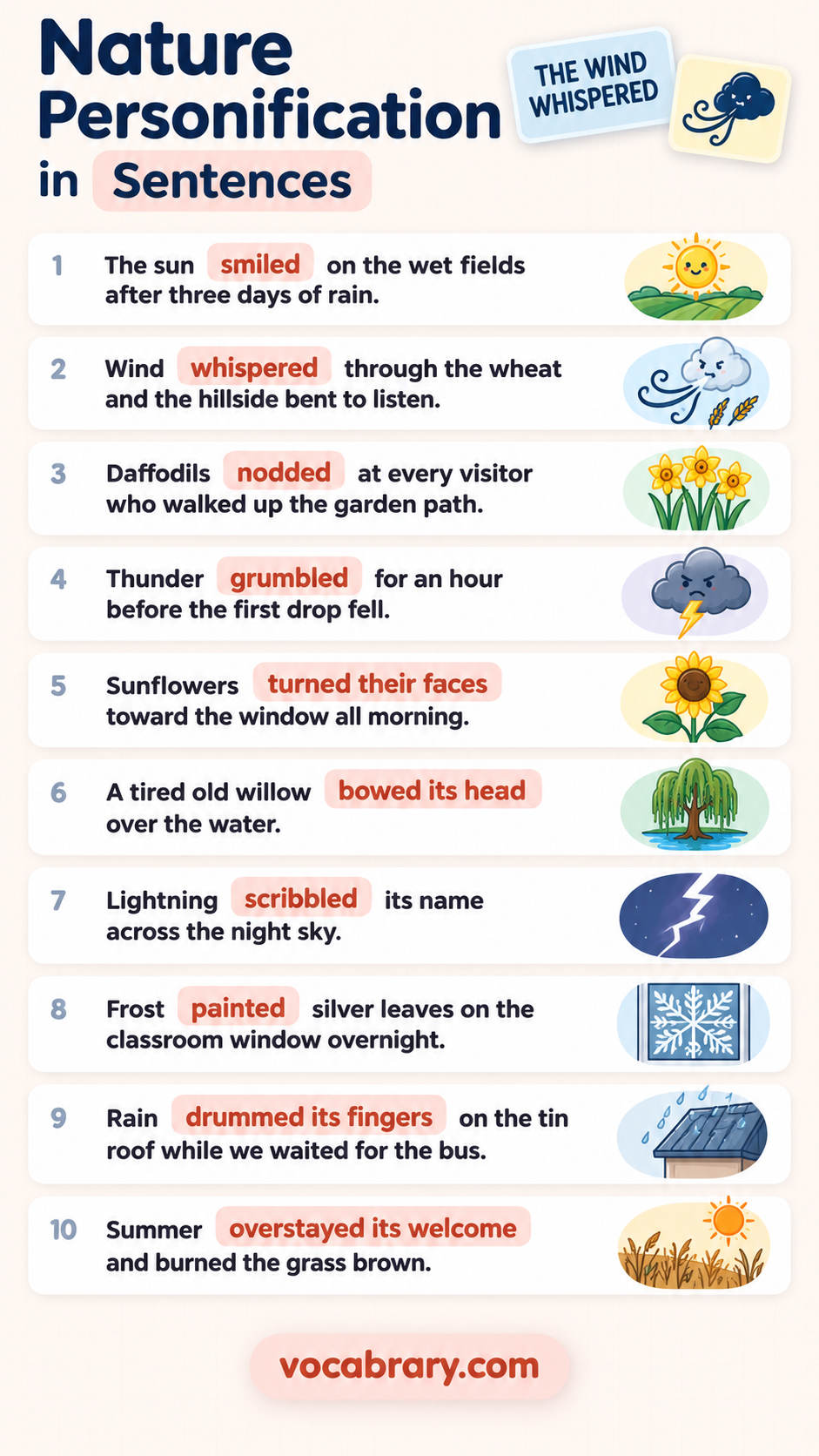
A smiling sun, a whispering wind, and nodding daffodils are the first nature sentences most learners meet, and each one gives a human action to something with no body at all.
- The sun smiled on the wet fields after three days of rain.
- Wind whispered through the wheat and the hillside bent to listen.
- Daffodils nodded at every visitor who walked up the garden path.
- Thunder grumbled for an hour before the first drop fell.
- Ice gripped the pond and refused to let go until April.
- Every spring, the river wakes up and shoves the winter branches downstream.
- Sunflowers turned their faces toward the window all morning.
- Fog crept across the harbour and swallowed the fishing boats.
- A tired old willow bowed its head over the water.
- Lightning scribbled its name across the night sky.
- Frost painted silver leaves on the classroom window overnight.
- Nobody heard the forest complain, though the storm tore at its branches all night.
- At dusk, the mountains pulled a blanket of cloud over their shoulders and settled in for the night.
- Rain drummed its fingers on the tin roof while we waited for the bus.
- Summer overstayed its welcome and burned the grass brown.
- Waves chased the children up the sand and then retreated.
- Autumn stripped the birch trees and left them shivering.
- Why does the sea argue with the cliffs every winter?
Personification Examples About the Sun
The sun stretches, glares, sulks behind cloud, and sinks into the sea in these sentences, so a single star gets the working day of a human being.
- The sun stretched over the rooftops and yawned into the kitchen window.
- By ten o’clock the sun glared at the road crew without mercy.
- Sunlight tiptoed across the floorboards while the baby slept.
- Every July the sun bullies the farmers off the field by noon.
- A weak winter sun struggled out of bed and gave up by three.
- Morning sun kissed the frost off the car windscreen.
- At the coast the sun sank into the sea and pulled the light down with it.
- Clouds arrived, and the sun hid its face for the rest of the afternoon.
- Our sun works a long shift in June and knocks off early in December.
- Does the sun ever grow tired of chasing the moon around the sky?
- Farmers thanked the sun for being generous with the barley this year.
- Heat from the afternoon sun slapped us the moment we opened the door.
- That stubborn sun refused to leave the classroom windows alone.
- Behind grey cloud the sun sulked for a whole week.
- Dawn light crawled up the valley wall.
- When the sun finally smiled, the whole village came outside to eat lunch in the market square.
Personification Examples About the Moon and Stars
Night skies fill with human behaviour when the moon peeks through curtains, stars wink at campers, and Venus saves a seat for the rest of the evening.
- The moon peeked through the curtains and watched us pack.
- Stars winked at the campers all night.
- A full moon leaned over the harbour to count the boats.
- Clouds kept teasing the moon, hiding her and then letting her go again.
- Last night the moon followed our car for forty miles down the motorway.
- Orion marches across the winter sky every January.
- Not one star bothered to show up during the storm.
- Moonlight crept under the door and lay down on the rug.
- The crescent moon grinned at the sleeping town.
- Old sailors said the moon pulls the tide home every evening.
- Why do the stars whisper to each other when the town goes quiet?
- Over the desert, a thousand stars argued about which of them shone brightest.
- Every winter the moon wears a ring and warns the shepherds of snow.
- Venus arrived first and saved a seat for the rest of the evening sky.
- Shy stars hid behind the city lights.
- During the eclipse, the moon stepped in front of the sun and refused to move for four minutes.
Personification Examples About the Wind
Howling at a cabin door, stealing a hat, and wrestling a tent all night, the wind earns more human verbs than any other part of nature.
- Wind howled at the cabin door for three hours.
- A cold northerly shoved the walkers back down the hill.
- The breeze played with Hana’s hair and stole her hat.
- Nothing argued with the fence that night except the wind.
- Outside, the gale hammered the shutters and screamed for attention.
- Every March the wind sweeps the yard and tidies nothing.
- A gentle breeze sang through the pines behind the school.
- Autumn wind snatched the newspaper from Grandpa’s hands.
- Does the wind ever grow bored of pushing clouds around the sky?
- Gusts wrestled the tent all night and won by morning.
- Up on the moor the wind bites the ears of anyone who forgets a hat.
- Warm air wandered in from the sea and settled on the terrace.
- Sailors say a friendly wind walks a boat home.
- That treacherous wind waited at the corner and knocked the cyclist sideways.
- Rain and wind conspired to ruin the school sports day.
- Nobody warned us that the mountain wind shouts all night and falls asleep exactly at dawn.
Personification Examples About Rain and Storms
Rain that taps politely, drizzle that nags a bus queue, and a downpour that punishes the allotments turn ordinary wet weather into a person with a temper.
- Rain tapped politely on the window before it let itself in through the roof.
- All afternoon the drizzle nagged the crowd at the bus stop.
- A summer shower washed the town’s face and left in a hurry.
- Heavy rain punished the allotments for two straight days.
- Nobody invited the rain, yet it arrived at the wedding dressed for a fight.
- Soft rain kissed the dust on the cricket pitch.
- Every October the rain moves in and refuses to pay rent until March.
- Puddles giggled under the boots of the nursery children.
- Sleet spat at the windscreen the whole way to Leeds.
- Did the rain really wait until the picnic blanket was open?
- That first monsoon rain hugged the dry fields of Punjab.
- Drizzle loitered over the churchyard until evening.
- Two showers took turns at the washing line all Saturday.
- Outside the hospital window, the rain wept quietly through the night shift and stopped at breakfast.
Thunder and Lightning Personification Sentences
Thunder clears its throat, lightning shows off for tourists, and hail hammers a greenhouse before apologising, which gives a storm the temper of an angry neighbour.
- Thunder cleared its throat over the valley.
- Lightning tore open the sky and stitched it shut again.
- All night the storm threw furniture around the farmyard.
- A distant rumble muttered something rude about the campsite.
- Hail hammered the greenhouse for ninety seconds and then apologised.
- Somewhere over the hills, thunder argued with itself until dawn.
- The storm lost its temper at midnight and took the power lines with it.
- Did you hear the thunder scold the dog?
- Every August, storms bully the coast of Florida.
- Grey clouds held a meeting over the school and voted for rain.
- Lightning showed off for the tourists on the ferry.
- Once the squall had finished shouting at the rooftops, the harbour sighed with relief and went back to sleep before dawn.
Personification Examples About Trees and Forests
An oak stretching its arms, pines muttering together, and ivy strangling a garden wall show how easily trees take on human posture and human bad manners.
- The old oak stretched its arms over the neighbour’s fence.
- Pines muttered together whenever the wind passed.
- A young birch shivered at the edge of the car park.
- Willows bent to drink from the canal.
- Every autumn the maples set themselves on fire and drop their coats.
- Nothing in the wood spoke until the woodpecker interrupted.
- Roots elbowed the pavement until it cracked.
- That ancient yew has kept watch over the churchyard for four hundred years.
- Branches grabbed at our coats as we pushed through the hedge.
- Our forest breathes more slowly in winter.
- Do the trees gossip about the walkers who carve their names?
- Leaves argued with the rake all afternoon.
- Beeches held hands underground and shared their food.
- Bare in January, the cherry tree waits patiently for its one week of glory.
- Ivy strangled the garden wall and claimed the shed as well.
- After the storm, a broken elm lay across the lane for a whole weekend and apologised to nobody for the diversion.
Personification Examples About Flowers and Grass
Daisies open their eyes, poppies wave at a train, and orchids sulk on a windowsill in this group, where small plants get human faces and human feelings.
- Daisies opened their eyes as soon as the sun appeared.
- A single rose blushed by the front door.
- Tulips stood to attention along the path.
- Grass crept over the abandoned tennis court.
- Every June the lavender invites half the county’s bees to dinner.
- Weeds bullied the lettuces out of the vegetable bed.
- Poppies waved at the passing train.
- Sunflowers followed the light all day and hung their heads at dusk.
- Do the snowdrops know that February is still cold?
- That stubborn dandelion refused to die, whatever the gardener tried.
- Cut grass sighed its green smell across the whole village.
- Wildflowers crowded the roadside and shouted in yellow and purple.
- Orchids on the windowsill sulk when Mum forgets them.
- By Friday the roses had given up and dropped their petals all over the terrace.
Personification Examples About Mountains and Rocks
Cliffs stare down at a village, scree shrugs walkers back down a slope, and granite shoulders the weather, so the oldest parts of the countryside gain patience and stubbornness.
- The mountain kept its head in the clouds all morning.
- Cliffs stared down at the little fishing village.
- A grey boulder refused to move for three hundred years.
- Rocks grumbled underfoot as the walkers climbed.
- Every winter Ben Nevis wears a white cap.
- The cave swallowed our torchlight.
- Nothing frightens the old volcano, and nothing hurries it either.
- Scree shrugged and sent us sliding back down.
- Do the hills remember every walker who has crossed them?
- Granite shoulders the weather year after year without complaint.
- Two peaks argued over the last of the evening light.
- Ancient stones at Avebury have watched the fields change for four thousand years.
- Down in the south, the valley cradled the sleeping village.
- Loose slate whispered warnings to the climbers picking their way up the gully.
Personification Examples About Rivers, Lakes, and the Sea
The Thames hurrying past Westminster, a brook whispering to alder roots, and floodwater shouldering a fence aside give moving water the hurry and temper of a person.
- The Thames hurries past Westminster and slows down at Greenwich.
- Our stream chatters all the way down the hill.
- A swollen river swallowed the footbridge in March.
- Every spring the meltwater races the walkers to the valley floor.
- Water danced over the stones behind the mill.
- Nothing stops the Ganges once the monsoon feeds it.
- The brook whispered to the roots of the alder trees.
- Do rivers grow impatient when a dam halts them?
- Brown floodwater shouldered the fence aside.
- In summer our river grows lazy and naps among the reeds.
- Rapids roared at the kayakers and spat them out at the bottom.
- After weeks without rain, the little beck gave up and crawled into the gravel.
Lake and Pond Personification Sentences
Still water gets a personality when Windermere shrugs off the rain, ice locks a pond and refuses to open it, and a village pond wears a green coat by August.
- The lake lay still and held its breath until dawn.
- Windermere shrugged off the rain and went back to sleep.
- A duck pond complained about the children every Saturday.
- Ice locked the pond and refused to open it until March.
- Our village pond wears a green coat by August.
- Nothing disturbs Loch Ness at six in the morning.
- Ripples ran to the bank and told the reeds.
- Does the lake miss the swimmers in winter?
- At sunset the water wore the colour of the whole sky.
- Reservoirs shrank back from their own shores during the long English drought of 1976, uncovering two drowned villages.
Sea and Ocean Personification Sentences
Waves whisper to sand, tides come to collect the sandcastles, and the Atlantic bullies the Cornish coast, which gives the sea both tenderness and violence.
- The sea threw itself at the harbour wall all night.
- Waves whispered to the sand and slipped away.
- A calm ocean lied to the fishermen that morning.
- Every autumn the Atlantic bullies the Cornish coast.
- Tides come to collect the sandcastles at six o’clock.
- Nothing soothes the North Sea in January.
- Foam chased the toddlers and tickled their ankles.
- Do the waves grow bored of repeating themselves?
- Warm shallows invited us in and refused to let us leave.
- Out past the reef, the ocean guards its secrets and shares none.
- The Mediterranean naps through August afternoons.
- Salt spray slapped the lighthouse keeper awake.
- Storm surges stole whole metres of dune in a single weekend.
- Under a grey sky, the sea sulked, muttered, and refused to show a single sail.
Personification Examples About Fire
Flames lick a log, embers whisper after the singing stops, and an old fireplace coughs when the chimney is cold, so heat behaves like a guest in the room.
- Flames licked the edge of the log and crept along the bark.
- The campfire danced for the scouts until midnight.
- A single spark leapt onto the dry grass and called its friends.
- Fire ate through the barn in twenty minutes.
- Every winter the woodstove hums a low song in the corner.
- Nothing calms a wildfire once the wind joins in.
- Embers whispered long after the singing stopped.
- Did the bonfire wave at the children on the hill?
- Smoke wandered through the pines, looking for a way out.
- Hungry flames climbed the curtain and reached for the ceiling.
- Our old fireplace coughs whenever the chimney is cold.
- By three in the morning the fire had grown sleepy and given the room back to the dark.
Personification Examples About Snow and Ice
Snow tiptoes down overnight, black ice waits at the bottom of a hill, and frost flowers dress the windows, which makes cold weather sound deliberate.
- Snow tiptoed down all night and surprised the village at breakfast.
- Ice locked the gate and laughed at the postman.
- A late frost murdered the apple blossom in one night.
- Every January the drifts pile against the farm gate without permission.
- Icicles eavesdropped from the gutter all week.
- Nothing hurries a glacier, and nothing turns it back.
- Frozen puddles cracked jokes under the children’s boots.
- Does snow enjoy falling on a Sunday?
- Fresh powder invited the skiers and hid the rocks underneath.
- Black ice waited at the bottom of the hill for careless drivers.
- Our windows wore frost flowers every morning that February.
- Sleet scolded anybody who left home without a coat.
- Melting snow crept into the cellar and made itself at home.
- By March the last patch of snow had surrendered, shrunk to a grey rag, and vanished behind the shed.
Personification Examples About the Seasons
Each season arrives, works, and leaves like a person with a job: spring apologises for a late start, summer sprawls over the village, and winter knocks hard at the door.
Spring Personification Sentences
Blossom showing off for three days, new leaves unfolding their fingers, and frost losing the argument in April give the first season a young, impatient character.
- Spring arrived late and apologised with a week of sunshine.
- The first warm morning woke the whole street.
- Blossom crowded the lane and showed off for three days.
- Every March the hedgerows wake up hungry for light.
- New leaves unfolded their fingers overnight.
- Does spring ever forget to come back?
- Rain and sun took turns all through April.
- Warm earth invited the seeds to come out.
- Frost lost the argument in the middle of April.
- By the last week of March the garden had thrown off its blanket and started work again.
Summer Personification Sentences
Summer sprawls, heat presses its hands on the windows, and August packs its bags quietly, so the hottest months behave like a guest who overstays and then vanishes.
- Summer sprawled over the village and refused to move.
- A lazy August afternoon dozed in the orchard.
- Heat pressed its hands against every window.
- The long evenings teased the children into staying out.
- Every July the fields turn their backs on the rain.
- Does summer ever keep its promises in Scotland?
- Dry grass crackled a warning underfoot.
- Late summer packed its bags quietly and slipped away during the last week of August.
- Nothing hurries a July afternoon by the river.
- Sunburnt and slow, the whole month of August stopped trying and let the garden go brown.
Autumn Personification Sentences
October stripping the beeches, mist wrapping a valley in grey wool, and a harvest moon supervising the combining give autumn the manner of a tidy, slightly sad housekeeper.
- Autumn crept in through the back door in September.
- October stripped the beeches and swept the leaves into the ditch.
- A cold morning breathed on the windows.
- Every year autumn steals the light one minute at a time.
- Fallen leaves complained underfoot.
- Does autumn grieve for the summer it replaces?
- Mist wrapped the valley in grey wool before breakfast.
- The harvest moon supervised the last of the combining.
- Nothing prepares a garden for frost the way autumn does, quietly and without warning.
- By the middle of November the woods had undressed completely and gone to sleep for five months.
Winter Personification Sentences
Frost writes on parked cars, snow tucks a village into bed, and ice drops the postman on his back, which turns the coldest weeks into a rough practical joker.
- Winter knocked hard and let itself in before December.
- Frost wrote its name on every parked car.
- A bitter January wind hunted the last walkers off the fell.
- Every night the cold tightened its grip on the water pipes.
- Snow tucked the whole village into bed.
- Does winter ever feel sorry for the birds?
- Ice cracked a joke and dropped the postman on his back.
- The short days hurried everybody home by four.
- Nothing argues with a north wind in February.
- Somewhere under the frozen soil, next year’s bulbs waited their turn without a word of complaint.
Personification Examples About Weather and the Sky
A frowning sky, hailstones that leave without paying, and fog that steals the church bells show how weather takes on human manners in everyday speech.
- The sky frowned all afternoon and finally cried.
- Clouds raced each other across the moor.
- A grey morning refused to cheer up.
- Every forecast promises sunshine and lies by Thursday.
- Fog muffled the town and stole the church bells.
- Nothing hides from the weather on an open hillside.
- Sunshine broke through and shook hands with the wet street.
- Do the clouds quarrel before a thunderstorm?
- Hailstones pelted the car and left without paying for the damage.
- Blue sky peeped between two grey banks of cloud.
- Humidity smothered the city for a fortnight.
- Cold air slid down from the hills and crept under the doors.
- That miserable drizzle followed us from Glasgow to Carlisle.
- Long after midnight the sky cleared its throat, blinked twice, and let the stars out.
Personification Examples About Animals and Birds
A robin demanding crumbs, crows discussing an empty field, and a grouse storming off downhill give wild creatures human speech and human opinions.
- The robin demanded a share of the breakfast crumbs.
- Two crows discussed the empty field from the telephone wire.
- A fox strolled down the high street as though he owned it.
- Every morning the blackbird announces himself from the chimney pot.
- Cows stared at the hikers with open disapproval.
- Nothing worries a heron waiting at the edge of the pond.
- Swallows agreed on a date and left for Africa together.
- Does the owl really ask who is there?
- Bees argued over the lavender all afternoon.
- Our neighbour’s cat judges every visitor from the windowsill.
- Geese bickered in the sky the whole way south.
- That old sheepdog worries about the weather more than the farmer does.
- Salmon fight their way upriver and refuse to give up.
- Deep in the heather, a grouse complained loudly about the walkers and stormed off downhill.
Personification Examples About Night and Morning
Night pulls a blanket over the fields, dawn taps the shutters, and twilight keeps the door open for the first bat, so the hours themselves act like people.
- Night pulled a blanket over the fields.
- Dawn crept along the ridge and tapped the shutters.
- A long midsummer evening refused to end.
- Every morning the light knocks at the bedroom curtain.
- Darkness took over the lane by half past four.
- Nothing hurries a winter dawn in Aberdeen.
- Shadows stretched and yawned across the lawn.
- Does the night ever listen to the arguments it hides?
- Twilight held the door open for the first bat.
- Early mist kept the sun waiting until nine.
- Midnight stole the last of the colour from the garden.
- The moon handed over to the sun without a word.
- Cold starlight watched the shepherd cross the field.
- Long before the alarm rang, morning had opened the curtains, woken the birds, and warmed the back step.
Funny Nature Personification Examples
Wind that steals a toupee, nettles with a grudge against one pair of ankles, and a single cloud parked over a beach towel make nature sound petty on purpose.
- The wind stole Dad’s toupee and refused to apologise.
- Our lawn sulks whenever the mower comes out of the shed.
- A seagull mugged my nephew for a chip in Blackpool.
- Every thunderstorm in this town waits until the washing is on the line.
- Autumn leaves conspired to blow into the one pile we had already bagged.
- Nothing enjoys a barbecue more than the rain does.
- Nettles kept a grudge against my ankles for a fortnight.
- Does the fog check our holiday dates before it rolls in?
- Two squirrels argued about the bird feeder and ignored every rule of ownership.
- Our cactus judged us silently for three years and then died out of spite.
- January laughed at my gym membership.
- Behind the shed, the compost heap grumbles all winter and thanks nobody in spring.
- Wasps at the picnic read the menu, helped themselves, and left no tip.
- Somehow the only cloud in the sky found our beach towel and parked overhead for an hour.
Nature Personification Examples in Poetry
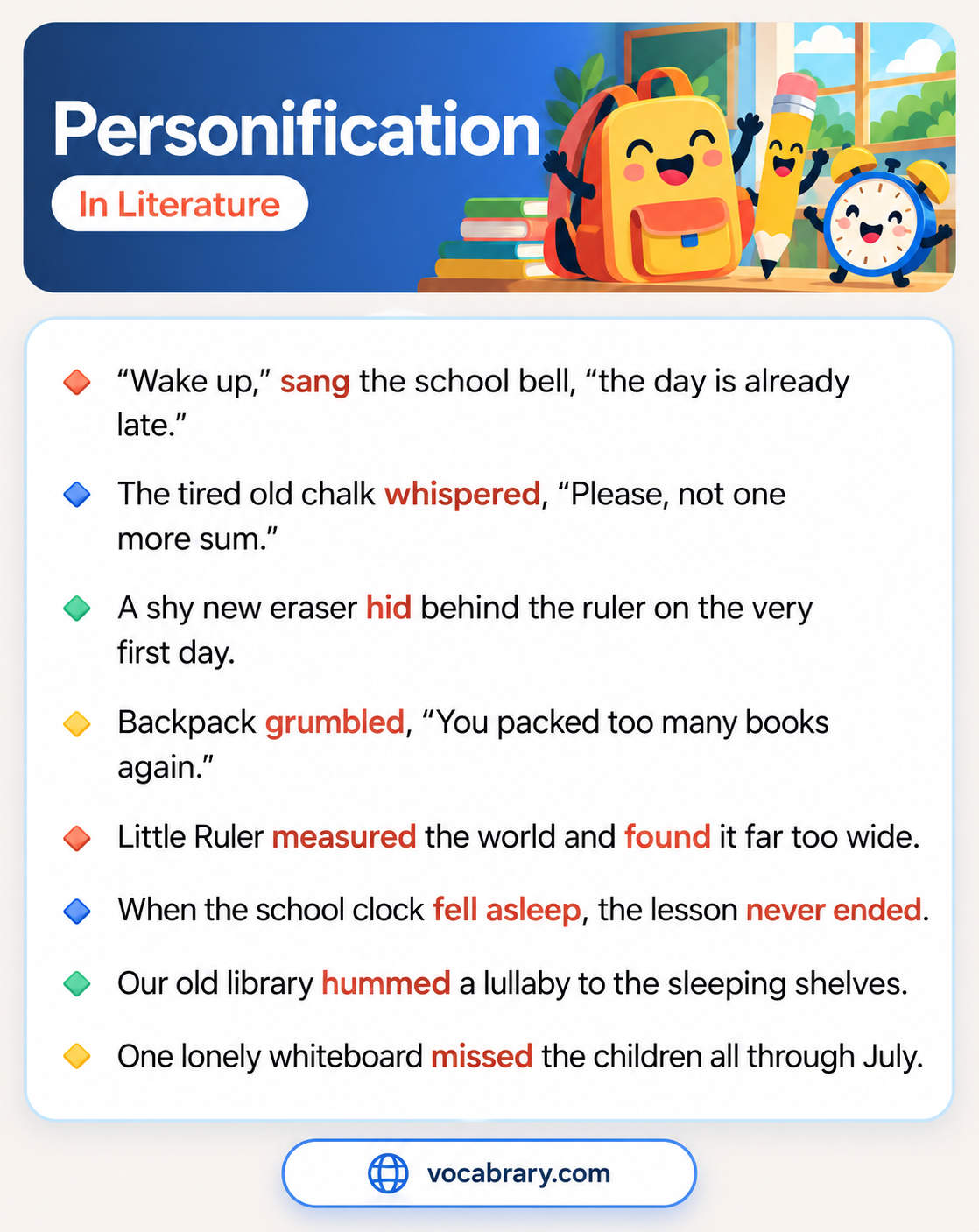
English poets have given nature human life for centuries, and Wordsworth, Dickinson, and Frost supply the lines that school exams quote most.
Wordsworth Nature Personification Lines
William Wordsworth wrote dancing daffodils, flowers that enjoy the air they breathe, and a cliff that strides after a boy in a stolen boat.
- Wordsworth’s “I Wandered Lonely as a Cloud” (1807) shows ten thousand daffodils tossing their heads in a dance.
- In that poem the waves of the lake dance too, though the flowers outdo them.
- Memory brings the daffodils back in the last stanza, where they dance again for the poet alone.
- “Lines Written in Early Spring” (1798) claims that every flower enjoys the air it breathes.
- Budding twigs in the same poem spread out their fan to catch the moving air.
- Periwinkle trails its wreaths through the primrose tufts.
- The birds around him hop and play, and Wordsworth reads pleasure into every movement.
- A cliff in “The Prelude” rears its head, strides after the boy, and drives him home in fright.
- Nature herself, in Wordsworth’s writing, teaches, grieves, and keeps company with the walker.
- Even the mountains of his Lake District speak to a boy who is out too late.
Dickinson Nature Personification Lines
Emily Dickinson gives a wind that knocks at the door, a snowflake that debates its route, and a frost that beheads a flower at play.
- Emily Dickinson’s “The Wind tapped like a tired Man” turns a gust into a caller who knocks and waits.
- In “The Sky is low, the Clouds are mean”, a travelling snowflake debates whether to cross a barn.
- That poem also hands the wind a grievance, and it complains all day about its treatment.
- Nature becomes a patient parent in “Nature, the gentlest mother”, hushing her noisiest child.
- Frost beheads a happy flower at its play.
- The sun in that poem proceeds unmoved after the killing, which makes the cruelty worse.
- Hills untie their bonnets at sunrise in “I’ll tell you how the Sun rose”.
- Her autumn maple wears a gayer scarf while the field puts on a scarlet gown.
- Grass divides for the narrow fellow in her poem about a snake in the meadow.
- Dickinson rarely lets weather stay neutral, so her storms threaten and her mornings arrive as guests.
Frost Nature Personification Lines
Robert Frost hands a horse a question, watches nature lose her first gold within an hour, and listens to trees that talk of going and never leave.
- Robert Frost’s “Stopping by Woods on a Snowy Evening” (1923) lets the little horse ask a question with his harness bells.
- Snow and a gentle wind in that poem invite the traveller to stay while his promises pull him home.
- In “Nothing Gold Can Stay” (1923), Nature loses her first gold within an hour.
- That same short poem watches Eden sink to grief and dawn go down to day.
- “Mending Wall” (1914) opens with something that does not love a wall.
- Frost’s frozen ground spills the upper boulders of that wall every spring.
- Birches in the poem of that name bow after an ice storm and never stand straight again.
- Ice in “Birches” makes the bent trees drag their hair on the ground.
- “The Sound of the Trees” (1916) asks why we listen to trees that talk of going and never leave.
- Nature in Frost’s New England keeps its own counsel and answers the farmer only in weather.
Nature Personification in Other Famous Poems
Keats, Shelley, Coleridge, and Sandburg wrote an autumn asleep on a granary floor, a west wind driving dead leaves, and a fog that arrives on cat feet.
- John Keats opens “To Autumn” (1819) with a season that conspires with the sun to ripen the vines.
- Keats shows autumn asleep on a granary floor with her hair lifted by the winnowing wind.
- Percy Bysshe Shelley calls the west wind the breath of autumn’s being in his ode of 1819.
- Dead leaves in that ode flee from the wind as ghosts flee an enchanter.
- Samuel Taylor Coleridge sends the sun up out of the sea as “he” in “The Rime of the Ancient Mariner” (1798).
- Carl Sandburg’s “Fog” (1916) has the fog come on little cat feet and move on after looking over the harbour.
- William Shakespeare gives summer a short lease in Sonnet 18.
- Christina Rossetti’s “Who Has Seen the Wind?” lets the trees bow down their heads as the wind passes by.
- Langston Hughes asks the rain to kiss the reader and sing a lullaby in “April Rain Song” (1921).
- Sylvia Plath’s “Mushrooms” (1959) gives the fungi their own quiet speech as they shoulder through the loam.
Nature Personification Examples in Books and Stories
Kenneth Grahame’s chattering River, the creeping fog of Dickens’s opening chapter, and Tolkien’s singing willow are the prose cases teachers set beside the poems.
- In “The Wind in the Willows” (1908), Kenneth Grahame lets the River chatter to Mole as a companion.
- Frances Hodgson Burnett’s “The Secret Garden” (1911) shows the garden waking and coming alive under Mary’s care.
- Dickens opens “Bleak House” (1853) with fog that creeps into the cabooses of collier brigs and hovers over the city.
- J.R.R. Tolkien’s Old Man Willow sings the hobbits to sleep and traps them inside his trunk.
- Tolkien’s Ents walk, talk, and go to war as trees.
- Emily Bronte named Wuthering Heights for the wind that torments the house in stormy weather.
- John Steinbeck opens “The Grapes of Wrath” (1939) with a drought and a wind that strip the Oklahoma fields.
- Jack London’s “To Build a Fire” (1908) makes the Yukon cold a patient enemy that waits for one mistake.
- Mary Shelley sends storms over the Alps in “Frankenstein” (1818) that answer Victor’s despair.
- Charlotte Bronte splits the chestnut tree at Thornfield with lightning, and the wounded tree groans all night.
- Hans Christian Andersen’s “The Fir Tree” (1844) gives the little tree its own wishes and regrets.
- C.S. Lewis keeps Narnia in a winter that refuses to let Christmas arrive.
Nature Personification Examples for Kids
A sun in a yellow hat, puddles that giggle under boots, and trees that clap their hands suit children who are meeting the device for the first time.
- The sun woke up and put on its yellow hat.
- Mr Moon tucked the sleepy owls into bed.
- Flowers waved hello when Amina walked past.
- A puddle giggled every time a boot landed in it.
- Trees clapped their hands when the wind blew.
- Snow tickled Ben’s nose.
- Every raindrop raced its friends down the window.
- Grass wriggled between Sara’s toes and said good morning.
- Does the rainbow smile after the rain?
- Clouds played hide and seek with the sun all afternoon.
- Our apple tree gave away its apples to the whole street.
- Leaves danced in circles and fell over laughing.
- The little stream sang the same song all day.
- Wind chased Tom’s kite and would not give it back.
- Baby birds shouted for breakfast at five in the morning.
- When the storm got angry, the old house hugged the children a little tighter.
Nature Personification Examples for Students
Retreating glaciers, starving coral reefs, and rising seas knocking at the doors of Jakarta give older writers nature sentences strong enough for an essay.
- The glacier retreated up the valley and left its rubble behind.
- Drought squeezed the Murray River until the towns along it begged for rain.
- A warming ocean swallows coastline that farmers once trusted.
- Every rainforest guards the rain it has made itself, and logging breaks the promise.
- Coral reefs starve when the sea loses its temper over one hot summer.
- Nothing forgives a hillside stripped of trees, and the first storm takes its revenge.
- Wildfire rewrites a national park in one afternoon.
- Soil that farmers have exhausted refuses to feed another crop.
- Do the seasons still keep their appointments in a warming world?
- Melting permafrost gives up the carbon it has guarded for ten thousand years.
- The Sahara pushes south every year, and the grassland retreats without a fight.
- Rising seas knock politely at the doors of Jakarta and Venice.
- Storm systems borrow energy from warm water and spend it on the coast.
- When the last glacier on a mountain dies, the rivers underneath it lose their steady pulse for good.
Short Nature Personification Sentences for Young Learners
Three-word and four-word lines such as a smiling sun, dancing flowers, and shouting thunder suit young learners who are copying a pattern into a notebook.
- The sun smiled.
- Rain knocked at the door.
- Wind sang in the trees.
- Flowers danced.
- Snow whispered to the roof.
- Thunder shouted.
- Leaves ran away down the street.
- The river giggled over the stones.
- Ice grabbed the pond.
- Stars blinked at us.
- Fog hid the hill.
- Grass stretched after the rain.
- Lightning winked.
- Trees bowed to the storm.
- Night closed its eyes.
- Every morning the friendly old sun peeps over the school roof and wakes the town.
Related
- Figures of Speech with Examples
- Figurative Language Examples Sentences
- Personification Examples About School
FAQs
Two examples in a sentence are "The sun smiled on the wet fields after three days of rain." and "Wind whispered through the wheat and the hillside bent to listen." Each one gives a human action to the weather.
Sun and moon examples include "Morning sun kissed the frost off the car windscreen." and "Stars winked at the campers all night." Both sentences give the sky a small human habit.
A wind example is "Wind howled at the cabin door for three hours," and a storm example is "Thunder cleared its throat over the valley." Both sentences name a sound that only a person makes.
River and sea examples include "Our stream chatters all the way down the hill." and "Waves whispered to the sand and slipped away." Both sentences give moving water a human voice or a human habit.
Tree and flower examples include "Pines muttered together whenever the wind passed." and "Tulips stood to attention along the path." Each plant is given a human voice or a human posture.
Season examples include "Spring arrived late and apologised with a week of sunshine." and "Winter knocked hard and let itself in before December." Spring is given manners, and winter is given a visit.
Animal examples include "The robin demanded a share of the breakfast crumbs." and "Geese bickered in the sky the whole way south." Each bird is given a human demand or a human quarrel.
Funny examples include "The wind stole Dad’s toupee and refused to apologise." and "A seagull mugged my nephew for a chip in Blackpool." Each sentence gives a weather event or an animal a petty human motive.
Poems give nature human acts, such as daffodils tossing their heads in Wordsworth, frost beheading a flower in Dickinson, and a horse asking a question in Frost. Carl Sandburg also writes a fog that comes on little cat feet.
Kid-friendly examples include "The sun woke up and put on its yellow hat." and "Flowers waved hello when Amina walked past." Each one is short and gives a plain human action to something in nature.