
Pathos is a rhetorical appeal in which a speaker stirs an audience’s emotions to win agreement, as when a charity advert shows one hungry child instead of a hunger statistic. Most pathos examples in sentences name one person, one loss, or one hope, and the common lines that follow do exactly that.
What Is Pathos?
Pathos is the emotional member of Aristotle’s three appeals, the one that asks an audience to feel pity, fear, hope, anger, or pride before they decide. Ethos draws on the speaker’s character and logos on evidence, while pathos works on what an audience already loves and dreads.
At the fundraiser, Dr. Okafor said, “She was eleven when she began walking six miles a day for water.“
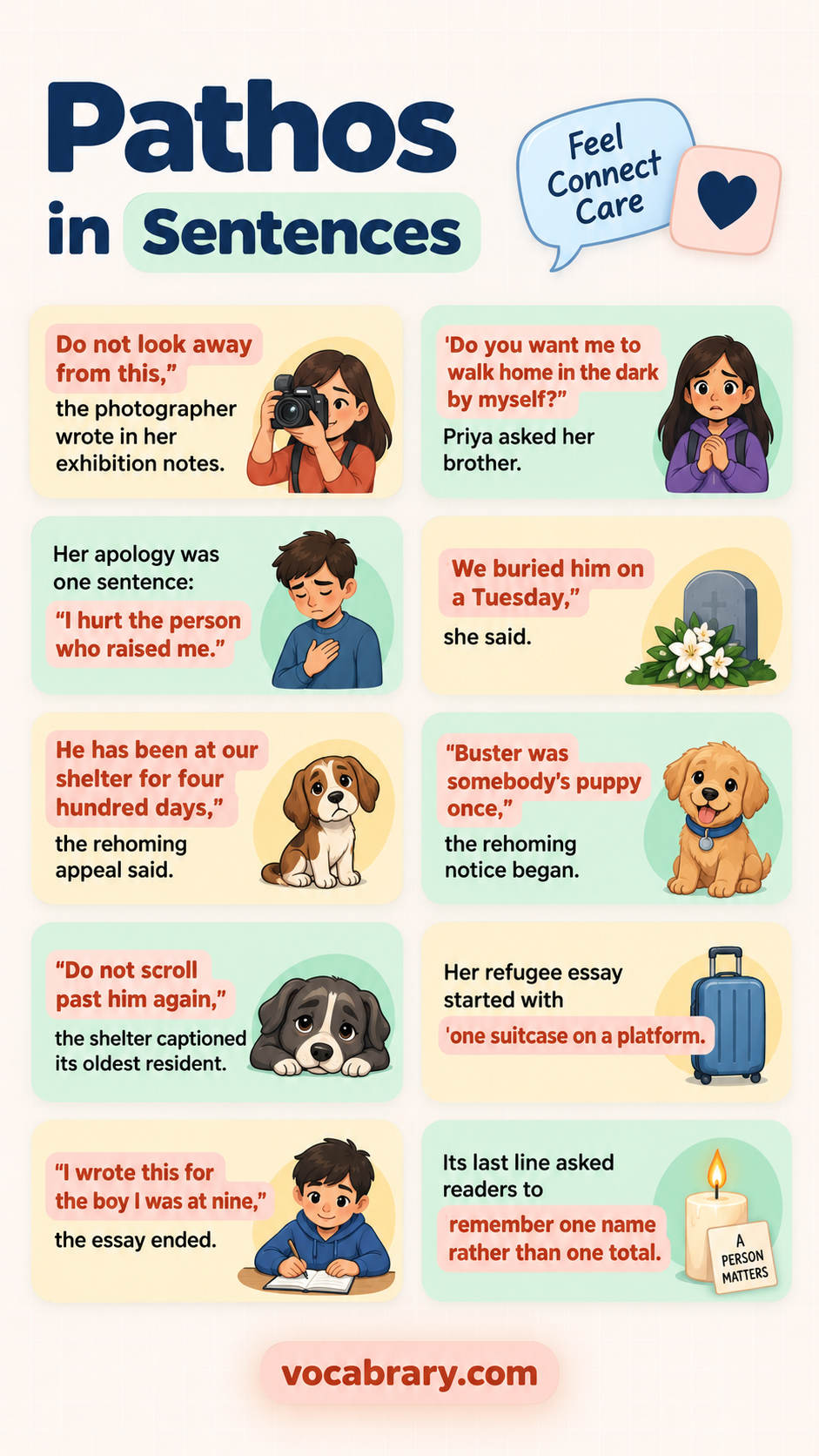
Common Pathos Examples in Sentences
Hungry children in charity adverts, an empty chair at a family dinner, and a shelter dog waiting by a locked gate are the textbook cases of pathos. One named person does the persuading that a statistic never would.
- “Every night, three thousand children in this city go to sleep hungry,” the mayor told the council.
- The advert ended with one line: “She is six years old, and she has never owned a pair of shoes.“
- “Think of your own mother on that ward, awake at three in the morning, with nobody to call,” the nurse said.
- Before the vote, the teacher asked, “How many of these children will you look in the eye tomorrow?“
- Pointing at the empty chair, the father said, “That seat was his for nineteen years.“
- “No child should learn to read by candlelight in a leaking room,” the headteacher wrote in her appeal.
- The rescue worker’s report ended with a sentence nobody forgot: “The dog waited at the gate for eleven days.“
- “I am asking you to picture your own daughter standing in that queue,” the lawyer told the jury.
- Her letter to the landlord began, “My son has asthma, and the mould is inside his bedroom wall.“
- “We lost our house, our photographs, and every birthday card my grandmother ever sent us,” the survivor told reporters.
- Standing at the front of the hall, the coach said, “Half of you are the first in your family to finish school.“
- “You have the power to make tonight the last night she sleeps outside a shop doorway,” the fundraiser said.
- Signed by every parent on the street, the letter closed with a question: “What would you want a stranger to do if this were your father?“
- “Nobody in this town forgot the sound of that phone call,” the fire chief said at the memorial.
- Gripping the microphone with both hands, the widow said, “He went to work that morning and never came home.“
- “Imagine your own street with no school, no clinic, and no running water,” the aid worker told the donors.
- My grandmother’s hands shook as she said, “I have already buried two of my children.“
- “Ten pounds a month keeps Amara in a classroom instead of a factory,” the leaflet said.
- The senator paused, then said quietly, “I am standing here because one teacher believed in a poor boy from Ohio.“
- “These are not figures on a chart; these are my neighbours,” the councillor argued.
- After the flood, the reporter described “a wedding album drying on a fence in the sun.“
- “Your brother waited two years for that operation, and so did mine,” the campaigner told the minister.
- Reading the last name aloud, the principal said, “She wanted to be a doctor.“
- The poster said it in six words: “Somebody’s daughter sleeps in this doorway tonight.“
- “Do not look away from this,” the photographer wrote in her exhibition notes.
Pathos Examples in Everyday Conversation
Teenagers bargaining for a later curfew, flatmates arguing over an unwashed sink, and a son reminded of his ageing grandmother all use pathos in ordinary talk. Guilt and affection settle the question faster than reasons do.
- “After the week I have had, please do not ask me to cook tonight,” Dana said.
- “You promised Grandma you would visit her before she forgets our names,” Nadia reminded her brother.
- My flatmate looked at the sink and said, “I washed up alone every single night this week.“
- “If you loved me even a little, you would stop smoking,” she told him outside the hospital.
- Tom begged for a later curfew: “Everyone else stays until midnight, and I stay at home alone.“
- “Do you want me to walk home in the dark by myself?” Priya asked her brother.
- Wiping her eyes, the child said, “But you promised we would go to the beach today.“
- “I have been saving for this trip since I was fourteen years old,” Ben told his parents.
- The neighbour knocked and said, “My mother fell last night, and I have nobody to drive her.“
- “Think about how your father would feel if he heard you say that to me,” my aunt said.
- Rosa refused to argue and said only, “I am tired, and I am frightened.“
- “Nobody visited me in that hospital for eleven days,” Uncle Karim said at dinner.
- Leaving the party early, Ahmed said, “My dog has been alone since seven this morning.“
- “You forgot my birthday again,” she wrote, “and I waited beside the phone all evening.“
- “Please, just this once,” Luis said. “I have never asked you for anything.“
- When the landlord raised the rent, my mother said, “We have lived in this flat since I was born.“
- “Is one Sunday a month really too much to give your grandmother?” my father asked.
- Her apology was one sentence: “I hurt the person who raised me.“
- “I have never asked my brother for money, not once in thirty years, and now I am asking you,” Grandad said quietly.
- “We buried him on a Tuesday,” she said.
Pathos Examples in Charity and Fundraising Appeals
Water walks, winter shelter beds, and children’s hospital wards give fundraising letters their pathos, where one named child replaces the annual total and asks the reader to decide tonight.
- “For the price of two coffees, Amina walks to school instead of walking to the river,” the leaflet said.
- The appeal opened with a name: “This is Joseph. He is four years old. He has never had a full plate.“
- “Last winter, eleven people died on our streets, and this winter the number is yours to decide,” the shelter wrote.
- “Your twenty pounds buys a mosquito net, and a mosquito net buys a child one more birthday,” the flier said.
- Her mother’s email to supporters read, “Rosa is seven and has waited nine months for her wheelchair.“
- “We are not asking you for pity. We are asking you for a classroom roof,” the village committee wrote.
- Volunteers ended every call the same way: “Nobody should spend Christmas Day alone in a cold flat.“
- “Ahmed carried his sister four miles to the clinic, and your gift shortens that walk for the next family,” the charity said.
- Written by hand, the appeal showed one sentence: “Her father sold his taxi to pay for the first operation.“
- “Every hour you wait, another family reaches this camp with nothing at all,” the aid agency warned.
- Marathon runners asked sponsors, “Will you give one pound for every mile my mother never walked again?“
- “Sixty pence feeds Kofi today. Six pounds feeds him until the harvest,” the poster said.
- The letter closed without a single figure: “Just answer this. Who will stay with her tonight?“
- “I was that boy on the doorstep twenty years ago,” the charity’s founder wrote to donors.
- “No mother should choose between heating her room and buying her daughter’s medicine,” the campaign slogan read.
- Donors were asked one question at the gala: “What is an eleven-year-old girl’s eyesight worth to you?“
- The three-line appeal read, “Sabina is nine. Sabina is blind. Sabina is waiting.“
Pathos Examples in Advertising
Insurance films about a first family home, pet-food spots about an ageing dog, and road-safety posters about an empty school desk sell feeling before product. Advertising supplies more pathos examples in sentences than any other source.
Pathos in Television Commercials
Budweiser’s 2014 Super Bowl advert about a puppy and a horse, the 2011 John Lewis Christmas advert about a boy waiting to give a present, and Sarah McLachlan’s shelter appeals share one habit. Each wins an audience before naming a product.
- Budweiser’s 2014 Super Bowl advert “Puppy Love” sold beer with a puppy who refused to leave a horse, and viewers cried before the logo appeared.
- The John Lewis Christmas advert of 2011 built its pathos on a boy impatient to give a present, rather than to open one.
- An insurance advert ends on the father’s line, “I wanted her to have one address for her whole childhood.“
- “Thirty years in this kitchen, and now the chairs are empty,” the grandmother says before the supermarket logo arrives.
- Road-safety adverts show an empty school desk and ask drivers, “Whose child is worth four seconds?“
- In the dog-food advert, an old spaniel struggles onto the sofa while the narrator says, “Give him one more good year.“
- “She waited beside the window every Sunday,” the care-home advert says, “and this Sunday you came.“
- A bank’s advert follows a student’s first night away from home and ends, “Somebody should be on your side.“
- Thai Life Insurance earned a global reputation for long adverts in which a small act of kindness is repaid years later.
- A charity shop advert ends with a child’s outgrown coat, folded on a bed, and the words “Somebody else needs it more.“
- “Do you remember who taught you to ride a bike?” the advert asks before naming its pension plan.
- Sarah McLachlan’s ASPCA adverts, first broadcast in 2007, paired shelter animals with her song “Angel” and raised millions of dollars.
Pathos in Pet and Animal Ads
Rehoming posts about a dog nobody chose, a cat that flinches at an outstretched hand, and a rescued horse still afraid of buckets turn adoption appeals into pure pathos.
- “He has been at our shelter for four hundred days,” the rehoming appeal said.
- A three-legged cat looked into the camera while the narrator said, “Nobody ever asked her what happened.“
- “Every winter we take in dogs tied to our gate at midnight,” the sanctuary wrote.
- The donkey sanctuary’s appeal ended, “Twelve years of work, and not one kind hand.“
- “Buster was somebody’s puppy once,” the rehoming notice began.
- Rescue volunteers write, “She flinches when a hand comes near her, and she is learning not to.“
- “Do not scroll past him again,” the shelter captioned its oldest resident.
- One rehoming advert asked a single question: “Who will be waiting at the door when you get home tonight?“
- “Our kennels are full, and the phone has not stopped ringing since Friday,” the manager told local radio.
- A single line under the horse’s name read, “Rescued in March. Still afraid of buckets.“
Pathos in Public Health Campaigns
Anti-smoking films with a child’s question, drink-driving posters about a family awake at midnight, and Britain’s Ask Twice mental-health campaign all persuade by fear and love rather than by figures.
- The anti-smoking advert ended with a child’s question: “Daddy, will you still be here when I turn ten?“
- “One drink. One corner. One family awake all night,” the drink-driving poster warned.
- Britain’s 1971 seat-belt campaign, “Clunk Click Every Trip,” tied a catchy phrase to the fear of losing a passenger.
- “Your daughter copies everything you do, and this as well,” the anti-smoking leaflet said.
- Nurses in the vaccination advert say, “I have held the hand of a parent who waited too long.“
- “Wash your hands for your grandmother, not for me,” the public notice said in 2020.
- Time to Change launched its “Ask Twice” campaign in Britain in 2017, urging people to repeat the question to a friend who answers “I’m fine.”
- “Children copy what they watch, and tonight they are watching you drive,” the road-safety notice read.
- The sun-safety advert asked parents one question: “Whose shoulders burned on that beach holiday?“
- “Nobody plans to leave a child without a parent,” the health board’s poster said.
Pathos Examples in Political Speeches
Martin Luther King Jr. naming his own four children, Reagan mourning the Challenger crew, and a local candidate describing a shut factory show how public speaking reaches an audience through grief, pride, and hope.
Pathos in Famous Speeches
Lincoln at Gettysburg, Mandela at the Rivonia Trial, and Malala Yousafzai at the United Nations built arguments on one remembered person or one remembered day, which is why their sentences outlived the debates around them.
- In his March on Washington speech of August 1963, Martin Luther King Jr. asked America to imagine his four little children judged by character rather than colour.
- Abraham Lincoln closed the Gettysburg Address in November 1863 by honouring soldiers who gave “the last full measure of devotion“.
- Ronald Reagan ended his address on the Challenger disaster, January 28, 1986, by saying the crew had “slipped the surly bonds of Earth“.
- Robert F. Kennedy announced King’s death to a crowd in Indianapolis on April 4, 1968, and spoke of his own brother’s killing before asking for calm.
- Nelson Mandela told the Rivonia court in April 1964 that a free society was an ideal he was prepared to die for.
- Speaking at the United Nations on her sixteenth birthday in July 2013, Malala Yousafzai turned her own interrupted schooling into a demand for every girl’s education.
- Greta Thunberg opened her United Nations speech in September 2019 with “How dare you“, and the anger did the persuading.
- Emmeline Pankhurst told a Hartford audience in November 1913 that she came before them as a soldier who had temporarily left the battlefield.
- Elie Wiesel warned a White House audience in April 1999 that indifference wounds the forgotten more deeply than anger ever does.
- Barack Obama closed his election-night speech in Chicago in November 2008 with the story of Ann Nixon Cooper, a voter of one hundred and six.
- In June 1940, Winston Churchill promised the Commons that Britain would fight on the beaches, and dread turned into resolve.
- Jim Valvano, already ill with cancer, told the 1993 ESPY audience, “Don’t give up. Don’t ever give up.“
Pathos in Campaign and Rally Sentences
Candidates describing a shut factory, a February house with the heating switched off, and a childhood caravan behind a petrol station win rooms by trading policy detail for one remembered hardship.
- “My father lost his job at that factory, and so did four hundred of your fathers,” the candidate said.
- “I have knocked on doors where the heating was switched off in the middle of February,” she told the rally.
- The mayor asked the crowd, “How many of you have waited eleven hours in that emergency department?“
- “We owe our veterans more than a wreath once a year,” the senator told the hall.
- Raising her hand as the applause faded, the councillor said, “These are our children, and they are eating free school dinners.“
- “Do not tell a farmer whose barn burned down that the system is working,” he said.
- “I grew up in a caravan behind that petrol station,” the candidate told reporters.
- Her closing line named a street: “Nobody from Marsh Lane has ever spoken in that parliament.“
- “You deserve a town your grandchildren refuse to leave,” the campaigner told the market square.
- “They call it a statistic, but on our road it had a name, a school bag, and a red bicycle left by the gate,” the councillor said.
Pathos Examples in Essays and Persuasive Writing
Food-bank essays that open on an empty lunchbox, climate essays that open at a dry well, and conclusions that circle back to one named child are how students build pathos into an essay.
Pathos in Essay Opening Hooks
An empty lunchbox at half past twelve, a grandfather who learned to read at sixty-one, and a bear pacing nine steps give first paragraphs the pull that a definition or a percentage never gives them.
- The essay on food banks opened, “Ellie unpacks an empty lunchbox at half past twelve every school day.“
- “My grandfather learned to read at sixty-one, and he hid that fact until he was eighty,” the student began.
- Her refugee essay started with one suitcase on a platform.
- “Picture the last bus of the night, and picture nobody aboard it going home,” the opinion column began.
- The climate essay opened at a dry well in northern Kenya, where a girl queued four hours every morning.
- “I was nine years old when the bailiffs came,” the writer began, and readers stayed for the argument.
- An essay against zoos began with a bear pacing the same nine steps, over and over, for twenty years.
- “Nobody in my family has ever finished school. I am writing this at university,” the personal statement opened.
- Writing on hospital waiting times, the columnist began with a father asleep in a corridor chair.
- “Read this sentence slowly, and then read it again: a child on your own street is going to bed hungry tonight,” the editorial began.
Pathos in Essay Closing Paragraphs
Conclusions that name one waiting girl, one grandmother on a corridor trolley, or one boy the writer used to be leave an argument with a face attached to it.
- The conclusion asked one question: “Which of these children will you explain this policy to?“
- “We have the money. What we lack is the will to look at her,” the essay concluded.
- Her final paragraph returned to the empty lunchbox of her first line, this time full.
- “Somebody’s grandmother will spend tonight on a trolley in a hospital corridor,” the writer ended.
- Naming nobody at all, the closing sentence moved everybody: “She is still waiting.“
- “I wrote this for the boy I was at nine,” the essay ended.
- Ending on a promise instead of a plea, the writer said, “No child in this borough will queue for breakfast again.“
- “Argue with the figures if you must, but do not argue with Amina,” the conclusion read.
- Its last line asked readers to remember one name rather than one total.
- “If this were your mother, you would have stopped reading and started phoning,” the writer ended.
Pathos Examples in Literature
Tiny Tim’s empty chair, Oliver Twist asking for more gruel, and Lear grieving over Cordelia are the scenes that teachers reach for first, because each one wins the reader’s sympathy before any argument arrives.
Pathos in Novels
Dickens, Steinbeck, and Harper Lee built famous chapters on a hungry child, a family burying a grandmother by the roadside, and a father pleading with twelve jurors.
- Charles Dickens gave A Christmas Carol its pathos in 1843 with a crutch by an empty chair in Scrooge’s vision of the years ahead.
- In Oliver Twist, published in 1838, Dickens made a whole argument about workhouses from one starving boy asking for more gruel.
- John Steinbeck let the Joads bury their grandmother by the roadside in The Grapes of Wrath of 1939, and Ma says almost nothing at all.
- Harper Lee ends Atticus Finch’s closing argument in To Kill a Mockingbird, published in 1960, with a plea to twelve jurors to do their duty.
- Mary Shelley earned sympathy for the creature in Frankenstein of 1818 by showing him watching a family through a cottage wall, longing for company.
- Khaled Hosseini built The Kite Runner of 2003 on Amir’s guilt over a friend he failed in an alleyway.
- Markus Zusak narrated The Book Thief of 2005 through Death, whose pity for a German girl and her stolen books disarms the reader.
- Fyodor Dostoevsky drew sympathy in Crime and Punishment of 1866 from the Marmeladov children going hungry in one freezing room.
- Emily Bronte gave Wuthering Heights its rawest pathos in 1847: Heathcliff refuses all comfort.
- Kazuo Ishiguro made Never Let Me Go of 2005 unbearable by having Kathy describe a short life in calm, ordinary words.
- Anne Frank’s diary, published in 1947, gains its pathos from a teenager writing about the sky she was unable to walk under.
- Nicholas Sparks built The Notebook of 1996 around a husband reading a love story aloud to a wife who no longer knows him.
Pathos in Shakespeare
Lear with Cordelia in his arms, Mark Antony unfolding a torn cloak, and Shylock asking whether a Jew has eyes show how a crowd or a courtroom is turned by grief, shame, and pride.
- King Lear, written around 1606, reaches its lowest point when the old king brings Cordelia onstage and asks for a mirror.
- In Julius Caesar of 1599, Mark Antony turns a hostile crowd by unfolding Caesar’s torn cloak in front of them.
- Shylock disarms the court in The Merchant of Venice with the question “Hath not a Jew eyes?“, asking to be counted as human.
- Macduff, hearing in Macbeth that his family is gone, answers with the broken question “All my pretty ones?“
- Othello’s last speech asks the Venetians to speak of him as he was, neither softened nor blackened.
- Hamlet, holding a jester’s skull in the graveyard scene, remembers the man who carried him on his back as a child.
- Henry V binds frightened soldiers together before Agincourt by calling them “we happy few, we band of brothers“.
- Romeo, believing Juliet dead in the Capulet tomb, says farewell to her in the gentlest words in the play.
Pathos in Poems
Poe mourning Annabel Lee, Dylan Thomas urging his dying father on, and Langston Hughes writing in a mother’s words turn private grief and private courage into public feeling.
- Edgar Allan Poe built “Annabel Lee” of 1849 entirely on a young man mourning a love the sea took from him.
- Dylan Thomas turned a son’s helplessness into an order in 1951: “Do not go gentle into that good night.“
- Langston Hughes let a mother tell her son in 1922 that her life had been “no crystal stair“, and that one phrase did the arguing.
- Wilfred Owen made exhausted soldiers pitiable in “Dulce et Decorum Est”, written in 1917, by describing men limping asleep on their feet.
- Thomas Gray mourned the unremembered village dead in “Elegy Written in a Country Churchyard” of 1751.
- W. H. Auden opened “Funeral Blues” in 1938 by demanding that the clocks be stopped for one death.
- Emma Lazarus wrote “The New Colossus” in 1883 so that a statue would welcome the tired, the poor, and the homeless.
- Seamus Heaney ended “Mid-Term Break” of 1966 with a four-foot coffin for a small brother, and said nothing more.
Pathos in Children’s Stories
Charlotte’s last summer in the barn, a swallow giving away a statue’s gold, and a velveteen rabbit longing to be real teach young readers grief and kindness without a single argument.
- E. B. White let Wilbur grieve for Charlotte alone in the fairground barn in Charlotte’s Web of 1952.
- Hans Christian Andersen made “The Little Match Girl” of 1845 unforgettable with a cold child striking matches for warmth on New Year’s Eve.
- Oscar Wilde’s “The Happy Prince” of 1888 gives a statue its sapphire eyes to a hungry family while a swallow stays behind to help.
- Margery Williams built The Velveteen Rabbit of 1922 on a toy that longs to be loved into realness.
- Michael Morpurgo told the First World War through a farm horse in War Horse of 1982, so that a boy’s search for Joey became the reader’s own.
- Frances Hodgson Burnett left Sara Crewe cold and hungry in an attic in A Little Princess of 1905 before restoring her fortune.
- Kate DiCamillo paired a lonely new girl with a stray dog in Because of Winn-Dixie of 2000.
- Andersen’s “The Ugly Duckling” of 1843 earns its ending by first showing a young bird mocked by everyone he meets.
Pathos Examples in Films
Carl and Ellie’s silent montage in Up, the farewell in Marley & Me, and the toys reaching for one another in Toy Story 3 need no dialogue. A few wordless seconds of film persuade faster than speeches.
- Pixar opened Up in 2009 with a silent montage of Carl and Ellie’s whole marriage, and audiences wept in the first ten minutes.
- Marley & Me of 2008 spends ninety minutes making viewers love a badly behaved dog, then asks them to say goodbye to him.
- Bambi, released by Disney in 1942, built eight decades of pathos on one gunshot the audience never sees.
- The Lion King of 1994 shows Simba nudging his motionless father in the gorge, unable to understand what has happened.
- Toy Story 3 of 2010 earns its ending twice, first as the toys reach for one another and later as Andy gives them away.
- Inside Out of 2015 asks a young audience to grieve an imaginary friend who steps aside so that a girl gets home.
- Coco of 2017 turns its whole story on a boy singing “Remember Me” to his great-grandmother.
- Steven Spielberg ended Schindler’s List in 1993 with Oskar Schindler breaking down over the people he failed to save.
- James Cameron gave Titanic of 1997 its quietest pathos with an elderly couple lying still while the water rises.
- Forrest Gump of 1994 puts its hero beside Jenny’s grave under the tree from his own childhood.
- E.T. the Extra-Terrestrial of 1982 ends on a boy and an alien saying goodbye, and Spielberg lets the pause run long.
- Life Is Beautiful of 1997 wins its audience with a father turning a camp into a game to protect his son.
- Dead Poets Society of 1989 closes with students climbing onto their desks, and pride does what argument never did.
Pathos Examples in News Reporting
Correspondents who name the boy in the blue jacket, bulletins that end on one exhausted nurse, and dispatches that count empty desks instead of casualties give reporting its emotional pull.
- The correspondent ended her report with one line: “Nobody has come for the boy in the blue jacket.“
- “This family of six now owns whatever fits inside one carrier bag,” the reporter said from the shelter.
- Reporting from the flooded village, he described a kitchen clock still ticking over the waterline.
- “She has been waiting at this border crossing for nine days,” the presenter told viewers.
- A bulletin closed on a nurse who said, “I have not been home since Tuesday morning.“
- “Four hundred jobs went this morning, and one of them was my neighbour’s,” the local reporter wrote.
- Newspapers printed the name of every passenger instead of the total, and the total finally meant something.
- “The school bell rang at nine, and half the desks were empty,” the dispatch began.
- A photographer’s caption named a grandmother queuing for bread before dawn, and readers shared her story more widely than any figure.
- “Her father waited outside the hospital gate the entire night,” the correspondent reported from the city.
- Radio news carried one mother’s account of the evacuation, and donations arrived within the hour.
- “We are standing where the market stood on Friday,” the reporter said quietly.
Pathos Examples on Social Media
Fundraising messages written by a brother, anniversary captions that still set a place at dinner, and farewells to an old family dog make pathos the common currency of a feed.
- The fundraising message began, “My sister is eleven, and she asked me not to tell anyone she is ill.“
- “Share this if you have ever eaten dinner alone on your own birthday,” the caption read.
- Her caption about an old dog said, “Sixteen years. The best of them.“
- “One like will never feed a child, so here is the link instead,” the volunteer posted.
- A fundraising appeal opened with a father’s sentence: “I am asking strangers because I have nobody left to ask.“
- “Tag somebody who still phones their grandmother every Sunday,” the charity wrote.
- The comment chain ended, “She died on Thursday, and forty thousand of you were kind to her.“
- “Do not scroll. Two minutes. That is all I am asking of you,” the campaigner wrote.
- Posting on the anniversary, he wrote, “Three years today, and I still set his place at dinner.“
- “This is what a food bank queue looks like at eight on a Tuesday morning in one of the richest boroughs in England,” the councillor posted.
- A teenager’s update about her school closure read, “I will never meet those friends in a corridor again.“
- “Every reply here is somebody who believed they were the only one,” the moderator wrote.
Short Pathos Examples for Students
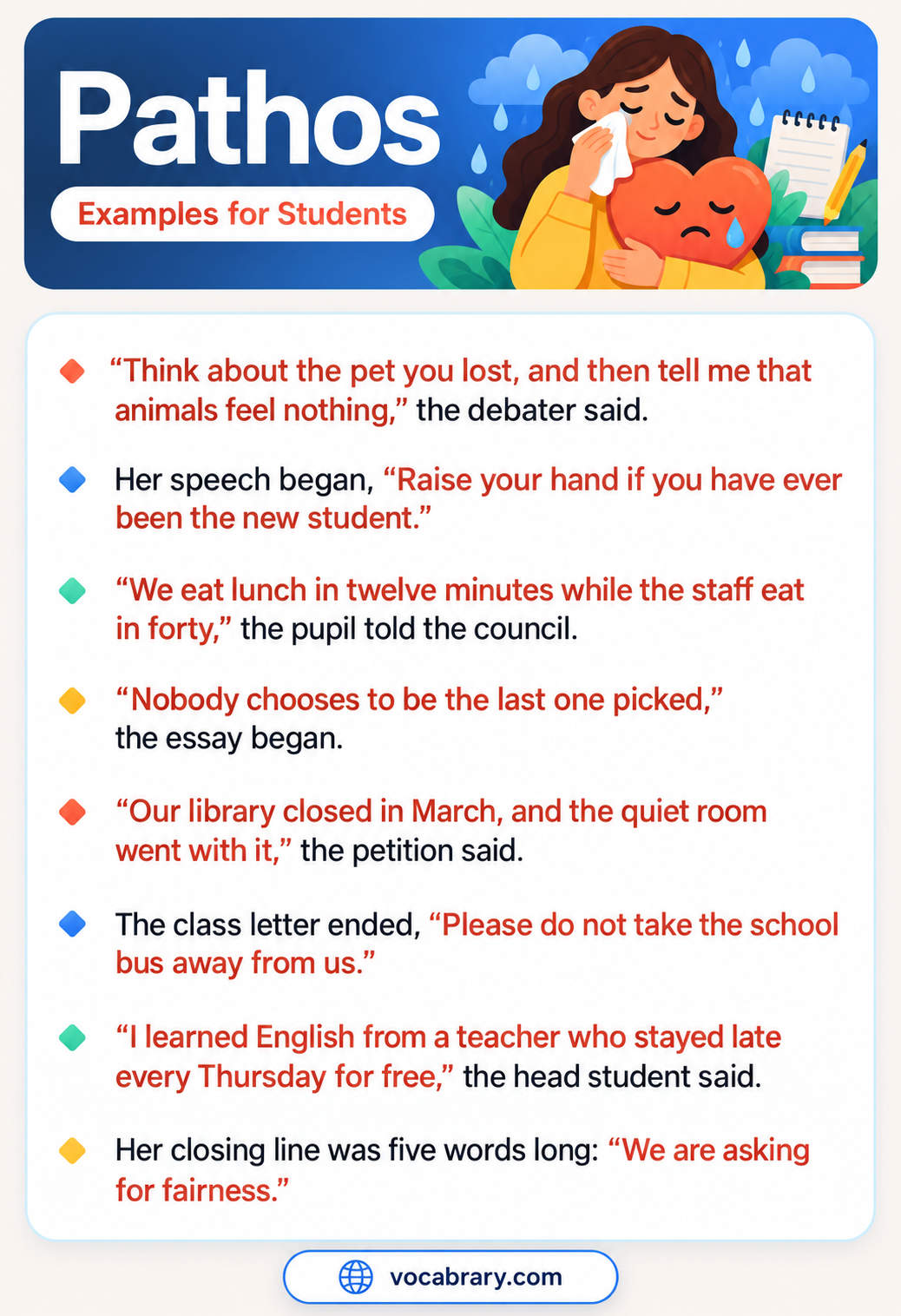
Debate-club openings about a lost pet, petitions about a closed library, and a twelve-minute lunch break give pupils short pathos sentences they practise before writing longer speeches.
- “Think about the pet you lost, and then tell me that animals feel nothing,” the debater said.
- “I am the first person in my family to apply to a university,” the applicant wrote.
- Her speech began, “Raise your hand if you have ever been the new student.“
- “We eat lunch in twelve minutes while the staff eat in forty,” the pupil told the council.
- The debate captain asked, “Who here has waited at a gate for a parent who never arrived?“
- “Nobody chooses to be the last one picked,” the essay began.
- Ali argued for later start times: “Half of my class falls asleep before nine.“
- “Our library closed in March, and the quiet room went with it,” the petition said.
- Speaking without notes at the governors’ meeting, she said, “My little brother reads by torchlight every night, because four of us share one bedroom.“
- “You have a choice tonight. He does not,” the student’s poster read.
- The class letter ended, “Please do not take the school bus away from us.“
- “I learned English from a teacher who stayed late every Thursday for free,” the head student said.
- “Imagine your first day here with nobody to eat lunch beside,” the mentor told the new pupils.
- Her closing line was five words long: “We are asking for fairness.“
Types of Emotional Appeal in Pathos
Fear of a closing ward, hope of a first classroom, pity for one hungry child, pride in a shipbuilding town, and guilt over a broken promise are five separate appeals. Most pathos examples in sentences reach for one of them.
Pathos Built on Fear
Closing hospital wards, debt letters after one missed payment, and a lorry that needs forty metres to stop give warning sentences their force, because each names a loss the listener already dreads.
- “Wait another winter and this ward closes for good,” the consultant told the board.
- “Your children will inherit the bill for tonight’s vote,” the campaigner warned.
- The security advert asked, “Who is at your front door while you sleep?“
- “One missed payment, and the letters start arriving,” the debt charity’s poster said.
- “Do you want to be the one who explains this disappearing shoreline to your grandchildren in twenty years?” the scientist asked the committee.
- Warning parents about the crossing, the head teacher said, “A lorry needs forty metres to stop.“
- “We have eighteen months, and after that the choice is gone,” the negotiator said.
- “Nobody believes it will be their street until it is,” the flood officer told residents.
- The fire brigade’s leaflet ended, “Smoke wakes nobody. Alarms do.“
- “If this factory shuts, the school shuts the year after,” the union leader told the town.
Pathos Built on Hope
One classroom for forty girls, nine hundred days of sobriety that began with a phone call, and a set of keys handed over at a shelter door make hope as persuasive as dread.
- “One classroom in this village changes everything for forty girls,” the founder said.
- “Your grandchildren will open a schoolbook one day and read about the year this chamber finally got it right,” the senator said.
- She ended her pitch simply: “We are three months away from the first vaccine.“
- “Somebody in this hall will cure it,” the professor told the first-year students.
- The recovery poster read, “Nine hundred days sober, and it started with one phone call.“
- “Imagine a town where nobody queues outside a food bank on a Tuesday,” the mayor said.
- Handing over the keys, the charity worker said, “This is your address now.“
- “Our mothers were unable to vote, and our daughters will run for office,” the organiser said.
- “Every one of you is somebody’s second chance,” the volunteer coordinator said.
- The campaign slogan promised hope in four words: “Brighter mornings start here.“
Pathos Built on Pity
A woman sleeping under a station bridge, school shoes two sizes too small in March, and a child moved eleven times in three years are the sentences that ask an audience for sympathy first.
- “She sleeps under the bridge by the station, and she is somebody’s mother,” the outreach worker said.
- “He has nobody at all,” the nurse wrote in the referral.
- The appeal described a boy walking eleven miles to a classroom with no roof.
- “Her school shoes were two sizes too small back in March,” the teacher told the governors.
- Describing the shelter at midnight, the volunteer said, “Four of them are under six years old.“
- “Nobody visits him. Not at Christmas, not ever,” the care worker said.
- The rescue notice read, “Found tied to a fence in the rain. Still wagging.“
- “They fled with the clothes they were wearing, and the youngest of them was still in her school uniform,” the aid worker told the camera.
- “My father worked forty years and now he counts coins for the meter,” she wrote.
- Reading the file aloud, the social worker said, “This child has moved eleven times in three years.“
Pathos Built on Pride and Belonging
A town that built ships, grandmothers who marched down the same road in 1968, and a hall paid for out of somebody’s wages turn loyalty into the argument itself.
- “This town built the ships that crossed that ocean,” the mayor reminded the crowd.
- “You are the first class to finish in this new building,” the principal told them.
- The coach said one sentence before kick-off: “Play for the name on the front of the shirt.“
- “Our grandmothers marched down this very road in 1968,” the organiser said.
- “Nobody gave this valley anything. We built it ourselves,” the union leader said.
- Raising the flag at the ceremony, the veteran said, “Twelve of us came home out of forty.“
- “You are not customers here. You are members,” the society’s letter began.
- “Every brick in this hall was paid for out of somebody’s wages, penny by penny, across four generations of this parish,” the trustee said.
- The school motto still moves former pupils: “We rise together.“
- “Show your daughters what a woman from this street achieved,” the campaigner said.
Pathos Built on Guilt
A board that knew in March, a sister who nursed alone, and a donor whose gift never arrived this year are the cases where pathos works by reminding an audience of a promise.
- “You knew about this in March, and you said nothing at all,” the campaigner told the board.
- “I stayed with her every night while you were abroad,” his sister said.
- The letter ended, “We asked you three times. This is the fourth.“
- “Somebody in this room signed that order,” the lawyer said to the committee.
- “Your gift last year kept Amara in school, and her place is held open until the end of this month,” the charity wrote to lapsed donors.
- Looking at the untouched plate, my grandmother said, “I cooked from seven this morning.“
- “We promised these families a home by Christmas,” the minister admitted.
- “Nobody made you leave. You chose to,” his brother said quietly.
- The message was one sentence long: “She waited at the gate until six.“
- “You walked past her twice today,” the outreach poster read.
Pathos Paired With Ethos and Logos
A consultant names thirty years on a ward before naming one patient, and a councillor follows a borough total with one girl called Ellie. Pathos works beside the other two appeals rather than against them.
Pathos and Ethos Together
Veterans, coroners, and nurses open with the years they have served and close with the one night that still wakes them, so credibility and feeling arrive in the same sentence.
- “In thirty years on this ward, through two recessions and one pandemic, I have never seen a queue like this,” the consultant told MPs.
- “I fought in that war, and I am asking you not to send them,” the veteran said.
- The head teacher began, “I have taught here for nineteen years, and this is the hungriest year.“
- “As her doctor, I am telling you she will not survive another winter outdoors,” he said.
- “I buried my own son. Listen to me about seat belts,” the campaigner told the assembly.
- Speaking as a former inspector, she said, “I signed off buildings like that one, and I was wrong.“
- “Twenty years in this fire service, and that night still wakes me,” the officer said.
- Writing about her own childhood in care, the author said, “Believe me when I describe that bedroom.“
- The coroner said, “I have seen four hundred of these, and every one was preventable.“
- “We are nurses, not politicians, and we are frightened,” the open letter began.
Pathos and Logos Together
Borough hunger totals answered by one girl called Ellie, waiting-time figures answered by one mother, and flood models answered by one street show how evidence and emotion strengthen each other.
- “Four thousand children in this borough go hungry, and Ellie is one of them,” the councillor said.
- “Waiting times rose by nine weeks, and my mother waited eleven of them,” she told the inquiry.
- The scientist paired the rising figure with one sentence: “That street floods four times a year now.“
- “Nine in ten of these dogs are rehomed, and Buster has been here the longest,” the shelter said.
- “Every pound buys three meals, and tonight three meals is everything for Amina,” the appeal read.
- Quoting the audit before the story, he said, “The audit found forty homes. I have been inside eleven of them.“
- “Road deaths fell by half after the last campaign, and half of somebody’s family came home,” the officer said.
- “Sixty per cent of our pupils qualify for free meals, and one of them wrote this,” the head teacher said.
- Beside the national figure, the charity printed one family’s first name.
- “The model predicts a two-degree rise, and my daughter turns fifty that year,” the researcher said.
Related
FAQs
Two pathos examples in a sentence are "Every night, three thousand children in this city go to sleep hungry." and "The dog waited at the gate for eleven days." Each one names a loss that a listener is able to picture.
Charity examples include "Ahmed carried his sister four miles to the clinic, and your gift shortens that walk for the next family." and "Nobody should spend Christmas Day alone in a cold flat." Each one names a single person or a single loss.
Advertising examples for road safety and pet food include "Whose child is worth four seconds?" and "Give him one more good year." Each one puts a person or a pet in front of the product.
Political examples include Abraham Lincoln honouring soldiers who gave "the last full measure of devotion" at Gettysburg in November 1863. Ronald Reagan told the nation in 1986 that the Challenger crew had "slipped the surly bonds of Earth." Each speaker names a loss before any request.
Essay examples include "Which of these children will you explain this policy to?" and "She is still waiting." Each one hands a single person to the reader.
Literary examples include Dickens placing a crutch by an empty chair in "A Christmas Carol" and Shakespeare’s Macduff asking "All my pretty ones?" in "Macbeth." Both scenes win sympathy before any argument arrives.
Film examples include the silent montage of Carl and Ellie in Up and Simba nudging his motionless father in The Lion King. Neither scene needs a speech to move the audience.
Social media examples include "Three years today, and I still set his place at dinner." and "I am asking strangers because I have nobody left to ask." Each caption names a single loss.
Short examples for students include "We eat lunch in twelve minutes while the staff eat in forty." and "Nobody chooses to be the last one picked." Each line names an unfair or lonely moment.
Fear examples include "Who is at your front door while you sleep?" and "A lorry needs forty metres to stop." Each one names a loss that the listener already dreads.