
Logos is a rhetorical appeal in which a speaker persuades through logic and evidence, as when a doctor cites a trial’s survival rate rather than a personal story. Most logos examples in sentences rely on counted numbers, stated causes, and if-then reasoning, like a parent explaining a household budget.
What Is Logos?
Logos is Aristotle’s appeal to reason, the mode of persuasion that wins agreement with figures, precedents, and step-by-step argument rather than with feeling. Ethos asks an audience to trust the speaker and pathos asks it to feel something, while logos asks it to follow a chain of proof.
The council approved the new crossing once the traffic survey counted 412 children crossing that road between seven and nine each morning.
Common Logos Examples in Sentences
Counted attendance figures, an expired warranty, and a bus timetable read aloud are the textbook logos examples in sentences, where a speaker wins the argument by handing over something the listener is able to check.
- Our flight leaves at six, the drive takes ninety minutes, so we have to leave the house by four thirty.
- Three of the four smoke alarms failed the monthly test, so the landlord replaced every one of them.
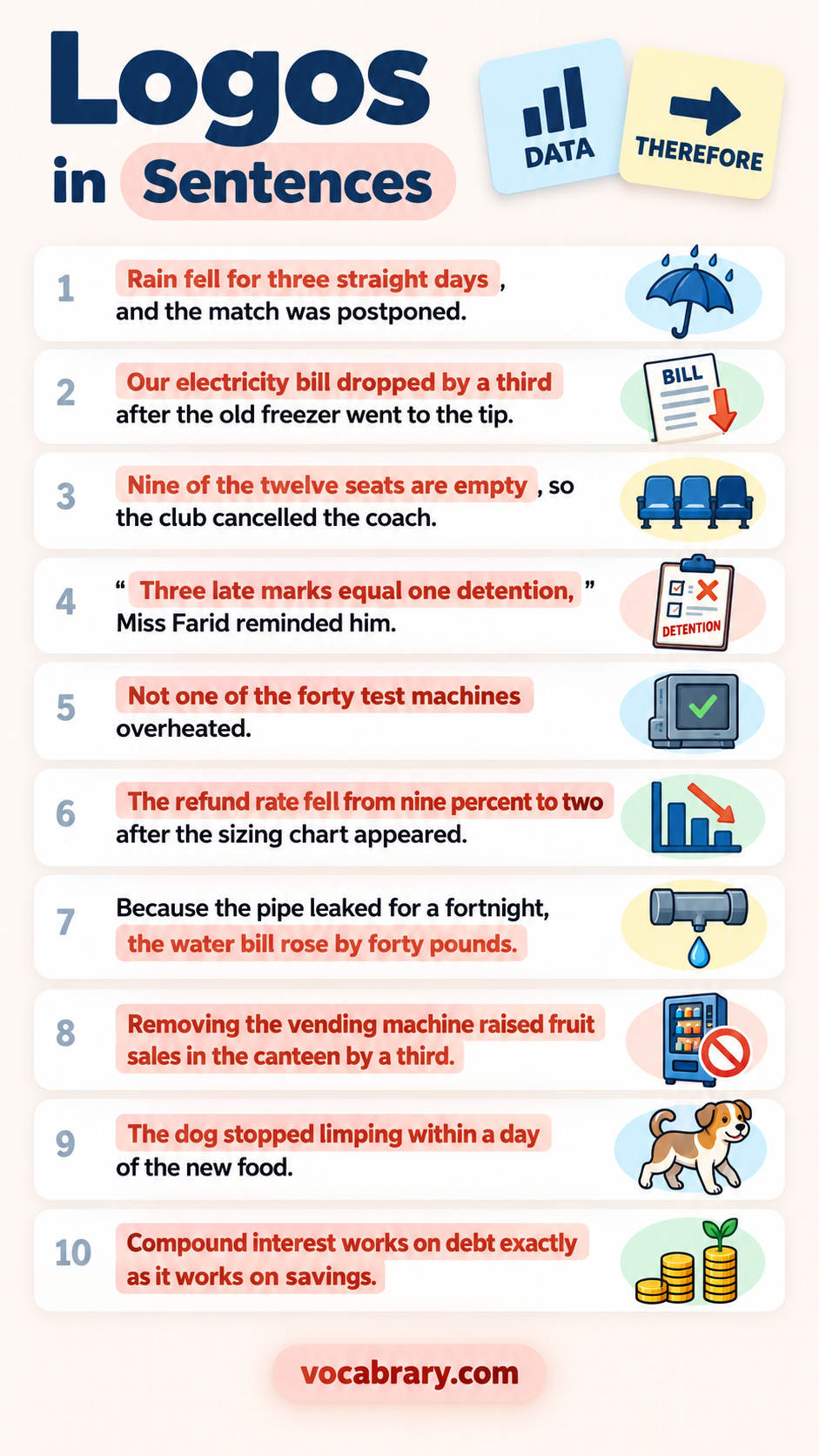
- Rain fell for three straight days, and the match was postponed.
- Water boils at 100 degrees Celsius at sea level, so the recipe timing changes in a mountain kitchen.
- Maya argued for the earlier train because the later one arrives after the interview starts.
- Every shirt in the shop is marked forty percent off, so the jacket at sixty pounds now costs thirty-six.
- Dad refused the extended warranty: the repair costs less than four years of the monthly fee.
- The recycling bin was emptied on Tuesday and is full again, which means the household refills it in six days.
- We booked the smaller hall because only thirty-one guests replied yes and the larger hall seats two hundred.
- A litre of paint reaches twelve square metres, and the wall measures thirty, so three litres finish the job.
- Since the tap drips once a second, the sink takes on eleven litres of wasted water every day.
- Nobody in the class scored under seventy on the retest, so the teacher kept the new study plan.
- Rex gained four kilos in six months, and the vet traced it to the extra evening meal.
- Rent rose by ninety pounds and wages stayed flat, so Zara moved two stops further out.
- Is the earlier bus faster? It departs twelve minutes sooner and reaches the depot at the same hour, so no.
- Our electricity bill dropped by a third after the old freezer went to the tip.
- Priya chose the second flat because the commute is nineteen minutes shorter each way, five days a week.
- Eleven of the fourteen reviews mention a broken zip, so Omar ordered a different rucksack.
- Nine of the twelve seats are empty, so the club cancelled the coach.
- Two people will not fit under one umbrella in a storm, so Ben bought a second at the station.
- The landlord raised the deposit, but the tenancy agreement caps any rise at five percent a year and this one came to eleven, so the tribunal refused it.
- The receipt proves the milk was scanned twice, which explains the two-pound difference at the till.
Logos Examples in Everyday Conversation
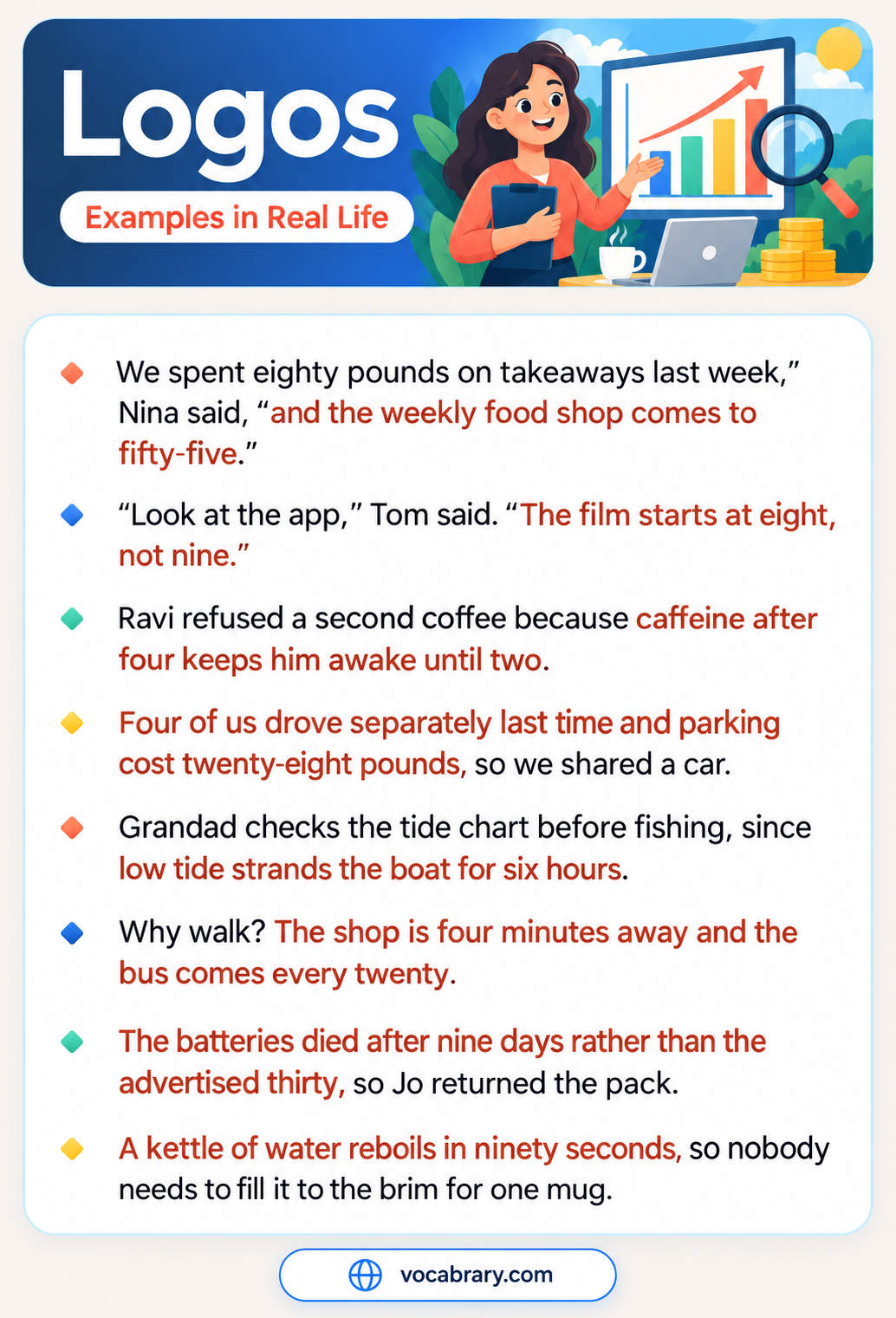
Household budgets, a phone battery draining by lunchtime, and a friend proving the cinema starts at eight are the everyday logos examples in sentences, settling a disagreement with a number nobody disputes.
- “We spent eighty pounds on takeaways last week,” Nina said, “and the weekly food shop comes to fifty-five.”
- My phone drops to twelve percent by lunchtime, so I keep the charger in my bag.
- “Look at the app,” Tom said. “The film starts at eight, not nine.“
- The recipe feeds four and there are seven of us, so Hana doubled everything.
- Ravi refused a second coffee because caffeine after four keeps him awake until two.
- “You said the shop shuts at six, but the sign on the door says five thirty,” Amal replied.
- Four of us drove separately last time and parking cost twenty-eight pounds, so we shared a car.
- Grandad checks the tide chart before fishing, since low tide strands the boat for six hours.
- “Our bin was collected on Thursday for the last three weeks, so it will be Thursday again,” Dad said.
- The hotel charges per night, and a Sunday arrival adds a whole night for two hours of sleep, so Leila booked Monday.
- Why walk? The shop is four minutes away and the bus comes every twenty.
- Every window in the flat faces north, which explains why the plants never flowered.
- Sam skipped the gym membership: at forty pounds a month he would need eleven visits to undercut the drop-in fee.
- The batteries died after nine days rather than the advertised thirty, so Jo returned the pack.
- “You borrowed the drill in March and it is September,” Marcus said, holding out his hand.
- A kettle of water reboils in ninety seconds, so nobody needs to fill it to the brim for one mug.
Logos Sentences Parents and Teachers Use
Bedtimes worked backwards from a school bell, biscuits counted against a dentist’s advice, and an essay deadline set beside a football final give parents and teachers their favourite logos. A child follows the reasoning without being told to obey.
- “Bedtime is nine because the alarm goes at seven and your body needs ten hours,” Mum told Zoe.
- You ate four biscuits already, and the dentist asked for two a day.
- “Your essay is due Friday and Thursday is the football final, so Wednesday is your writing evening.”
- Screens after ten delay sleep by about an hour in our house, so the tablet charges in the kitchen.
- “If everyone talks at once, nobody hears the instructions and we repeat the whole lesson,” Mr Obi said.
- The coach seats fifty-two and thirty-nine of you signed up, so there is room for the parents.
- “You lost two pens this term, and the school sells them at a pound each,” his tutor noted.
- Reading twenty minutes a night comes to over a hundred hours a year, Miss Farid told the class, and she wrote the total on the board.
- “Three late marks equal one detention,” Miss Farid reminded him.
- “Your bag weighs more than your little sister,” Dad said, “so leave the two folders at school.”
- Homework handed in late scores a grade lower under the marking policy, so Ella finished hers on Sunday.
Types of Logos With Examples
Survey percentages, a salted road followed by fewer crashes, and ten dry Julys in a row are the standard forms of logos. Each argues from evidence a listener is able to test.
Logos Built on Statistics
Pothole complaints counted door to door, a trial in which ninety of a hundred patients reported no side effects, and a refund rate cut by a sizing chart show logos at its most numerical. A percentage settles what opinion never would.
- Sixty-eight percent of the 900 residents surveyed by Harrowgate Council named potholes as their first complaint, so the repair budget doubled.
- Absence dropped from eleven percent to four after Northgate Academy moved the start time to nine.
- The union argued for a night bonus because staff turnover on nights runs at three times the daytime figure.
- One in five packages arrived damaged last quarter at Kestrel Logistics, so the warehouse changed suppliers.
- Ninety of the hundred trial patients at Redhill Clinic reported no side effects.
- Since the library counted 2,400 visits in June and 1,100 in July, the trustees kept the summer opening hours.
- Vantor Foods cut sugar by a third and sales rose eight percent, which answered the board’s worry.
- Two thirds of the class failed question four, so the teacher reworked that method.
- A Bellmore University study of 4,000 commuters found cyclists arrived nine minutes earlier than drivers on the same three-mile route, and the city widened the lane.
- How many complaints justify a redesign? Thirty-one in a month on a product with 400 buyers is eight percent, and the team rebuilt it.
- Not one of the forty test machines overheated.
- Merrow Valley logged eleven flood warnings this decade against two in the previous one, so the insurer repriced the whole valley.
- Half of last year’s leavers cited pay and a quarter cited hours, so the partners raised the starting salary.
- The refund rate fell from nine percent to two after the sizing chart appeared.
Logos Built on Cause and Effect
Salted roads and fewer crashes, a leaking pipe and a bill forty pounds higher, an April frost and a thin apple harvest trace logos through cause and effect, where one measured change explains the next.
- Salt went down on the roads on Monday, and Tuesday’s crash count fell from nine to two.
- Because the pipe leaked for a fortnight, the water bill rose by forty pounds.
- Hiring two extra nurses cut the average wait at the clinic from fifty minutes to nineteen.
- The bakery moved the ovens to six, so the morning queue cleared twenty minutes sooner.
- Removing the vending machine raised fruit sales in the canteen by a third.
- Why did the garden flood? The neighbour paved the drive, and rain now runs off onto our lawn instead of soaking away.
- Frost killed the blossom in April, so the orchard picked a third of last year’s apples.
- Once the factory switched to night deliveries, complaints about lorry noise dropped to zero.
- No streetlight on Carter Lane has worked since March, and reported thefts there have tripled.
- Trimming the meeting from an hour to twenty minutes gave every team six extra hours a month, which the manager put into training.
- The dog stopped limping within a day of the new food.
- Rain in the first week of term kept the field closed, so the school fitness scores fell for the only time in five years.
Logos Built on Analogy
A body fighting infection beside a city fighting fire, an unpatched server beside a leaking roof, and a dam inspected like a bridge give logos its analogy form. A proven case supplies the reasoning for an unproven one.
- A city that keeps three fire crews for one blaze is doing what the body does with white blood cells, the lecturer argued.
- Ignoring the server patch is like leaving a hole in the roof through a wet winter, the engineer told the board.
- Cut a school budget the way a garden goes without water and nothing grows back.
- Ships pass safety checks before every voyage, and an aircraft carrying four hundred people deserves the same rule.
- Is a tax rise different from a rent rise? Both take the same pound from the same wallet, the economist replied.
- Treating a symptom without the cause repeats the plumber who mops the floor and never finds the burst pipe.
- Vaccines train the immune system the way a fire drill trains a school, the nurse explained.
- Since a bridge is inspected every two years, a dam that stores far more water earns at least the same schedule.
- Compound interest works on debt exactly as it works on savings.
- An untested backup is a parachute nobody has opened, so the IT team ran a full restore on Sunday.
Logos Built on Deductive Reasoning
Whales that breathe because every mammal does, a void contract after a missed payment, and a frozen pond under minus four make deductive logos. The reasoning starts from a rule the listener already grants.
- All mammals breathe air, and a whale is a mammal, so a whale breathes air.
- Every player on the squad trained on Friday, and Yusuf is on the squad, so Yusuf trained on Friday.
- No member under eighteen votes, and Priya turns eighteen in March, so she waits one more meeting.
- Tuesday deliveries arrive by noon, today is Tuesday, and the crate is still in the van at three, so the driver is late.
- If the alarm sounds when smoke reaches the sensor, and the alarm sounded, then smoke reached the sensor.
- Metals expand when heated, the rail is steel, and steel is a metal, so the rail expands in July.
- Anyone who passed the exam was sent a letter, and Farah received no letter, so Farah did not pass.
- Every book in this room is library property, and this atlas is in this room.
- Since all squares are rectangles, and this figure is a square, it is also a rectangle.
- The contract voids on a missed payment, and the March payment never cleared, so the contract is void.
- Water freezes under zero, the reading was minus four, and the pond froze.
- Whoever signed the form was in the office that morning, and Dan signed the form, so Dan was in the office.
Logos Built on Inductive Reasoning
Ten dry Julys in a row, a bus late at the same corner every morning, and thirty years of white swans on one lake make inductive logos. Repeated observation supports a general claim without ever proving it.
- The last ten Julys in this town passed without rain, so the farmer planted a drought-tolerant crop.
- Every bus Kofi caught at that corner ran late, so he now leaves fifteen minutes earlier.
- Four of Maria’s five cousins developed the same allergy, which sent the family to a specialist.
- Since every swan counted on the lake for thirty years has been white, the warden expected a white one.
- Sales climbed in each of the past six Decembers, so the shop hired extra staff again.
- Nobody who took the eight o’clock ferry last winter missed the connection, and Sofia booked it without worry.
- Three unrelated builders quoted between nine and ten thousand, so Ravi treated ten thousand as the honest price.
- Every batch tested so far has held its colour after forty washes.
- How reliable is the old boiler? It failed in January, in February, and again last week, so the plumber advised replacement.
- The bridge has flooded after every storm warning since 2019, and the council finally raised the road.
Logos Examples in Advertising With Statistics
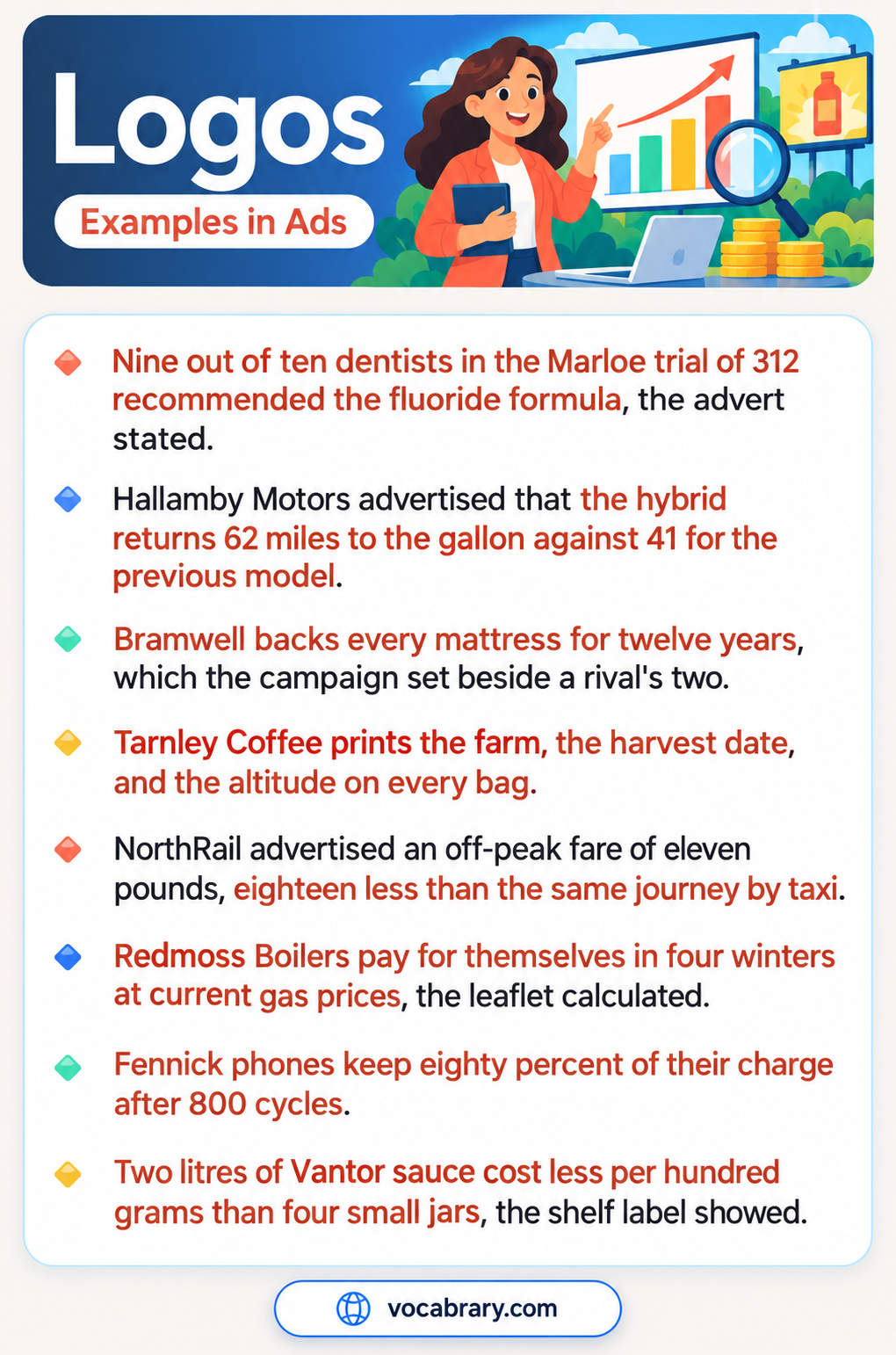
A toothpaste trial with 312 dentists, a battery timed against a rival torch, and a mattress warranty measured in years give advertising its logos. Such logos examples in sentences argue with a figure instead of a mood.
- Nine out of ten dentists in the Marloe trial of 312 recommended the fluoride formula, the advert stated.
- Hallamby Motors advertised that the hybrid returns 62 miles to the gallon against 41 for the previous model.
- One Fenlow battery outlasted two of the leading brand in the timed torch test, the packaging claimed.
- Bramwell backs every mattress for twelve years, which the campaign set beside a rival’s two.
- Why pay a monthly fee? Wrenfield Insurance charges once a year and refunds unused months, the radio advert argued.
- Tarnley Coffee prints the farm, the harvest date, and the altitude on every bag.
- Larkmoor Trainers cut returns to two percent by printing a foot-width chart inside the lid, the press advert explained.
- Switching to Dunwold saves the average household nine washes a year, the poster read.
- NorthRail advertised an off-peak fare of eleven pounds, eighteen less than the same journey by taxi.
- Redmoss Boilers pay for themselves in four winters at current gas prices, the leaflet calculated.
- Ashcombe Shampoo doubled its refill sales after printing the cost per wash on the shelf label.
- Fennick phones keep eighty percent of their charge after 800 cycles.
- How much is a free trial worth? Wexley Bank showed that customers who tried it kept the account for an average of five years, the billboard claimed.
- Two litres of Vantor sauce cost less per hundred grams than four small jars, the shelf label showed.
Logos Examples in Science and Health Writing
A trial with a control group, a dose measured against body mass, and a finding repeated in three laboratories give science and health writing its logos. No claim arrives without the measurement behind it.
- The Redhill Clinic trial randomised 480 patients, and the treated group healed eleven days sooner than the control group.
- Since the finding repeated in three independent laboratories, the journal accepted the paper.
- Blood pressure fell by an average of nine millimetres of mercury in the treated group and by one in the placebo group.
- Dosing is set against body mass, so a forty-kilo child never receives the adult amount.
- Only two of the sixty samples showed contamination, so the batch passed inspection.
- Because the sample held just twelve volunteers, the authors called the finding preliminary.
- Ice cores drilled at four sites show the same temperature rise across the same century.
- What proves the drug works? A double-blind design in which neither doctor nor patient knew who received it, the reviewer answered.
- Antibiotics treat bacteria and never act on a virus, which is why the nurse refused the prescription.
- Bellmore University measured a nine-decibel drop in classrooms after the acoustic panels went up.
- The tumour shrank in eleven of nineteen mice.
- Fossil layers under the cliff run in the same order at every exposed face along forty miles of coast, the geologist wrote.
Logos Examples in Essays and Research Papers
A cited census figure, a counterargument answered with a second study, and a paragraph tracing one tax change to one outcome give an essay its logos. Markers reward that appeal over enthusiasm.
- Three separate surveys reach the same conclusion, which makes the claim harder to dismiss, the student wrote.
- Because the census logged a fall of twelve percent, the essay rejected the opposite assumption.
- Critics answer that the sample was urban, yet the rural study of 1,200 households found the same pattern.
- Her paragraph moves from the tax change in 2014 to the rise in registrations one year later.
- Since the two definitions conflict, the paper adopts the narrower one and states why.
- Every claim in this chapter ends with a citation.
- How strong is the evidence? Two of the four studies used control groups and both reported the same direction, the essay noted.
- The counterargument fails on its own figures: the cost it quotes applies to a scheme abandoned in 2011.
- Nothing in the archive supports the traditional date, so the thesis proposes a later one.
- The writer set out the assumption first, then tested it against the figures for each of the past nine years.
- A sample of thirty is too small to generalise across a city of two million, the marker commented.
- Reordering the chapters put the strongest evidence before the interpretation that depends on it.
Logos Sentences for Thesis Statements
Thesis lines naming a figure, a date, or a measured change give an essay its logos in one sentence. The marker learns what the evidence will be before the first paragraph.
- Because train fares rose faster than wages between 2010 and 2020, commuting patterns in the north-east changed permanently.
- School start times of nine or later reduce absence, as the Northgate figures across four terms demonstrate.
- Three measurable outcomes follow the 2015 levy: lower sugar content, steadier sales, and a smaller price rise than predicted.
- The evidence from forty coastal towns supports a planning rule rather than a national ban.
- Home working cut commuting miles by a third in this sample.
- Since the two policies ran in neighbouring counties, their outcomes make a fair comparison.
- Rising insurance premiums, not falling rainfall, explain the decline in valley farming since 2005.
- Any reading of the 1911 census that ignores household servants understates the size of the working poor by roughly a fifth.
Logos Examples in Debates
A rebuttal naming the study behind a rival’s figure, a cost worked out per household, and a concession followed by one counted exception give debate its logos. Judges score the side that shows its arithmetic.
- My opponent quoted a 2018 survey of 200 people, while the national sample ran to 12,000, the first speaker replied.
- Granting that the scheme costs money, the same budget funds it for eleven years at the stated rate.
- Ban the fee and three quarters of the members lose nothing, because they already pay less.
- How does the motion survive its own figures? It assumes a rise of nine percent when the logged rise was two.
- Nobody on the opposing bench disputed the cost per household, so that number goes unchallenged.
- Second speaker for the proposition argued that two neighbouring counties tried both policies and reported opposite outcomes.
- The proposition needs every one of its four claims to be true, and the third failed on its own source.
- One counterexample defeats a universal claim.
- Since the motion applies to every school, the single successful pilot proves nothing about the other 24,000.
- Timing the two routes across four weeks produced a difference of eleven minutes, not the claimed hour.
- Our opponents changed the definition halfway through, which makes their statistic answer a different question.
- A fine of fifty pounds against a saving of six hundred will never change a builder’s behaviour, the closing speaker said.
Logos Examples in Courtroom Arguments
Phone timings set against a witness statement, a bruise on the wrong side of a face, and a receipt placing a defendant thirty miles away give courtroom argument its logos. Every claim is checked against the clock.
- The bank camera timestamps the withdrawal at 9:14, and the witness places my client across town at nine, counsel argued.
- In Harper Lee’s novel, Atticus Finch argues that Mayella’s bruises came from a left-handed man while Tom Robinson’s left arm is crippled.
- No fingerprint on the window matches the defendant, the forensic officer testified.
- Since the receipt is stamped in Leeds at half past seven, the drive alone rules out an eight o’clock burglary in Hull.
- Three witnesses gave three different colours for the same car, which the defence set against a single confident identification.
- Both parties signed the contract before the clause was added, as the tracked version history proves.
- How reliable is the memory of a stranger’s face after eleven months? The study the defence cited puts accuracy near half.
- Blood on the gate matches neither party, so a third person entered the garden.
- The alarm logged nobody arriving between midnight and six.
- Counsel observed that the ladder reaches only four metres and the window is at six.
- Every payment the prosecution calls suspicious repeats on the same date each month, the accountant explained.
- Phone activity proves the handset never left the house that night, and the mast reading is not disputed.
Logos Examples in Business Cases and Pitches
A payback period counted in months, churn measured against a discount, and a pilot run in two warehouses give a pitch its logos. Boards fund the version with arithmetic attached.
- The machine costs 40,000 pounds and saves 3,500 a month, so it pays for itself before the second winter.
- Kestrel Logistics ran the pilot in two warehouses, and picking errors fell by a fifth in both.
- Churn dropped from nine percent to five after the annual discount launched, the founder told the investors.
- Why raise now? Twelve months of runway against an eighteen-month build leaves a six-month hole, the deck argued.
- Every pound spent on the referral scheme returned four in tracked sales last quarter.
- Hiring a second driver adds 2,400 a month and removes 7,000 in late-delivery penalties.
- Our three largest customers renewed at the higher rate.
- Since the factory runs at sixty percent capacity, the new contract needs no capital at all.
- Support tickets per customer halved after the help centre rewrite, which freed two staff for onboarding.
- How big is the market? Four thousand firms in this county employ between ten and fifty staff, and 310 already pay a rival.
- The rival charges per seat and we charge per site, so a forty-person office saves 6,000 a year with us.
- Nothing in the forecast assumes a price rise, the finance director stressed to the board.
Logos Examples in News Reporting
Turnout counted against the last election, a road scheme priced beside its approved budget, and rainfall measured against the January average give news writing its logos. Readers judge the event by the number attached to it.
- Turnout reached 61 percent, four higher than the previous election, the correspondent reported.
- Council papers show the road scheme now costs 14 million against the 9 million approved in 2021.
- Hospital waiting times in the county fell for a fourth straight month, according to the trust’s own figures.
- Rainfall in the catchment measured double the January average, which explains the flooding downstream.
- How many homes lost power? The network operator confirmed 4,300 across three postcodes, restored by Sunday evening.
- Two of the three bidders withdrew before the deadline, leaving a single tender for a 60-million contract.
- Police logged 190 reports of bicycle theft at the station last year and 41 this year, after the new racks went in.
- Exports fell for the sixth quarter.
- Since the census counted 900 more children in the district, the authority opened a second reception class.
- The company reported a profit of 11 million while announcing 200 redundancies, a contrast the paper set out in one paragraph.
Logos Examples in Famous Speeches and Letters
Susan B. Anthony reading the constitutional preamble aloud, Lincoln counting back to 1776, and Greta Thunberg reciting a carbon budget are the famous cases of logos, where a speaker hands an audience a verifiable claim.
- Susan B. Anthony argued in 1873 that the constitutional preamble names the people, not the male half of them, so her vote broke no law.
- Abraham Lincoln opened the Gettysburg Address in 1863 by counting back four score and seven years to 1776, dating the nation before he defended it.
- Thomas Paine reasoned in 1776 that no island governs a continent.
- In 1852 Frederick Douglass argued that laws punishing the enslaved already treat them as men, since no statute punishes cattle.
- John F. Kennedy compressed fifty thousand years of human history into half a century at Rice University in 1962, then placed the Moon landing at the end of it.
- Martin Luther King Jr. wrote from Birmingham jail in 1963 that a just law squares with moral law and an unjust one does not, citing Aquinas.
- Emmeline Pankhurst told a Hartford audience in 1913 that women shut out of lawmaking are made lawbreakers by that same exclusion.
- Greta Thunberg read the IPCC carbon budget aloud at the United Nations in 2019 rather than describe her feelings.
- The Declaration of Independence of 1776 names the king’s acts one by one before drawing its conclusion.
- Sojourner Truth asked an Akron convention in 1851 how a woman who ploughed and harvested was weaker than any man present.
Logos Examples in Literature
Shylock reasoning from shared senses, Sherlock Holmes reading a sunburn, and Mark Watney counting calories on Mars are the literary cases of logos, where a character argues an audience into agreement instead of moving it.
- Shylock reasons in Shakespeare’s The Merchant of Venice that a Jew bleeds, laughs, and sickens as a Christian does, so revenge follows the same rule.
- George Orwell has Winston write in 1984 that freedom is the freedom to say two plus two make four.
- Holmes concludes in Arthur Conan Doyle’s A Study in Scarlet that a tanned face, a stiff arm, and a military bearing place Watson in Afghanistan.
- Jonathan Swift’s A Modest Proposal of 1729 argues in mock arithmetic, counting the children of the poor before pricing them.
- Mark Watney rations calories against harvest dates in Andy Weir’s The Martian, turning survival into a sum.
- In Mary Shelley’s Frankenstein, the creature argues that his cruelty grew from rejection, so a companion would end it.
- Mr Collins numbers his reasons for marrying before he proposes in Jane Austen’s Pride and Prejudice, and Elizabeth answers each one.
- Poirot reads the varying force of the stab wounds in Agatha Christie’s Murder on the Orient Express and concludes that several hands held the knife.
- Mustapha Mond defends the caste system in Aldous Huxley’s Brave New World as the price of a society without war or want.
- Phileas Fogg stakes his fortune on a printed timetable in Jules Verne’s Around the World in Eighty Days.
Logos Examples in Movies and TV
Juror Eight timing a walk across a room, Katherine Johnson working return coordinates by hand, and Peter Brand pricing runs rather than players are the screen cases of logos. One measurement overturns the whole room.
- Juror Eight in Twelve Angry Men times the old man’s walk to the door and proves fifteen seconds impossible.
- Engineers in Apollo 13 fit a square filter to a round fitting using only what the crew already had aboard.
- Katherine Johnson in Hidden Figures works the return coordinates by hand while the room waits.
- Peter Brand argues in Moneyball that a team buys runs, not players, and prices on-base percentage accordingly.
- In the BBC series Sherlock, Holmes reads scratches around a phone’s charging socket and draws a conclusion about its former owner.
- Contagion has its epidemiologist explain how one case becoming two becomes a city.
- Erin Brockovich matches water-sample readings to the medical files of people living nearest the plant.
- Michael Burry reads the individual mortgage bonds in The Big Short instead of trusting the rating on the cover.
Logos Examples for Students
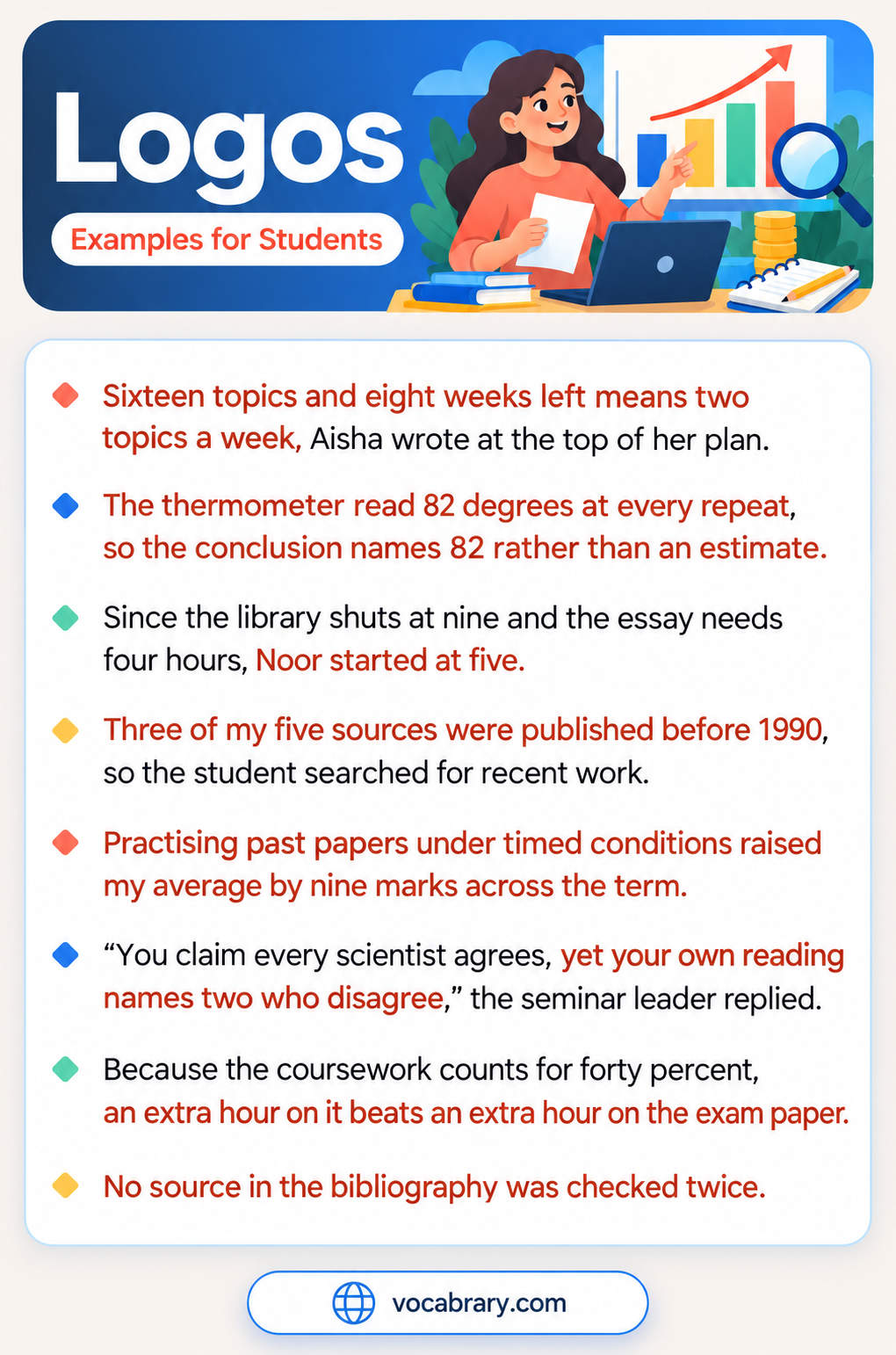
Revision timetables worked back from an exam date, a lab conclusion tied to a reading, and a rebuttal built on one counted exception give students their logos. These logos examples in sentences are the ones markers ask for by name.
- Sixteen topics and eight weeks left means two topics a week, Aisha wrote at the top of her plan.
- “I dropped marks on question three in both mocks, so that is where the revision goes,” Daniel told his tutor.
- The thermometer read 82 degrees at every repeat, so the conclusion names 82 rather than an estimate.
- Since the library shuts at nine and the essay needs four hours, Noor started at five.
- Three of my five sources were published before 1990, so the student searched for recent work.
- How many words remain? The limit is 2,500, the draft runs to 1,900, and the final part needs about 600.
- Practising past papers under timed conditions raised my average by nine marks across the term.
- “You claim every scientist agrees, yet your own reading names two who disagree,” the seminar leader replied.
- A bar chart of six readings makes the trend visible in one glance, which the report used instead of a paragraph.
- Because the coursework counts for forty percent, an extra hour on it beats an extra hour on the exam paper.
- No source in the bibliography was checked twice.
- “Your graph starts at fifty rather than zero, which doubles the apparent rise,” the teacher noted on the draft.
Logos Examples Paired With Ethos and Pathos
A surgeon quoting her own audit, a campaigner naming a child beside a national figure, and a mechanic pricing a repair show how logos joins ethos and pathos. Evidence arrives with a reason to trust it or a reason to care.
Logos and Ethos in One Sentence
A surgeon citing her own audit, an engineer citing the bridge she inspected, and an examiner citing thirty years of marking put logos beside ethos. The figure and the person offering it are weighed together.
- “In twenty years of surgery I have logged 1,400 of these operations, and eleven needed a second procedure,” she told the panel.
- An engineer who inspected the bridge reported cracking at three joints, which ended the argument in the chamber.
- “I have marked this paper for thirty years, and a script with no citations has never scored higher than a C,” the examiner said.
- Counting four exits for an audience of nine hundred, the fire officer closed the hall that evening.
- Since the auditor signed off the figures herself, the board treated the eleven percent as final.
- “As the pharmacist who filled every prescription on this street last winter, I saw the shortage begin in November,” he testified.
- A pilot with 9,000 hours explained that the runway needed 300 more metres at that temperature.
- “My laboratory ran the samples twice, and both runs returned the same reading,” the researcher told the committee.
- The midwife who attended 2,000 births set her own figures beside the trust’s.
- “I built forty of these roofs, and none of them used that bracket,” the contractor said to the surveyor.
Logos and Pathos in One Sentence
A child named beside a hospital waiting figure, a flooded kitchen priced in pounds, and a grandmother’s bus fare set against a timetable put logos beside pathos, so a number lands with a face attached.
“Ten thousand children wait longer than a year, and one of them is my daughter Amira,” the campaigner said.
Flooding filled the kitchen to the second stair and cost 14,000 pounds to repair, the resident told the inquiry.
“My grandmother pays 4.80 each way, which is a tenth of her weekly pension for one hospital visit,” Leon explained.
Forty families on this street lost a job last year.
Since the ward closed, patients drive fifty miles for dialysis three times a week, and Mr Hale is eighty-one.
“Two hundred pupils share one working toilet,” the parent governor read aloud from the inspection.
The factory employed a third of the village before the gates shut in March.
“Nine of my eleven neighbours have left, and the school roll fell from 90 to 41,” the councillor told the meeting.
Every pound cut from the night bus costs a cleaner an hour of walking at four in the morning.
“The treatment costs 60,000 a year, and my son has been waiting 400 days for a decision,” she said.
Related
FAQs
Two logos examples in a sentence are "Rain fell for three straight days, and the match was postponed." and "Nine of the twelve seats are empty, so the club cancelled the coach." Each one states a fact and the conclusion that follows.
Statistical examples include "Not one of the forty test machines overheated." and "The refund rate fell from nine percent to two after the sizing chart appeared." Each one gives a count that a listener is able to test.
Cause and effect examples include "Removing the vending machine raised fruit sales in the canteen by a third." and "The dog stopped limping within a day of the new food." Each one links a measured change to the change before it.
Deductive examples include "All mammals breathe air, and a whale is a mammal, so a whale breathes air." and "Water freezes under zero, the reading was minus four, and the pond froze." Each one starts from a rule the listener already grants.
Inductive examples include "The last ten Julys in this town passed without rain" and "Sales climbed in each of the past six Decembers." Each one moves from repeated observation to a general expectation.
Advertising examples include "Fennick phones keep eighty percent of their charge after 800 cycles." and "Redmoss Boilers pay for themselves in four winters at current gas prices, the leaflet calculated." Each one argues from a figure instead of a mood.
Essay examples include "Every claim in this chapter ends with a citation." and "A sample of thirty is too small to generalise across a city of two million, the marker commented." Each one rests on a count or a source.
Debate examples include "Nobody on the opposing bench disputed the cost per household, so that number goes unchallenged." and "One counterexample defeats a universal claim." Each one answers a rival with a fact or a count.
Courtroom examples include "No fingerprint on the window matches the defendant, the forensic officer testified." and "The alarm logged nobody arriving between midnight and six." Each one rests on a record that was checked.
Famous examples include Abraham Lincoln counting back four score and seven years to 1776 in the Gettysburg Address and Thomas Paine reasoning in 1776 that no island governs a continent. Each speaker argues from a date or a plain fact.