
Ethos is a rhetorical appeal in which a speaker earns belief by proving character or experience, as when a surgeon opens advice with thirty years in surgery. Most ethos examples in sentences name a qualification before the argument starts, which is why the common ones sound alike in clinics, classrooms, and courtrooms.
What Is Ethos?
Ethos is the persuasive force a speaker gains from their own standing: training, track record, honesty, and goodwill toward the audience. Pathos appeals to feeling and logos to evidence, while ethos depends on who is speaking.
"As the engineer who signed off on this bridge, I am telling you to close it today," Priya said.
Common Ethos Examples in Sentences
Nurses naming their years in emergency care, mechanics naming the engines they rebuild, and neighbors naming their decades on a street are the textbook ethos examples in sentences. Standing is proved first, and the claim follows.
- As a nurse with fifteen years in emergency care, I refuse to call a fever of forty degrees routine.
- Having repaired diesel engines since 1994, Karl told the driver that the gearbox was the real fault.
- Speaking as someone who grew up on this street, Mrs. Alvarez asked the council to keep the crossing.
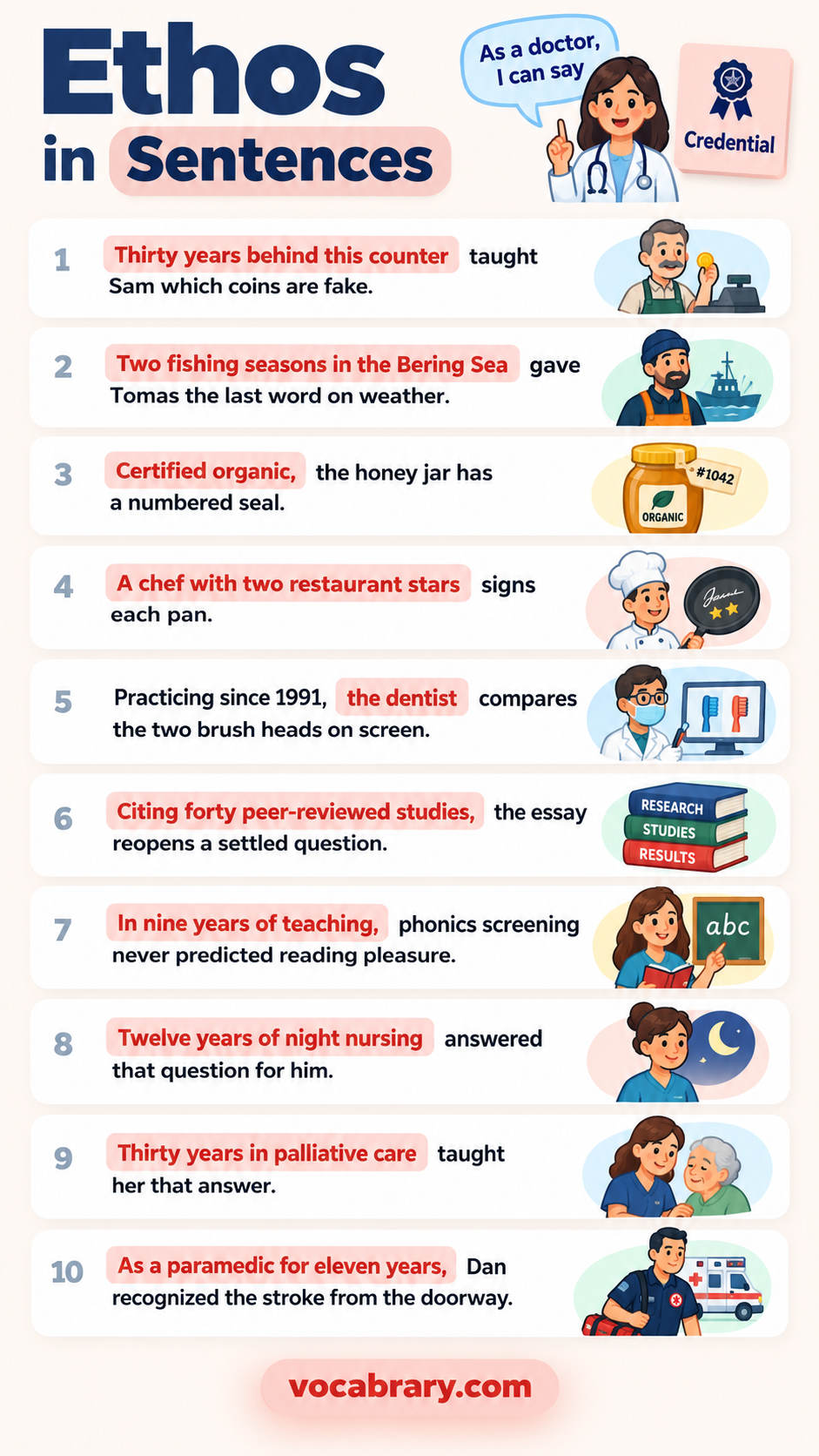
- Thirty years behind this counter taught Sam which coins are fake.
- My grandmother, who raised six children through two recessions, earned the right to talk about money.
- I read all four hundred pages of that contract, so I know exactly what clause nineteen says.
- Professor Idris began the lecture by noting that she had excavated the site herself for eleven summers.
- After twenty years of coaching swimmers to national finals, Coach Bell knows a false start when she sees one.
- As the only accountant in the room, Farid asked the board to read the footnotes again.
- The pilot calmed the cabin by saying she had flown through worse turbulence over the Andes for a decade.
- Trained by the luthier who built my father’s violin, Ana repairs instruments nobody else will touch.
- Because I have paid tax in this town for thirty-one years, I want a word about the new budget.
- Judge Okafor reminded the court that he had presided over four hundred custody hearings.
- Nobody has walked this trail more than I have, the ranger said, turning the hikers back before dusk.
- A midwife who has delivered nine hundred babies never panics at a slow first labor.
- With a decade on the night shift, Marcus knows which corridor floods first in a storm.
- I lost my own savings in the 2008 crash, Elena said, which is why she teaches budgeting for free.
- Our vet won us over by saying she had treated this breed’s hip trouble since veterinary school.
- Two fishing seasons in the Bering Sea gave Tomas the last word on weather.
Ethos Examples in Everyday Conversation
Parents citing winters of icy driving, friends vouching for a plumber who answered at two in the morning, and grandparents citing four decades of butchering are ethos at the kitchen table. Personal history replaces evidence.
- I have driven this road in ice for twenty winters, so fasten your seatbelt and let me steer.
- Trust the plumber I sent you, because he fixed our burst pipe at two in the morning and charged nothing extra.
- Ask anyone who has lived here since the flood whether that riverbank is safe for children.
- As the one who cooked for this family every night for eleven years, I say the oven is finished.
- My uncle, a butcher for four decades, chooses the lamb for every family wedding.
- I have painted sixty houses with this brand, Dad said, so ignore the advert on television.
- Nadia takes money advice from her sister, who cleared thirty thousand in debt on a teacher’s salary.
- Having failed my driving test twice, I promise the examiner watches your mirrors more than your hands.
- You have known me since school, Omar said, so you know I would never repeat this.
- Three cats and one stubborn spaniel later, Grandma has firm opinions about which vet to call.
- The barber built a queue around the corner by telling everyone he had cut hair in that shop since he was nineteen.
- I grew up in that neighborhood, Leah told her friend, and the rent they quoted is double the going rate.
- Anyone who has nursed a newborn through colic understands why she refuses to judge tired parents.
- After eight house moves in nine years, Jonas packs a kitchen faster than the removal crew.
- Would you take gardening advice from a man whose roses never bloom? Hana asked her son.
Ethos Examples in Advertising
Dentist-approved toothpaste, boots worn by mountain rescue teams, and a bakery founded in 1902 are the advertising form of ethos, where a seal, a profession, or a founding date does the persuading for the product.
- Recommended by dentists across the country, Brightline toothpaste protects enamel for twelve hours.
- Worn by mountain rescue teams in three countries, these boots grip wet granite.
- Baking in the same stone oven since 1902, Kessler’s still shapes every loaf by hand.
- Every stitch inspected by a tailor with thirty years at the bench, reads the label inside the coat.
- Designed by engineers who spent a decade building satellites, the new telescope focuses in under a second.
- Nine out of ten vets feed it to their own dogs, the packet announces in heavy type.
- Certified organic, the honey jar has a numbered seal.
- The only cream tested in a dermatology clinic for two full years, the poster claims.
- Founded by two nurses who were tired of cheap gloves, the company now supplies half the county’s hospitals.
- Musicians have trusted these strings since 1968, and the maker prints that date on every packet.
- Our chief brewer trained in Bavaria for seven years, the bottle label says in small print.
- Approved by the national allergy association, the vacuum advert repeats the phrase three times.
- Made by a family of glassblowers in their fourth generation, each vase arrives with a signed card.
Celebrity and Expert Endorsements in Ads
Olympic sprinters fronting running spikes, a two-star chef signing the base of a pan, and a retired long-haul pilot testing suitcase wheels borrow ethos from the endorser’s own record.
- An Olympic sprinter who has raced in these spikes since her first final narrates the whole advert.
- A chef with two restaurant stars signs each pan.
- Retired after twenty-nine years of long-haul flying, the pilot in the commercial drags the suitcase across gravel.
- In a white coat, the dermatologist reads the ingredient card aloud to the camera.
- Climbers who reached the summit without oxygen wear the down jacket through the whole campaign.
- The physiotherapist who treats the national rugby squad demonstrates the massage gun.
- Rebuilding these engines for thirty years gave the mechanic in the oil commercial his authority.
- With twenty-two years as a midwife, Ruth introduces the baby monitor in the television advert.
- Firefighters from three stations gather behind the smoke alarm in the poster, and each of them gives a name and a rank.
- Practicing since 1991, the dentist compares the two brush heads on screen.
- Six national swimming champions endorse the goggles in a single sixty-second advert.
Ethos Examples in Speeches
A candidate naming nineteen years on a factory floor, a fire chief naming the crew he buried, and a union leader holding up her 1987 pay slip open speeches with ethos. Listeners weigh the speaker first.
- I stood on that factory floor for nineteen years, the candidate told the hall before saying a word about jobs.
- Having buried two of my own crew, the fire chief asked the council to fund a second engine.
- As the first woman to lead this union, Dolores opened the rally with her pay slip from 1987.
- Nobody signed those discharge papers but me, the surgeon general said at the hearing.
- Forty years of teaching in this district give me the standing to speak about the new tests.
- You elected me twice, and twice I published every expense, the mayor reminded the crowd.
- Nobody in this room has lost more to the river than my family, the farmer said at the flood meeting.
- Speaking as a mother of three and a paediatric nurse, Rania asked the board to reopen the clinic.
- I have read every line of the inquiry, the barrister told the assembly, and the official timeline does not fit the evidence.
- We built this port with our own hands, the dockers’ representative said at the start of the strike vote.
- As someone who failed out of this university and came back at forty, Paul began his graduation address.
- Twelve years of mine rescue work stood behind every sentence of the inspector’s warning.
Famous Speeches That Build Ethos
Martin Luther King Jr. naming his role at the Southern Christian Leadership Conference, Churchill naming his American mother, and Frederick Douglass speaking as a formerly enslaved man are the historical cases of ethos.
- Martin Luther King Jr. opens his 1963 "Letter From Birmingham Jail" by naming himself president of the Southern Christian Leadership Conference, invited to the city by a local affiliate.
- In his address to the United States Congress in December 1941, Winston Churchill noted his American mother and British father before asking for unity.
- Frederick Douglass spoke at Rochester on 5 July 1852 as a man who had escaped slavery, which gave his question about Independence Day its force.
- Sojourner Truth grounded her 1851 speech in Akron on the field work she had done herself, answering men who called women too delicate to vote.
- Barack Obama’s 2004 Democratic convention keynote begins with a father from Kenya and a mother from Kansas.
- Elie Wiesel opened "The Perils of Indifference" at the White House in 1999 by recalling the young Jewish boy freed from Buchenwald.
- Malala Yousafzai addressed the United Nations in July 2013 as a schoolgirl shot for going to class.
- Socrates defends his own conduct as a citizen and a soldier before answering the charges in Plato’s "Apology."
- Susan B. Anthony built her 1873 lecture on her own arrest for voting, telling audiences she had committed no crime.
- Nelson Mandela’s 1964 statement from the dock in the Rivonia Trial names his training as an attorney and his part in the struggle.
- Dwight Eisenhower’s order of the day on 6 June 1944 speaks as the supreme commander addressing the Allied Expeditionary Force.
- Queen Elizabeth I told her troops at Tilbury in 1588 that she had the heart and stomach of a king.
- Greta Thunberg told the United Nations in September 2019 that she should have been at school, speaking for the generation affected.
Ethos Examples in Essays and Academic Writing
Fieldwork in Nairobi, census figures the writer checked personally, and a former care-home inspector writing about inspections show how essays build ethos: the writer proves the source of the knowledge before arguing from it.
- Drawing on three years of fieldwork in Nairobi, this study argues that the transport levy failed commuters.
- Every figure in this paper comes from the national census, the author states in the second paragraph.
- As a practicing paediatrician and a researcher, Dr. Hale writes about screen time from both sides.
- Reviewed by two independent statisticians, the model behind this chapter survived a second test.
- Having taught the course for eleven years, the writer declines to blame students for falling attendance.
- The interviews quoted here were conducted in person by the author, the methods chapter explains.
- Citing forty peer-reviewed studies, the essay reopens a settled question.
- A former inspector of care homes, the writer describes the inspection system from inside it.
- Our laboratory has replicated the experiment eleven times, the discussion notes, and every run produced the same fall in yield.
- Trained in both economics and epidemiology, she reads the pandemic figures against the unemployment curve.
- I spent the winter of 2019 driving with night-shift couriers, the journalist writes in the opening chapter.
- Because the archive was closed to everyone else, this thesis prints letters no historian has quoted.
Ethos Sentence Starters for Essays
Attribution phrases such as "according to the national transport institute," "peer-reviewed since 2014," and "in my nine years of classroom practice" are the starters students use to borrow or claim authority.
- According to the national transport institute, rail freight has doubled since the tunnel opened.
- Peer-reviewed since 2014, this measure of soil loss now guides four agriculture ministries and two banks that lend to farmers.
- In nine years of teaching, phonics screening never predicted reading pleasure.
- Researchers at the country’s oldest marine laboratory report the same coral loss across six reefs.
- Two government reviews reached this conclusion independently, which is why the claim deserves attention.
- As a volunteer at the shelter every Saturday since 2018, I saw the referral numbers change first.
- The World Health Organization defines the condition narrowly, and this essay follows that definition.
- Doctors who treat the illness daily disagree with the guideline, and their letters appear in the appendix.
- My family farmed this valley for four generations, so the drought argument is personal as well as academic.
- Every statistic quoted in this essay comes from official sources, all of them named in the bibliography.
Ethos Examples in Job Interviews and Resumes
Managing twelve staff through two mergers, a certification dated 2016, and a promotion after six months are the credibility claims that fill interviews and resumes, where proof of competence has to fit one line.
- I managed a team of twelve through two mergers, Priya told the panel in her first answer.
- Certified in project management since 2016, the applicant named three contracts delivered under budget.
- Promoted to shift supervisor after six months, Daniel put the date at the top of his resume.
- Fluent in Arabic and French, she translated for the ward herself rather than waiting for the service.
- My last employer kept me on through three rounds of redundancies, Ben said when asked about his record.
- Having trained forty apprentices, the candidate offered to bring letters from every one of them.
- Your company still uses the system I built, the engineer said, and the interviewer put down her pen.
- Twelve years of night nursing answered that question for him.
- Awarded technician of the year by the regional board, Lucia listed the prize without elaborating.
- A qualified electrician since the age of twenty, Ravi keeps his certification card in his van.
- Nobody on this shortlist has shipped a product to two million users, she said, except me.
- Recommended by my previous head teacher, the applicant attached the reference to her covering letter.
- I started on the shop floor and worked through every department, the operations manager told the board.
- Having audited hospitals in four countries, Femi answered the compliance question in one sentence and named the two rules the panel had confused.
Ethos Examples From Doctors and Health Experts
A cardiologist naming four thousand operations, a pharmacist naming her licence, and an epidemiologist naming two outbreaks are medical ethos, where the qualification decides whether the patient follows the advice.
- I have performed four thousand heart operations, the cardiologist said, so let me explain the risk.
- As the pharmacist who has filled your prescriptions for nine years, Rosa warned him about the interaction.
- Having worked through two cholera outbreaks in Yemen, the epidemiologist refused to call the curve harmless.
- Every midwife on this ward has attended a thousand births, the ward sister told the anxious father, who stopped asking for a second opinion.
- I trained in trauma surgery in Johannesburg, Dr. Mensah said, and I have seen this injury before.
- A dietitian registered with the national board corrected the influencer’s claim about protein.
- Thirty years in palliative care taught her that answer.
- The consultant who wrote the national guideline on this fracture is standing in front of you.
- Because I survived the same treatment myself, the oncologist talks to patients about hair loss differently.
- Two radiologists read your scan with me, he said before delivering the diagnosis.
- As a paramedic for eleven years, Dan recognized the stroke from the doorway.
- Nurses with a decade on this ward recognize sepsis before the monitors do.
Ethos Examples From Teachers and Classrooms
A teacher naming twenty-two years of marking, a coach naming the finals she reached, and a librarian naming the syllabus she wrote build classroom ethos. Naming real experience wins a room’s attention without any shouting.
- I have marked this exam for twenty-two years, Mr. Doyle said, so believe me about the timing.
- Having coached three teams to the national final, Ms. Ferreira changed the warm-up without discussion.
- As the teacher who wrote this syllabus, I know which chapter the examiners care about.
- Every essay I hand back has been read twice, she told the class on the first morning.
- I sat the same exam at your age and failed it, Mr. Kaur admitted, which is why his advice lands.
- Thirty years in this library taught Mrs. Owens which revision books lie.
- A physics teacher who worked six years in a reactor lab made the safety lecture unforgettable.
- Because I learned English at eighteen myself, the language teacher never mocks a pronunciation error.
- The head of department has taught in four countries, which is why her advice on exchange trips is followed.
- No student of mine has ever lost coursework, the tutor said, holding up the signed receipt book.
- Our science teacher published research on volcanoes before she ever set foot in a classroom.
- Ask the students I taught a decade ago whether the rule about drafts was worth following.
Ethos Examples in Politics
Candidates naming military service, a mayor naming her own audited expenses, and a legislator naming the bill she drafted are political ethos, where standing is claimed before any policy argument begins.
- I served two tours before I ever ran for office, the senator said at the veterans’ hall.
- As the only person on this stage who has run a payroll, she asked about the small-business tax.
- Having drafted the housing bill myself, the legislator answered every technical question from memory.
- My expenses have been published every year since 2011, the mayor told the sceptical reporter.
- I grew up in a house that lost its heating every winter, the candidate said during the energy debate.
- Nobody in this parliament has visited more flooded towns than I have, the minister claimed.
- A former police inspector, the councillor spoke about the patrol budget with unusual precision.
- Because my own brother waited nine months for surgery, the health spokesperson refused the official figure.
- Twenty years of negotiating trade deals shaped her answer about tariffs.
- Ten years teaching in a public school shaped his proposal for the teacher pay rise.
- We have governed this city through two floods and a pandemic, the incumbent reminded voters.
- Ask the farmers who elected me four times whether I have ever broken a promise on water rights.
Ethos Examples in Business and Brands
Founding dates, safety awards, family ownership across generations, and audited supply chains are the credibility claims companies print on packaging and repeat in board meetings.
- Family-owned since 1907, the mill prints that date on every sack.
- Audited by an independent body twice a year, the coffee company publishes each report in full.
- We have never missed a delivery deadline in eighteen years, the logistics director told the client.
- A workshop that has restored pianos for four generations now repairs instruments for two orchestras.
- Having survived three recessions without redundancies, the firm makes that promise part of its hiring pitch.
- Our safety record is the best in the industry, the site manager said, and the regulator confirmed it.
- Winner of the national engineering prize in 2019, the company leads with that line in every tender.
- Every supplier we use has been visited by our own staff, the chocolate maker states on the wrapper.
- I founded this company in my garage and still answer the phone, the chief executive wrote to customers after the price rise.
- Certified carbon neutral by an external assessor, the airline repeats the claim in its safety briefing.
- Trusted by every hospital in the region since 1984, the laundry service quotes that line in its bid.
- Because we make the parts ourselves, the bicycle brand offers a lifetime warranty to every buyer.
Ethos Examples on Social Media
Bios that give a licence number, captions naming a decade of practice, and creators who photograph their own certificates are how ethos works online. One line decides whether a stranger is believed.
- Registered dietitian, licence number on my profile, her bio says before any recipe.
- I have coded in this language since it was released, the developer wrote under the tutorial video.
- Twelve years as a groomer, the caption reads, so stop shaving huskies.
- A certified electrician of nineteen years filmed himself correcting the viral wiring hack.
- Because I have trained rescue dogs since 2009, she posts corrections whenever the advice turns cruel.
- My before-and-after photos span four years, not four weeks, the fitness creator wrote in the pinned comment.
- Every claim here is sourced, the historian wrote, linking each document in turn.
- Having worked in the kitchen he reviewed, the food writer disclosed the connection in his opening line.
- I am a lawyer and this is general commentary, not advice, the caption warns in the first line.
- Ask any beekeeper with twenty hives whether that honey test doing the rounds on the internet proves anything at all about purity.
- The nurse who wrote this works in the same hospital, which is why the warning went around the country.
- Second-generation farmer here, he replied, and the soil advice in that video will ruin your field.
Ethos Examples for Students
Class presentations that open with a survey the student ran, debates that quote a named professor, and science fair boards that name the lab are student ethos. Naming a real source wins marks for credibility.
- I surveyed one hundred and twelve students in this school myself, Maya began her presentation.
- According to Professor Adeyemi, who studies river pollution, the council’s figure is measured wrongly.
- Having volunteered at the animal shelter for two years, Theo argued against the new licensing fee.
- Our science fair data came from the university laboratory downstairs, the poster explains at the top.
- I have played the violin for nine years, she told the debate panel, so the music budget is personal for me.
- Because my family runs a bakery, Ines answered the economics question with real supplier prices.
- Every source on my slide comes from a journal, Josh said when a classmate objected to his claim about antibiotics.
- As the student who cleaned the riverbank in April, Lena described the rubbish nobody else had seen.
- A fellow pupil who has used a wheelchair since primary school gave the access speech to the governors.
- A summer interning at the observatory gave Kwame the telescope images he explained.
- Ask my chemistry teacher whether I checked this three times, Amira told the judges.
- Two years on the debating team taught him to name his sources before his opponent had the chance.
Ethos Examples in Literature
Nick Carraway promising to reserve judgement, Atticus Finch addressing a jury, and Ishmael proving his whaling knowledge are the literary cases of ethos, where a narrator or character earns the reader’s belief.
Ethos in Novels
Fitzgerald’s opening about reserved judgement, Melville’s whaling lore, and Defoe’s mariner’s own account are novel-length ethos, built so that the reader accepts the teller before the tale.
- Nick Carraway opens Fitzgerald’s "The Great Gatsby" of 1925 by quoting his father’s advice and claiming he reserves judgement.
- Atticus Finch closes his defense in Harper Lee’s "To Kill a Mockingbird" by appealing to the jury’s duty and his own plain reading of the evidence.
- Ishmael proves his years at sea and his reading about whales across the cetology chapters of Melville’s "Moby-Dick."
- Hawthorne’s narrator in "The Scarlet Letter" claims he found the embroidered letter and a manuscript in the Salem custom house.
- Defoe presents "Robinson Crusoe" of 1719 as a mariner’s own account, printed without a novelist named anywhere on it.
- Lemuel Gulliver begins Swift’s "Gulliver’s Travels" with his schooling, his apprenticeship, and his work as a ship’s surgeon.
- Sherlock Holmes wins Watson’s respect in "The Sign of Four" by reading a whole family history from a pocket watch.
- Captain Nemo earns Professor Aronnax’s deference in Verne’s "Twenty Thousand Leagues Under the Sea" through his laboratory and his library.
- Stoker assembles "Dracula" from journals, letters, and a ship’s log, so the account reads as gathered testimony.
- Victor Frankenstein tells his story to Walton as a man of science warning another, in Mary Shelley’s novel of 1818.
- Thoreau grounds "Walden" in the two years and two months he lived beside the pond.
- Jane Eyre narrates Charlotte Bronte’s novel as an autobiography, addressing the reader directly and admitting her own faults.
Ethos in Shakespeare and Drama
Mark Antony calling himself a plain speaker, Othello recounting his battles to the senate, and Prospero reminding Miranda of his dukedom are dramatic ethos, spoken by characters who must be believed at once.
- Mark Antony calls himself a plain blunt man and Caesar’s friend before turning the Roman crowd in "Julius Caesar."
- Othello answers the Venetian senate by recounting the battles and sieges he survived before he won Desdemona’s love.
- Henry V speaks to his outnumbered army at Agincourt as a brother among brothers.
- Prospero reminds Miranda in "The Tempest" that he was once Duke of Milan before explaining the storm.
- Reverend Hale arrives in Arthur Miller’s "The Crucible" carrying heavy books and a reputation for studying witchcraft.
- Creon in Sophocles’ "Antigone" grounds every order in his position as the new king of Thebes.
- Brutus asks the Roman crowd to believe him on the strength of his own honour and his love of Rome.
- Lady Macbeth challenges her husband by invoking her own resolve, which she claims exceeds his.
Ethos in Poetry and Older Works
Milton’s invocation of the Muse, Wilfred Owen’s trench service, and Odysseus naming himself to the Phaeacians are older forms of ethos, where the poet or narrator claims the right to be heard.
- Milton opens "Paradise Lost" by calling on the Heavenly Muse, claiming the authority to justify God’s ways.
- Wilfred Owen writes "Dulce et Decorum Est" as a soldier who marched with the men he describes.
- Odysseus names himself son of Laertes, known among men for his cunning, before telling the Phaeacians his story.
- The Wife of Bath begins her prologue in Chaucer’s "Canterbury Tales" by placing experience over written authority.
- Beowulf recites his swimming contest with Breca and his fights with sea monsters before Hrothgar lets him face Grendel.
- Julius Caesar writes his "Commentaries on the Gallic War" in the third person, which makes the general sound like a neutral witness.
- Dante presents "The Divine Comedy" as the report of a traveler who saw the three realms himself.
- Frederick Douglass published his 1845 narrative with prefaces from two well-known abolitionists vouching that he wrote it himself.
Three Parts of Ethos With Examples
Aristotle divided ethos in Book Two of his "Rhetoric" into practical wisdom, good character, and goodwill toward the audience, and each part produces its own style of sentence.
Phronesis Examples (Practical Wisdom)
Judgement proven by experience sounds like a builder reading a crack, a captain reading a sky, and an auditor reading a balance sheet, all of them showing wisdom earned on the job.
- I have seen that crack in forty houses, the builder said, and it never means subsidence.
- Having sailed this coast since childhood, the captain turned back before the cloud reached the harbour.
- Twenty audits taught me where firms hide a loss, Beatriz told the committee.
- As a translator of legal contracts for eleven years, he flagged the ambiguity in clause four.
- Nobody reads a soil sample better than a farmer who has failed a harvest, her father said.
- Because I have rewired houses this old before, the electrician refused to start without a survey.
- The prison governor who reduced violence in three jails was asked to redesign the training.
- Two decades of crisis negotiation stood behind every pause in her answer.
Arete Examples (Good Character)
Returning a wallet with the cash untouched, refusing a contract from a friend, and publishing a mistake before anyone notices are sentences that prove the speaker’s virtue rather than skill.
- I returned the wallet with every note still inside, the shopkeeper said, and the town remembered it.
- Having refused the contract because my cousin owns the firm, the councillor kept her vote.
- Our newspaper printed the correction on the front of the paper, the editor reminded readers.
- The doctor who reported her own error was the one patients requested afterwards.
- No supplier has ever bought me so much as a lunch, the procurement officer told the tribunal.
- Because he gave evidence against his own employer, the inspector lost the job and won the argument.
- Twice offered a bribe and twice refusing, the customs officer became the training example.
- She repaid every creditor after the bankruptcy, which is why the bank reopened her account.
Eunoia Examples (Goodwill Toward the Audience)
Sentences that prove goodwill sound like a teacher staying late, a doctor asking what the patient fears, and a mayor giving out a home number, each showing the speaker is on the listener’s side.
- I stayed late every Thursday for your mock exams, the teacher reminded her class.
- Because your comfort comes before my schedule, the doctor asked what frightened him most.
- My home number is on the notice board, the mayor said, and it has been for six years.
- Having lost my own home to this bank, the campaigner promised the tenants she would not settle quietly.
- Your children and mine will drive the same road, the candidate told the meeting.
- Every complaint reaches my desk unopened by anyone else, the manager assured the staff.
- The union leader took the same pay cut as the workers, which ended the argument in one sentence.
- Nobody here will lose a shift over this, the supervisor said before announcing the new rota.
Ethos Paired With Pathos or Logos
The strongest persuasion joins credibility with feeling or with proof, as when a surgeon names both her thousand operations and her own childhood illness.
Ethos and Pathos in One Sentence
A surgeon who names her own illness, a firefighter who names a child he failed to reach, and a teacher who names her own hunger join standing with emotion.
- As a surgeon of a thousand operations and a woman who nearly died at nine, she pleaded for the ward.
- I have fought fires for eleven years, and I still hear the child we reached too late, he told the inquiry.
- Twenty years of teaching, and I have watched children fall asleep from hunger, the head teacher said.
- Having buried my own father after a nine-month wait, the consultant asked the minister for surgery funding.
- Every nurse in this room has held a hand at the end, she said, so do not lecture us about compassion.
- Because I sold my mother’s house to pay these fees, the campaigner refused to leave the hearing.
- I am a veteran, and my closest friend came home to find no bed waiting, the speaker told the council.
- A paediatrician for thirty years, he wept describing the cold ward.
- My licence proves I am a lawyer, and my scars prove I was a victim first, she told the jury.
- Two decades on this dock, and I have watched sons leave for work abroad, the foreman said.
Ethos and Logos in One Sentence
Credentials placed next to numbers make the argument twice: an epidemiologist quoting her own dataset, an engineer quoting a tolerance figure, an auditor quoting a percentage.
- As the epidemiologist who built this dataset, I confirm that infections fell by sixty-one percent.
- Having designed the bridge, I measured a tolerance of eight tonnes, the engineer told the committee.
- Our audit covered every invoice, and four percent were duplicates, Femi reported.
- I have run this trial twice, and both times the drug outperformed the placebo, the researcher said.
- Thirty years of soil testing gave me these figures: nitrogen down by a third since 2010, the agronomist said.
- Because my laboratory processed the samples, I know the error margin is under two percent, she explained.
- The inspector who visited all fourteen sites in person found safety breaches at nine of them, each one photographed.
- A pharmacist of twenty years, he counted eleven interactions in the patient’s prescription.
- Every figure in this chapter comes from my own fieldwork, and the trend has held for six years.
- I taught this cohort, and their reading scores rose eighteen marks in one term, the teacher told the governors in October.
Ethos Examples That Attack Credibility
Reminders that a witness lied under oath, that a consultant is paid by the company he praises, and that a critic has never cooked professionally attack ethos instead of building it.
- You lied to this court under oath in March, the barrister said, and the witness lost the jury before lunch.
- The consultant praising the drug is paid by its maker, the journalist wrote.
- A critic who has never worked a service in a professional kitchen reviewed the restaurant in three lines.
- Having failed to file accounts for three years, the treasurer was asked to leave the finance meeting.
- Nobody who missed eleven council meetings should lecture us on attendance, the opposition leader said.
- I checked his qualification, and the institute that awarded it closed in 2004, the recruiter reported.
- Because she withdrew two papers for falsified data, her evidence was struck from the review.
- The blogger selling the supplement wrote the study praising it, which the regulator later confirmed.
- My opponent has changed position four times this year, the candidate said.
- Ask why the safety expert resigned from his last two jobs, the union representative told the workers.
Related
FAQs
You use ethos in a sentence by naming the qualification, experience, or shared value that gives you the right to speak, and then making the claim. "As a nurse with fifteen years in emergency care, I refuse to call this fever routine" puts the credential first and the argument second. The credential has to be true and relevant, or the appeal collapses.
Five everyday examples of ethos are a doctor citing thirty years in surgery, an advert stating that dentists recommend a toothpaste, and a candidate naming military service. A student quoting a named professor and a company printing its founding date on the packaging are two more. Each one asks the audience to believe the speaker before weighing the claim.
Ethos, pathos, and logos are Aristotle’s three appeals, and they differ in what they lean on: ethos on the speaker’s character, pathos on the audience’s emotion, and logos on reasoning and evidence. A surgeon citing her training uses ethos, a charity advert showing a hungry child uses pathos, and a report citing survival rates uses logos.
The three parts of ethos, as Aristotle sets them out in Book Two of his "Rhetoric," are phronesis, arete, and eunoia. Phronesis is practical wisdom, arete is good character, and eunoia is goodwill toward the audience. A speaker who proves all three is believed on competence, honesty, and motive at once.
Ethos and credibility overlap without being identical, because credibility describes how believable a speaker already is, while ethos names the persuasive appeal built from that standing. A surgeon has credibility in theatre, and she uses ethos the moment she cites her operations to win an argument about funding.
You appeal to ethos in an essay by naming credible sources, describing your own relevant experience, and writing accurately enough that the reader trusts the rest. Citing peer-reviewed research, quoting named experts, and acknowledging the strongest counterargument all build the writer’s standing without a single boastful sentence.
Ethos appeals to the audience’s judgement of the speaker rather than to their feelings or their reasoning. It asks one question on the listener’s behalf: does this person know enough, and are they honest enough, to be believed on this claim? That judgement is formed from credentials, track record, fairness, and goodwill.
Advertisements use ethos by borrowing authority from experts, professional bodies, celebrities, and their own history. Dentist endorsements, certification seals, Olympic athletes in sportswear campaigns, and phrases such as "family-owned since 1907" all transfer someone else’s standing to the product on the shelf.
You build ethos in a speech by stating your connection to the audience and your experience of the problem in the opening minute. Martin Luther King Jr. named his role at the Southern Christian Leadership Conference at the start of his 1963 letter, and Winston Churchill mentioned his American mother before addressing Congress in 1941.
Any person has ethos whenever an audience treats their character and their record as a reason to believe them. A paramedic with eleven years on the road and a teacher who has marked the same exam for two decades both bring ethos into an argument. Institutions earn it the same way, through a track record the audience already knows.
Ethos, pathos, and logos are rhetorical appeals rather than figures of speech, which is why writers group them with argument strategy instead of with metaphor or rhetorical questions. Aristotle called them the three artistic proofs, and every persuasive text draws on at least one of them.
Ethos is written in lower case as an ordinary English noun, and the same applies to pathos and logos. Capitals appear only at the start of a sentence, in a title, or when a brand uses the word as a name. Italics are unnecessary, since the word has been fully absorbed into English.
Ethos is pronounced EE-thoss in most English-speaking countries, with a long first vowel and a soft "th" as in "think." British and American speakers agree on the stress, which falls on the first syllable, and the plural form "ethoi" is rare outside academic writing.

Leave a Comment