
Epithet is a literary device in which a descriptive word or phrase joins a name or replaces it, as when Alexander III of Macedon becomes Alexander the Great. The most familiar epithet examples are nicknames that people give to friends, rulers, cities, and athletes, each one naming a trait that listeners recognize at once.
What Is Epithet?
An epithet is a label, either an adjective or a descriptive phrase, that names a defining trait of a person, place, animal, or object. A kenning differs, because it replaces a noun with a compressed metaphor such as whale-road for the sea, while an epithet names a real trait of its bearer, as swift-footed does for Achilles.
Everyone in the fishing village called the old sailor Sam the Silent, because he never said a word at sea.
Common Epithet Examples in Sentences
Alexander the Great, the Big Apple, and man’s best friend are the epithet examples that most English speakers already know, since each one replaces or extends a name with a single famous trait.
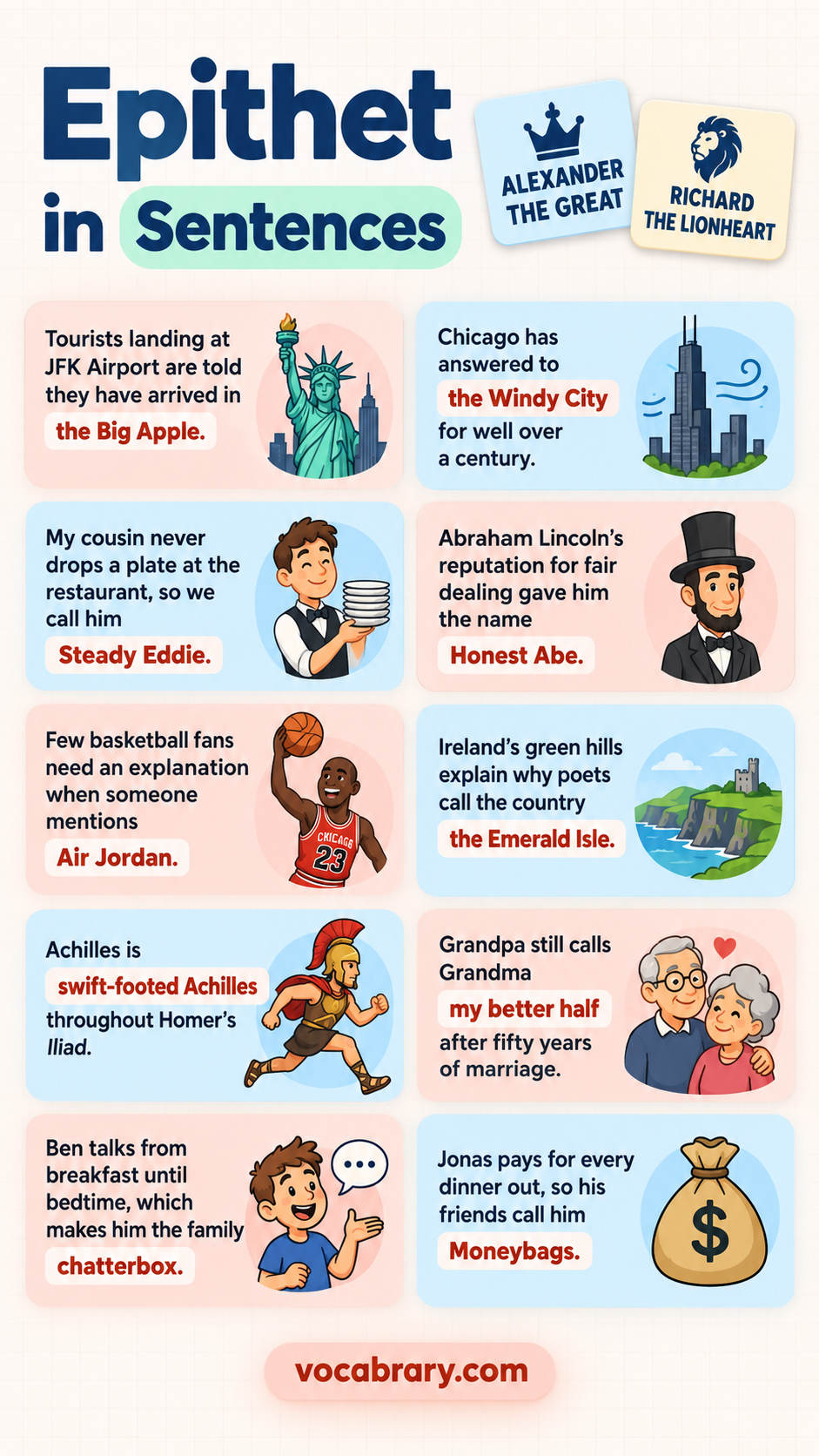
- After conquering the Persian Empire, Alexander III of Macedon became known to history as Alexander the Great.
- Tourists landing at JFK Airport are told they have arrived in the Big Apple.
- Our grandmother calls the family dog man’s best friend every time he fetches her slippers.
- In Homer’s Odyssey, the goddess of the morning returns again and again as rosy-fingered Dawn.
- English teachers across the world refer to William Shakespeare simply as the Bard.
- A Soviet army newspaper named Margaret Thatcher the Iron Lady in 1976, and she adopted the title with pride.
- Richard I of England earned the name Richard the Lionheart for his courage in the Third Crusade.
- Chicago has answered to the Windy City for well over a century.
- Elvis Presley is still the King of Rock and Roll to millions of fans.
- Did you know that Paris became the City of Light partly because of its early gas street lamps?
- My cousin never drops a plate at the restaurant, so we call him Steady Eddie.
- The French peasant girl who lifted the siege of Orléans in 1429 is remembered as the Maid of Orléans.
- Abraham Lincoln’s reputation for fair dealing gave him the name Honest Abe.
- Florence Nightingale became the Lady with the Lamp during her night rounds of wounded soldiers in the Crimean War.
- Few basketball fans need an explanation when someone mentions Air Jordan.
- Ireland’s green hills explain why poets call the country the Emerald Isle.
- Frightened wizards in the Harry Potter books refer to Voldemort only as You-Know-Who.
- Achilles is swift-footed Achilles throughout Homer’s Iliad.
- Louis XIV of France chose the sun as his emblem and became the Sun King.
- Our neighbor, who grows prize tomatoes every summer, is known on the street as green-fingered Mrs. Patel.
- Isn’t it strange that Ivan IV of Russia is still called Ivan the Terrible more than four centuries after his death?
Epithet Examples in Everyday Conversation
Families and friends use sleepyhead, bookworm, and butterfingers in daily talk, where a speaker swaps a name for a quick epithet to tease someone about a habit everyone has noticed.
- "Wake up, sleepyhead, breakfast is getting cold," Dad called up the stairs.
- Maria dropped her third glass of the evening and laughed, "I’m such a butterfingers."
- My brother reads four novels a week, so the whole family calls him the bookworm.
- Grandpa still calls Grandma my better half after fifty years of marriage.
- When Leo fixed the leaking tap, the fridge door, and the broken lamp in one afternoon, his roommates crowned him Mr. Fix-It.
- "Here comes the birthday girl," the waiter announced as he set the cake in front of Amira.
- Our neighbor knows every rumor on the street, and the children call her a real Nosy Parker.
- Ben talks from breakfast until bedtime, which makes him the family chatterbox.
- "Good morning, early bird," Mom said when Sara came downstairs at five.
- Jonas pays for every dinner out, so his friends call him Moneybags.
- "Don’t be such a scaredy-cat," Ella told her little brother at the haunted house.
- Tim has never seen a sunrise, and his flatmates know him only as Night Owl Tim.
- "Thanks, sunshine," the barista told the regular who always arrives smiling.
- Aunt Rosa, the family peacemaker, ended the argument over the last slice of pie.
- "Who ate the last cookie, Cookie Monster?" Mom asked, looking at the crumbs on Omar’s shirt.
- At every wedding, Carlos is the life of the party until the band packs up.
- Grandma calls my tall uncle Beanpole, even though he turned sixty last year.
- "Nice work, champ," Coach Rivera said after Nia scored her first goal.
Epithet Examples at Work and School
Office wizards, class clowns, and walking dictionaries are the epithets that coworkers and classmates give each other, each one naming the job or habit a person is known for.
- The IT manager who fixes every crash within minutes is the office wizard.
- Nobody on the sales team outsells Dana, the Queen of Cold Calls.
- Our accountant, Mr. Spreadsheet, color-codes even his lunch orders.
- Priya brings pastries every Friday, which has made her the Snack Fairy of the third floor.
- When the new intern finished the report in an hour, the boss started calling him Speedy Sam.
- Mr. Hart, the grammar police of the newsroom, circles every misplaced comma in red.
- Before each deadline, the team turns to Omar, the calm one, for advice.
- Leila answers every question in class, so her classmates call her the walking dictionary.
- Room 12’s class clown tells a joke before every test.
- Few students envy Jake, known in every hallway as the teacher’s pet.
- Ms. Lopez, the Science Queen, runs the robotics club after school.
- "Ask Professor Know-It-All," the students teased when Ravi raised his hand again.
- At our school, the librarian goes by the Book Detective, because she finds any title in seconds.
- Why did Coach Brown become the Whistle to every student on the team?
- In the break room, the woman who never runs out of coffee is the Coffee Queen.
- After winning three spelling bees in a row, Nora became Spelling Bee Nora to the whole school.
Funny Epithet Examples
Captain Obvious, the Lord of the Remote, and a cat named Destructo the Magnificent show epithets used for laughs, where speakers use a grand title to poke fun at a small, silly habit.
- My roommate states every obvious fact, so we call him Captain Obvious.
- Dad refuses to hand over the TV remote, which has earned him the title Lord of the Remote.
- After napping through three alarms, Jess became Lady Snooze-a-Lot.
- Uncle Frank, the Human Vacuum, finishes every plate at Sunday lunch.
- Our cat knocks every glass off the counter, so we named her Destructo the Magnificent.
- My sister, the Queen of Selfies, took forty photos at breakfast.
- Tom trips over nothing, so his teammates call him Twinkle-Toes.
- Our neighbor’s dog, Barky McBarkface, starts every morning at six sharp.
- "Here comes Mr. Always Late," the team groaned as Kevin rushed in at 9:40.
- Grandpa, the Great Sock Thief, somehow ends up with everyone’s socks in his drawer.
- Why does everyone call my little brother the Fridge Raider?
- Clumsy Dave, also known as Dave the Destroyer, broke two chairs at his own birthday party.
Epithet Examples About Yourself
Maya the Tea-Obsessed Traveler, the Plant Whisperer, and Ravi the Brave are epithets that people choose for themselves in bios, introductions, and usernames to name the trait they are proudest of.
- In her online bio, Maya describes herself as Maya the Tea-Obsessed Traveler.
- I sign every birthday card as Aunt Jen, Maker of Terrible Puns.
- On the running club app, Marco calls himself Marco the Marathon Machine.
- "Just call me the Plant Whisperer," Lena said, pointing at her forty houseplants.
- My gaming username is Sam the Unstoppable, though my win record says otherwise.
- For the class introduction, Jae wrote, "I am Jae the Curious, and I ask too many questions."
- At the top of her résumé, Fatima presents herself as a problem solver with a sharp eye.
- Grandpa introduces himself at every party as Old Joe the Storyteller, and within ten minutes he is telling the fishing story again.
- Nobody else calls me Chef Extraordinaire, but I still wear the apron that says so.
- When the camp leader asked for nicknames, Ravi picked Ravi the Brave.
Epithet Examples for Kids
Clifford the Big Red Dog, Bob the Builder, and the Very Hungry Caterpillar are picture-book epithets, and young readers learn each character’s main trait from the name before the story even starts.
- Clifford the Big Red Dog is so huge that he sleeps outside in the yard.
- Every morning, Thomas the Tank Engine pulls his two coaches around the Island of Sodor.
- Winnie-the-Pooh calls himself a Bear of Very Little Brain in A. A. Milne’s stories.
- In Eric Carle’s picture book, the Very Hungry Caterpillar eats through a huge pile of food before turning into a butterfly.
- Bob the Builder and his team fix roads, houses, and bridges.
- In E. B. White’s Charlotte’s Web, the spider weaves the words Some Pig into her web to save Wilbur.
- Charlotte later spins Terrific, Radiant, and Humble to describe her friend.
- Roald Dahl’s Fantastic Mr Fox outsmarts three nasty farmers named Boggis, Bunce, and Bean.
- Sophie’s friend in another Roald Dahl story is the BFG, short for the Big Friendly Giant.
- Roger Hargreaves gave each of his characters a one-word epithet, such as Mr. Tickle, Mr. Happy, and Little Miss Bossy.
- Francesca Simon’s naughty hero goes by Horrid Henry, and his well-behaved brother is Perfect Peter.
- Dora the Explorer goes on adventures with her backpack and her monkey friend, Boots.
- Why is the reindeer in the holiday song called Rudolph the Red-Nosed Reindeer?
- My little sister named her teddy bear Sir Fluffington the Brave.
- In Dr. Seuss’s book, the Cat in the Hat turns a rainy afternoon into chaos.
- Curious George gets into trouble every time the Man with the Yellow Hat leaves him alone.
Types of Epithets With Examples
Rosy-fingered Dawn, the ring-giver, the whale-road, a sleepless night, Comrade Napoleon, and eagle-eyed illustrate the six main types of epithet: fixed, stock, kenning, transferred, argumentative, and compound.
Fixed and Homeric Epithets
Swift-footed Achilles, grey-eyed Athena, and the wine-dark sea are fixed epithets, repeated by Homer each time he names the same hero, goddess, or place in the Iliad and the Odyssey.
- In the Iliad, Homer repeatedly calls his hero swift-footed Achilles, even when Achilles is sulking in his tent.
- Many English translations of the Odyssey call the goddess grey-eyed Athena.
- Each new morning in the Odyssey begins with the arrival of rosy-fingered Dawn.
- Odysseus spends ten years trying to sail home across the wine-dark sea.
- Homer’s queen of the gods is white-armed Hera in scene after scene of the Iliad.
- Because of his gleaming bronze helmet, Homer names the Trojan prince Hector of the shining helm.
- The Iliad closes with the funeral of Hector, tamer of horses.
- Homer gives Agamemnon the formal title lord of men.
- Translators render Odysseus as resourceful Odysseus or Odysseus of many wiles, depending on the scene.
- Greek soldiers at Troy are the well-greaved Achaeans, named for the bronze armor on their shins.
- Elsewhere the same army is the long-haired Achaeans.
- Troy itself becomes windy Troy in many lines of the poem.
- Odysseus’s son is thoughtful Telemachus, and his faithful wife is wise Penelope.
- Menelaus, the wronged husband of Helen, is Menelaus of the great war cry.
- Singers who performed the Iliad aloud relied on stock phrases like swift-footed Achilles to complete a line of verse.
Epithets for Greek and Norse Gods
Cloud-gathering Zeus, the Earth-Shaker Poseidon, and Odin the All-Father show how ancient poets named each god by a power or a sacred object.
- Zeus is the cloud-gatherer in Homer, since he sends storms across the sky.
- Poseidon’s power over earthquakes gave him the title Earth-Shaker.
- Older translations of the Iliad describe the queen of Olympus as ox-eyed Hera.
- Hermes, the messenger of the gods, delivers Zeus’s orders on winged sandals.
- In Norse myth, Odin rules Asgard as the All-Father.
- Thor, the Thunderer, swings his hammer Mjölnir at the giants.
- Greek poets called the goddess of wisdom Pallas Athena, and Athens honored her as its protector.
- At the start of the Iliad, Apollo, the god of the silver bow, sends a plague on the Greek camp.
- Homer’s goddess of love is laughter-loving Aphrodite.
- Heimdall, the watchman of the gods, guards the rainbow bridge to Asgard.
Stock Epithets and Kennings in Beowulf
The ring-giver, the son of Ecgtheow, and the whale-road are the stock epithets and kennings that the Beowulf poet repeats for kings, heroes, and the sea.
- In the opening lines of Beowulf, the tribes beyond the whale-road pay tribute to King Scyld.
- Beowulf is introduced again and again as son of Ecgtheow.
- Hrothgar rewards his warriors with gold, which makes him the ring-giver of the Danes.
- The poet also names Hrothgar protector of the Scyldings.
- Grendel, a descendant of Cain, is God’s adversary in the poem.
- Old English poets called the human body the bone-house, and Beowulf uses the same word.
- Blood becomes battle-sweat in the poem’s fight scenes.
- When Beowulf returns to Geatland, the poet calls the shining sun the world-candle.
- When the sword Hrunting fails against Grendel’s mother, the poet calls the blade the battle-light.
- Beowulf’s loyal young kinsman is Wiglaf, son of Weohstan.
Transferred Epithets
A sleepless night, a nervous cigarette, and a condemned cell are transferred epithets, or hypallage, where an adjective that describes a person’s feeling is attached to a nearby object or stretch of time.
- Worried about her chemistry exam, Mei spent a sleepless night staring at the ceiling.
- Pacing outside the delivery room, the old-fashioned father lit a nervous cigarette.
- In Thomas Gray’s "Elegy Written in a Country Churchyard," the ploughman plods homeward on his weary way.
- The prisoner spent his final week in the condemned cell.
- Sam regretted a thoughtless remark about his sister’s cooking.
- On the beach, the children spent a happy afternoon building sandcastles.
- In a Bertie Wooster story by P. G. Wodehouse, Bertie balances a thoughtful lump of sugar on his teaspoon.
- We spent a lazy Sunday on the sofa watching old films.
- Grandpa sank into his tired armchair after the long drive home.
- The patient’s family endured an anxious wait outside the operating theater.
- Before opening the door, Mrs. Green gave the stranger a suspicious glance.
- Did you hear the angry slam of the door when Leo stormed out?
- The hikers reached camp after a hungry climb up the ridge.
- Ravi gave a proud wave from the stage after his first solo.
- After losing the final, the team rode home on a silent bus.
- Lying awake before the battle, the young soldier turned over and over on his restless pillow.
- A delivery driver took a careless turn and scraped the side of the van along the wall.
Argumentative Epithets
Comrade Napoleon, Tricky Dick, and the Teflon President are argumentative epithets, labels that a speaker uses to praise or attack a target, revealing the speaker’s opinion.
- In Animal Farm, the other animals learn to address the ruling pig as Comrade Napoleon.
- Critics of Richard Nixon called him Tricky Dick, a label dating from his 1950 Senate race.
- Congresswoman Pat Schroeder called Ronald Reagan the Teflon President in 1983, because no scandal stuck to him.
- Reagan’s supporters answered by praising him as the Great Communicator.
- At the end of Macbeth, Malcolm dismisses the dead king and his wife as this dead butcher and his fiend-like queen.
- Queen Margaret insults Richard III as a bottled spider.
- British cartoonists and French royalists mocked Napoleon Bonaparte as the Corsican Ogre.
- Admirers celebrated Winston Churchill as the British Bulldog during the Second World War.
- Newspapers named the gangster Al Capone Scarface, a nickname he hated.
- Protesters outside the factory called the owner the Smog King.
Compound Epithets
Eagle-eyed grandmothers, lion-hearted firefighters, and silver-tongued neighbors show compound epithets, where two words joined by a hyphen name a trait in one quick adjective.
- My eagle-eyed grandmother spotted the typo on the wedding invitation.
- The lion-hearted firefighter ran back into the burning barn for the last goat.
- Fleet-footed Jamal won the relay for our school.
- The tight-fisted landlord refused to fix the heater all winter, even when the tenants wore coats and gloves indoors.
- Our silver-tongued neighbor talked the council into repaving the road in one meeting.
- Big-hearted Ms. Ito donated her bonus to the animal shelter.
- Everyone at the club feared iron-fisted Coach Diaz.
- Light-fingered Lucy was banned from the market after the third stolen apple.
- Bleary-eyed students shuffled into the eight o’clock lecture.
- Nobody argued with the sharp-tongued judge on the cooking show.
Royal and Historical Epithet Examples
William the Conqueror, Bloody Mary, and Old Hickory are epithets that chroniclers, subjects, and reporters gave to rulers and leaders, naming a victory, a cruelty, or a toughness in a single phrase.
Epithets for Kings and Queens
Catherine the Great, Vlad the Impaler, and Harald Bluetooth are royal epithets, and historians use them to tell apart rulers who share a first name by a deed, a feature of appearance, or a reputation.
- William, Duke of Normandy, became William the Conqueror after his victory at Hastings in 1066.
- Catherine II expanded Russia’s borders and supported the arts, earning the name Catherine the Great.
- Peter I built a new capital at St. Petersburg and went down in history as Peter the Great.
- Alfred of Wessex, who defended his kingdom against Viking armies, is Alfred the Great in English history.
- English king Æthelred II is remembered as Æthelred the Unready, from an Old English word meaning "poorly advised."
- Charlemagne’s grandson Charles II of West Francia is known as Charles the Bald.
- Pepin, the father of Charlemagne, went down in history as Pepin the Short.
- Mary I of England earned the grim name Bloody Mary after hundreds of Protestants were burned during her reign.
- Elizabeth I never married and became the Virgin Queen.
- Vlad III of Wallachia is remembered as Vlad the Impaler because of how he executed his enemies.
- Europeans called the Ottoman sultan Suleiman I Suleiman the Magnificent, while Turks called him the Lawgiver.
- Harald Gormsson of Denmark went by Harald Bluetooth, and modern wireless technology is named after him.
- Norway’s first king is remembered as Harald Fairhair.
- Before his death in 1066, Edward the Confessor built the first Westminster Abbey.
- Charles Edward Stuart led the Jacobite rising of 1745 as Bonnie Prince Charlie.
- Charlemagne’s son and heir ruled as Louis the Pious.
- Frederick II of Prussia won so many battles that he became Frederick the Great.
- Philip IV of France was so handsome that his subjects called him Philip the Fair.
Epithets for Leaders and Public Figures
The Father of His Country, Old Hickory, and the Iron Chancellor are epithets for presidents, generals, and statesmen, each one summing up a career in two or three words.
- George Washington is the Father of His Country in American schoolbooks.
- Andrew Jackson’s toughness in the War of 1812 gave him the name Old Hickory.
- Calvin Coolidge said so little in public that reporters called him Silent Cal.
- Otto von Bismarck, who unified Germany, became the Iron Chancellor.
- After defeating Napoleon at Waterloo, the Duke of Wellington went by the Iron Duke.
- Napoleon’s soldiers fondly called their commander the Little Corporal.
- Indians honored Mohandas Gandhi with the title Mahatma, meaning "great soul."
- In his tribute after her death in 1997, Tony Blair called Diana the People’s Princess.
- Theodore Roosevelt led a volunteer cavalry regiment in 1898 and became the Rough Rider in the press.
- Roman writer Cicero called the Greek historian Herodotus the Father of History.
- Doctors today still refer to Hippocrates as the Father of Medicine.
- A medieval poem praised Charlemagne as the Father of Europe.
Geographic Epithet Examples
The Eternal City, the Motor City, and the Land of the Rising Sun are geographic epithets that name a city or country by its history, its industry, or its position on the globe.
Epithets for Cities
Detroit as the Motor City, Edinburgh as Auld Reekie, and Denver as the Mile High City are city epithets, which name a place by its industry, its old coal smoke, or its elevation.
- New Orleans is the Big Easy, famous for jazz and a relaxed pace of life.
- Detroit earned the name the Motor City as home to Ford, General Motors, and Chrysler.
- Tourists who visit Sin City head straight for the casinos of the Las Vegas Strip.
- Denver’s elevation of exactly one mile gives it the name the Mile High City.
- Roman poets were already calling Rome the Eternal City more than two thousand years ago.
- Philadelphia’s Greek name explains why Americans call it the City of Brotherly Love.
- Los Angeles means "the angels" in Spanish, which is why people call it the City of Angels.
- Seattle’s evergreen forests give it the nickname the Emerald City.
- Edinburgh’s coal smoke gave the city the Scots name Auld Reekie.
- Londoners have long called their capital the Big Smoke.
- Jaipur painted its buildings pink for a royal visit in 1876 and became the Pink City.
- Aberdeen is the Granite City because of its grey stone buildings.
- Amsterdam, with its hundreds of canals, is one of several places called the Venice of the North.
- Singapore’s Sanskrit name means the Lion City.
- Have you ever watched the sunrise from a rooftop in the City That Never Sleeps?
Epithets for Countries
Japan as the Land of the Rising Sun, Iceland as the Land of Fire and Ice, and Italy as the Boot show country epithets, drawn from a nation’s name, scenery, or outline on the map.
- Japan calls itself the Land of the Rising Sun, a meaning built into its name, Nippon.
- Australians and visitors alike refer to Australia as the Land Down Under.
- Finland is the Land of a Thousand Lakes, though it has close to 188,000 of them.
- Iceland, with glaciers beside active volcanoes, is the Land of Fire and Ice.
- New Zealand’s Māori name, Aotearoa, is translated as the Land of the Long White Cloud.
- Archbishop Desmond Tutu called South Africa after apartheid the Rainbow Nation.
- Travel brochures welcome visitors to Thailand as the Land of Smiles.
- French newspapers refer to mainland France as the Hexagon because of its six-sided outline.
- Italy’s long peninsula gives it the nickname the Boot.
- Winston Churchill called Uganda the Pearl of Africa in his 1908 book My African Journey.
- In summer, northern Norway is the Land of the Midnight Sun, because the sun never sets north of the Arctic Circle.
- China’s own name, Zhongguo, means the Middle Kingdom.
Sports Epithet Examples
The Great One, the Iron Horse, and the Bronx Bombers are sports epithets that fans, reporters, and a few athletes themselves create to celebrate a talent or a streak.
- Wayne Gretzky scored so many goals that hockey fans still call him the Great One.
- Muhammad Ali called himself the Greatest long before he retired from boxing.
- Babe Ruth’s home runs earned him the names the Sultan of Swat and the Bambino.
- Lou Gehrig played 2,130 games in a row and became the Iron Horse.
- LeBron James entered the NBA already known as King James.
- Kobe Bryant gave himself the name the Black Mamba.
- To sprint fans, Usain Bolt is simply Lightning Bolt.
- In 1986, Iron Mike Tyson knocked out Trevor Berbick to become the youngest heavyweight champion in history.
- Golfer Jack Nicklaus won eighteen major titles as the Golden Bear.
- Snooker fans call Ronnie O’Sullivan the Rocket because of his fast play.
- The press turned José Mourinho’s boast at his first Chelsea press conference in 2004 into the nickname the Special One.
- New Zealand’s national rugby team plays in black and goes by the All Blacks.
- Fans of the New York Yankees know their team as the Bronx Bombers.
- Manchester United players are the Red Devils to supporters around the world.
- Florence Griffith Joyner, known everywhere as Flo-Jo, set the 100-meter world record in 1988.
- Karl Malone became the Mailman because he delivered baskets as reliably as the mail.
- Italian striker Roberto Baggio is still the Divine Ponytail to his fans.
- Did the Chicago Bears really let the Refrigerator, William Perry, score a touchdown in Super Bowl XX?
Epithet Examples in Literature
Shakespeare’s star-cross’d lovers, Joyce’s snotgreen sea, and Tolkien’s Gandalf the Grey show writers across four centuries using epithets so that readers remember a character or a setting.
Epithets in Shakespeare
Star-cross’d lovers, honest Iago, and the fair Ophelia are Shakespeare’s best-known epithets, and several of them, such as honest Iago, become ironic once the audience learns the truth about the character.
- The Prologue to Romeo and Juliet introduces the couple as a pair of star-cross’d lovers.
- Catching sight of Ophelia, Hamlet murmurs, "Soft you now, the fair Ophelia."
- In the final act of Macbeth, Macduff finds his enemy and shouts, "Turn, hell-hound, turn!"
- Othello trusts the man who betrays him and keeps calling him honest Iago.
- Horatio bids the dying prince farewell with "Good night, sweet prince."
- Petruchio teases his bride with names like plain Kate, bonny Kate, and Kate the curst.
- In Henry IV, Part 1, Henry Percy is Hotspur because of his rash temper in battle.
- Gadshill boasts in the same play that he never rides with purple-hued maltworms.
- Falstaff defends himself to Prince Hal with a stream of flattering epithets, such as sweet Jack Falstaff and valiant Jack Falstaff.
- When his spirit servant finishes a task in The Tempest, Prospero praises him as my dainty Ariel.
- Puck in A Midsummer Night’s Dream also goes by the folk name Robin Goodfellow.
- Mercutio mocks Tybalt as Prince of Cats in Romeo and Juliet.
- Julius Caesar distrusts Cassius because of his lean and hungry look.
Epithets in James Joyce’s Ulysses
James Joyce opens Ulysses (1922) with stately, plump Buck Mulligan and the snotgreen sea, two epithets that parody Homer, and Mulligan’s Greek quotation is a direct allusion to the wine-dark sea.
- Ulysses opens by introducing its first character as stately, plump Buck Mulligan.
- Looking out from the Martello tower, Mulligan names the bay the snotgreen sea.
- Moments later he quotes Homer’s Greek phrase for the wine-dark sea and urges Stephen to read the Greeks in the original.
- Mulligan also calls the sea a great sweet mother, a phrase he credits to the poet Swinburne.
- Mulligan’s nickname for Stephen Dedalus is Kinch.
- From the tower roof in the opening scene, Mulligan shouts down to his friend, calling him you fearful jesuit.
- Molly Bloom calls her husband, Leopold, Poldy.
- In the pub chapter, the loud nationalist has no name and is known only as the citizen.
- During the fantasy scenes in Nighttown, a mock doctor declares Bloom the new womanly man.
Epithets in Novels and Fantasy
Gandalf the Grey, the Artful Dodger, and the Boy Who Lived are novel epithets, and readers meet them in chapter after chapter, until the epithets become as familiar as the real names.
- Tolkien’s wizard falls in battle as Gandalf the Grey and returns in The Two Towers as Gandalf the White.
- Radagast the Brown is a wizard who prefers the company of birds and beasts.
- To the hobbits at the inn in Bree, Aragorn is only Strider.
- Harry Potter is the Boy Who Lived after surviving Voldemort’s curse as a baby.
- Jack Dawkins, the young pickpocket in Dickens’s Oliver Twist, is better known as the Artful Dodger.
- In Treasure Island, the one-legged ship’s cook is Long John Silver.
- Ralph’s friend in Lord of the Flies never escapes the nickname Piggy.
- Dickens piles harsh adjectives onto Scrooge in A Christmas Carol, calling him a covetous old sinner.
- Jane Eyre confronts Rochester by asking whether he thinks she has no soul because she is poor, obscure, plain, and little.
- Robin Hood’s biggest companion is Little John, an epithet that jokes about his size.
- In George R. R. Martin’s novels, Daenerys Targaryen collects titles such as Mother of Dragons and Breaker of Chains.
- Jaime Lannister becomes the Kingslayer after killing the king he swore to protect.
- In Moby-Dick, Ahab chases the White Whale across the oceans of the world.
- Arthur Radley never leaves his house in To Kill a Mockingbird, and the children know him as Boo Radley.
- J. M. Barrie subtitled his play about Peter Pan The Boy Who Wouldn’t Grow Up.
Epithets in Poetry
Keats’s bride of quietness, Shelley’s destroyer and preserver, and Poe’s ghastly grim and ancient Raven show poets addressing an object, a wind, or a bird by an epithet instead of its name.
- Keats addresses the urn as thou still unravish’d bride of quietness in "Ode on a Grecian Urn."
- In the same ode, Keats also names the urn a sylvan historian, a storyteller of the woods.
- Shelley calls the west wind destroyer and preserver in "Ode to the West Wind."
- The opening line of Shelley’s ode names the wind breath of Autumn’s being.
- Walt Whitman mourns Abraham Lincoln as my Captain in "O Captain! My Captain!"
- Coleridge’s sailor has no name at all, only the title the Ancient Mariner.
- Early in Paradise Lost, Milton names Satan th’ infernal Serpent.
- Tennyson honors the doomed cavalry in "The Charge of the Light Brigade" as the six hundred.
- Poe’s narrator greets the bird in "The Raven" as ghastly grim and ancient Raven.
- In the same poem, the lost love is the rare and radiant maiden whom the angels name Lenore.
Pop Culture Epithet Examples
The Dude, the Man of Steel, and the King of Pop show epithets from films, comics, and music, where a nickname becomes as famous as the real name of the person or character.
Epithets in Movies and TV
The Dude, the Man with No Name, and the Bride are screen epithets so well known that audiences barely remember the characters’ real names.
- Jeff Bridges plays a man in The Big Lebowski who insists everyone call him the Dude.
- Clint Eastwood’s drifter in the Dollars films was marketed as the Man with No Name.
- For most of Kill Bill, Uma Thurman’s character is known only as the Bride.
- In The Silence of the Lambs, Dr. Lecter goes by the tabloid name Hannibal the Cannibal.
- Eastwood also plays Inspector Harry Callahan, better known as Dirty Harry.
- Pete Mitchell flies under the call sign Maverick in Top Gun.
- On Game of Thrones, Sandor Clegane is the Hound and his brother Gregor is the Mountain.
- Tyrion Lannister’s enemies sneer at him as the Imp.
- Anakin Skywalker is the Chosen One in the Star Wars prequels.
- Before viewers learned his name was Grogu, the little green alien in The Mandalorian was simply the Child.
Superhero Epithets
The Man of Steel, the Caped Crusader, and the Merc with a Mouth are superhero epithets that comic book publishers repeat in titles and ads to promote a hero’s defining power.
- Superman is the Man of Steel because bullets bounce off him.
- Batman patrols Gotham as the Caped Crusader.
- Later comics and films prefer the darker title the Dark Knight.
- Peter Parker introduces himself as your friendly neighborhood Spider-Man.
- Deadpool never stops joking, which is why fans call him the Merc with a Mouth.
- The Flash races through Central City as the Fastest Man Alive.
- Marvel’s Thor proudly calls himself the God of Thunder.
- Bruce Banner’s green alter ego is the Incredible Hulk.
- Captain America’s first solo film called him the First Avenger.
Epithets for Musicians and Celebrities
The King of Pop, the Queen of Soul, and the Boss are celebrity epithets that fans and reporters use so widely that nobody has to say the real names.
- Michael Jackson was crowned the King of Pop in the 1980s.
- Aretha Franklin is remembered as the Queen of Soul.
- James Brown called himself the Godfather of Soul.
- Frank Sinatra’s famous eyes gave him the name Ol’ Blue Eyes.
- Fans in New Jersey still cheer for Bruce Springsteen as the Boss.
- Alfred Hitchcock made so many thrillers that critics named him the Master of Suspense.
- Billy Joel has performed as the Piano Man since the 1970s.
- In the 1960s, reporters shortened the Beatles to the Fab Four.
- Louis Armstrong’s fans knew him by his nickname Satchmo.
- Beyoncé’s fans call her Queen Bey.
Epithet Examples in Advertising
The Ultimate Driving Machine, the King of Beers, and Tony the Tiger show brands giving products and mascots an epithet that sums up the promise of the product.
- BMW has promoted its cars as the Ultimate Driving Machine since the 1970s.
- Budweiser calls itself the King of Beers.
- Disneyland advertises itself as the Happiest Place on Earth.
- Wheaties markets its cereal as the Breakfast of Champions.
- Bounty paper towels became the Quicker Picker-Upper in television ads.
- Coca-Cola ads in 1969 called the drink the Real Thing.
- Kellogg’s cereal mascot is Tony the Tiger.
- Children giggle when the Pillsbury Doughboy gets a poke in the belly.
- Green Giant vegetables come with a cheerful mascot, the Jolly Green Giant.
Specific Epithet Examples in Biology
Sapiens in Homo sapiens, rex in Tyrannosaurus rex, and leo in Panthera leo are specific epithets, the second word of a scientific species name, and most of them describe a trait of the species.
- In Homo sapiens, the specific epithet sapiens is Latin for "wise."
- The famous dinosaur Tyrannosaurus rex takes its specific epithet from the Latin word for king.
- Zoologists name the lion Panthera leo, with leo as its specific epithet.
- The giant panda’s name, Ailuropoda melanoleuca, ends in an epithet meaning "black and white."
- Escherichia coli takes its epithet from the colon, where the bacterium grows.
- Botanists call the red maple Acer rubrum, from the Latin word for red.
- White oak is Quercus alba, and alba means white, a name that refers to the pale gray bark of the tree.
- In Gorilla gorilla, the specific epithet simply repeats the genus name.
- Gardeners know the common sunflower as Helianthus annuus, meaning annual.
- Why do so many plants end in vulgaris?
- Latin vulgaris means common, as in Thymus vulgaris, garden thyme.
Related
FAQs
Some well-known examples of epithets are Alexander the Great, the Big Apple, man’s best friend, the Iron Lady, and swift-footed Achilles. Each one names a trait of its bearer, and several have replaced the original name in everyday speech.
Writers use epithets to name a character’s defining trait in a few words, so readers recognize the person or place at once. Homer and other oral poets also used fixed epithets to complete lines of verse, while modern writers use ones such as the Boy Who Lived to add humor, fame, or judgment.
The main kinds of epithets are fixed or Homeric epithets, stock epithets, kennings, transferred epithets, argumentative epithets, and compound epithets. Royal titles such as Peter the Great and place names such as the Windy City are the most familiar modern forms. Epithets are one of many figures of speech that writers use to describe people and places.
Five examples of transferred epithet are a sleepless night, a nervous cigarette, a condemned cell, a thoughtless remark, and an anxious wait. In each phrase, the adjective describes a person’s state of mind but is attached to an object or a stretch of time.
Transferred epithet and personification differ in what the adjective does, because a transferred epithet moves a human feeling onto a nearby noun, while personification gives an object human actions or qualities. "A sleepless night" is a transferred epithet, but "the wind whispered through the trees" is personification.
An ordinary epithet describes the noun it names, as in swift-footed Achilles, while a transferred epithet describes a different noun from the one it modifies. In "a sleepless night," the person lacks sleep, not the night.
A Homeric epithet is a fixed descriptive phrase that Homer attaches to the same god, hero, or object each time he names it in the Iliad and the Odyssey. Grey-eyed Athena, rosy-fingered Dawn, and the wine-dark sea are the best-known cases, and singers used their set rhythm to perform the poems from memory.
The stock epithets in Beowulf are repeated formulas such as son of Ecgtheow for the hero, ring-giver for a generous king, and protector of the Scyldings for Hrothgar. The poet also uses kennings, such as whale-road for the sea and bone-house for the body.
A derogatory epithet is an insulting word or phrase used in place of a person’s name to attack who they are, and in this sense the word overlaps with slur. News reports use "epithet" with this negative meaning when they describe hateful language, while literary epithets such as Richard the Lionheart involve no insult at all.
A specific epithet is the second word of a scientific species name, and it identifies the species inside its genus. In Homo sapiens, sapiens is the specific epithet, and in Panthera leo, leo is.
You write an epithet by picking one defining trait of a person, place, or object and turning it into a short adjective or phrase attached to the name, as in Nora the Fearless. Compound adjectives such as eagle-eyed or silver-tongued are a good choice, as long as readers recognize the trait at once.

Leave a Comment