
Epistrophe is a rhetorical device in which a word or phrase repeats at the end of successive clauses or sentences, as in Lincoln’s "government of the people, by the people, for the people." Most epistrophe examples in daily speech end each clause on the same short phrase, so the final words receive the strongest stress.
What Is Epistrophe?
Epistrophe, also called epiphora, is the deliberate return of the same closing word or phrase across two or more neighboring clauses, lines, or sentences. Anaphora works at the opposite end, repeating the opening words of each clause instead.
By Friday the printer was broken, the coffee machine was broken, and the team’s patience was broken.
Common Epistrophe Examples in Sentences
Lincoln’s government "for the people," the proverb about seeing, hearing, and speaking no evil, and a family that eats, argues, and laughs together are common epistrophe examples, where every clause closes on the same word.
- Lincoln ended the Gettysburg Address in 1863 with a hope for government of the people, by the people, for the people.
- The old proverb tells us to see no evil, hear no evil, and speak no evil.
- Sam wants the truth, needs the truth, and deserves the truth.
- In our family, we eat together, we argue together, and we laugh together.
- In the morning the house was quiet, at noon it was quiet, and at midnight it was still quiet.
- Nobody saw the fire, nobody heard the fire, and nobody reported the fire until the neighbors woke up.
- Leo never forgot that summer, never regretted that summer, and never stopped talking about that summer.
- Why did you ignore the warning, dismiss the warning, and then deny the warning?
- This team plays as one, trains as one, and wins as one.
- Grandpa built the boat himself, painted it himself, and sold it himself.
- On Monday we got rain, on Tuesday we got rain, and on the weekend we got even more rain.
- All afternoon the kids begged for ice cream, sang about ice cream, and dreamed about ice cream.
- Your effort is enough, your kindness is enough, and you are enough.
- Nina called for the cat, searched the whole garden for the cat, and finally gave up on the cat.
- I don’t want an excuse, I don’t need an excuse, and I won’t accept an excuse.
- The town grew on coal, got rich on coal, and went broke on coal.
- Rosa believed in him, fought for him, and waited three long years for him.
- She is smart at school, popular at school, and happiest at school.
- The flood took everything, the repairs cost everything, and the move changed everything.
- Are you with us, or are you against us?
- Tom trusted the plan, followed the plan, and still lost the match with the plan.
- At the airport, Omar lost his bag, filled out a form about his bag, and at midnight got back his bag.
- The doctor told Mia to rest her knee, ice her knee, and for a whole month stop running on her knee.
- Money never bought happiness, fame never bought happiness, and luck never bought him happiness.
Epistrophe Examples in Everyday Life
A dead phone, a late train, and shops closed on a holiday show epistrophe in ordinary talk. People repeat the last word of a complaint to stress how bad the day was.
- My phone is dead, my laptop is dead, and after this commute I feel half dead.
- The bus was late, the train was late, and of course I was late.
- Every shop in town was closed: the bakery was closed, the pharmacy was closed, even the café was closed.
- Grandma cooks with love, serves with love, and scolds with love.
- The fridge is empty, the cupboard is empty, and my wallet is empty.
- Dad checked the weather, complained about the weather, and then dressed badly for the weather.
- On weekends we sleep late, eat breakfast late, and go to bed late.
- Is the milk fresh? Is the bread fresh? Are the eggs fresh?
- At the market, Ana paid in cash, tipped in cash, and got her change in cash.
- In the morning our neighbors are noisy, at dinner they are noisy, and at two in the morning they are still noisy.
- The puppy chewed my shoes, hid my shoes, and slept on my shoes.
- I’m not asking for much, I’m not expecting much, and honestly I don’t need much.
- This year the rent went up, the electric bill went up, and even the price of coffee went up.
- Kai walked to work in the rain, waited for the bus in the rain, and lost his umbrella in the rain.
- My sister borrowed my jacket, stretched my jacket, and then lost my jacket.
- Nobody asked for your opinion, nobody wanted your opinion, and nobody will remember your opinion.
From Parents at Home
Mothers who want vegetables eaten "now," fathers who ask whether the dog was fed, walked, and brushed, and aunts who ban phones at dinner use epistrophe to turn a rule into a chant children remember.
- "Eat your vegetables now, do your homework now, and turn off that screen now," Mom said.
- "Be home on time, eat dinner on time, and go to bed on time," Dad said every summer.
- "I’m not angry with you, I’m disappointed in you, and I still believe in you," my father said quietly.
- Our parents worked for us, saved for us, and gave up their own holidays for us.
- "Brush your teeth before bed, read one chapter before bed, and say your prayers before bed," Grandma reminded the twins.
- When the toddler cried, Mom picked him up again, rocked him again, and sang to him again.
- "Before your friends come over, did you feed the dog, did you walk the dog, and did you remember to brush the dog?" Dad asked.
- A good parent listens with patience, corrects with patience, and forgives with patience.
- "No phones at dinner, no toys at dinner, and no arguments at dinner," Aunt Rosa said.
- Mom made my lunch, wrote my name on my lunch, and still forgot to hand me my lunch.
- My mother never gave up on me, never lied to me, and never stopped praying for me.
- Dad taught us to respect our elders, help our elders, and listen to our elders.
From Teachers at School
Ms. Patel’s advice to read and check "carefully," a drama teacher’s rule to think "before you speak," and a librarian asking about "your sources" show teachers using epistrophe to make an instruction easy to remember.
- "Read the question carefully, plan your answer carefully, and check your work carefully," Ms. Patel told the class.
- Mr. Lee wanted our homework on his desk, our phones on his desk, and our excuses nowhere near his desk.
- "Think before you speak, listen before you speak, and breathe before you speak," the drama teacher said.
- Every morning our class had to observe the plant, measure the plant, and draw the plant.
- "Nobody leaves until the bell, nobody packs up until the bell, and nobody talks until the bell," Mrs. Grant warned.
- Our art teacher told us to mix the paint with care, use the brushes with care, and wash them with care.
- "You’re capable of more, you’re ready for more, and I expect more," said Mr. Diaz.
- "Did you cite your sources? Did you check your sources?" the librarian asked.
- In kindergarten, Miss Anna taught us to share every day, say please every day, and help a friend every day.
- The history teacher asked us to question the story, research the story, and then retell the story.
- A great teacher explains with humor, corrects with humor, and even ends the school year with humor.
- "I don’t grade your handwriting, I don’t grade your spelling, but I do grade your thinking," Professor Adams said.
At Work and in Business
Deadlines set "by Friday," a manager who wins and loses "as a team," and a chef who tastes and stirs "the sauce" show epistrophe in offices, shops, and kitchens.
- Our client wanted the design by Friday, the report by Friday, and the invoice by Friday.
- "We win as a team, we lose as a team, and we fix mistakes as a team," the manager said.
- Before the meeting, Priya checked the numbers, rechecked the numbers, and then triple-checked the numbers.
- "Listen to the customer, learn from the customer, and never argue with the customer," the store owner told new staff.
- Our new intern asked about the deadline, worried about the deadline, and then missed the deadline.
- "Nobody reads the memo, nobody answers the memo, and nobody follows the memo," Jen complained.
- Lena’s startup was founded on trust, funded on trust, and sold on trust.
- Were the files saved? Were the backups saved? Was anything saved?
- Every evening the chef tastes the sauce, salts the sauce, and stirs the sauce.
- Mark arrives early, eats lunch early, and goes home early.
- A strong manager leads by example, teaches by example, and corrects by example.
- The nurses worked through the night, cared for twelve patients through the night, and joked with each other through the night.
In Sports and Coaching
A captain who trains and sweats "for this," a goalkeeper who stops a first, second, and third penalty, and fans who sing and cry "for the team" show epistrophe in locker rooms and stadiums.
- "We train for this, we sweat for this, and tonight we play for this," the captain told the team.
- "Run for the ball, fight for the ball, and dive for the ball," Coach Rivera shouted.
- After the final whistle, the fans sang for the team, cheered for the team, and cried for the team.
- Our goalkeeper stopped the first penalty, the second penalty, and the third penalty.
- "Play with heart, defend with heart, and lose with heart," the old coach said.
- Leo trained for the race, dreamed about the race, and finally won the race.
- The referee blew the whistle again, warned the player again, and showed him a yellow card again.
- "No shortcuts in training, no excuses in training, and no phones in training," Coach Park said.
- Did we give our best, and did we play our best?
- The marathon runners faced the heat together, the hills together, and the last painful mile together.
- A true champion wins with grace, loses with grace, and trains with grace.
- She swims every morning, stretches every morning, and eats the same breakfast of oats and bananas every morning.
In Love and Friendship
Promises to choose "you" every day, friends who laugh and cry "with you," and a sister someone would cross an ocean for show epistrophe in vows, cards, and late-night texts.
- Today I choose you, tomorrow I choose you, and on every hard day I choose you.
- A true friend laughs with you, cries with you, and grows old with you.
- Mia missed him, wrote letters to him, and dreamed about him.
- We were friends at school, friends after school, and friends long after we left school.
- Nadia promised to support Ben no matter what, forgive him no matter what, and love him no matter what.
- Real friends keep your secrets, respect your secrets, and never trade your secrets.
- "I trust her, I admire her, and I’d cross an ocean for her," Jake said about his sister.
- Why do you text me, call me, and then ignore me?
- Home is wherever you are, peace is wherever you are, and happiness is wherever you are.
- Old friends forgive the past, laugh about the past, and let go of the past.
- The two girls shared everything: they swapped everything, and they told each other everything.
- On their fortieth anniversary, Walter thanked his wife for her love, her patience in love, and forty years of love.
Epistrophe Examples in Persuasive Writing and Ads
Slogans that promise you will "sleep better, wake better, live better," editorials that fight for "our students," and debaters who ask whether a rule protects "anyone" all end each claim on one repeated word.
Advertising Slogans
A juice brand with real fruit "in every bottle," a bank with no fees "at all," and a car built for "the road" repeat a brand promise at the end of each line.
- A juice brand calls itself real fruit in every bottle, real juice in every bottle, real flavor in every bottle.
- An SUV commercial promises a car built for the road, tested on the road, and loved on the road.
- DreamWell sells its mattresses with the line "Sleep better, wake better, live better."
- "Pay less, worry less, stress less," reads the sign outside the discount store.
- A dairy farm labels its cartons "Made in Ohio, grown in Ohio, loved in Ohio."
- "No fees at all, no contracts at all, no surprises at all," the bank’s radio ad says.
- Our internet company claims it streams for you, games for you, and works overtime for you.
- Sunny Days sunscreen protects your skin, soothes your skin, and loves your skin.
- "Drive with confidence, park with confidence, arrive with confidence," says the car dealer’s billboard.
- Taste it in every bite, smell it in every bite, and remember it long after every bite.
- The gym’s poster tells passersby to train today, sweat today, and change today.
- Why wait for the weekend? Why save your fun for the weekend?
Persuasive Essays and Debates
Arguments about plastic that chokes "our oceans," library cuts that fail "our students," and bike lanes that are good "for the city" show epistrophe closing each claim in essays, letters, and debates.
- Plastic chokes our oceans, poisons our oceans, and, long after every bottle we buy this year is forgotten, will still outlast our oceans.
- If we close the library, we fail our students, we ignore our students, and we lose our students.
- This policy is unfair to workers, unsafe for workers, and unaffordable for workers.
- The town needs more trees, deserves more trees, and will thrive with more trees.
- Hunger is not their problem, it is not your problem, it is our problem.
- We ask for fairness, we vote for fairness, and we will keep marching for fairness.
- Bike lanes are good for the city, safe for the city, and cheap for the city.
- Is this rule fair to anyone? Does it help anyone? Does it protect anyone?
- Free public schools open doors for everyone, create jobs for everyone, and build a future for everyone.
- Longer school days tire children, stress children, and fail children.
Famous Epistrophe Examples in Speeches
Lincoln’s government "for the people," Lyndon B. Johnson’s "American problem," and Nelson Mandela’s time for healing that "has come" are famous epistrophe examples in speeches, where the repeated ending becomes the line the crowd remembers.
- In the Gettysburg Address of November 19, 1863, Abraham Lincoln called for government of the people, by the people, for the people.
- Addressing Congress on March 15, 1965, Lyndon B. Johnson said there was no Negro problem, no Southern problem, and no Northern problem, only an American problem.
- In his 1963 "I Have a Dream" speech, Martin Luther King Jr. hoped Americans would work together, pray together, struggle together, and go to jail together.
- At his 1994 inauguration, Nelson Mandela said the time for healing the wounds has come and the moment to bridge the chasms has come.
- Campaigning in 1960, John F. Kennedy said that he wanted the best, that the nation needed the best, and that it deserved the best.
- Bill Clinton’s first inaugural address in 1993 said nothing is wrong with America that cannot be cured by what is right with America.
- Barack Obama told the 2004 Democratic convention there was no liberal America and no conservative America, only the United States of America.
- After the New Hampshire primary in January 2008, Obama closed line after line with the refrain "Yes, we can."
- Speaking in Akron, Ohio, in 1851, Sojourner Truth ended passage after passage with the question "Ain’t I a woman?"
- Franklin D. Roosevelt’s Four Freedoms speech of January 1941 ended the first three freedoms with the words everywhere in the world.
- Aragorn, in the 2003 film The Return of the King, tells his army that men will one day lose their courage, but it is not this day.
- Aragorn then describes an hour of shattered shields and falling men, and again he answers that it is not this day.
Epistrophe Examples in Literature
Shakespeare’s Shylock demanding "my bond," Steinbeck’s Tom Joad promising "I’ll be there," and Vonnegut’s "so it goes" are epistrophe examples in literature that give a character one ending readers remember.
Shakespeare’s Plays
Shylock’s bond, Bassanio’s ring, and Mark Antony’s "honourable man" are the most quoted epistrophe examples in Shakespeare, and each one repeats a single word until the repetition sounds bitter or accusing.
- Shylock, in The Merchant of Venice (Act 3, Scene 3), refuses to listen and insists three times that he will have my bond.
- Near the end of The Merchant of Venice, Bassanio ends five lines in a row with the words the ring.
- Portia answers Bassanio in the same scene by ending four lines of her own reply with the ring.
- Brutus, in Julius Caesar (Act 3, Scene 2), asks the crowd three questions, and each answer ends with for him have I offended.
- Mark Antony’s funeral speech in Julius Caesar keeps returning to the words an honourable man, until the praise of Brutus sounds like an accusation.
- Antony also repeats that Brutus says Caesar was ambitious, then asks the crowd whether Caesar really was ambitious.
- Isabella lists Angelo’s crimes and ends each charge in Measure for Measure (Act 5, Scene 1) by asking whether it is not strange.
- In The Tempest (Act 4, Scene 1), Juno and Ceres sing a wedding blessing whose lines end on the word you.
Novels and Prose
Tom Joad’s promise in The Grapes of Wrath, Dickens’s "best of times," and Morrison’s final lines in Beloved show novelists placing epistrophe at the emotional peak of a book.
- In The Grapes of Wrath (1939), Tom Joad tells Ma that wherever hungry people fight for food, I’ll be there.
- Tom adds that wherever a policeman beats a man, I’ll be there, so Ma will feel him close even after he leaves.
- Charles Dickens opens A Tale of Two Cities (1859) by calling the era the best of times and the worst of times.
- Peter Walsh, in Virginia Woolf’s Mrs Dalloway (1925), recalls old remarks of Clarissa’s and follows each one with the question "was that it?"
- Kurt Vonnegut follows nearly every death in Slaughterhouse-Five (1969) with the same three words, so it goes.
- Thomas Wilson’s The Arte of Rhetorique (1553) warns that where emotion rules, reason is subdued, honesty is subdued, and good will is subdued.
- Anne Morrow Lindbergh writes in Gift from the Sea (1955) that each cycle of the tide is valid, each cycle of the wave is valid, and each cycle of a relationship is valid.
- Toni Morrison ends Beloved (1987) by closing short paragraphs on nearly the same words, not a story to pass on.
Epistrophe Examples in Poetry
Whitman’s "in their place," Poe’s "nevermore," and Maya Angelou’s "I rise" are epistrophe examples in poetry, where a repeated line ending becomes a refrain the reader expects.
- In "Song of Myself" (1855), Walt Whitman ends a run of lines about moths, fish eggs, and suns with in their place.
- Edgar Allan Poe closes stanza after stanza of "Annabel Lee" (1849) with the name Annabel Lee and the words by the sea.
- The first stanzas of Poe’s "The Raven" (1845) end with nothing more, and the later ones end with nevermore.
- Poe’s "The Bells" (1849) closes its stanzas by ringing out the bells again and again.
- In "The Love Song of J. Alfred Prufrock" (1915), T. S. Eliot ends two short sentences with the words at all.
- Eliot’s "Marina" (1930) follows each group of sinners in its opening lines with the same two words, meaning Death.
- Robert Frost ends the last two lines of "Stopping by Woods on a Snowy Evening" (1923) with the same words, before I sleep.
- Dylan Thomas ends every stanza of "Do Not Go Gentle Into That Good Night" (1951) with either that good night or the dying of the light.
- Maya Angelou’s "Still I Rise" (1978) closes stanza after stanza with the defiant words I rise.
- Whitman’s "Song of Myself" then turns the same ending into in its place for the palpable and the impalpable.
Epistrophe Examples in the Bible
Paul speaking "as a child," the Psalm 136 refrain about mercy, and Paul’s "so am I" are epistrophe examples in the Bible. Their repeated endings give verses the rhythm of a prayer.
- In 1 Corinthians 13:11, Paul says that when he was young he spoke as a child, understood as a child, and thought as a child.
- Every one of the 26 verses of Psalm 136 ends with the refrain for his mercy endureth for ever.
- Paul asks in 2 Corinthians 11:22 whether his rivals are Hebrews, Israelites, and children of Abraham, answering each time so am I.
- Psalm 118:10 to 12 says three times that enemies surrounded the psalmist, and each verse ends with I will destroy them.
- The psalmist in Psalm 115:9 to 11 tells Israel, the house of Aaron, and all who fear God to trust the Lord, since he is their help and their shield.
- God lists famine, drought, and plague, and each verse of Amos 4:6 to 11 ends with yet have ye not returned unto me.
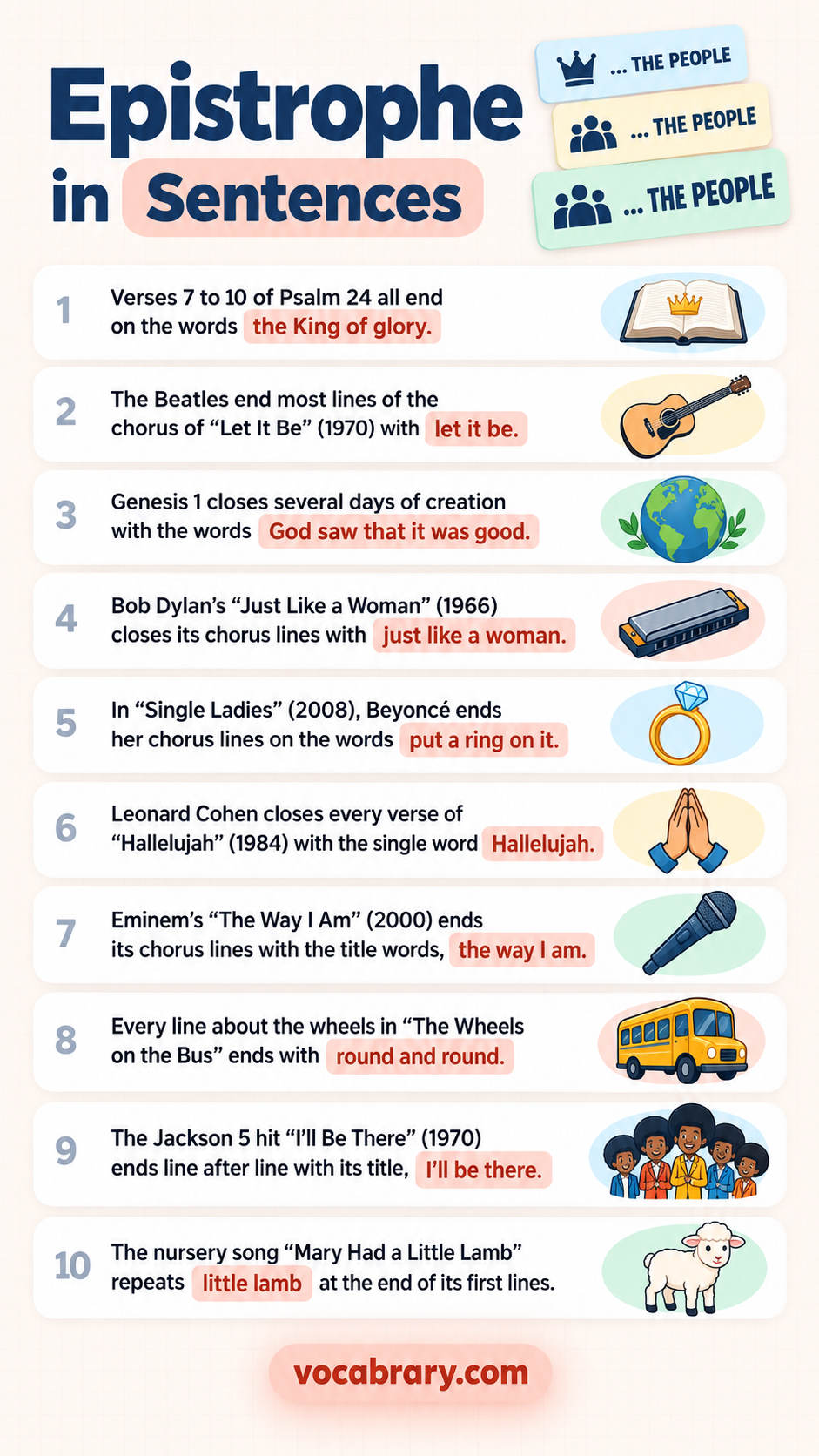
- Genesis 1 closes several days of creation with the words God saw that it was good.
- Verses 7 to 10 of Psalm 24 all end on the words the King of glory.
Epistrophe Examples in Songs
Songs such as "Let It Be," "Hallelujah," and "Blowin’ in the Wind" end verse after verse on their own title words. That repeated title is the part everyone sings along to.
- The Jackson 5 hit "I’ll Be There" (1970) ends line after line with its title, I’ll be there.
- In "Single Ladies" (2008), Beyoncé ends her chorus lines on the words put a ring on it.
- Bob Dylan’s "Just Like a Woman" (1966) closes its chorus lines with just like a woman.
- Each verse of Dylan’s "Blowin’ in the Wind" (1963) ends by giving the same answer, blowin’ in the wind.
- The Beatles end most lines of the chorus of "Let It Be" (1970) with let it be.
- Leonard Cohen closes every verse of "Hallelujah" (1984) with the single word Hallelujah.
- Most verses of Simon and Garfunkel’s "The Sound of Silence" (1964) end on the sound of silence.
- Eminem’s "The Way I Am" (2000) ends its chorus lines with the title words, the way I am.
- Bob Marley’s "No Woman, No Cry" (1974) returns again and again to no woman, no cry.
- Queen’s stadium anthem "We Will Rock You" (1977), with its stamping and clapping, closes each chorus line on the words rock you.
Epistrophe Examples for Kids
A kitten that begs for "milk," a dog that growls "at the mailman," and the picture book Brown Bear, Brown Bear, What Do You See? give children short epistrophe examples that are fun to read aloud.
- Our kitten wanted milk, asked for milk, and meowed for more milk.
- In Brown Bear, Brown Bear, What Do You See? (1967) by Bill Martin Jr., every animal’s line ends with looking at me.
- In Green Eggs and Ham (1960), Dr. Seuss ends line after line with the name Sam-I-am.
- The nursery song "Mary Had a Little Lamb" repeats little lamb at the end of its first lines.
- Every line about the wheels in "The Wheels on the Bus" ends with round and round.
- The action song "If You’re Happy and You Know It" closes its first lines with clap your hands.
- Our dog barks at the mailman, growls at the mailman, and wags his tail at the mailman.
- Lily played in the sand, built castles in the sand, and lost her shoe in the sand.
- All day Ben ate pizza, drew pizza, and dreamed about pizza.
- Baby Rosie giggled at the bubbles, clapped at the bubbles, and grabbed at the bubbles.
- My teddy eats with me, plays with me, and sleeps with me.
- At the zoo, we looked at the monkeys, laughed at the monkeys, and waved at the monkeys.
- Is it sunny outside? Are the swings dry outside? Are my friends outside?
- A little green frog hopped in the pond, swam in the pond, and took a nap in the pond.
Epistrophe Examples for Students
Noah studying "at the library," a student council that promises to work "for students," and a thesis about uniforms that punish "self-expression" show epistrophe in essays, campaign speeches, and campus life.
- Before finals, Noah studied at the library, ate at the library, and nearly slept at the library.
- "Our school needs more teachers, more respect for teachers, and better pay for teachers," Zara wrote in her editorial.
- In her college essay, Priya wrote that she learned from failure, grew from failure, and never ran from failure.
- The student council president promised to listen to students, work for students, and answer to students.
- Our dorm is noisy at night, cold at night, and fun at night.
- "I studied for this, I stayed up for this, and I earned this," Jamal said after graduation.
- Every writing teacher gives the same advice: write the draft, reread the draft, and then rewrite the draft.
- Was the test hard? Was the homework hard? Was anything this term not hard?
- "Science taught me to question the world, measure the world, and respect the world," the valedictorian said.
- During exam week, Lena drank coffee at dawn, reviewed her notes at dawn, and walked into her first test at dawn.
- School uniforms limit self-expression, discourage self-expression, and punish self-expression.
- In his campaign speech, Omar asked for your vote, worked for your vote, and promised to deserve your vote.
- Mia read the novel twice, annotated it twice, and cited it twice in her essay.
- Sophomores complain about homework, joke about homework, and secretly worry about homework.
Epistrophe Examples With Slightly Different Endings
Brutus weeping for, honoring, and killing "him," Tennyson’s "six hundred," and Roosevelt’s shift from "everywhere" to "anywhere in the world" show epistrophe that bends the repeated ending slightly while keeping its core word.
- In Julius Caesar, Brutus says that because Caesar loved him he weeps for him, because Caesar was brave he honors him, and because Caesar was ambitious he killed him.
- Tennyson’s "The Charge of the Light Brigade" (1854) ends its stanzas with the six hundred, not the six hundred, and left of six hundred.
- Roosevelt’s Four Freedoms speech moves from everywhere in the world for three freedoms to anywhere in the world for the fourth.
- He was never a friend to me, never kind toward me, and never once there for me.
- The fans love winning, the players need to win, and the owner only counts wins.
- Our parents worried, our teachers were worried, and by midnight even the police were worrying.
- I trust my team, I back my teammates, and I defend our team.
- Tim was scared of the dark, his sister was terrified of the darkness, and the dog hid from the dark.
- Grandpa fished in the river, swam in the rivers near his village, and was baptized in a river.
- The first train was delayed, the second train faced a delay, and by noon every train had delays.
Symploce Examples (Epistrophe Plus Anaphora)
John F. Kennedy’s "Let them come to Berlin," Dickens’s "we had … before us," and a snacker who eats when hungry, bored, or sad show symploce, which repeats both the opening and the ending of each clause.
- In Berlin in June 1963, Kennedy began several sentences with there are some who say and ended each one with let them come to Berlin.
- Dickens writes in A Tale of Two Cities that we had everything before us, we had nothing before us.
- I was born in this town, I was raised in this town, and I was married in this town.
- She never lied to me, she never shouted at me, and she never gave up on me.
- When I’m hungry, I eat; when I’m bored, I eat; when I’m sad, I eat.
- If you want to win, train harder; if you want to lead, train harder.
- Who cooked the dinner? Who paid for the dinner? Who is washing up after the dinner?
- Every morning we pray, and every evening we pray.
- Some days we win at home, and some days we lose at home.
- Most people want peace, and most people vote for peace.
Related
FAQs
No, epistrophe is not the same as anaphora, because the two devices repeat words at opposite ends of a clause. Anaphora repeats the opening words, as in Churchill’s "we shall fight on the beaches, we shall fight on the landing grounds," while epistrophe repeats the closing words, as in "by the people, for the people." More anaphora examples show the opening pattern.
Five well-known examples of epistrophe are Lincoln’s government "for the people," Shylock’s "my bond," Tom Joad’s "I’ll be there," Paul speaking "as a child," and Johnson’s "American problem." In each one, the same words close two or more clauses in a row.
One of the best-known examples of epistrophe in the Bible is 1 Corinthians 13:11, where Paul says he spoke, understood, and thought "as a child." Psalm 136 goes further and ends all 26 of its verses with the same refrain about God’s mercy.
Writers use epistrophe to put the strongest stress on one word or phrase, because listeners remember the end of a sentence best. The repeated ending also builds rhythm and a sense of closure, which is why speechwriters save it for applause lines.
We use epistrophe in speeches, sermons, debates, advertising, songs, and poems, wherever a speaker wants an audience to leave with one phrase in mind. In daily talk it turns up in complaints ("the bus was late, the train was late"), rules from parents, and team talks from coaches.
You identify epistrophe by reading the last words of each clause or sentence in a passage and checking whether the same word or phrase returns. The repeats must come in neighboring clauses, and if the repeated words open the clauses instead of closing them, the device is anaphora.
Figures of repetition are rhetorical devices that repeat sounds, words, or structures for emphasis, and epistrophe, anaphora, symploce, and epizeuxis are four of the best known. Each one repeats in a different position, and these repetition examples show the wider family.
Yes, epiphora and epistrophe are two names for the same device, since both describe repeating a word or phrase at the end of successive clauses or sentences. Some textbooks prefer one name and some the other, but the examples are identical.
The main characteristics of epistrophe are a repeated word or phrase, a position at the end of each clause or sentence, and at least two neighboring clauses that share that ending. The repeated clauses are also parallel in structure, which places epistrophe among the figures of speech that build rhythm.
The function of epistrophe is to make one idea impossible to miss by returning to it at every stopping point. In Lincoln’s Gettysburg Address, ending three phrases on "the people" tells listeners exactly whom the government serves.

Leave a Comment