
Chiasmus is a rhetorical device in which two parallel phrases repeat the same words or meanings in reverse order, as in the saying "Eat to live, not live to eat." Everyday chiasmus examples follow this ABBA pattern with pairs such as work and play, time and money, or friends and help.
What Is Chiasmus?
Chiasmus is a crossed arrangement of two matching phrases, where the second phrase takes the terms of the first and returns them in the opposite sequence. Unlike antimetabole, which repeats the exact same words, chiasmus also counts reversals of meaning in different words, as in "by day the frolic, and the dance by night."
Theo cooks to relax, and on weekends he relaxes by cooking.
Common Chiasmus Examples in Sentences
Eating to live rather than living to eat, spending time to save money, and asking a friend for help are the textbook chiasmus examples, where the second half swaps the order of the first.
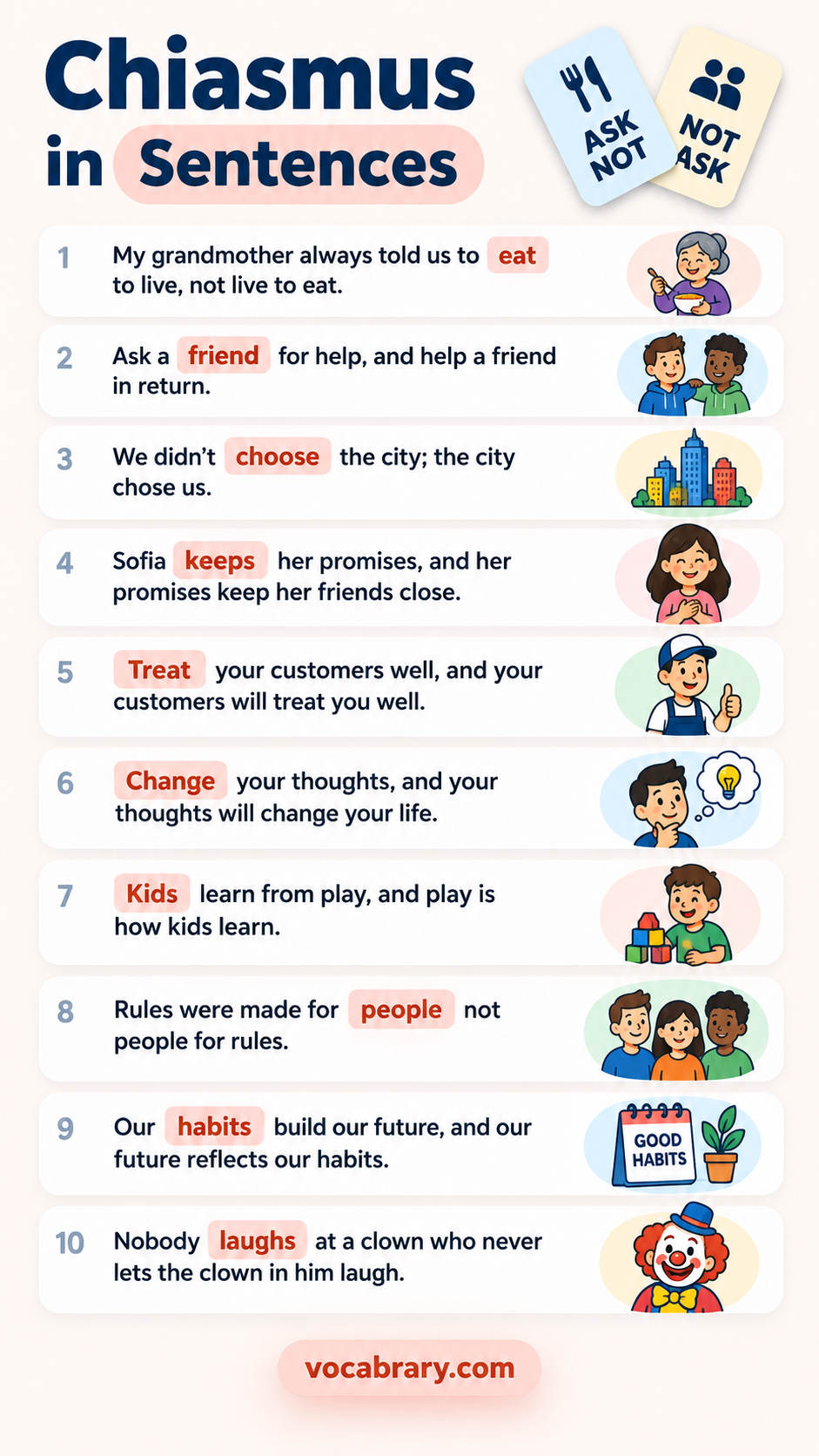
- My grandmother always told us to eat to live, not live to eat.
- Some people spend money to save time, and others spend time to save money.
- Ask a friend for help, and help a friend in return.
- A good teacher is always a student, and a good student is quietly a teacher.
- Is it love that turns the world, or the world that teaches us to love?
- We didn’t choose the city; the city chose us.
- Sofia keeps her promises, and her promises keep her friends close.
- Treat your customers well, and your customers will treat you well.
- Change your thoughts, and your thoughts will change your life.
- Kids learn from play, and play is how kids learn.
- A smile starts a conversation, and a conversation ends in a smile.
- Rules were made for people, not people for rules.
- Our habits build our future, and our future reflects our habits.
- Nobody laughs at a clown who never lets the clown in him laugh.
- The student became the teacher, and years later the teacher became a student again.
- On our farm, we eat what we grow, and we grow what we eat.
- Old friends turn into the best friends, and the best friends turn into old friends.
- It isn’t how much you have that makes you happy, but how happy you are with what you have.
- Did Dad adopt the puppy, or did the puppy adopt Dad?
- A question leads to an answer, and every good answer leads to a new question.
- Words reveal a person, and a person is judged by their words.
- In our family, dinner waits for Grandpa, but Grandpa never waits for dinner.
- Some people talk to learn, while others learn to talk less.
- When a nation trusts its teachers, its teachers build a stronger nation.
- Grace never follows the crowd, yet the crowd always follows Grace.
Chiasmus Examples in Everyday Life
Kitchens, bus stops, and airports supply everyday chiasmus, as when a neighbor walks his dog at dawn and the dog walks him at dusk, or a delayed plane waits for a late passenger.
- Our neighbor walks his dog at dawn, and at dusk the dog walks him.
- We moved to the city for jobs, and the jobs kept us in the city.
- My brother doesn’t own his phone; his phone owns him.
- Tidy as you cook, and you’ll cook in a tidy kitchen.
- When the kids fall asleep, the parents wake up, and when the parents fall asleep, the kids wake up.
- Bad sleep leads to stress, and stress leads to bad sleep.
- Exercise gives Rahul energy, and energy pushes him to exercise.
- The more we cooked at home, the less we ate out, and the less we ate out, the more we cooked at home.
- Does Jess drink coffee to wake up, or wake up to drink coffee?
- On Sundays, Grandma cooks for the family, and the family cooks for Grandma.
- We bought the house for the garden and spent more time in the garden than in the house.
- At the airport, Paolo waited for the plane, and then the plane waited for Paolo.
- Some shoppers wear clothes for comfort; others give up comfort for clothes.
- Carlos saved his money for a bike, and the bike saved him money on bus fares.
- Keep your car in good repair, and your car will keep you safe.
- In winter we heat the house, and the house heats our cold hands.
- Lina doesn’t run her schedule; her schedule runs her.
- Mom tidies the kitchen after dinner, and the tidy kitchen calms Mom.
- Every morning the alarm wakes Ravi, and every night Ravi sets the alarm again.
- If the bus never waits for us, why do we always wait for the bus?
Chiasmus in Proverbs and Everyday Sayings
"When the going gets tough, the tough get going" and "Fail to plan, and you plan to fail" are proverbs that pass advice on through a reversed pair.
- When the going gets tough, the tough get going.
- Fail to plan, and you plan to fail.
- Say what you mean, and mean what you say.
- Don’t count the days; make the days count.
- It’s not the years in your life that count; it’s the life in your years.
- A place for everything, and everything in its place.
- Do what you love, and love what you do.
- Some say seeing is believing, but for many people believing is seeing.
- Time is money, but no amount of money buys back time.
- Newsroom editors say a dog biting a man is no story, but a man biting a dog is headline news.
- Look after your friends, and your friends will look after you.
- You don’t stop playing because you grow old; you grow old because you stop playing.
- Winners never quit, and quitters never win.
- You reap what you sow, so sow what you want to reap.
- Health is wealth, and wealth without health is worth little.
Chiasmus Examples About Love and Friendship
Couples who were friends before they fell in love, a heart that picks a person, and friends who share secrets appear in these love lines, where two people give the same thing back.
- Love the life you live, and live the life you love.
- Jana didn’t find love; love found Jana at a bus stop in Lisbon.
- We were friends before we fell in love, and we fell in love because we were friends.
- In a good marriage, you listen to love and love to listen.
- Choose a partner who makes you laugh, and laugh with the partner you choose.
- Friends share their secrets, and secrets test their friends.
- Absence never weakens true love; true love outlasts every absence.
- Is it the heart that picks the person, or the person who wins the heart?
- Some couples fight to stay together, and others stay together to fight.
- Keep your friends close, and let your close friends keep you honest.
- "I married my best friend, and my best friend married me," Omar joked in his wedding speech.
- Grandpa said he married Grandma for her laugh and then laughed with Grandma for sixty years.
Chiasmus Examples About Work and Success
Leaders who read, money that works for its owner, and a company that looks after its staff are workplace chiasmus examples, and each one ties effort to reward in both directions.
- Leaders read, and readers lead.
- Choose a job you love, and you will love the job you choose.
- Don’t work for money; make money work for you.
- Happiness leads to success far more than success leads to happiness.
- The company takes care of its staff, and the staff take care of the company.
- Plan your work, and work your plan.
- You don’t build a business; you build people, and people build the business.
- Profit follows quality, but quality never follows profit.
- Is Marco working to pay the bills, or paying the bills to keep working?
- Our startup didn’t choose the market; the market chose our startup.
- The more you earn, the more you spend, and the more you spend, the more you need to earn.
- Aisha never chases deadlines, because deadlines never get the chance to chase Aisha.
Chiasmus Examples in Sports and Motivation
Hard work that outlasts lazy talent, champions who never make excuses, and a swimmer who stays fit to keep swimming turn up in locker rooms and gyms, where a reversed motto drives the team.
- Hard work beats talent when talent doesn’t work hard.
- Take care of your body, and your body will take care of you.
- Train like you want to win, and win the way you trained.
- The team fights for the coach, and the coach fights for the team.
- Champions don’t make excuses, and excuses don’t make champions.
- Winning isn’t everything, but everything goes into winning.
- Push your limits, and each week your limits push back a little less.
- You miss the shots you never take, and you never take the shots you fear missing.
- Mia swims to stay fit, and she stays fit to keep swimming.
- Is it confidence that brings wins, or wins that bring confidence?
- Motivation starts the habit, and the habit keeps the motivation going.
- Before the final, the coach told us to run for the team, not to wait for the team to run for us.
Funny Chiasmus Examples
Cats who own their owners, a snoring dad, and a diet that restarts every Monday make up these funny chiasmus examples, where the swap reveals who is really in charge.
- My cat doesn’t live with me; I live with my cat.
- Dad doesn’t snore in his sleep; he sleeps in his snore.
- I don’t have a sweet tooth; my sweet tooth has me.
- My diet starts tomorrow, and tomorrow starts my diet all over again.
- At our office, the printer doesn’t work for us; we work for the printer.
- Aunt Lucy eats cake to celebrate, and she celebrates to eat cake.
- Some people drink coffee to work; I work to drink coffee.
- Did I skip the gym, or did the gym skip me?
- Tom’s socks don’t get lost in the dryer; the dryer gets lost under Tom’s socks.
- Comedian Yakov Smirnoff made the Russian reversal famous with jokes in which you don’t watch TV, because in Soviet Russia TV watches you.
- I don’t put off my homework; my homework puts off me.
- Our weekend never ends on Monday, because Monday ends our weekend before it starts.
Short Chiasmus Examples for Kids
Cats and mice, bees and flowers, and a big sister who helps her little brother are short chiasmus examples for kids, since each pair swaps places in the second half.
- Mom hugs me, and I hug Mom.
- Bees love flowers, and flowers love bees.
- The cat chased the mouse, and then the mouse chased the cat.
- I feed my dog, and my dog feeds me kisses.
- My dog trusts me, and I trust my dog.
- Play fair with friends, and friends will play fair with you.
- Big sister helps little brother, and little brother helps big sister.
- The rain waters the garden, and the garden drinks the rain.
- In class, we listen to Ms. Patel, and Ms. Patel listens to us.
- Nina smiled at the baby, and the baby smiled back at Nina.
- Do you pick the puppy, or does the puppy pick you?
- At bedtime, I read a story to my teddy bear, and my teddy bear listens to every story I read.
Chiasmus Examples for Students
Exams, homework, and history class supply chiasmus examples for students, as in passing tests because you learn or questions that lead to answers, and these lines suit AP Lang essays and debate speeches.
- We don’t learn to pass exams; we pass exams because we learn.
- Teachers learn from their students, and students learn from their teachers.
- The more you practice, the better you get, and the better you get, the more you want to practice.
- In my essay, I argued that schools change students and students change schools.
- Maria asks questions to find answers, and her answers lead to new questions.
- Homework builds habits, and good habits make homework faster.
- For the debate, Kofi wrote that we should not fear change but change what we fear.
- In history class, we learned that people make history and history makes people.
- Is the grade a measure of learning, or has learning become a chase for the grade?
- My AP Lang essay ended with a warning: we must defend freedom so that freedom defends us.
- Knowledge brings confidence in class, and confidence brings more knowledge.
- Good writers read to write, and good readers write to read more closely.
Types of Chiasmus With Examples
Antimetabole, conceptual chiasmus, grammatical chiasmus, and the longer ABCCBA form are the four types of chiasmus that rhetoric teachers name, and each one reverses a different layer of the sentence.
Antimetabole
Antimetabole repeats the identical words in reverse order, as when an artist paints what she sees and sees what she paints, or music moves people and people move to music.
- The artist paints what she sees and sees what she paints.
- Music moves people, and people move to music.
- The more Juan sings, the happier he gets, and the happier he gets, the more he sings.
- Nurses care for patients, and patients care about their nurses.
- In this mountain town, you don’t choose the weather; the weather chooses you.
- Ambition fuels effort, and effort fuels ambition.
- Food brings families together, and families bring food home.
- Stories teach children, and children teach us new stories.
- We live to dance, and we dance to live.
- Did the river build the city, or did the city build up the river?
Conceptual Chiasmus
Conceptual chiasmus reverses meanings rather than exact words, as when Farah is rich in money but in friendship poor, or gentle words give way to a harsh silence.
- Lena has my love, and my heart is hers.
- Hector has my trust, and my faith is in Hector.
- Farah was rich in money, in friendship poor.
- Her words were gentle, but harsh was her silence.
- Mateo spends his mornings on work, and on rest he spends his evenings.
- I trust my doctor, and my physician trusts me.
- The farmer loves his land, and his fields love him back.
- Our coach praised the defense, and the offense got his criticism.
- The fans cheered the win, and the loss they mourned in silence.
- Early to the office, to bed late: that was Dr. Okafor’s routine for the thirty years she ran the city hospital.
Grammatical Chiasmus
Grammatical chiasmus flips the grammar itself, so a bright morning turns into an evening dark, or a man born poor dies rich.
- Bright was the morning, and the evening dark.
- Quick to laugh, to anger slow, Grandpa never lost a friend.
- She loves the sea, and the mountains she fears.
- The soup was hot, and cold the bread.
- Kind in words, in actions cruel, the villain fooled the whole town.
- Born poor, rich he died.
- He ate the cake, and the pie he left.
- Long was the exam, and short the break.
Extended Chiasmus
Extended chiasmus runs three terms forward and then three back, ABCCBA, as in planting, watering, and harvesting before watering and planting again, or reading a book, watching the film, and arguing.
- First we plan, then we build, then we test; the test improves the build, and the build improves the plan.
- Ana wakes early, runs to the park, and stretches; then she stretches, runs home, and wakes the house.
- We read the book, watched the film, and argued; after arguing, we watched the film again and reread the book.
- Seeds need soil, soil needs rain, and rain returns to the soil that feeds the seeds.
- Money buys time, time buys freedom, and freedom, given time, earns money again.
- Mom checks the stove, locks the door, and turns off the lights; Dad turns on the lights, opens the door, and checks the stove.
- In spring we plant, in summer we water, and in fall we harvest; after the harvest, we water the soil and plant again.
- Coffee wakes the mind, the mind finds the words, and the words keep the mind alert for more coffee.
Famous Chiasmus Examples in Speeches and Quotes
John F. Kennedy’s 1961 inaugural, Winston Churchill’s wartime speeches, and Abraham Lincoln’s 1864 letter supply the most famous chiasmus examples, and every one of them is still quoted today.
Chiasmus in Political Speeches
Kennedy on negotiating out of fear, Churchill on the end of the beginning, and John McCain on changing Washington used chiasmus at the moment an audience listened most closely.
- John F. Kennedy’s inaugural address of January 1961 urged Americans to stop asking what their country would do for them and to ask what they would do for their country.
- Kennedy asked the nation in that 1961 inaugural never to negotiate out of fear, but never to fear to negotiate.
- Speaking to the United Nations in September 1961, Kennedy warned that mankind must put an end to war, or war will put an end to mankind.
- After the victory at El Alamein in November 1942, Winston Churchill said the war had not reached the beginning of the end, only the end of the beginning.
- Arguing in October 1943 for rebuilding the bombed House of Commons in its old form, Churchill said that we shape our buildings, and afterward our buildings shape us.
- Accepting the Republican nomination in September 2008, John McCain admitted that his party was elected to change Washington and instead let Washington change them.
- Malcolm X told his listeners that Black Americans never landed on Plymouth Rock, because Plymouth Rock landed on them.
Chiasmus Quotes From Writers and Thinkers
Confucius on learning and thought, Socrates on eating and living, and Oscar Wilde on life and art put a whole philosophy into one reversed line.
- Confucius, in the Analects, called learning without thought wasted effort and thought without learning dangerous.
- Socrates, according to the ancient biographer Diogenes Laertius, said that other men live to eat, while he ate to live.
- Abraham Lincoln wrote in an April 1864 letter that he had not controlled events, and that events had controlled him.
- Karl Marx argued in his 1859 preface to A Contribution to the Critique of Political Economy that consciousness does not decide social being, but social being decides consciousness.
- In Oscar Wilde’s 1889 essay "The Decay of Lying," the speaker Vivian argues that life imitates art far more than art imitates life.
Chiasmus Examples in Literature
Macbeth’s witches, Milton’s Satan, and Carroll’s Mad Hatter deliver the best-known chiasmus examples in literature, and each reversal compresses a paradox into a single line.
Chiasmus in Shakespeare
The witches in Macbeth, the imprisoned king in Richard II, and Hamlet coaching the actors show that Shakespeare used chiasmus for spells, regrets, and stage advice alike.
- The witches in Macbeth open the play by chanting that fair is foul, and foul is fair.
- Locked in prison near the end of Richard II, King Richard admits that he wasted time, and now time wastes him.
- Shakespeare ends Sonnet 154 with the line that love’s fire heats water, while water never cools love.
- In Othello, Iago describes a jealous husband as a man who dotes yet doubts, suspects yet still loves.
- Hamlet tells the traveling players to suit the action to the word, and the word to the action.
Chiasmus in Poetry
John Keats, Mary Leapor, and John Milton in Paradise Lost (1667) each closed or balanced a line of verse with a reversal, and the chiasmus gives the line a finished sound.
- John Keats closes "Ode on a Grecian Urn" (1819) with the urn’s message that beauty is truth, truth beauty.
- Samuel Johnson describes a young man’s pleasures in "The Vanity of Human Wishes" (1749) as "by day the frolic, and the dance by night."
- Alexander Pope’s The Dunciad mocks a man who passes for a wit among dunces and a dunce among wits.
- Mary Leapor’s "An Essay on Woman" (1751) complains that a woman is despised if ugly, and if fair, betrayed.
- In "Song of Myself," Walt Whitman says the people he watches tend inward to him, and he tends outward to them.
- Lord Byron’s Don Juan calls pleasure a sin, and then admits that sin is now and then a pleasure.
- In Book 1 of Paradise Lost, Satan boasts that the mind turns heaven into hell and hell into heaven.
- Milton introduces the first couple in Book 4 of Paradise Lost as Adam, first of men, beside the first of women, Eve.
- Earlier in Book 4, Milton calls Adam the goodliest of men and the fairest of her daughters Eve.
- Book 3 of Paradise Lost describes the Son’s mercy as love without end, and without measure grace.
Chiasmus in Novels and Memoirs
Frederick Douglass, George Orwell, and Cormac McCarthy each turned a reversed phrase into the line readers remember from the whole book.
- In his 1845 Narrative, Frederick Douglass tells readers they have seen how a man was made a slave and will now see how a slave was made a man.
- Alexandre Dumas gives the heroes of The Three Musketeers (1844) the motto all for one, one for all.
- Cormac McCarthy’s The Road (2006) observes that people forget what they want to remember and remember what they want to forget.
- George Orwell ends Animal Farm (1945) with the farm animals looking from pig to man, and from man to pig, unable to tell which is which.
- Lord Henry tells Dorian in Oscar Wilde’s The Picture of Dorian Gray (1890) that only the senses cure the soul, just as only the soul cures the senses.
Chiasmus in Children’s Books
Horton the elephant and the guests at the Mad Tea-Party in Alice’s Adventures in Wonderland play with chiasmus, and young readers enjoy hearing the same words swap places.
- In Dr. Seuss’s Horton Hatches the Egg (1940), Horton promises that he meant what he said and said what he meant.
- At the Mad Tea-Party in Lewis Carroll’s Alice’s Adventures in Wonderland (1865), Alice claims that meaning what she says equals saying what she means.
- The Hatter answers Alice that seeing what you eat is not the same as eating what you see.
- Joining in, the March Hare adds that liking what you get differs from getting what you like.
- Half asleep, the Dormouse says that breathing when you sleep is not the same as sleeping when you breathe.
Chiasmus Examples in the Bible
The first who will be last, the Sabbath made for man, and whoever finds his life and loses it are chiasmus examples from the Bible that reverse worldly expectations.
Chiasmus in the Gospels
Matthew, Mark, and Luke record Jesus reversing first and last, exalted and humbled, and finding and losing, so each saying turns ordinary status upside down.
- Jesus tells his followers in Matthew 19:30 that many who are first will be last, and the last will be first.
- In Mark 2:27, Jesus says the Sabbath was made for man, not man for the Sabbath.
- Matthew 10:39 teaches that whoever finds his life will lose it, and whoever loses his life for Christ’s sake will find it.
- According to Matthew 23:12, whoever exalts himself will be humbled, and whoever humbles himself will be exalted.
- Luke 13:30 repeats the reversal, saying some who are last will be first, and some who are first will be last.
- Warning his listeners in Matthew 7:6, Jesus tells them not to give what is holy to dogs or pearls to swine, lest the swine trample them and the dogs turn and attack.
- The parable of the vineyard workers in Matthew 20:16 ends with the saying that the last will be first, and the first last.
Chiasmus in the Hebrew Bible
Genesis on the creation of man, Isaiah on calling evil good, and Isaiah on God’s thoughts and ways show chiasmus in Hebrew scripture, where the reversal marks a law, a warning, or a promise.
- According to Genesis 1:27, God created man in his own image, and in the image of God he created him.
- Genesis 9:6 rules that whoever sheds the blood of man, by man shall that person’s blood be shed.
- Isaiah 5:20 condemns those who call evil good and good evil.
- In Isaiah 55:8, God tells the people that my thoughts are not your thoughts, and your ways are not my ways.
- The prophet in Isaiah 6:10 is told to dull the people’s heart, ears, and eyes, so they will not see with their eyes, hear with their ears, or understand with their heart.
Chiasmus Examples in Advertising and Slogans
A 1990s Bounce commercial, a bakery that bakes what you love, and a gym banner about getting fit show why marketers favor chiasmus: shoppers repeat a reversed slogan after one hearing.
- A 1990s Bounce dryer sheet commercial promised that the product stops static before static stops you.
- The gym banner read, "Get fit to have fun, and have fun getting fit."
- At Rosa’s Bakery, the sign says, "We bake what you love, and you love what we bake."
- "Don’t just see the world; let the world see you," read the travel agency’s billboard.
- The coffee chain’s poster said, "You wake up for coffee, and coffee wakes you up."
- Our local bank’s slogan is "We work for your money, so your money works for you."
- Outside the pet shop, a chalkboard said, "Love your pet, and your pet will love you back."
- "Wear our jackets in the rain, and the rain won’t wear you down," the outdoor brand promised.
- One phone company’s ad told customers to stay connected to their family so their family stays connected to them.
- Green Leaf Farms uses the line "We grow your food, and our food keeps you growing."
- "Books open minds, and open minds find books," declared the bookstore’s window.
- Why sell cars, the dealership’s radio ad asked, when our cars sell themselves?
Related
FAQs
Five well-known examples of chiasmus are "Eat to live, not live to eat," "Fair is foul, and foul is fair" from Macbeth, and "Beauty is truth, truth beauty" from Keats. The other two are Kennedy’s line about never negotiating out of fear and never fearing to negotiate, and Mark 2:27, where the Sabbath was made for man, not man for the Sabbath.
No, chiasmus and antimetabole are not exactly the same, because antimetabole is the narrower type that repeats the identical words in reverse order. "Eat to live, not live to eat" is antimetabole and chiasmus at once, while "despised if ugly; if fair, betrayed" is chiasmus only, since it reverses related meanings rather than repeating words.
Chiasmus and antithesis differ in what they do with the two halves: chiasmus reverses the order of repeated words or meanings, while antithesis sets two opposite meanings side by side in parallel form. "Fair is foul, and foul is fair" uses both devices, since fair and foul are opposites and they also swap places. More antithesis examples show the parallel contrast without the reversal.
Authors use chiasmus to make a line memorable, to stress a contrast, and to give a sentence a balanced rhythm. Speakers such as Kennedy and Churchill relied on it because listeners repeat a reversed phrase like "the end of the beginning" long after the speech ends.
The effect of chiasmus on the reader is a pause at the turn, where the reader compares the two halves and notices how the second half changes the first. In "Life imitates art far more than art imitates life," readers stop to rethink which one copies the other, and that second look is what makes the line stay with them.
Yes, chiasmus is a figure of speech, and more precisely a rhetorical device, because its effect comes from the arrangement of words rather than from any change in their literal meaning. Most classroom groupings of figures of speech place it beside antithesis, parallelism, and anaphora.
Chiasmus is pronounced kye-AZ-muss, with a hard k sound at the start and the stress on the second syllable. The plural is chiasmi (kye-AZ-mye) or chiasmuses, and the adjective is chiastic (kye-AS-tik).
The word chiasmus comes from the Greek verb chiazein, meaning to mark with the letter chi, which looks like a cross when written. The device itself is far older than the name, since Hebrew scripture, Greek orators, and Latin poets all used crossed word order.
Chiasmus is used in the Bible at two levels: in single verses such as Matthew 20:16 and in longer passages built as ABCCBA patterns around a central line. Isaiah 6:10 is a short case of the longer kind, since heart, ears, and eyes return in reverse order as eyes, ears, and heart.
You write a chiasmus by stating a phrase with two terms, A and B, and then repeating or echoing those terms in reverse order in the second half. Start with a pair such as money and time: "spend money to save time" becomes "spend time to save money" in the second half. The chiasmus lesson on Englishan explains the ABBA structure step by step.
The parts of a chiasmus are two matching halves, the repeated terms inside each half, and the turn where the order of those terms reverses. In "Say what you mean, and mean what you say," the halves share the verbs say and mean, and the turn comes right after the comma.

Leave a Comment