
Begging the question is a logical fallacy in which an argument assumes in its premise the claim it sets out to prove, as when a rule is called fair because it treats people fairly. The plainest begging the question examples restate the conclusion as a reason, wrapped in one confident sentence.
What Is Begging the Question?
Begging the question is a fallacy of presumption where the reason offered for a conclusion already takes that conclusion for granted, so the argument moves in a closed loop. Circular reasoning describes a loop stretched over several steps, while begging the question compresses the loop into a single premise.
The new schedule is the fairest one ever written because no fairer schedule has ever been written.
Common Begging the Question Examples in Sentences
Calling a rule fair because it treats people fairly, praising a novel as the finest because none was better, and defending a bridge as safe because engineers certify no unsafe bridges are the textbook cases. Each reason repeats the conclusion in fresh words.
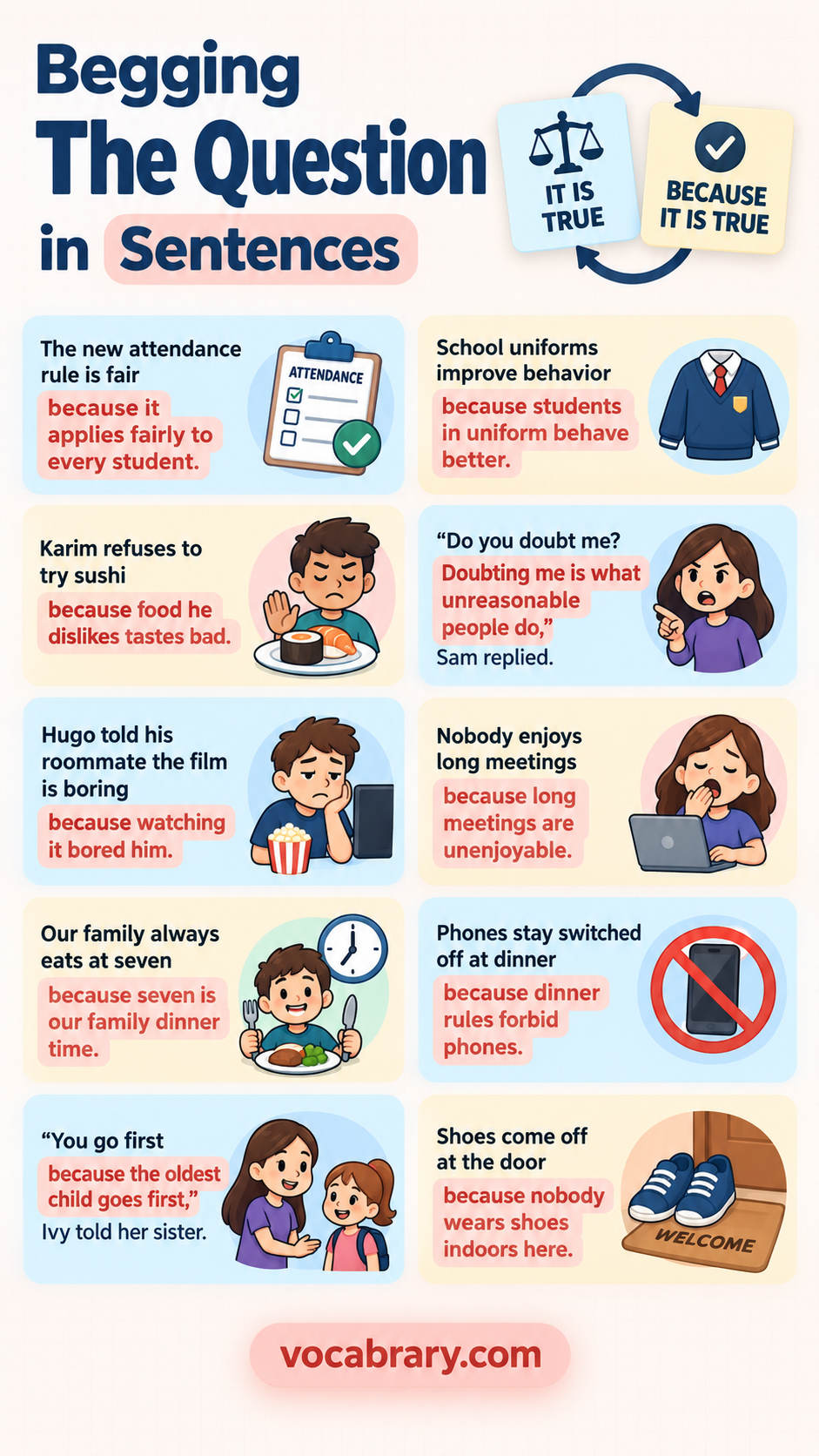
- The new attendance rule is fair because it applies fairly to every student.
- Sara insists her novel is the finest of the year because no better novel came out this year.
- "Lying is wrong because it is immoral," Daniel told the debate club, and nobody asked him why.
- Voting deserves everyone’s effort because a country without voters has no democracy, the flyer argued, proving nothing.
- Our coffee is the freshest in town because nowhere in town sells fresher coffee.
- Marcus argued that the treaty is legal because the law permits it, without naming a single statute.
- Reading every night makes children smarter because nightly readers grow into smarter children.
- "Everyone believes it, so it must be what everyone believes," Hana said, and the room went quiet.
- That painting deserves the prize because it is the most deserving painting entered.
- The committee ruled the vote honest because honest committees never approve dishonest votes, and the minutes say nothing more.
- Nobody doubts the report because reports this thorough leave no room for doubt.
- Leo claims cheating hurts a class because classes where students cheat end up hurt.
- A pamphlet claimed the medicine works because patients who take it get well, citing no trial.
- Is the policy sensible? Of course, since only a sensible policy would pass this committee.
- Yusuf turned in an essay arguing that free speech protects liberty because liberty depends on free speech.
- Drivers were told the bridge is safe because engineers never certify unsafe bridges.
- Rita refuses to call the plan risky because plans this careful involve no risk.
- "The recipe is authentic because real cooks make it this way," Nonna said, ending the discussion.
- School uniforms improve behavior because students in uniform behave better.
- Every word of the manual is accurate because the manual was written to be accurate.
Begging the Question Examples in Everyday Conversation
Friends at dinner defend a cafe as the best nearby, a neighbour vouches for a terrier, and a brother claims the last slice by right. Begging the question examples in ordinary talk end an argument by repeating it.
- "Trust me, I am right because I am never wrong," Adnan told his brother over dinner.
- My neighbour calls his terrier friendly because friendly dogs never bite strangers.
- Tamsin swears the new cafe is the best nearby because no cafe in the neighbourhood is better.
- "Everyone loves that show because it is universally loved," Bea said, scrolling past the reviews.
- Karim refuses to try sushi because food he dislikes tastes bad.
- "I deserve the last slice because the last slice is mine by right," Theo announced.
- Priya insists her route home is quickest because no quicker route exists from here.
- Nothing beats a homemade birthday cake because bought cakes are never as good as homemade ones.
- "You are being rude because rude people talk exactly the way you are talking right now," Nora said.
- Jonah argues that expensive headphones sound better because cheap headphones sound worse.
- My uncle never trusts weather apps because unreliable forecasts prove the apps are wrong.
- "That restaurant is overrated because people rate it too highly," Felix said between bites.
- Anika calls her cousin the funniest person alive because nobody alive is funnier.
- Waking early makes a morning productive because productive mornings start early.
- "Do you doubt me? Doubting me is what unreasonable people do," Sam replied.
- Hugo told his roommate the film is boring because watching it bored him.
- Nobody enjoys long meetings because long meetings are unenjoyable.
- Our family always eats at seven because seven is our family dinner time.
Begging the Question Examples in Home and Family Rules
Bedtime at nine, shoes off at the door, and Saturday cleaning are household rules defended by naming themselves. Parents repeat the rule itself the moment a child asks why, since the rule becomes its own reason.
- "Bedtime is nine because nine is bedtime in this house," Dad said, closing the door.
- Phones stay switched off at dinner because dinner rules forbid phones.
- Mum ended the argument by saying the chore chart is fair because she wrote it to be fair.
- "You go first because the oldest child goes first," Ivy told her sister.
- Shoes come off at the door because nobody wears shoes indoors here.
- Grandpa insists Sunday lunch is sacred because sacred meals are never skipped.
- "Why is the rule the rule? Because it is the rule," my brother mimicked.
- Screen time ends at eight because eight is when screen time ends.
- Dad refuses to raise the allowance because the current allowance is already the right amount.
- "Sharing is only fair because fairness means sharing," Mum told the twins, who kept fighting.
- Nobody skips Saturday cleaning because Saturday is cleaning day.
- My aunt argues that her lasagna beats every other because no other lasagna in the family compares.
- The youngest never picks the film because film choice goes to the older children.
- "Ask your father because your father decides such questions," Mum said without looking up.
- Curfew stays at ten because ten is late enough for a fourteen-year-old, and late enough is late enough.
Begging the Question Examples at School and in Exams
Ms. Delgado’s grading, an unfair history paper, and an essay marked A because A-grade essays argue that way come from classrooms where begging the question settles a dispute without evidence.
- "This answer is correct because the correct answer is the one I wrote," Milo argued.
- The history exam was unfair because fair exams never confuse students the way that one did.
- Ms. Delgado insists her grading is objective because objective teachers grade the way she does.
- Homework builds discipline because disciplined students are the ones who finish homework.
- "That essay deserves an A because A-grade essays argue like that one," the tutor wrote.
- Nadia claims chemistry is harder than biology because biology is easier.
- Students who study alone score higher because higher scores come from solitary study.
- The library rule against talking is reasonable because reasonable libraries stay silent.
- "You failed because failing students never prepare," the principal told Omar flatly.
- Group projects teach teamwork because teamwork is what group projects teach.
- Rashid argues that his university is the strongest in the country because the country has no stronger university.
- Calculators ruin arithmetic because arithmetic skills vanish when pupils use calculators.
- "Is the marking scheme fair? A fair scheme was used, so yes," the examiner replied.
- Our school day begins at eight because eight in the morning is the proper start.
- Cheating deserves expulsion because expulsion is the penalty cheaters earn.
Begging the Question Examples at Work and in Hiring
Panels that call a candidate qualified because only qualified people reach interview, appraisal scores praised for their accuracy, and voluntary overtime nobody is forced to volunteer for show the fallacy at work.
- "The candidate is qualified because we only interview qualified candidates," the manager told the panel.
- Overtime is voluntary because nobody is forced to volunteer.
- Farida defended the promotion as merit-based because the company promotes on merit.
- "Our process is bias-free because unbiased recruiters designed it," the slide announced.
- Remote workers are less committed because committed employees come to the office.
- The appraisal system is accurate because accurate scores come out of it every quarter.
- Dimitri argues that the salary offer is generous because stingy firms never offer this much.
- Nobody questions the budget because the finance director approved it, and the finance director approves nothing unsound.
- "She is the right hire because the right hire looks exactly like her resume," Klaus said.
- Long hours prove loyalty because loyal staff stay late.
- Restructuring the team is necessary because the company needs it.
- Emil refuses to reopen the vacancy because the shortlist already names the strongest applicants.
- Our training works because staff who complete it perform effectively.
- "Was the rejection fair? Fair panels reject weak applicants, so yes," the email said.
- Freelancers earn less because lower pay is what freelance work brings.
Begging the Question Examples in Advertising
Slogans for juice, detergent, and mattresses promise the freshest, the deepest, and the most comfortable because nothing surpasses them. Advertising begging the question examples turn a superlative into its own proof.
- "The freshest juice on the shelf because nothing on the shelf is fresher," the label promised.
- Our detergent cleans deepest because no detergent cleans deeper.
- A poster for a gym claimed the plan works because members who follow it get fitter.
- "Doctors recommend it because it is the brand doctors recommend," the advert repeated.
- Vela Water tastes purer because purity is what Vela bottles.
- The mattress is the most comfortable ever made because no mattress ever made is more comfortable.
- "Buy the original because imitations are never original," the radio slogan urged.
- Nordvik boots last longest because long-lasting leather goes into every pair.
- A shampoo advert argued that the formula repairs hair because repaired hair proves the formula worked.
- "Voted best in the city because the city voted for us," the billboard read.
- Sunrise Cereal keeps children full because full children stop asking for snacks.
- Wide coverage justifies the price because one coat is all this paint needs.
- "Nine out of ten owners choose it because it is what nine out of ten owners choose," the packet said.
- Oravel toothpaste whitens better because whiter teeth follow every tube.
- A car advert insisted the model is the safest because safety engineers built it for safety.
Begging the Question Examples in Law and Courtrooms
Prosecutors who call a defendant guilty because innocent people never reach the dock, judges who declare a search lawful, and a confession praised as reliable put the fallacy into legal argument.
- "The defendant is guilty because innocent people never end up in this dock," the prosecutor argued.
- The statute is constitutional because the constitution permits statutes of this kind.
- Judge Alvarez ruled the search lawful because lawful officers conducted it.
- "His confession is reliable because reliable suspects confess," the sergeant wrote in the file.
- Capital punishment deters crime because the death penalty deters.
- Counsel argued that the contract binds both parties because binding contracts oblige everyone who signs.
- "Is the witness credible? Credible witnesses testify under oath, and she did," the barrister said.
- Nobody disputes the verdict because juries this careful never reach a wrong verdict.
- Her eviction was legal because the landlord followed a legal process.
- Ms. Okafor insisted the will is valid because invalid wills never survive probate.
- Bail was refused because refusing bail suits defendants of this kind.
- "Torture is unjustified because justice forbids it," the defence submitted, offering no further reason.
- A tribunal upheld the dismissal because dismissals that follow procedure survive appeal.
- The police report is accurate because officers write accurate reports.
- Every clause of the lease is enforceable because unenforceable clauses never appear in leases drafted by this firm.
Begging the Question Examples in Science and Research Claims
Press releases about a drug that works because working drugs pass trials, peer review defended by the quality of reviewed papers, and a sample called representative misuse proof. Research writing hides the circle behind technical language.
- "The trial proves the drug works because working drugs pass trials," the press release claimed.
- Peer review guarantees quality because reviewed papers are quality papers.
- Dr. Haruki argued that the theory is sound because unsound theories never survive scrutiny.
- "Our data is reliable because we collected it reliably," the conference poster read.
- Homeopathy works because patients who take it recover.
- That sample is representative because it represents the population.
- Nobody questions the finding because published findings have already been questioned.
- A biologist claimed the species is endangered because endangered animals show declining numbers.
- "Is the model accurate? Accurate models predict well, and ours predicted well," the analyst replied.
- Statistics never lie because numbers are honest, and honest measures never mislead.
- Professor Lindqvist maintains that the method is objective because objectivity is built into the method.
- Health officials called the vaccine safe because safety trials cleared it.
- Evolution explains adaptation because adapted creatures evolved.
- Every finding in the paper replicates because irreproducible work never reaches this journal, and this paper reached it.
Begging the Question Examples in Politics
Ministers defending a policy that serves the public, leaflets from the honest party, and a referendum called legitimate because legitimate votes produced it repeat the same claim as its own proof in political speech.
- "This policy serves the public because the public is served by policies like this," the minister said.
- Democracy is the finest system because no system surpasses democracy.
- A councillor defended the tax rise because necessary rises are always necessary.
- "Our party tells the truth because we are the honest party," the leaflet declared.
- Term limits protect voters because unprotected voters keep bad leaders.
- The referendum was legitimate because legitimate votes produced it.
- Nobody trusts the opposition because untrustworthy parties lose elections, and they lost.
- A mayor argued that the curfew reduces crime because crime falls wherever curfews work.
- "Is the budget responsible? Responsible governments write responsible budgets," the spokesperson answered.
- Free markets create wealth because wealth grows wherever markets stay free.
- Senator Abaza claimed the treaty protects the country because unprotected countries never sign treaties like it.
- Immigration rules are fair because fairness guided the drafting.
- Public broadcasting deserves funding because funded broadcasters serve the public.
- Every vote counted because uncounted votes never appear in a certified total, and the total was certified.
Loaded Questions That Assume Guilt
Questions about stopped habits, a hidden file, and unexplained overcharging assume the guilt they pretend to investigate, which separates them from a rhetorical question that expects no answer at all.
- "Have you stopped losing the office keys?" Marcus asked, assuming Priya had lost them before.
- The interviewer opened with "Why does your company overcharge customers?" before any overcharging was shown.
- "When did you decide to stop revising?" Ms. Bello asked a pupil who had revised every night.
- A reporter asked the coach, "How long has the team been cheating?" without naming a rule broken.
- "Who helped you copy the homework?" the teacher demanded, taking the copying for granted.
- Tariq faced the question "Why do you always arrive late?" during his first punctual week.
- "Do you still refuse to apologise?" Nadia asked, treating the refusal as settled.
- The form asked applicants, "How many times have you been dismissed for dishonesty?"
- "Where did you hide the missing file?" the auditor asked before proving a file went missing.
- Zoya was asked, "Why is your department wasting money?" in front of the whole board.
- "Have you told your parents about the damage you caused?" the landlord wrote in his letter to the family.
- A lawyer asked the witness, "What were you drinking before the crash?" though nobody had mentioned drinking.
- "When will you admit the project failed?" Owen asked, assuming a failure the data denied.
- My landlord’s email began, "Why do you keep breaking the lift?" after one jammed door.
Begging the Question Examples in Philosophy and Classical Arguments
Aristotle’s Prior Analytics, Moliere’s opium joke of 1673, and Arnauld’s circle objection to Descartes gave begging the question its history. Named sources sharpen what a seminar argument about determinism or scepticism only repeats.
- Aristotle named the error in his Prior Analytics, describing an arguer who asks for the original claim instead of proving it.
- In Sophistical Refutations, Aristotle listed petitio principii among the debating tricks that win by assuming what was in dispute.
- The Latin phrase petitio principii means a request for the starting premise, granted before any argument begins.
- Moliere’s comedy The Imaginary Invalid of 1673 mocks a student who says opium causes sleep because opium has a sleep-inducing power.
- Antoine Arnauld pressed the Fourth Set of Objections to Descartes’s Meditations of 1641, charging that Descartes trusts distinct perceptions because God is no deceiver, then proves God from distinct perceptions.
- John Stuart Mill claimed in A System of Logic of 1843 that every syllogism assumes in its general premise the conclusion it goes on to draw.
- Sextus Empiricus recorded the circular mode among the Five Modes of Agrippa, where a proof depends on what it was supposed to establish.
- Readers of Anselm’s Proslogion of 1078 object that the ontological argument builds existence into the definition of God before proving it.
- A philosophy seminar rejected the claim that the mind is immaterial because immaterial minds have no physical parts.
- "Nothing outside the senses is knowable because knowledge arrives through the senses," the empiricist essay argued.
- One moral realist wrote that some acts are wrong in themselves because wrongness is a property they possess.
- A student defended determinism because every event has a cause, and uncaused events never happen.
- Is the universe designed? A design argument answers yes because designed objects show the marks of design.
- The sceptic insisted that certainty is impossible because nobody is ever certain of anything.
"Begs the Question" Used to Mean "Raises the Question"
Factory closures, cancelled trains, and a prize-winning novel written in six weeks prompt a further question rather than assume one. English speakers attach begs the question to that prompting sense every day.
- The factory closed after forty years, which begs the question of what the town does next.
- "Sales doubled in one quarter, and that begs the question: what changed?" the analyst wrote.
- Ticket prices rose twice in a month, a jump that begs the question of who approved them.
- Half the team resigned in June, which begs the question whether the manager knew.
- "The bridge reopened without an inspection, and it begs the question of who signed it off," a resident said.
- Rainfall fell for the fifth straight year, and the figure begs the question of how long the reservoir lasts.
- Nobody applied for the job, which begs the question of why.
- A novel written in six weeks won the prize, and that begs the question of how long good writing takes.
- "Attendance dropped by a third this term, which begs the question: where did the students go?" the head teacher asked.
- My neighbour repainted his house twice in a year, which begs the question of what he is hiding.
- The museum returned the statue quietly, and the silence begs the question of where it came from.
- Three trains were cancelled before seven, which begs the question whether the timetable was ever workable.
- Zara passed the exam without opening a textbook, and her score begs the question of how the paper was set.
- "Our rivals cut prices overnight, and that begs the question of how they afford it," Farid told the board.
- Only one supplier bid for the contract, which begs the question of how the tender was advertised.
Circular Sentences Rewritten With Independent Proof
Audits of a school rule, a trial of 800 patients, and a five-star crash rating replace the circular reason with proof drawn from outside the claim. Each rewritten sentence gives a doubter something to check.
- Instead of calling the rule fair because it is fair, Dana wrote that three audits found no difference in how the rule treated each year group.
- Yusuf dropped the circle and argued the medicine works because a trial of 800 patients cut recovery time by four days.
- The gym advert now claims its plan works because members lost an average of six kilos over twelve weeks.
- Rather than call the cafe the best, Tamsin praised it because the roaster won a regional award two years running.
- A prosecutor replaced the guilt loop with testimony because two cameras recorded the defendant leaving with the bag.
- Ms. Delgado defends her grading because a second marker scored the same essays within two marks.
- Councillors justified the tax rise because repair costs for the ring road rose by nine million.
- Nadia argued chemistry is harder than biology because pass rates ran twelve percent lower for three years.
- In place of the safety slogan, the car maker cited a five-star crash rating from an independent test body.
- Emil reopened the vacancy because only two of the nine shortlisted applicants met the language requirement.
- Our landlord dropped his accusation because the engineer’s report blamed a worn cable rather than a tenant.
- Professor Lindqvist defended the method because two rival labs reached the same measurement within one percent.
Begging the Question Examples for Students
Essay drafts about reliable authors, a debate motion that failed, and a thesis defended by its own defensibility are the begging the question examples students meet in seminars and marking comments.
- "The author is reliable because reliable authors write books like this one," Meera noted in her essay draft.
- A debate club motion failed because losing motions never persuade the floor.
- Ravi wrote that the novel is a classic because classics stay in print.
- "Is my thesis defensible? Defensible theses survive questions, and mine did," Tom told his tutor.
- The poem earns a place on the syllabus because syllabus poems are worth studying.
- Studying in the library beats studying at home because home study distracts, and distraction never happens in libraries.
- Anaya defended her sources because trustworthy websites publish trustworthy pages.
- "This argument is valid because the reasoning inside it is valid," the seminar leader said.
- Nobody revises for art because art exams need no revision.
- A first-year essay claimed Shakespeare is the greatest dramatist because no dramatist wrote greater plays.
- Group work is worth the trouble because troublesome tasks teach patience.
- Layla argues that her handwriting is legible because illegible writing earns complaints, and she has had none.
- "Why is the deadline Friday? Because Friday is the deadline," the seminar tutor repeated.
- Learning vocabulary from lists fails because failed learners used lists.
- Every citation in the bibliography is genuine because fake citations never survive a tutor’s check, and this tutor checked.
Related
FAQs
Circular reasoning and begging the question describe the same closed loop at different lengths. Begging the question packs the conclusion into a single premise, while circular reasoning stretches the loop across a chain of steps. Saying a law is just because justice demands it begs the question, while a three-step defence that ends where it started is circular reasoning. Most logicians treat the two names as interchangeable in ordinary use.
A complex question fallacy and a begging the question fallacy both smuggle in an unproven assumption, but the complex question hides that assumption inside a question while begging the question hides it inside a premise. Asking a colleague when he stopped losing the office keys assumes the losing. Stating that a rule is fair because it treats people fairly assumes the fairness.
Five common cases of begging the question are a rule called fair because it treats people fairly and a book praised as the best because nothing beats it. A third is a law defended as just because justice demands it. Two further cases are an advert promising the freshest juice because nothing on the shelf is fresher, and a witness called reliable because reliable people never lie.
Begging the question earned its odd name through a chain of translations from Aristotle’s Prior Analytics, where the Greek phrase meant asking for the original claim at issue. Latin writers rendered it petitio principii, a request for the starting premise. English translators turned petitio into begging, which explains why the name fits the fallacy so badly.
In everyday speech, begs the question now means raises the question for most English speakers, as when a sudden factory closure begs the question of what the town does next. Logicians and style editors treat that use as an error, since the phrase was reserved for the fallacy. Both senses appear in print, so the surrounding sentence decides which one a writer intends.
Begging the question counts as an informal fallacy, because the flaw lies in the content of the premise rather than in the logical form of the inference. An argument that begs the question stays valid on paper, since a conclusion already stated in the premise follows from it. The failure is rhetorical rather than structural.
Begging the question and a tautology overlap without matching, because a tautology repeats one meaning inside a single statement while begging the question repeats the conclusion inside a reason. Calling a free gift something that costs nothing is a tautology. Arguing that the gift is free because nobody is charged for it begs the question.
You identify begging the question by asking whether the reason would persuade a person who rejects the conclusion. Strip the sentence down to its premise and its conclusion, then test whether the two say the same thing in different words. If the premise already assumes the conclusion, the appeal to logos collapses.
You avoid begging the question by supporting every contested claim with evidence drawn from outside the claim itself. Replace a reason that restates the thesis with a measurement, a dated source, a sworn statement, or a comparison someone else recorded. A marker who disagrees with your thesis should still accept the evidence.
In philosophy, begging the question names the fallacy of petitio principii, where a proof assumes its conclusion among the premises and therefore establishes nothing. Aristotle described the move in Prior Analytics. Antoine Arnauld aimed the charge at Descartes in the Fourth Set of Objections of 1641, and John Stuart Mill later aimed it at the syllogism itself.
You use beg the question in its strict sense by naming an argument that assumes its own conclusion. One model sentence runs: the manifesto begs the question by calling the policy fair because fairness guided the drafting. In the popular sense, writers attach the phrase to a fact that prompts a further question. Academic writing keeps the strict sense.
A question-begging argument is valid in the technical sense, since a conclusion contained in the premises follows from those premises without fail. Validity and persuasion part company here, because a reader who doubts the conclusion is given no fresh reason to change. John Stuart Mill pressed that exact complaint against the syllogism in A System of Logic of 1843.

Leave a Comment