
Bandwagon fallacy is a logical fallacy in which a claim is treated as true because many people accept it, as when a film is called the year’s best for selling the most tickets. These bandwagon fallacy examples begin with the crowd and end with a conclusion nobody tested.
What Is a Bandwagon Fallacy?
A bandwagon fallacy counts heads instead of reasons, treating the size of a crowd, a sales figure, or a poll number as the proof that a claim must be right. Unlike an appeal to authority, which borrows the word of one expert, a bandwagon fallacy borrows the agreement of the many.
Ravi picked the hotel because four thousand reviewers gave it five stars, never once reading what they wrote.
Common Bandwagon Fallacy Examples in Sentences
Crowded diners, best-selling phones, and a song at the top of the chart supply the common bandwagon fallacy examples. Each sentence offers a headcount in place of a reason.
- Nobody questions the diner on Fifth Street, because the line outside runs past three shops.
- Ravi bought the phone after the assistant told him it outsells every other model in the country.
- "Four million readers cannot be wrong," said the bookseller, pushing the novel across the counter.
- Our neighbours switched insurers once they heard that half the road had already switched.
- Elena defends the song as the year’s finest because it spent nine weeks at number one.
- The tour operator sold out the trip by repeating that every family in the neighbourhood books it twice.
- Why trust a restaurant review when a thousand diners have already given it five stars?
- Marcus refuses to read the science, insisting that most of his colleagues believe the same.
- A remedy with two hundred thousand happy buyers was the one Farah reached for first.
- "Everyone in this town drives one," the dealer said, as if that answered the safety question.
- Not one study convinced Dana, though the majority of her book club swore by the method.
- Popularity decided the vote: nine of the twelve members had already agreed, so the rest followed.
- Since the app has been downloaded fifty million times, Omar treats its advice as settled fact.
- The landlord justified the rent by observing that every flat on the road asks the same.
- Karim chose the course because the seminar room was full for all three sessions.
- "Nine out of ten shoppers pick this brand," the label announced, offering no test behind the claim.
- Lara called the theory proven, since the audience applauded every speaker who repeated it.
- Told that the whole department uses the shortcut, the new analyst copied it without asking why.
- A rumour repeated by thousands of strangers convinced Hugo that the road would close.
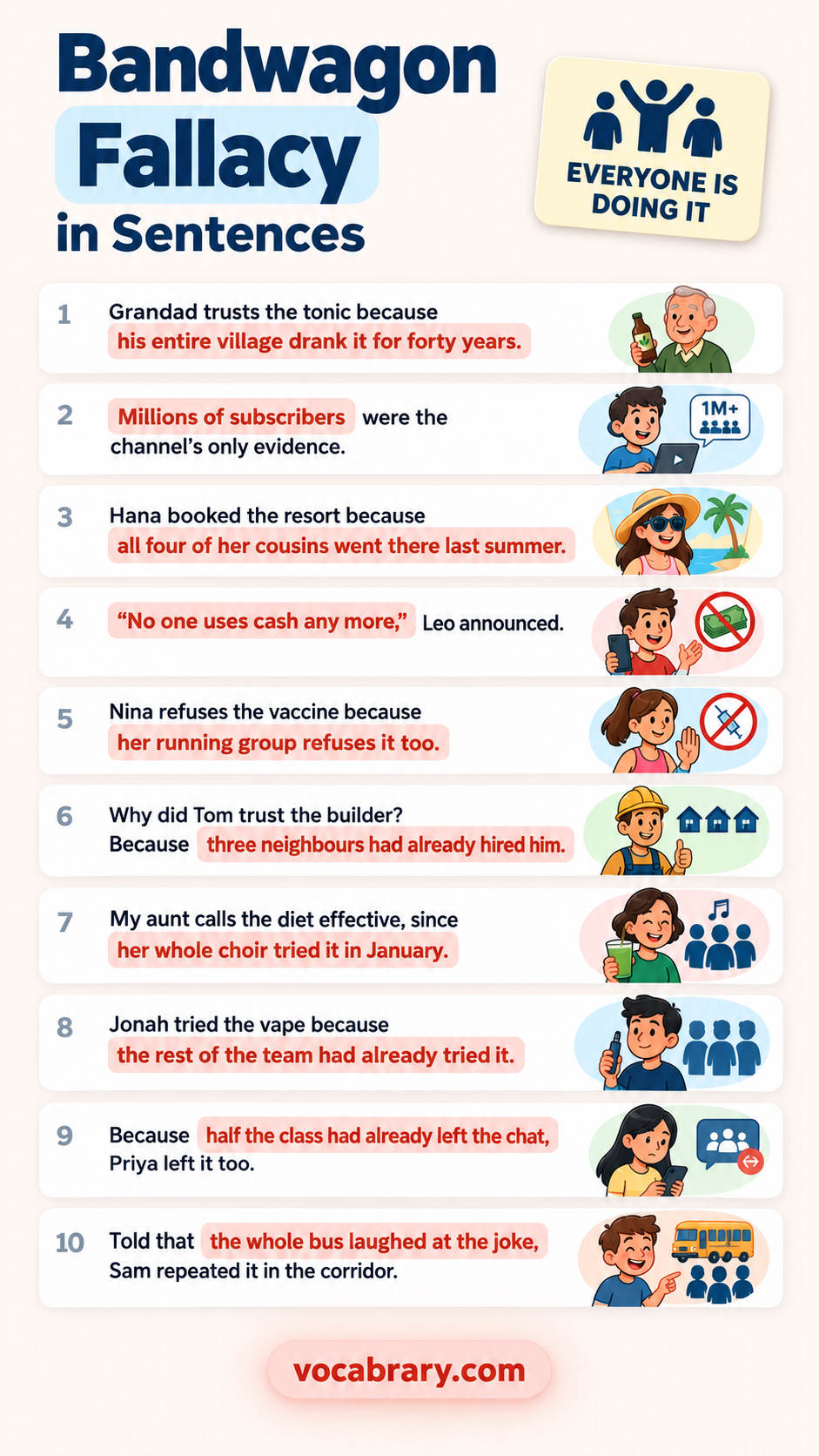
- Grandad trusts the tonic because his entire village drank it for forty years.
- Was the film worth watching only because it sold more tickets than any other release that month?
- Sofia dismissed the objection by noting that no one else in the room had raised it.
- Millions of subscribers were the channel’s only evidence.
- Bilal signed up for the savings scheme, having heard on Sunday that his whole cricket team had already joined it.
Bandwagon Fallacy Examples in Everyday Conversation
Traffic shortcuts, holiday bookings, and a neighbour’s new boiler drive ordinary talk, and the speaker settles each question with a headcount. These bandwagon fallacy examples treat agreement as proof.
- "Everybody takes the ring road now," Dad insisted, refusing to look at the map.
- Hana booked the resort because all four of her cousins went there last summer.
- Our plumber recommended the boiler on the ground that every house on his round has one fitted.
- "No one uses cash any more," Leo announced.
- Nina refuses the vaccine because her running group refuses it too.
- A friend of mine buys whichever kettle the most reviewers rate highly, never checking the wattage.
- Why did Tom trust the builder? Because three neighbours had already hired him.
- My aunt calls the diet effective, since her whole choir tried it in January.
- Told that everyone at the school gate shops there, Rosa changed supermarkets that afternoon.
- Paul argues that the film is overrated, because hardly anybody he knows enjoyed it.
- Since the entire family votes the same way at quiz night, Sam never checks the answer himself.
- "All the parents agree," Kim said, ending a discussion that had barely started.
- Nobody in the car doubted the route once the driver said half the town uses it daily.
- Grace defends her phone plan by repeating that more people are on it than any rival plan.
- A dog trainer won the argument with the words every owner in the park does it this way.
- Hassan judged the dentist excellent because the waiting room was crowded at nine in the morning.
- Was the paint worth the price only because the shop sold out of it twice?
- On Tuesday evening Ruth called the rumour true, on the ground that her whole street had already repeated it.
Bandwagon Fallacy Examples in Peer Pressure Among Teenagers
Vape pens passed round a park, curfews argued at the front door, and a party the whole year group claims to attend produce the sharpest bandwagon fallacy examples among teenagers. A number replaces the reason in every one.
- "Everyone in Year Ten is going," Maya told her mother, as if the count settled the curfew.
- Jonah tried the vape because the rest of the team had already tried it.
- Not one of them asked whether the dare was safe, since the whole group had done it first.
- "Nobody wears that brand any more," Ella said, dropping a jacket she had loved for a year.
- Amir skipped revision on the ground that none of his friends were revising either.
- Because half the class had already left the chat, Priya left it too.
- Why should the rule apply, Leo argued, when every sixth-former ignores it?
- Told that the whole bus laughed at the joke, Sam repeated it in the corridor.
- A fourteen-year-old defends the broken curfew with the words all my friends stay out until midnight.
- Zara dyed her hair because three girls in her form had dyed theirs that week.
- "The entire squad skips breakfast," Danny said, treating a habit as a training rule.
- Nobody challenged the prank once the older students called it a tradition.
- Since every group chat had shared the rumour, Yasmin treated it as confirmed.
- Ibrahim gave up the trumpet, insisting that no one his age plays an instrument.
- A boy at the back copied the answer because the two cleverest students had written the same.
- Was the challenge sensible only because half the school had filmed themselves doing it?
- Lucy agreed to the tattoo after hearing that her whole friendship group had booked one.
- Hearing that nobody revises for mocks, Theo closed his folder.
Bandwagon Fallacy Examples in School and the Classroom
Multiple-choice answers changed to match the noisiest group, an essay question chosen because the class chose it, and a trip approved on a show of hands. Each classroom sentence turns a headcount into a verdict.
- Half the class changed the answer once twelve hands went up for option C.
- "Everyone picked the war poem," Amira told her teacher, defending a question she had not read.
- Mr Ellis let the deadline slide because most of the year group asked for the same extension.
- Nobody queried the formula, since the whole row had written it the same way.
- Why redo the experiment when every other pair wrote down the same figure?
- Told that the sixth form all chose economics, Bea abandoned geography without reading either syllabus.
- A student defended her essay claim by writing that most historians say so, naming none of them.
- Sam copied the layout because the two highest-scoring classmates had used it.
- "Nobody revises the last chapter," Dev announced, a week before it appeared on the paper.
- Because the whole class groaned at the novel, Lily decided it was worthless before chapter two.
- Our debating captain won a round by claiming that the audience already agreed with her side, and the judges accepted it.
- Rashid trusted the online answer, since four hundred students had marked it correct.
- Was the textbook reliable only because every school in the district had ordered it?
- A teacher dismissed the complaint on the ground that no other parent had raised it.
- Since the majority voted for the museum trip, Jade decided the museum must be the better choice.
- Freya wrote her group’s conclusion, treating six matching answers as proof.
- Nobody read the marking scheme once the class agreed on what the examiner wanted.
- Told by three classmates that the quiz was pointless, Owen skipped it and lost the marks.
Bandwagon Fallacy Examples in Work and Office Culture
Software bought because rival firms bought it, a Monday briefing kept because no other team dropped theirs, and a restructure sold on a count of competitors. Every workplace sentence treats agreement as evidence.
- The board approved the software because four competitors had already bought it.
- "Every firm in the sector works Saturdays now," the manager said, ending the discussion.
- Nobody questioned the process, since the department had followed it for eleven years.
- Rita adopted the reporting format after learning that most of her peers use it.
- Why keep the Monday briefing? Because no other team has dropped theirs.
- Told that the whole floor stays past seven, the new hire cancelled his evening class.
- A consultant sold the restructure by repeating that nine of the top ten rivals had restructured.
- Priya signed the petition because forty colleagues had signed before her.
- "Nobody complains about the parking," the supervisor replied, which settled nothing.
- Since the sales team all use the same script, Leo assumed the script must work.
- Our director defends the open office on the ground that most modern companies chose one.
- Was the supplier trustworthy only because half the industry had signed with them?
- Hana dropped her objection once every other manager voted in favour.
- A policy nobody had read passed because the loudest half of the room applauded it.
- Kofi believed the forecast, since every analyst on the call repeated the same number.
- Nobody measured the outcome; general enthusiasm was the measure.
- Because the entire graduate intake stayed late on Thursdays, Ines felt obliged to stay late as well.
- "Every serious professional uses this platform," the recruiter wrote, offering no comparison at all.
Bandwagon Fallacy Examples in Advertising and Marketing Slogans
Toothpaste sold on a count of dentists, sparkling water sold on bottles opened per second, and a phone sold on the length of the queue outside. Each advertising sentence offers a number instead of a product claim.
- "Nine out of ten dentists recommend Palmero," the advert repeated, without naming a single trial.
- Norvello built its campaign on the line that two million families switched last year.
- A billboard for Kettlewick Tea asked shoppers why forty countries drink it every morning.
- "Join the twelve million," urged the Brightloom advert, offering no reason beyond the number.
- Zestara sells its sparkling water on the claim that a bottle is opened every second worldwide.
- Because the queue outside the Lumora store wrapped round the corner, the campaign called the phone the best ever made.
- Why buy elsewhere, the poster asked, when most of the country already buys Vantara?
- Oravel Shampoo tells buyers that the nation’s most-shared haircare brand must be the finest.
- "Everybody’s drinking Duskwell," sang the radio advert.
- Fernhill Insurance advertises a hundred thousand new customers this quarter and stops there.
- Crestbury Motors put the top-selling estate car in Europe on every poster and left safety unmentioned.
- A trailer sold the film on record opening ticket sales rather than on a single review.
- Nobody asked what was in the supplement, since the label promised four hundred thousand daily users.
- Was the mattress worth the price only because Nimbus Rest had shipped a million of them?
- Told that the cafe chain had opened its thousandth branch, Leyla assumed the coffee was excellent.
- "The world’s favourite" appeared on the Palmero carton in letters larger than the ingredients.
- Since the app topped the download chart for six weeks, the advert called it the safest banking tool.
- A supermarket promoted the biscuit as the one three in four households buy, and said nothing else.
Bandwagon Fallacy Examples in Commercials and Product Claims
Narrators counting customers, packets printed with percentages, and rival brands compared by sales volume alone. Each commercial sentence sells a headcount and calls it quality.
- "More families choose Fernhill than any other insurer," the narrator says, as the screen fades.
- Brightloom paint claims the country’s decorators use it more than any rival, and offers no durability figure.
- A cereal packet declares that eight in ten children ask for Zestara Flakes.
- Why compare engines, the Crestbury commercial asks, when more drivers chose Crestbury last year?
- "Ten million downloads and counting," flashes across the Nimbus Rest advert before the music starts.
- Duskwell Soda answers every rival with the line the nation’s number one for thirty years.
- Nobody hears a single ingredient named; the queue at the counter is the whole argument.
- Told by the advert that half the street already subscribes, Adam typed in his card number.
- Oravel calls its conditioner the best on the shelf because the salons order it in bulk.
- A voucher promised savings and printed two hundred thousand members where a price comparison would have gone.
- Kettlewick advertises the most-poured tea in Britain.
- Was the toothpaste better only because Palmero sold more tubes than the other four brands combined?
Bandwagon Fallacy Examples in Social Media Trends
Viral dances copied within a day, a rumour believed after eleven thousand shares, and a creator trusted for follower counts alone. These bandwagon fallacy examples treat engagement figures as evidence.
- Tia believed the claim because it had been shared eleven thousand times before lunch.
- "The whole feed is doing it," Jonah said, filming the dance in his kitchen.
- Nobody checked the source once the clip reached a million views.
- A creator with four million followers was treated as an expert on nutrition.
- Why doubt the warning when every account you follow repeated it?
- Since the hashtag trended for two days, Meera treated the rumour as confirmed news.
- Told that the comments underneath agreed unanimously, Ruben deleted his own reply.
- Kofi joined the challenge because his entire year group had filmed one.
- "Two hundred thousand likes" was the only evidence offered for the health tip.
- Ana bought the serum after the trend feed called it the most talked-about product of the month.
- Nobody read the study; the number of reshares decided what the study said.
- Was the restaurant genuinely good, or did a viral video with nine million views decide that?
- A stranger’s advice convinced Dan, since the reply beneath it had twelve thousand thumbs up.
- Because every creator she follows switched apps, Layla switched as well.
- Farah called the theory settled on the ground that her whole timeline repeated it.
- "Nobody uses that app any more," Ellis declared, an hour after reading one viral complaint.
- The rumour spread because each reshare made the next reader believe it faster.
- On the strength of sixty million views across the creator’s videos, Sana trusted a diet plan written by nobody qualified.
Bandwagon Fallacy Examples in Fashion and Shopping
Trainers bought because the shop sold out, a coat dropped the week the office dropped it, and a bag judged by its waiting time. Each shopping sentence makes popularity the measure of quality.
- Nadia bought the trainers because the shop sold out within an hour.
- "Nobody wears bootcut any more," Ruth said, bagging a pair she still liked.
- A jacket was judged stylish only because the resale site showed four thousand searches a day.
- Since every window on the high street shows the same colour, Amir assumed the colour suited him.
- Why question the fit when half the office has bought the same coat?
- Told that the bag had a waiting time of nine months, Grace joined the queue.
- Leo threw out his round glasses after a magazine said nobody wears them now.
- "Three million pairs sold" was printed where the fabric description would have gone.
- Nobody asked whether the fabric lasted; the sales figure answered every question.
- A shopper trusted the brand because the queue outside stretched past two shops.
- Was the dress flattering only because the whole party arrived in one like it?
- Zainab abandoned the trainers she loved once her friends called them dated.
- Because the influencer’s followers all bought the same coat, Beth ordered it in two colours.
- Hugo defends the watch on the ground that more men own it than any rival model.
- "Everybody in the city is wearing wide legs," the stylist said, which decided nothing about fit.
- Priya kept the heels she disliked.
Bandwagon Fallacy Examples in Sports Fandom
Fans who pick a club after a cup final, a goalkeeper rated by a radio phone-in, and a player judged by shirt sales. Each sentence treats the size of a following as a measure of merit.
- Callum supports the club because half his city started supporting it after the cup final.
- "Nobody rates that goalkeeper," Dan said, having watched him play twice.
- A player was called the finest in the league because his shirt outsold every other shirt.
- Since sixty thousand fans chanted for the substitution, the pundit called the substitution correct.
- Why argue about the penalty when the whole ground booed the referee?
- Told that every pub in town had switched to the rival channel, Hana switched too.
- Bea joined the fantasy league because her entire office had joined.
- "Most fans want him sacked," the caller said, offering nothing about the manager’s season.
- Nobody looked at the passing figures; the crowd’s reaction decided the rating.
- A tennis player was called overrated once the phone-in audience agreed she was.
- Was the transfer wise only because the supporters’ poll voted ninety per cent in favour?
- Ravi changed his prediction after the studio panel all tipped the same side.
- Because the whole family follows the northern club, Sam has never watched another team.
- Ibrahim called the boxer unbeatable, since the arena sold out in eleven minutes.
- "Everyone knows he is past it," shouted a fan who had missed ten games.
- Jade rated the new kit the finest ever made because it broke the club’s first-week sales record by nine thousand shirts.
Bandwagon Fallacy Examples in Investing and Money
Shares bought because the office bought them, a coin trusted for its trading volume, and a fund praised for inflows alone. Dutch tulip buyers of 1636 made the same mistake with flowers.
- Ivan bought the shares because everyone in his office had bought them that week.
- "A million new accounts opened this month," the broker wrote, which is no valuation at all.
- Nobody read the prospectus once the fund reported the largest inflows of the year.
- A coin was called safe because its trading volume had tripled in a fortnight.
- Since her whole family had moved into property, Nina moved her savings there too.
- Why check the balance sheet when the forum has forty thousand members buying the stock?
- Told that the flotation was nine times oversubscribed, Raj applied for more.
- Dana called the property market safe, since her entire street had borrowed the same way.
- "Everybody is buying" was the only reason Hugo gave for a purchase he regretted by March.
- A pension adviser sold the plan on the number of savers already enrolled.
- Was the startup worth the valuation only because eleven other funds had invested first?
- Because the tulip trade drew half the town in the winter of 1636, Dutch buyers treated a rising price as proof of value.
- Farah avoided the bond, then bought it once her colleagues called it the consensus trade.
- Nobody questioned the mortgage terms; the volume of approvals convinced the whole street.
- "Nine of ten analysts rate it a buy," the newsletter said, naming no argument behind any rating.
- Sam joined the scheme after hearing that four hundred savers had joined that morning.
Bandwagon Fallacy Examples in Politics and Public Opinion
Poll leads treated as proof of policy, a rally crowd counted as an argument, and a petition accepted because a million people signed it. Each political sentence exchanges a headcount for a reason.
- A candidate argued for the policy because the latest poll showed sixty per cent in favour.
- "The majority has spoken," the councillor said, which answers nothing about whether the plan works.
- Nobody examined the costing once the rally filled the town square.
- Since every party in the chamber supported the bill, Ines assumed it must be sound.
- Why oppose the measure when four out of five voters approve of it?
- Told that the petition had reached a million signatures, the committee treated the case as proven.
- A spokesperson defended the tax on the ground that most neighbouring countries charge one.
- Voters were urged to back the winning side because the winning side was winning.
- "Nobody believes the old argument any more," the campaigner claimed, naming no study.
- Because the loudest part of the crowd cheered, the reporter called the speech persuasive.
- Was the referendum question fair only because most of the press supported one answer?
- Hana changed her view after a survey showed her whole age group disagreed with her.
- A pamphlet argued that twenty councils had already adopted the scheme, and stopped there.
- Nobody asked what the law would cost; the show of hands was treated as the answer.
- Since the public mood had turned, the minister called the reversal correct rather than argue for it.
- "Join the millions already with us," read the leaflet.
Bandwagon Fallacy Examples in Food and Diet Trends
Cleanses started on subscriber counts, a cooking oil dropped because an online crowd dropped it, and a supplement trusted for its sales rank. Each food sentence treats popularity as nutrition evidence.
- Priya started the cleanse because two million subscribers had started it that January.
- "Everybody has given up bread," Nadia said, repeating a claim she had never tested.
- Nobody read the nutrition label once the supplement reached the top of the sales chart.
- A cooking oil was dropped by half the neighbourhood after an online crowd declared it harmful.
- Since her whole gym drinks the green powder, Leah ordered a tub without checking the dose.
- Why doubt the plan when eleven thousand members of the group swear by it?
- Told that the cafe’s queue never shortens, Amir assumed the food must be healthy.
- A juice bar advertises the most-ordered smoothie in the country and names no ingredient.
- "Nine out of ten athletes use it," the label said, with no study behind the figure.
- Because the whole book group tried intermittent fasting, Ruth tried it as well.
- Was the diet sound only because four million people downloaded the app in a month?
- Nobody asked a dietitian; the number of five-star reviews settled the question.
- Sam avoided the fruit after a viral video convinced thousands that it was dangerous.
- A herbal tea is sold as proven medicine because it has been drunk every winter for centuries in three neighbouring countries.
- Since every other diner ordered the special, Kofi ordered it too.
- "The country’s favourite cereal" was the only health claim on the packet.
Bandwagon Fallacy Examples in Literature
Andersen’s invisible cloth, the accusations of Arthur Miller’s Salem, and the sleep-taught slogans of Aldous Huxley. Each retold sentence names a character who accepts a claim because the crowd accepts it.
- Hans Christian Andersen’s 1837 tale has the courtiers praise the emperor’s invisible cloth because every other courtier praises it.
- Andersen ends the procession with a child who breaks the silence the whole crowd had agreed to keep.
- Arthur Miller’s The Crucible, first staged in 1953, shows Salem villagers accepting each accusation because the whole village accepts it.
- Shirley Jackson’s story The Lottery, published in 1948, has villagers defend the stoning on the ground that every village has done the same for generations.
- George Orwell’s Nineteen Eighty-Four, published in 1949, has Winston join the chanting at the Two Minutes Hate because refusing the chant would mark him out.
- Ray Bradbury’s Fahrenheit 451, published in 1953, shows Mildred defending her wall screens because everyone she knows watches them.
- Boys in William Golding’s Lord of the Flies, published in 1954, join Jack’s tribe once most of the group has joined.
- Eugene Ionesco’s play Rhinoceros, first performed in 1959, turns conformity into farce as the whole town becomes rhinoceroses and presses Berenger to follow.
- Mark Twain’s Adventures of Huckleberry Finn, published in 1884, has a cheated audience applaud the show so that their neighbours will be cheated too.
- In Harper Lee’s To Kill a Mockingbird, published in 1960, the jail mob acts as one because no man in it wants to break from the rest.
- Aldous Huxley’s Brave New World, published in 1932, teaches its citizens slogans in their sleep until everyone repeats them and nobody asks where they came from.
- Dr. Seuss published The Sneetches in 1961, where a star on the belly decides worth because the starred group is the group everybody copies.
- Henrik Ibsen’s An Enemy of the People, first performed in 1883, shows a town voting down a doctor’s evidence because the majority prefers the baths to stay open.
- Okonkwo, in Chinua Achebe’s Things Fall Apart of 1958, dreads being judged weak because the village measures every man against the same crowd.
Bandwagon Fallacy Examples in Movies and TV
Sidney Lumet’s jury of twelve, the school hierarchy of Mean Girls, and the mortgage desks of The Big Short. Each film sentence shows a character changing a verdict because the room has already changed.
- Sidney Lumet’s 12 Angry Men, released in 1957, has eleven jurors vote guilty and press the twelfth to agree with the rest of the room.
- Mark Waters directed Mean Girls in 2004, where students copy the Plastics because the most popular clique sets the rule.
- Adam McKay’s The Big Short, released in 2015, shows bankers trusting mortgage bonds because every desk on Wall Street trusted them.
- Boys walking a courtyard in Peter Weir’s Dead Poets Society, released in 1989, fall into step because the others have fallen into step.
- The 1981 television film The Wave dramatises a classroom experiment where students join a movement because the class keeps joining.
- Frank Capra’s It’s a Wonderful Life, released in 1946, shows savers demanding their money because their neighbours are demanding theirs.
- The Simpsons episode Marge vs. the Monorail, broadcast in 1993, has a town buy a monorail because the whole hall is cheering for it.
- In Andrew Stanton’s WALL-E, released in 2008, passengers change the colour of their suits the moment a broadcast tells them everyone is wearing blue.
- Michael Lehmann’s Heathers, released in 1988, shows a school copying a clique because the clique is the group everybody watches.
- Patients in Milos Forman’s One Flew Over the Cuckoo’s Nest, released in 1975, raise their hands the way the loudest patients raise theirs.
- Jaws, directed by Steven Spielberg in 1975, keeps its beaches open because the traders agree.
- In Robert Zemeckis’s Forrest Gump, released in 1994, strangers join the run because the crowd behind Forrest makes joining look right.
Sentences Rewritten to Ask for Evidence
A jacket, a supplement, and a poll lead lose their force once the reply asks what the crowd actually knows. Each rewrite answers the headcount with a request for proof.
- Instead of accepting that everyone in the office uses the software, Rita asked which task it does faster.
- "Nine out of ten dentists agree" met the reply, "Which trial, and how many dentists were asked?"
- Hearing that two million families switched insurers, Omar asked what those families paid afterwards.
- Rather than repeat that the whole class chose the war poem, Amira asked which poem she had evidence to write about.
- Told that the fund had the largest inflows of the year, Nina asked for its five-year return.
- When Dad said everybody takes the ring road, Hana timed both routes.
- Faced with a million signatures, the committee asked what the petition would cost to enact.
- Ravi answered four thousand five-star reviews by reading the three detailed complaints instead.
- Before joining a challenge because his year group had filmed one, Kofi asked whether anyone had been hurt.
- Leah met the claim that the whole gym drinks the powder with a question about the dose.
- Sam replied to the record shirt sales by asking for the player’s passing figures.
- Asked to back the bill because most voters approve, Ines requested the independent costing.
- Instead of buying trainers because the shop sold out in an hour, Nadia read the durability test and ordered a cheaper pair.
- Beth answered ten million downloads with a question about who had audited the security.
Bandwagon Fallacy Examples for Kids
Playground games joined because the class joined, a lunchbox hidden to match the others, and a cartoon called the best because most children watch it. Each sentence shows a child agreeing with the group instead of thinking.
- Milly joined the game because all the other children were playing it.
- "Everyone in my class has these shoes," Ben told his dad at the shop door.
- Nobody tried the new fruit until three friends said they liked it.
- Sam calls the cartoon the best because most children in school watch it.
- Why should I share, asked Leo, when nobody else shares in that group?
- Told that the whole team loves the sticker book, Ruby wanted one too.
- A girl copied the drawing because four classmates had drawn the same cat.
- "Nobody plays that game any more," said Kofi, and the ball stayed in the cupboard.
- Since every child in the line chose chocolate, Maya chose chocolate as well.
- Ella believed the ghost story once six children said it was true.
- Because the class clapped for the blue team, Theo decided the blue team had won.
- Nobody asked the teacher; a show of hands decided the answer.
- Was the song good only because the whole playground was singing it?
- Ravi ate the sandwich he disliked, since his friends ate the same one.
- A boy hid his lunchbox because the other lunchboxes had cartoons on them.
- "All my friends stay up late," Lily argued at bedtime, and her mother asked her who had counted them.
Bandwagon Fallacy Examples for Students
Essay claims propped up by "most historians agree", a journal paper trusted for its citation count, and a seminar answer accepted on a vote. Each student sentence names the appeal an examiner marks down.
- An essay claimed the war was avoidable because most historians say so, naming none of them.
- "Every study agrees," wrote Dev, citing two sources.
- Nobody verified the statistic once four classmates had used it in their drafts.
- A student trusted the journal paper because it had been cited nine hundred times.
- Since the seminar group reached the same conclusion, Farah stopped testing her own.
- Why cite a source, asked Leo, when everybody accepts the claim already?
- Told that the whole cohort chose the easier question, Jade chose it too.
- Examiners mark down the sentence the majority of scholars believe this, because belief is not evidence.
- "No serious researcher doubts it," Nina wrote, which shifts the burden rather than meeting it.
- Because the textbook is the most widely used in the country, Sam treated its every claim as settled.
- Was the argument sound only because the lecture theatre nodded along?
- A debate team won a round by repeating that the audience already agreed.
- Ravi dropped his thesis question once three friends called it unpopular.
- Nobody read the counterargument; the number of citations decided which paper was right.
- Since the revision forum voted for one answer, Leyla wrote that answer without checking.
- "Everyone in my year got a first with this structure," Beth said.
Related
FAQs
Another name for the bandwagon fallacy is argumentum ad populum, the Latin for an appeal to the people. Writers also call it the appeal to popularity, the appeal to common belief, and the appeal to the crowd. A related label, appeal to common practice, applies to the version that defends a habit because most people share it.
The bandwagon fallacy takes its name from the decorated wagon that brought a band through American towns in the nineteenth century, drawing a crowd along behind it. Campaigners hired those wagons, and supporters who climbed aboard showed onlookers which side was winning. By the 1890s English speakers were using jump on the bandwagon for joining a cause because it was already popular.
The bandwagon fallacy is an informal fallacy, which means the fault is in the content of the argument rather than in its logical form. Fallacies of relevance such as this one and the straw man fallacy fail because the reply addresses something other than the truth of the claim. Formal fallacies, by contrast, break a rule of deduction whatever the argument is about.
The bandwagon fallacy is a problem because a headcount tells you nothing about whether a claim survives testing. Whole populations have agreed on medical advice and market prices that later proved wrong, and every one of those majorities felt certain at the time. An argument settled by numbers also silences the one person in the room holding the evidence.
You identify a bandwagon fallacy by finding the place where a number of people replaces a reason, then asking what that crowd knows. Watch for everyone, nobody, most people, nine out of ten, and best-selling wherever proof should appear. If deleting the popularity claim leaves the argument with nothing behind it, the argument was a bandwagon appeal.
You counter a bandwagon fallacy by granting the popularity and then asking for the evidence behind it, which separates two questions that the speaker merged. Ask who counted, what they measured, and whether the majority had access to any test. A polite request for the study behind nine out of ten ends most bandwagon appeals in a single exchange.
You avoid the bandwagon fallacy in academic writing by replacing every claim of consensus with the studies that built it. Write the finding, the sample size, and the date instead of most scholars agree. Markers reward a paragraph that names three sources and penalise one that counts unnamed believers.
The bandwagon fallacy and the bandwagon effect name a reasoning error and a behaviour pattern. The fallacy is the argument that a claim must be true because many accept it, while the effect is the observed tendency for people to adopt a belief as its popularity grows. The economist Harvey Leibenstein named the effect in a 1950 paper on consumer demand.
The main assumption behind a bandwagon fallacy is that a large group has already checked the claim, so no further checking is needed. Popularity acts as a substitute for a study, a test, or a reason. The assumption collapses whenever a crowd has inherited its belief from one unchecked source, which is how a rumour reaches a million people unexamined.
A bandwagon fallacy and an appeal to authority differ in whose agreement is offered as proof. The bandwagon appeal counts the many, as in four million buyers cannot be wrong, while the appeal to authority quotes one expert whose field does not match the question. Both skip the evidence, and both fail once the argument is put back to the facts.
A bandwagon fallacy and a hasty generalization fail at different steps of an argument. The bandwagon appeal treats the number of believers as proof of a claim, while a hasty generalization draws a wide rule from too few cases. Ten thousand shoppers buying one kettle is a bandwagon appeal, and two broken kettles proving that every kettle fails is a hasty generalization.
Popularity is good evidence only where the crowd has measured something, as when thousands of independent reviewers report the same fault in the same washing machine. Buyers who each tested a product supply data, while buyers copying one another supply none. The bandwagon fallacy begins the moment agreement replaces the testing rather than reporting it.
You use bandwagon in a sentence as a noun for the crowd itself, as in "That is a bandwagon appeal, because a sales figure never tests a safety claim." Speakers also treat it as a verb and say that a rival has jumped on the bandwagon. Naming the move during a debate pushes the other speaker back to the evidence.

Leave a Comment