
Appeal to authority is a logical fallacy in which a claim counts as true because a respected name backs it, not because evidence does, as when an advert dresses an actor in a lab coat. Common appeal to authority examples name a doctor, a professor, or a coach, then stop before the proof arrives.
What Is Appeal to Authority?
An appeal to authority treats a person’s standing as the reason to accept a claim, so the credential replaces a measurement, a trial, or a calculation. Unlike ethos, which builds credibility and then still supplies proof, this fallacy ends at the name.
"Professor Renn has taught physics for thirty years, so his verdict on the vaccine is final," Bea said.
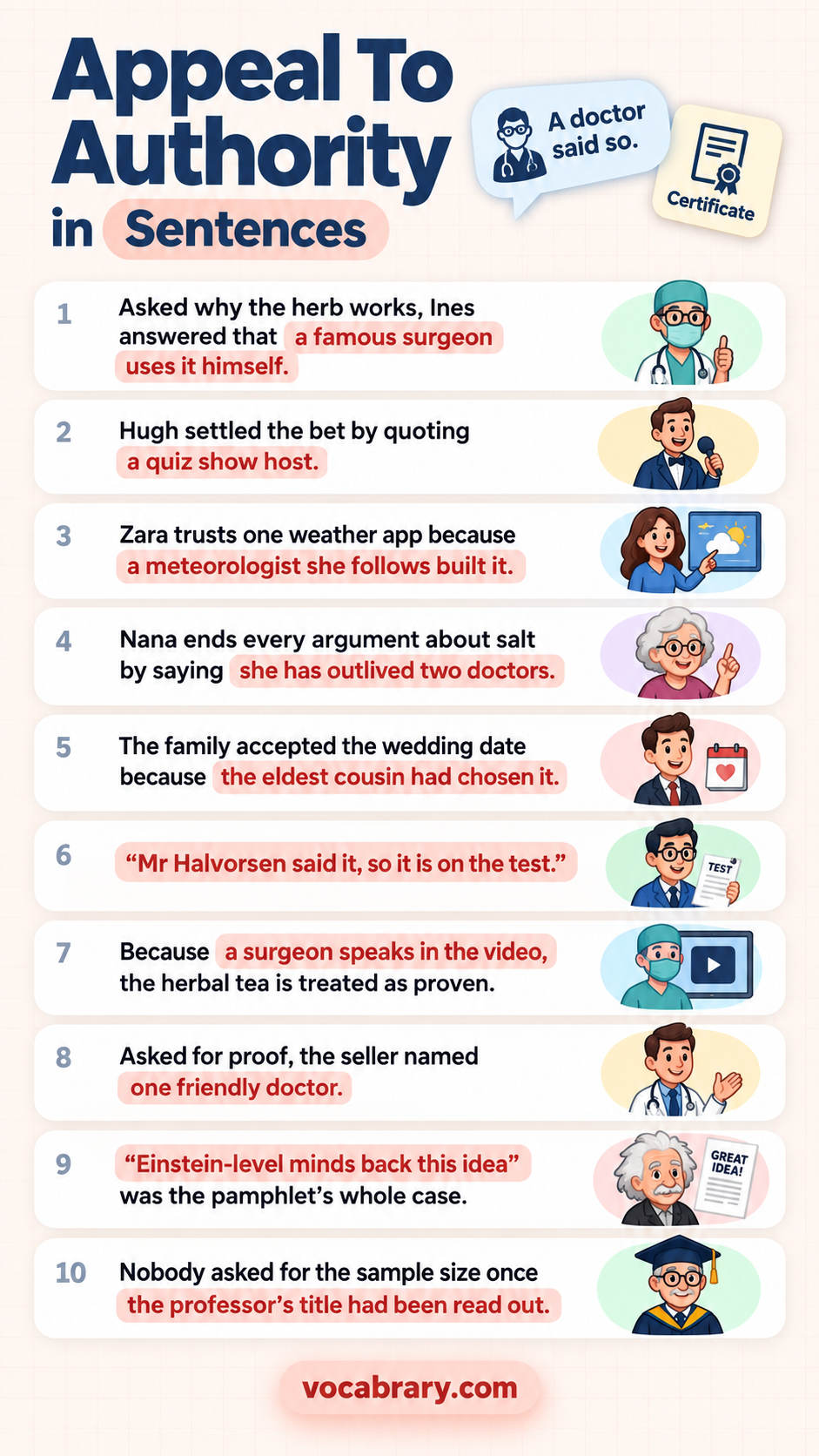
Common Appeal to Authority Examples in Sentences
A dentist quoted in a toothpaste advert, an uncle who trusts a television doctor, and a debater who ends a row with a professor’s name are the common cases of appeal to authority. Each sentence swaps proof for a title.
- "Dr Alina Verek says the diet works, so it works," Mira told the group, and nobody asked for the trial data.
- Samir ended the argument by announcing that a Nobel winner had signed the letter.
- Because the professor had thirty years in the field, the class accepted the claim without checking the figures.
- "My dentist recommends this brand," Lara said, which settled the purchase for everyone at the table.
- Rather than open the report, the manager repeated that the consultancy that wrote it charges the highest fees in the country.
- "Four out of five doctors agree," the label announced, naming none of them.
- Tomas rejected the safety warning because a retired general on television had laughed at it.
- Since an engineer with a doctorate had stamped the cover, the council accepted the flood plan.
- "A professor of economics told me so" was the only support offered for the entire forecast.
- Nobody questioned the reading list once the librarian said an Oxford scholar had chosen it.
- Asked why the herb works, Ines answered that a famous surgeon uses it himself.
- After learning that the minister’s own adviser had approved the clause, the committee dropped its objection.
- "He has a PhD, so he is right about the climate model," Dev insisted, though the doctorate is in dentistry.
- Every doubt about the software vanished when the salesman mentioned the airline chief who swears by it.
- "The textbook says it, and the textbook is by Halvard Renn," the student wrote, quoting no study.
- Priya trusts the investment because a billionaire she follows praised it in an interview.
- Told the bridge design was risky, the developer replied that the architect had won three awards.
- "Would you argue with a man who has been a judge for twenty years?" Nadia asked, avoiding the question of law.
- Nobody challenged the vitamin claim because a doctor in a white coat had read it aloud.
- Farid ended the argument with the name of his old chemistry lecturer and no chemistry at all.
- "Zeltra Labs tested it, and Zeltra Labs is famous," the seller repeated when asked for the numbers.
- Once the bishop had spoken, the village treated the calendar question as settled by his office alone.
- My father answers every question about money by naming the presenter of a finance show.
- "The head of the department disagrees with you," Ola said, which told the room nothing about the measurements.
Appeal to Authority Examples in Everyday Conversation
Neighbours quoting a plumber, friends settling a film row with a critic’s name, and shoppers trusting a magazine columnist fill ordinary talk with appeal to authority. The job title of the person quoted arrives in place of a reason.
- "My plumber says that boiler will last ten years," Owen told the neighbours, and the rust went unmentioned.
- Jo refused to re-cook the rice because a chef on breakfast television does it her way.
- "The critic at the paper gave it one star, so the film is bad," Ravi announced before watching it.
- Asked how she knew the road was safe, Bea answered that her brother-in-law drives a lorry.
- "A magazine columnist recommended this cleaner," Kim said, and the stain stayed exactly where it was.
- Hugh settled the bet by quoting a quiz show host.
- "You are arguing with a man who has read three books on this," Tariq warned his friend.
- Every disagreement about the garden ends when Ellie mentions the presenter of her favourite gardening programme.
- "Our old geography teacher told us the opposite," Sami said, thirty years after the lesson.
- Callum dismissed the recipe because a baker with a television series bakes it differently.
- "The man at the shop has fitted a thousand of these," Ines said, though the fitting was still wrong.
- Zara trusts one weather app because a meteorologist she follows built it.
- Told the mushroom was risky, Theo replied that his uncle has picked mushrooms for forty years.
- "Nobody argues with a nurse about sleep," Noor said, closing a question about her own schedule.
- Farid buys one brand of tyre because a rally driver praised it in an old interview.
- "A retired headmaster wrote that letter, so the complaint is justified," Lena decided without reading it.
Appeal to Authority Examples From Parents and Elders at Home
Grandmothers quoting their own mothers, fathers counting years on the job, and elders who answer a question with their age produce the household version. Seniority arrives instead of a reason.
- "I have run this kitchen for forty years, so the recipe is correct," Grandma said.
- My father refuses every repair suggestion because he has owned cars since 1979.
- "Your grandmother did it this way," Mum answered when asked why the plant was moved.
- Because Uncle Rashid is the eldest, his verdict on the inheritance went unquestioned.
- "You are twelve and I am forty, so I am right about the homework," Dad said.
- Nana ends every argument about salt by saying she has outlived two doctors.
- Asked why the window stays shut at night, Grandad said his own father never opened one.
- "I raised four children, so I know what that cough means," Aunt Meera told the room.
- The family accepted the wedding date because the eldest cousin had chosen it.
- Told the wiring looked wrong, Dad replied that he wired the shed himself in 1988.
- "Nobody in this house argues with your grandfather," my mother said, and the map stayed folded.
- Every question about money at home ends with my father’s forty years in a bank.
- "Your aunt is a teacher, so her spelling is final," Rosa announced, and the dictionary stayed shut.
- Kemal accepted the planting advice without question because his grandmother has kept the same allotment since the year he was born.
Appeal to Authority Examples in School and From Teachers
A pupil who answers with the textbook author’s name, a class that accepts a wrong date on the teacher’s say-so, and an essay propped up by one famous quotation are the school versions.
- "Mr Halvorsen said it, so it is on the test."
- The class accepted the wrong date because the teacher has taught history for twenty years.
- Asked to justify his answer, Leo wrote that the textbook author is a professor at a famous university.
- "My tutor went to Cambridge, so her method is the right one," Yusuf argued.
- Every essay in the pile supported its case with one quotation from a single well-known critic.
- Told his workings were wrong, Sami replied that the head of maths had shown him that shortcut.
- "The marking scheme was written by examiners, so no answer outside it earns credit," the pupil insisted.
- Nia refused to check the calculation because a prize-winning student had done it first.
- "Our old teacher told us commas never go there," Dev said, ignoring the style manual in front of him.
- During the debate, one side offered only the name of a professor who agrees with them.
- "You are a first-year, and Dr Feld has published forty papers," the seminar leader said, ending the question.
- Maya wrote the whole paragraph around a single sentence from a famous lecture, with no study behind it.
- Because the revision book is the best seller, the group treated its chapter on Rome as proof.
- "A grammar professor wrote this app, so its corrections are always right," Omar told his classmates.
Appeal to Authority Examples at Work and From Managers
Boards that wave a proposal through on a partner’s endorsement, supervisors who answer a query with their years in the trade, and buyers who quote an expensive consultancy show the workplace form.
- "The director approved it, so the figure is correct," the team lead said, and nobody opened the model.
- Marco dismissed the safety report because the head of operations had signed the earlier version.
- "Our consultants charge four thousand a day, and they chose this supplier," the buyer explained.
- Nobody questioned the schedule once the chief engineer nodded at it in the meeting.
- "I have managed this warehouse since before you were hired," Farid told the new analyst, ending the review.
- Asked why the budget assumes ten percent growth, Kim answered that a famous economist predicts it.
- "Legal said no," the manager repeated, naming no clause.
- The proposal went through because a partner from a well-known firm had endorsed it over lunch.
- Told the invoice looked wrong, Bea replied that the finance director has never made an error.
- "You are questioning a man with two decades in this industry," the supervisor warned.
- Every objection to the new software died when someone mentioned the chief executive’s personal enthusiasm.
- Ola accepted the hiring decision because the panel chair has interviewed a thousand candidates.
- "Our auditors are the biggest in Europe, so the accounts are sound," the treasurer told the board.
- Because the trainer once worked at a famous airline, the crew stopped checking his procedure.
Appeal to Authority Examples in Advertising and Celebrity Endorsements
An actor in a stethoscope, an Olympic swimmer on a goggle packet, and a slogan about dental professionals who are never named give advertising its favourite version of appeal to authority.
- "Nine out of ten vets choose Orenta," the advert promises, naming no study and no vet.
- A former footballer in a white coat recommends Velmora razors, and the metal is never tested on screen.
- "Recommended by dental professionals" is printed on the Brightlin tube, with no professional named.
- The paint advert wins its argument by putting a famous television builder beside the tin.
- Because an Olympic swimmer smiles on the packet, shoppers at the counter treat Tavren goggles as the better pair without checking the lens.
- "Chosen by Formula One engineers," the oil label announces, though the engine on sale is a family hatchback.
- Lumeo sells its mattress with a sleep scientist nobody outside the advert has heard of.
- An actor in a stethoscope tells the camera that doctors trust Orenta throat drops.
- "Trusted by chefs," the jar says, and the sauce inside is never compared with any other.
- The bank runs its campaign on a retired athlete’s signature, not on its interest rate.
- Every shot in the advert shows the laboratory coat, and no figure from the laboratory.
- "Designed with a professor of sleep," reads the pillow label, which names neither the professor nor the university.
- Shoppers buy the Tavren blender because a famous chef is photographed beside one.
- "As used by the national team," the boot advert claims, leaving the stitching untested.
Appeal to Authority Examples in Health Claims and Supplements
Herbal tea defended by a surgeon in a video, a tub of powder sold on a television doctor’s word, and a brochure naming three unnamed specialists share one move. Each argues from standing rather than from a trial.
- "A doctor on television recommended this powder," Nadia said, though the tub names no trial.
- The supplement advert offers a nutritionist with a large following and no published study.
- "My chiropractor swears by these drops," Owen told the group, and the argument ended there.
- Because a surgeon speaks in the video, the herbal tea is treated as proven.
- "Nurses recommend it" is printed on the packet, with no nurse and no trial named.
- Tom refuses the pharmacist’s warning because a wellness author with a bestseller disagrees.
- "A professor of biology sells this brand, so the capsules work," Lena insisted, quoting no research.
- The clinic’s website argues from the founder’s medical degree rather than from any published finding.
- Asked for proof, the seller named one friendly doctor.
- "Three specialists at a private hospital use it themselves," the brochure claims, and the hospital is never named.
- Every question about the dosage was answered with the name of a celebrity doctor.
- Priya believed the sleep claim because an influencer with a nursing diploma repeated it.
- "My dentist’s own dentist uses this whitening gel," Ines said, and no one asked about the enamel study.
- Told the tea had no measured effect, Sami replied that a famous athlete drinks it daily.
Appeal to Authority Examples in Science and Expert Quotes
A podcast physicist, a headline that says scientists agree, and a witness who answers a question about sample size with three degrees are the cases where a credential arrives where a measurement should.
- "A physicist said it on a podcast, so the theory is settled," Dev wrote in his forum reply.
- One website rejects an entire climate study because one retired geologist disagrees with it.
- Because the paper has a famous name in the author line, the seminar accepted its method unchecked.
- "Einstein-level minds back this idea" was the pamphlet’s whole case.
- Nobody asked for the sample size once the professor’s title had been read out.
- "Dr Feld has two hundred citations, so her guess about the virus is fact," the presenter claimed.
- Told the experiment had never been repeated, Ola answered that the laboratory is world famous.
- An interviewer accepted the forecast because the speaker chairs a scientific society.
- "A chemist told me the additive is harmless," Bea said, naming no measurement at all.
- The panel dropped its question when the witness read out her three degrees.
- Every objection to the model was met with the name of the institute that built it.
- "Scientists agree," the headline declares, and the study behind it is never identified.
Appeal to Authority Examples in Law and Courtrooms
Advocates who quote a revered judge instead of a statute, juries impressed by a service medal, and ministers who name a chief constable in place of a reason give the courtroom form of this fallacy.
- "A judge with thirty years on the bench ruled this way once," the advocate said, citing no statute.
- The jury accepted the timeline because a detective with a long service medal described it.
- Because the expert witness has written a textbook, her estimate went unchallenged for an hour.
- "My solicitor is the best in the city, so the contract is watertight," Kim told her business partner.
- Asked for authority, the barrister named a retired professor of law instead of a decided case.
- Nobody in the room queried the valuation once the surveyor’s fellowship was read aloud.
- "The Home Office says so," the officer repeated, and the tenant’s question about the rule went unanswered.
- Told the forensic method is disputed, the prosecutor replied that the laboratory director is internationally known.
- "A chief constable supports this clause," the minister argued, without naming one effect of the clause.
- Rather than weigh reports, the tribunal trusted the chairman’s reputation.
- Every doubt about the will disappeared when the family learned a King’s Counsel had drafted it.
- "Would you correct a man who has practised law since 1991?" the partner asked the trainee.
Appeal to Authority Examples From Social Media Influencers
A blue tick offered as proof, a screenshot of a certificate, and a video that opens with the words "as a doctor" are how the fallacy reaches comment replies and short clips.
- "@TheCalmChemist has a chemistry degree, so the cleaning tip is safe," the reply read.
- Discussion under the video ended when someone posted a screenshot of the influencer’s certificate.
- Because @LedgerLuca has two million followers, his verdict on the fund went unexamined.
- "She is verified, so her medical claim is true," Ana wrote beneath the clip.
- Nobody in the replies asked for a source once the creator mentioned her old job at a famous teaching hospital.
- "A former engineer posted this, so the battery advice is correct," Hugh commented.
- Told the statistic was ten years old, Priya replied that @MiraReads is a librarian.
- Every reply defended the recipe with the chef’s blue tick.
- "My favourite creator tried it for thirty days," Lena wrote, offering nothing else.
- The video wins its argument by opening with the words "as a doctor" and no study.
- Asked how she knew the app was secure, Zara said a famous developer follows it.
- "He trained at a top university," one follower wrote, and the maths in his comment stayed wrong.
Appeal to Authority Examples in Sports Coaching
A captain who quotes his manager’s playing career, a squad that keeps a drill because a former international designed it, and parents impressed by a scout’s old club all reason from standing.
- "Coach Duro played at the top level, so his tactic is right," the captain told the squad.
- The club kept the training plan because a former international designed it.
- Because the manager has three trophies, nobody questioned the substitution.
- "A famous striker says never stretch before a match," Nia announced in the changing room.
- Told the drill was outdated, the assistant replied that the head coach learned it in Italy.
- Every argument about the formation ends when someone mentions the manager’s playing career.
- "My old PE teacher swore by this warm-up," Sami said, thirty years after the lesson ended.
- Asked why the team runs hills on Fridays, Kemal answered that a champion runner does the same.
- "Would you tell an Olympic coach how to sprint?" Ola asked, dodging the question about the timing data.
- The parents accepted the selection because the scout once worked for a famous academy.
- Nobody checked the injury advice, since the physiotherapist trained a national squad.
- "He has coached for forty years," the chairman said, and the losing run went undiscussed.
Types of Appeal to Authority With Examples
Logicians separate the fallacy by which authority is named: a celebrity with no training, an unnamed source, a paid insider, a specialist moved outside her field, and a long-dead master.
Appeal to False Authority Examples
A novelist quoted on vaccine policy, a chess grandmaster writing about interest rates, and a reality show winner giving parenting advice are the false-authority cases, where the fame is real and the training absent.
- "A famous actor endorses the treatment, so it works," Dev said of a man with no medical training.
- The pamphlet quotes a novelist on vaccine policy and no immunologist at all.
- Because a retired footballer praised the fund, Tomas moved his savings into it.
- "My favourite singer studied nutrition for a week," Lena said, defending the meal plan.
- Asked about the tax rule, Kim quoted an actor who plays an accountant on television.
- Nobody corrected the claim, since a chat show host had made it with great confidence.
- "A chess grandmaster wrote this column on interest rates," the newsletter boasted.
- Every engine argument ended with a comedian’s opinion.
- Told the forecast was unreliable, Sami replied that the presenter is very famous.
- "She won a reality show, so her parenting advice is sound," Rosa argued.
Appeal to Anonymous Authority Examples
Experts say, studies show, they say, and leading dentists recommend are the anonymous forms. No name is given, so the claim is impossible to trace and impossible to check.
- "Experts say the market will recover," the broker told his client, naming not one expert.
- The headline depends on unnamed sources close to the inquiry.
- Because studies show it, Bea repeated the claim, though no study was ever cited.
- "Scientists have proved this powder burns fat," the advert says, with no scientist, no trial, and no journal named anywhere on the tub.
- Asked which doctor recommended the change, Owen answered a doctor.
- "They say the bridge is unsafe," Farid told the meeting, and no one asked who they are.
- Nobody managed to name the authority behind the phrase "leading dentists recommend".
- Every worried reply repeated that a nurse online had warned about the batch.
- Told to cite the research, Priya wrote studies have shown and moved on.
- "A government adviser told my friend," Hugh said, ending a question about the new rule.
Appeal to Biased Authority Examples
A scientist paid by the industry he clears, a surveyor the selling agency employs, and a report the pipeline firm commissioned are the biased cases, where the credential is genuine and the interest undisclosed.
- "The tobacco company’s own scientist found no harm," the lobbyist told the committee.
- Because the study was paid for by the sugar trade, its verdict on sugar went unquestioned.
- "Our supplier’s engineer inspected the beam and passed it," the developer said, and no independent engineer has looked at the beam since.
- Nobody in the room noted that the expert praising the drug is employed by its maker.
- Asked who valued the house, the agent named a surveyor the agency pays.
- "A consultant hired by the board says the merger is safe," the chairman announced.
- The mine’s safety case depends on a geologist on the company payroll.
- Told the review was written in-house, Ola replied that the reviewer has a doctorate.
- "Our own laboratory tested it," the brand insists, and no outside laboratory has tried.
- Every question about the pipeline was answered with a report the pipeline firm commissioned.
Appeal to Unqualified Authority Examples
A cardiologist writing the climate column, a physicist quoted on child psychology, and a dentist ruling on vaccine schedules are unqualified-authority cases. The expertise is genuine and was earned in another field.
- "A cardiologist wrote the climate column, so the science is settled," Dev argued.
- The school quotes a physicist on child psychology and no psychologist whatsoever.
- Because the professor of literature has a doctorate, the meeting accepted her ruling on pension law without asking a single lawyer.
- "My dentist says the vaccine schedule is wrong," Bea told the playgroup.
- Asked about bridge loads, the panel listened to an award-winning interior designer.
- "He is a surgeon, so his view on the economy is expert," Nia insisted.
- Nobody objected when a veterinary surgeon was quoted on human kidney treatment.
- Every claim in the pamphlet came from a theologian writing about geology.
- Told that the lawyer had no engineering training, Hugh replied that she is very intelligent.
- "A famous mathematician doubts the vaccine, so I doubt it too," Lena wrote.
Appeal to Ancient and Traditional Authority Examples
A guild refusing a method because the old one is four hundred years old, an apothecary quoting a physician dead since 1650, and a lecturer teaching Galen after Harvey are the traditional forms.
- "Aristotle taught that heavier objects fall faster, so they do," the tutor told his pupils in 1580, and nobody in the room dropped a stone to check.
- Because the practice is four hundred years old, the guild refused the new method.
- "Our founder wrote the rule in 1912," the secretary said, and the committee kept it unchanged.
- Nobody in the workshop questioned the joint, since the master carpenter’s manual from 1903 approves it.
- Asked why the dose is measured that way, the apothecary named a physician who died in 1650.
- "Galen described the blood’s movement this way," the lecturer repeated, sixty years after Harvey demonstrated otherwise.
- The village kept its planting date because the almanac of their great-grandparents had set it.
- Told the grammar rule was invented by one eighteenth-century bishop, Ola defended it as the older teaching.
- "It is written in the oldest textbook we have," Farid said, closing the question.
- Every objection to the ritual was answered with the age of the tradition.
Appeal to Authority Examples in Literature and Film
Chaucer’s pilgrims quoting old books at each other, Squealer ending every dispute with Napoleon’s name, and a poetry textbook torn up in Dead Poets Society give the fallacy its best-known scenes.
Appeal to Authority in Novels and Plays
Mr Collins reporting Lady Catherine’s opinion, Argan obeying any prescription a physician signs, and Reverend Hale arriving in Salem with heavy books are the novel and playhouse versions.
- In Chaucer’s The Canterbury Tales, the Wife of Bath opens her prologue by setting her own experience against the written authorities men quote at her.
- Pertelote, in Chaucer’s Nun’s Priest’s Tale, dismisses her husband’s dream by citing Cato, and Chauntecleer answers with a longer parade of authorities.
- Mr Collins, in Jane Austen’s Pride and Prejudice (1813), settles every question by reporting the opinion of Lady Catherine de Bourgh.
- Squealer, in George Orwell’s Animal Farm (1945), ends each dispute with the assurance that Napoleon is always right.
- Arthur Miller’s The Crucible (1953) gives Reverend Hale a stack of heavy books, and Salem treats his reading on witchcraft as proof.
- Argan, the hypochondriac of Moliere’s The Imaginary Invalid (1673), accepts any prescription because a physician signed it.
- A woodcutter’s Latin nonsense passes for medicine in Moliere’s The Doctor in Spite of Himself (1666) once the villagers call him doctor.
- Calpurnia, in Shakespeare’s Julius Caesar (1599), begs her husband to stay home because the augurers found no heart in the sacrifice.
- Bertolt Brecht’s Life of Galileo (1938) shows a philosopher refusing to look through the telescope, since Aristotle has already settled the question.
- Umbridge, in J. K. Rowling’s Order of the Phoenix (2003), tells her class that a Ministry-approved textbook is all the defence training they need.
Appeal to Authority in Film and Television
A scarecrow who recites a theorem the moment a diploma reaches his hand, villagers convinced by a knight’s reasoning, and a lobbyist quoting his own industry’s laboratory are the screen cases.
- Peter Weir’s Dead Poets Society (1989) opens its poetry lesson with a textbook essay by Dr J. Evans Pritchard, which Keating orders the class to tear out.
- The Wizard of Oz (1939) gives the Scarecrow a diploma, and he recites a theorem the moment the paper reaches his hand.
- Villagers in Monty Python and the Holy Grail (1975) condemn a woman because Sir Bedevere’s learned reasoning convinced them.
- Jurors in Twelve Angry Men (1957) treat the switchblade as one of a kind because the shopkeeper said so, until Juror Eight produces an identical knife.
- Jason Reitman’s Thank You for Smoking (2005) sends a lobbyist to quote the Academy of Tobacco Studies, a laboratory his own industry funds.
- Harold Hill wins over River City in The Music Man (1962) by claiming a degree from the Gary Conservatory, gold medal class of 1905.
- Chance the gardener, in Hal Ashby’s Being There (1979), is taken for an economic sage because Washington assumes a man in a good suit must be one.
- Miracle on 34th Street (1947) ends when the court accepts sacks of mail delivered by a federal agency as proof of the old man’s identity.
- Colonel Jessup, in Rob Reiner’s A Few Good Men (1992), answers the young lawyer by invoking his rank and his command rather than the order in dispute.
- Sir Humphrey Appleby, in the BBC comedy Yes Minister, closes debate by invoking the department’s accumulated expertise.
Appeal to Authority in Philosophy and Recorded Debate
Cicero mocking the Pythagoreans, Locke naming the fallacy in Latin, and Galileo’s Simplicio quoting Aristotle where a telescope is wanted are the classic philosophical cases.
- Cicero, in De Natura Deorum, mocks the Pythagoreans who answered every objection with ipse dixit, "he himself said it".
- Thomas Aquinas calls the argument from human authority the weakest form of proof in the Summa Theologiae.
- Francis Bacon’s Novum Organum (1620) names the Idols of the Theatre, the errors readers inherit because a famous system said so.
- Galileo’s Dialogue Concerning the Two Chief World Systems (1632) gives Simplicio nothing but passages from Aristotle where observation is wanted.
- Rene Descartes begins his 1637 treatise on method by refusing to believe anything merely because learned men have written it.
- John Locke gave the fallacy its Latin name, argumentum ad verecundiam, in An Essay Concerning Human Understanding (1690).
- Immanuel Kant, in "What Is Enlightenment?" (1784), describes the man who lets a book do his thinking and a doctor choose his diet.
- Arthur Schopenhauer lists the move among his debating stratagems, advising the reader to quote an authority the opponent respects.
- Aristotle’s own Rhetoric treats the testimony of ancient poets and proverbs as one means of persuasion open to a speaker.
- Michel de Montaigne, writing on the education of children in 1580, tells the tutor to make a pupil sift a claim rather than swallow it because an old master wrote it.
Appeal to Authority Examples Answered With Evidence
A cardiologist’s 2023 trial, a structural engineer’s calculation, and a mechanic’s worn brake pad separate a fair citation from the fallacy: each names what was measured, not who measured it.
Fair Expert Citations Paired With the Fallacy
A pilot on her own landing, a chemist on solvents, and a historian who gives her sources are fair citations. Each pairs with a version where the same person is quoted outside her field or without proof.
- Naming the 2023 trial a cardiologist ran is fair; saying the cardiologist is famous, so the drug works is the fallacy.
- A pilot’s account of her own landing is testimony; her wings as proof about tax law are nothing of the sort.
- Quoting a structural engineer’s calculation supports the beam; quoting his job title alone supports nothing.
- Asking a chemist which solvent dissolves the stain is sensible; asking the same chemist to settle a custody case is not.
- When a historian gives her sources, the date is evidence; when she gives only her chair at the university, the date is unsupported.
- The dentist’s X-ray is proof of the crack; his opinion on your mortgage is not.
- Citing the meteorologist’s model and its error bars is fair; citing her thirty years on television is the fallacy.
- Trusting an electrician about the wiring is reasonable; trusting the same electrician about the vaccine schedule is not.
- In law a judge’s ruling settles the case, yet her fame settles nothing about the physics of the crash.
- Reporting what a nutrition trial measured is evidence; reporting that a nutritionist has a million followers is not.
- The mechanic who shows the worn brake pad has proved it; the mechanic who says trust me, I have done this for years has not.
- Relying on a translator’s reading of the Latin is fair; relying on her doctorate to settle the archaeology is the fallacy.
Sentences Rewritten to Cite Evidence
A diet claim, a flood plan, and a training row each turn up twice: first propped up by a name, then rebuilt on the trial, the map, or the sprint times behind it.
- Instead of "Dr Verek says the diet works," Mira quoted the twelve-week trial and the fourteen kilograms it measured.
- Rather than repeat that a Nobel winner signed the letter, Samir summarised the three findings inside it.
- Dropping "the consultancy charges the highest fees," the manager opened the model and checked its growth assumption.
- In place of "four out of five doctors agree," the label now names the 2024 trial and its sample of 900.
- Once "he has a PhD" was struck out, Dev compared two climate models against the same decade of measurements.
- The council swapped the engineer’s award for the flood map, and the plan moved by two metres.
- Replacing "my dentist recommends it," Lara read the enamel study printed on the manufacturer’s own site.
- Kim cut "a famous economist predicts it" and showed the board five years of fuel prices instead.
- After deleting "scientists agree," the headline named the journal, the authors, and the size of the sample.
- When "the head of operations signed the older version" went, Marco named the four faults the inspection found.
- Zara dropped "a famous developer follows it" and posted the security audit.
- Swapping "coach Duro played at the top level," Nia showed the sprint times from the last four sessions.
Short Appeal to Authority Examples for Students
Quick lines suit revision cards and debate practice. A homework answer, an advert slogan, and a one-line dismissal in class each show the whole fallacy in a dozen words or fewer.
- "A professor said it, so it is true."
- Ben believed the claim about the moon landing because a famous actor repeated it on a chat show.
- "My doctor drinks this tea, so it works."
- The class accepted the date because the teacher is old.
- "Experts agree" with no expert named anywhere.
- Nia trusted the app since a celebrity uses it.
- "Four out of five dentists choose it."
- Omar answered the maths question with the textbook author’s name instead of the working.
- "Would you argue with a scientist?"
- Sami kept the rule because his grandfather taught it.
- "She has a doctorate, so she is right about everything."
- Told to prove the statistic, Leo named a television presenter he watches every evening.
- "Studies show it," the essay said, naming no study.
- Every debate in the club ended with the name of one famous coach and no figures at all.
Related
FAQs
An example of appeal to authority is answering a question about a diet with "a famous surgeon recommends it," since the surgeon’s fame arrives in place of the trial data. The same move turns up in advertising whenever an actor in a white coat praises a toothpaste. In both sentences the claim itself goes untested.
An appeal to authority turns into a fallacy when the person cited has no standing on the question, when the field disagrees with him, or when the name replaces the evidence altogether. A cardiologist quoted on heart surgery is a reasonable source, while the same cardiologist quoted on tax law is not. Rejecting a claim because of who made it is the mirror move, ad hominem.
You identify an appeal to authority fallacy by deleting the famous name from the sentence and asking what proof survives. If nothing remains but a title, the reasoning depends on standing rather than on measurement. Two further questions finish the test: does the expert work in this field, and who pays for the opinion?
The appeal to authority fallacy convinces because deference to specialists saves effort, and most listeners lack the training to audit a claim themselves. A title, a white coat, or a university name signals safety, so the audience stops asking for the study. Advertisers buy that shortcut every time they hire an actor to play a doctor.
Ethos and appeal to authority overlap, because both draw on the standing of the speaker, yet they part company at the evidence. Ethos earns trust through demonstrated knowledge, fairness, and goodwill, and the argument still supplies its proof afterwards. The fallacy stops at the credential and offers nothing further.
The appeal to authority is called argumentum ad verecundiam in Latin, which translates as the argument to modesty or to shame. John Locke coined that label in An Essay Concerning Human Understanding (1690) for the move that shames an opponent into deferring to eminent names. Older writers used ipse dixit, "he himself said it," for the same error.
Appeal to authority is an informal fallacy, because the error lies in the content of the premise rather than in the structure of the argument. No rule of logic is broken by naming a person, and the failure is that the naming gives no reason for the conclusion. Formal fallacies break down on their pattern alone.
Appeal to false authority is the version in which the person cited has no training in the field at hand, as when an actor endorses a medical claim. A chess champion writing on interest rates and a singer advising on vaccines both fall into this group. The title is genuine, and its relevance is missing.
You counter an appeal to authority by asking for the study, the measurement, or the reasoning that the named person relied on. Naming the move politely works as well: "her career is impressive, and I still want the figures behind the claim." Where the field disagrees, cite the disagreement itself rather than a rival celebrity, which would repeat the same error.
People use appeal to authority because a name is quicker to produce than evidence, and because audiences reward confidence that comes with a title. Marketers pay for the effect, debaters reach for it when the numbers run against them, and families use seniority the same way. The move ends an argument without settling the question.
The main kinds of appeal to authority are false authority, anonymous authority, biased authority, unqualified authority, and ancient authority. False authority quotes a celebrity with no training, anonymous authority hides behind "experts say," and biased authority relies on a paid insider. Unqualified authority moves a real specialist outside her field, and ancient authority defers to a long-dead master.
The closest opposite of appeal to authority is the bandwagon fallacy, which counts heads rather than credentials: one says the expert believes it, the other says everybody believes it. Both skip the evidence, and both leave the claim exactly where it started. An argument that gives the measurement instead escapes them both.

Leave a Comment