
Ad hominem is a logical fallacy in which a reply attacks the person making an argument instead of the argument itself, as when a student answers a maths proof by calling the teacher boring. Everyday ad hominem examples swap the question for a remark about the speaker’s job, age, or past, leaving the claim unanswered.
What Is Ad Hominem?
An ad hominem argument rejects a claim by naming a flaw in whoever made it, rather than testing whether the claim is true. Unlike the straw man fallacy, which distorts an argument before knocking it down, ad hominem never touches the argument at all.
“You failed your own driving test twice, so your road safety plan is worthless,” Dev told the council member.
Common Ad Hominem Examples in Sentences
Calling a critic too young to judge, dismissing a report because its author once failed an exam, and answering a budget question with a remark about clothes are the common cases of ad hominem. Each attack leaves the argument itself untested.
- “You are too young to have an opinion on the budget,” the councillor told Dev, and the figures went undiscussed.
- Rather than answer the safety data, Marco called Lina too inexperienced to read a spreadsheet.
- “A person who failed chemistry twice has no business correcting me,” Sara snapped when her brother found the error.
- When Noor questioned the delivery schedule, her manager replied that she dresses like someone who has never worked a day.
- The landlord dismissed the repair petition by calling the tenants a pack of complainers who never pay on time.
- Ignoring the accountant’s warning, the owner said the man was too nervous to be trusted with numbers.
- “Says the guy who lost his own car keys yesterday,” Tom replied to a genuine safety concern.
- After the report criticised the new bus route, the planning chief called its author a bitter former employee.
- Half the room laughed when the speaker was dismissed as too lazy to have read the study she was quoting.
- My uncle answers every climate study by naming the author’s car.
- Priya’s proposal was rejected because she is the youngest person in the department, and nobody examined her costings.
- “Your handwriting is dreadful, so your maths is wrong as well,” the tutor joked, and the class copied the mistake.
- Two neighbours waved away the traffic study by calling the researcher a newcomer who knows nothing about this town.
- Because the reviewer once praised a rival film, the director called him jealous and answered none of the criticism.
- “You are far too emotional to discuss this sensibly,” Adam said, which explained nothing about the missing receipts.
- Every time Hana raises the recycling plan, someone mentions her old speeding fine instead of the plan.
- During the meeting, the chairman called the auditor a fussy little man and moved on without addressing the audit.
- A student dismissed the grammar correction by saying the teacher wears the same jumper every week.
- Nobody answered the objection, and the chair simply noted that the objector had arrived late three times that month.
- Lena’s warning about the contract was brushed aside because she is known for worrying.
- The debate ended when one side called the other a crowd of amateurs, and the evidence was never examined.
- Told that his figures were out of date, the treasurer replied that his critic keeps an untidy desk.
- At the residents’ meeting, the plan died because its author rents rather than owns, which says nothing about the plan.
- “Who listens to someone who cannot even park straight?” Bilal asked, avoiding the question about the parking rules.
Ad Hominem Examples in Everyday Conversation
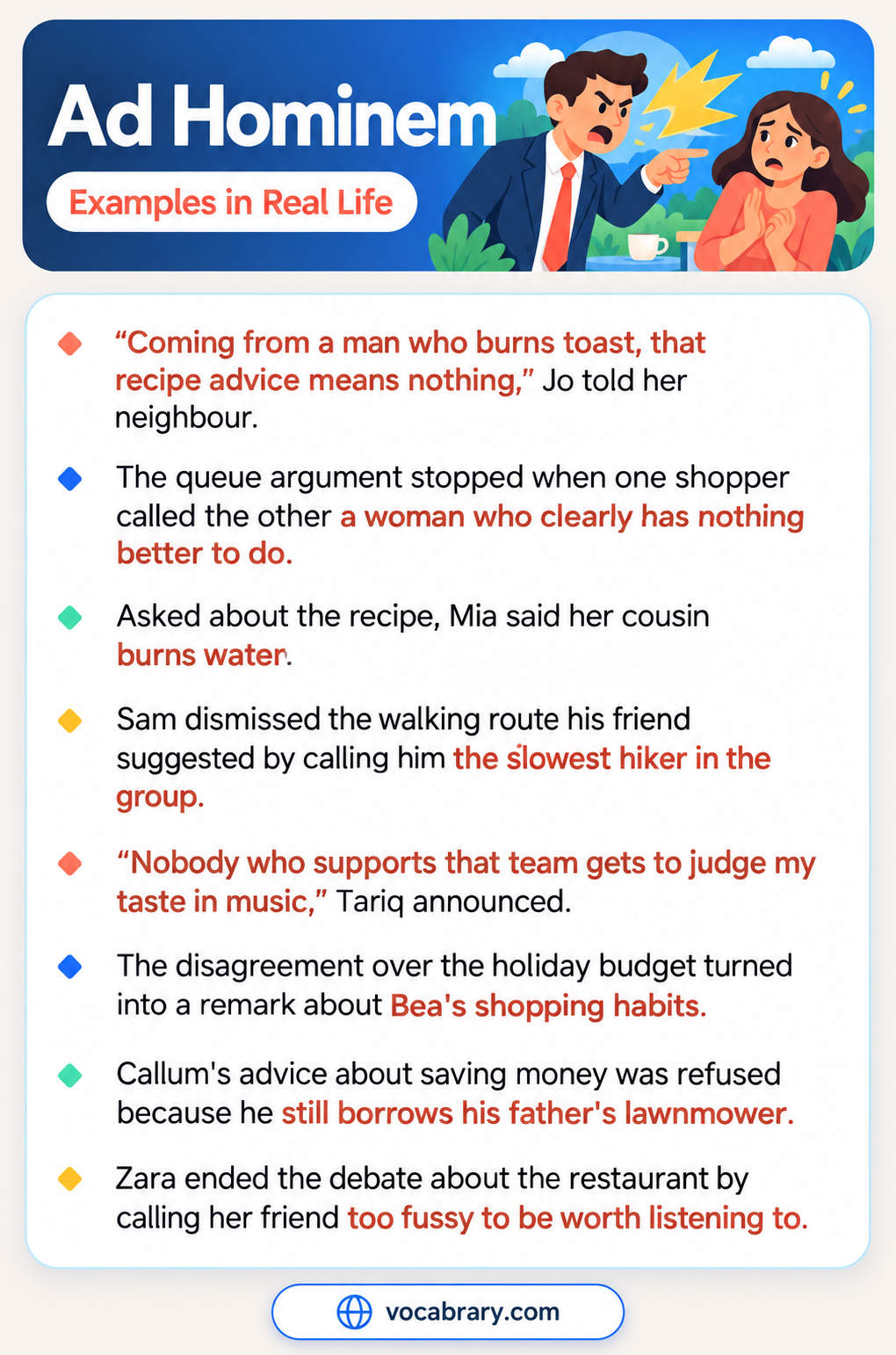
Neighbours arguing about bin collections, friends disagreeing over a film, and shoppers quarrelling in a queue produce most casual ad hominem. The speaker swaps the disagreement for a jab at the other person’s habits, looks, or history.
- “Coming from a man who burns toast, that recipe advice means nothing,” Jo told her neighbour.
- Farid rejected the film review because the critic once walked out of a comedy halfway through.
- “You have never finished a book in your life,” Ravi told his friend, ending the argument about the novel’s ending.
- The queue argument stopped when one shopper called the other a woman who clearly has nothing better to do.
- Asked about the recipe, Mia said her cousin burns water.
- “Your flat is a mess, so I will not take housekeeping tips from you,” Ellie said flatly.
- Sam dismissed the walking route his friend suggested by calling him the slowest hiker in the group.
- When Dad argued that the tyres needed changing, my brother replied that Dad cannot tell a wrench from a spanner.
- “Nobody who supports that team gets to judge my taste in music,” Tariq announced.
- Asked to justify the rent split, Kim answered that her flatmate eats cereal for dinner.
- The disagreement over the holiday budget turned into a remark about Bea’s shopping habits.
- “You are the last person who gets to talk about punctuality,” Ines told her sister, dodging the schedule question.
- Callum’s advice about saving money was refused because he still borrows his father’s lawnmower.
- “That is rich, coming from someone who wears socks with sandals,” Hugh laughed, leaving the fashion argument unanswered.
- My neighbour rejects every parking suggestion by mentioning that I failed my first test.
- Zara ended the debate about the restaurant by calling her friend too fussy to be worth listening to.
- “A man who feeds his dog crisps should not lecture me about health,” Owen said, ignoring the study altogether.
- The dispute over the fence was settled with an insult about the neighbour’s garden gnomes, and the boundary question stayed open.
Ad Hominem Examples in Family Arguments
Parents, teenagers, and in-laws trade these attacks during rows about curfews, money, and chores. A grandmother’s spending record, a teenager’s school report, and a brother’s messy room all replace the actual disagreement.
- “You failed three subjects last year, so your opinion on my career is worthless,” Nadia told her brother.
- Mum answered the curfew argument by reminding Leo that he forgot his keys twice this month.
- “A boy who cannot keep his room tidy has no say in family decisions,” Dad announced.
- Grandad dismissed the savings plan because his daughter-in-law overspent.
- When Amara argued for a later bedtime, her father replied that she naps every Saturday afternoon anyway.
- “Since when does the person who dented the car get to talk about driving?” Rosa asked her cousin.
- The row about the holiday ended when Uncle Hamid called his sister the family drama queen.
- My aunt rejects every diet suggestion by mentioning that her sister smoked for twenty years.
- “You were a terrible student, so do not tell me how to revise,” Jonah told his older brother.
- Talk about sharing the chores collapsed into a remark about Lila’s unwashed mugs.
- “Your marriage lasted eighteen months, so keep your relationship advice,” Tess said, answering none of it.
- Dad’s budget was rejected because Mum called him the man who bought a boat he never sailed.
- The argument over the family photo ended with someone calling Nasir too vain to be reasonable.
- “A person who still sleeps in his childhood bedroom cannot advise me on mortgages,” Simon told his younger sister.
- Instead of replying to the question about the will, Ruth accused her brother of being greedy since childhood.
Ad Hominem Examples in School and University Debates
Debate rounds, seminar rooms, and study groups fill with these attacks when a speaker runs short of evidence. A rival’s grade average, a captain’s poor attendance, and a first-year’s inexperience get named instead of the motion.
- “My opponent scored forty percent in economics, so this whole argument is unreliable,” the debater said.
- Rather than address the motion, Yusuf reminded the room that his rival had lost every round that term.
- “A first-year has no standing to argue about university funding,” the speaker announced, ignoring the figures entirely.
- The seminar ended with a student calling the presenter a show-off with a thesaurus.
- Meera’s data was dismissed because she attends a smaller college.
- “You missed six debate practices, so your view on preparation means nothing,” the captain snapped.
- When Elias argued for a later exam date, a classmate said he sleeps through lectures anyway.
- The judge stopped the round after one team called the other a group of privately schooled amateurs.
- “Says the girl who copied her lab notes,” Ben shot back, leaving the experiment question unanswered.
- Adaeze’s argument on climate policy was waved away because her father works for an oil company.
- “Nobody who arrives late to seminars gets to lecture us on discipline,” the tutor said.
- Instead of meeting the counterargument, the debater described his rival as loud and desperate.
- “Your essay had eleven spelling mistakes, so your reading of the poem is wrong,” Callie told her partner.
- The study group ignored Hiro’s correction because he had joined the course in the second term.
- Alina answered a question about her sources by calling the questioner jealous of her grades.
Ad Hominem Examples in Workplace Disputes
Budget meetings, performance reviews, and project handovers turn personal when a manager runs out of counterarguments. A junior’s age, a colleague’s old mistake, and a rival’s dress sense stand in for the business case.
- “You have been here six months, so your view on our pricing is worthless,” the director told Ayesha.
- Rather than answer the cost analysis, the head of sales called Rob a pessimist who drags every meeting down.
- “A man who lost the Henderson account should keep quiet about strategy,” Maya said in front of the team.
- The safety report was rejected because its author had complained about the canteen twice.
- “Nobody who comes to work in trainers gets to talk about professionalism,” the supervisor announced.
- When Tomas raised the overtime problem, his manager replied that he is the slowest coder on the floor.
- Farrah’s forecast was ignored because she misjudged last year’s launch.
- “Says the woman who cannot open a shared drive,” Greg replied to a reasonable question about backups.
- Instead of examining the invoice, the finance lead described the supplier as a family firm with no ambition.
- “You only got this job through your uncle,” Dan muttered, avoiding the question about the missing data.
- The client meeting collapsed when one side called the other a team of form-fillers.
- Wanda’s request for extra staff was refused because she is the loudest person in the building.
- “Someone who takes two hours for lunch should not lecture me about deadlines,” the team lead said.
- Asked about the delay, the contractor called the inspector an inexperienced graduate with a clipboard.
- The appraisal ended with the phrase a poor cultural fit, and none of the performance figures were discussed.
Ad Hominem Examples in Politics
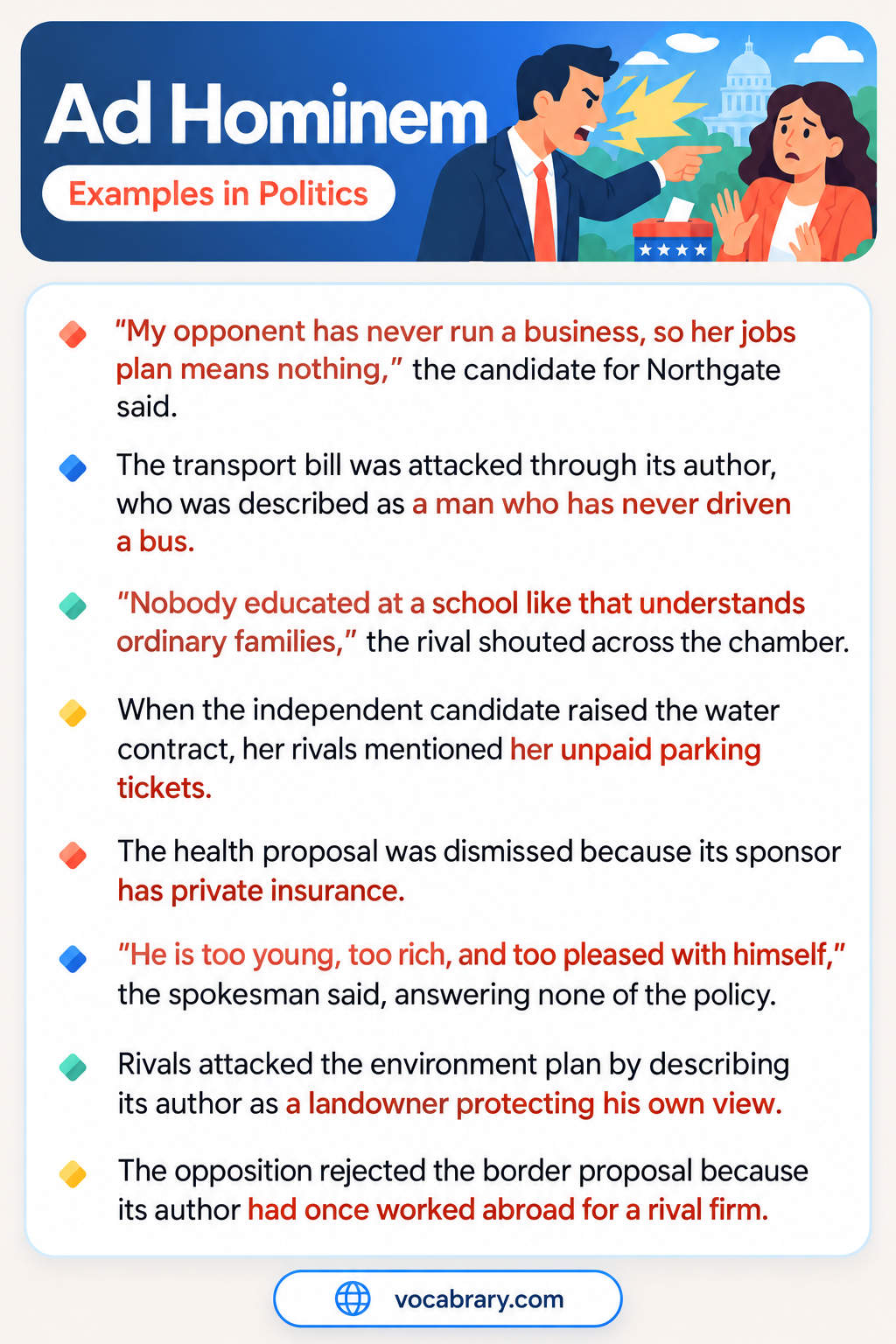
Campaign debates and council chambers produce these attacks when a rival’s argument proves awkward. A candidate’s school, a minister’s holiday, and an opponent’s inexperience get raised instead of the policy under discussion.
- “My opponent has never run a business, so her jobs plan means nothing,” the candidate for Northgate said.
- Rather than answer the housing question, the mayor called his challenger a career politician with soft hands.
- “A woman who took a holiday during the floods cannot lecture us on planning,” the council leader declared.
- The transport bill was attacked through its author, who was described as a man who has never driven a bus.
- “Nobody educated at a school like that understands ordinary families,” the rival shouted across the chamber.
- Instead of debating the tax figures, the minister called the report’s author an activist in a suit.
- When the independent candidate raised the water contract, her rivals mentioned her unpaid parking tickets.
- “You changed parties twice, so your promise on health funding is empty,” Councillor Maren said.
- The health proposal was dismissed because its sponsor has private insurance.
- “A first-time candidate has no business questioning our accounts,” the incumbent replied, and the accounts stayed unexamined.
- Debate on the school budget ended when one side called the other a chamber of amateurs.
- “He is too young, too rich, and too pleased with himself,” the spokesman said, answering none of the policy.
- Rivals attacked the environment plan by describing its author as a landowner protecting his own view.
- “Says the party that lost three elections,” the backbencher replied, leaving the pension question open.
- The opposition rejected the border proposal because its author had once worked abroad for a rival firm.
Ad Hominem Examples in Social Media Comments
Comment replies, quote-tweets, and group chats reward the fastest insult. A stranger’s grammar, follower count, and profile photo become the reply instead of an answer to the claim.
- “Nobody with four followers gets to correct me about economics,” the reply read.
- Rather than answer the statistic, a stranger described the writer as a keyboard warrior with too much free time.
- “Your spelling is atrocious, so your argument about the law is worthless,” one commenter wrote.
- The video’s claim about fuel prices was attacked through the presenter’s cheap microphone and messy kitchen.
- “Says someone whose profile photo is a cartoon frog,” came the reply under a careful explanation.
- When Dalia shared the study, a reply asked whether she even finished school.
- “You have been on this platform for two weeks,” one user wrote, ignoring the question about the data entirely.
- Comments under the recipe video attacked the cook as an influencer who has never worked in a kitchen.
- “Imagine taking health advice from a man who films himself eating,” a commenter wrote, answering nothing.
- The group chat dismissed Mo’s booking suggestion by calling him the one who forgot the tickets last year.
- “Deleted your last account, did you not?” a stranger asked, leaving the argument about the figures untouched.
- A reply to the climate graph mentioned the author’s holiday photos.
- “Your bio says student, so stay out of this one,” one reply said, avoiding the question about the budget.
- The review was dismissed because the reviewer had rated a rival product highly last month.
- Under the maths explanation, the top reply called the teacher a smug know-it-all, and the error stayed uncorrected.
Ad Hominem Examples in Advertising and Brand Attacks
Comparative adverts attack the rival maker rather than the rival product. An invented coffee chain, a challenger phone maker, and a paint company all answer a competitor’s test data with a remark about the competitor itself.
- “Made by a company that started in a garage last year,” the advert sneered, saying nothing about the phone itself.
- Bellweather Coffee answered its rival’s taste test by calling the rival a chain run by accountants.
- “Would you trust your roof to a firm that changed its name twice?” the radio advert asked.
- Harbour Paints described its competitor as a foreign outfit with no love for local homes.
- A trainer advert dismissed the rival’s laboratory data by calling the testers students paid in pizza.
- “Their engineers have never built a car for real roads,” the voiceover claimed, avoiding the safety figures.
- Northfield Bakery mocked its rival as a factory in a fake apron.
- The insurance advert attacked the rival’s price promise by calling its owners city investors who have never met a customer.
- “Sold by a brand your grandmother has never heard of,” the slogan warned.
- A cleaning product campaign answered a rival’s stain test by calling that rival new, small, and desperate.
- “Their founder sold his last company and left,” the advert said, leaving the warranty comparison undiscussed.
- The airline’s campaign described its competitor’s crew as teenagers in borrowed uniforms, and the on-time figures went unmentioned.
Ad Hominem Examples in Courtroom and Legal Argument
Cross-examination turns on credibility, so lawyers attack witnesses directly. An expert’s fee, a witness’s old conviction, and an opponent’s inexperience get raised in place of the testimony itself.
- “This expert is paid by the defence, so his measurements mean nothing,” counsel told the jury.
- Rather than dispute the timeline, the barrister called the witness a man with a conviction for petty theft.
- “A witness who has changed her address four times is unreliable,” the prosecutor argued.
- Defence counsel attacked the traffic study by describing its author as an engineer who failed his own licence exam.
- “My learned friend has been qualified for two years,” the barrister remarked, addressing none of the legal argument.
- The claimant’s medical evidence was answered with a remark about the doctor’s suspended registration in another country.
- “You were drinking that evening, so nothing you saw counts,” the lawyer told the witness.
- Counsel dismissed the accountant’s report by calling him a friend of the family since school.
- “She sued her last employer as well,” the defence said, leaving the current claim unanswered.
- The judge warned counsel for calling the solicitor sloppy.
- “Nobody who lost that many cases should lecture this court on precedent,” the barrister said.
- Cross-examination of the neighbour turned on an old dispute over a fence rather than what she saw that night.
- “Your client rents the flat, so his account of the fire is convenient,” counsel suggested.
Ad Hominem Examples in Sports and Fan Arguments
Phone-ins, stadium seats, and pub debates settle disputes by attacking the speaker. A pundit’s short playing career, a rival fan’s home town, and a referee’s fitness replace any look at the record.
- “A pundit who played forty games has no right to criticise a striker,” the caller argued.
- Rather than answer the statistic, the fan called his rival a supporter who has never been to a match.
- “You started following them when they won the cup,” Owen said, ignoring the point about the defence.
- The manager dismissed the tactical question by calling the reporter a man who has never kicked a ball.
- “Nobody from that town understands this club,” the fan shouted, and the transfer argument went nowhere.
- Callers called the referee too unfit to keep up.
- “Says the bloke who fell asleep at the semi-final,” Ash replied to a careful argument about substitutions.
- The coach’s training plan was rejected because he had been dropped from his own school team.
- “Your fantasy team finished last, so keep your selection advice,” Milo told his friend.
- Pundits answered the goalkeeper’s complaint by calling him a moaner with a bad record in finals.
- “An armchair fan cannot judge fitness,” the presenter snapped, leaving the injury data unexamined.
- Radio hosts dismissed the analyst’s numbers because she supports the opposing club.
- Supporters answered the ticket-price argument with a joke about the writer’s replica shirt from 1994.
Types of Ad Hominem With Examples
Textbooks separate four or five forms: abusive insults, circumstantial motives, tu quoque hypocrisy charges, guilt by association, and poisoning the well. The sentences under each form attack the arguer in a different way while leaving the argument standing.
Abusive Ad Hominem Examples
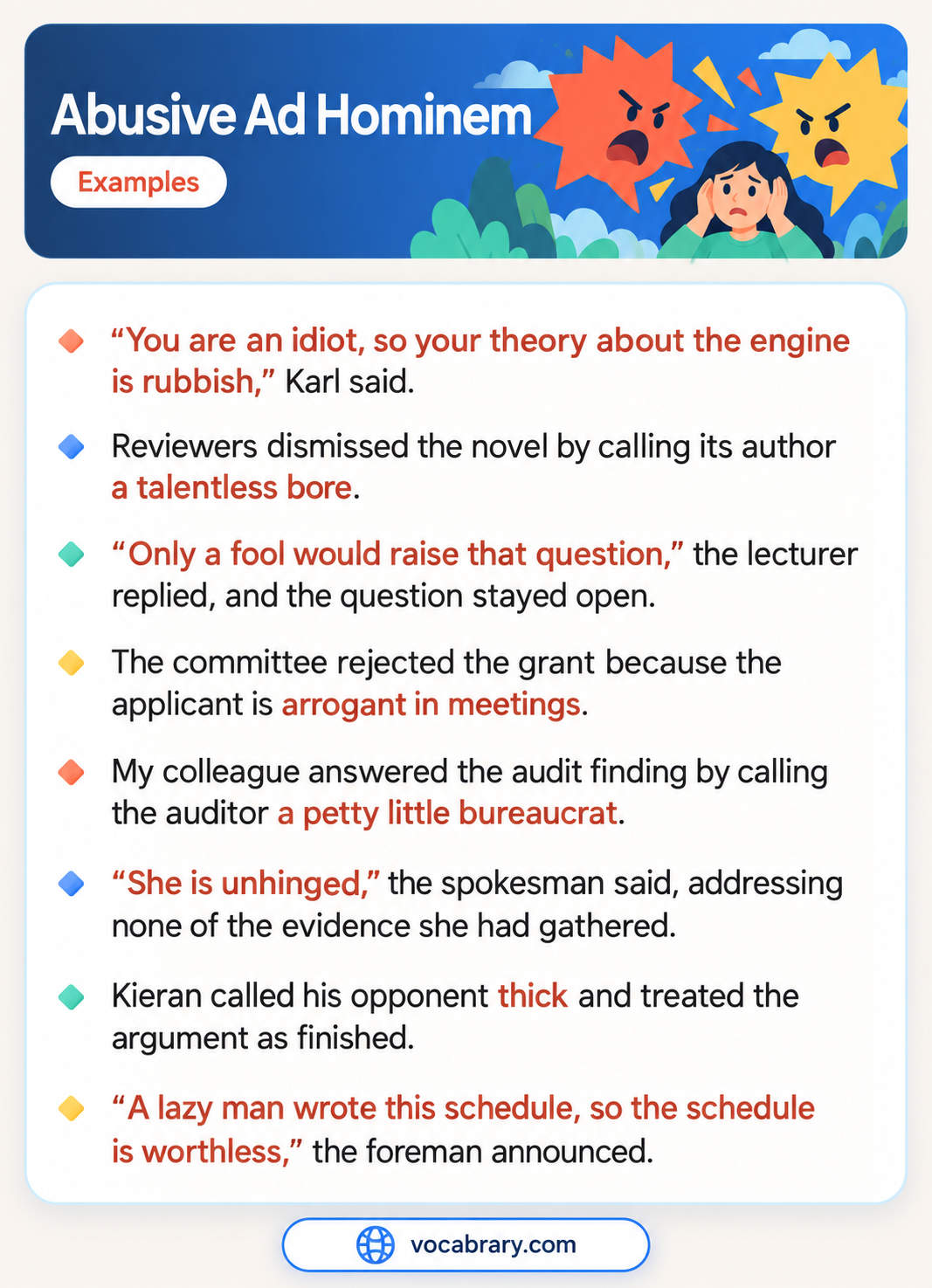
Direct insults make up the abusive form, where a reply calls the speaker stupid, lazy, or unstable and stops there. A rejected proposal, an ignored warning, and an unanswered statistic follow each insult.
- “You are an idiot, so your theory about the engine is rubbish,” Karl said.
- Reviewers dismissed the novel by calling its author a talentless bore.
- “Only a fool would raise that question,” the lecturer replied, and the question stayed open.
- The committee rejected the grant because the applicant is arrogant in meetings.
- “Shut up, you clown,” was the whole answer to a careful argument about pension costs.
- My colleague answered the audit finding by calling the auditor a petty little bureaucrat.
- “She is unhinged,” the spokesman said, addressing none of the evidence she had gathered.
- Kieran called his opponent thick and treated the argument as finished.
- “A lazy man wrote this schedule, so the schedule is worthless,” the foreman announced.
- Insults about the speaker’s second-hand coat replaced every reply to her transport figures, and nobody at the meeting checked a single number she had quoted.
Circumstantial Ad Hominem Examples
The circumstantial form names the arguer’s job, money, or loyalties instead of the claim. A tobacco firm’s lawyer, a landlord’s daughter, and a salesman on commission each get dismissed for their situation alone.
- “Of course you defend the rent rise, your father is a landlord,” Ida said.
- The safety study was rejected because its funding came from the industry it examined.
- “You sell insurance, so your advice about cover means nothing,” the customer replied.
- Critics answered the doctor’s paper by naming the drug company that paid her travel costs.
- “A man on commission would say that,” the buyer said, and the figures went unchecked.
- Ministers dismissed the charity’s report because the charity campaigns for higher benefits.
- “Your brother owns the site, so your planning argument is convenient,” the councillor said.
- Nobody tested the union’s wage data, since the union wanted the wage rise.
- “She teaches at that university, so naturally she praises its research,” the caller argued.
- The farmer’s objection to the bypass was waved away because the road would cross his own field, and the traffic counts behind his objection went unread.
Tu Quoque Ad Hominem Examples
Tu quoque answers criticism with a hypocrisy charge: you do it too. A smoking doctor, a late manager, and a parent with a phone habit all turn the accusation back instead of meeting it.
- “You smoke twenty a day, so spare me the health lecture,” the patient told his doctor.
- Reminded about the deadline, Priya replied that her manager had missed two reports that month.
- “Says the man who was late yesterday,” Theo answered, and the punctuality argument ended there.
- Teenagers answer screen-time rules by naming their parents’ evening scrolling.
- “And you ate three biscuits before dinner,” Anna told her mother, avoiding the question about her homework.
- The country rejected the criticism by naming the critic’s own record on the same issue.
- “Why should I recycle when you drive everywhere?” Callum asked instead of answering.
- Accused of shouting, the coach replied that the referee shouts at every match.
- “You cheated at cards last Christmas,” Mo said, leaving the accusation against him unanswered.
- Fans defended their club’s foul record by naming the rival club’s worse record, which left their own complaint about the referee unexamined.
Guilt by Association Ad Hominem Examples
Guilt by association rejects a claim because a disliked group agrees with it. A shared opinion with a rival club, a discredited author, and an unpopular committee decide the argument on their own.
- “A dishonest man once made the same argument, so yours fails,” the debater said.
- The recycling plan was attacked because a discredited consultancy had proposed something similar.
- “Your view on fees matches the worst landlord in town,” the tenant snapped.
- Members rejected the motion since a rival society had voted for it first.
- “People who believe that also believe the moon landing was faked,” the caller said.
- Critics answered the health claim by naming the fringe website that repeated it.
- “That is exactly what my old boss used to say,” Rafi replied, and the proposal was dropped without any discussion of its costs.
- The theory was dismissed because its first supporter was later jailed for fraud.
- “Only cranks agree with you,” the presenter told a guest with two studies in hand.
- Support from an unpopular committee was treated as proof that the library plan deserved rejection.
Poisoning the Well Ad Hominem Examples
Poisoning the well discredits a speaker in advance, before anybody has heard the argument. A warning about a liar, a whisper before a presentation, and an introduction about past mistakes all do the work early.
- “Before Ravi speaks, remember he was wrong about the roof,” the chairman warned.
- Colleagues were told the new analyst exaggerates everything minutes before her presentation began.
- “Whatever my opponent says next, she is being paid to say it,” the debater announced.
- The introduction described the guest as a man who lost his licence, and the audience stopped listening before he reached the first line of his report.
- “You will hear from someone who has lied to this committee before,” counsel said.
- Emails circulated about the consultant’s failed project the day before he presented his findings.
- “Treat anything from that department with suspicion,” the memo advised, naming no evidence at all.
- Parents were warned that the new teacher argues with everybody before she had taught a lesson.
- “He is a known troublemaker,” the supervisor said, and nobody read the complaint he had written.
- Whispers about the researcher’s old dispute ended her argument before the meeting opened.
Ad Hominem Examples in Literature and Film
Oedipus mocking a blind prophet, Lady Catherine attacking Elizabeth Bennet’s family, and a jury room turning on the one juror who doubts are the best-known scenes of ad hominem in storytelling. Writers use them to expose a character who has run out of reasons.
Ad Hominem in Plays and Novels
Sophocles, Austen, Orwell, and Ibsen all write characters who answer an unwelcome argument with an attack on the speaker. A prophet, a country gentlewoman, a pig, and a small-town doctor deliver these attacks.
- Sophocles’ “Oedipus Rex” has Oedipus answer the prophet Tiresias by mocking his blindness and accusing him of plotting with Creon, never testing the prophecy itself.
- Lady Catherine de Bourgh, in Jane Austen’s “Pride and Prejudice”, answers Elizabeth Bennet by attacking her family’s low connections rather than her reasoning.
- In Arthur Miller’s “The Crucible”, John Proctor’s testimony is met with questions about his church attendance and his unbaptised son.
- Townspeople in Harper Lee’s “To Kill a Mockingbird” insult Atticus Finch personally instead of weighing the evidence he presents at trial.
- Squealer, in George Orwell’s “Animal Farm”, destroys Snowball’s windmill argument by naming Snowball a traitor who worked for Jones.
- Jack, in William Golding’s “Lord of the Flies”, silences Piggy’s sensible proposals by mocking his glasses and his size.
- Victor Frankenstein, in Mary Shelley’s novel, refuses the creature’s argument because of the creature’s appearance rather than its content.
- Henrik Ibsen’s “An Enemy of the People” shows a whole town declaring Doctor Stockmann an enemy instead of testing his findings about the polluted baths.
Ad Hominem in Film and Television
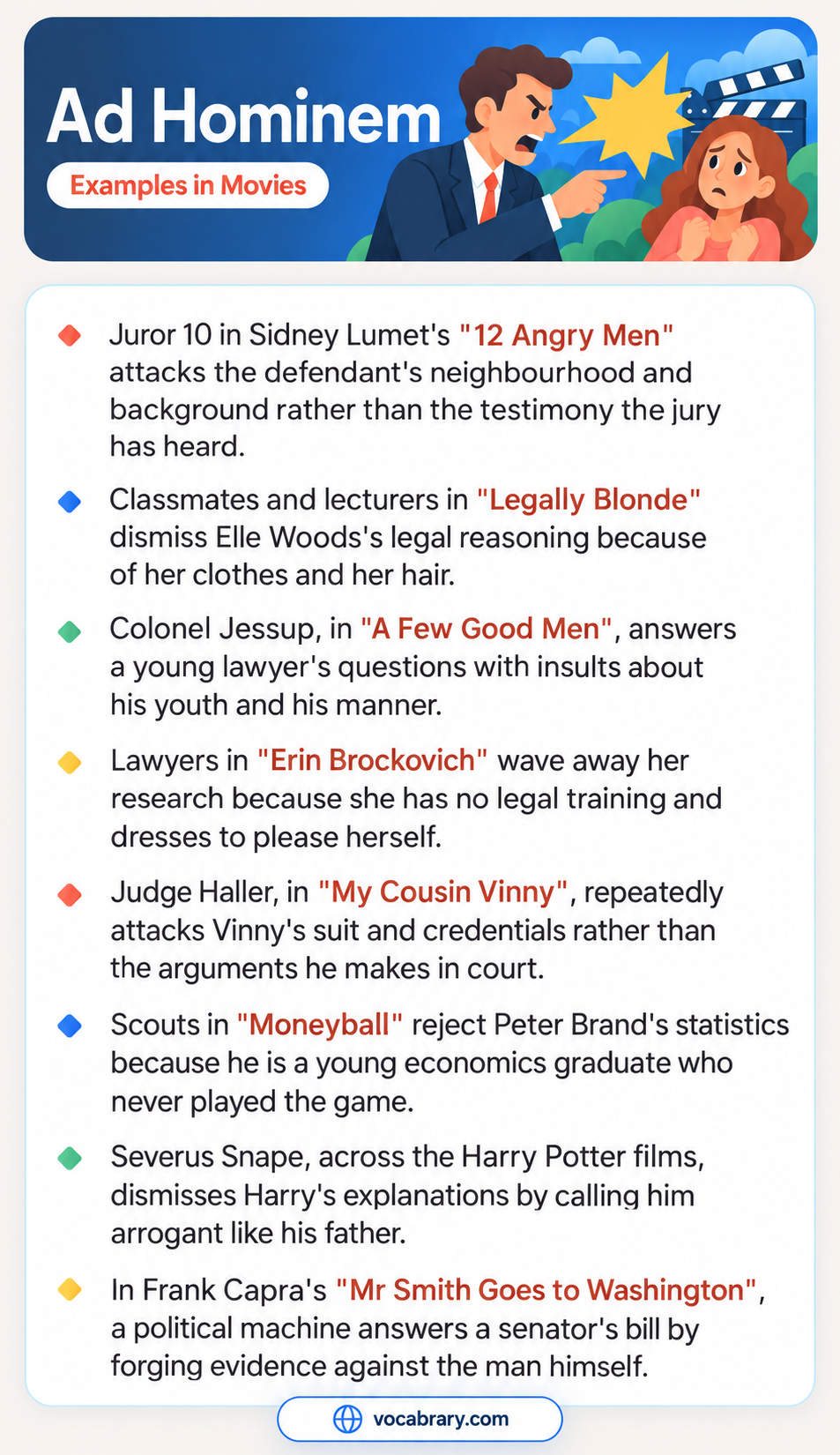
Courtroom films and jury dramas supply the sharpest screen cases. A doubting juror, a blonde law student, a young statistician, and a shouting colonel each get attacked in place of the case they are making.
- Juror 10 in Sidney Lumet’s “12 Angry Men” attacks the defendant’s neighbourhood and background rather than the testimony the jury has heard.
- Classmates and lecturers in “Legally Blonde” dismiss Elle Woods’s legal reasoning because of her clothes and her hair.
- Colonel Jessup, in “A Few Good Men”, answers a young lawyer’s questions with insults about his youth and his manner.
- Lawyers in “Erin Brockovich” wave away her research because she has no legal training and dresses to please herself.
- Judge Haller, in “My Cousin Vinny”, repeatedly attacks Vinny’s suit and credentials rather than the arguments he makes in court.
- Scouts in “Moneyball” reject Peter Brand’s statistics because he is a young economics graduate who never played the game.
- Severus Snape, across the Harry Potter films, dismisses Harry’s explanations by calling him arrogant like his father.
- In Frank Capra’s “Mr Smith Goes to Washington”, a political machine answers a senator’s bill by forging evidence against the man himself.
Ad Hominem in Recorded Debate and Philosophy
Logicians named this move early. Aristotle, Locke, Whately, and Schopenhauer each described attacking the arguer, and Cicero and the Oxford evolution debate supply the famous instances.
- Aristotle’s “Sophistical Refutations” separates a reply aimed at the questioner from a reply aimed at the argument under discussion.
- In John Locke’s “An Essay Concerning Human Understanding”, published in 1690, argumentum ad hominem means pressing an opponent with his own stated principles.
- Richard Whately, in his logic textbook of 1826, described the attack as one addressed to the character, circumstances, or past conduct of a person.
- Cicero’s “Philippics” attack Mark Antony’s drinking and private life far more than any argument Antony had made.
- Callicles, in Plato’s “Gorgias”, tells Socrates that philosophy makes a grown man ridiculous, which answers nothing Socrates has argued.
- Schopenhauer’s “The Art of Being Right” ends at stratagem thirty-eight with the advice to become personal and insulting once the argument is lost.
- At the Oxford meeting of 1860, Samuel Wilberforce asked Thomas Huxley whether the ape came through his grandfather or his grandmother, by most accounts.
- John Stuart Mill’s “On Liberty”, published in 1859, condemns debaters who answer an opponent by declaring him a bad and immoral man.
Sentences Rewritten to Answer the Argument Instead
The same disagreements look different once the insult goes. A budget row, a safety complaint, and a homework argument each appear twice, first as an attack on the speaker and then as a reply to the claim.
- Instead of “You are too lazy to read the budget,” Nadia said the budget assumes a ten percent fuel rise while last year’s rise was two.
- Rather than call the auditor a fussy little man, the chairman asked which invoices had been sampled and over what period.
- Dropping the line “a first-year has no standing here,” the debater asked for the funding figures behind the motion.
- In place of “your handwriting is dreadful,” the tutor circled the missing minus sign in the third equation.
- Karim swapped “you sell insurance, so you would say that” for a question about the excess on the policy.
- Once “she is unhinged” was struck out, the reply dealt with the three measurements her report questioned.
- Swapping “says the man who was late yesterday,” Theo agreed the deadline had moved and offered a new date.
- The insult “a bitter former employee” gave way to a paragraph on the route’s actual passenger numbers.
- After deleting “nobody with four followers gets to correct me,” the commenter asked which year the statistic came from.
- When “your brother owns the site” was dropped, the councillor asked about the flood risk on that land.
- Replacing “you failed chemistry twice,” Sara showed her brother the labelled diagram that settled the argument.
- Zoya cut “an armchair fan cannot judge fitness” and quoted the distance the midfielder had covered in the match.
Short Ad Hominem Examples for Students
Quick lines suit revision cards and debate practice. A homework excuse, a playground row, and a one-line dismissal in class each show the whole fallacy in a dozen words or fewer.
- “You are too lazy to be right about this.“
- Ben rejected the answer because Ana is the youngest in class.
- “Nobody asked the boy who forgets his pencil case.“
- The teacher was dismissed as boring, so her correction went unread.
- “Your trainers are ugly, so your argument is wrong.“
- Sami answered a fair question by calling his classmate a show-off.
- “Says the girl who lost the spelling bee.“
- Maya’s answer was ignored because she sat at the back all term.
- “He is new here, so who cares what he thinks?“
- Instead of checking the sum, Leo called Omar careless with numbers.
- “You copied last week, so you are wrong now.“
- The captain dismissed the tactic because Nia had never scored.
- “Only a show-off would use that word.“
- Yusuf answered his partner’s correction with a remark about her messy folder, and the error stayed in the essay.
Related
FAQs
Two ad hominem examples in a sentence are "You are too young to have an opinion on the budget" and "You smoke twenty a day, so spare me the health lecture." Each reply targets the speaker’s age or habits instead of the point being made.
Abusive ad hominem sentences answer an argument with a direct insult, as in "You are an idiot, so your theory about the engine is rubbish" and "Shut up, you clown." Both replies leave the engine theory and the pension costs untouched.
Circumstantial sentences reject a claim because of the speaker’s job or income, as in "You sell insurance, so your advice about cover means nothing" and "A man on commission would say that." The buyer in the second sentence never checks the figures.
A tu quoque reply answers criticism by pointing to the critic’s own fault, as in "Says the man who was late yesterday" and "And you ate three biscuits before dinner." In both sentences the original complaint is never addressed.
Guilt by association sentences reject a claim because a disliked person or group shares the view. Two cases are "A dishonest man once made the same argument, so yours fails" and "Your view on fees matches the worst landlord in town."
Poisoning the well discredits a speaker before the argument is heard. Two cases are "Before Ravi speaks, remember he was wrong about the roof" and "Whatever my opponent says next, she is being paid to say it."
Political attacks include "My opponent has never run a business, so her jobs plan means nothing" and "Nobody educated at a school like that understands ordinary families." Both statements target the speaker’s background in place of the policy.
Social media replies include "Nobody with four followers gets to correct me about economics" and "Your spelling is atrocious, so your argument about the law is worthless." Each comment judges the writer and ignores the claim.
Courtroom sentences include "This expert is paid by the defence, so his measurements mean nothing" and "A witness who has changed her address four times is unreliable." Each one attacks credibility without answering the testimony.
Short lines for students include "Your trainers are ugly, so your argument is wrong," "Says the girl who lost the spelling bee," and "Only a show-off would use that word." Each line fits on a revision card.