
Verbal irony is a figure of speech in which a speaker says one thing and means the opposite, as when someone calls a hurricane “lovely weather.” Most everyday verbal irony examples are complaints about traffic, weather, and bad luck phrased as praise, so the situation tells the listener what the speaker really means.
What Is Verbal Irony?
Verbal irony is a contrast between the literal words a speaker uses and the meaning the speaker intends. Unlike situational irony, which depends on events, verbal irony depends entirely on what someone says and on the listener reading the situation correctly.
Stuck in a two-hour queue, Omar muttered, “This is the best day of my life.“
Common Verbal Irony Examples in Sentences
Calling a hurricane “lovely weather,” thanking a waiter for cold soup, and praising a flat tire as “perfect timing” are the textbook cases of verbal irony, where the words praise exactly what the speaker dislikes.
- Staring at the hurricane through the window, Grandpa said, “Lovely weather for a picnic.“
- When the soup arrived cold, Maya told the waiter, “Wow, piping hot, just how I like it.“
- The tire went flat on the way to the airport, and Dad sighed, “Perfect timing.“
- “Oh, great, another Monday,” Lena groaned as her alarm rang at six.
- After the team lost seven to nothing, the coach told reporters, “Well, that went according to plan.“
- Jake spilled coffee down his white shirt and said, “This day just keeps getting better.“
- Watching his brother knock over a stack of plates, Sam clapped and said, “Smooth moves.“
- “Thanks a lot,” Priya muttered when the bus drove past her stop without slowing down.
- Stuck in a two-hour traffic jam, the driver told his passengers, “We’ll be there in no time.“
- After a nine-hour flight delay, one passenger announced, “I just love airports.“
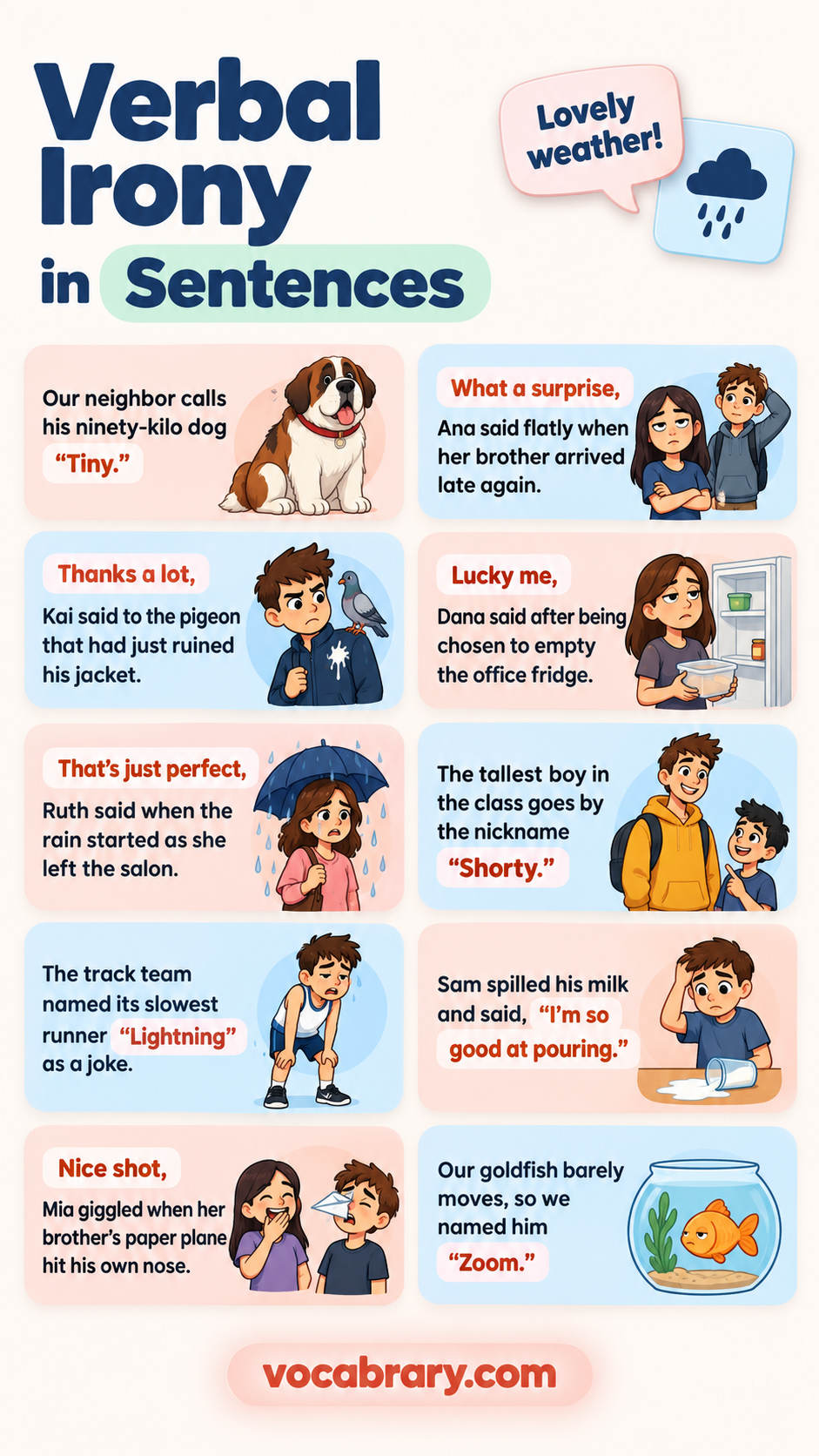
- Our neighbor calls his ninety-kilo dog “Tiny.”
- When the printer jammed for the fifth time, Rosa said, “Technology makes life so much easier.“
- Looking at the mountain of homework on his desk, Leo said, “I have absolutely nothing to do tonight.“
- “What a surprise,” Ana said flatly when her brother arrived late again.
- The waiter dropped a whole tray of glasses, and a diner called out, “Nice catch!“
- Seeing the rain pour on the day of the beach trip, Kim said, “Good thing we packed sunscreen.“
- Pointing at a rusted car with three dents, Tom’s friend asked, “Is this your new luxury ride?“
- After burning the toast, Mom announced, “Breakfast is served, courtesy of our master chef.“
- “Don’t work too hard,” Mia told her brother, who was asleep on the sofa at noon.
- The lecture ran two hours past schedule, and a student whispered, “That flew by.“
- Holding up an umbrella turned inside out by the wind, Carlos said, “Best umbrella ever.“
- Half the audience fell asleep during the film, and Jon called it “a real edge-of-your-seat thriller.”
- Nobody laughed at the host’s first joke, so he said, “I’ll take that as a standing ovation.“
- Surrounded by unopened moving cartons, Sara texted her friend, “Living the dream.“
- “Oh, you’re early,” the teacher said as Omar walked in forty minutes after the bell.
Verbal Irony Examples in Everyday Life
Bank queues that never move, a fridge that breaks right after the warranty ends, and a crushed parcel “handled with care” show where most people use verbal irony, as a quick joke that eases frustration.
- At the bank, the queue had not moved in twenty minutes, and a man said, “They sure are speedy today.“
- My sister came home with an uneven haircut and said, “I asked for something subtle.“
- The fridge broke the day after the warranty ended, and Dad said, “What excellent timing from this brand.“
- “I love doing laundry,” Nina said, staring at a pile of clothes taller than the chair.
- Halfway through Omar’s video call, the internet dropped, and he said, “Fantastic service as always.“
- After the power went out during the storm, Grandma lit a candle and said, “How romantic.“
- Carrying six grocery bags up five flights of stairs, Zoe asked, “Who needs a gym?“
- Our landlord raised the rent again, and my roommate said, “He’s so generous.“
- When the parcel arrived crushed, Ben said, “They really handled this with care.“
- Ignored by the shop assistant for ten minutes, Mom whispered, “Such warm service.“
- Stepping in a puddle on his way out, Raj said, “Great start to the morning.“
- “Don’t hurry on my account,” Leila told the cashier who was chatting on her phone.
- After the neighbor’s dog barked all night, Dad said at breakfast, “I slept like a baby.“
- The repairman arrived six hours late, and Aunt Rita greeted him with “Right on time.“
- Looking at the heap of dirty dishes his roommates left behind, Carlos said, “Thanks for tidying up, guys.“
- My little brother ate the last slice of cake, and I told him, “How thoughtful of you to save me some.“
- When the weather app promised sunshine and hail started falling, Ali said, “Very accurate forecast.“
- The self-checkout machine beeped at every product, and Julia said, “So much faster than a real cashier.“
- Our car alarm went off at three in the morning, and the neighbor shouted, “Beautiful music!“
- Seeing the ticket price for a small popcorn, Hana said, “What a bargain.“
Common Verbal Irony Phrases in Conversation
“Oh, great,” “Thanks a lot,” and “Just what I needed” are stock ironic phrases that English speakers use when something goes wrong, and each one means the opposite of its dictionary sense.
- “Oh, great,” Lucas said when the elevator stopped between floors.
- After a second bill arrived in the same week, Emma sighed, “Just what I needed.“
- “Thanks a lot,” Kai said to the pigeon that had just ruined his jacket.
- “Lucky me,” Dana said after being chosen to empty the office fridge.
- Tom looked at the keys locked inside the car and told his friend, “Nice going.“
- “That’s just perfect,” Ruth said when the rain started as she left the salon.
- “Well, this is fun,” Mateo said during the third hour of a power cut.
- At midnight, with loud music coming through the wall, Aunt June said, “How lovely.“
- “Isn’t this day getting better and better?” Farah asked after missing her train.
- When the store’s “sale” prices turned out higher than last week’s, Joel said, “Big surprise.“
- “Way to go,” the kids shouted when their teammate kicked the ball into his own goal.
- As her brother tried to fix the leak with chewing gum, Sofia said, “Brilliant plan.“
- Shivering in a tent full of rainwater, Leo said, “I’m so glad we did this.“
- “Real smooth,” Ivy said to herself after tripping over the doormat in front of her date.
- “Don’t mind me,” Grandpa said as the whole family walked past him without saying hello.
Funny Verbal Irony Examples
A ten-kilo cat named Speedy, a tall boy nicknamed Shorty, and a chef praising his own burnt pancakes show the playful side of verbal irony, where the joke depends on everyone knowing the truth.
- Our cat, a lazy ten-kilo tabby, answers to the name “Speedy.”
- Holding up a pancake burnt black, Chef Tony announced, “Perfection, as usual.“
- “I just adore six o’clock meetings,” Jess said, yawning into her third coffee.
- The tallest boy in the class goes by the nickname “Shorty.”
- After hunting for the glasses perched on his own head, Grandpa said, “My memory is as sharp as ever.“
- When his fantasy football team finished last, Mark called himself “a true sports genius.”
- Covered in paint after a failed home project, Rita posed for a photo and said, “Nailed it.“
- Our dog hides under the bed during every thunderstorm, and we call him “Brave” anyway.
- “Oh, I love a good surprise,” Ben said as his little sister jumped out and scared him for the tenth time.
- Seeing the “gourmet” sandwich arrive at half the size of its photo, Lina said, “Wow, generous portions.“
- Dad got lost using his new GPS and bragged, “I have a perfect sense of direction.“
- After tripping on stage at the talent show, Max bowed and said, “All part of the act.“
- Opening a birthday gift of socks for the fifth year in a row, Uncle Joe said, “Wow, I never saw this coming.“
- The track team named its slowest runner “Lightning” as a joke.
- “Great, now I’m famous,” Hugo said when a video of his fall went around the whole school.
Short Verbal Irony Examples for Kids
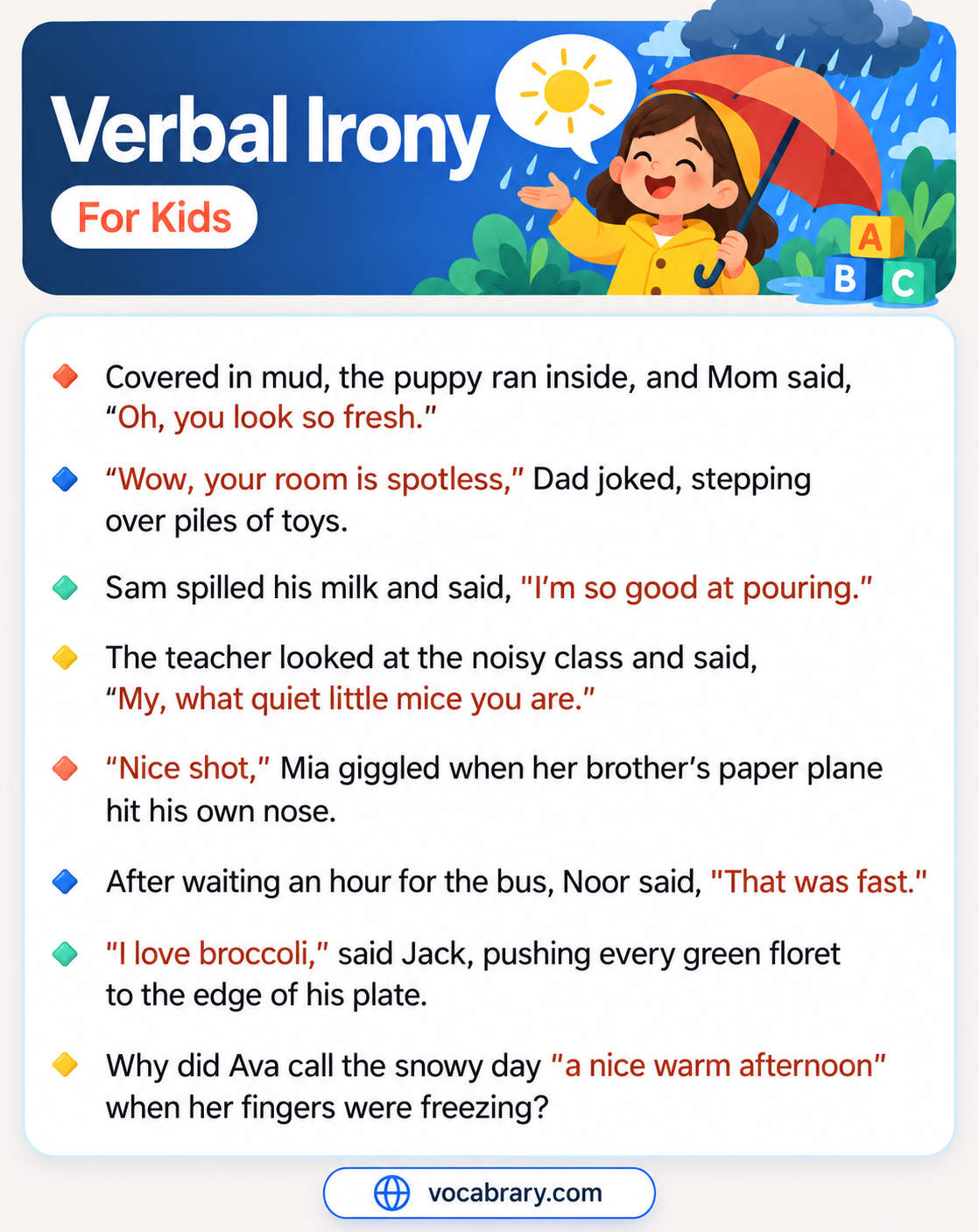
A mud-covered puppy called “so fresh,” a rainy day called “perfect for the beach,” and a messy bedroom called “spotless” give children short, familiar verbal irony examples.
- Covered in mud, the puppy ran inside, and Mom said, “Oh, you look so fresh.“
- Looking out at the rain, Ella said, “Perfect day for the beach.“
- “Wow, your room is spotless,” Dad joked, stepping over piles of toys.
- Sam spilled his milk and said, “I’m so good at pouring.“
- When the ice cream fell off his cone, Leo said, “This is my lucky day.“
- The teacher looked at the noisy class and said, “My, what quiet little mice you are.“
- “Nice shot,” Mia giggled when her brother’s paper plane hit his own nose.
- Our goldfish barely moves, so we named him “Zoom.”
- After waiting an hour for the bus, Noor said, “That was fast.“
- “I love broccoli,” said Jack, pushing every green floret to the edge of his plate.
- When his tower of wooden bricks fell over, Omar said, “Best building ever.“
- Why did Ava call the snowy day “a nice warm afternoon” when her fingers were freezing?
Verbal Irony Examples Without Sarcasm
A father calling his muddy son “Mr. Tidy” and a grandmother joking about her burnt lasagna are affectionate verbal irony with no insult. Sarcasm begins only when the speaker means to mock or hurt.
- Tucking in his muddy son, Dad said, “Goodnight, Mr. Tidy.“
- Serving slightly burnt lasagna, Grandma said, “Another masterpiece from my kitchen,” and everyone laughed with her.
- After finishing the marathon in last place, Lena grinned and said, “Look out, Olympic team.“
- Rocking her newborn at three in the morning, Priya whispered, “Sleep is overrated anyway.“
- The coach smiled at his exhausted players and said, “That was a light warm-up.“
- “Well, that was a relaxing holiday,” Tom said fondly after a week of chasing three toddlers.
- Admiring her tiny first apartment, Ana laughed and called it “my mansion.”
- Carrying her brother’s heavy suitcase, Sara teased, “Did you pack only feathers?“
- After fixing the leak himself, Uncle Ray called himself “a total amateur” with a proud smile.
- On a stormy wedding day, the bride laughed and told her guests, “We ordered this weather specially.“
Types of Verbal Irony With Examples
Sarcasm, understatement, overstatement, ironic similes, and Socratic irony are the five forms of verbal irony named in most literature courses, and each one separates the literal words from the intended meaning in a different way.
Sarcasm
Sarcasm is verbal irony aimed at a person, as when a manager calls a late employee “early bird” or a sister calls a tired pun “hilarious.” These sarcasm example sentences show the mocking form in more daily situations.
- When Kevin walked in an hour late, his manager said, “Good afternoon, early bird.“
- “Hilarious,” Maya said, without smiling, after her brother’s fifth pun.
- “Oh, sure, because you always listen,” Nora told her husband.
- After the referee missed an obvious foul, a fan shouted, “Great eyesight, ref!“
- “Thanks for the help,” Ali said to the coworker who had watched him haul every carton.
- Seeing his roommate’s tower of unwashed dishes, Ben asked, “Planning to start a collection?“
- “Wow, you’re a genius,” Lily said when her friend put salt in his coffee instead of sugar.
- The student who hadn’t read the book gave a two-word answer, and the teacher said, “Such depth.“
- When her brother spent an hour on the phone during family dinner, Jana said, “Thanks for joining us.“
- “Nice parking,” read the note left on a car parked across two bays.
Understatement
Understatement is verbal irony that makes a serious situation sound minor, as when a flooded kitchen becomes “a bit damp” or a lost championship becomes “not our best day.”
- Standing in thirty centimeters of water, Mr. Chen said the kitchen was “a bit damp.”
- After losing the final by six goals, the captain admitted it was “not our best day.”
- The astronaut described the broken oxygen tank as “a small problem.”
- Watching the moving truck drive off with all his furniture and the wrong address, Paul said, “Well, that’s inconvenient.“
- After running forty-two kilometers, Rosa said her legs felt “slightly tired.”
- The surgeon called the eight-hour operation “a little tricky.”
- When the tornado tore the roof off the barn, Uncle Pete called it “some wind.”
- “It’s a tad chilly,” Anna said as the thermometer hit minus thirty.
- Describing the billionaire’s yacht, Marco said, “It’s not a bad little boat.“
- Josh failed every exam and told his parents the term was “not ideal.”
Overstatement
Overstatement is verbal irony that uses deliberate exaggeration, as when someone calls for “an ambulance” over a paper cut or calls a tiny pay rise “life-changing money.”
- Seeing his brother’s paper cut, Ravi shouted, “Quick, call an ambulance!“
- When her boss offered a two-dollar raise, Carmen called it “life-changing money.”
- After a one-minute wait for the kettle, Jake groaned, “I’ve aged ten years.“
- “Stop the presses,” Emma said when her brother finally made his bed.
- Handing over a single cookie, Dad said, “Don’t eat it all at once.“
- The student who scored one mark over the pass line was called “the next Einstein” by his friends.
- “Alert the media,” Lara said when her roommate washed one plate.
- Looking at the tiny portion on his plate, Victor said, “I’ll never finish this feast.“
- When the Wi-Fi slowed for ten seconds, Nina declared, “Civilization has collapsed.“
- “Oh no, a whole drop of rain,” Sam teased his sister, who refused to leave without an umbrella.
Ironic Similes
Ironic similes compare something to its opposite, as in “as soft as a brick” or “as calm as a hurricane,” so the comparison says the reverse of its literal meaning.
- According to Dev, the instructions for the new printer were as clear as mud.
- Mr. Hale’s lecture on tax forms was about as exciting as watching paint dry.
- Guests complained that the old mattress was as soft as a brick.
- Our new puppy is as calm as a hurricane.
- Bread from that gas station is as fresh as last month’s newspaper.
- “He’s as quiet as a marching band,” Grandma said about her youngest grandson.
- For most students, the math final was about as relaxing as a dentist appointment.
- The motel promised comfort, but the pillows were as fluffy as concrete.
Socratic Irony
Socratic irony is verbal irony in which a speaker pretends to know less than they do, as when a teacher plays confused about the moon or a lawyer plays modest before a cross-examination. The name comes from Socrates, who questioned people in Athens while claiming to know nothing.
- The teacher asked, “I’m confused, how exactly does the moon stay up there?” to lead her students toward an explanation of gravity.
- “I’m no expert, of course,” the attorney said before exposing every contradiction in the witness’s story.
- In Plato’s dialogues, Socrates asks others to teach him about justice while claiming to know nothing himself.
- Lieutenant Columbo plays a forgetful, bumbling detective so that murder suspects relax and reveal their mistakes.
- “Explain it once more, please, I’m a bit slow,” the chess champion told the beginner who claimed to know every opening.
Verbal Irony Examples in Literature
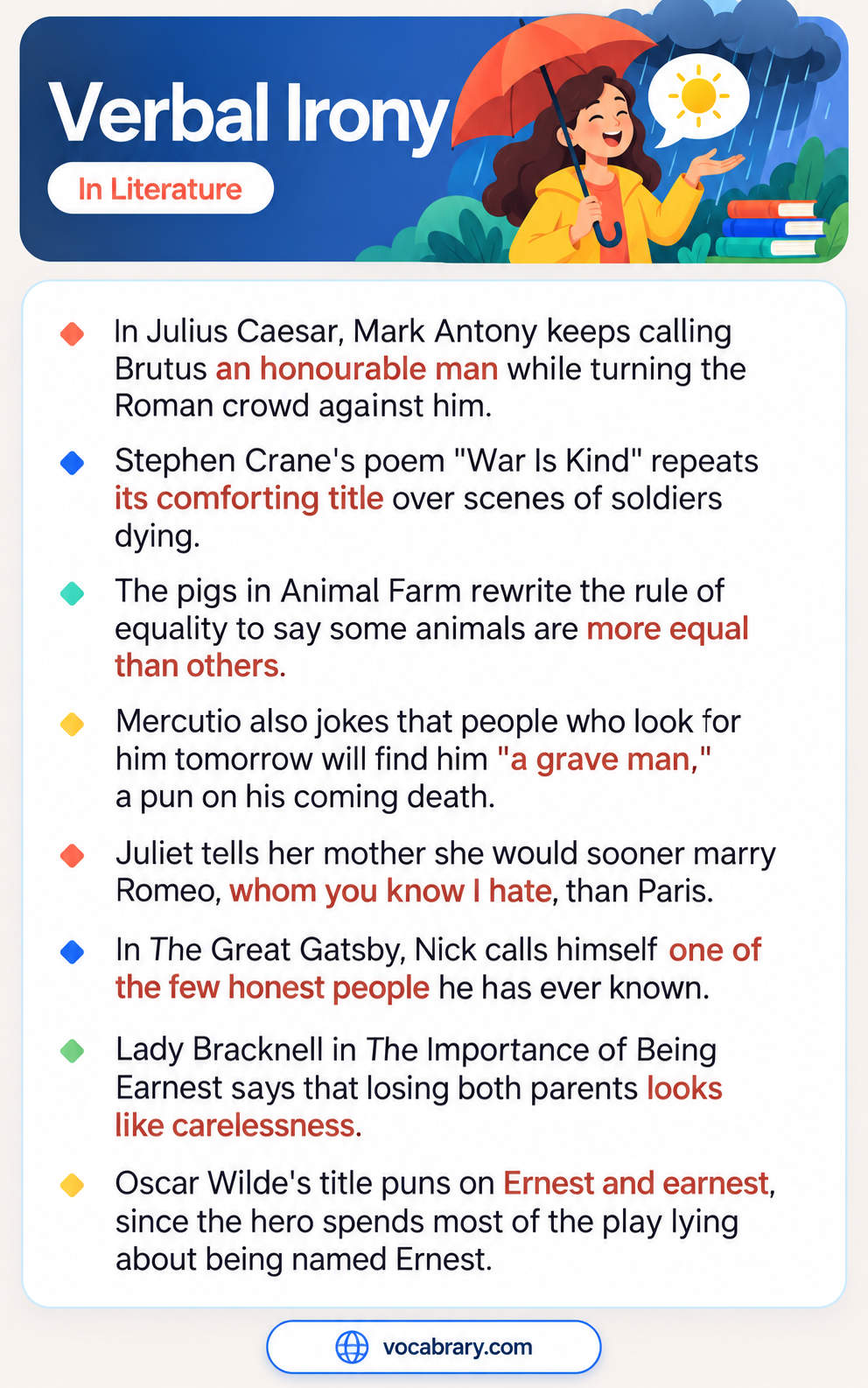
Mark Antony’s “honourable” Brutus, Montresor’s toast to Fortunato’s long life, and Swift’s “modest” plan to feed poor children to the rich are among the most studied verbal irony examples in literature.
Verbal Irony in Shakespeare
Mercutio calling his fatal wound “a scratch” and Juliet vowing to marry Romeo “whom you know I hate” show how Shakespeare gives single lines of dialogue a double meaning.
- In Julius Caesar, Mark Antony keeps calling Brutus “an honourable man” while turning the Roman crowd against him.
- Mortally wounded in Romeo and Juliet, Mercutio calls his injury “a scratch.”
- Mercutio also jokes that people who look for him tomorrow will find him “a grave man,” a pun on his coming death.
- Juliet tells her mother she would sooner marry Romeo, “whom you know I hate,” than Paris.
- After the murder of Duncan in Macbeth, Lady Macbeth claims that “a little water” will wash away their guilt.
- Hamlet explains his mother’s hasty wedding as thrift, since the leftover funeral food was served cold at the marriage feast.
Verbal Irony in Short Stories
Montresor toasting Fortunato’s long life and a detective saying the murder weapon is right under their noses are moments where the listener misses the speaker’s real meaning while the reader catches it.
- In Poe’s “The Cask of Amontillado,” Montresor drinks to Fortunato’s long life while leading him to his death.
- When Fortunato says a cough will not kill him, Montresor answers “True, true,” knowing exactly how Fortunato will die.
- Montresor keeps urging Fortunato to turn back because of his poor health, which only makes Fortunato more determined to go on.
- Eating the lamb in Roald Dahl’s “Lamb to the Slaughter,” a detective says the weapon is right under their very noses.
- The doctors in Kate Chopin’s “The Story of an Hour” say Louise died of “the joy that kills,” though her real shock was losing her new freedom.
Verbal Irony in Novels, Plays, and Essays
Jane Austen’s “universally acknowledged” truth, Orwell’s animals who are “more equal than others,” and Swift’s “modest” plan to eat children turn longer works into sustained verbal irony aimed at society.
- Pride and Prejudice opens by declaring it a truth universally acknowledged that a rich single man must want a wife, when the town’s mothers are the ones who want a husband for their daughters.
- The pigs in Animal Farm rewrite the rule of equality to say some animals are more equal than others.
- Jonathan Swift titles his plan to sell poor children as food “A Modest Proposal.”
- In The Great Gatsby, Nick calls himself one of the few honest people he has ever known.
- Lady Bracknell in The Importance of Being Earnest says that losing both parents looks like carelessness.
- Oscar Wilde’s title puns on Ernest and earnest, since the hero spends most of the play lying about being named Ernest.
Verbal Irony in Poems
Stephen Crane’s “War Is Kind,” Wilfred Owen’s “old Lie,” and Auden’s praise for a perfectly obedient citizen show poets using verbal irony to condemn what their words seem to celebrate.
- Stephen Crane’s poem “War Is Kind” repeats its comforting title over scenes of soldiers dying.
- Wilfred Owen ends “Dulce et Decorum Est” by calling the old saying about glorious death for one’s country the old Lie.
- In W. H. Auden’s “The Unknown Citizen,” the state praises a man for never causing trouble, and that praise exposes how little of his life was his own.
- The Duke in Robert Browning’s “My Last Duchess” praises his late wife’s smile while hinting that he ordered her death.
- Shakespeare’s Sonnet 130 insists that his mistress’s eyes are nothing like the sun, mocking the flattering comparisons of other love poems.
Verbal Irony Examples in Movies and TV
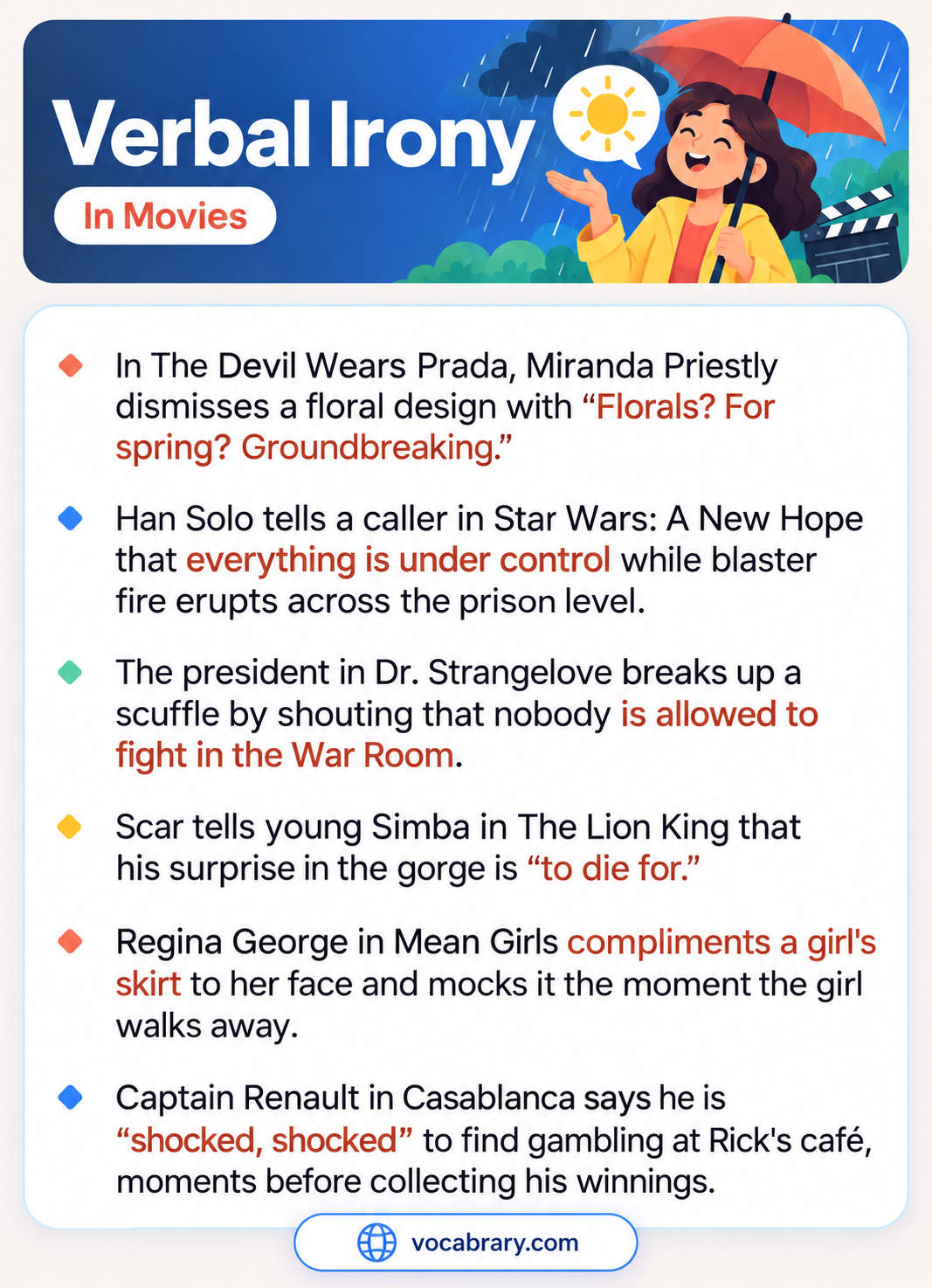
Miranda Priestly’s verdict on florals, Han Solo’s claim that everything is “under control,” and a War Room where fighting is forbidden show screenwriters using verbal irony for sharp, quotable dialogue.
- In The Devil Wears Prada, Miranda Priestly dismisses a floral design with “Florals? For spring? Groundbreaking.“
- Han Solo tells a caller in Star Wars: A New Hope that everything is under control while blaster fire erupts across the prison level.
- The president in Dr. Strangelove breaks up a scuffle by shouting that nobody is allowed to fight in the War Room.
- Scar tells young Simba in The Lion King that his surprise in the gorge is “to die for.”
- Regina George in Mean Girls compliments a girl’s skirt to her face and mocks it the moment the girl walks away.
- Captain Renault in Casablanca says he is “shocked, shocked” to find gambling at Rick’s café, moments before collecting his winnings.
Verbal Irony Examples in Satire
Headlines that celebrate a “record” pothole season and a “generous” two-minute lunch break are verbal irony examples from satire, aimed at city councils, companies, and landlords.
- A satirical headline read, “City Council Proudly Celebrates Its Record Pothole Season.“
- The comedy news show thanked the phone company for its “lightning-fast” support line with a four-hour wait on the line.
- Under a cartoon of a smog-filled city, the caption read “Breathe In the Fresh Air.“
- One parody news story congratulated the government on “another efficient year” in which no bridges were repaired.
- The satirical newsletter named the landlord “Humanitarian of the Year” after his fourth rent increase.
- On a late-night show, the host praised the company’s “generous” two-minute lunch break.
- Outside the factory, protesters raised a banner reading “Thanks for the Lovely River!” beside a pipe pouring out waste.
- At a mock award ceremony, the slowest government office won a trophy for “Outstanding Speed.”
Verbal Irony Examples in Texts and Social Media
Captions like “Living my best life” under a photo of a flooded basement and replies like “Love that for you” to bad news are verbal irony examples from text messages and social media. There, emojis and context stand in for the speaker’s delivery.
- Under a photo of his flooded basement, Mike wrote, “Living my best life.“
- Kara replied “Love that for you” when her friend said the landlord had doubled the rent.
- After her flight was canceled, Joy wrote, “Five stars, would recommend,” with a crying emoji.
- “So excited for my seven o’clock exam tomorrow,” Liam wrote, adding three skull emojis.
- The group chat filled with “Wow, early as always” when Dev replied to a message from last week.
- Sharing a picture of her burnt cookies, Hana wrote, “Future bakery owner right here.“
- Tom’s status said “Great weekend so far” over a photo of his car on a tow truck.
- “Nothing says romance like a parking ticket,” Eva wrote on Valentine’s Day.
- When the app crashed during checkout, a shopper reviewed it as “flawless technology.”
- A student shared a stack of twelve textbooks with the caption “Light summer reading.“
- Replying to a coworker’s reply-all email about the broken printer, Paul wrote, “Riveting update, thanks.“
- “This is fine,” Owen wrote under a photo of his kitchen full of smoke.
Related
- Figures of Speech with Examples
- Situational Irony Examples
- Sarcasm Example Sentences
- Understatement Examples Sentences
FAQs
Two verbal irony examples in a sentence are "Lovely weather for a picnic" and "Wow, piping hot, just how I like it." Grandpa says the first during a hurricane, and Maya says the second about cold soup.
Everyday sentences include "They really handled this with care" about a crushed parcel and "Right on time" to a repairman who arrives six hours late. Both praise the opposite of what happened.
Funny sentences include "Perfection, as usual," "Nailed it," and "All part of the act." Each one is a joke about a plain failure.
Sentences for kids include "Wow, your room is spotless," "Perfect day for the beach," and "I love broccoli." Each one comes from a familiar scene at home or school.
Sarcastic sentences include "Good afternoon, early bird" for a late employee and "Nice parking" on a note left on a car across two bays. Both aim the praise at a person.
Understatement sentences include "a bit damp" for a flooded kitchen and "not our best day" for a lost final. Overstatement sentences include "life-changing money" and "Civilization has collapsed."
Two verbal irony examples in Shakespeare are Mercutio calling his wound "a scratch" and Juliet choosing Romeo, "whom you know I hate." Lady Macbeth’s "a little water" is a third case.
Movie sentences include "to die for" from Scar, "shocked, shocked" from Captain Renault, and "everything is under control" from Han Solo. Each line says the reverse of what the scene contains.
Two verbal irony examples in satire are "City Council Proudly Celebrates Its Record Pothole Season" and "Humanitarian of the Year" for a landlord. Each one praises the target for a failing.
Social media sentences include "Living my best life," "Love that for you," and "Nothing says romance like a parking ticket." Emojis in the posts stand in for a speaker’s tone.