
Sibilance is a sound device in which hissing consonant sounds such as s, sh, and z repeat in nearby words, as in the tongue twister “She sells seashells by the seashore.” Most everyday sibilance examples imitate whispers, waves, wind, and hissing snakes, so the sound of each sentence echoes the scene it describes.
What Is Sibilance?
Sibilance is the repetition of hissing or hushing consonant sounds, mainly s, z, sh, and zh, in words placed close together. It is a type of consonance limited to those sounds, and unlike alliteration, it counts the sound anywhere in a word, whether at the start, in the middle, or at the end.
The surf swished softly against the sleeping seaside town.
Common Sibilance Examples in Sentences
Sea spray hissing on the sand, a snake gliding past the stones, and a sister whispering secrets are the most common sibilance examples, where repeated s sounds copy soft, hissing noises.
- Sea spray hissed across the sand at sunset.
- A snake sidled silently past the stones.
- My sister whispered secrets across the sleeping house.
- Sunlight slipped softly across the sofa.
- Steam seeped from the kettle’s spout and misted the mirror.
- Nobody noticed the silence settle over the classroom.
- Sasha’s skates scraped the surface of the ice.
- Did you see the sparrows scatter from the hedges?
- Swiftly and silently, the ship sailed south.
- Soup simmered on the stove while Samir set the dishes out.
- Her scissors snipped through the silk in seconds.
- The fizz of soda spilled over the sides of his glass.
- Leaves rustled as the breeze swept through the grass.
- Sam never says sorry, Susie insists.
- In the sauna, sweat slid down Seth’s shoulders.
- Showers splashed on the sidewalk all Saturday.
- A soft sigh escaped from the sleepy student.
- Sirens screamed across the city streets at sunrise.
- Scarves, sweaters, and socks spilled out of Sue’s suitcase.
- Silas swept the dust from the stairs before his guests arrived.
- Why does the sea sound so sad at dusk?
- Snow settled softly on silent fields.
- Stars shimmered over the still lake.
- With a swish, the curtains closed on the stage.
- Several sailors sensed a storm rising somewhere past the cliffs, so they stayed in the harbor instead of setting sail.
Sibilance Examples by Sound
The s in “sister,” the soft c in “city,” the z in “buzzed,” the sh in “shells,” and the zh in “treasure” are the five sounds most sources count in sibilance examples.
Sibilance With the S Sound
Six silver spoons in the sink, a seal on a slippery rock, and Sara’s sandcastle sinking into the sea repeat the plain s sound, the hiss most readers link with sibilance.
- Six silver spoons sparkled in the sink.
- A seal sunned itself on a slippery rock.
- Sara’s sandcastle sank slowly into the sea.
- Stella sold seven sketches at the street fair.
- The bus stopped suddenly, and sixteen passengers stumbled.
- Is this seat saved for Simon?
- Last summer, we swam in salty pools beside the cliffs.
- Mist rose from the stream just past the stables.
- Don’t slam the screen door, Sid.
- Sanjay scribbled sums on scraps of paper.
- Swallows swooped and soared over the still pond.
- After six long seasons at sea, the sailor stepped onto the sand and smiled at his sister.
Sibilance With the Soft C Sound
Cecil’s cedar fence, a circus in the city, and a slice of cinnamon bread spell the s sound with a c, since the letter c hisses before e, i, and y.
- Cindy sliced cinnamon bread since nobody else would.
- The circus came to the city in December.
- Cecil noticed a nice cedar fence.
- Cereal scattered across the kitchen surface.
- Princess Cecilia danced with precise, graceful steps.
- The police officer cycled past the office.
- Is the science center closed since the fire?
- Lucy ceased her dance at once.
- Nancy never cycles across the icy city center.
- Decisions at the council meeting pleased citizens across the city, since the cycle lanes were finally approved.
Sibilance With the Z Sound
Buzzing bees, dozing zebras, and Zoe’s fizzy drinks repeat the voiced z sound, which the letter s also makes in words such as “roses” and “is.”
- Bees buzzed lazily among the daisies.
- The zebras dozed in the zoo’s breeze.
- Zoe’s fizzy drinks froze in the freezer.
- Is Liz amazed by the dazzling prize?
- Roses and daisies grow in Rosa’s gardens.
- Jazz music buzzed through the hazy room.
- Zack zipped his cozy fleece up to his nose.
- Don’t freeze those pizzas, Suzie.
- Dozens of blazing fireworks dazzled the crowds.
- Easily amused, the twins raised their eyebrows at Uncle Ozzie’s puzzles, then used the pieces as toys.
Sibilance With the SH Sound
Shiny shells in the shallows, a shepherd shushing his sheep, and Marsha’s polished shoes repeat the sh sound, the softest and most hushed of the sibilant sounds.
- Shiny shells shifted in the shallows.
- The shepherd shushed his sheep in the shed.
- Sheila rushed to wash the dishes after the show.
- A fresh shower washed the shop windows.
- Should Josh share his cashews?
- Shadows stretched as the sunshine faded.
- Nobody shouted, and nobody shoved, when the ship docked in Shanghai.
- Marsha polished her shoes until they shone.
- Sharks flashed through the shimmering ocean.
- Chef Sasha shucked fresh shellfish for the wedding brunch.
- Ashes from the bonfire brushed Shaun’s shirt.
- Special permission allowed Trisha to push her wheelchair straight to the front of the station for the shuttle.
Sibilance With the ZH Sound
Divers searching for treasure at leisure, a beige garage measured with precision, and a television explosion repeat the zh sound, the rarest hissing sound in English.
- Divers searched at leisure for buried treasure.
- Jacques measured the beige garage with precision.
- The usual decision was a casual lunch at leisure.
- Explosions in the television show gave Sam an illusion of danger.
- Is it a pleasure to measure the treasure?
- Collisions and confusion closed the highway exit.
- Jean’s favorite genre is Asian fusion cooking shows.
- After the invasion scene, the audience gasped at a vision of Persian treasure glistening in the cave.
Sibilance Examples in Nature
Seagulls over the surf, sleet on the streets, and snow drifting past the streetlights are sibilance examples from nature, where the hissing s imitates wind, waves, and falling rain.
Sibilance Examples About the Sea
Seagulls screeching over the surf, salt spray on a swimmer’s skin, and seaweed swaying in shallow water show why writers use sibilance to describe the sea.
- Seagulls screeched over the surf at sunrise.
- Salt spray stung the swimmer’s skin.
- Seaweed swayed in the shallow sea.
- Waves swept across the sand and seeped into the castle’s moat.
- The surf never stops hissing against the stony shore.
- Sails snapped as the sloop sped seaward.
- Is that a seal splashing past the rocks?
- Silver fish slipped beneath the surface.
- Starfish stuck to the slick stones at low tide.
- Softly, the sea sighed against the harbor wall.
- Sunken ships lie silent on the sea floor.
- At dusk, fishermen dragged their nets across the sand, separating the sardines from the seaweed as the sky turned scarlet.
Sibilance Examples About Weather
Rainy, snowy, and stormy days sound sharper with sibilance, as when sleet hits the streets, a summer storm passes over hot stones, or drizzle mists Susan’s glasses.
- Sleet stung the streets all afternoon.
- A summer storm sizzled on the hot stones.
- Snow sifted past the streetlights.
- Showers swept across the city squares.
- Is the sun still shining in Seattle?
- Frost silvered the grass outside the school.
- Mist spread across the hills at sunset.
- The wind hissed through the cracks in the shutters.
- Not a single cloud spoiled the sky on Sunday.
- Hailstones smashed on the greenhouse glass.
- Drizzle misted Susan’s glasses on the walk to the station.
- By six o’clock, snowdrifts stretched across the streets, and the school sent students home safely before the storm grew worse.
Sibilance Examples About Snakes and Animals
A snake slithering over stones, a squirrel scampering up a sycamore, and swans sliding across a lake are animal sibilance examples, where the s sound echoes how each creature moves.
- The snake slithered silently across the stones.
- Hissing, the serpent slid beneath the shed.
- A squirrel scampered up the sycamore.
- Swans slid across the still lake.
- Snails slowly spread silver slime on the steps.
- Seven sleek cats stretched in the sunshine.
- Does the python sense someone’s steps?
- Our mouse, Whiskers, squeaked and scurried into a sock.
- Sheep grazed peacefully on the grassy slopes.
- A spider spun silk across the window.
- Sly foxes sneaked past the sleeping hens.
- Seahorses never swim fast; they sway in the current.
- Lizards basked on the sun-warmed sandstone.
- In the reptile house, Sofia stared at a massive snake as it swallowed a mouse whole and settled slowly into the sand.
Sibilance Examples About Silence and Secrets
Silent streets at midnight, sisters swapping secrets, and a stranger whispering in a crowded station are sibilance examples about quiet moments, where the soft s copies the sound of a hush.
Sibilance Examples About Night and Silence
At night, sibilance softens a scene, as when stars sparkle over silent streets, hushed footsteps pass a nursery door, or Stefan switches off the last lamp.
- Stars sparkled over the silent streets.
- The sleepy house settled after midnight.
- Silence spread across the empty stadium.
- Stefan switched off the last lamp and slept.
- Nothing stirred in the still, sleeping village.
- Is someone pacing upstairs?
- Moths fluttered softly against the glass.
- Crickets sang in the silver dusk.
- Hushed footsteps passed the nursery door.
- Snores drifted from Grandpa’s study.
- The city sighed into stillness as the stores closed.
- Long after sunset, Marcus stayed on the steps, listening to the soft rustle of grass and the distant hiss of sprinklers.
Sibilance Examples About Secrets and Whispers
Sisters swapping secrets under the blankets, Simone slipping a note across a desk, and spies exchanging passwords give secret-keeping sentences their hushed, sibilant sound.
- Sisters swapped secrets under the blankets.
- A stranger whispered in the crowded station.
- Simone slipped a secret note across the desk.
- “Psst, pass the message silently,” said Tess.
- Nobody suspects Silas of stealing the sweets.
- Will you swear to keep this secret, Stacy?
- Whispers spread across the school by lunch.
- Susan hissed a warning to her sister.
- The spies exchanged passwords in Swedish.
- Shh, someone is listening outside.
- Grandma sealed the secret recipe in a safe.
- At the surprise party, sixty guests stayed silent inside the darkened house until Stephen switched on the lights.
Sibilance Examples About Love
Couples like Simon and Stella, Sean and Sophie, and Susan on the dance floor bring sibilance into love sentences, where sweet songs, slow kisses, and whispered promises share a gentle hiss.
- They shared a slow, sweet kiss beside the fountain.
- Simon sang sweet songs to Stella on the sofa.
- Promises were whispered on their first date.
- Sarah’s smile sent sparks racing through his chest.
- Is this sweetheart serious about us?
- Sophie saves every sweet message from Sean.
- Silky roses scattered across the sheets.
- Soulmates sense each other’s sadness instantly.
- Stay, sweetheart, the stars are still shining.
- Nobody else makes Sam smile so easily.
- Her wedding dress swished as Susan swept across the dance floor.
- Years after their first summer together, Sean still surprises Sophie with sunflowers, sonnets, and slow dances in the kitchen.
Sibilance Examples About Food
In the kitchen, sausages spitting in a skillet, spicy salsa, and sugar sprinkles on cupcakes make food sentences sound as crisp and fizzy as the dishes they describe.
- Sausages sizzled and spat in the skillet.
- Salty snacks vanished fast at the sleepover.
- Sweet strawberry sundaes suit a summer Sunday.
- Sofia sliced cheese for the sandwiches.
- Syrup seeped into the stacks of pancakes.
- Is the soup salty enough, Suki?
- Spicy salsa stung Steve’s tongue.
- Crispy fries sizzled in the fryer.
- Nobody finishes Grandma’s massive Sunday roast.
- Sugar sprinkles sparkled on the cupcakes.
- Fresh sushi and miso soup arrived at six.
- At the Sunday market, stalls selling sourdough, sea salt, and smoked salmon stretched across the square past noon.
Sibilance Examples in Everyday Life
Commuters, students, and roommates meet sibilance every day, in a stuffy subway, socks lost in the washing machine, and dishes stacked beside the sink.
- Stacy scrolled through her messages on the sofa.
- The subway was stuffy and silent this morning.
- Sid set his alarm for six sharp.
- Dishes stacked up beside the sink again.
- Is the supermarket still open on Sundays?
- Socks vanish in the washing machine somehow.
- Seth’s dentist insisted that he stop snacking on sweets.
- Stressed commuters squeezed onto the six forty-five bus.
- Nobody washed the glasses last night.
- Sunday mornings smell of toast and sausages.
- My sister’s sneakers squeak on the stairs.
- The nurse wished Señor Sanchez a speedy recovery.
- Shopping bags split on the sidewalk.
- Please switch your phones to silent, sir.
- After school, Lisa folds shirts, fixes a snack, and starts her science homework before her parents arrive.
Sibilance Examples in Tongue Twisters
Silly Sally shooing seven sheep, six slippery snails, and the sixth sick sheikh’s sheep are traditional tongue twisters that pile s and sh sounds together until the speaker stumbles.
- “Silly Sally swiftly shooed seven silly sheep” is a favorite warm-up for drama students.
- Six slippery snails slid slowly seaward, and the tongue slips with them.
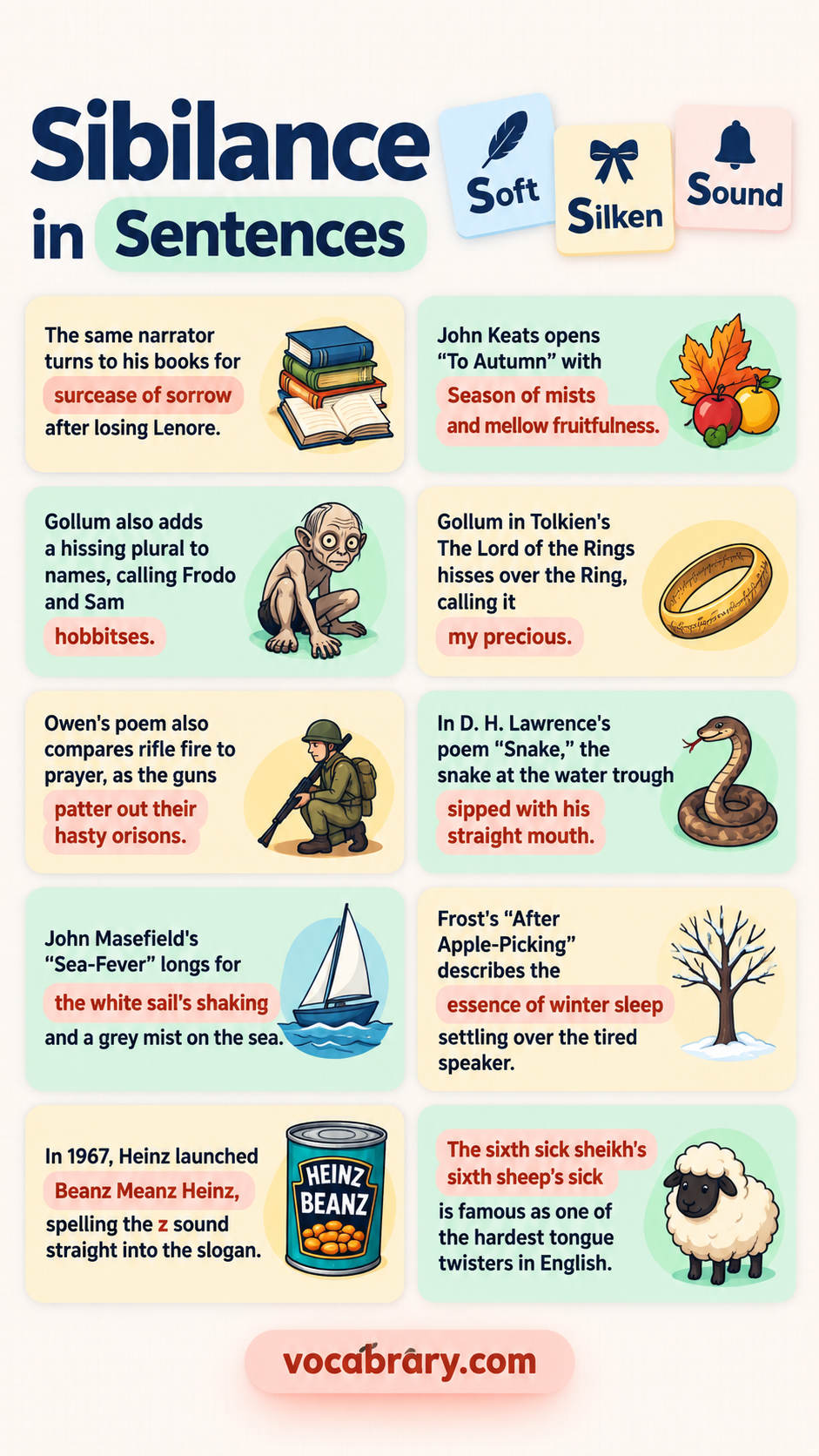
- “The sixth sick sheikh’s sixth sheep’s sick” is famous as one of the hardest tongue twisters in English.
- Sure the ship’s shipshape, sir, the sailor said without a single slip.
- Try saying “selfish shellfish” six times fast.
- “Swan swam over the sea; swim, swan, swim!” is an old rhyme speech coaches still use.
- Sheep should sleep in a shed, not in a shack, goes one classic twister.
- Six sticky skeletons trip up almost every speaker by the third try.
- “A skunk sat on a stump” ends with the skunk and the stump each insisting the other stunk.
- Susie works in a shoeshine shop is the opening line of a twister built on the s and sh sounds.
Sibilance Examples for Kids
A sleepy seal on a slide, six silly socks, and Sam’s sister singing in the sandbox give children short sibilance examples with sounds they already know.
- The sleepy seal slid down the slide.
- Six silly socks sang a song.
- Sam’s sister sings in the sandbox.
- Is the sun smiling at us?
- Snowmen smile in the snow.
- Suzy’s puppy sneezes at flowers.
- Sadie spilled her juice on her shoes.
- Seesaws squeak at the park.
- Don’t splash in the sink, Seth!
- Little stars sparkle in the sky.
- Soapy bubbles float past my nose.
- A snail slowly slides on a stone.
- Grandma sings “Sing a Song of Sixpence” at bedtime.
- Seven sleepy sheep snuggled close together in the soft straw after a long, sunny day.
Sibilance Examples for Students
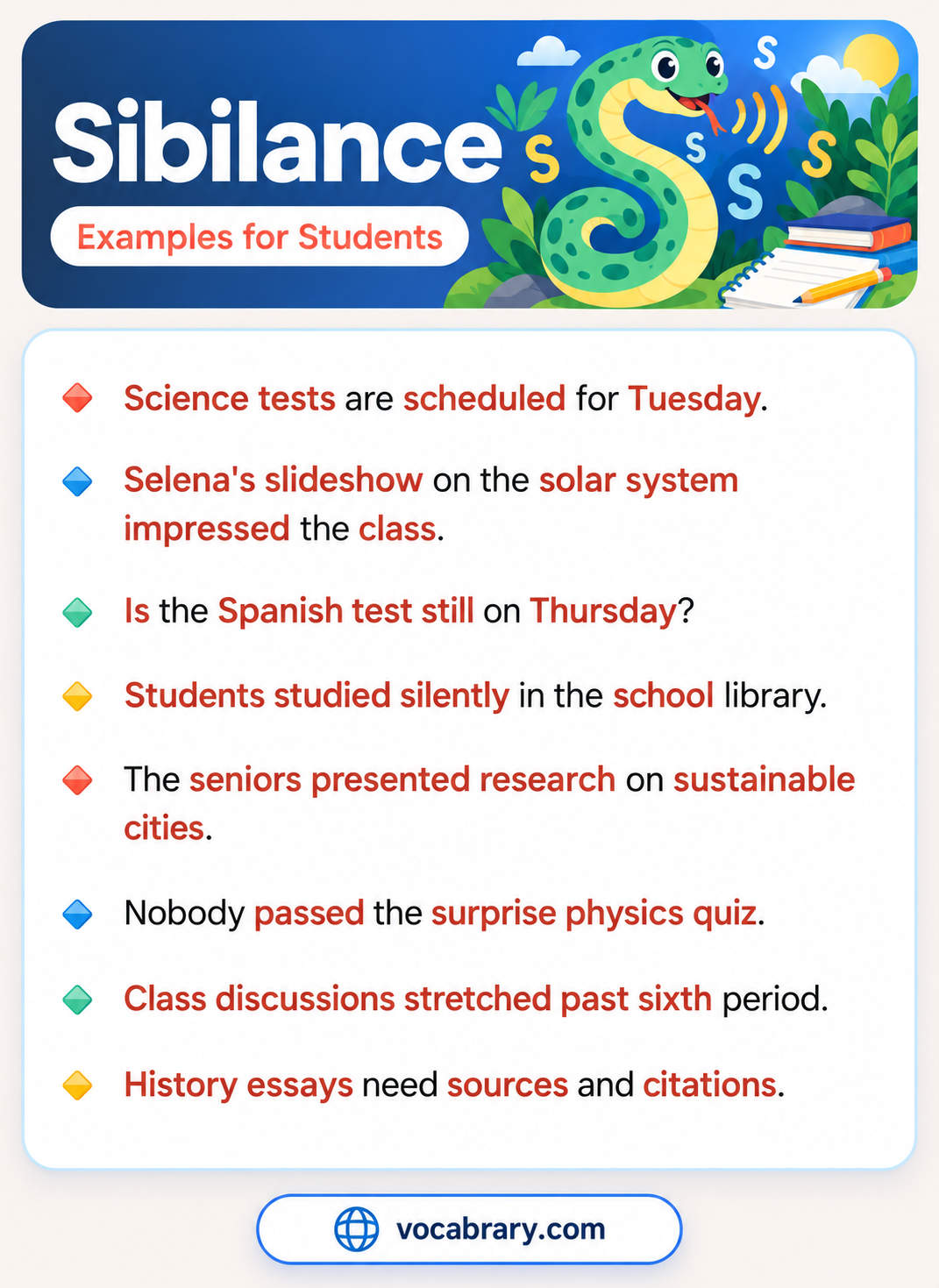
Science tests on Tuesday, Selena’s slideshow on the solar system, and history essays that need sources set sibilance in school life, where students hear it in their own week.
- Science tests are scheduled for Tuesday.
- Selena’s slideshow on the solar system impressed the class.
- Essays are due before the semester ends.
- Is the Spanish test still on Thursday?
- Students studied silently in the school library.
- Professor Sanders stressed the same lesson six times.
- The seniors presented research on sustainable cities.
- Nobody passed the surprise physics quiz.
- Sadia sharpened six pencils before the SAT.
- Class discussions stretched past sixth period.
- History essays need sources and citations.
- During the spring semester, Samira stayed after class six times to master the stubborn statistics questions her professor assigned.
Sibilance Examples in Literature and Film
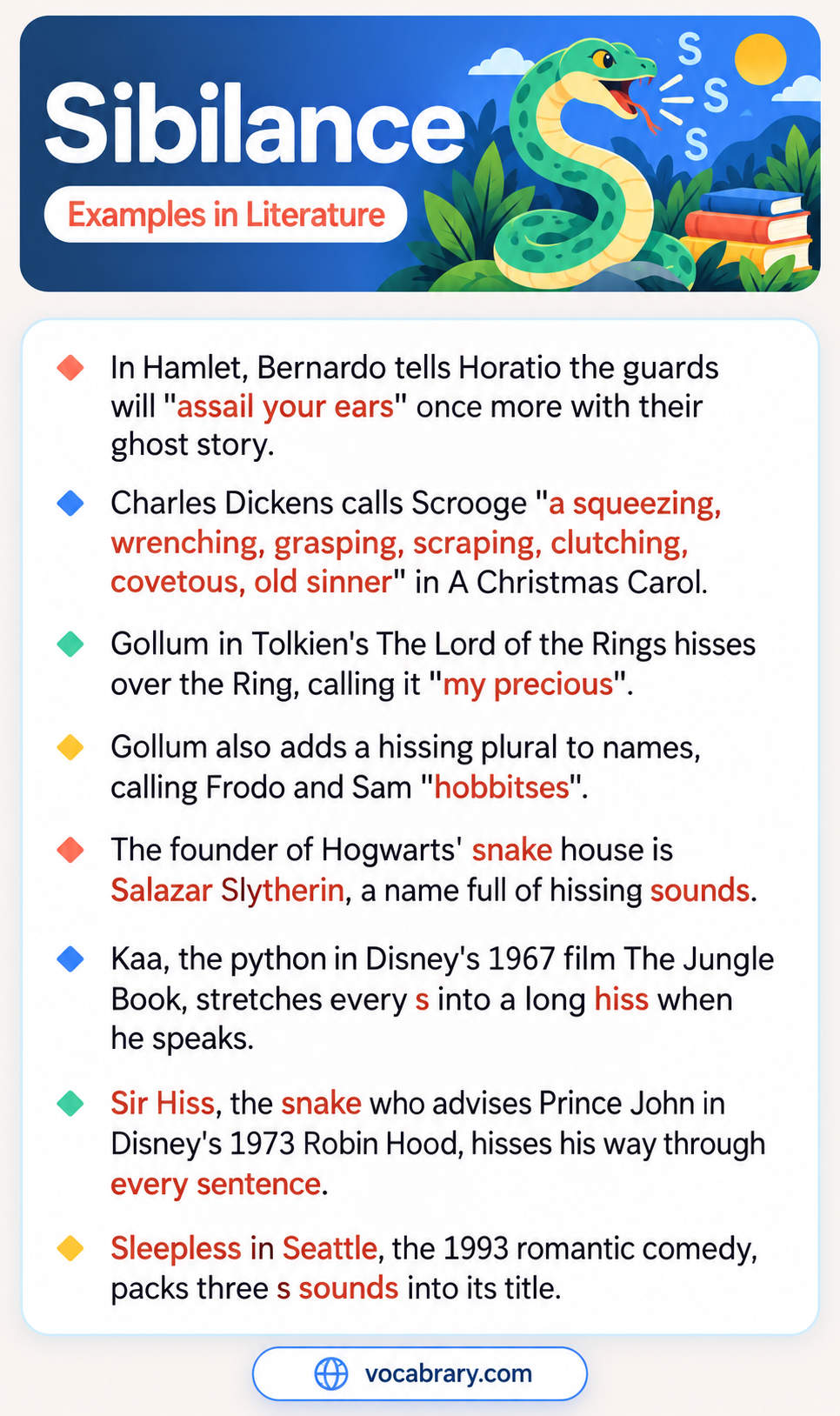
Poets, novelists, and screenwriters use sibilance for grief, menace, and memory, from Poe’s rustling curtains and Owen’s wailing shells to Gollum’s hissed “my precious.”
Sibilance in Poetry
Poe’s “silken, sad, uncertain rustling,” Shakespeare’s “sessions of sweet silent thought,” and Owen’s “wailing shells” are famous sibilance examples in poetry, each setting a mood of grief, memory, or war.
- On a bleak December night, Poe’s narrator in “The Raven” hears the “silken, sad, uncertain rustling” of the purple curtains.
- The same narrator turns to his books for “surcease of sorrow” after losing Lenore.
- Shakespeare opens Sonnet 30 with “sessions of sweet silent thought,” as the speaker calls up memories of past losses.
- Wilfred Owen’s “Anthem for Doomed Youth” replaces church choirs with “the shrill, demented choirs of wailing shells.”
- Owen’s poem also compares rifle fire to prayer, as the guns “patter out their hasty orisons.”
- John Keats opens “To Autumn” with “Season of mists and mellow fruitfulness.”
- The traveler in Robert Frost’s “Stopping by Woods on a Snowy Evening” notes that “the only other sound’s the sweep” of wind and snow.
- Frost’s “After Apple-Picking” describes the “essence of winter sleep” settling over the tired speaker.
- In D. H. Lawrence’s poem “Snake,” the snake at the water trough “sipped with his straight mouth.”
- Emily Dickinson’s “A narrow Fellow in the Grass” describes a snake passing through grass that divides as if someone combed it.
- In Book 10 of Paradise Lost, Milton’s Satan hears “a dismal universal hiss” as his followers turn into serpents.
- John Masefield’s “Sea-Fever” longs for “the white sail’s shaking” and a grey mist on the sea.
Sibilance in Novels, Plays, and Films
Dickens describing Scrooge, Tolkien’s Gollum, and Disney’s hissing snakes Kaa and Sir Hiss show how storytellers use sibilance to make a character sound mean or menacing.
- In Hamlet, Bernardo tells Horatio the guards will “assail your ears” once more with their ghost story.
- Charles Dickens calls Scrooge “a squeezing, wrenching, grasping, scraping, clutching, covetous, old sinner” in A Christmas Carol.
- Gollum in Tolkien’s The Lord of the Rings hisses over the Ring, calling it “my precious.”
- Gollum also adds a hissing plural to names, calling Frodo and Sam “hobbitses.”
- In Harry Potter and the Chamber of Secrets, Harry learns that he speaks Parseltongue, the hissing language of snakes.
- The founder of Hogwarts’ snake house is Salazar Slytherin, a name full of hissing sounds.
- Kaa, the python in Disney’s 1967 film The Jungle Book, stretches every s into a long hiss when he speaks.
- Sir Hiss, the snake who advises Prince John in Disney’s 1973 Robin Hood, hisses his way through every sentence.
- Jane Austen’s novel Sense and Sensibility repeats the s sound four times in its title.
- Sleepless in Seattle, the 1993 romantic comedy, packs three s sounds into its title.
Sibilance Examples in Slogans and Brand Names
Specsavers, Heinz, and Schweppes built famous slogans on sibilance, and brand names like Swiss Miss and Sunsilk repeat the hiss so shoppers remember them after one hearing.
- Specsavers ads end with the line “Should’ve gone to Specsavers” after someone makes an embarrassing mistake.
- In 1967, Heinz launched “Beanz Meanz Heinz,” spelling the z sound straight into the slogan.
- Schweppes television ads from the 1960s used the hushed tagline “Schhh… You Know Who.”
- For years, Snickers used the tagline “Snickers really satisfies.”
- Trix cereal ads ended with children telling the cartoon rabbit, “Silly rabbit, Trix are for kids!“
- Wrestler Randy Savage shouted “Snap into a Slim Jim!” in commercials for the meat snack.
- Florists have used the slogan “Say it with flowers” since 1917.
- Swiss Miss hot cocoa repeats the s sound in both halves of its name.
- Sunsilk shampoo pairs sun and silk in one soft brand name.
- A SodaStream machine turns tap water into sparkling soda at home.
Related
FAQs
Two examples are "Sea spray hissed across the sand at sunset" and "Snow settled softly on silent fields." Each sentence repeats the hissing s sound in most of its words.
Sea scenes give "Seagulls screeched over the surf at sunrise" and "Softly, the sea sighed against the harbor wall." Both sentences repeat s sounds to match the hiss of waves.
Weather lines include "Sleet stung the streets all afternoon" and "Snow sifted past the streetlights." Each sentence repeats s sounds to match falling rain or snow.
Snake lines include "The snake slithered silently across the stones" and "Hissing, the serpent slid beneath the shed." Both sentences repeat s sounds to match the animal.
The voiced z is heard in "Bees buzzed lazily among the daisies" and "The zebras dozed in the zoo’s breeze." Both sentences repeat a buzzing sound instead of a plain hiss.
Hushed sh sounds are heard in "Shiny shells shifted in the shallows" and "The shepherd shushed his sheep in the shed." Both sentences repeat the softest hiss.
Drama students practise "Silly Sally swiftly shooed seven silly sheep" and "selfish shellfish" as warm-ups. Each one packs s and sh sounds into a short line.
Poets use "silken, sad, uncertain rustling," "sessions of sweet silent thought," and "the shrill, demented choirs of wailing shells." The three lines come from Poe, Shakespeare, and Owen.
Short lines for kids include "The sleepy seal slid down the slide" and "Snowmen smile in the snow." Each line has a few words, so a young child repeats it in one breath.
Slogans include "Beanz Meanz Heinz" and "Silly rabbit, Trix are for kids!" Brand names such as Swiss Miss and Sunsilk repeat the hiss in a short name.