
Consonance is a sound device in which a consonant sound repeats in nearby words, especially in the middle or at the end, as in "odds and ends." Strong consonance examples in sentences repeat the k in "black truck" or the t in "sweet treat," so one sound links the whole line.
What Is Consonance?
Consonance is the repetition of a consonant sound in words placed close together. Unlike alliteration, which repeats the first sound of each word, consonance repeats a sound anywhere in the word, and the repetition is most noticeable in middle and final positions.
The black cat struck a stack of books off the desk.
Common Consonance Examples in Sentences
A black truck stuck at the dock, a sweet treat eaten late, and a bell that fell down the hall are everyday consonance examples with repeated k, t, and l sounds.
- A black truck got stuck at the back of the dock.
- Nate ate a sweet treat late at night.
- With a loud clang, the bell fell and rolled down the hall.
- Mike likes to take his bike on long hikes.
- After we missed the last bus, we crossed the grass on foot.
- Our kitten batted at the bright light.
- At the end of the year, the old gold ring was sold.
- The wind blew down the lane and into the barn.
- Dust drifted past the misty glass.
- Grandpa tripped on the step and dropped his cup.
- In the kitchen, the chef washed fresh fish in a dish.
- Did the big dog dig a bog in the fog?
- Fran found ten pens in the bin.
- All night, the clock ticked and tocked in the dark kitchen.
- Luke took a look at the book.
- By morning, the old mill will fill the hill with the smell of bread.
- Jill felt ill after the spill.
- Nobody heard the bird over the herd in the yard.
- One sharp tap on the cap woke the pup.
- Don’t let the cat get wet.
- Thick smoke made the duck quack.
- Bess pressed her dress fast.
- The wild child smiled in the cold.
- Lit streetlights glittered in the mist.
- Why did the frog jog through the fog?
- For a time, the warm stream seemed calm.
- Sam winked and drank the pink drink.
- Carefully, the trained bird landed on the wooden board.
- Crisp toast cost less than the rest.
- Pat put the pot on the top shelf.
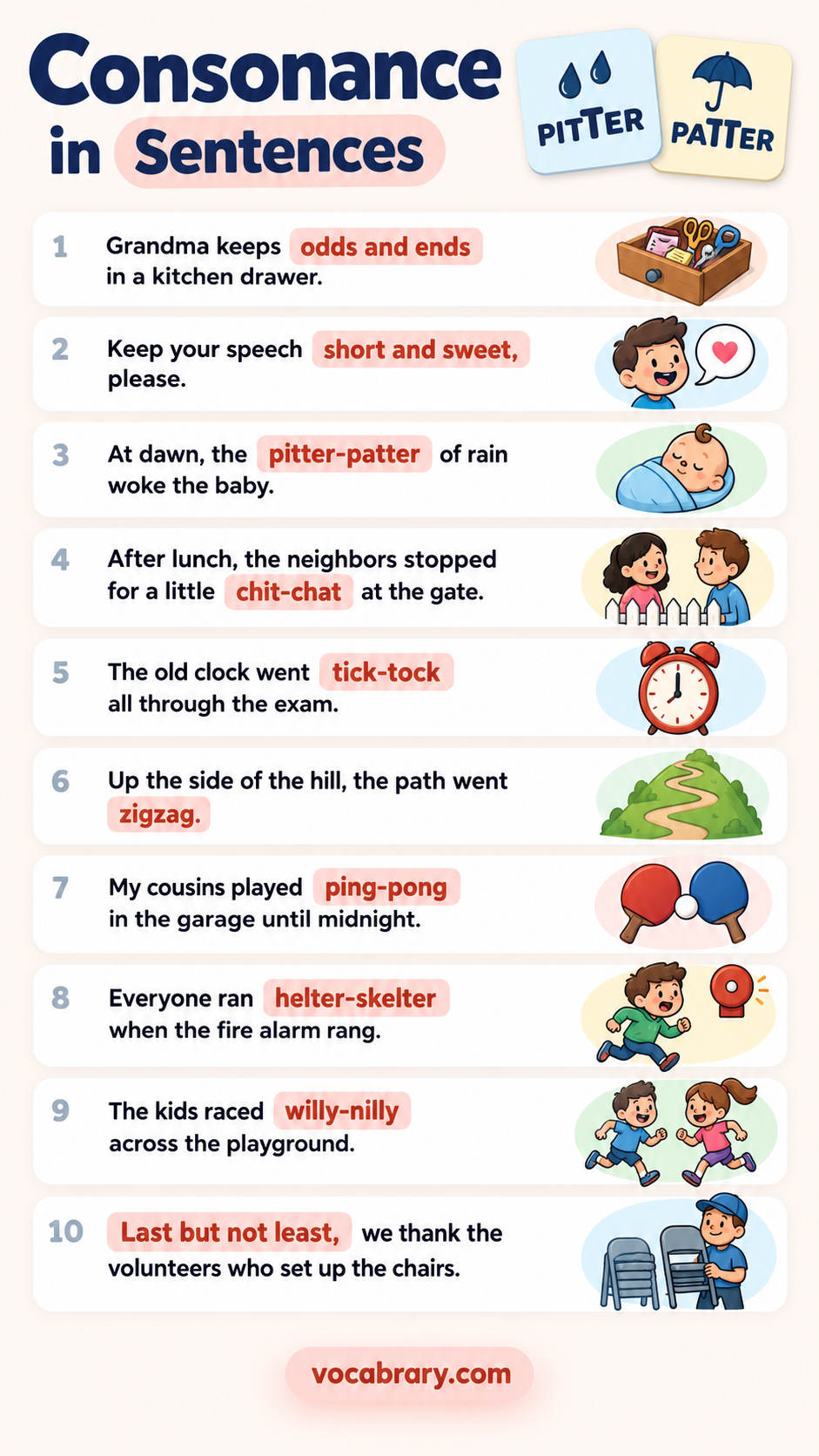
Consonance Examples in Everyday Phrases
Odds and ends, short and sweet, and the hustle and bustle of a city are fixed English phrases with repeated consonant sounds, and speakers remember them partly because of that repetition.
- Grandma keeps odds and ends in a kitchen drawer.
- Keep your speech short and sweet, please.
- At dawn, the pitter-patter of rain woke the baby.
- After lunch, the neighbors stopped for a little chit-chat at the gate.
- The old clock went tick-tock all through the exam.
- Aunt Mae’s shelves are full of knick-knacks from every country she has visited.
- Up the side of the hill, the path went zigzag.
- Ben wore flip-flops to the beach and lost one in the sand.
- My cousins played ping-pong in the garage until midnight.
- We left the hustle and bustle of the city for a quiet weekend in a cabin by the lake.
- Everyone ran helter-skelter when the fire alarm rang.
- The kids raced willy-nilly across the playground.
- Last but not least, we thank the volunteers who set up the chairs.
- "A stitch in time saves nine," Mom said as she fixed the tiny tear.
- This recipe is tried and tested by three generations.
- After ten winters, the old boots showed plenty of wear and tear.
- Rugby players have to be rough and tough.
- Winning the raffle was a real stroke of luck for Omar.
- The doorbell went ding-dong just as dinner was served.
- Her lunch was a mishmash of leftovers.
- Our new stereo sounds super-duper, according to my little brother.
- Isn’t it true that all’s well that ends well?
Consonance Examples by Consonant Sound
The hard k in "black truck," the hissing s in "slippery snake," and the humming m in "calm hymn" are the consonant sounds English writers repeat most.
Consonance With the K Sound
A black cat knocking over books, a quick duck by a creek, and Jack picking a pack of sticks repeat the hard k sound, spelled c, k, ck, or q.
- The black cat knocked a stack of books off the desk.
- A quick duck quacked by the creek.
- Jack picked a pack of sticks for the fire.
- Don’t kick the rocks near the deck.
- Every week, Rick cooks cake for his kids.
- Nick’s truck struck a rock on the track.
- Why does the old rocking chair creak in the dark?
- The cook took thick milk from the back shelf.
- Kate packed her jacket and socks.
- Snakes make tracks across the creek bank.
- Before the storm, Jack locked the back deck and stacked the kindling by the shack.
Consonance With the T Sound
Pete eating hot toast at eight and Matt meeting a pet goat at the fair repeat the crisp t sound, which ends many short English words.
- Pete ate hot toast at eight.
- Our cat left a little toy at the gate.
- Matt met a tiny pet goat at the fair.
- Don’t wait till the tea gets cold.
- A light mist settled over the street at night.
- Rita wrote a short note to her aunt.
- Ten fat cats watched a bat at twilight.
- Is it true that Scott forgot his ticket?
- Tate tied a tight knot.
- After sunset, the boats floated out of sight.
- At eight, Tom’s little sister started writing a story about a lost kitten.
Consonance With the S Sound
Sibilance is consonance that repeats hissing s, sh, and z sounds, as in a slippery snake sliding past sunflowers or the sea washing over shells on the shore.
- A slippery snake slid past the sunflowers.
- The sea washed over the shells on the shore.
- Susan sews dresses for six sisters.
- Soft mist rose from the grass.
- Bees buzzed across the roses all summer.
- Hush, Sasha is sleeping on the sofa.
- Cross the grass fast, Jess.
- Is Sam’s sister still sick?
- Wisps of smoke swirled past the glass.
- The sweet scent of soap stayed in the sink.
- Six sailors sang sea songs as the ship slid past the misty islands.
Consonance With the L Sound
A little yellow ball rolling downhill and twelve bells tolling across a valley repeat the l sound, which makes a sentence sound smooth and gentle.
- The little yellow ball rolled all the way downhill.
- Bill will tell you all about the well.
- A pale gull called over the hill.
- Please fill the pail until it spills.
- Ellie smelled wild lilies in the field.
- Why is the tall wall so cold?
- The old owl felt small in the hall.
- Paul fell while pulling the sail.
- Holly sold dolls at the mall.
- Twelve bells tolled slowly across the valley.
- All fall, Lily walked slowly along the hilly trail while yellow leaves fell.
Consonance With the R Sound
Rory’s car roaring down a dark road and a farmer storing corn in the barn repeat the r sound, which suits scenes of noise and motion.
- Rory’s car roared far down the dark road.
- The bird stirred on its perch near the door.
- Barry wore a red scarf to the fair.
- Four more stars shone far over the harbor.
- Is the river near the ranger’s tower?
- The farmer stored corn in the barn.
- Hurry, the storm is roaring over the shore!
- Sarah heard a rare bird chirp.
- A purple curtain stirred in the corner.
- Mother ordered four pears for dinner.
- Every morning, the farmer’s daughter rides her horse across the orchard before breakfast.
Consonance With the M and N Sounds
Mom humming a calm hymn at home and nine men singing songs in the rain repeat the nasal m and n sounds, which give a sentence a soft, humming quality.
- Mom hummed a calm hymn at home.
- Dan spent ten minutes in the sun.
- Emma came home from the gym at nine.
- Nina won seven green pins.
- Is the gym dim at dawn?
- The warm cinnamon smell reached every room.
- Nine men sang songs in the rain.
- Sam climbed the hill at noon.
- Don’t slam the gate again, Tim.
- In autumn, brown leaves turn golden.
- In the evening, Grandma hums old melodies while sunlight dims behind the mountains.
Consonance With the D Sound
An old dog guarding a yard and a red kite tied to a wooden rod repeat the d sound, which closes many past-tense verbs such as guarded and nodded.
- The old dog guarded the yard all day.
- Ed tied a red kite to a wooden rod.
- After the flood, the road was covered in mud.
- Heidi hid the candy under her bed.
- Did the kid find the gold coin in the sand?
- Fred nodded and shared his bread with the bird.
- A cold cloud drifted toward the island by midday.
- Maddie added seeds to the garden bed before the wind started.
- Don’t forget Todd’s birthday card.
- The proud bride smiled as the band played a loud tune for the crowd.
Consonance With the P Sound
A pup napping on Pop’s lap and a ship dipping in a deep sea repeat the p sound, which ends short words such as tap, cup, and step.
- The pup napped on Pop’s lap.
- A ship dipped in the deep sea.
- Pippa hopped over the puddle and kept up with the group.
- Stop and tap the top of the cap.
- Pepper dropped a scoop of soup.
- Is the sleepy puppy happy in the shop?
- Hope wrapped the apple pie in paper.
- The ape gripped the rope and swept up to the top of the tree in one leap.
- Keep your map up until we camp at the top.
- After supper, Grandpa slipped into a deep sleep in his chair.
Consonance With the G Sound
A pig hugging a rag bag and a frog leaping onto a log repeat the hard g sound heard in dig, bag, and egg.
- The pig hugged a rag bag.
- A frog leaped onto a log.
- Meg begged for a big egg.
- Greg tugged the wagon up the grassy slope.
- Is the bug in the rug again?
- Doug dug for bugs in the soggy ground.
- Maggie giggled as the dog wagged its tail by the gate.
- The baggy jogging suit dragged on the ground as Gary jogged.
- Don’t drag the heavy bag through the garden after the fog has made the ground soggy.
- Eager tigers tugged at the big log by the lagoon.
Consonance Examples for Kids
A pig in a wig, a cat in a hat, and a duck stuck in the muck give children short consonance examples that use sounds they already know.
- The pig in the wig did a jig.
- A cat in a hat met a bat.
- The duck got stuck in the muck.
- Ted fed his red dog.
- My dog dug a big hole in the mud.
- Look at the book by the brook.
- Jack has a black backpack.
- Pam’s lamb is calm.
- Why did the fox run fast past the rocks?
- Is the little kitten sitting on the mat?
- Ben’s ten hens sleep in a pen.
- A frog on a log saw a dog in the fog.
- Bill fell down the hill.
- Don’t tap the cap on the map.
- Dad had a bad cold.
- Mia likes pink socks.
- In June, the sun is fun.
- Ruth wore her red shirt.
- Bella’s little yellow balloon floated all the way up to the ceiling.
Consonance Examples for Students
A missed class test, a project printed at the last minute, and chalk that cracks on the board give students consonance examples set in school life.
- Chris missed the last test of the class.
- Our teacher tested us on facts about insects.
- After the bell, Will pulled his heavy school bag uphill.
- Lab tubes bubbled on the bench.
- Mark took notes quickly in the back row.
- Did Liz pass the class?
- Priya printed her project at the last minute.
- The debate team met late on Tuesday.
- Grade cards arrived today.
- Sam lost his textbook twice this term.
- A quiz on fractions puzzled the class.
- Study hard and read ahead.
- In science, we tested seeds in soil.
- Jen spent ten minutes on the opening line.
- Why does the chalk crack when Nick writes?
- Our school bus stops just past the bakery.
- Dylan dreaded reading aloud in English class.
- Finish the English worksheet first.
- Before the final exam, Nina spent seven evenings learning nine long poems.
Consonance Examples About Love
A heart racing at the start of a first date, sweet notes waiting at the door, and ten red roses sent to Jen show consonance in love sentences, where repeated sounds match tender moments.
- Her heart raced harder at the start of their first date.
- Sweet notes waited at the door each night.
- He whispered softly as the sun set.
- Lovers stroll slowly along the lake all evening.
- Marry me, Emma, and come home.
- Their kiss lasted past sunset.
- A tender letter ended the long winter.
- Ben sent Jen ten red roses.
- Is true love worth the wait?
- Dance with me once more, since it’s our last chance.
- Wedding bells rang well into the evening.
- Gentle rain fell on the newlyweds.
- On their tenth anniversary, Dan handed Jenna a ring engraved with seven tiny stones.
Consonance Examples in Tongue Twisters
She sells seashells and Betty Botter’s bitter butter mix alliteration with consonance, since the tricky sounds repeat inside words as well as at the start.
- She sells seashells by the seashore.
- Betty Botter bought some butter, but the butter was bitter.
- A big black bug bit a big black bear.
- Red lorry, yellow lorry.
- Fuzzy Wuzzy was a bear, and Fuzzy Wuzzy had no hair.
- Toy boat, toy boat, toy boat.
- Unique New York, unique New York.
- Peter Piper picked a peck of pickled peppers.
- Six sick hicks nick six slick bricks with picks and sticks.
Consonance Examples in Brand Names and Titles
Kit Kat, Tic Tac, and Humpty Dumpty repeat the same consonant sounds inside a short name, so shoppers and children remember them after one hearing.
- Grandpa always keeps a Kit Kat in his coat pocket in case the grandchildren get hungry on long drives.
- Mia shook a pack of Tic Tacs until the lid popped open.
- The children recited "Humpty Dumpty" before bed.
- Every Halloween, our family watches Hocus Pocus.
- Pixar’s short film Knick Knack shows a snowman trapped inside a snow globe.
- My brother ate a whole bag of Jelly Belly beans.
- In Disney’s Peter Pan, a crocodile named Tick-Tock chases Captain Hook.
- Dad ordered an ice-cold Coca-Cola with his pizza.
Consonance Examples in Poetry and Literature
Poe’s "silken, sad, uncertain rustling" curtain, Frost’s woods "lovely, dark and deep," and Tennyson’s eagle with "crooked hands" show poets repeating consonant sounds to set a mood.
- In "The Raven," Poe describes the "silken, sad, uncertain rustling" of a purple curtain.
- Robert Frost’s traveler looks at woods that are "lovely, dark and deep" in "Stopping by Woods on a Snowy Evening."
- Tennyson’s eagle "clasps the crag with crooked hands" in the poem "The Eagle."
- Gerard Manley Hopkins praises everything "fickle, freckled" in "Pied Beauty."
- Emily Dickinson’s speaker "heard a Fly buzz" at the moment of death.
- Wilfred Owen pairs near-rhymes such as "escaped" and "scooped" in "Strange Meeting."
- Owen also pairs "groined" with "groaned" in the same poem.
- The witches in Macbeth chant "Double, double toil and trouble" over their cauldron.
- Charles Dickens opens A Tale of Two Cities with "the best of times" and "the worst of times."
- Poe’s poem "The Bells" repeats the tinkle of silver sleigh bells and coins the word "tintinnabulation."
- William Blake’s "The Tyger" opens with a tiger "burning bright."
Consonance Examples With Explanation
In "Mike likes his bike," the k sound returns in three words, while in "odds and ends," the d and z sounds close both halves of the phrase.
- Mike likes his bike. The k sound repeats at the end of Mike, likes, and bike.
- We collected odds and ends. The d and z sounds close both odds and ends.
- The clock ticked in the dark. The k sound ends clock, ticked, and dark.
- Nate ate a sweet treat. The t sound closes all four main words.
- All will fall. The l sound ends every word in the phrase.
- The ship dipped deep. The p sound ends ship, dipped, and deep.
- Hush, the fish is fresh. The sh sound ends hush, fish, and fresh.
- Ten men won. The n sound closes each word.
- Birds heard the herd. The rd sound ends three words in a row.
- Stop and drop the cup. The p sound ends stop, drop, and cup.
Plain Sentences Rewritten With Consonance
"The dog was loud" turning into "The dark dog barked back" and "It rained a lot" turning into "Rain roared on the roof for hours" show consonance added to plain sentences. The meaning stays the same.
- "The dog was loud" becomes "The dark dog barked back."
- "The room was quiet" becomes "The still hall fell silent."
- "She ate some food" becomes "Kate ate a hot treat at eight."
- "The sea was calm" becomes "Soft waves washed across the sand."
- "It rained a lot" becomes "Rain roared on the roof for hours."
- "The baby slept" becomes "The calm baby hummed in her warm room."
- "The car broke down" becomes "The truck struck a rock and stuck."
- "He was tired" becomes "Ted dragged his tired legs to bed."
- "The bell rang" becomes "The bell pealed all till nightfall."
- "We walked home" becomes "We wound down the lane again."
Related
FAQs
Consonance and alliteration differ in where the repeated sound falls within each word. Alliteration repeats the first consonant sound of nearby words, as in "big brown bear," while consonance repeats a consonant sound anywhere, most noticeably in the middle or at the end, as in "odds and ends." For sentence sets built on first sounds, see these alliteration examples.
Consonance and assonance differ in the type of sound they repeat, since consonance repeats consonant sounds and assonance repeats vowel sounds. "Black truck stuck" is consonance because of the k sound, and "the rain in Spain" is assonance because of the long a sound. These assonance examples show the vowel kind in full sentences.
Five common consonance examples are "odds and ends," "pitter-patter," "short and sweet," "tick-tock," and "Mike likes his bike." Each phrase repeats one consonant sound inside or at the end of nearby words.
No, consonance is a separate sound device, although some teachers treat alliteration as a special form of consonance. Alliteration repeats only the first sound of words, and consonance repeats the sound in any position.
No, consonance does not need rhyme, because it repeats only consonant sounds while the vowels change. "Blank" and "think" share consonance through the nk sound without rhyming.
Consonance is a sound device, which many school textbooks group with the figures of speech. It works on how words sound rather than on what they mean, so teachers also call it a poetic device.
Sibilance is a type of consonance that repeats only hissing sounds such as s, sh, and z. "She sells seashells by the seashore" is sibilance, while "black truck stuck" is consonance without sibilance.
Yes, a repeated consonant sound at the start of a word still counts as consonance in the broad sense of the term. When the repetition falls only on first sounds, though, most teachers call it alliteration instead.
Consonance needs the repeated words close enough for a listener to hear the pattern, which in poetry means the same line or neighboring lines. A consonant sound repeated three stanzas apart is too far away for a listener to notice.
Poets use consonance to create rhythm, to link words together, and to match the sound of a line to its mood. Hard k and t sounds make a line sound sharp, while l, m, and n sounds make it sound soft.
You identify consonance by reading a sentence aloud and listening for one consonant sound that returns in several nearby words. Mark every word with that sound, then check whether the sound falls in the middle or at the end of most of them.
No, consonance is common in everyday speech, advertising, brand names, and prose as well as poetry. Phrases like "short and sweet" and names like Kit Kat use consonance in daily life.
Consonance and dissonance have different meanings in music and in poetry. In music, consonance means notes that sound pleasant together and dissonance means notes that clash. In poetry, consonance means repeated consonant sounds, while dissonance describes harsh, jarring sound combinations.

Leave a Comment