
Colloquialism is a literary device in which a speaker or writer uses informal, everyday language, as when a friend says, "I’m gonna grab a bite." Colloquialism examples in sentences show words like y’all, bloke, and hang out in real conversation at home, at work, and among friends.
What Is Colloquialism?
A colloquialism is a word or phrase from relaxed, spoken English that formal writing avoids. Unlike slang, which starts inside one group and fades fast, a colloquialism is understood by most speakers of a region and stays in use for generations.
After the late shift, Dana yawned and said, "I’m gonna hit the hay."
Common Colloquialism Examples in Sentences
"What’s up," "hang out," and "my bad" are among the most common colloquialisms in English, and speakers use them with friends and family where a formal phrase would sound stiff.
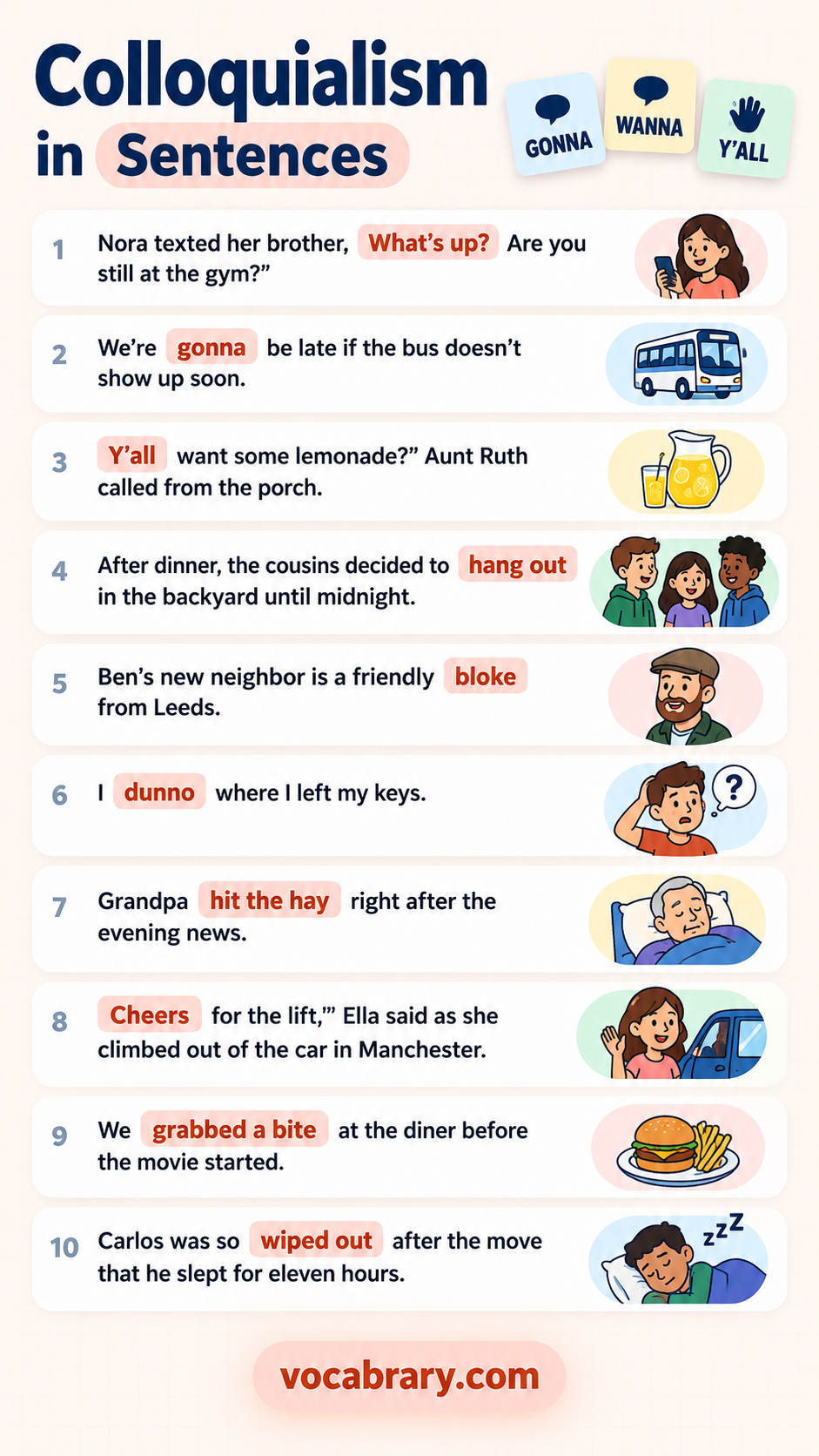
- Nora texted her brother, "What’s up? Are you still at the gym?"
- We’re gonna be late if the bus doesn’t show up soon.
- "Y’all want some lemonade?" Aunt Ruth called from the porch.
- After dinner, the cousins decided to hang out in the backyard until midnight.
- Ben’s new neighbor is a friendly bloke from Leeds.
- "No worries, I’ll pay you back tomorrow," Liam told his flatmate in Sydney.
- I dunno where I left my keys.
- Grandpa hit the hay right after the evening news.
- "Cheers for the lift," Ella said as she climbed out of the car in Manchester.
- We grabbed a bite at the diner before the movie started.
- Carlos was so wiped out after the move that he slept for eleven hours.
- "My bad," Jordan said after bumping into the waiter.
- Do you wanna come to the lake with us on Saturday?
- "Chill out, the train doesn’t leave for another hour," Dad told Priya.
- Omar crashed on his friend’s couch after the party.
- Rosa aced her driving test on the first try.
- "Hang on a sec, I need to find my phone," Tessa said.
- That new pizza place downtown is awesome.
- Our flight got canceled, so we had to hit the road at five in the morning and drive the whole way to Denver instead.
- Kevin’s old ride broke down again on the highway.
- "You guys ready to order?" the server asked the six friends by the window.
- Jenna bailed on the study group at the last minute.
- "Let’s call it a night," Mom said, switching off the television.
- Aren’t you freaking out about the exam tomorrow?
- It’s no big deal if you forget the napkins, Hana.
Colloquialism Examples in Everyday Life
A dad turned couch potato on Sunday, a printer acting up before a flight, and a Wi-Fi router on the fritz in a storm show colloquial English at home, on the road, and online.
- Dad spent the whole Sunday as a couch potato in front of the football game.
- My phone is on its last legs, so I’m saving for a new one.
- The printer is acting up again, and I need my boarding pass in ten minutes.
- Sara had a little fender bender in the grocery store parking lot.
- "Gimme a minute, I’m almost ready," Leo shouted from the bathroom.
- Swing by my place after work, and we’ll walk the dog together.
- After the flu shot, Mina felt a bit under the weather for a day.
- The doctor told Grandpa to lay off the salty snacks for a while.
- Our Wi-Fi went on the fritz during the storm.
- "I’m off, see you tonight," Jess called on her way to the car.
- Tom zonked out on the train and missed his stop.
- Every time the neighbors throw a party, their dog goes nuts.
- Did you catch the game last night?
- "Honey, the dishwasher’s busted again," Rick said.
- Ana nipped out to the corner shop for milk.
- Priya and I caught up over coffee after ten years apart, and it felt as if no time had passed at all.
- The laptop froze up right before I hit save.
- Traffic on the bridge was bumper-to-bumper for an hour.
- The toddler threw a fit in the middle of the supermarket.
- Why is the fridge making that racket again?
- "I’m pooped," Grandma said after chasing the grandkids around the park.
Colloquial Contractions Like Gonna, Wanna, and Gotta
Gonna, wanna, and gotta blend "going to," "want to," and "got to" into single spoken words, and dunno, lemme, and gimme work the same way in fast, casual speech.
- I’m gonna call you back after lunch.
- Do you wanna watch a movie tonight?
- We gotta leave by six to miss the rush-hour traffic.
- "I dunno, maybe tomorrow," Ali said with a shrug.
- Lemme see your new shoes!
- "Gimme five more minutes," Zoe groaned from under the blanket.
- That movie was kinda boring, to be honest.
- "The old truck ain’t worth fixing anymore," Uncle Earl said.
- Get outta here, you won a trip to Hawaii?
- We ate a lotta pizza at the sleepover.
- You shoulda seen the look on his face when the birthday cake came out with forty candles on it.
- If the train hadn’t stopped for an hour, I coulda made it on time.
- Whatcha doing this weekend?
- "Gotcha, I’ll send the file tonight," Marcus replied.
- C’mon, the game’s about to start!
- Tell ’em we’ll be there in ten minutes.
- I betcha the Lakers win tonight.
- Kids oughta wear helmets when they ride bikes.
- You hafta try Grandma’s peach pie.
Colloquialism Examples by Region
Y’all in Georgia, bloke in London, grand in Dublin, and arvo in Sydney show that each English-speaking country has its own informal words, and some change from one city to the next.
American Colloquialisms
Rain checks, ballpark figures, and a friend greeted as "dude" are American colloquialisms heard from New York to California, in offices, dorms, and ballparks.
- "I’ll take a rain check on dinner, I have to work late," Megan said.
- Give me a ballpark figure for the roof repairs.
- "What’s up, dude?" Tyler said as he dropped onto the couch.
- Shoot, I left my wallet in the car.
- Lauren’s go-to snack is popcorn with extra butter.
- It’s no biggie if you’re a few minutes late.
- Stop being a Monday morning quarterback about a game you didn’t even play in.
- "Sounds good, see you at eight," Dan texted back.
- The cops pulled over a speeding van on the interstate.
- Jake totaled his car on an icy road but walked away without a scratch.
- The new app was a total home run for the startup.
- Hit me up when you land in Chicago.
- "Knock it off, you two!" Dad yelled from the front seat on the long drive to Grandma’s house in Ohio.
- The fans went bananas when the Cubs scored in the ninth inning.
- Nick is a total jock who spends every afternoon at the gym.
Southern US Colloquialisms
Y’all, fixin’ to, and over yonder mark speech across the American South, and "bless your heart" turns into sarcasm when a Southerner says it about someone’s poor choices.
- "Y’all come back now," the waitress told the family as they left the diner in Georgia.
- I’m fixin’ to head to the store; need anything?
- The barn is over yonder, past the pecan trees.
- "Well, bless your heart, you tried your best," Miss Lottie said to the boy who had burned the cornbread.
- I reckon it’ll rain before supper.
- Mama told Cody to mash the elevator button.
- Grab a buggy at the front of the store, since we need a week’s worth of groceries.
- Want a Coke? We’ve got root beer and orange.
- She threw a hissy fit when the salon canceled her appointment.
- The painting over the fireplace is hanging cattywampus.
- Howdy, neighbor!
- We caught a mess of catfish down at the creek.
- The kids were plumb tuckered out after the county fair.
- "Don’t be ugly to your sister," Grandma warned.
- "All y’all are invited to the fish fry on Saturday," Pastor Dale announced.
Regional US Colloquialisms
Wicked in Boston, ope in the Midwest, yinz in Pittsburgh, and hella in Northern California show American speech splitting by city and state as well as by North and South.
- The Red Sox game last night was wicked good.
- "Ope, sorry, just gonna squeeze past you," a shopper in Minneapolis said in the cereal aisle.
- In Ohio, Ashley asked for a pop with her pizza.
- Are yinz coming to the Steelers game?
- "Grab that jawn off the counter for me," Malik said in his South Philly kitchen.
- That hike in the Oakland hills was hella steep.
- The kids lined up at the bubbler after recess in Milwaukee.
- Dad brought home two Italian hoagies from a deli in Philadelphia.
- At the sandwich shop in Providence, Nick ordered a meatball grinder.
- "You betcha," the Minnesota farmer said when asked if the lake froze every winter.
- In Manhattan, people wait on line at the bakery.
- Traffic on the 405 was stuck for two hours in Los Angeles.
- "I had to schlep these groceries up four flights," Rachel complained in her Brooklyn walk-up.
- "Uff da, that’s cold," Grandpa said as he stepped onto the frozen dock in northern Minnesota.
British Colloquialisms
Knackered after a long shift, gutted after a lost final, and chuffed about exam marks are British colloquialisms that name tiredness, disappointment, and pride in one word each.
- I’m absolutely knackered after that twelve-hour shift.
- Sam was gutted when his team lost the cup final.
- Priya was well chuffed with her exam marks.
- I’m skint until payday, so no pub tonight.
- That jacket cost forty quid in the sale.
- Fancy a cuppa? The kettle’s just boiled.
- Some bloke at the bus stop asked me the way to King’s Cross.
- Where’s the loo, mate?
- Don’t forget your brolly, because it’s chucking it down outside.
- "Are you taking the mickey?" Jess asked when her brother praised her singing.
- We were gobsmacked by the price of a flat in central London.
- That secondhand phone looks a bit dodgy to me.
- Stop faffing about and get your shoes on!
- There’s nothing on the telly tonight except repeats.
- Before dinner, Harry went upstairs for a quick kip on the sofa bed in the spare room.
- "Turn left at the lights, and Bob’s your uncle, you’re there," the shopkeeper said.
- Someone nicked my bike from outside the library.
- Gran was feeling a bit peckish, so she made toast.
Irish Colloquialisms
Grand for "fine," craic for fun or news, and an eejit who forgets his coat are Irish colloquialisms heard in kitchens, pubs, and classrooms from Dublin to Galway and Cork.
- "I’m grand, thanks for asking," Siobhan said.
- "What’s the craic?" Ciarán asked as he walked into the pub in Galway.
- Don’t be an eejit; put your coat on in this weather.
- Mam was giving out to us for tracking mud through the kitchen.
- Your uncle is gas; he had the whole family laughing at dinner.
- Pass me that yoke beside the kettle.
- The concert in Dublin last night was deadly.
- It’s fierce cold out there this morning.
- Put the cereal back in the press, please.
- "Stop being bold," the teacher told the giggling boys at the back of the classroom in Cork.
Australian Colloquialisms
Arvo for afternoon, brekkie for breakfast, and a trip to the servo for petrol are Australian colloquialisms built by clipping a word and adding an o or ie ending.
- See you this arvo at the beach.
- We stopped at the servo for petrol and a meat pie.
- Let’s grab brekkie before the surf.
- Dad’s firing up the barbie for the footy final.
- Don’t forget your thongs and sunnies; it’s thirty-five degrees.
- "She’ll be right," Jack said about the dent in his ute.
- G’day, how are you going?
- Is that story fair dinkum, or are you pulling my leg?
- After the cricket, the train home was chockers.
- Mia called in crook and spent the day in bed.
- Building that fence in the summer heat outside Brisbane was real hard yakka for the whole family.
- The mozzies were terrible at the campsite last night.
- We grabbed Maccas on the drive to Melbourne.
- The tradie charged us heaps for fixing the roof.
Canadian Colloquialisms
A double-double from Timmies, a toque at minus twenty, and a pocket full of loonies and toonies are Canadian colloquialisms for coffee, winter hats, and coins.
- "Grab me a double-double from Timmies on your way in," Brent said.
- Pull on your toque; it’s minus twenty out there.
- That old vending machine only takes loonies and toonies.
- Excuse me, where’s the washroom?
- Our hydro bill doubled in January.
- Nice day for a skate, eh?
- The class keener had her hand up before the teacher finished the question.
- "Just give’r," the coach shouted as the team skated out for overtime.
Colloquialisms About Money
Fifty bucks for a ticket, a loaded uncle, and a friend who is broke until Friday show how informal English talks about having money, lacking it, and spending it.
- Tickets are fifty bucks each.
- Jake is broke until his paycheck comes in on Friday.
- Tom’s uncle is loaded; he owns three restaurants.
- Fixing the roof cost us a pretty penny.
- I had to shell out two hundred dollars for new tires.
- The mechanic charged me a grand for the new brakes.
- Twelve dollars for a coffee? What a rip-off!
- Ashley decided to splurge on concert tickets for her birthday.
- Don’t be such a cheapskate; leave the waiter a tip.
- Dad finally coughed up the money for my school trip.
- The owner told us the desserts were on the house.
- Where did you get all that dough, Eddie?
- We’re strapped for cash this month because the car needed a new transmission and two new tires.
- My sister is a real penny-pincher who clips coupons for everything.
Colloquialisms About Food
Pigging out on pizza, a cheese sarnie for the train, and a doggy bag for leftover lasagna show colloquial English at home, on trains, and in restaurants.
- After the game, the boys pigged out on pizza.
- I’m stuffed; I couldn’t eat another bite.
- I’ve got the munchies; is there any popcorn left?
- Out at the campsite, the grub was better than any restaurant in town.
- Chloe packed a cheese sarnie for the train to Leeds.
- The farmhands chowed down on biscuits and gravy at dawn.
- Ask the waiter for a doggy bag for the leftover lasagna.
- Eat your veggies before dessert, kids.
- When is dinner? I’m starving!
- Grandad mashed a pile of spuds for Sunday lunch.
- Let’s split a meatball sub at lunch.
- The kids wolfed down their pancakes in two minutes flat.
- Ella’s aunt makes a mean lasagna with four kinds of cheese and a sauce that simmers all afternoon.
- Everyone agreed the nosh at the wedding was fantastic.
Colloquialisms About Feelings
Stoked about a road trip, bummed about a canceled concert, and down in the dumps after a friend moves away are colloquialisms that name moods faster than formal words do.
- I’m totally stoked about the road trip.
- Luis was bummed that the concert got canceled.
- Rachel is over the moon about her new job.
- Grandma has been down in the dumps since her best friend moved to Arizona.
- Kenji is fed up with the noise from upstairs.
- The kids are hyped for the water park.
- Why are you so cranky this morning?
- Dev got freaked out by the scratching noise in the attic.
- Mom was ticked off when we tracked mud across her freshly mopped floor.
- I’m feeling a bit blue today.
- Aunt Rosa was a little miffed that nobody called on her birthday.
- Everyone was psyched when the principal announced a snow day.
- Jamal has been in a funk ever since the breakup.
- Nadia lost it when she saw the mess.
Colloquialism Examples at Work
Calling it a day, touching base with a client, and feeling swamped all week are workplace colloquialisms heard in offices, restaurants, and video calls every day.
- Let’s call it a day and finish the report tomorrow.
- I’ll touch base with the client after lunch.
- Sorry for the late reply; I’ve been swamped all week.
- The restaurant was slammed during the Friday dinner rush.
- Kim’s new gig at the radio station pays better than her old job.
- Thanks for the heads-up about the fire drill.
- Run it by the manager before you send the email.
- The company pulled the plug on the project after six months.
- Our new intern hit the ground running on her first day.
- Omar clocked out at five and headed straight to the gym.
- Tired of the rat race, Lena quit her office job in Chicago and opened a small bakery in her hometown.
- Don’t slack off while the boss is away.
- Let’s circle back to the budget on Monday.
- Is he really happy in that dead-end job?
School and Teen Colloquialisms
Cramming for a chemistry test, pulling an all-nighter, and calling "shotgun" for the front seat are school and teen colloquialisms, mixed here with newer slang like "sus" and "no cap."
- I have to cram for the chemistry test tonight.
- Josh pulled an all-nighter to finish his history project.
- Mia totally flunked the math quiz.
- The teacher gave us a pop quiz on Friday morning.
- That new kid is lowkey funny.
- His excuse sounds sus to me.
- "For real? You got tickets?" Ava asked.
- My bestie and I are going to the mall after school.
- "Shotgun!" Tyler yelled, racing his sister to the front seat.
- Everyone thinks Ethan is the teacher’s pet.
- A few seniors ditched class to watch the playoff game.
- Mr. Lopez said my essay was legit good.
- "No cap, this is the best pizza in town," Jaden said after his third slice at the team dinner.
Funny Colloquialism Examples
A doohickey on the workbench, a goat that causes a hullabaloo, and a grandfather who calls the remote a whatchamacallit show colloquialisms whose sound alone gets a laugh.
- Hand me that doohickey on the workbench.
- Where’s the thingamajig that opens the pickle jar?
- Grandpa calls the TV remote the whatchamacallit.
- The twins got up to all sorts of shenanigans at the wedding.
- They bought the house, the boat, and the whole shebang.
- There was a real hullabaloo when the goat got into the classroom.
- "Everything’s hunky-dory," Dad said as smoke poured from the grill.
- "That’s utter codswallop," Gran snorted at the village gossip.
- The new tax form left me completely discombobulated.
- We got bamboozled by a street magician in Chicago.
- Quit your lollygagging and get in the car!
- The kids skedaddled as soon as they heard the ice-cream truck.
- A kerfuffle broke out at the bake sale over the last brownie.
- Mike has a gazillion photos of his cat on his phone.
- Nobody expected the cockamamie plan to work, yet the whole class escaped the rainstorm dry.
Colloquialism Examples for Kids
Tummy aches, boo-boos, and yucky broccoli are colloquialisms children learn at home before school, and every one of them sounds friendlier than the formal word.
- My tummy hurts after all that cake.
- Mom put a bandage on Leo’s boo-boo.
- Eww, this broccoli is yucky!
- "Nighty-night, sleep tight," Dad whispered.
- That dinosaur is ginormous!
- Emma is a scaredy-cat during thunderstorms, so she hides under a blanket with her stuffed rabbit until the rain stops.
- "No fair, she got a bigger slice!" Max complained.
- Okey-dokey, let’s go to the park.
- The doggy wagged its tail at the kids.
- Did you see that super cool rainbow?
- Stay away from Timmy; he has cooties!
Colloquialism Examples for Students
A prof who moves the midterm, a brain fried after four hours in the library, and a group that decides to wing it show colloquial English on a college campus.
- I’m going to hit the books after dinner.
- My prof moved the midterm to Thursday.
- Nadia nailed her final presentation.
- I totally bombed the statistics exam.
- After four hours in the library, my brain is fried.
- Our study group decided to wing it on the group presentation.
- Choosing the elective was a no-brainer.
- The dorm was noisy all night before finals.
- Sam gave me a crash course in citation rules the night before our research paper was due.
- Ben cut class to sleep in.
- "Wanna grab coffee after the lecture?" Lucia asked.
Colloquialism Examples in Literature
Huck Finn’s "ain’t," Holden Caulfield’s "phony," and Gatsby’s "old sport" are among the most studied colloquialism examples in literature, each placing a character in a real region and class.
Colloquialism in Mark Twain’s Huckleberry Finn
Mark Twain gives Huck his Missouri speech from the first paragraph, where he says "ain’t," to the final chapter, where Huck plans to "light out" for the Territory.
- Huck narrates Mark Twain’s Adventures of Huckleberry Finn (1884) in the everyday speech of a Missouri boy, who uses "ain’t" in the very first paragraph.
- According to Huck, the Widow Douglas wants to "sivilize" him, a spelling that copies his pronunciation.
- When he feels he is unable to stand life in the widow’s house any longer, Huck says he "lit out."
- Throughout the novel, Huck calls his father "Pap."
- "I reckon" replaces "I think" or "I suppose" again and again in Huck’s narration.
- To Huck, the widow is "dismal regular" and decent in all her ways.
- At the end, Huck says he means to "light out for the Territory" before Aunt Sally tries to civilize him.
- In a note at the front of the book, Twain explains that his characters speak several distinct dialects, among them the "Pike County" speech of Missouri.
Colloquialism in American Novels
Holden Caulfield’s "phony," Gatsby’s "old sport," and Lennie’s dream of living "off the fatta the lan’" show American novelists using colloquial speech to reveal age, class, and background.
- Holden Caulfield in J. D. Salinger’s The Catcher in the Rye (1951) calls almost every adult he meets a "phony."
- Salinger’s narrator ends sentence after sentence with "and all," a habit that makes the novel sound like a teenager talking.
- When something amuses him, Holden says it "killed" him.
- In John Steinbeck’s Of Mice and Men (1937), George and Lennie arrive at the ranch with their "bindles," the rolled blankets of migrant workers.
- Lennie begs George again and again to describe the day they will "live off the fatta the lan’."
- Jay Gatsby in F. Scott Fitzgerald’s The Great Gatsby (1925) calls Nick "old sport" throughout the novel.
- Alice Walker writes The Color Purple (1982) as letters in Celie’s own rural Georgia speech.
- Zora Neale Hurston’s Their Eyes Were Watching God (1937) sets its dialogue in the everyday speech of Eatonville, Florida, while the narrator uses standard English.
Colloquialism in British and Irish Fiction
Eliza Doolittle’s "bloody," Hagrid’s "yer," and the Edinburgh "ken" of Trainspotting show British and Irish writers putting working-class speech into novels and plays.
- In George Bernard Shaw’s Pygmalion (1913), the flower seller Eliza Doolittle shocks Mrs. Higgins’s polite guests with "Not bloody likely."
- Charles Dickens gives the Artful Dodger in Oliver Twist the street slang of London’s young pickpockets.
- Sam Weller, the Cockney servant in Dickens’s The Pickwick Papers, swaps his v and w sounds when he talks.
- Irvine Welsh writes much of Trainspotting (1993) in Edinburgh Scots, where "ken" means "know."
- Hagrid in J. K. Rowling’s Harry Potter and the Philosopher’s Stone (1997) tells Harry, "Yer a wizard."
- Joseph, the old servant in Emily Brontë’s Wuthering Heights (1847), speaks in broad Yorkshire dialect.
- Roddy Doyle packs The Commitments (1987) with the Dublin slang of young working-class musicians.
Related
FAQs
A common example of a colloquialism is "gonna," the spoken form of "going to," as in "I’m gonna be late." Others are "y’all" in the American South, "bloke" in Britain, and "arvo" in Australia. The englishan.com lesson on what a colloquialism is explains the term with 50+ more cases.
Colloquialism and slang differ in how widely they spread and how long they last. A colloquialism like "gonna" or "hang out" is informal but understood by nearly every speaker of a region. Slang like "sus" or "no cap" starts in a smaller group and falls out of fashion faster. All slang is informal, but not every colloquialism is slang.
No, colloquialisms and idioms are not the same, although the two categories overlap. An idiom is a fixed phrase whose meaning differs from its words, like "over the moon," and some idioms appear in formal writing. A colloquialism is any informal word or phrase, such as "gonna" or "loo," whether or not its meaning is figurative.
No, jargon is the specialist vocabulary of a profession, such as "stat" in a hospital or "bandwidth" in tech, while a colloquialism is informal language shared by the general public of a region. Jargon is formal inside its field, and a colloquialism is informal everywhere.
Yes, "ain’t" is a colloquialism, a spoken contraction of "am not," "is not," "are not," "has not," and "have not." Dictionaries label it nonstandard, so it turns up in dialogue and song titles but not in formal essays. Huck Finn uses it in the first paragraph of Twain’s novel.
Yes, colloquialism counts as a literary device when a writer chooses informal speech on purpose to build character or setting, as Twain does with Huck Finn. It is a choice of diction rather than a figure of speech like metaphor or simile, which bend a word’s meaning. More figures of speech show that second group.
Writers use colloquialism to make dialogue sound real, to show where a character comes from, and to set a friendly, conversational feel. Holden Caulfield’s "phony" and Hagrid’s "yer" each tell readers about the speaker’s age, class, or home in a single phrase.
Yes, most colloquialisms follow English grammar; they are informal, not wrong. "Hang out" and "grab a bite" are standard phrasal verbs in casual use, while forms like "ain’t" and "gonna" count as nonstandard and stay out of formal writing.
No, a colloquialism is a single word or phrase, while a dialect is the whole variety of a language spoken in a region or community, with its own grammar, vocabulary, and pronunciation. Southern American English is a dialect, and "y’all" is one colloquialism inside it.
Only the informal contractions count as colloquialisms. Standard contractions like "don’t," "it’s," and "we’ll" are acceptable in most writing, while spoken blends like "gonna," "wanna," "gotta," and "ain’t" are colloquialisms. The second kind rarely turns up outside dialogue, texts, and casual emails.
Colloquialism makes a text feel closer and more personal, as if the reader were listening to a friend. In fiction, it also places a story in a real time and region, so a reader who meets "reckon" and "yonder" pictures the rural South before any setting is named.
Colloquialism is pronounced kuh-LOH-kwee-uh-liz-um, with the stress on the second syllable. The adjective colloquial follows the same pattern: kuh-LOH-kwee-ul.

Leave a Comment