
A cliche is a phrase or expression that has lost its force through overuse, as when a coach says the team will take it "one game at a time." Cliche examples in sentences show these overused phrases in daily talk, office emails, sports interviews, and fiction.
What Is a Cliche?
A cliche is a saying, comparison, or line of dialogue repeated so widely that it no longer surprises anyone who hears or reads it. Unlike an idiom, which is defined by a meaning that differs from its literal words, a cliche is defined by overuse, so a literal phrase such as "better late than never" counts as one.
When the bus finally pulled in forty minutes behind schedule, Mr. Okafor shrugged and said, "Better late than never."
Common Cliche Examples in Sentences
"Better late than never," "every cloud has a silver lining," and "only time will tell" are among the most common cliches in English, repeated so widely that listeners finish them before the speaker does.
- When the bus finally pulled in forty minutes late, Grandpa muttered, "Better late than never."
- Losing the job felt awful at first, but Maria now calls it a blessing in disguise.
- "Every cloud has a silver lining," Coach Reyes told the team after the rainout.
- Nobody knows whether the new café will survive its first winter, so only time will tell.
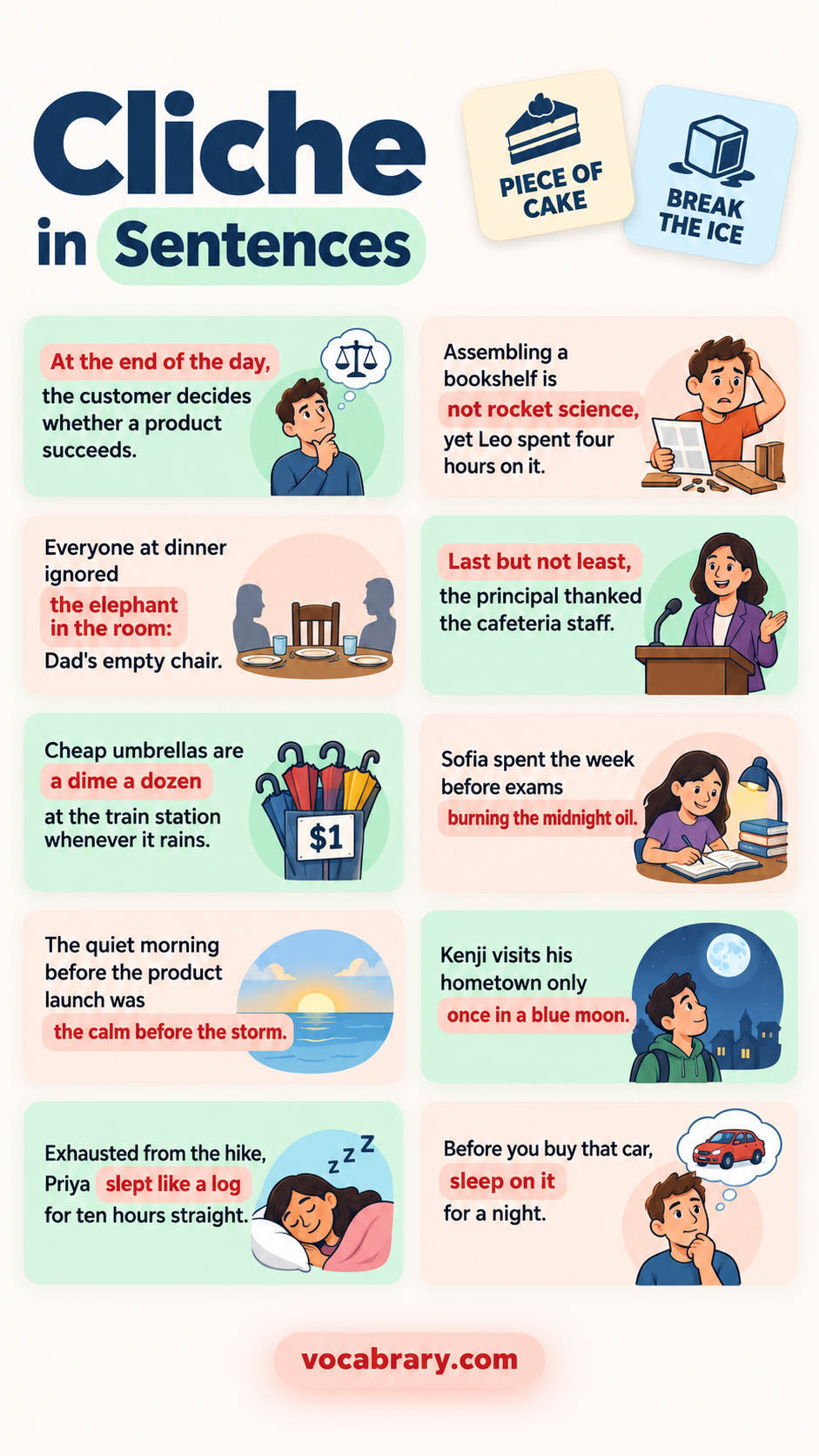
- At the end of the day, the customer decides whether a product succeeds.
- My brother keeps promising to tidy the garage, but actions speak louder than words.
- Stuck choosing between a pay cut and a two-hour commute, Dev felt caught between a rock and a hard place.
- Ever since the argument at Thanksgiving, Aunt June has avoided her neighbor like the plague.
- The firefighters arrived in the nick of time and carried the family’s dog out of the smoke.
- Assembling a bookshelf is not rocket science, yet Leo spent four hours on it.
- Everyone at dinner ignored the elephant in the room: Dad’s empty chair.
- Last but not least, the principal thanked the cafeteria staff.
- Cheap umbrellas are a dime a dozen at the train station whenever it rains.
- After his knee surgery, Mr. Patel is back on the tennis court and fit as a fiddle.
- Sofia spent the week before exams burning the midnight oil.
- The quiet morning before the product launch was the calm before the storm.
- Hana finally bit the bullet and booked the dentist appointment she had dodged for a year.
- Do you really believe the grass is always greener on the other side?
- Her grandmother insists that what goes around comes around, especially for rude drivers.
- To break the ice at the workshop, the trainer asked everyone to name a favorite snack.
- "We’ll cross that bridge when we come to it," Omar said when his roommate asked about next year’s rent.
- The leaked trailer let the cat out of the bag a month before the official announcement.
- Kenji visits his hometown only once in a blue moon.
- Two missed deadlines were just the tip of the iceberg for the struggling contractor.
- Exhausted from the hike, Priya slept like a log for ten hours straight.
- "All’s fair in love and war," Ben joked as he grabbed the last slice of pizza.
Cliche Examples in Everyday Conversation
Saying "long time no see" to an old friend, "it’s a small world" at a chance meeting, and "sleep on it" before a big purchase are daily-chat cliches that people repeat without thinking.
- "Long time no see!" Rosa shouted when she saw her college roommate at the airport.
- Running into my dentist at a concert in Lisbon, I laughed and said, "It’s a small world."
- Before you buy that car, sleep on it for a night.
- "Better safe than sorry," Mom said, packing a third jacket for the trip.
- Jamal told his sister not to worry about the broken vase, because accidents happen.
- "Speak of the devil," Lucy said as Tom walked through the door.
- My neighbor waves off every flat tire and burnt dinner as just one of those days.
- "Don’t get me started," Uncle Raj groaned when someone mentioned parking fees downtown.
- Asked what was new at work, Marcus shrugged and said, "Same old, same old."
- "It’s not the end of the world," Grandma said when I spilled grape juice on her white rug.
- Carla hates small talk, yet she still greets every cashier with "How about this weather?"
- "Easier said than done," Nadia replied when her trainer told her to cut out sugar.
- Theo lost his keys twice in one week, and his wife said he would lose his head if it wasn’t screwed on.
- "It’s the thought that counts," Sam said, unwrapping a sweater three sizes too big.
- To make a long story short, we missed the ferry and slept in the car.
- Before her first skydiving jump, Ana told her nervous father, "You only live once."
- "What’s done is done," Dad said, sweeping up the pieces of the broken plate.
- Why does every relative say "My, how you’ve grown" at family reunions?
- The barista said "Have a nice day" to two hundred customers before lunch.
- "Mind your own business," Leila told her little brother when he read her text messages.
Cliche Examples at Work and in Business
Managers who promise to "circle back," teams chasing "low-hanging fruit," and pitches about "moving the needle" are office cliches that sound busy but say little.
- "Let’s circle back on the budget after lunch," Priya wrote in the team chat.
- Our new sales plan targets the low-hanging fruit first: customers who already use our app.
- Our marketing director wants a campaign that will actually move the needle on sign-ups.
- At Tuesday’s workshop, the facilitator urged everyone to think outside the box.
- Staff heard the merger pitched as a win-win for both companies.
- Our new hire hit the ground running and closed two deals in her first week.
- When the prototype failed its safety test, the engineers went back to the drawing board.
- "Going forward, every expense report needs a receipt," the finance manager announced.
- Please touch base with the supplier before Friday.
- I don’t have the bandwidth to take on another project this quarter.
- The CEO called the new software a game changer, though nobody on the sales floor agreed.
- Why reinvent the wheel when the old onboarding checklist still works?
- The bottom line is that the store lost money for three straight quarters.
- Rather than debate the vendor problem in front of everyone, Mark asked to take it offline.
- Every job ad the startup posts asks for someone who will work hard and play hard.
- A consultant hired in March promised a paradigm shift in how the warehouse handles returns.
- After missing two deadlines, Jorge promised his boss he would pull out all the stops this time.
- The quarterly review was full of talk about synergy, yet the two departments still refuse to share a printer.
- The store manager reminded new cashiers that the customer is always right, even about expired coupons.
- "Let’s run it up the flagpole and see who salutes," the ad executive suggested.
Cliche Examples by Theme
Cliche examples in sentences about love, time, money, and weather show that each theme has stock phrases of its own, such as "head over heels," "time flies," and "money doesn’t grow on trees."
Cliches About Love and Relationships
Falling "head over heels," finding "love at first sight," and hearing there are "plenty of fish in the sea" after a breakup are the romance cliches that wedding toasts and greeting cards repeat.
- By their third date, Amara was head over heels for the quiet librarian.
- My grandparents swear it was love at first sight at a 1962 dance in Manila.
- After the breakup, Jess’s friends reminded her that there are plenty of fish in the sea.
- Carlos and Mei finally tied the knot in a small ceremony by the lake.
- A tidy accountant married a chaotic painter, which proves that opposites attract, according to their friends.
- "Love is blind," Kate whispered when her cousin introduced a fiancé who talked only about crypto.
- Ever since high school, Daniel has called Rachel the one that got away.
- The best man ended his toast by wishing the couple happily ever after.
- "It’s not you, it’s me," Tyler said, and Nina rolled her eyes.
- Married fifty years, Rosa and Eli are still two peas in a pod.
- Absence makes the heart grow fonder, or so Leo hoped during his six-month posting overseas.
- Aren’t they a match made in heaven?
- Sam knew Mia was the love of his life the moment she laughed at his terrible joke.
- The couple insisted that love conquers all, even a three-hour commute between their cities.
- When Ravi admitted he still texted his ex, his girlfriend told him he wasn’t allowed to have his cake and eat it too.
Cliches About Family and Friends
Blood that is "thicker than water," a son who is "like father, like son," and friends who are "thick as thieves" are the family and friendship cliches heard at reunions, graduations, and school gates.
- Despite years of arguing, the Nguyen siblings stood by each other, because blood is thicker than water.
- Jake fixes engines on weekends just like his dad did: like father, like son.
- Lily and Zara have been thick as thieves since kindergarten.
- When Omar lent me his car during my move, he proved that a friend in need is a friend indeed.
- My cousin is the black sheep of the family, the only one who skipped law school to become a drummer.
- "The apple doesn’t fall far from the tree," Grandma said when my son started painting like my mother.
- Birds of a feather flock together, so the chess club members all ended up rooming in the same dorm.
- After a month of backpacking through Peru, Kiran agreed that home is where the heart is.
- "We’re one big happy family here," the new boss said on day one.
- "Friends are the family you choose," Maya wrote in her maid-of-honor speech.
- The twins are joined at the hip; neither goes to the mall without the other.
- At the reunion, Aunt Dora pinched my cheek and said I was the spitting image of my grandfather.
Cliches About Time
"Time flies," "time is money," and "Rome wasn’t built in a day" are the time cliches people use to excuse lateness, hurry a team along, or ask for patience.
- Our summer in Portugal ended so fast; time flies when you’re having fun.
- "Time is money," the foreman barked when the lunch break ran twenty minutes over.
- Learning Mandarin takes years, and Rome wasn’t built in a day.
- The early bird catches the worm, so Dad was at the garage sale by six.
- Six months after the divorce, Elena began to believe that time heals all wounds.
- "There’s no time like the present," my trainer said when I suggested starting next Monday.
- Finals week arrived before we knew it.
- "We’ll get married one of these days," Paul said for the ninth year in a row.
- Mr. Lee keeps promising the shop will get a card reader in due time.
- Tickets for the reunion tour sold out in the blink of an eye.
- The rescue team was racing against the clock as the tide rose around the stranded kayakers.
- "Stop living in the past; it’s water under the bridge," Maria told her brother.
- Old habits die hard, so Grandpa still sets his alarm for five on Sundays.
- With the deadline moved up two weeks, time is running out.
- Every soldier in my family describes army life as "hurry up and wait."
Cliches About Money and Success
Parents who say "money doesn’t grow on trees," shoppers told "you get what you pay for," and founders urged to "strike while the iron is hot" hear the money and success cliches most.
- When I asked for new sneakers, Mom reminded me that money doesn’t grow on trees.
- The cheap blender broke in a week; you get what you pay for.
- Ticket prices doubled this year, and a single seat now costs an arm and a leg.
- "A penny saved is a penny earned," Grandpa said, dropping coins into a jar.
- With investors calling daily, the founders decided to strike while the iron is hot.
- A new film tells a rags-to-riches story about a shoeshine boy who builds a shipping empire.
- Nobody should expect overnight success; the band played bars for ten years first.
- After winning the lottery, Uncle Ted was rolling in dough, then broke within three years.
- Renting a lake cabin for one weekend won’t break the bank.
- "Money talks," the reporter said when the billionaire’s case was quietly dropped.
- Priya spent a decade climbing the corporate ladder before starting her own firm.
- After paying $500 for a "secret" stock tip, Ravi learned that a fool and his money are soon parted.
- "Nothing ventured, nothing gained," Tess said as she mailed her application to Juilliard.
- The investor warned the eager founders that there’s no such thing as a free lunch.
Cliches About Weather and Nature
Rain falling "cats and dogs," a friend "under the weather," and "any port in a storm" show how weather and nature cliches describe moods and hard times as well as the sky.
- We canceled the picnic because it was raining cats and dogs.
- Tom stayed home from school feeling under the weather.
- The company lost its biggest client, its CFO, and its office lease in one month: it never rains but it pours.
- Their marriage weathered the storm of two job losses and a flooded basement.
- Our new receptionist is a ray of sunshine on gray Mondays.
- "Lightning never strikes twice," Dad said, parking in the same lot where his car was stolen last year.
- With the shop busy all December, the owner decided to make hay while the sun shines.
- After a week of rest and soup, the patient was right as rain.
- My sister stole my thunder by announcing her engagement at my graduation party.
- Leo felt like a fish out of water at the black-tie gala.
- Low interest rates, cheap land, and eager buyers created a perfect storm for a housing boom.
- "Any port in a storm," Dev said, taking a shift at the car wash after losing his office job.
Motivational Cliches
"No pain, no gain," "the sky’s the limit," and "follow your dreams" are printed on gym walls, graduation cards, and office posters so widely that readers skim past them.
- The spin instructor yelled "No pain, no gain!" as the class reached the final hill.
- With a scholarship and a supportive family, Aisha knew the sky was the limit.
- Every graduation card Jordan received told him to follow his dreams.
- "If at first you don’t succeed, try, try again," Coach Diaz said after the team’s fourth loss.
- "What doesn’t kill you makes you stronger," my roommate said after surviving finals week.
- The poster by the break room sink tells everyone to reach for the stars.
- Dad wrote "Believe in yourself" on a sticky note inside my lunchbox before the audition.
- "It’s always darkest before the dawn," the counselor told Ben during his toughest semester.
- "Hard work pays off," Grandpa said, pointing at the rows of tomatoes he had planted in April.
- Why does every motivational speaker end with "Never give up on your dreams"?
- "A journey of a thousand miles begins with a single step," Sara reminded herself as she laced up for her first run.
- Ahmed printed dream big on the first slide of his startup pitch.
- When life gives you lemons, make lemonade, the café owner joked after the power outage spoiled her ice cream.
Cliches About Food
"Spill the beans," "the icing on the cake," and "cool as a cucumber" are food cliches that people use far from any kitchen, at school, at work, and at home.
- Mira finally spilled the beans about the surprise party.
- We won the match, and a free team dinner was the icing on the cake.
- Even with the exam clock ticking, Tariq stayed cool as a cucumber.
- Nadia works two jobs to bring home the bacon for her three kids.
- Six people editing one slide deck proved that too many cooks spoil the broth.
- "An apple a day keeps the doctor away," Grandma said, slicing a Granny Smith for each of us.
- There’s no use crying over spilled milk, so Josh reprinted the ruined report and moved on.
- My little sister thinks folding phones are the best thing since sliced bread.
- The kids buttered up their parents for a week before asking for a puppy.
- "You are what you eat," the nurse reminded Mr. Lopez as he reached for another donut.
Sports Cliches in Sentences
Athletes promising to "give 110 percent," coaches taking it "one game at a time," and office workers who "drop the ball" show how sports cliches spread from locker rooms to boardrooms.
Cliches From Players and Coaches
Postgame interviews repeat "we left it all on the field," "one game at a time," and "there’s no I in team," cliches that let players answer reporters without saying anything newsworthy.
- "We’re taking it one game at a time," the rookie told reporters after the win.
- Before the final, the striker promised to give 110 percent.
- "We left it all on the field," the captain said after the overtime loss.
- "There’s no I in team," the coach reminded his star point guard.
- Yogi Berra’s line "it ain’t over till it’s over," first said during the Mets’ 1973 pennant race, is now repeated by every trailing coach.
- "They just wanted it more than we did," the goalie admitted after the shutout.
- "Defense wins championships," the veteran coach told his players at every practice.
- Football is a game of inches, and Sunday’s loss came down to one missed field goal.
- Asked about the stalled offense, the quarterback said for the third straight week, "We just have to execute."
- "A win is a win," the coach said about the ugly one-nothing victory.
- The Olympic swimmer called her first gold medal a dream come true.
- The underdog’s upset proved that on any given Sunday, the worst team in the league beats the best.
- "We control our own destiny," the manager told fans with three games left in the season.
Sports Cliches in Everyday Speech
Offices say "the ball is in your court," grandparents "step up to the plate," and new hires "knock it out of the park," so sports cliches reach people who never watch a match.
- Your move: the ball is in your court.
- When the babysitter canceled, Grandma stepped up to the plate.
- Maya knocked it out of the park with her first client presentation.
- The contractor dropped the ball and forgot to order the bathroom tiles.
- Winning the city council seat was a slam dunk for the popular mayor.
- New rules gave small shops a level playing field against the big chains.
- Every time our sales team meets a quarterly target, the regional boss moves the goalposts and raises the number again.
- Without enough evidence, the lawyer’s closing argument was a Hail Mary.
- Olivia took one for the team and worked the holiday shift.
- Plenty of residents turned into Monday-morning quarterbacks after the mayor’s snow plan failed.
- The surprise quiz on Friday threw the whole class a curveball.
- That tiny bakery on Elm Street is in a league of its own.
- Don’t throw in the towel yet; the bank hasn’t answered your loan request.
Thought-Terminating Cliches
"It is what it is," "everything happens for a reason," and "rules are rules" are thought-terminating cliches, a term from psychiatrist Robert Jay Lifton’s 1961 book on thought reform, used to end a discussion.
- When the airline canceled our flight, the agent just shrugged and said, "It is what it is."
- "Everything happens for a reason," my aunt said at the funeral, and nobody replied.
- Asked why the library closes at four, the clerk answered, "Rules are rules."
- Over dessert, the two uncles agreed to disagree.
- "Boys will be boys," the coach said, dismissing the locker-room fight.
- Whenever I question the chore chart, Mom says, "Because I said so."
- "That’s just the way it is," the landlord said about the broken heater.
- "It’s all good," Jayden texted after I forgot his birthday.
- "Don’t overthink it," the manager said when Rina raised concerns about the contract.
- The sales rep ended every objection with "Trust the process."
- "Whatever will be, will be," Grandma sighed when the harvest failed.
- "Who’s to say?" Kevin asked, ending the debate about the missing cookies.
- "Let’s not go there," Dana said the moment her sister mentioned the wedding.
- "Life isn’t fair," the principal said, closing the complaint about uneven grading.
- "You’ll understand when you’re older," Dad said when I asked why I had to be home by nine, and he never explained the rule.
Cliches in Writing and Fiction
Dark and stormy nights, orphaned chosen ones, and villains who explain their plans before the hero escapes are fiction cliches that editors mark in almost every slush pile.
Descriptive Cliches
Eyes "as blue as the ocean," hair "black as night," and a "deafening silence" are descriptive cliches, comparisons that began as fresh figurative language and are now so familiar that readers no longer picture them.
- Her eyes were as blue as the ocean, and his heart pounded like a drum.
- Tall and silent, the stranger had hair black as night.
- A deafening silence filled the courtroom after the verdict.
- It was a dark and stormy night when the detective arrived at the manor.
- Grandma’s hands were as cold as ice when she came in from the garden.
- Flashing a smile as bright as the sun, the hero stepped onto the stage.
- The heroine let out a breath she didn’t know she was holding.
- Hearing the villain’s laugh made her blood run cold.
- After midnight, the city streets were as quiet as the grave.
- The salesman’s pitch was smooth as silk.
- Fresh snow lay like a blanket of white over the sleeping town.
- Tears streamed down her face as the train pulled away.
- In her wedding photos, the bride looked pretty as a picture.
Character Cliches
The mad scientist, the gossiping neighbor, and the emotionless English butler are stock characters so familiar that readers predict their every move.
- In chapter two, the mad scientist cackles over a bubbling beaker in his tower.
- Whenever a car pulls into the street, the gossiping neighbor peers through the blinds.
- Stiff and silent, the emotionless English butler serves tea while the mystery unfolds.
- On the first day of school, the unlikable rich kid mocks the scholarship student.
- Halfway through the book, the wise old mentor dies, and the hero finishes the quest alone.
- The chosen one turns out to be a farm boy who never left his village.
- At the salon, the flamboyant hairdresser delivers the town’s latest gossip with every trim.
- The loner detective with a drinking problem solves the case nobody else wanted.
- A damsel in distress waits in the tower.
- In Cinderella, the evil stepmother makes the girl scrub floors while her own daughters dress for the ball.
Plot Cliches
A curse broken by true love’s kiss, an orphan who alone defeats the villain, and a heist that goes wrong are plot cliches that readers recognize within the first chapter.
- In Disney’s Snow White and the Seven Dwarfs (1937), true love’s kiss wakes the sleeping princess, a cliche that Shrek (2001) later turned on its head.
- Harry Potter follows the orphan who is the only one able to defeat the villain, a cliche fantasy writers still reuse.
- The heist that goes wrong at the last minute drives the second half of the crime novel.
- "It was all a dream," the final chapter revealed, and angry readers flooded the author’s inbox.
- Instead of finishing off the hero, the villain explains his whole plan and leaves the room.
- A band of adventurers sets out to find a magic sword before the dark lord does.
- After the apocalypse, a ragged group of survivors learns to trust each other.
- "The butler did it" became a mystery cliche, and the phrase is linked to Mary Roberts Rinehart’s 1930 novel The Door.
- By the last chapter, two leads who hated each other at first have fallen in love.
- In the final act, a long-lost twin turns up to explain the murder.
- Waking up with amnesia, the hero spends the whole novel piecing together his past.
Dialogue Cliches
"We need to talk," "it’s not what it looks like," and "you just don’t get it, do you?" are dialogue cliches that screenwriters cut in revision because every viewer has heard them.
- "We need to talk," Emma said as she took the chair across from Jake, and the whole audience knew a breakup was coming.
- Caught in the kitchen at midnight, the husband stammered, "It’s not what it looks like."
- "You just don’t get it, do you?" the teenager screamed before slamming the bedroom door.
- "Is that all you’ve got?" the hero sneered, wiping blood from his lip.
- "Let’s do this," the captain growled.
- "Cover me, I’m going in!" the rookie cop shouted.
- "Stay with me," the soldier begged as his friend closed his eyes.
- "Over my dead body," the father replied when his daughter asked to marry the drummer.
- Leaning back in his chair, the detective said, "Something doesn’t add up."
- "Did you miss me?" the villain asked, stepping out of the shadows.
- As three fighter jets appeared on the radar, the pilot muttered, "We have company."
Cliches in Movies and TV
Han Solo’s "bad feeling about this," a horror gang that decides to split up, and a lover racing through an airport are screen cliches repeated across decades of films and shows.
Cliched Movie Lines
Lines such as "I’ve got a bad feeling about this," "we’re not so different, you and I," and "don’t you die on me" recur in so many films that audiences mouth them along.
- Some version of "I’ve got a bad feeling about this" is spoken in nearly every Star Wars film, starting with the 1977 original.
- The villain leaned close to the hero and hissed, "We’re not so different, you and I."
- Pounding on the patient’s chest, the doctor shouted, "Don’t you die on me!"
- "Let’s get out of here," the hero said as the building exploded behind him.
- In Lethal Weapon (1987), Danny Glover’s Roger Murtaugh keeps grumbling that he is getting too old for this, a line now used by every tired movie cop.
- "It’s quiet. Too quiet," the sheriff muttered, scanning the empty street.
- Scarlett O’Hara ends Gone with the Wind (1939) by telling herself that tomorrow is another day.
- "Trust me, I know what I’m doing," the teenager said just before crashing the boat.
- The SWAT leader kicked open the door and yelled, "Go, go, go!"
- "This isn’t over," the defeated villain growled as he vanished into the fog.
Horror Movie Cliches
Teenagers who split up, a phone with no signal, and a victim who promises "I’ll be right back" are horror cliches, and Scream (1996) turned several of them into spoken rules.
- In Scream (1996), the film buff Randy warns partygoers never to say "I’ll be right back," the cliche that dooms whoever says it.
- Fred’s call of "Let’s split up, gang" in Scooby-Doo turned a horror cliche into a running joke.
- Just as the footsteps reached the cabin porch, the phone showed no signal.
- With the masked killer walking slowly across the parking lot, the car refused to start.
- Why does the babysitter always go down to the basement to check on a strange noise?
- In the final scene, the killer who isn’t really dead rises again behind the heroine.
- A creepy doll turns its head whenever nobody is looking.
- The new family learns too late that the house was built on an old cemetery.
- Only the final girl survives, a term popularized by film scholar Carol Clover’s 1992 book Men, Women, and Chain Saws.
- The jump scare turns out to be a cat leaping from a cupboard.
Romantic Comedy Cliches
A meet-cute over spilled coffee, a makeover on a staircase, and a dash through an airport are rom-com cliches, and films like She’s All That (1999) and Love Actually (2003) made them famous.
- The leads have a meet-cute when she spills coffee all over his manuscript.
- She’s All That (1999) builds its plot on a bet to turn a shy art student into prom queen, complete with the makeover scene on the staircase.
- Love Actually (2003) sends young Sam sprinting through the airport to reach the girl he loves before she flies home.
- Two rival bookstore owners in You’ve Got Mail (1998) hate each other until they fall in love.
- In Say Anything (1989), Lloyd lifts a boombox over his head outside Diane’s window, a gesture rom-coms still copy.
- A fake relationship for a family wedding turns real by the final dance.
- Right on schedule, the big misunderstanding splits the couple in the third act.
- Of course, the film ends with a kiss in the rain.
Cliches in Advertising
"New and improved," "for a limited time only," and "four out of five dentists" are advertising cliches repeated on packages, radio spots, billboards, and late-night infomercials.
- The detergent bottle promised a new and improved formula for the third year running.
- For the third month in a row, the radio ad shouted that the sofa sale lasts for a limited time only.
- "Act now and receive a second blender free!" the late-night host shouted.
- Trident’s old claim that four out of five dentists recommend sugarless gum became an advertising cliche.
- Trailer narrator Don LaFontaine made "In a world where" the most famous opening in movie trailers.
- "But wait, there’s more," the infomercial host announced, lifting a second set of knives.
- "Everything must go!" read the banner outside the furniture store for two full years.
- Old Sears catalogs promised satisfaction guaranteed or your money back.
- According to the ad, the face cream is clinically proven to reduce wrinkles.
- While supplies last, every customer gets a free tote bag.
- Glossy resort brochures promised the vacation of a lifetime.
- The toy commercial ended with "batteries not included" in tiny print.
- A clickbait headline claimed, "You won’t believe what happens next."
Cliche Examples for Kids
"Busy as a bee," "quiet as a mouse," and "slow and steady wins the race" are cliches children learn early from parents, teachers, and fables such as Aesop’s tortoise and hare.
- Mia was as busy as a bee building her sandcastle.
- The class was as quiet as a mouse during the spelling test.
- In Aesop’s fable, the tortoise shows that slow and steady wins the race.
- Practice makes perfect, so Leo plays piano every day after school.
- "Sleep tight, don’t let the bedbugs bite," Dad said as he turned off the light.
- Wrapped in her blanket, the baby was snug as a bug in a rug.
- "Cat got your tongue?" Grandpa asked when shy Ben forgot his lines.
- "Don’t count your chickens before they hatch," Mom said when Jay planned how to spend his birthday money.
- After finding the lost puppy, Ella was happy as a clam.
- Two heads are better than one, so Ava and Noah solved the puzzle together.
- "The more, the merrier," said Mrs. Kim when three more kids asked to join the picnic.
- "Curiosity killed the cat," Aunt Jo warned when Sam peeked into the present.
- "Sharing is caring," the teacher said, handing Tim half the crayons.
- Our dog is as good as gold when visitors come.
- Riding a bike was as easy as pie after the first week.
- "Finders keepers, losers weepers!" Max shouted as he grabbed the ball.
Cliche Examples for Students
Essays that open "since the dawn of time," reports that begin "Webster’s Dictionary defines," and application letters from "a people person" repeat the student cliches that writing teachers mark in red on every draft.
- "Since the dawn of time, humans have loved pizza," began Josh’s history essay.
- Maya opened her report on friendship with "Webster’s Dictionary defines," and her teacher sighed.
- "In today’s society, phones have taken over," wrote nearly half the class.
- The college essay began, "I’m a people person," like thousands of others in the admissions pile.
- "Throughout history, wars have changed borders," the thesis said, without naming a single war.
- Aiden’s personal statement began, "Little did I know that one summer camp would change my life."
- "It goes without saying that teamwork wins games," Leila wrote, and then said it anyway.
- Needless to say, the five-person group project was finished at two in the morning, a few hours before it was due.
- First and foremost, Carlos thanked his parents in his scholarship speech.
- The debate student called social media a double-edged sword.
- "In this day and age, nobody writes letters," Rhys argued.
- People from all walks of life enjoy music, the essay concluded.
- Priya’s application ended by saying that failing a math test made her who she is today.
- "Hard work and dedication" appeared in almost every scholarship essay the committee read that year.
- In conclusion, Omar’s lab report repeated its introduction word for word.
Funny Cliche Examples
Uncle Pete cramming four cliches into one toast, a manager who mixes up two bridge sayings, and a boy who looks for falling puppies show the funny side of cliches.
- Uncle Pete’s wedding toast strung together four cliches: "At the end of the day, love is blind, opposites attract, and only time will tell."
- "We’ll burn that bridge when we come to it," the manager said, mixing up two cliches.
- "It’s not rocket science," said the rocket scientist, fixing the toaster.
- Our coach told us to give 110 percent, so Jin asked where the extra ten percent comes from.
- When Dad said it was raining cats and dogs, my little brother ran to the window looking for puppies.
- After I told her to break a leg before the audition, Nora tripped on the stage stairs and sprained her ankle.
- The café’s sign said Rome wasn’t built in a day, and our sandwich took almost that long.
- My friend promised to think outside the box, then spent an hour folding one.
- "Money doesn’t grow on trees," said the orchard owner, "but apples do."
- Grandma says the early bird catches the worm, and my brother says the second mouse gets the cheese.
- The weather reporter, soaked to the bone, assured viewers that every cloud has a silver lining.
- My trainer said no pain, no gain, so I stopped going and felt no pain at all.
Cliches Rewritten Into Fresh Sentences
Rain "cats and dogs" becomes rain drumming on a tin roof, and "fit as a fiddle" becomes a grandfather hiking five miles, replacing each cliche with a concrete picture.
- "It was raining cats and dogs" becomes "Rain drummed on the tin roof so loudly that Nora had to shout."
- "Grandpa is fit as a fiddle" becomes "At eighty-one, Grandpa still hikes five miles before breakfast."
- "Time flies" becomes "The school year ended before Maya finished her September pencils."
- "She was as cold as ice" becomes "She answered my apology with a single nod and left the room."
- "The calm before the storm" becomes "For ten minutes before the doors opened, the only sound in the store was the hum of the freezers."
- "He slept like a log" becomes "He slept through two alarms, a thunderstorm, and his sister’s trumpet practice."
- "Every cloud has a silver lining" becomes "Losing the lease forced Omar to move his bakery to a busier street, where sales doubled."
- "Jonah avoids his neighbor like the plague" becomes "Jonah climbs six flights of stairs rather than share an elevator with his neighbor."
- "My heart was pounding like a drum" becomes "My pulse thumped so hard that I heard it in my ears."
- "It was a dark and stormy night" becomes "Hail peppered the windows as the last bus left without us."
- "He’s a people person" becomes "He learned the names of all forty regulars at the diner within a month."
- "Since the dawn of time, people have told stories" becomes "Painters at Lascaux in France covered cave walls with horses and bulls about 17,000 years ago."
- "The silence was deafening" becomes "Nobody spoke, and the ticking of the wall clock filled the room."
- "He was over the moon" becomes "Within ten minutes of reading the acceptance email, he called his mother, his coach, and his old piano teacher."
- "They lived happily ever after" becomes "They argued about the dishwasher for forty years and still held hands at every movie."
Related
FAQs
A familiar case of a cliche is "better late than never," a phrase so overused that most listeners finish it before the speaker does. Other everyday cases are "every cloud has a silver lining," "time flies when you’re having fun," and "it’s raining cats and dogs."
You use the word cliche as a noun in a sentence such as "The speech was full of cliches," and as an adjective in "The ending felt cliched." Writers also say a plot or character "is a cliche" when it copies a pattern readers have met many times.
A cliche and an idiom differ in what defines them: an idiom is a fixed phrase whose meaning differs from its literal words, while a cliche is any phrase that overuse has made stale. "Break a leg" is an idiom, "better late than never" is a cliche with a literal meaning, and "raining cats and dogs" is both.
No, a cliche is not slang, because slang is new, informal vocabulary tied to one group or generation, while a cliche is an established phrase repeated until it loses impact. Slang terms fade within a few years, but "time is money" has been in use since Benjamin Franklin wrote it in 1748. Informal everyday speech is on show in these colloquialism examples.
Common synonyms for cliche are platitude, commonplace, bromide, truism, and hackneyed phrase. Platitude is the closest match when the cliche offers stale moral advice, such as "everything happens for a reason."
The word cliche is spelled c-l-i-c-h-e in English, and the original French spelling adds an acute accent over the final letter: cliché. Dictionaries accept both spellings, and the adjective form is cliched.
You avoid cliches in writing by rereading each draft for phrases you have heard many times and replacing each one with a concrete fact from your own story. Swap "fit as a fiddle" for "hikes five miles at eighty-one," and replace an opener like "throughout history" with a dated event.
Cliches should be avoided in writing because readers skim past a phrase they have heard hundreds of times, so the sentence delivers no new picture or fact. Teachers and editors also mark stock openers such as "since the dawn of time," because the phrase replaces a specific claim the writer never makes.
No, not all cliches are bad, because a familiar phrase works well in dialogue, in comedy, and in speeches where listeners need a fast shared reference. A character who talks only in cliches reveals something about that character, and a toast that ends "happily ever after" gives guests a line they expect.
People use cliches because the phrases are ready-made, understood by everyone, and fast to say when a speaker has no time to find fresh words. At funerals, job interviews, and postgame press conferences, a cliche also lets the speaker avoid saying something risky.
A thought-terminating cliche is a stock phrase used to end a discussion or dismiss a doubt, such as "it is what it is" or "rules are rules." Psychiatrist Robert Jay Lifton named the idea in his 1961 book Thought Reform and the Psychology of Totalism, and the phrase is now common in writing about figures of speech and persuasion.
A cliche and a stereotype differ in target: a cliche is an overused phrase or story device, while a stereotype is an oversimplified belief about a group of people. Both words began as French printing terms for metal plates that reproduced the same text again and again, and a stock character such as the mad scientist is where the two overlap.

Leave a Comment