
Circumlocution is a figure of speech in which a speaker uses many words where one would do, as when someone asks for "the thing you use to open tins" instead of a tin opener. Most circumlocution examples come from forgotten words, polite refusals, office jargon, and political answers, beginning with everyday roundabout phrases.
What Is Circumlocution?
Circumlocution means describing a word or idea at length instead of naming it, because the speaker has forgotten the word, wants to soften it, or wants to dodge it. Euphemism swaps a harsh word for a milder one, while circumlocution talks around the word with a longer description.
Unable to remember the word "ladder," Kemal asked for the metal steps you climb to reach the roof.
Common Circumlocution Examples in Sentences
A tin opener called "the thing you use to open tins," a report described as "not entirely accurate," and a slow neighbor called "not the sharpest tool in the shed" are everyday circumlocution. Each long phrase replaces one short word.
- Mia asked her brother to pass the thing you use to open tins, since the word had slipped her mind (direct: tin opener).
- According to the manager, the report was not entirely accurate in every respect (direct: wrong).
- "He’s not the sharpest tool in the shed," Uncle Leo said about the new neighbor (direct: not clever).
- Grandpa calls his umbrella the folding rain shield I take on walks (direct: umbrella).
- Instead of saying no, Carla told her friend she would have to think about it and get back to her at some point (direct: no).
- The waiter described the dish as a cold soup made from blended tomatoes, cucumber, and peppers (direct: gazpacho).
- Our teacher never says "late"; she says students arrived after the lesson had already begun (direct: late).
- "I’m experiencing a temporary shortage of funds," Dev admitted when the bill came (direct: broke).
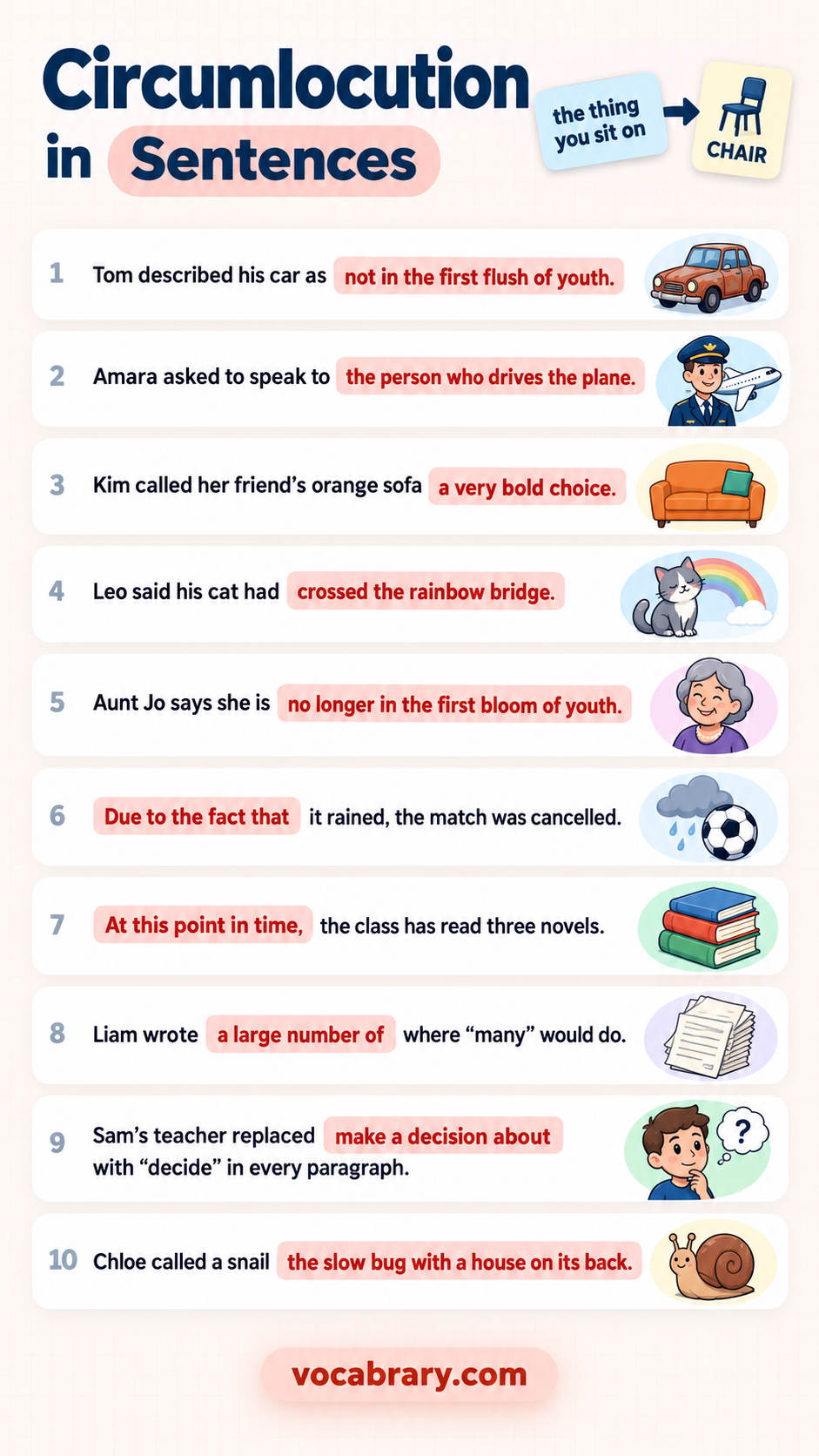
- Tom described his car as not in the first flush of youth (direct: old).
- Rather than admit he was lost, Dad said we were taking the scenic route while he got his bearings (direct: lost).
- The sign on the lift read, "This elevator is temporarily not in a state of operation" (direct: broken).
- Ana told the salesman she was not in a position to make a purchase at this moment in time (direct: no).
- My brother calls his phone charger the white cable that makes the battery full again (direct: charger).
- Why did Ben say the large bird we eat at Thanksgiving when he meant turkey?
- Would you mind opening the glass door that lets you out to the garden, please (direct: patio door)?
- The receptionist said the doctor was currently engaged with another patient and unavailable to see anyone (direct: busy).
- Leila’s toddler calls a zebra the horse wearing black and white pyjamas (direct: zebra).
- Hugo calls the microwave the little oven that heats food with invisible waves (direct: microwave).
- When asked his age, Mr. Grant said he was on the far side of sixty and closer to seventy than he liked (direct: sixty-eight).
- Priya didn’t say she was tired; she said she was not operating at full strength after a short night (direct: tired).
Circumlocution Examples in Everyday Speech
Shoppers, grandparents, and hotel guests use everyday circumlocution, as when a nail becomes "a metal pin you hit with a hammer" and a toilet becomes "the smallest room in the house."
- At the hardware store, Sam asked for a metal pin with a flat head that you hit with a hammer (direct: nail).
- "Pass me the clicker thing for changing the channels," Grandma said from the sofa (direct: remote).
- Lina told the pharmacist she needed something for the tickly feeling at the back of her throat (direct: cough medicine).
- My dad calls the dishwasher the machine that does the washing-up while we sleep (direct: dishwasher).
- The bus driver announced an unscheduled change of route owing to roadworks further along the road (direct: detour).
- Noah texted his mom that he was on his way and would arrive in the not-too-distant future (direct: soon).
- Aunt Rosa asked the shop assistant for those little paper cups you bake the cakes in (direct: cupcake cases).
- "We’re having a bit of a disagreement about whose turn it is," Ella said as the twins shouted (direct: fighting).
- Instead of "vacuum," Kenji says he will push the noisy carpet-sucking machine around the living room (direct: vacuum).
- Omar’s grandmother calls Wi-Fi the invisible internet from the blinking gadget by the TV (direct: Wi-Fi).
- Hana asked the barista for coffee with a lot of hot foamy milk on top in a big cup (direct: latte).
- Where did you put the long flat pan for cooking pancakes and eggs (direct: frying pan)?
- After dinner, Mateo said he was going to visit the smallest room in the house (direct: toilet).
- Julia asked the hotel clerk about the morning meal that comes with the price of the room (direct: breakfast).
- Seven-year-old Max called the escalator the stairs that move by themselves (direct: escalator).
- My roommate said the fridge was in need of a trip to the supermarket (direct: empty).
- "Don’t forget the paper you show the man at the gate before you get on the plane," Mom reminded him (direct: boarding pass).
- Not wanting to say "diet," Carlos told the waiter he was watching what went on his plate these days (direct: dieting).
Tip-of-the-Tongue Circumlocution Examples
Speakers who forget the word "stapler," "colander," or "tweezers" use tip-of-the-tongue circumlocution, describing what the object does until they remember its name.
- "Where’s the thing that clicks and joins papers together with little metal bits?" Jonas asked (direct: stapler).
- Mrs. Reyes pointed at the sink and asked for the bowl with holes in it for draining pasta (direct: colander).
- I need those tiny pincers for pulling out splinters, but the word has gone right out of my head (direct: tweezers).
- Dan described the tall iron tower in Paris that everyone photographs until his friend said "Eiffel Tower."
- "It’s on the tip of my tongue: the man who fixes pipes and leaking taps," said Aisha (direct: plumber).
- Grandpa asked for the see-through tape that sticks to everything (direct: sticky tape).
- For five minutes Leo talked about the animal like a big rat with a flat tail that builds dams before remembering "beaver."
- What do you call the doctor who looks after people’s feet? Sara asked her sister (direct: podiatrist).
- Emma wanted the little rubber tip on the end of a pencil for fixing mistakes (direct: eraser).
- During the quiz, Raj described the instrument with black and white keys to his teammate (direct: piano).
- Unable to find the word, Kofi asked the baker for the long thin bread the French eat (direct: baguette).
- My mother kept saying that actor from the film about the sinking ship instead of the name Leonardo DiCaprio.
- Ines asked the mechanic about the part that makes the car stop when you press the pedal (direct: brakes).
- Halfway through the story, Pete forgot the word and called it the big boat that breaks the ice near the North Pole (direct: icebreaker).
Circumlocution Strategy Examples for Language Learners
English learners who lack a word describe it instead: a wheelbarrow becomes "the cart with one wheel that you push," and a library becomes "the place where you borrow books for free." Teachers train these circumlocution strategies so learners keep talking.
- Not knowing the word "wheelbarrow," Yuki asked the gardener for the cart with one wheel that you push (direct: wheelbarrow).
- Carlos, a new English learner, asked for the tool next to the fork that cuts the meat (direct: knife).
- "It’s a type of fruit, small and red, with a stone inside," Mei explained to the shopkeeper (direct: cherry).
- Ahmed described his job as a person who checks the money and the numbers for a company (direct: accountant).
- In her English class, Sofia said, "It’s the place where you borrow books for free" (direct: library).
- Dmitri told the doctor he had a pain inside my head that goes boom, boom, boom (direct: headache).
- "It looks like a lemon, but it’s green and smaller," Lucía said at the market (direct: lime).
- The teacher asked the class to explain "umbrella" without saying it, and Kenta said, "You open it over your head when water falls from the sky."
- Min-jun lost the small leather thing for money and cards on the train (direct: wallet).
- Amara asked to speak to the person who drives the plane (direct: pilot).
- What’s the word for the machine that makes the air cold in summer (direct: air conditioner)?
- During her job interview, Ana described herself as someone who is never late and always finishes the work, because the word "reliable" escaped her.
- Paolo told the pharmacist he needed cream for the red skin you get from too much sun (direct: sunburn cream).
- Instead of "stepmother," Fatima said my father’s new wife (direct: stepmother).
- In a speaking test, Hiro described a big room where people watch films on a giant screen (direct: cinema).
Circumlocution Examples in Aphasia
Patients who ask for "the round thing on your wrist that tells the time" or "the cold cupboard where the milk goes" show circumlocution in aphasia. The speaker describes a word they know but cannot retrieve.
- After his stroke, Mr. Okafor asked his wife for the round thing on your wrist that tells the time (direct: watch).
- Mrs. Lindqvist, who has anomic aphasia, called the fridge the cold cupboard where the milk goes.
- "Pass me the thing you drink out of, the hot one," said Arthur during speech therapy (direct: mug).
- The speech therapist held up a comb, and Rosa called it the thing that goes through your hair to make it neat.
- Unable to name his daughter’s job, Frank said she teaches the very small children, before real school (direct: nursery teacher).
- Doreen asked the nurse to open the glass in the wall that lets the light in (direct: window).
- When his grandson visited, Walter introduced him as my son’s boy, the tall one who plays football (direct: grandson).
- In a naming exercise, Pat looked at a picture of a toaster and said, "It makes bread go brown and hot."
- Gloria wanted the scissors and said, "The cutting one, with two holes for your fingers."
- Eduardo struggled with "dentist" and said he had to see the doctor for teeth on Tuesday.
- Is that the flying one with the engines that goes on holiday? Mr. Bell asked about the photo of an airplane.
- Beth, recovering from a head injury, described an orange as the round fruit you peel that has the same name as its color.
Business and Corporate Circumlocution Examples
Negative growth, rightsizing, and "a challenging period" are the corporate circumlocution examples heard in offices every week, where managers describe losses, job cuts, and poor sales in long, mild phrases.
Office Jargon
Circling back, touching base offline, and calling a printer "a document output solution" are office jargon habits that turn a plain request into several management words.
- Our manager asked us to circle back and touch base offline about the budget (direct: talk later).
- The email said the team would leverage our core competencies going forward (direct: use our skills).
- Instead of saying "we’ll see," Hannah promised to take that under advisement and revert at a later date (direct: maybe).
- "Let’s park that for now and revisit it at a future juncture," the director said (direct: later).
- Jason described the new printer as a document output solution for the modern workplace (direct: printer).
- The memo asked all staff to utilize the designated receptacles for the disposal of refuse (direct: use the bins).
- Why did the invitation call lunch a working nutritional break with stakeholders?
- According to IT, the outage was an unplanned interruption in service availability (direct: crash).
- Mei’s boss told her the project needed more bandwidth than the team currently has at its disposal (direct: more people).
- A job advert asked for a customer happiness hero to answer phone calls (direct: receptionist).
Layoffs and Job Losses
Rightsizing, "a reduction in force," and "an involuntary career break" are phrases for losing a job that avoid the word "fired."
- The company announced it was rightsizing the workforce to meet market conditions (direct: firing staff).
- Two hundred workers were told their roles had been affected by a reduction in force (direct: laid off).
- Omar’s letter said he was being released to pursue other opportunities (direct: fired).
- HR described the layoffs as a strategic headcount adjustment (direct: job cuts).
- After the merger, Linda’s job was no longer required in the new structure (direct: cut).
- "We’ve decided to let you go," the manager told Sam on Friday afternoon (direct: you’re fired).
- A press release called the closure of the factory a consolidation of manufacturing capacity (direct: closing).
- Rita joked that she was enjoying an involuntary career break after losing her job (direct: unemployed).
Company Losses and Price Rises
Negative growth, "an upward price adjustment," and "a pre-owned vehicle" are the phrases companies choose when sales fall, prices climb, or the product is secondhand.
- Last year’s annual report described the fall in sales as negative growth (direct: decline).
- Speaking to shareholders, the CEO called a year of heavy losses a challenging period for the business (direct: bad year).
- Customers received a letter about an upward price adjustment starting next month (direct: price rise).
- An airline announcement said the flight was experiencing an operational delay (direct: late).
- Investors heard that profits had failed to meet expectations by a significant margin (direct: fell).
- The dealership sold Paul a pre-owned vehicle with some previous history (direct: used car).
- Instead of admitting the product failed, the brand said it did not achieve the anticipated level of market acceptance (direct: flopped).
- Was the chocolate bar smaller, or had the maker just optimized the portion size for today’s consumer (direct: shrunk it)?
Circumlocution Examples in Politics and Government
Collateral damage, "enhanced interrogation techniques," and "serious mistakes were made" are political circumlocution examples in which officials describe harm, blame, or failure in long, impersonal phrases.
Government and Military Language
Officials in military briefings, budget offices, and press releases use phrases such as "collateral damage," "strategic withdrawal," and "revenue enhancement," which replace a blunt word with a technical one.
- Military briefings use collateral damage for civilians killed or property destroyed during an attack (direct: civilian casualties).
- After 2001, US officials used the term enhanced interrogation techniques for methods such as waterboarding, which critics called torture.
- In March 2011, White House adviser Ben Rhodes described US operations in Libya as kinetic military action rather than war.
- In the 1980s, American budget officials called tax increases revenue enhancement (direct: tax rise).
- The army announced a strategic withdrawal to prepared positions (direct: retreat).
- Soldiers hit by their own side are described as victims of friendly fire (direct: killed by their own troops).
- The council described the eviction of residents as a managed relocation program (direct: eviction).
- A ministry statement called the new charge a user contribution toward service costs (direct: fee).
- A spokesperson said the minister was stepping back to spend more time with his family (direct: resigning).
- Extraordinary rendition is the US government term for transferring suspects to other countries for interrogation.
Answers That Avoid the Question
Reagan’s "serious mistakes were made," Sir Robert Armstrong’s "economical with the truth," and Churchill’s "terminological inexactitude" are famous evasive answers, where a long phrase replaces a yes, a no, or a lie.
- Asked whether taxes would rise, the senator said the government was looking closely at the full range of possibilities (direct: maybe).
- "I’m not going to speculate on hypotheticals," the minister said when asked about job cuts.
- Ronald Reagan told Congress in his 1987 State of the Union address that in the Iran-Contra affair serious mistakes were made.
- British Cabinet Secretary Sir Robert Armstrong told an Australian court in 1986 that he had been economical with the truth (direct: misleading).
- In a 1906 Commons speech, Winston Churchill coined terminological inexactitude, a phrase later used as a polite word for a lie.
- Baseball star Mark McGwire told a 2005 congressional hearing on steroids that he was not here to talk about the past.
- The mayor’s press office said the figures were under active and ongoing review (direct: we don’t know).
- When asked for a yes or no, the candidate said he would not rule anything in or out at this stage.
Polite Circumlocution Examples
Hosts hinting that guests should leave, friends praising a dry cake as "very interesting," and workers turning down offers use polite circumlocution, where the speaker refuses or criticizes without the blunt word.
- "I’m not sure it’s quite the right fit for us at the moment," Nadia said, turning down the offer (direct: no).
- Rather than call the cake dry, Sam said it was very interesting, with a character all its own (direct: dry).
- At ten o’clock, Mrs. Park yawned and said, "Well, I shouldn’t keep you any longer" (direct: please leave).
- Hugo told his host that he and mushrooms have never really seen eye to eye (direct: I dislike mushrooms).
- Lisa’s reply to the wedding invitation mentioned a prior commitment she was unable to move (direct: I’m not coming).
- "Let me see what my schedule looks like and I’ll let you know," Tariq told the salesman (direct: no).
- The landlord asked whether the tenants would consider keeping their music at a more modest volume (direct: turn it down).
- Instead of saying Ben was wrong, his coworker said, "That’s one way of looking at it."
- Kim called her friend’s orange sofa a very bold choice (direct: ugly).
- "I wonder if we’re drifting slightly off track here," the chair said to the rambling speaker (direct: stop).
- Would you be so kind as to let the rest of us have a turn (direct: stop talking)?
- Aunt Carol described her nephew’s new girlfriend as full of energy and not shy about sharing her opinions (direct: loud).
- The doctor suggested that Mr. Evans think about cutting back on second helpings (direct: eat less).
- My boss never says "no" to a request; she says it is not something we’re in a position to support right now.
- Ella texted, "I’m feeling a bit under the weather, so tonight is a no from me" (direct: I’m not coming).
Circumlocution Examples for Bad News
Doctors, managers, and parents use circumlocution when the news is death, illness, or rejection, turning "died" into "passed away" and "rejected" into "decided to move forward with other candidates."
Death and Dying
"Passed away," "gone to meet her maker," and "no longer with us" are the most familiar circumlocution examples for death, used to spare listeners the word "died."
- The nurse told the family that their father had passed away peacefully in the night (direct: died).
- Grandma said her old friend had gone to meet her maker last spring (direct: died).
- The hospital letter described the patient’s death as a negative patient outcome (direct: death).
- "Our goldfish has gone to live on a farm in the country," Dad told the twins (direct: died).
- Mourners gathered to remember a woman who had reached the end of her long journey (direct: died).
- Charlie’s mother said the old dog had gone to sleep and would not be waking up (direct: was put down).
- Mr. Ruiz’s obituary said he left this world surrounded by his children (direct: died).
- "We regret to inform you that your uncle is no longer with us," the letter began (direct: died).
- Leo said his cat had crossed the rainbow bridge (direct: died).
- In The Godfather (1972), the message that Luca Brasi sleeps with the fishes means he has been murdered.
Illness, Age, and Breakups
An abnormal test "requiring further investigation," a grandfather with "a little trouble catching conversations," and a boyfriend who wants "some time apart" show speakers softening talk of illness, old age, and breakups.
- The doctor said Ravi’s scan showed an abnormality that requires further investigation (direct: a problem).
- Grandpa calls his hearing loss a little trouble catching conversations in noisy rooms (direct: deafness).
- Aunt Jo says she is no longer in the first bloom of youth (direct: old).
- A retirement village advertises itself to people in their golden years (direct: old people).
- "It’s not you, it’s me, and I need some time to figure out who I am," Jake told Chloe (direct: I’m breaking up with you).
- Maya’s boyfriend said they should take some time apart to think about where the relationship is going (direct: break up).
- Tenants received a letter explaining that the tenancy would not be renewed beyond the current term (direct: move out).
- After the interview, Sam got an email saying the company had decided to move forward with other candidates (direct: rejected).
Circumlocution Examples in School and Essays
"Due to the fact that," "at this point in time," and "in the event that" are the circumlocution examples teachers cross out most in essays, since each long phrase replaces one short word.
- Due to the fact that it rained, the match was cancelled (direct: because).
- At this point in time, the class has read three novels (direct: now).
- The essay argued that, in the event that funding is cut, the library would close (direct: if).
- Aisha wrote that the poet gives expression to feelings of a sad and sorrowful nature (direct: expresses sadness).
- Mr. Hill circled for the purpose of in Jake’s report and wrote "for" in the margin.
- Our history essay began, "Throughout the entire course of human history since the dawn of time, people have fought wars" (direct: always).
- Liam wrote a large number of where "many" would do.
- The student explained that the experiment was not without a certain degree of difficulty (direct: was hard).
- Why did Priya write in spite of the fact that instead of "although"?
- Stretching for the word count, Tom described the frog as a small green amphibious creature that dwells near water (direct: frog).
- The book review said the plot moved forward at a pace that was far from rapid (direct: slow).
- "With regard to the question of homework," the principal began, and the students groaned (direct: about).
- Nora’s lab report said the plant experienced a cessation of growth (direct: stopped growing).
- Sam’s teacher replaced make a decision about with "decide" in every paragraph.
- A report card that says a student is still developing strategies for staying on task means he keeps getting distracted.
Funny Circumlocution Examples
A nap called "a horizontal meeting with the sofa cushions," a dog called "a furry vacuum cleaner for crumbs," and burnt toast called "caramelized well past the recommended level" are circumlocution played for laughs.
- Dad calls his afternoon nap a horizontal meeting with the sofa cushions (direct: nap).
- Our dog is a four-legged furry vacuum cleaner for crumbs under the dining chairs (direct: dog).
- "I’m not lost," Uncle Ray said, "I’m just exploring alternative routes to the same destination" (direct: lost).
- Meg described her messy bedroom as a creative arrangement of laundry on every surface (direct: mess).
- Jake called the burnt toast bread that has been caramelized well past the recommended level (direct: burnt).
- My brother calls his homework a series of unwanted evening challenges from the school (direct: homework).
- When Ellie spilled juice, she said she was testing the absorbency of the carpet (direct: I spilled it).
- Grandpa describes his bald head as a solar panel for a thinking machine (direct: bald).
- "We’re not late, we’re fashionably delayed by circumstances beyond our control," Rina announced (direct: late).
- Who calls salad a bowl of crunchy green disappointment?
- Ben described his dance moves as an energetic interpretation of a man falling down the stairs (direct: bad dancing).
- Luis refers to his alarm clock as the small machine that ends my happiness at six every morning (direct: alarm clock).
- Sara told her boss she was operating on a strictly caffeine-dependent basis before nine (direct: tired).
- After the gym, Tony said his legs had entered a phase of total non-cooperation (direct: sore).
- Mom never says we’re out of snacks; she says the cupboard is currently between shipments (direct: empty).
Circumlocution Examples for Kids
A giraffe called "the tall animal with the very long neck," a crayon called "the colored stick you draw with," and a bus called "the big yellow car" are circumlocution for kids. The children describe each word instead of naming it.
- Little Mia pointed across the zoo at the tall animal with the very long neck (direct: giraffe).
- Leo asked for the colored stick you draw with because the word had slipped away (direct: crayon).
- "Look, it’s the big yellow car that takes kids to school!" shouted Amir (direct: bus).
- Chloe called a snail the slow bug with a house on its back (direct: snail).
- Instead of "pillow," Sam asked for the soft thing you put your head on at night.
- In a guessing game, Zoe described a yellow fruit that monkeys love, and the class guessed "banana."
- Ben told his mom he needed the white paste that makes paper stick together for his project (direct: glue).
- What do you call the man in the red suit who brings presents at Christmas (direct: Santa Claus)?
- My little sister says the water that falls from the sky when she means rain.
- During circle time, Noah described the colored curve in the sky after a storm (direct: rainbow).
- Emma calls her dentist the tooth doctor.
- Hungry after school, Jack asked for the round bread with tomato and cheese on top (direct: pizza).
Circumlocution Examples From Superstition and Taboo
Actors who say "the Scottish Play" for Macbeth, speakers who say "Old Nick" for the devil, and nurses who avoid "the Q-word" use circumlocution to dodge names that people believe bring bad luck.
- Actors call Shakespeare’s Macbeth the Scottish Play, since saying the title inside a theatre is considered bad luck.
- In older English speech, the devil was called Old Nick (direct: the devil).
- Irish folklore refers to fairies as the Good People so as not to offend them.
- Many linguists trace the English word "bear" to a Germanic word meaning the brown one, used so hunters avoided the animal’s real name.
- Many religious speakers say the Almighty rather than name God directly.
- Jewish tradition replaces the divine name with HaShem, Hebrew for "the Name."
- Older relatives called cancer the Big C and lowered their voices when they said it (direct: cancer).
- Victorian shoppers asked for unmentionables instead of underwear.
- Guests at the dinner party excused themselves to powder their noses (direct: go to the toilet).
- Hospital staff never mention the Q-word on a night shift, believing it brings a rush of patients (direct: quiet).
Circumlocution Examples in Literature
Dickens’s Circumlocution Office, Voldemort’s title "He Who Must Not Be Named," and Polonius’s long-winded speeches in Hamlet are the most studied circumlocution examples in literature.
The Circumlocution Office in Little Dorrit
Arthur Clennam’s wasted visits, Daniel Doyce’s years of paperwork, and the office motto "How not to do it" make the Circumlocution Office in Charles Dickens’s Little Dorrit the model of bureaucratic circumlocution.
- In Little Dorrit (1855 to 1857), Charles Dickens invents the Circumlocution Office, a government department that exists to delay every request.
- Dickens prints the office’s guiding principle in capitals: HOW NOT TO DO IT.
- Arthur Clennam visits the office again and again to ask about William Dorrit’s debts and is passed from one clerk to the next without an answer.
- Barnacle Junior protests that Clennam must not come into the place saying he wants to know, as if a direct question broke the rules.
- The engineer Daniel Doyce spends years of petitions, boards, and minutes trying to get his invention adopted, and the office never helps him.
- Mr. Tite Barnacle and his relatives staff the office, and Dickens named the family after barnacles that cling to a ship’s hull.
Harry Potter and He Who Must Not Be Named
You-Know-Who, He Who Must Not Be Named, and the Dark Lord are the circumlocutions J.K. Rowling’s characters use for Voldemort, and each one shows how much the wizarding world fears a single name.
- Across J.K. Rowling’s Harry Potter series, most witches and wizards call Voldemort You-Know-Who out of fear.
- The longer title He Who Must Not Be Named shows how frightened the wizarding world is of one name.
- Voldemort’s followers, the Death Eaters, refer to him as the Dark Lord.
- In Harry Potter and the Philosopher’s Stone (1997), Dumbledore tells Harry to avoid names like You-Know-Who and call Voldemort by name, since fear of a name increases fear of the thing itself.
- Wizards call Harry the Boy Who Lived because he survived Voldemort’s curse as a baby.
- By Harry Potter and the Deathly Hallows (2007), speaking Voldemort’s name has become a Taboo that reveals the speaker’s location to Death Eaters, so You-Know-Who returns to every conversation.
Circumlocution in Shakespeare
Polonius rambling about brevity, Hamlet’s "undiscovered country," and Lady Macbeth’s "great business" show Shakespeare using circumlocution for comedy, for death, and for murder.
- In Hamlet, Polonius announces that brevity is the soul of wit in the middle of one of his longest speeches.
- Queen Gertrude grows impatient with Polonius and asks for more matter, with less art.
- Hamlet’s "To be, or not to be" soliloquy describes dying as shuffling off this mortal coil (direct: death).
- Hamlet also calls death the undiscovered country from which no traveller returns.
- Lady Macbeth refers to the planned murder of King Duncan as this night’s great business (direct: murder).
- Macbeth returns from Duncan’s chamber and says only that he has done the deed (direct: killed him).
Circumlocution in Novels and Essays
Squealer’s "readjustment" in Animal Farm, Orwell’s "pacification," and Waugh’s "Up to a point, Lord Copper" show novelists and essayists exposing circumlocution as a way to hide the truth.
- In George Orwell’s Animal Farm (1945), Squealer calls a cut in food rations a readjustment, never a reduction.
- Orwell’s 1946 essay "Politics and the English Language" notes that bombing defenseless villages from the air is called pacification.
- The appendix to Orwell’s Nineteen Eighty-Four explains that Newspeak calls a forced-labour camp a joycamp.
- Evelyn Waugh’s Scoop (1938) gives Mr. Salter the reply up to a point, Lord Copper whenever he means no.
- Mr. Micawber in Dickens’s David Copperfield builds long, grand sentences before ending with in short and the plain fact.
Circumlocution in Poetry
The Beowulf poet’s "whale-road," Coleridge’s "twice five miles," and the eighteenth-century "finny tribe" show poets naming the sea, fish, and distances through longer descriptions.
- The Beowulf poet calls the sea the whale-road, a kenning that names a thing through a description (direct: sea).
- Beowulf also calls the human body the bone-house (direct: body).
- In "Kubla Khan," Samuel Taylor Coleridge writes of twice five miles of fertile ground (direct: ten miles).
- Eighteenth-century poets wrote the finny tribe for fish, the poetic diction Wordsworth rejected in his Preface to Lyrical Ballads.
- John Keats opens "Ode to a Nightingale" with an aching heart and a drowsy numbness where a plain speaker says "I feel low."
Circumlocution in Comedy Sketches and Sitcoms
Monty Python’s "ex-parrot" and Sir Humphrey’s "courageous" decisions in Yes, Minister show comedy writers turning circumlocution into the joke itself.
- In Monty Python’s "Dead Parrot" sketch (1969), John Cleese’s customer insists the bird has ceased to be (direct: dead).
- Cleese’s customer tries one death phrase after another before declaring the bird an ex-parrot.
- Michael Palin’s shopkeeper claims the Norwegian Blue is only resting and pining for the fjords (direct: dead).
- Sir Humphrey Appleby in Yes, Minister (BBC, 1980 to 1984) calls a policy courageous when he means it will lose the election.
- Jim Hacker’s plain questions get long speeches full of clauses from Sir Humphrey, and the minister ends up more confused than before.
Related
FAQs
One example of a sentence that uses circumlocution is "I need the thing you use to open tins," spoken by someone who has forgotten the word "tin opener." Another is "He is no longer with the company" in place of "He was fired."
Five examples of circumlocution are "passed away" for died, "negative growth" for decline, "due to the fact that" for because, "the smallest room in the house" for toilet, and "You-Know-Who" for Voldemort. Each one uses several words where one would do.
Yes, circumlocution is a figure of speech and a rhetorical device, because the speaker deliberately talks around a word instead of naming it. Rhetoric textbooks also call it periphrasis, and it is one of the common figures of speech, alongside euphemism and litotes.
The closest synonym for circumlocution is periphrasis, and everyday alternatives are wordiness, verbosity, long-windedness, and beating around the bush. Pleonasm is a related fault that adds redundant words, as in "free gift," while circumlocution replaces a direct word with a description; these pleonasm examples show the difference.
People use circumlocution when they forget a word, want to soften bad news, or prefer to avoid a direct answer. Polite and taboo cases overlap with euphemism, as the euphemism examples on englishan.com show, while learners and aphasia patients use the forgotten-word kind to keep a conversation going.
Circumlocution strategies are the phrases language learners use to describe a word they do not know, such as "It’s a type of…," "It’s something you use to…," and "It looks like…." Teachers practice them in guessing games so learners keep talking instead of stopping at a missing word.
Yes, circumlocution is a recognized word-finding strategy in speech therapy for people with aphasia after a stroke or brain injury. A patient who cannot retrieve "watch" describes "the thing on your wrist that tells the time," and the listener still understands the message.
The Circumlocution Office is a fictional government department in Charles Dickens’s novel Little Dorrit, whose guiding principle is "how not to do it." Dickens used it to mock the delays and paperwork of British government offices, and people still use the name for any slow bureaucracy.
Circumlocutory speech means talk that uses far more words than the message needs and never names the point directly. A speaker who says "at this moment in time" instead of "now" is circumlocutory, and the adjective describes both the habit and the person.
You use circumlocution in a sentence as a noun meaning wordy, indirect talk, as in "The minister’s answer was a masterpiece of circumlocution." The plural works the same way, as in "His report was full of circumlocutions."
Circumlocution is pronounced sur-kum-loh-KYOO-shun, with the main stress on the fourth syllable. The word comes from the Latin circum, meaning "around," and locutio, meaning "speaking," so it literally means speaking around something.
Yes, circumlocution is a noun, and its plural form is circumlocutions. The adjective is circumlocutory, as in "a circumlocutory reply."

Leave a Comment