
Dysphemism is a figure of speech in which a neutral word is replaced with a harsher or more insulting one, as when someone calls an accountant a "bean counter." In the best-known dysphemism examples, speakers mock jobs, food, cars, and places, so a doctor becomes a "quack" and a meal becomes "grub."
What Is Dysphemism?
Dysphemism is the deliberate choice of a rude, mocking, or unpleasant term where a polite or plain one already exists, used to insult, to complain, or to joke. It works in the opposite direction from euphemism: a euphemism softens "died" into "passed away," while a dysphemism roughens it into "croaked."
Dad refuses to call his old station wagon a car and calls it the heap instead.
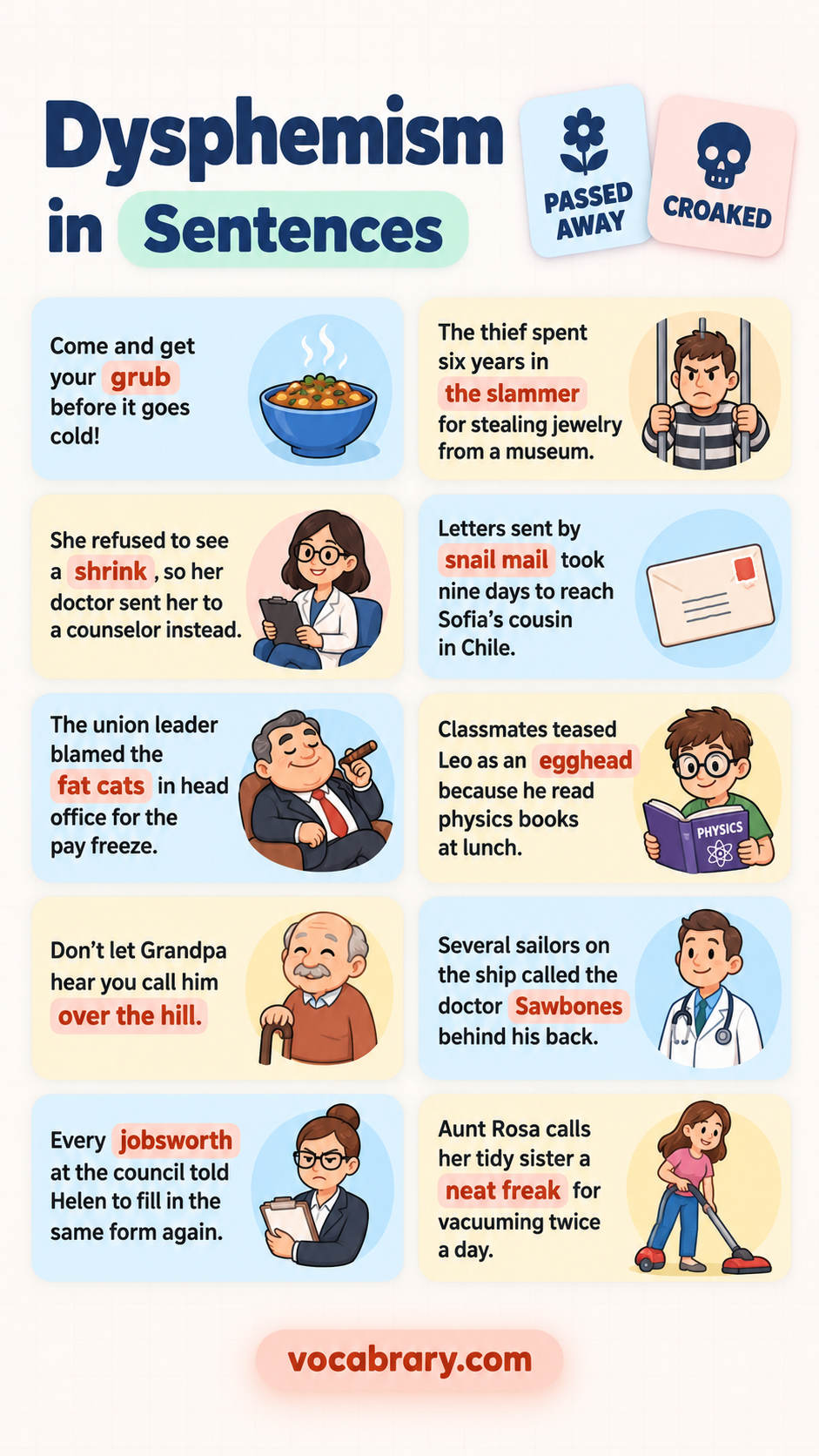
Common Dysphemism Examples in Sentences
Bean counters, ambulance chasers, and cancer sticks are the textbook dysphemism examples, where an everyday job or product gets a name chosen to belittle it.
- My uncle calls every accountant at his firm a bean counter, even though he relies on them at tax time.
- Nobody in the family trusts the ambulance chaser who advertises on every bus bench in town.
- After twenty years in the same office, Marcus describes himself as a pencil pusher with a pension.
- Grandma still calls cigarettes cancer sticks and opens every window when a guest lights one.
- Is that rust bucket in the driveway really going to make it to the coast?
- Priya’s brother calls the local newspaper a rag and reads it every morning anyway.
- Old Mr. Hendricks finally kicked the bucket at ninety-eight, still arguing about the weather.
- Come and get your grub before it goes cold!
- The thief spent six years in the slammer for stealing jewelry from a museum.
- Dad calls the television the idiot box and hides the remote on school nights.
- She refused to see a shrink, so her doctor sent her to a counselor instead.
- My neighbor called his doctor a quack after a second opinion found nothing wrong with his knee.
- Letters sent by snail mail took nine days to reach Sofia’s cousin in Chile.
- We ate breakfast at a greasy spoon near the station, and the eggs were perfect.
- The union leader blamed the fat cats in head office for the pay freeze.
- Tom’s new apartment is a dump with a leaking roof and no heating.
- According to my aunt, the man who fixed her car is a grease monkey who charged her double.
- Classmates teased Leo as an egghead because he read physics books at lunch.
- Kevin drives an old jalopy that rattles every time it goes over forty miles an hour.
- The senator dismissed the reporter as a hack who writes whatever his editor wants.
- Don’t let Grandpa hear you call him over the hill.
- Once again, my sister’s bedroom is a pigsty, with clothes on every chair.
- Several sailors on the ship called the doctor Sawbones behind his back.
- Our family moved out to the boondocks, forty minutes from the nearest supermarket.
- Every jobsworth at the council told Helen to fill in the same form again.
Dysphemism Examples in Everyday Life
A messy bedroom called a pigsty, a lazy cousin called a couch potato, and a talkative neighbor called a windbag show dysphemism at home, where a harsh label replaces a polite complaint.
- Mom called my room a pigsty and cancelled my Saturday plans until it was tidy.
- Ever since he lost his job, my cousin has been a couch potato who watches cartoons all afternoon.
- Our neighbor is a windbag who talks for an hour about his lawnmower every time we meet him at the mailbox.
- Aunt Rosa calls her tidy sister a neat freak for vacuuming twice a day.
- Nobody wanted to invite Jake again after he played the killjoy at the beach party.
- "Don’t be such a wet blanket," Mia told her brother when he refused to dance.
- The busybody next door knows every car that parks on our street.
- Why does Grandpa call every advertising flyer junk mail before he has even opened it?
- My little brother is a tattletale who reports every cookie I eat.
- Sam calls his roommate a slob because the dishes never leave the sink.
- A nosy parker from the flat upstairs asked Olivia how much her rent was.
- Her boss is a control freak who rewrites every email before it goes out.
- Tired of the noise, Luis called his neighbor’s tiny dog that yapping rat.
- Hannah’s grandmother calls the local teenagers hooligans for skateboarding near the church.
- Walking home, Priyanka passed the dive on the corner where her father once played darts.
- "Turn off that racket," Dad shouted when my band started rehearsing in the garage.
Dysphemism Examples for Jobs and Occupations
Accountants, lawyers, doctors, and journalists all have dysphemism nicknames, such as bean counter, ambulance chaser, quack, and hack, which reduce a trained professional to a sneering label.
- The finance team was nicknamed the bean counters after they cut the holiday party budget.
- A lawyer who phones accident victims in hospital earns the name ambulance chaser.
- Martin left his job as a pencil pusher at the insurance company to open a surf shop.
- Everyone at the garage called the new apprentice a grease monkey within a week.
- Aisha’s grandfather refuses to visit that quack on Main Street again.
- In old sea stories, the ship’s surgeon was called the sawbones.
- Did the shrink at your school ever ask about your dreams?
- Critics dismissed the columnist as a hack after she copied a rival’s headline.
- A struggling novelist jokingly calls himself a scribbler on his website.
- My cousin works as a desk jockey at a bank and dreams of becoming a pilot.
- Ben calls the parking officer a jobsworth for ticketing his car at 9:01.
- Ms. Grant laughed off being called a mop pusher by the new students.
- Software developers at the startup call themselves code monkeys during crunch week.
- Some teenagers dismiss fast-food work as burger flipping, yet Carla paid for college that way.
- Frustrated by the homework rules, one parent called the teachers glorified babysitters.
- The security guard hated being called a rent-a-cop by shoppers, especially after he caught a thief in the food court last month.
- The lawyer everyone fears in court is known as the shark.
- Soldiers in the British army call themselves squaddies without a hint of shame.
- Harold, a retired magistrate, still laughs about being called the beak by young offenders.
- The scientists in the lab were labeled eggheads by the local newspaper.
- Olivia’s father calls every consultant who visits his factory a suit.
- Not one of the paper pushers at city hall answered my letter.
Dysphemism Examples at School
Teacher’s pets, smarty-pants, and cafeteria slop are school dysphemisms, where pupils mock classmates, homework, and lunch with names harsher than the polite ones.
- Nobody sat with Eli after the class started calling him the teacher’s pet.
- "All right, smarty-pants, then you solve the last equation," said Mr. Ortiz.
- The cafeteria served gray slop that the students swore was once chicken.
- Mina’s older brother calls the school building the prison, because the windows are barred and the gates lock at nine.
- Every Friday, the cooks served mystery meat in brown gravy.
- Why do the seventh graders call the chemistry teacher the dragon?
- Lena was called a know-it-all after she corrected the substitute teacher twice.
- In British schools, a pupil who studies all weekend is teased as a swot.
- The seniors refer to the new ninth graders as the babies.
- A goody two-shoes like Raj never forgets his homework.
- On the bus, the older kids called the science club the nerd herd.
- Theo calls his algebra textbook the doorstop because it is so thick and so dull.
- Most students never call the principal’s office anything but the dungeon.
- Omar, a proud bookworm, finished three novels during spring break.
Dysphemism Examples for Food and Eating
Grub, rabbit food, and rotgut are food dysphemisms, and each one makes a meal or a drink sound cheap, bland, or barely edible.
- Grab your plate, because the grub is ready!
- Uncle Dave refuses to eat salad and calls it rabbit food.
- At six o’clock sharp, the soldiers lined up for chow.
- We stopped at a greasy spoon off the highway for pancakes and coffee.
- My steak was so tough that Dad called it shoe leather.
- The burger came out burnt, and Nadia called it a hockey puck.
- Grandpa calls the cheap wine at family parties rotgut, yet he still pours himself a second glass when he thinks nobody is watching.
- After the hike, the boys pigged out on pizza and ice cream.
- Her brother dismissed the hospital dinner as pig swill.
- At the camp, breakfast was a bowl of lukewarm gruel that nobody finished.
- Isn’t that frozen pizza just cardboard with cheese?
- My roommate scarfed down three sandwiches before class.
- The food critic called the restaurant’s soup dishwater in her review.
- Wes calls energy drinks liquid junk and never buys them.
Dysphemism Examples for Death and Illness
Croaked, bit the dust, and pushing up daisies are mild death dysphemisms, and speakers choose them to joke about dying where a gentler speaker would say "passed away."
- Two days after the fair, the goldfish croaked.
- Our old lawnmower finally bit the dust last summer.
- The pirate captain in the story is long gone and pushing up daisies.
- "When I kick the bucket, the piano goes to you," Grandpa joked.
- In the cowboy film, the sheriff warned that the outlaw would soon be six feet under.
- In old war slang, a pilot who crashed was said to have bought the farm.
- Great-uncle Ray popped his clogs at ninety, according to my British cousins.
- My grandmother insists she is not ready to snuff it yet.
- The detective in the mystery novel called the body in the library "the stiff."
- Joe called the cemetery the boneyard and walked quickly past it at night.
- According to the cartoon villain, the hero will be worm food by morning.
- Half the office is off with the lurgy this week.
- Why is the nursery called a germ factory by every parent I know?
- Dad refused to go back to the surgeon he called the butcher.
- Is the doctor who prescribes pills for every complaint really a pill pusher?
Dysphemism Examples for Places and Objects
Dumps, jalopies, and snail mail are dysphemisms for places, vehicles, and gadgets, and speakers use each one to mock something people live in, drive, or use every day.
Places and Buildings
Hovel, fleapit, and the sticks are place dysphemisms that make a barracks, a cinema, or a village sound dirty, cramped, or far from anywhere.
- The motel on Route 9 was such a dump that we slept in the car.
- Sergeant Price called the cramped desert barracks the hovel in every letter home.
- We watched the film in a fleapit with sticky floors and broken seats.
- My parents left London for the sticks, where the nearest shop is five miles away.
- Nobody expected Lucy to rent a shoebox apartment with one window.
- Our neighbors called the huge new house on the hill a McMansion.
- After the robbery, the gang spent ten years in the big house.
- Is that dive on Fifth Street really the best bar in town?
- Tourists love the city, but Kofi calls it a concrete jungle.
- The student flat was a rabbit hutch with bunk beds in the kitchen.
- Gran calls the new shopping mall that monstrosity.
- Few families wanted to live in the boonies, so the village school had just nine pupils.
Cars and Machines
Owners and passengers call old cars a jalopy, a clunker, or a death trap, choosing the harshest name to complain about a vehicle’s age, noise, or danger.
- Daniel bought a rust bucket for five hundred dollars and spent three thousand fixing it.
- My first car was a clunker with no radio and one working headlight.
- That old bus is a death trap, and the city should have scrapped it years ago.
- In Britain, a cheap old car is known as a banger.
- Her brother’s pickup is a gas guzzler that empties the tank in two days.
- They drove the old jalopy across three states without breaking down once.
- Grandpa’s bicycle is a boneshaker with no gears and a hard seat.
- We learned the hard way that the used car was a lemon.
- Don’t park that heap in front of my house!
- Ahmed’s family car is a beater that he drives only to the train station.
- Our ancient office printer is a dinosaur that jams on every third sheet and takes five minutes to warm up each morning.
Technology and Media
Snail mail, the gogglebox, and a brick of a phone are technology dysphemisms, and people use them to call older or cheaper devices slow, dumb, or clumsy.
- Grandma still sends every birthday card, holiday greeting, and thank-you note to her grandchildren by snail mail.
- Mom calls Dad’s gaming console the time-waster and switches it off at dinner.
- British viewers jokingly call the television the gogglebox.
- Dad’s first cell phone was a brick that weighed as much as a dictionary.
- My laptop is so slow that my sister calls it the steam engine.
- Her inbox is full of spam from shoe stores she visited once.
- Did you film that concert on a potato?
- Ana calls her smartwatch a glorified alarm clock.
- Online news sites full of clickbait annoy my history teacher.
- The old computer lab was full of dinosaurs from the 1990s.
- Plenty of viewers call reality shows trash TV.
- Maya’s math teacher calls calculators brain crutches.
Dysphemism Examples for Money and Spending
Cheapskates, loan sharks, and rip-offs are money dysphemisms, and they make a careful saver, a lender, or a price sound greedy or unfair.
- My uncle is such a cheapskate that he reuses birthday wrapping paper.
- Ten dollars for a coffee is highway robbery.
- Never borrow from a loan shark, however desperate you feel.
- The company pays its interns peanuts.
- For Noah, a two-hundred-dollar raise was chump change.
- Their old farmhouse turned into a money pit after the roof and the pipes failed.
- The tourist shop sold us a rip-off watch that stopped the next day.
- Dana’s landlord is a slumlord who never fixes the heating.
- Is Rob really a tightwad, or is he just saving for a house?
- Ellie’s friends call her a shopaholic after her third shopping trip this week.
- Chris got fleeced by a mechanic who charged him for new brakes he never fitted.
- A penny-pincher like my aunt splits every restaurant bill to the cent.
Dysphemistic Terms to Describe People
Speakers call someone a birdbrain, a numbskull, or an old geezer to mock their brains or their age, and these are the most personal dysphemisms in daily speech.
Dysphemisms for a Lack of Intelligence
Airhead, numbskull, and "not the sharpest knife in the drawer" are dysphemisms for a slow thinker, and each one makes a small mistake sound like a lack of brains.
- Only a birdbrain would leave the front door open in winter.
- Sophie felt like an airhead after she forgot her own phone number.
- "You numbskull, the milk goes in the fridge," Tom’s sister said.
- The coach called the players boneheads for missing training.
- Marco is kind, but he is not the sharpest knife in the drawer.
- According to my brother, anyone who believes that rumor is a few sandwiches short of a picnic.
- When the teacher asked Leo a question, the lights were on but nobody was home.
- Don’t call your classmate a dimwit just because he misread the question.
- The villain in the cartoon calls his helpers pea-brains whenever a plan fails.
- In old schools, a slow pupil was forced to wear a dunce cap in the corner.
Dysphemisms for Old Age
Old geezer, fossil, and over the hill are age dysphemisms, and speakers use them to turn a grandparent or a senior colleague into a joke about being old-fashioned or worn out.
- The old geezer at the end of the bar tells the same fishing story every night.
- Grandpa calls himself an old fossil when he forgets his passwords.
- At forty, my mother decided she was over the hill and bought a sports car.
- A crabby old codger shouted at the kids to get off his lawn.
- Fans were furious when a critic called the band’s founding members dinosaurs.
- Children at the pool called the sixty-year-old lifeguard Grandpa.
- My nephew thinks anyone over thirty is ancient.
- In British slang, a very old person is jokingly called a coffin dodger.
- Don’t call your grandmother an old bat, even as a joke.
- Is sixty really past it for a marathon runner?
Dysphemism Examples in Politics and Media
Death tax, nanny state, and fat cats show political dysphemism, where one side picks the harshest name for a policy or group before the debate even begins.
- Opponents of the estate tax campaign against it as the death tax.
- The opposition accused the government of building a nanny state that bans fizzy drinks.
- Protesters marched outside the bank, chanting about fat cats and bonuses.
- One newspaper described the civil service as the blob.
- Voters complained that the committee was a talking shop that never passed a law.
- Every minister has a spin doctor who rewrites bad news before the press sees it, so voters hear only the cheerful version.
- The senator called the rival paper a rag that prints gossip as news.
- Her rival dismissed the new climate law as a power grab.
- Are the analysts on the evening news just talking heads?
- Several reporters called the minister’s spokesman a mouthpiece for the party.
- Critics of the president described the parliament as a rubber stamp for his decisions.
- Taxpayers are tired of career politicians riding the gravy train.
- The mayor dismissed the complaints as tabloid trash.
- Opponents labeled the fuel tax increase a cash grab.
- Who wants to read the gutter press at breakfast?
Humorous and Affectionate Dysphemism Examples
Friends and family use "you old goat," "you big lug," and "the old man" as warm insults, where the speaker means affection instead of spite.
- "Happy birthday, you old goat," Maria wrote on her father’s card.
- My best friend hugged me and said, "Welcome back, you big lug."
- On Sundays, Kevin calls the old man to check on the garden.
- Grandma calls the twins little monsters, then gives them extra cake.
- "Get over here, you knucklehead," Coach laughed as the team celebrated.
- British friends greet each other with "Hello, you muppet" after a silly mistake.
- The puppy chewed my slipper, the little rascal.
- After twenty years of marriage, Hugh still calls his wife trouble.
- Olivia’s brother is a brat, yet she drives him to football every weekend.
- Nobody minds when Priya calls her friends a bunch of goofballs.
- Aren’t you coming to dinner, stinker?
- Jess calls her grandfather the old fossil, and he calls her the baby.
- In the group chat, the friends call each other losers after every lost quiz night.
- Mom calls the family dog the furry freeloader because he never catches mice.
Types of Dysphemism With Examples
Animal names like snake and weasel, part-for-whole labels like the suits and four-eyes, and cold uses of a first name such as Richard are the three main forms of dysphemism.
Dysphemistic Epithets
Snake, weasel, and chicken are dysphemistic epithets, where the speaker compares a person to an animal to call them sneaky, dishonest, or cowardly.
- My business partner turned out to be a snake who emptied our account.
- That weasel of a salesman lied about the warranty.
- Don’t be a chicken; the roller coaster is perfectly safe.
- Somebody in the office is a rat who told the boss about the party.
- Liam ate the whole cake like a pig.
- The debt collectors were vultures who phoned the family every day.
- Are the teenagers who copy every trend just sheep?
- Carla’s stubborn husband is a mule about asking for directions.
- The old bear in apartment 3B growls at anyone who knocks.
- A toad like him never apologizes.
Synecdoche Dysphemism
Suits, four-eyes, and bigmouth are synecdoche dysphemisms, where a speaker calls a person by one garment or feature, such as a manager’s suit or a talker’s mouth.
- The suits from head office closed our branch without visiting it.
- Bullies called Nadia four-eyes until she got contact lenses.
- Tell that bigmouth nothing unless you want the whole town to know.
- After the third dropped ball, the coach shouted, "Nice catch, butterfingers."
- My chatty aunt is a motormouth who talks through every film.
- We just need a warm body at the reception desk until Monday.
- "Hey, glasses, you dropped your pen," a boy called across the playground.
- Several officers arrived, and the protesters shouted at the uniforms.
Name Dysphemism
Calling a father Richard, a grandson William, or a relative "that man" is name dysphemism, where the speaker picks a name to show anger or distance.
- Instead of "Dad," the angry teenager called his father Richard all through dinner.
- When his mother yells Jonathan Michael Carter, Jon knows he is in trouble.
- Billy’s grandmother calls him William whenever he tracks mud into the kitchen.
- "I will not have that man in my house," Aunt Vera said about her brother-in-law.
- Emma stopped calling her stepmother Karen and started calling her Mrs. Holt.
- Why did Coach greet me with a cold "Morning, Hughes" instead of my first name?
- After the argument, Sara called her former best friend that girl and never used her name again.
- Her grandfather, furious about the dent, called her young lady for the rest of the week.
Dysphemism Examples in Literature and Film
Capulet, Macbeth, Uncle Vernon, and Princess Leia all call someone by a harsh label instead of a name, and readers learn about the speaker’s anger or rivalry from that one insult.
Dysphemism in Shakespeare
Capulet in Romeo and Juliet and Beatrice in Much Ado About Nothing use insults in place of names, and each insult shows Capulet’s rage or Beatrice’s rivalry with Benedick.
- Capulet, furious that Juliet refuses to marry Paris, calls his daughter a "tallow-face" and a "disobedient wretch" in Act 3, Scene 5 of Romeo and Juliet.
- Prince Hal, in Henry IV, Part 1, calls his large companion Falstaff "that roasted Manningtree ox."
- In Act 5 of Macbeth, Macbeth calls a frightened servant a "cream-faced loon."
- The same servant is mocked as a "lily-livered boy" and "whey-face" for bringing bad news.
- Beatrice, in Much Ado About Nothing, mocks the soldier Benedick as "a very valiant trencherman," a hero at dinner rather than in battle.
- Benedick answers her with the nickname "Lady Disdain."
- At the masked dance, Beatrice calls Benedick "the prince’s jester" to his face.
- In King Lear, the loyal Kent insults the steward Oswald as "an eater of broken meats," a servant fed on scraps.
- Katherine, in The Taming of the Shrew, tells Petruchio he is a "movable," no better than a stool.
- Falstaff mocks the thin Prince Hal as a "starveling" in the same play.
Dysphemism in Books and Movies
Uncle Vernon’s "crackpot old fool," Leia’s "walking carpet," and Woody’s "child’s plaything" are dysphemisms from modern stories, each one a sneering label for a wizard, a Wookiee, or a toy astronaut.
- Uncle Vernon, in Harry Potter and the Philosopher’s Stone, calls Dumbledore a "crackpot old fool."
- Aunt Petunia, in the same novel, dismisses her magical sister Lily as a freak.
- Princess Leia calls Chewbacca a "walking carpet" in Star Wars (1977).
- When Luke Skywalker first sees the Millennium Falcon, he calls it "a piece of junk."
- In The Empire Strikes Back (1980), Leia calls Han Solo a "scruffy-looking nerf herder."
- Han Solo teases Chewbacca in the same film with "Laugh it up, fuzzball."
- Later in that film, Han greets his old friend Lando Calrissian as a "no-good swindler" at Cloud City, then hugs him.
- Newspaper editor J. Jonah Jameson brands the hero a menace in Spider-Man (2002).
- Woody, in Toy Story (1995), tells Buzz Lightyear he is only "a child’s plaything."
British and American Dysphemism Examples
Jobsworth, banger, and gogglebox are British favorites, while rent-a-cop, McMansion, and the boonies are American, and speakers on both sides of the Atlantic use them to mock officials, cars, homes, and towns.
British Dysphemisms
Britons call a rule-obsessed official a jobsworth, a magistrate the beak, and a cheap café a greasy spoon, poking fun at authority and daily routine.
- The jobsworth at the ticket gate refused to let Nina through with a crumpled ticket.
- Teenagers in old London slang called the local magistrate the beak.
- On rainy Saturdays, Dev and his dad eat bacon rolls at the greasy spoon by the market.
- The minister’s critics complained about pen-pushers in Whitehall.
- My dad drove a rattling old banger to work for fifteen years.
- British newspapers love to complain about the nanny state.
- Half of Year 9 was off school with the lurgy.
- Isn’t that squaddie your cousin from Portsmouth?
- "You absolute muppet," Lee laughed when his friend locked the keys in the car.
- Great-aunt Maud popped her clogs at a hundred and two.
- Tom’s mum calls the television the gogglebox.
- In 1984, Prince Charles described a planned extension to the National Gallery as a "monstrous carbuncle."
American Dysphemisms
Americans call a security guard a rent-a-cop, a big suburban house a McMansion, and a small town the boonies to mock the job, the house, or the town.
- The rent-a-cop at the mall chased the skateboarders out of the parking lot.
- Every McMansion in the new development has the same beige walls.
- Growing up out in the boonies, Carter rode a bus for an hour to school.
- A local ambulance chaser put his face on every billboard along the interstate.
- Her father called his job at the county office pushing paper.
- The movie gangster spent a decade in the pen and came out to find his old neighborhood full of coffee shops.
- Old detective novels call a street patrol officer a flatfoot.
- Jenna left the cubicle farm downtown to work from home.
- Candidates from both parties promise to drain the swamp in Washington.
- Why do American teenagers dismiss their parents’ advice as the talk of boomers?
- Sports fans called the new owner a carpetbagger after he moved the team to another state.
Related
FAQs
Euphemism and dysphemism work in opposite directions, because a euphemism softens an unpleasant idea while a dysphemism makes a neutral idea sound harsher. "Passed away" is a euphemism for died, and "croaked" is a dysphemism for the same event. More euphemism examples show the softening side in full sentences.
Common examples of dysphemism are "bean counter" for an accountant, "shrink" for a psychiatrist, "quack" for a doctor, and "ambulance chaser" for a lawyer. Everyday speech adds "grub" for food, "rag" for a newspaper, "snail mail" for letters, and "cancer stick" for a cigarette.
The opposite of euphemism is dysphemism, the choice of a harsher or more offensive word in place of a polite one. The linguists Keith Allan and Kate Burridge use "orthophemism" for the neutral middle term, so "prison" is the neutral word, "correctional facility" the euphemism, and "the slammer" the dysphemism.
People use dysphemisms to express anger or contempt, to mock a person or group, to sound tough, and to joke with friends. A frustrated patient calls a doctor a "quack," while two old friends trade "you old goat" as a sign of closeness. Many dysphemisms are slang, so they overlap with colloquialism examples such as "grub" and "chow."
The main types of dysphemism are dysphemistic epithets, synecdoche dysphemism, and name dysphemism. Epithets call people by animal names ("snake," "weasel"), and synecdoche names a person after one feature ("four-eyes," "the suits"). Name dysphemism uses a name coldly, as when a teenager calls his father by his first name. Writers also describe slang, humorous, and political dysphemism as further types.
Literary dysphemism is the use of harsh substitute names by characters in fiction, drama, and poetry to reveal anger, class, or conflict. Shakespeare uses it heavily: Capulet calls Juliet a "tallow-face," and Macbeth calls his servant a "cream-faced loon." Writers use it to expose a character’s temper or cruelty without a narrator explaining it.
A close synonym for dysphemism is "cacophemism," a rarer term for a deliberately harsh or offensive expression. "Malphemism" is also recorded, and in everyday English people call dysphemisms insults, put-downs, or derogatory terms.
No, dysphemism is not acceptable in academic writing as your own word choice, because academic prose calls for neutral terms such as "lawyer" rather than "ambulance chaser." Quoting and analyzing a dysphemism is fine, for example when an essay examines Capulet’s insults or a political label like "death tax."
No, dysphemism is not always offensive, because friends and family use harsh words playfully to show closeness. "You old goat" on a birthday card or "you big lug" in a hug signals affection, while the same words from a stranger would sting. Whether a dysphemism insults or amuses depends on the relationship between speaker and listener.
The word dysphemism comes from the Greek "dys," meaning bad or mis-, and "pheme," meaning speech or reputation. It entered English in the late nineteenth century as a counterpart to euphemism, which starts with the Greek "eu," meaning good.

Leave a Comment