
A double entendre is a figure of speech in which a word or phrase has two readings at once, as when a bakery sign promises "We knead you." Good double entendre examples rely on puns, sound-alike words, and idioms that give both meanings in a single sentence.
What Is a Double Entendre?
A double entendre is a word or phrase that a listener understands in two different ways, with both readings making sense in the same sentence. A pun is a single play on sound or sense made for a laugh, while a double entendre offers two complete readings of the same line, one on the surface and one hidden.
At the grand opening, the bank manager told every new customer, "We’re interested in you."
Common Double Entendre Examples in Sentences
A tailor who will "fit you in," a baker who wants more "dough," and a scarecrow "outstanding in his field" are classic double entendre examples, where a job gives a phrase two senses.
- Outside the bakery, a chalkboard promised every passerby, "We knead you."
- "I’ll fit you in on Tuesday," the tailor told Omar, who needed an appointment and a new suit.
- Our dentist ends every checkup by telling patients to brace themselves for the bill.
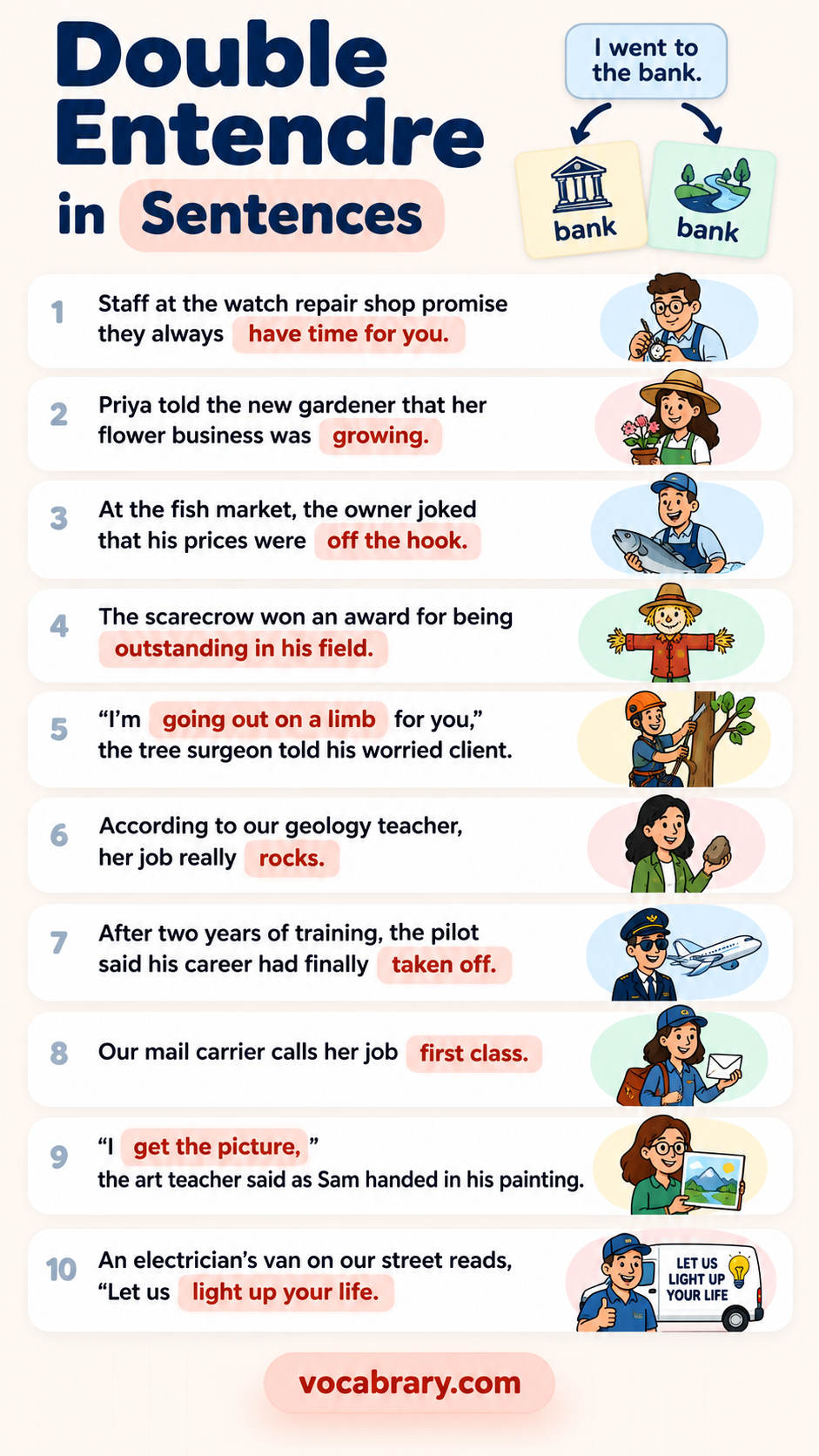
- Staff at the watch repair shop promise they always have time for you.
- Priya told the new gardener that her flower business was growing.
- At the fish market, the owner joked that his prices were off the hook.
- Nobody in the house knew whether the electrician meant the danger or the mess when he called the old wiring shocking.
- Did the optician mean an eye exam or a friendly goodbye when she said, "I’ll see you next week"?
- The scarecrow won an award for being outstanding in his field.
- "I’m going out on a limb for you," the tree surgeon told his worried client.
- According to our geology teacher, her job really rocks.
- After two years of training, the pilot said his career had finally taken off.
- A baker in our town says he got into bread because he wanted to make more dough.
- Our mail carrier calls her job first class.
- Fresh coffee beans, according to the café’s chalkboard, are grounds for celebration.
- Ever since the new telescope arrived, the astronomer says her career is looking up.
- Having lost every game, the tennis player said the match was still full of love.
- "I get the picture," the art teacher said as Sam handed in his painting.
- Hikers were warned by their mountain leader that the price of the trip was steep.
- In the deep end of the pool, the new swim coach admitted she was in over her head.
- An electrician’s van on our street reads, "Let us light up your life."
- Our music teacher says her best students are always sharp.
- Without a second thought, the florist told reporters that her business was blooming.
- Lena, who repairs elevators, says her job has plenty of ups and downs.
Double Entendre Examples in Everyday Conversation
A finished milkshake called "the last straw," a snapped chocolate bar, and a sushi lover "on a roll" show double entendre in daily chat, where an idiom matches a literal action.
- "That joke went over my head," Ali said, just as a paper plane flew past his ear.
- At breakfast, Dad said the burnt toast was a bit crummy.
- "I’m on a roll," Sofia announced, reaching for her third sushi roll.
- "Let’s wrap this up," Grandma said as she folded paper around the last birthday present.
- The cook who dropped a tray of eggs said she had cracked under pressure.
- Stuck in a traffic jam for an hour, Omar sighed, "This trip is going nowhere."
- "That’s the last straw," Nina said, sucking up the final drop of her milkshake.
- "I need a break," Carlos said, snapping his chocolate bar in two.
- After the soccer pass slipped through his hands in the park, Sam admitted he had dropped the ball.
- "I’ll sleep on it," Ana told the salesman as she lay down on a mattress in the store.
- When the basketball team asked for twelve pizzas, the waiter said, "That’s a tall order."
- "Well, that went down the drain," Rosa groaned as her ring slipped into the sink.
- Sniffing around the old garage, Grandpa muttered, "I smell a rat."
- Mom turned on the oven and said the dinner party was heating up.
- "You crack me up," Zoe told her brother while he peeled a bowl of boiled eggs.
- Why did Leo say he was feeling crushed after the grape-stomping festival?
- Wearing a paper crown at his birthday lunch, Uncle Raj declared that he was king of the day.
- Pouring cereal into a bowl, my little sister said breakfast was a snap.
- Nobody laughed when Kim, covered in flour, said her baking was on the rise.
- Handing over a pair of warm mittens, Jake said he was glad to lend a hand.
Double Entendre Examples at Work and in the Office
Accountants whose work "counts," a roller coaster designer kept "in the loop," and a pottery boss who "fired" everything are workplace double entendres, pairing office slang with literal tools.
- Our accountant likes to remind everyone that her work really counts.
- "Keep me in the loop," the roller coaster designer told her engineers.
- At the pottery studio, the manager said she fired everything the new staff made on Monday.
- "We’ll cut corners here," said the carpenter as he sanded the edges of the new desk.
- Profits at the airline are sky-high, the boss told shareholders.
- "This deal is in the bag," the grocery manager said as she packed the last order.
- Nobody at the construction firm argued when the manager called the new project groundbreaking.
- "Let’s circle back to this," said the manager of the racetrack.
- The architect sharpened her pencils and said the team had to go back to the drawing board.
- "Our new courier really delivers," the office manager told the team.
- Sales at the paper company look excellent on paper.
- "We need to raise the bar," said the pole-vault coach at the staff meeting.
- Everyone at the coffee supplier knew the big merger had been brewing for weeks.
- During the office softball game, the boss asked every department to pitch in.
- "I’ll run the numbers tonight," said the marathon organizer as she counted the race bibs.
- After the window cleaner slipped on a wet ladder, he told his boss the job was a real pane.
- Why did the bank teller say her job never loses interest?
- "Let’s touch base after lunch," the baseball club’s office manager wrote in her email.
Double Entendre Examples From School and Teachers
History classes that "made history," a chemistry answer with "no solution," and a poem praised as "well-versed" are school double entendres, where a teacher’s comment matches the lesson it comes from.
- On the last day of term, the history teacher told us we had made history.
- Our English teacher handed Max a long sentence after he talked during the test.
- The geography teacher said the new students were all over the map.
- "I’m counting on you," the math teacher told the class before the big quiz.
- Model rockets filled the lab, and the science teacher called every project out of this world.
- Looking at the triangles, the geometry teacher said the homework was all right.
- According to the chemistry teacher, Omar’s answer had no solution.
- Nobody expected the physics lesson on falling objects to have so much gravity.
- The principal said every student in the gifted program was in a class of their own.
- "Friday’s lunch is food for thought," the cafeteria cook announced.
- Staring at the empty sketchbook, Hana told her art teacher she was drawing a blank.
- Zoe’s English teacher called her sonnet well-versed.
- Students agreed that the teacher who spent an hour on soil and rocks was very down to earth.
- A new calculator, the math teacher told the class, is always a plus.
- During the spelling bee, the champion joked that she was under a spell.
- "Don’t lose your marbles," the teacher warned as the class counted glass marbles for a probability lesson.
- Did the coach mean the stopwatch or the season when he said the relay team had run out of time?
- In the band room, the drummer bragged that he kept time better than anyone else.
Double Entendre Examples on Signs and Notices
Shop signs such as "Fine for parking here," "Ears pierced while you wait," and a travel agency’s "Go away" are famous double entendres, where a short notice gives a sensible order and a silly one.
- "Fine for parking here," read the sign beside the farm gate.
- Near the primary school, a yellow road sign warns drivers, "Slow Children at Play."
- A famous London Underground notice says, "Dogs must be carried on the escalator."
- "Ears pierced while you wait," promised the sign in the jewelry shop window.
- At the low bridge by the pond, a single word was painted on the beam: "Duck."
- Our town library has a banner over its door that says, "Check us out."
- "We’ve got you covered," reads the sign at the paint store.
- Painted on the roofer’s van is the promise, "We’re always on top of the job."
- In the travel agency window, a poster simply said, "Go away."
- "Get the scoop," says the chalkboard outside the ice cream parlor.
- Every laundry customer sees the sign, "We’ll iron out your problems."
- Painted on a moving company truck is the slogan, "We’ll move you."
- If you don’t see what you’re looking for, the sign at the optician’s shop says, you’ve come to the right place.
- Outside the bike shop, a sign promises to get riders "back on track."
- "Tired of your old wheels?" asks a banner on the tire shop wall.
- Taped to the butcher’s window is a note that reads, "Meet your new favorite steak."
Accidental Double Entendre Examples in Newspaper Headlines
"Squad Helps Dog Bite Victim," "Kids Make Nutritious Snacks," and "Eye Drops Off Shelf" are much-quoted newspaper headlines, where a missing word or a noun read as a verb gives a second, absurd meaning.
- Readers laughed at the headline "Squad Helps Dog Bite Victim," which sounds as if the rescue team helped the dog.
- "Kids Make Nutritious Snacks" was meant as a cooking story, not a warning about hungry parents.
- Did the headline "Eye Drops Off Shelf" describe a product recall or a runaway eyeball?
- A pet store story ran under "Man Eating Piranha Mistakenly Sold as Pet Fish."
- Golf fans cheered when a paper announced, "Grandmother of Eight Makes Hole in One."
- The headline "Milk Drinkers Are Turning to Powder" referred to powdered milk, not a strange illness.
- "Teacher Strikes Idle Kids" reported a staff walkout, yet many readers pictured a teacher hitting students.
- Shoppers smiled at "Two Sisters Reunited After 18 Years at Checkout Counter," as if the sisters had queued for eighteen years.
- Nobody doubted the church appointment in "Blind Bishop Appointed to See," but the wordplay made it famous.
- Sports editors still quote "Complaints About NBA Referees Growing Ugly."
- A lawsuit story appeared as "Hospitals Are Sued by 7 Foot Doctors."
- Under the headline "Farmer Bill Dies in House," a law had failed, though some readers pictured a man named Bill.
- "Stolen Painting Found by Tree" left readers wondering whether the tree had solved the case.
- Radio listeners puzzled over "Dealers Will Hear Car Talk at Noon."
- One science desk printed "New Study of Obesity Looks for Larger Test Group."
- A British paper once ran "British Left Waffles on Falklands," and readers pictured breakfast instead of politics.
Double Entendre Examples in Advertising Slogans
Morton Salt’s "When it rains, it pours," Kit Kat’s "Have a break," and Allstate’s "good hands" are brand slogans where a product fact and a common saying share the same words.
- Since 1914, Morton Salt has promised that "When it rains, it pours," because its salt still flows in damp weather.
- Kit Kat tells snackers to "Have a break," which means both resting and snapping the wafer bar.
- Allstate’s line "You’re in good hands" matches the cupped hands in the insurer’s logo.
- The energy drink Red Bull claims it "gives you wings," though nobody has flown after a drink.
- Maybelline’s slogan "Maybe she’s born with it" hides the brand name inside the first word.
- Painted on the side of a hardware store van is the slogan, "We nail every job."
- Volkswagen’s 1959 Beetle advert "Think Small" praised a tiny car and modest spending at once.
- In 1984, Wendy’s asked "Where’s the beef?" about rival burgers, and the question became slang for missing substance.
- Timex watches "take a licking and keep on ticking," which describes a working watch and a tough survivor.
- Taco Bell’s "Think outside the bun" turns an office cliché into a food joke.
- John Deere tractor owners know the slogan "Nothing runs like a Deere," which sounds like the fast animal.
- Esso gas stations told drivers to "Put a tiger in your tank," promising power rather than a wild animal.
- AT&T’s 1979 slogan "Reach out and touch someone" meant a phone call as well as a hug.
- A mattress shop down the road promises shoppers, "We’ll never let you down."
Types of Double Entendre With Examples
Homophones like "knight shift," multiple-meaning words like "racket," and idioms taken literally like "spill the beans" are the three main sources of double entendre, and each type creates a second reading in a different way.
Homophone Double Entendres
A "knight shift," a nurse asking for "patience," and a bakery called "The Flour Shop" build double entendres from sound-alike words, where the story suggests the second spelling.
- The bicycle refused to stay upright on its own because it was two tired.
- Sir Owen told the castle guards that he always takes the knight shift.
- "Our new patient needs plenty of patience," the nurse told the doctor.
- When a florist opened a bakery, she named it The Flour Shop.
- "Sew what?" the tailor replied when asked why he spent all day mending.
- At the zoo on Saturday, the lion show was the mane event.
- After a wet summer, the king complained about his long reign.
- Our carpenter spends every day cutting planks, so he calls himself board stiff.
- At the salon, a rabbit asked the barber for a hare cut.
- Why do church choirs love shoe repair shops that promise to save soles?
- Curled up by the fire after dinner, the old cat told her kittens a bedtime story with a very long tail.
- Working every weekend, the ice cream truck driver called his job a sundae job.
Multiple-Meaning Word Double Entendres
A tennis company calling business "a racket," a pianist choosing "keys" at the locksmith, and a manicurist opening a "file" show one word used in two dictionary senses in a single sentence.
- Selling tennis gear, the shop owner admitted his business was a real racket.
- At the baseball game, a bat flew over the dugout, and half the crowd ducked.
- According to the kitchen knife seller, her prices are cutting-edge.
- Every Saturday, our banker friend goes fishing on the river bank.
- Prices at the flower shop rose again this spring.
- Nobody wanted to swim with the electrician, who kept talking about the strong current.
- The pianist told the locksmith her favorite keys were black and white.
- Every Friday the chess champion writes a check for her club fees.
- Our grandfather clock is always wound up by Sunday night, just like Grandpa before a big football match on television.
- A manicurist opened a file on every new client.
- Tired of painting in her garage, the artist said she was drawn to the new studio.
- Hundreds of customers came to the mattress shop’s spring sale.
Literal Idiom Double Entendres
A chef who says "spill the beans," a potato farmer who says "eyes peeled," and a dog "barking up the wrong tree" turn idioms into true statements about the scene.
- The chef told her kitchen staff not to spill the beans about the new menu.
- "Keep your eyes peeled," the potato farmer told the new workers.
- Before the first skating lesson, the coach said, "Let’s break the ice."
- In the garden, Grandma told the new helper to turn over a new leaf.
- Leo was told to hit the books, so he drummed on his math textbook.
- "Don’t cry over spilled milk," the dairy farmer said after the tank leaked.
- At dawn, the paving crew hit the road.
- "I’m not pulling your leg," the physiotherapist promised during the stretch.
- Our dog was barking up the wrong tree, since the squirrel was on the roof.
- When a kitten jumped from a shopping bag, the shop assistant had let the cat out of the bag.
- "We’re in hot water," Leo said as the kettle boiled over.
- Standing barefoot in the snow before the ceremony, the bride joked that she had cold feet.
Double Entendre Examples in Literature
Shakespeare’s dying Mercutio, Homer’s Odysseus calling himself "Nobody," and Oscar Wilde’s "Earnest" are literary double entendres, where a name or remark means more to the reader than to the characters.
Double Entendres in Shakespeare
Mercutio’s "grave man," Hamlet’s complaint about the "sun," and a cobbler mending "soles" in Julius Caesar show Shakespeare’s family-friendly double meanings, each adding a joke or a warning.
- In Romeo and Juliet, the wounded Mercutio tells his friends that tomorrow they will find him a grave man, meaning both serious and buried.
- When King Claudius asks why he still looks gloomy, Hamlet replies that he is too much in the sun, a dig at being called "son."
- Hamlet’s first line in the play calls himself "a little more than kin, and less than kind," mocking his new stepfather.
- The title Much Ado About Nothing also suggests "noting," since the plot turns on eavesdropping and overheard talk.
- At the start of Richard III, Richard calls his brother Edward the sun of York, a nod to Edward being the son of the Duke of York.
- During the opening scene of Julius Caesar, a cobbler tells two tribunes that he is a mender of bad soles.
- The same cobbler says he earns his living with the awl, which sounds like "all."
- Before the Capulet party, Romeo tells Mercutio that his friends have dancing shoes with nimble soles, while he has a soul of lead.
- Lady Macbeth plans to gild the sleeping guards’ faces in Macbeth so the crime looks like their guilt.
- Feste, the clown in Twelfth Night, claims to live by the church, then explains that his house is next to it.
- Sampson and Gregory, two Capulet servants, open Romeo and Juliet by trading puns on colliers, choler, and collar.
Double Entendres in Novels, Plays, and Myths
Wilde’s Ernest, Lewis Carroll’s Mock Turtle, and Norton Juster’s Island of Conclusions give readers double meanings built into names, places, and school jokes.
- Oscar Wilde’s 1895 comedy The Importance of Being Earnest is about a man pretending to be named Ernest and a lesson in honesty.
- Homer’s Odysseus tells the Cyclops Polyphemus that his name is Nobody, so in the Odyssey the other Cyclopes ignore the giant’s cries that "Nobody" is hurting him.
- Lewis Carroll’s Mock Turtle, in Alice’s Adventures in Wonderland, says the old teacher was called Tortoise because he taught us.
- When Carroll’s Mouse promises Alice a long, sad tale, she stares at its tail instead.
- Carroll’s Gryphon explains that lessons earn their name because they lessen from day to day.
- Pip’s great expectations in Charles Dickens’s novel are both his hopes and the fortune he expects to inherit.
- In Norton Juster’s The Phantom Tollbooth, Milo jumps to Conclusions without thinking and lands on an island of that name.
- Guests at King Azaz’s banquet in The Phantom Tollbooth literally eat their words after giving speeches.
- J.K. Rowling named the wizard shopping street Diagon Alley, which sounds like "diagonally."
Double Entendre Examples in Movies and TV
Pixar’s Inside Out, the sitcom Cheers, and the legal drama Suits are screen titles with double meanings, where one name describes both the setting and the story behind it.
- Pixar’s 2015 film Inside Out takes place inside eleven-year-old Riley’s mind while her feelings are turned inside out by a move to a new city.
- In Pixar’s Soul (2020), a middle school band teacher who plays jazz piano loses track of his soul, and the title also names his favorite music.
- DreamWorks called its 2007 cartoon about a talking bee Bee Movie, a nod to cheap old B-movies.
- Disney’s Frozen (2013) freezes a whole kingdom in winter and a sister who shuts herself away, so the title is both frozen land and a frozen heart.
- The Boston bar in the sitcom Cheers is named after the toast, and the show’s regulars greet each other with cheers.
- Suits follows lawyers at a New York firm who wear sharp suits and fight lawsuits.
- Survivors of a plane crash in the TV drama Lost are lost on an island and lost in their personal struggles.
- The family sitcom Arrested Development begins with the father’s arrest, and his grown children never quite grow up.
- New Directions, the singing club in Glee, is a glee club whose members are chasing a little glee of their own.
- NBC’s Community follows a study group at a community college that slowly turns into a community of friends.
Funny Double Entendre Examples
A skeleton with "no body" to go with, a belt arrested for "holding up" trousers, and a "framed" picture are jokes whose punch line depends on a word read the second way.
- I used to be a baker, but I never managed to make enough dough.
- My math book looks sad because it has too many problems.
- The skeleton skipped the school dance because he had no body to go with.
- Of course the calendar is popular, since it has a lot of dates.
- Uncle Joe wore two pairs of trousers to golf in case he got a hole in one.
- Nobody heard the ocean say goodbye; it just waved.
- "Put it on my bill," the duck told the waiter.
- Why did the cookie visit the doctor? It felt crummy.
- Police arrested the belt for holding up a pair of trousers.
- The picture went to jail because it was framed.
- Eggs never tell each other jokes, because they would crack each other up.
- Feeling hungry at lunchtime, the clock went back four seconds.
- A thief who steals calendars gets twelve months.
- Mia is reading a book about anti-gravity, and it is impossible to put down.
- I’d tell you a chemistry joke, but I know I wouldn’t get a reaction.
- Late for work again, the broom admitted it had overswept.
Double Entendre Examples for Kids
A teddy bear who is always "stuffed," a banana not "peeling" well, and a lamb saying "I love ewe" are kid-friendly double entendres, where an animal or toy gives a word two meanings.
- My teddy bear never wants dessert because he is always stuffed.
- The banana went to the doctor because it wasn’t peeling well.
- On Mother’s Day, the little lamb made a card that said, "I love ewe."
- "I’m all ears," said the bunny when her friend started a story.
- The sticker told the notebook, "I’m stuck on you."
- After an hour in the summer sun, our puppy was a real hot dog.
- "I’m feeling blue," said Ben, covered from head to toe in blue paint.
- The giraffe said the spelling test went right over his head.
- A snowman told his friends it was a cool day for a party.
- Floating just over the carpet, the old balloon said, "I’m feeling down."
- Every monkey at the zoo thought the clown’s joke was bananas.
- According to the owl, the school play was a real hoot.
- "Don’t bug me," the beetle said to the ladybird.
- Math teachers love dessert, especially pi.
- Why did the little chick refuse to cross the road? It was too chicken.
- Two pencils argued about who was sharper, but neither had a point worth making.
Double Entendre Examples for Students
The old linguistics joke "Time flies like an arrow; fruit flies like a banana," the phrase "visiting relatives," and a chicken "ready to eat" are student-level double entendres, where grammar alone produces two sensible readings.
- An old linguistics joke says, "Time flies like an arrow; fruit flies like a banana," and the second half turns "flies" into insects.
- I saw the man with the telescope, though nobody knows who was holding it.
- For a grammar lesson, Ms. Reyes wrote, "Visiting relatives bore me," and asked who was doing the visiting.
- "The chicken is ready to eat," Dad announced, and Leo asked whether the chicken was hungry.
- We saw her duck as the frisbee flew toward the picnic.
- The lamb is too hot to eat, so the farmer moved it into the shade.
- Our linguistics professor asked the class whether "students hate annoying professors" describes a feeling or a warning.
- Priya titled her science fair project on bees The Buzz.
- A biology report on seedlings earned the title Growing Pains.
- Ahmed called his history essay on the printing press Pressing News.
- Did the headline writer mean "Look at the dog with one eye" as a warning or a description?
- Hoping for a laugh, Tom titled his essay on the gold rush Panning Out.
- My economics teacher called the lessons on banking Interesting Times, and every student groaned.
- Before the class debate, Nina named her speech on recycling A Waste of Time.
Related
FAQs
A double entendre and a pun differ in their aim: a pun plays openly on sound or sense for a quick laugh, while a double entendre offers two full readings of one phrase. The scarecrow "outstanding in his field" is both, because the joke depends on a single phrase that makes sense in two ways.
A well-known example of a double entendre is Mercutio’s remark in Romeo and Juliet that tomorrow his friends will find him "a grave man," meaning both serious and buried. Everyday cases are a bank that is "interested in you" and a bakery sign that says "We knead you."
A triple entendre is a word or phrase with three readings at once, which makes it rarer and harder to write than a double entendre. A carpenter who joins the school board and calls the meetings "board stiff" manages three: wooden boards, the school board, and being bored.
No, double entendres are not always inappropriate, because most of them are harmless wordplay about jobs, food, animals, and school. Shop signs like "Ears pierced while you wait," Kit Kat’s "Have a break," and the headline "Kids Make Nutritious Snacks" are fine for any classroom.
Shakespeare used so many double entendres because his audiences mixed nobles with apprentices, and quick wordplay gave every group something to laugh at. English spelling and pronunciation were still unsettled in his time, which let audiences hear sound-alike jokes such as "nothing" and "noting" or "soles" and "souls."
Children’s movies use double entendres so that the parents watching alongside their kids get jokes of their own. The DreamWorks title Bee Movie, for example, amuses adults who know the term "B-movie," while children enjoy the talking bee.
Using a double entendre is risky only when the audience misses the intended second meaning or finds one the writer never planned. Newspaper editors learned this from headlines like "Squad Helps Dog Bite Victim," so a reread from a stranger’s point of view catches most accidental ones.
A double entendre works best in an essay title, an opening hook, or a closing line, where the reader has time to notice both meanings. A science report on bees titled "The Buzz" or a history essay called "Pressing News" is typical, and one per essay is enough. Our figurative language examples give more wordplay of this sort.
Good double entendre examples turn up in shop signs, brand slogans, newspaper headlines, joke books, and the plays of Shakespeare. Lewis Carroll’s Alice’s Adventures in Wonderland and Norton Juster’s The Phantom Tollbooth are two children’s books full of them.
You should use a double entendre when you want a line to be memorable and playful, as in a title, a slogan, a toast, or a joke. It works poorly in instructions and safety notices, where a second reading causes confusion, as the London Underground’s "Dogs must be carried" sign proves. Like puns and irony, it is one of the figures of speech that depend on a listener noticing more than the literal words.

Leave a Comment