
Malapropism is a literary device in which a speaker uses a sound-alike word with an unrelated meaning, as when a character in Sheridan’s The Rivals calls a gentleman "the very pineapple of politeness." The funniest malapropism examples come from confident speakers, whose wrong word turns a serious remark into nonsense.
What Is Malapropism?
A malapropism is the mistaken use of one real word in place of another that shares its sound, rhythm, or stress, producing a sentence that makes no sense. Unlike a spoonerism, which trades the opening sounds of two words, a malapropism replaces one whole word.
At the town meeting, Mr. Brooks promised to illuminate every pothole on Main Street by spring (intended: eliminate).
Common Malapropism Examples in Sentences
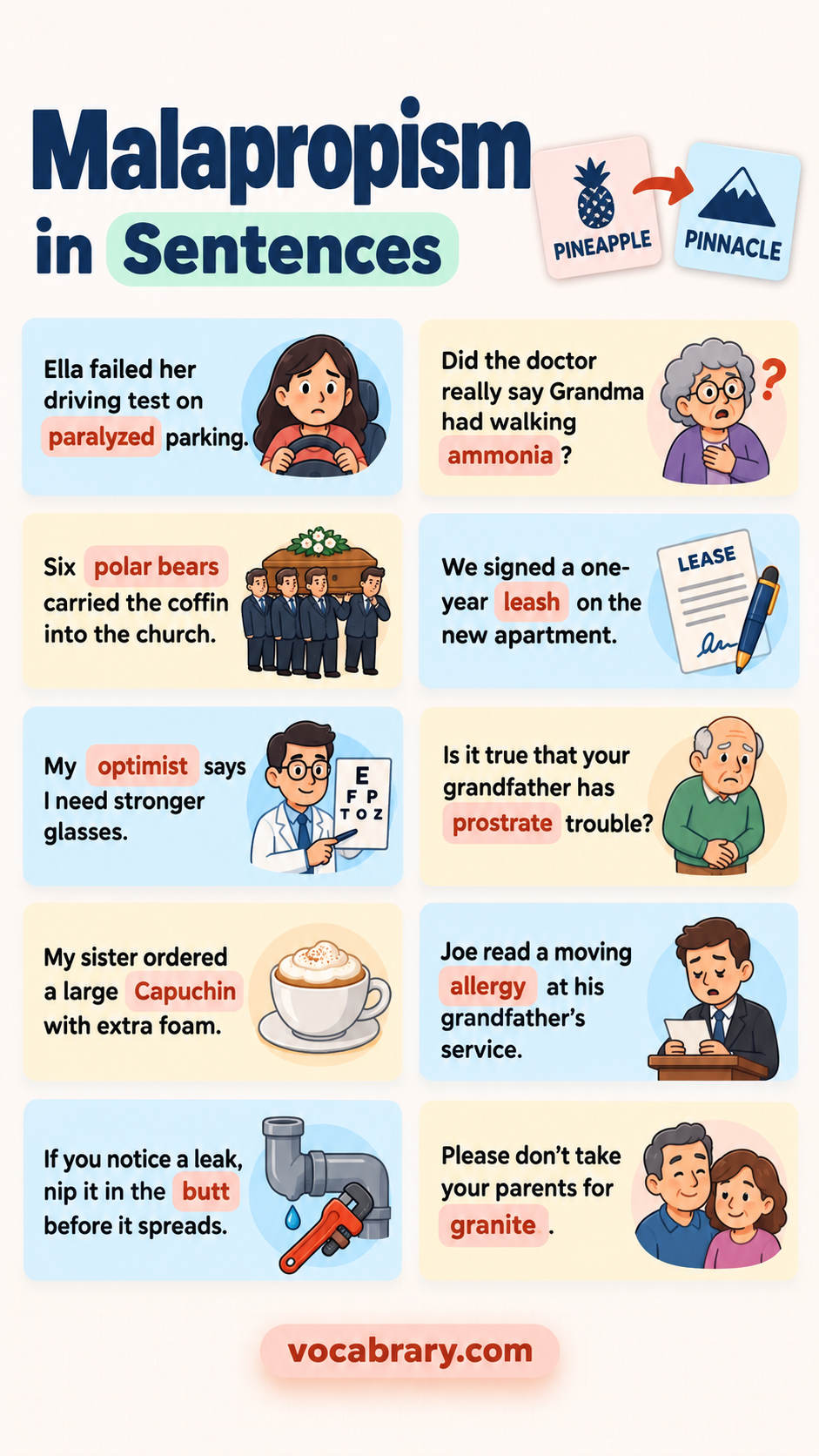
Decapitated coffee, condiments offered at a funeral, and polar bears carrying a coffin are the classic malapropism examples, where a wrong word with the right sound produces a meaning nobody intended.
- The coach said the rule change was a mute point, since the season had already ended (intended: moot).
- "Would you be a little more pacific about the time?" Dana asked her brother (intended: specific).
- After dinner, my uncle always orders a decapitated coffee so he sleeps well (intended: decaffeinated).
- Priya rode the accelerator to the third floor of the mall (intended: escalator).
- Grandpa told a funny antidote about his first job at a gas station (intended: anecdote).
- At the funeral, Leo offered the widow his deepest condiments (intended: condolences).
- Our neighbor keeps bragging that his dog has a long pedicure of champion show winners (intended: pedigree).
- She has a photogenic memory and never forgets a phone number (intended: photographic).
- That ghost you saw last night was just a pigment of your imagination (intended: figment).
- Nobody expected Mia to sign up for flamingo lessons after her trip to Seville (intended: flamenco).
- The police promised to instigate the robbery at the jewelry store (intended: investigate).
- Before the hurricane, the mayor ordered every family on the coast to evaporate (intended: evacuate).
- Why does Tom keep telling people he is a perspiring actor? (intended: aspiring)
- Carla’s dentist gave her amnesia before pulling the tooth (intended: anesthesia).
- Standing in the museum, Omar admired the perfect cemetery of the temple’s columns (intended: symmetry).
- Rainy weather is always hard on my sciences, Aunt Bea complains (intended: sinuses).
- Mr. Hill is the best vegetarian in town, and he treated our sick cat for free (intended: veterinarian).
- Everyone in the neighborhood respects Pastor Green as a man of great statue (intended: stature).
- Dad asked the waiter for extra neutrons on his Caesar salad (intended: croutons).
- The horror film was so frightening that Lily sat putrefied in her seat until the credits rolled (intended: petrified).
- At forty, Jake finally found his true vacation as a nurse (intended: vocation).
- My cousin’s handwriting is so eligible that nobody reads her notes (intended: illegible).
- Ella failed her driving test on paralyzed parking (intended: parallel).
- Did the doctor really say Grandma had walking ammonia? (intended: pneumonia)
- The donor wished to remain unanimous, so her name never appeared on the plaque (intended: anonymous).
- Six polar bears carried the coffin into the church (intended: pallbearers).
Malapropism Examples in Everyday Life
Pharmacies, restaurants, and rented apartments are where most everyday malapropisms turn up, such as a subscription for blood pressure pills, a shrimp temperature, and a one-year leash, all spoken with total confidence.
- At the pharmacy, Mr. Diaz asked to renew his subscription for blood pressure pills (intended: prescription).
- We signed a one-year leash on the new apartment (intended: lease).
- Our landlord promised to fix the installation in the attic before winter (intended: insulation).
- Aunt Rosa’s favorite part of Venice was riding the gorgonzolas along the canals (intended: gondolas).
- Mom loves the quiet ambulance of the little Italian restaurant on Elm Street (intended: ambience).
- Sam booked a visit with a taxidermist about the rash on his arm (intended: dermatologist).
- My optimist says I need stronger glasses (intended: optometrist).
- Dad turned left at the busy insurrection and got lost for an hour (intended: intersection).
- The waiter recommended the shrimp temperature with a sweet chili dip (intended: tempura).
- Is it true that your grandfather has prostrate trouble? (intended: prostate)
- Right after the wedding deception, the happy couple left for Hawaii (intended: reception).
- Don’t forget to write the dentist appointment on the colander (intended: calendar).
- My sister ordered a large Capuchin with extra foam (intended: cappuccino).
- The doctor warned Grandpa that his sedimentary lifestyle was bad for his heart (intended: sedentary).
- We spent a rainy afternoon at the natural history mausoleum looking at dinosaur bones (intended: museum).
- Nora mailed a symphony card to her neighbor after the funeral (intended: sympathy).
- Uncle Walt died interstate, so the family argued over his house for years (intended: intestate).
- Twenty years in Portugal haven’t made Glen an ex-patriot, and he still cheers for his home team (intended: expatriate).
- Joe read a moving allergy at his grandfather’s service (intended: elegy).
- "Turn the thermos up, it’s freezing in here," Jin told his roommate (intended: thermostat).
Malapropisms in Common Phrases
Speakers learn idioms by ear, and that habit produces malapropisms, which is how a scapegoat becomes an escape goat and a damp squib becomes a damp squid.
- If you notice a leak, nip it in the butt before it spreads (intended: bud).
- The manager needed an escape goat, so he blamed the new intern (intended: scapegoat).
- Please don’t take your parents for granite (intended: granted).
- After the rain, the fireworks show turned out to be a damp squid (intended: squib).
- A rolling stone gathers no moths, Grandma likes to remind us (intended: moss).
- For all intensive purposes, the project is finished (intended: intents and).
- That painting of a staircase is an optical allusion (intended: illusion).
- Everyone says Ben is the splitting image of his father (intended: spitting).
- The whole family waited on tender hooks for the exam scores (intended: tenterhooks).
- Losing that job turned out to be a blessing in the skies (intended: disguise).
- My brother expects the rest of us to be at his beckon call all weekend (intended: beck and).
- Why did the lawyer keep mentioning the statue of limitations? (intended: statute)
- Tired after the ten-mile hike, Rita curled up in the feudal position (intended: fetal).
- Our old van didn’t pass mustard at the safety inspection (intended: muster).
- Nick is biting his time until the right job opens up (intended: biding).
- After the loss, the team vowed to extract revenge next season (intended: exact).
Malapropism Examples at School
Red-hot larva, distinct dinosaurs, and a coma after every name show how new classroom vocabulary gets swapped for a familiar word with a similar sound.
- Our history teacher called Gettysburg the most climatic battle of the war (intended: climactic).
- Maya put a coma after every name on the invitation (intended: comma).
- In science class, Ethan said the volcano poured out red-hot larva (intended: lava).
- "The dinosaurs are completely distinct," Jonah announced during his report (intended: extinct).
- Ms. Park asked us to circle the terminator of each fraction (intended: denominator).
- The school’s hysterical society is visiting the old courthouse on Friday (intended: historical).
- Liam’s big brother joined the infancy after high school (intended: infantry).
- On the globe, our class traced the line that splits the Earth into two atmospheres (intended: hemispheres).
- Ruby says she loves geometry because she wants to learn about other countries (intended: geography).
- The school nurse said Owen needed surgery on his tinsel (intended: tonsils).
- In gym class, the coach praised Zara for being amphibious, since she shoots with both hands (intended: ambidextrous).
- Before the speech contest, our teacher gave a lesson on electrocution (intended: elocution).
- "My conscious won’t let me copy your homework," Theo told his friend (intended: conscience).
- For her book report, Aisha wrote a bibliography of Abraham Lincoln (intended: biography).
- Didn’t the science fair judges call Leo’s robot ingenuous? (intended: ingenious)
- Ms. Grant reminded the class that punctuation means arriving on time (intended: punctuality).
Malapropism Examples at Work
A laxative contract, an herbal warning, and the executioner board are office malapropisms, where a sound-alike word replaces a business term and the meeting stops for laughter.
- Please precede with the meeting while I find the slides (intended: proceed).
- This new sales contract is very laxative for our company (intended: lucrative).
- Our boss gave Mark an herbal warning for being late three days in a row (intended: verbal).
- By Friday, the board hopes to reach a census (intended: consensus).
- HR is offering a sales insensitive of five hundred dollars to the top seller this quarter (intended: incentive).
- After a careful paralysis of the budget, Tina found the error (intended: analysis).
- Every Monday at nine, the executioner board meets in Room 4 (intended: executive).
- Our team leader praised Omar’s invasive new design (intended: innovative).
- Nobody at corporal headquarters answered the phone all afternoon (intended: corporate).
- Is your schedule flammable enough to cover the late shift? (intended: flexible)
- Last year, the oil magnet bought three more tankers (intended: magnate).
- Every new hire reads the company’s five tenants on the first day (intended: tenets).
- After twenty years of teaching, Professor Lee was finally granted tenor (intended: tenure).
- Ask the personal department about your vacation days (intended: personnel).
- The new manager wants more conservation between the sales and design teams (intended: conversation).
- The company’s flounder still visits the factory floor every week (intended: founder).
Funny Malapropism Examples
The funniest malapropisms, such as flying buttocks on a cathedral, a numerologist for headaches, and an invertebrate gambler, pair a formal setting with a wrong word from a far less dignified world.
- Aunt June proudly told the wedding guests that her new husband was monotonous (intended: monogamous).
- Standing in front of Notre-Dame, Dad praised the cathedral’s flying buttocks (intended: buttresses).
- My grandfather is an invertebrate gambler who bets on anything (intended: inveterate).
- The dog show judge called Bella a hexagon of good manners (intended: paragon).
- Uncle Sal says his new diet is a real detergent to midnight snacking (intended: deterrent).
- Pam laughed so hard at the joke that she became historical (intended: hysterical).
- A proud father told the audience that his daughter was a child progeny at the piano (intended: prodigy).
- My cousin wants to become an ornithologist because she dreams of straightening people’s teeth (intended: orthodontist).
- Mike asked the pharmacist for something to elevate his headache (intended: alleviate).
- "Does the museum have a real Egyptian esophagus?" Theo asked (intended: sarcophagus).
- The fashion critic praised the model’s well-propositioned figure (intended: well-proportioned).
- Uncle Bill never catches the flu, he says, because he has been vacillated against everything (intended: vaccinated).
- Grandma took Grandpa to a numerologist about his headaches (intended: neurologist).
- Mom described the new neighbors as very hostile people who throw great parties (intended: hospitable).
- Rob refused to shop at the new mall because the prices were exuberant (intended: exorbitant).
Malapropism Examples for Kids
Bears that hyphenate, a fire hydrangea, and the Leaning Tower of Pizza are short malapropisms that children notice quickly, since the wrong word names something they already know.
- Bears hyphenate all winter in their caves (intended: hibernate).
- We took a photo in front of the Leaning Tower of Pizza (intended: Pisa).
- The defective found the missing cookies in the dog’s bed (intended: detective).
- "Did you spill the juice on porpoise?" Mom asked (intended: purpose).
- Our teacher says a lion is a carnival because it eats only meat (intended: carnivore).
- At the dentist, Mia had her very first gravity filled (intended: cavity).
- Lucy told the class that the Earth spins on its axle (intended: axis).
- The kindergarten choir sang in perfect harmonica (intended: harmony).
- Sam wants to be an astrologer and study planets through a giant telescope (intended: astronomer).
- At the aquarium, Eli pointed at the octagon hiding behind a rock (intended: octopus).
- When the old barn caught fire, the firefighters hooked their long hose to the bright red fire hydrangea on the corner (intended: hydrant).
- Frogs are ambitious because they live on land and in water, Noah explained (intended: amphibious).
Malapropism Examples for Students
History papers about the Founding Farmers, lab reports on fraction, and essays about Darwin’s theory of revolution show malapropisms in student writing, where a single wrong word changes the whole claim.
- In her lab report, Emma measured the fraction between two wooden blocks (intended: friction).
- A history paper stated that the colonists protested unfair taxidermy (intended: taxation).
- Priya’s book review praised the novel’s illusion to Greek myths (intended: allusion).
- Tom’s biology notes say that plants make food through photography (intended: photosynthesis).
- According to Hugo’s essay, Darwin’s theory of revolution changed science forever (intended: evolution).
- Leah wrote that the Declaration of Independence was signed by the Founding Farmers (intended: Fathers).
- Did Noah really write that Shakespeare is famous for his sonatas? (intended: sonnets)
- Isabel’s report claimed that ancient Romans spoke Latino at home (intended: Latin).
- Kate’s civics essay said the state decided to persecute the thieves in court (intended: prosecute).
- Grace described the novel’s hero as a lonely orphanage raised by his uncle (intended: orphan).
- Sana argued that the main character in the mystery suffers from amnesty after the car crash (intended: amnesia).
- For his project on medieval Europe, Rob wrote that knights fought in the crucibles (intended: Crusades).
Malapropism Examples in Literature
Mrs. Malaprop’s "pineapple of politeness," Dogberry’s "comparisons are odorous," and Aunt Sally’s "putrified with astonishment" are the best-known malapropism examples in literature, each written to mock a character who wants to sound educated.
Mrs. Malaprop in The Rivals
Richard Brinsley Sheridan wrote The Rivals in 1775 and gave Mrs. Malaprop lines such as an "allegory on the banks of the Nile" and a "progeny of learning," which gave the device its name.
- Praising Captain Absolute, Mrs. Malaprop calls him "the very pineapple of politeness" (intended: pinnacle).
- In The Rivals, she complains that her niece Lydia is as headstrong as an allegory on the banks of the Nile (intended: alligator).
- Lydia is ordered to illiterate her young admirer quite from her memory (intended: obliterate).
- Offended by a letter that mocks her speech, she says that if she reprehends anything, it is the use of her own tongue (intended: apprehends).
- The same speech boasts of her oracular tongue (intended: vernacular).
- She also takes pride in "a nice derangement of epitaphs" (intended: arrangement of epithets).
- On a girl’s schooling, Mrs. Malaprop wants a supercilious knowledge of accounts (intended: superficial).
- A young woman should study geometry, she adds, to learn about the contagious countries (intended: geography, contiguous).
- She wants a girl to be "mistress of orthodoxy" so she never misspells a word (intended: orthography).
- No daughter of hers, she insists, will be a progeny of learning (intended: prodigy).
- Good schooling, in her view, helps a girl reprehend the true meaning of what she says (intended: comprehend).
- Sir Anthony’s marriage offer is a preposition she has laid before Lydia (intended: proposition).
- Long ago, she says, she laid her positive conjunctions on Lydia never to think of Beverley again (intended: injunctions).
- The letter in her hand is one more she has interceded from the young man (intended: intercepted).
- She had believed that Lydia persisted from writing to him (intended: desisted).
- That discovery gives her the hydrostatics (intended: hysterics).
- Didn’t she tell Sir Anthony, to his face, that he was an absolute misanthropy? (intended: misanthrope)
- Mrs. Malaprop hopes the captain will find Lydia "not altogether illegible" as a bride (intended: eligible).
- Female punctuation, she says, forbids her to say more (intended: compunction).
- Warning the maid Lucy against betrayal, she threatens that Lucy will forfeit her malevolence forever (intended: benevolence).
- She will be glad, she says, to get Lydia out from under her intuition (intended: tuition).
Dogberryisms in Much Ado About Nothing
Constable Dogberry, Shakespeare’s pompous officer, comprehends suspects instead of apprehending them and calls comparisons odorous, the reason these slips are also called Dogberryisms.
- Dogberry picks George Seacoal as "the most senseless and fit man" to lead the night watch (intended: sensible).
- He orders the watchmen to comprehend all vagrom men (intended: apprehend).
- In the same scene, he says that for the watch to babble is most tolerable and not to be endured (intended: intolerable).
- Reporting to Leonato, he says the watch has comprehended two aspicious persons (intended: apprehended, suspicious).
- "Comparisons are odorous," Dogberry tells his partner Verges (intended: odious).
- He asks for a learned writer to set down their excommunication of the prisoners (intended: examination).
- Opening the hearing, he asks whether the whole dissembly has appeared (intended: assembly).
- Borachio, he declares, will be condemned into everlasting redemption (intended: damnation).
- When Conrade calls him an ass, he cries out, "Dost thou not suspect my place?" (intended: respect)
- Verges, not to be outdone, says that wrongdoers should suffer salvation, body and soul (intended: damnation).
Malapropisms in A Midsummer Night’s Dream
Bottom’s odious savours and Flute’s Ninny’s tomb come from the amateur actors in A Midsummer Night’s Dream, who mangle grand words in rehearsal and again in their final play.
- Playing Pyramus in rehearsal, Bottom speaks of flowers of odious savours sweet until Quince corrects him (intended: odorous).
- Flute, rehearsing as Thisbe, keeps saying Ninny’s tomb (intended: Ninus’).
- Quince calls Bottom a very paramour for singing sweetly, and Flute corrects him (intended: paragon).
- Bottom promises to aggravate his lion’s roar so it frightens no one (intended: moderate).
- Resting in Titania’s bower, Bottom says an exposition of sleep has come upon him (intended: disposition).
- In the final play, Pyramus mourns that a lion has deflowered his dear Thisbe (intended: devoured).
Other Shakespeare Malapropisms
Juliet’s Nurse, Mistress Quickly, and Launcelot Gobbo show that Shakespeare gave malapropisms to servants and innkeepers in his comedies, histories, and tragedies alike.
- In Romeo and Juliet, the Nurse tells Romeo she desires some confidence with him (intended: conference).
- Benvolio mocks her by joking that she will indite Romeo to some supper (intended: invite).
- Mistress Quickly, in Henry IV, Part 2, says Falstaff is indited to dinner (intended: invited).
- Angry at Falstaff in the same scene, she calls him a honeysuckle villain (intended: homicidal).
- Describing Falstaff’s death in Henry V, she says he is in Arthur’s bosom (intended: Abraham’s).
- Launcelot Gobbo tells Shylock that his young master expects his reproach (intended: approach).
- Constable Elbow, in Measure for Measure, brings in two notorious benefactors (intended: malefactors).
Malapropisms in Novels
Aunt Sally’s putrified astonishment and the king’s funeral orgies show how Mark Twain used malapropisms in Adventures of Huckleberry Finn to expose characters who pretend to be more refined than they are.
- In Mark Twain’s Adventures of Huckleberry Finn, Aunt Sally says she was putrified with astonishment when "Sid" kissed her (intended: petrified).
- Twain’s con man, the king, speaks of funeral orgies and ignores the duke’s written correction (intended: obsequies).
- Ring Lardner’s The Young Immigrunts (1920) jokes about the bride and glum (intended: groom).
Malapropism Examples in TV and Film
Archie Bunker’s groinecologist, Michael Scott’s claim to be a great philanderer, and Ricky’s worst case Ontario show TV writers using malapropisms as a running joke for loud, overconfident characters.
Archie Bunker in All in the Family
Norman Lear’s All in the Family (1971 to 1979) gave Archie Bunker so many slips, such as a detergent to crime and a remark not German to the conversation, that fans called them Bunkerisms.
- Archie Bunker calls Edith’s doctor a groinecologist (intended: gynecologist).
- On All in the Family, Archie insists that patience is a virgin (intended: virtue).
- Anything off track, he says, is not German to the conversation (intended: germane).
- He argues that capital punishment is a detergent to crime (intended: deterrent).
- His name for an interior designer is an inferior decorator (intended: interior).
- Archie’s attempt at a cheerful "mazel tov" comes out as Molotov (intended: mazel tov).
Michael Scott and Other Screen Characters
Michael Scott in The Office, Stan Laurel in Sons of the Desert, and Emily Litella on Saturday Night Live each swap a grand word for a sound-alike in the middle of a serious moment.
- In the 2006 Office episode "Casino Night," Michael Scott calls himself a great philanderer (intended: philanthropist).
- Stan Laurel, in the 1933 film Sons of the Desert, addresses the lodge leader as the Exhausted Ruler (intended: Exalted).
- Gilda Radner’s Saturday Night Live character Emily Litella rants about the plight of Soviet jewelry (intended: Jewry).
- Ricky on Trailer Park Boys plans for the worst case Ontario (intended: scenario).
Malapropism Examples in the News and Politics
George W. Bush’s "misunderestimated," Richard J. Daley’s police who preserve disorder, and Tony Abbott’s "suppository of all wisdom" are malapropisms that reporters recorded and repeated for years.
Malapropisms by American Politicians
Chicago mayor Richard J. Daley, Texas governor Rick Perry, and Congresswoman Marjorie Taylor Greene all produced malapropisms in public remarks, where one wrong word became the headline.
- Speaking in Bentonville, Arkansas, in November 2000, George W. Bush said critics had misunderestimated him (intended: underestimated).
- Chicago mayor Richard J. Daley said in 1968 that the police were there to preserve disorder (intended: order).
- Daley also urged the city to rise to higher and higher platitudes (intended: plateaus).
- In another speech, the mayor marveled at what scientists will do once they get the atom harassed (intended: harnessed).
- The same mayor once referred to Alcoholics Unanimous (intended: Anonymous).
- Daley called a bicycle built for two a tantrum bicycle (intended: tandem).
- Texas governor Rick Perry described the states as lavatories of innovation and democracy (intended: laboratories).
- Marjorie Taylor Greene warned in 2022 about Nancy Pelosi’s gazpacho police (intended: Gestapo).
- In a separate remark, Greene referred to a peach tree dish (intended: petri).
- Did Greene also claim that a rule had been fragrantly violated? She did (intended: flagrantly).
Malapropisms by World Leaders
Tony Abbott’s suppository, Bertie Ahern’s apple tart, and Keir Starmer’s sausages show that heads of government in Australia, Ireland, and Britain make the same sound-alike slips as anyone else.
- Campaigning in 2013, Tony Abbott said that no one is the suppository of all wisdom (intended: repository).
- Irish leader Bertie Ahern warned against upsetting the apple tart (intended: cart).
- In September 2024, British prime minister Keir Starmer called for the return of the sausages held in Gaza (intended: hostages).
- Welsh Conservative leader Andrew Davies urged voters in 2016 to make breakfast a success (intended: Brexit).
- Philippine official Mocha Uson spoke of a right against self-discrimination (intended: self-incrimination).
Malapropisms by Athletes and Celebrities
Mike Tyson’s Bolivian, Charles Shackleford’s amphibious shooting, and Justin Bieber’s Sixteenth Chapel are malapropisms spoken in interviews, where no script was there to catch the error.
- After losing to Lennox Lewis in 2002, Mike Tyson said he would fade into Bolivian (intended: oblivion).
- Basketball player Charles Shackleford of NC State said he shoots with either hand because he is amphibious (intended: ambidextrous).
- On David Letterman’s show in 2012, Justin Bieber said his tattoos were not going for the Sixteenth Chapel (intended: Sistine).
Related
FAQs
A malapropism and a pun differ in intent: a pun plays on two meanings on purpose, while a malapropism is a speaker’s mistake, so the joke lands on the speaker. Sheridan was joking when he wrote Mrs. Malaprop’s lines, but she was not, which is also what separates a malapropism from verbal irony.
Five famous examples are Mrs. Malaprop’s "pineapple of politeness," Dogberry’s "comparisons are odorous," Mike Tyson’s "fade into Bolivian," Tony Abbott’s "suppository of all wisdom," and Richard J. Daley’s police who "preserve disorder." Treat some famous lines with care. "Texas has a lot of electrical votes," credited to Yogi Berra, traces back only to a 1989 anecdote book with no news report behind it.
Malapropisms are funny because the wrong word brings in a meaning that clashes with the moment, such as condiments offered at a funeral. The speaker’s confidence adds to the joke, since Mrs. Malaprop and Dogberry both believe they speak beautifully.
A malapropism comes from a retrieval slip, in which the brain grabs a stored word that sounds like the target. Psycholinguists David Fay and Anne Cutler found that the wrong word matches the intended one in part of speech and stress pattern, as "pineapple" matches "pinnacle." Long, unfamiliar words and nerves raise the chance of a slip.
The word comes from Mrs. Malaprop, the aunt in Richard Brinsley Sheridan’s comedy The Rivals (1775). Sheridan built her name from the French phrase mal à propos, meaning "out of place." Shakespeare’s earlier constable gave English a second name for the same error, Dogberryism.
Dogberry speaks in malapropisms because Shakespeare wrote him as a pompous constable who wants to sound learned and gets the long words wrong. His errors, such as "comprehended two aspicious persons," make his authority look ridiculous. The irony is that his bumbling watch, not the clever nobles, uncovers Don John’s plot.
No, not in the strict sense, because a figure of speech is deliberate and a malapropism is an error. It becomes a literary device when an author writes the errors on purpose for a character, as Sheridan and Shakespeare did. Deliberate devices such as simile and hyperbole appear in these figures of speech sentences.
Eggcorns are close relatives of malapropisms rather than exact matches. An eggcorn swaps in a word that creates a plausible new meaning, as in "old-timer’s disease" for Alzheimer’s, while a classic malapropism creates nonsense, as in "pineapple of politeness." Phrases like "for all intensive purposes" get labeled both ways.
A spoonerism and a malapropism differ in what the speaker swaps. A spoonerism trades the first sounds of two words, as in "a blushing crow" for "a crushing blow," while a malapropism replaces one whole word, as in "fade into Bolivian." Both are named after real or fictional people, William Archibald Spooner and Mrs. Malaprop.
Speakers make malapropisms by accident, but writers and comedians create them on purpose. Sheridan, Shakespeare, and the writers of All in the Family gave characters malapropisms to mock pretension, and comedian Norm Crosby built a stage act around them.
You identify a malapropism by asking whether a word sounds like a better-fitting word and makes nonsense where it is. In "the police will instigate the robbery," swapping in "investigate" fixes the sentence, so the original is a malapropism. A misspelling does not count, because a malapropism always uses a different real word.
A malaphor and a malapropism differ in scale: a malaphor blends two idioms, as in "we’ll burn that bridge when we get to it," while a malapropism swaps one word for a sound-alike. A malaphor mixes up meanings, and a malapropism mixes up sounds.

Leave a Comment