
Apostrophe is a figure of speech in which a speaker addresses someone or something unable to answer, as when a child sings "Twinkle, twinkle, little star" to the night sky. Most apostrophe figure of speech examples open with a name or "O," then speak to a lost friend, a car, or Death.
What Is Apostrophe?
Apostrophe is the act of speaking directly to a listener who is dead, absent, nonhuman, or abstract, as if that listener were present and able to hear. It shares its name with the punctuation mark (‘), but the mark shows possession or a missing letter, while the figure of speech is a form of address.
Staring at the empty chair, Ellen said, "Dad, you would have loved tonight’s game."
Common Apostrophe Figure of Speech Examples in Sentences
Songs to a star, pleas to a car that won’t start, and words at a grandmother’s grave are the most common apostrophe figure of speech examples, each addressed to a listener unable to reply.
- Looking up from the backyard, Mia sang, "Twinkle, twinkle, little star," to the brightest light in the sky.
- "Oh, car, please start just this once," Dev begged, turning the ignition a third time.
- Standing at her grandmother’s grave, Rosa whispered, "Grandma, I finally finished my degree."
- "Rain, please stay away until the picnic is over," Tom said to the gray clouds.
- "Death, you will not take my brother tonight," the nurse muttered as she checked the monitor again.
- "O Time, slow down," sighed Elena as her daughter climbed onto the school bus for the first time.
- Kai glared at the frozen laptop and said, "Why do you hate me, computer?"
- "Dear Moon, keep an eye on Dad while he drives home," said four-year-old Ben at the window.
- In the King James Bible, Paul asks, "O death, where is thy sting?"
- "Hello, old house," Nadia said softly as she unlocked the door of her childhood home.
- After missing the bus, Leo shouted at the empty road, "Come back, you big yellow traitor!"
- "Luck, where were you when I needed you?" asked Priya after losing the final by one goal.
- "Summer, don’t leave yet," Omar pleaded on the last warm evening of August.
- "Sleep, why won’t you come?" Hana asked her dark bedroom at three in the morning.
- "Goodbye, little apartment, and thank you," Carlos said before handing the keys to the landlord.
- Wiping flour from her hands, Grandma told the oven, "Don’t you dare burn these cookies."
- "Love, you have made a fool of me again," Jun wrote in his journal.
- "Ocean, you look calmer than I feel," Sara said as she walked along the empty beach.
- "Coffee, my old friend, you have saved me again," Liam announced at his desk.
- Gazing at her late husband’s photo, Maria said, "You would have loved this wedding, Jorge."
- "Monday, we meet again," Aisha groaned.
- "Stupid stairs, I will conquer you," Noah told the five flights up to his new flat.
- "Where have you gone, my youth?" Uncle Frank asked on the morning of his sixtieth birthday.
- At the memorial bench in the park, Ben said, "Old friend, the team finally won the cup."
- "Wind, blow harder and push this boat home," the sailor shouted at the sky.
Apostrophe Examples in Everyday Speech
Traffic lights told to change, printers begged for one more copy, and a weekend asked where it went are apostrophe in daily speech, where people talk to objects and days out of frustration or fondness.
- "Come on, green light, change already," muttered the taxi driver.
- Stuck in traffic, Maya said to the dashboard clock, "Please don’t hit nine yet."
- "Printer, I am begging you, just one more copy," Victor said at the office.
- "Hey, weekend, where did you go?" Lena asked on Sunday night.
- Nick slapped the vending machine and said, "Give me my chips, you thief."
- "Traffic, you are ruining my life," Ali said, gripping the wheel.
- "Please, Wi-Fi, don’t drop now," whispered Julia minutes before her job interview call.
- "Oh, sweet bed, I have missed you all day," Tanya said as she collapsed onto the mattress.
- "Universe, why me?" Sam asked when a passing bus splashed him with muddy water.
- Talking to his phone, Raj said, "Battery, just give me five more minutes."
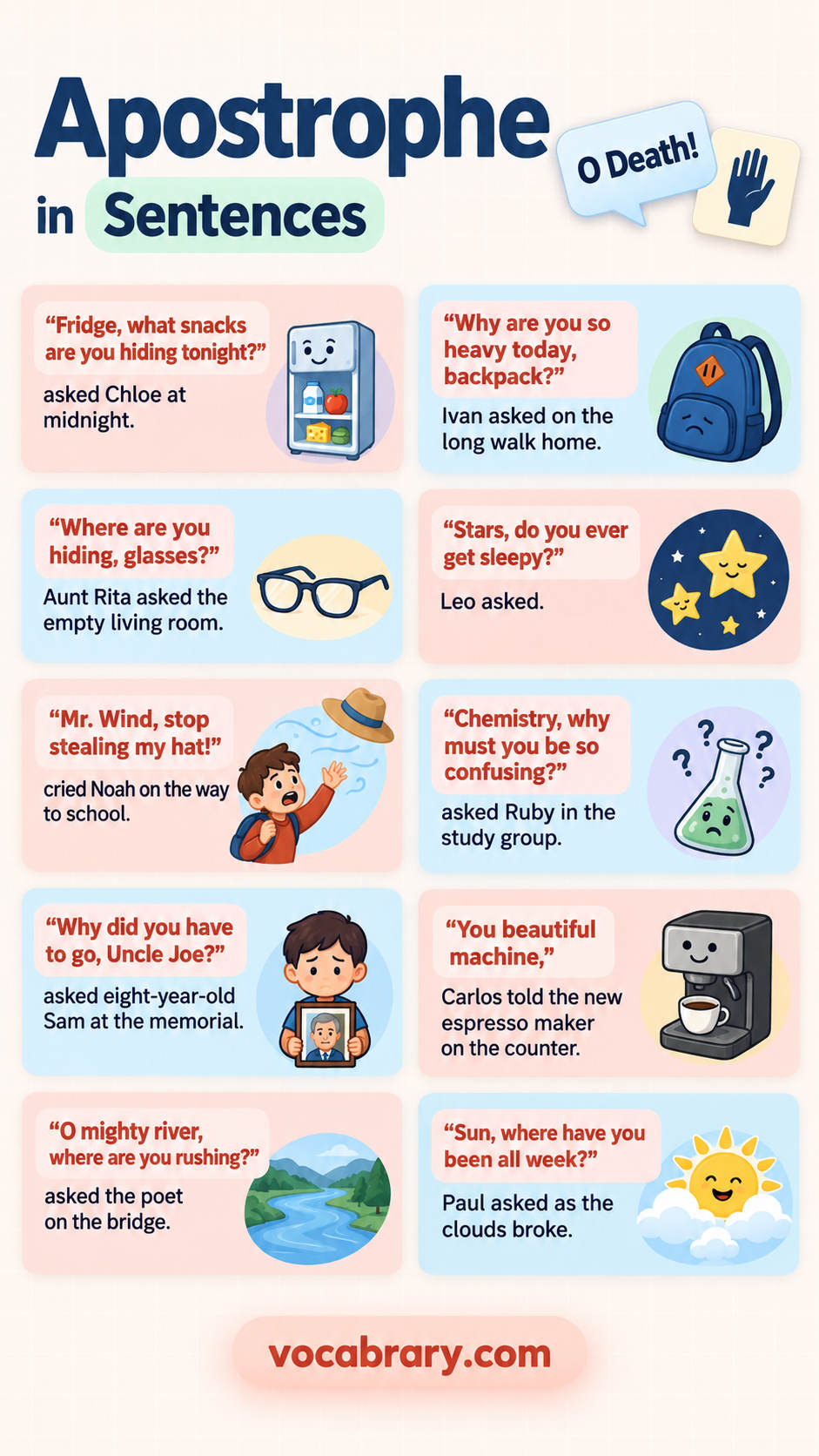
- "Fridge, what snacks are you hiding tonight?" asked Chloe at midnight.
- "Rain, you picked the worst day," said the bride’s father, looking at the sky.
- "Keep going, legs," Farah told herself at the twentieth kilometer of the marathon.
- "Dear diary, today was the longest day of my life," Emma wrote before bed.
- "Why are you so heavy today, backpack?" Ivan asked on the long walk home.
- "Cake, I promise this is the last slice," said Mom, reaching for the knife.
- "Rise and shine, old car," Grandpa said every winter morning as he started the engine.
- As the plane lifted off, Noor looked down at the city and whispered, "Goodbye, London."
- "Snow, you are beautiful, but please stop," said the man shoveling his driveway for the third time that day.
- "Where are you hiding, glasses?" Aunt Rita asked the empty living room.
Short Apostrophe Examples for Kids
Nursery rhymes that tell the rain to go away, a bedtime book that says good night to the moon, and a child begging a snowman not to melt give young learners short apostrophe examples.
- In Jane Taylor’s 1806 poem "The Star," a child sings "Twinkle, twinkle, little star" to a star in the night sky.
- The old nursery rhyme "Rain, rain, go away" asks the rain to come again another day.
- Another rhyme tells a ladybird, "Ladybird, ladybird, fly away home."
- Margaret Wise Brown’s 1947 picture book Goodnight Moon has a little bunny saying good night to the moon and everything in the great green room.
- "Good night, moon," Lily whispered, pulling up her blanket.
- "Teddy, don’t be scared of the thunder," said Max.
- "Sun, please come out so I get to play," said Ava, pressing her nose to the window.
- "Hello, tree, you grew so tall," said Jack.
- "Snowman, please don’t melt," Zoe begged on the warm morning.
- "Bye-bye, bathwater," giggled the toddler as the tub drained.
- "Wake up, flowers, it’s spring," sang the kindergarten class in the school garden.
- "Stars, do you ever get sleepy?" Leo asked.
- "Thank you, cookie jar, for being full," Mia said with a grin.
- "Mr. Wind, stop stealing my hat!" cried Noah on the way to school.
Apostrophe Examples for Students
Pleas to a math test, complaints to Shakespeare about long sentences, and a letter to a late grandfather show students using apostrophe in school life, essays, and creative writing.
- "Math test, I am ready for you," Aiden told the exam hall doors.
- "Summer holidays, please come faster," Grace wrote on the corner of her notebook.
- "Shakespeare, why did you write such long sentences?" groaned Theo over his essay.
- In her poetry assignment, Yuki addressed the ocean: "O restless sea, teach me patience."
- "Homework, you will not defeat me tonight," Marcus declared at his desk.
- For creative writing class, Ethan began his poem with "Dear old school bell, you ruled my mornings."
- "Alarm clock, five more minutes," mumbled Sofia before her first lecture.
- "Library, you are my second home," Hassan said in his graduation speech.
- "Goodbye, old locker," Mia said on the last day of senior year.
- Staring at the blank screen, Jonah said, "Words, where are you?"
- "Graduation, you felt so far away four years ago," Chloe said as she put on her gown.
- "Chemistry, why must you be so confusing?" asked Ruby in the study group.
- "Einstein, help me understand this formula," Kofi joked, tapping the poster on the classroom wall.
- Diego’s essay on grief took the form of a letter to his late grandfather that opened, "Abuelo, I passed my driving test."
Apostrophe Examples With Explanation
Words to the moon, a scolding for a stubborn jar, and a call to the Muse count as apostrophe because each speaker addresses a listener unable to reply.
- "O moon, you follow me home every night." The speaker talks to the moon, which is unable to hear or reply.
- "Grandpa, your garden bloomed again this year." The speaker addresses a grandfather who has died, as if he were listening.
- "Time, you thief, give me back my weekend." Time is an abstract quality, so speaking to it is apostrophe.
- "Come on, phone, ring!" The phone is unable to obey.
- "Muse, lend me one good line." The writer calls on a Greek goddess of poetry, the oldest form of apostrophe in Western literature.
- "Love, why do you hurt so much?" The question goes to love itself, not to a person in the room.
- "Farewell, dear mountains, until next summer." The hiker speaks to mountains, which are unable to answer.
- "Maria, I wish you were here to see this." The speaker addresses a friend who is far away.
- "Death, you have no power over us." Speaking to Death as a listener echoes John Donne’s sonnet "Death, be not proud."
- "Oh, stubborn jar, open up." The speaker scolds a jar as though it chose to stay shut.
Types of Apostrophe With Examples
The dead, absent people, objects, nature, abstract qualities like love and time, and gods or Muses are the six listeners that apostrophe addresses, and each one is unable to answer the speaker.
Addressing the Dead
A daughter at her father’s cemetery, a soldier saluting a coffin, and a husband telling his late wife about the grandkids show apostrophe as a way to keep talking to someone after death.
- "Dad, the roses you planted are blooming again," Clara said at the cemetery.
- On the tenth anniversary of the crash, Marcus raised a glass and said, "This one is for you, Danny."
- "Mom, your granddaughter has your laugh," Leila whispered to the photo on the shelf.
- "Sleep well, old boy," Tom told the grave of his dog under the apple tree.
- "Grandma, I finally learned your bread recipe," Aiko said, lighting a candle.
- At the funeral, the soldier saluted the coffin and said, "Goodbye, brother."
- "You left too soon, my friend," the singer said before dedicating the song to her late bandmate.
- "Mr. Patel, your students still quote you," wrote a former pupil on the teacher’s memorial website.
- Every Sunday after church, Hector visits his wife’s grave on the hill and tells her, "The grandkids won the football match again, Rosa."
- "Why did you have to go, Uncle Joe?" asked eight-year-old Sam at the memorial.
- "Papa, you would be proud of the farm," Luis said as he walked the fields at sunset.
Addressing an Absent Person
A roommate away for the weekend, a sister overseas, and a letter to one’s future self are the absent listeners in these sentences, addressed as if each person were in the room.
- "Oh, Jenna, why won’t you call me back?" Mark said to his silent phone.
- Alone on the balcony, Nina whispered, "Where are you tonight, Paolo?"
- "Mom, I miss your cooking," Kenji said as he ate instant noodles in his dorm.
- "Brother, I hope the army is treating you well," Amira said, looking at the map on her wall.
- "Dear future me, I hope you finished that novel," Priya wrote in a letter to open in ten years.
- "Hurry home, sweetheart," Grandma said to the empty driveway.
- "Coach, you missed the goal of the season," Diego shouted toward the empty seats.
- "Jake, you owe me twenty dollars," Ben grumbled to nobody after his roommate left for the weekend.
- "Wherever you are, Lucy, happy birthday," Ana said, blowing out a candle for her sister overseas.
- "Sarah, you were right about everything," Tom admitted to the empty kitchen after their argument.
Addressing Objects
A toaster that burned the bread, an old bike on a steep hill, and a zipper on an overstuffed suitcase are the objects people speak to here, scolding or thanking them aloud.
- "Oh, my poor phone, you survived another fall," Mei said, checking the cracked screen.
- "Toaster, I trusted you," Owen sighed.
- "Keep going, old bike, just one more hill," Kim pleaded.
- "Zipper, don’t you dare rip," Lara warned, sitting on her overstuffed suitcase.
- "Thank you, faithful boots, for ten winters," Pete said as he dropped them in the bin.
- "Why are you always lost, remote?" Dad asked, digging through the sofa cushions.
- "Hello again, my trusty guitar," Ravi said, lifting it off the wall.
- "Pen, work with me here," Maya muttered, shaking the dried-up ballpoint.
- "Little boat, bring us safely home," whispered the fisherman as the storm grew.
- "Goodbye, old desk, you saw me through every exam," said Theo, packing up his room.
- "Dishwasher, please don’t flood the kitchen again," Rita told the machine as she pressed start.
- "You beautiful machine," Carlos told the new espresso maker on the counter.
Addressing Nature and Animals
Rivers, mountains, a sparrow outside an office window, and the moon on a walk home after a night shift are the natural listeners in these apostrophe examples.
- "O mighty river, where are you rushing?" asked the poet on the bridge.
- "Mountains, you make me feel small," said Ingrid at the summit.
- "Sun, where have you been all week?" Paul asked as the clouds broke.
- "Hush, wind," Grandma said as the shutters rattled.
- "Little sparrow, you are free to fly anywhere," Mia sighed from her office window.
- "Sea, give me back my sunglasses," Kyle shouted after a wave swept them away.
- "Beautiful autumn, stay a little longer," said Rosa, raking red leaves.
- "Hey, stars, are you still up there behind the city lights?" asked Tomas.
- "Snow, cover this town and make it quiet," whispered Anya at the window.
- The farmer looked at the dry field and said, "Rain, we are waiting for you."
- "Moon, you are the only one awake with me," Jin said, walking home after a night shift.
- "You old oak, you have watched five generations of this family," Uncle Ben told the tree.
Addressing Love, Time, and Death
Love, time, death, fear, and grief are abstract qualities, and in these sentences speakers talk to them directly, as if each one were a person who had wronged them.
- "Love, you have turned my life upside down," Maya wrote in her diary.
- "Time, you move too fast when I’m happy," said Leo at the end of the holiday.
- "Death, you have taken enough from this family," the old man said at the funeral.
- "Fear, you will not stop me from singing tonight," Ana told herself backstage.
- "Hope, don’t abandon me now," whispered the climber trapped on the ledge.
- "O Loneliness, you are my oldest companion," read the first line of Hiro’s poem.
- "Freedom, we have waited so long for you," the crowd chanted in the square outside the old palace on the first night of the protests.
- "Fortune, smile on me just once," Jack said as he rolled the dice.
- "Hunger, go away until lunch," Sophie groaned in the ten o’clock meeting.
- "Grief, when will you let me sleep?" Paula asked the dark.
- "Patience, stay with me," the teacher muttered as the class got louder.
- "Youth, where did you disappear to?" asked Grandpa, looking at his wedding photo.
Addressing Gods and Muses
Calls to the Muse, Zeus, and Athena come from ancient epic poetry, and these sentences borrow the same form for school plays, exams, and traffic jams.
- "Sing, Muse, of my long journey home," began Lena’s travel poem, copying Homer’s opening.
- "Great Zeus, send rain to our fields," cried the farmers in the school play about ancient Greece.
- "Apollo, steady my arrow," the archer whispered in the novel’s opening chapter.
- "Muse of comedy, I need one joke before Friday," the scriptwriter muttered.
- "Lord, give me strength," Aunt Rosa sighed as the toddlers began to scream.
- "Poseidon, calm your waves," the sailors shouted in the Greek myth Mr. Evans read aloud.
- "Goddess of wisdom, help me pass this exam," Nia joked before the philosophy test.
- "Heavenly Muse, inspire me," wrote Ahmed at the top of his epic poem for class.
- "Oh, traffic gods, have mercy," joked Max.
- "Athena, grant me your calm," said the actor playing Odysseus in rehearsal.
Apostrophe Examples in Literature
Hamlet speaking to Yorick’s skull, Keats praising a nightingale, and John Donne telling Death not to be proud are the most studied apostrophe figure of speech examples in English literature.
Apostrophe in Shakespeare
Macbeth’s floating dagger, Lear’s storm, and Juliet’s call to the absent Romeo show Shakespeare using apostrophe in soliloquies, when a character alone on stage speaks to someone or something that will never answer.
- Macbeth sees a dagger floating in the air and asks it, "Is this a dagger which I see before me," before trying to grab it.
- Lady Macbeth calls on the spirits of murderous thought to "unsex me here" in Act 1, Scene 5 of Macbeth.
- Before Banquo’s murder, Macbeth summons the dark with "Come, seeling night," asking it to hide the deed.
- Hamlet cries "Alas, poor Yorick!" over the jester’s skull and then asks the skull where its jokes and songs have gone.
- In his first soliloquy, Hamlet exclaims "Frailty, thy name is woman!" as he condemns his mother’s quick remarriage.
- King Lear orders the storm, "Blow, winds, and crack your cheeks!" as he rages on the heath.
- Alone with Caesar’s body in Julius Caesar, Mark Antony says "O, pardon me" and begs the corpse to forgive his gentleness with the killers.
- On her balcony, Juliet asks the absent Romeo "wherefore art thou Romeo?" without knowing he is listening in the orchard.
- Juliet calls to the evening, "Come, gentle night," and begs it to bring Romeo to her.
- Inside the Capulet tomb, Juliet speaks to Romeo’s dagger, "O happy dagger!" before stabbing herself.
- Romeo calls the tomb itself a "detestable maw" as he forces it open.
- After drinking the poison, Romeo praises the absent seller with "O true apothecary!"
- Othello speaks to the candle in Desdemona’s bedroom before he kills her, comparing its flame to her life with "Put out the light."
- Edmund opens his soliloquy in King Lear with "Thou, Nature, art my goddess," pledging himself to nature instead of law.
Apostrophe in Odes
John Keats’s nightingale, Shelley’s West Wind, and Wordsworth’s Duty are the listeners of famous odes, a poetic form that by tradition speaks directly to the person or thing it praises.
- In "Ode to a Nightingale" (1819), John Keats tells the bird, "Thou wast not born for death, immortal Bird!"
- Keats ends the same ode with "Adieu! adieu!" as the nightingale’s song fades.
- "Ode on a Grecian Urn" addresses an ancient vase as a "still unravish’d bride of quietness."
- In "To Autumn," Keats tells the season not to mourn the songs of spring, because "thou hast thy music too."
- Keats’s "Ode to Psyche" begins, "O Goddess! hear these tuneless numbers," speaking to the goddess of the soul.
- Percy Bysshe Shelley opens "Ode to the West Wind" with "O wild West Wind" and later begs the wind, "Be thou me, impetuous one!"
- Shelley’s "To a Skylark" (1820) greets the bird with "Hail to thee, blithe Spirit!"
- William Wordsworth’s "Ode to Duty" (1807) cries "O Duty!" in its opening lines and calls Duty a stern daughter of God.
- Thomas Gray’s "Hymn to Adversity" addresses Adversity as the "Daughter of Jove, relentless power."
- William Collins speaks to Evening as "chaste Eve" in his "Ode to Evening" (1746).
Apostrophe in Elegies
Ben Jonson’s farewell to his son, Walt Whitman’s dead captain, and Sylvia Plath’s father show elegies turning grief into direct speech to the person who has died.
- Ben Jonson’s "On My First Son" says farewell to his seven-year-old son, calling him the "child of my right hand."
- In "O Captain! My Captain!" (1865), Walt Whitman urges the dead captain, a figure for Abraham Lincoln, to "rise up and hear the bells."
- Alfred Tennyson’s "Break, Break, Break" mourns his friend Arthur Hallam while speaking to the waves, "O Sea!"
- John Milton opens "Lycidas" (1638), his elegy for a drowned college friend, by addressing plants: "Yet once more, O ye laurels."
- Shelley’s "Adonais" (1821), an elegy for Keats, asks the mother of Adonais, "Where wert thou, mighty Mother," when her son died.
- Sylvia Plath’s "Daddy" (1962) speaks directly to her father, who died when she was eight.
- Henry King’s "The Exequy" tells his dead wife, "Sleep on, my love, in thy cold bed."
- The Roman poet Catullus ends poem 101, written at his brother’s grave, with "hail and farewell."
Apostrophe in Sonnets
Shakespeare’s Devouring Time, John Donne’s proud Death, and Sir Philip Sidney’s sad moon are the listeners of these sonnets, which spend fourteen lines speaking to something that never answers.
- Shakespeare’s Sonnet 19 opens by commanding, "Devouring Time, blunt thou the lion’s paws."
- Shakespeare addresses his own soul in Sonnet 146 as "Poor soul, the centre of my sinful earth."
- John Donne’s Holy Sonnet 10 begins "Death, be not proud" and ends by telling Death that it shall die.
- Sir Philip Sidney’s Astrophel and Stella 31 asks the moon why it climbs the skies "with how sad steps."
- Sonnet 39 of the same sequence begs, "Come sleep! O sleep," for a night of rest.
- In "Bright Star," Keats wishes the speaker were "stedfast as thou art," speaking straight to a star.
- Keats’s sonnet "To Sleep" greets sleep as "O soft embalmer of the still midnight."
- Wordsworth’s "London, 1802" calls to the long-dead poet: "Milton! thou shouldst be living at this hour."
- Edgar Allan Poe’s sonnet to Science (1829) calls Science the "true daughter of Old Time."
Apostrophe in Epic Poems
Homer’s goddess, Virgil’s Muse, and Milton’s Heavenly Muse open the great epics, and Homer also turns aside from his story to speak to Patroclus as the hero’s death nears.
- Homer’s Iliad opens by asking a goddess to sing of the anger of Achilles.
- The Odyssey begins with a plea to the Muse to tell the story of the clever man who wandered after the fall of Troy.
- In Book 16 of the Iliad, Homer turns from the story to speak to Patroclus himself as his death draws near.
- Achilles tells the dead Patroclus to fare well even in the house of Hades in Book 23 of the Iliad.
- Virgil opens the Aeneid by asking the Muse to recall the causes of Juno’s anger.
- Dante cries "O Muses, O high genius" and asks for help in Canto 2 of Inferno.
- Milton begins Paradise Lost (1667) by calling on the "Heav’nly Muse" to sing of man’s first disobedience.
- Book 3 of Paradise Lost opens with "Hail, holy Light," Milton’s address to light itself.
Apostrophe in Famous Poems
Robert Burns’s field mouse, William Blake’s tiger, and Lord Byron’s ocean are the listeners in these poems, which speak to animals, rivers, and the sun as though each one heard every word.
- Robert Burns speaks to a frightened field mouse in "To a Mouse" (1785), calling it a "wee, sleekit, cow’rin, tim’rous beastie."
- In "The Banks o’ Doon," Burns asks the riverbanks how they bloom "sae fresh and fair" while he is full of care.
- William Blake’s "The Tyger" (1794) asks the tiger which immortal hand or eye created its "fearful symmetry."
- Blake’s "The Lamb" (1789) asks the animal, "Little Lamb, who made thee?"
- Lord Byron commands, "Roll on, thou deep and dark blue Ocean," in Childe Harold’s Pilgrimage.
- Wordsworth turns to the River Wye with "O sylvan Wye!" in "Tintern Abbey" (1798).
- Wordsworth greets a bird in "To the Cuckoo" as "O blithe New-comer!"
- John Donne scolds the morning sun as a "Busy old fool, unruly sun" in "The Sun Rising."
- Robert Frost’s "Tree at My Window" (1928) talks directly to the tree outside his bedroom.
- Edgar Allan Poe’s "To Helen" (1831) opens by telling Helen what her beauty means to him.
- Emily Brontë’s "No Coward Soul Is Mine" turns in prayer to "O God within my breast."
Apostrophe Examples in Songs
Eric Clapton’s song to his late son, "Hey There Delilah," and "Moon River" show songwriters using apostrophe to speak to lost family, faraway lovers, and places.
- In "Hey There Delilah" (2006), Plain White T’s sing to a girlfriend far away in New York City.
- Eric Clapton’s "Tears in Heaven" (1992) speaks to his young son, Conor, who died in 1991.
- Puff Daddy and Faith Evans address the late Notorious B.I.G. in "I’ll Be Missing You" (1997).
- Wiz Khalifa and Charlie Puth’s "See You Again" (2015) speaks to the late actor Paul Walker as a farewell in Furious 7.
- Elton John rewrote "Candle in the Wind" in 1997 as a farewell to Princess Diana, while the 1973 original addressed Marilyn Monroe.
- Simon & Garfunkel’s "The Sound of Silence" (1964) opens by greeting darkness as an old friend.
- Henry Mancini and Johnny Mercer’s "Moon River" (1961), from Breakfast at Tiffany’s, speaks straight to the river.
- Rodgers and Hart’s "Blue Moon" (1934) has the singer confide in the moon about being alone.
- The Chordettes’ "Mr. Sandman" (1954) asks the Sandman, a figure from folklore, to bring a dream.
- Sung every December, the carol "O Christmas Tree," from the German "O Tannenbaum," praises a fir tree directly.
- "O Canada," the Canadian national anthem, speaks to the country from its first words.
- Katharine Lee Bates’s "America the Beautiful" addresses America by name in its chorus.
Apostrophe Examples in Movies and TV
Chuck Noland’s volleyball in Cast Away, Forrest Gump at Jenny’s grave, and Carl’s words to his late wife in Up show filmmakers using apostrophe to reveal loneliness and grief.
- Stranded on an island in Cast Away (2000), Tom Hanks’s character Chuck Noland talks for years to Wilson, a volleyball with a painted face.
- When Wilson drifts away on the ocean, Chuck shouts an apology to the ball and weeps.
- At the end of Forrest Gump (1994), Forrest speaks to Jenny at her grave, telling her about their son.
- Pixar’s Up (2009) has Carl Fredricksen talking aloud to his late wife, Ellie, as he flies their house toward South America.
- Alone at night in The Lion King (1994), Simba shouts at the sky that his dead father promised to always be there for him.
- The final scene of Brokeback Mountain (2005) has Ennis speaking to the dead Jack while looking at their two shirts in his closet.
- Kneeling before small carved figures in Gladiator (2000), Maximus asks his ancestors to watch over his wife and son.
- A classic TV commercial had a stressed mother sink into a bubble bath and plead, "Calgon, take me away!"
Related
FAQs
Yes, apostrophe is a figure of speech when a speaker turns to address someone or something unable to answer, such as a dead friend, the moon, or Time. It is taught alongside metaphor, personification, and hyperbole among the figures of speech in school.
The punctuation mark (‘) is a written symbol, while the figure of speech is a way of speaking to an absent listener. The mark shows possession or a missing letter, as in "Sam’s bike" and "don’t." Englishan explains the rules for the apostrophe mark in full.
Five well-known cases are John Donne’s "Death, be not proud," the nursery rhyme "Twinkle, twinkle, little star," Hamlet’s "Alas, poor Yorick!", Keats’s words to a nightingale, and Macbeth’s question to a floating dagger. Everyday lines like "Come on, car, start" count too.
Personification gives human qualities to a nonhuman thing, while apostrophe speaks directly to it. "The wind whispered" is personification, and "Wind, stop howling!" is apostrophe. Many lines use both at once, as when Donne tells Death not to be proud.
Writers use apostrophe to express grief, love, anger, or wonder too strong for a plain statement. Speaking to a dead father, a lost love, or Death itself lets the reader overhear a private moment. Poets also use it to open odes, elegies, and epics.
You identify apostrophe by finding a name or noun in direct address, marked by "O," "thou," "you," or a comma after the name. Then check whether the listener is absent, dead, nonhuman, or abstract. In "O wild West Wind," Shelley addresses the wind, so the line is apostrophe.
The word comes from the Greek apostrephein, meaning "to turn away." In ancient speeches, an orator turned away from the audience to address someone else, such as an absent person or a god. The punctuation mark took the same Greek word into English by a separate path through Latin and French.
Three well-known cases are Eric Clapton’s "Tears in Heaven," addressed to his late son, "Hey There Delilah," addressed to a faraway girlfriend, and "Moon River," addressed to a river. National anthems like "O Canada" address a whole country.
No, apostrophe addresses any listener unable to respond, such as absent people, objects, animals, places, and abstract qualities. "Rain, rain, go away" speaks to the weather, and Blake asks a lamb who made it, a rhetorical question that expects no reply.
Apostrophe and an aside differ in who the speaker is talking to. In an aside, a character speaks to the audience while the other characters on stage fail to hear. In apostrophe, the character speaks to someone or something absent or unable to hear, as Macbeth does when he questions the floating dagger.

Leave a Comment