
Asyndeton is a rhetorical device in which a writer leaves out the conjunctions between words, phrases, or clauses in a series, as in Caesar’s "I came, I saw, I conquered." Most asyndeton examples in daily speech are quick runs of actions or qualities, where dropping "and" makes a routine sound faster and firmer.
What Is Asyndeton?
Asyndeton is the deliberate omission of "and," "or," and "but" from a run of parallel words, phrases, or clauses, so only commas or full stops separate them. Polysyndeton does the reverse, repeating the conjunction before every new member of the series.
Before dawn, the bakers mixed, kneaded, rolled, baked four hundred loaves.
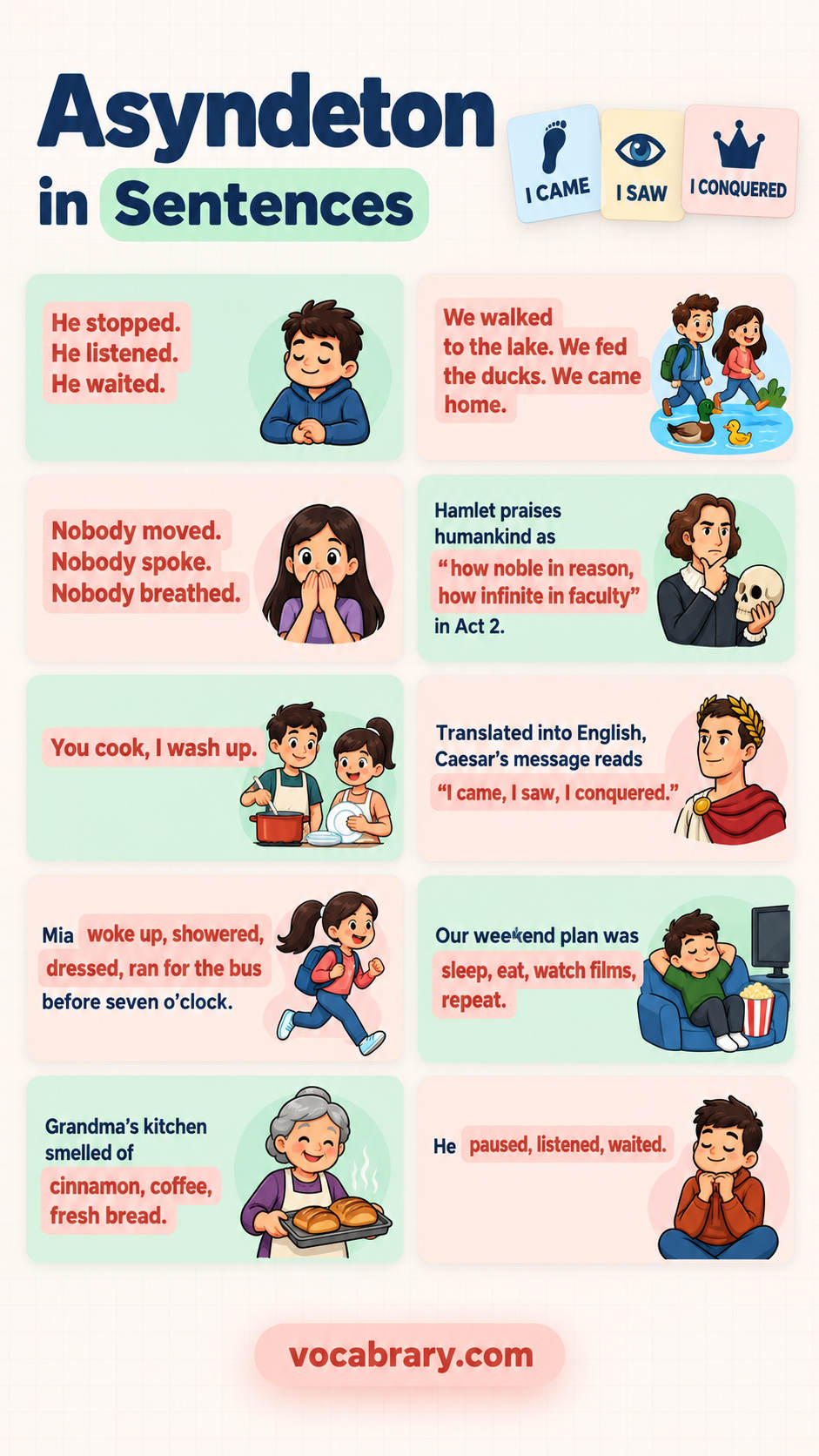
Common Asyndeton Examples in Sentences
Caesar’s "Veni, vidi, vici," the recycling motto "Reduce, reuse, recycle," and Mia’s rush to wake, shower, and catch the bus are textbook asyndeton, where the missing "and" makes each series quicker.
- Julius Caesar reported his fast victory at Zela in 47 BC with three words: "Veni, vidi, vici."
- Translated into English, Caesar’s message reads "I came, I saw, I conquered."
- Mia woke up, showered, dressed, ran for the bus before seven o’clock.
- Every recycling bin at our school is printed with the same three words: "Reduce, reuse, recycle."
- Our weekend plan was sleep, eat, watch films, repeat.
- Last night the storm knocked out the power, flooded the road, closed every school in the county.
- Grandma’s kitchen smelled of cinnamon, coffee, fresh bread.
- He paused, listened, waited.
- My older brother is tall, loud, funny, impossible to ignore.
- Why did you leave early, skip dinner, ignore every call?
- In one afternoon, the puppy chewed two shoes, tore a pillow, dug up the roses.
- At the market we picked up apples, cheese, bread, olives, a bunch of tulips.
- Tom never complains, argues, sulks after losing a game.
- That concert was loud, crowded, sweaty, unforgettable.
- Work hard, save money, stay kind was Grandpa’s advice to every grandchild.
- Sara read the letter, folded it, slipped it into her pocket, walked away.
- New York never sleeps, never slows down, never stops talking.
- A good teacher is patient, fair, curious.
- From the plane window, Leo saw mountains, lakes, pine forests, tiny villages.
- At the airport gate they laughed, cried, hugged, said goodbye.
- Keep your answers short, honest, polite.
- The film offered two hours of car chases, explosions, bad jokes.
Asyndeton Examples in Everyday Life
Dad’s washed, dried, and folded laundry, a toddler kicking and screaming in the supermarket, and Uncle Ben’s Sunday of coffee, newspapers, and naps show asyndeton in ordinary talk. Each quick series sums up a whole routine.
- On Sundays we do laundry, groceries, homework, dinner with Grandma.
- Dad washed, dried, folded three baskets of clothes before lunch.
- The toddler kicked, screamed, rolled on the floor in the middle of the supermarket.
- Our fridge held nothing but ketchup, old cheese, half a lemon.
- My roommate cooks, cleans, pays the bills on time, which makes her the perfect roommate.
- Monday morning brought rain, traffic, a flat tire, a missed meeting.
- Aunt Rosa talks, laughs, hugs everyone the moment she walks in.
- Uncle Ben’s perfect Sunday is coffee, newspapers, long naps.
- Before bed, Omar locks the door, turns off the lights, checks on the kids.
- Did you water the plants, feed the cat, take out the trash?
- The new apartment is small, bright, quiet, close to the park.
- Priya spent Saturday cleaning, sorting, donating half of her wardrobe.
- The neighbors are friendly, noisy, generous with homemade soup.
- We ordered pizza, salad, garlic bread.
- By nine o’clock, the kids had eaten, bathed, brushed their teeth, fallen asleep.
- My phone buzzes with messages, alerts, reminders, updates all day long.
- No time, no money, no energy summed up Jake’s first month as a new dad.
- Mom cooked, served, cleared the dishes without sitting down once.
Asyndeton Examples at Work
A supervisor who plans, assigns, and follows up, a morning of emails, calls, and invoices, and clients who want work faster, cheaper, and better show asyndeton in office talk. Each short run of tasks signals a busy day.
- Our manager wants the report shorter, sharper, finished by Friday.
- Today I answered emails, calls, invoices, complaints before my first coffee.
- A good supervisor plans, assigns, follows up.
- The new intern is punctual, polite, eager to learn.
- Why does every client want the work faster, cheaper, better?
- In one week, Dana hired two designers, fired a supplier, signed the biggest contract of the year.
- The warehouse team unpacked, checked, labeled, shelved eight hundred boxes.
- We need fresh numbers, fresh charts, a fresh plan before the board meeting.
- Nobody on the night shift complained, argued, left early.
- Carlos listened, took notes, asked one sharp question during the interview.
- The office is open, bright, noisy after ten.
- Arrive early, dress neatly, speak up is the advice Mr. Ito gives every new hire.
- My job is meetings, deadlines, spreadsheets, repeat.
- After the merger, the staff felt tired, nervous, unsure of the future.
- Nurses on the ward checked pulses, changed dressings, calmed worried relatives all night.
- Last quarter we cut costs, raised prices, doubled profits.
Asyndeton Examples at School
Students who read, highlight, and make flashcards, a backpack stuffed with books, pens, and a calculator, and a lab report with a question, a method, and a conclusion show asyndeton in classroom life.
- Before the exam, Nina read, highlighted, made flashcards, tested herself.
- Inside my backpack were books, pens, a calculator, a squashed sandwich.
- The teacher asked us to stop talking, open our books, turn to chapter six.
- Mr. Hale is strict, funny, fair to every student.
- For the science fair, Omar built, tested, rebuilt his model bridge four times.
- Every lab report needs a question, a method, a conclusion.
- During finals week, we studied, slept, studied again.
- Did you finish the essay, print it, hand it in?
- The library was silent, warm, packed with students.
- Leila felt shy, nervous, excited.
- Our class trip was museums, buses, packed lunches, tired feet.
- Coach reminded the debate team to speak slowly, look up, finish strong.
- Jamal raised his hand, answered, sat back down without a smile.
- In art class we sketched, painted, glued, glittered all afternoon.
- The school rules are be kind, be on time, be ready.
- A high school week is grades, friends, clubs, homework.
Asyndeton Examples in Sports
The Olympic motto "Citius, Altius, Fortius," Muhammad Ali’s "float like a butterfly, sting like a bee," and a coach’s shout of "Run, pass, shoot!" are sports asyndeton. Short commands like these match the speed of the game.
- The Olympic motto is "Citius, Altius, Fortius," Latin for faster, higher, stronger.
- Before his 1964 title fight with Sonny Liston, Muhammad Ali promised to float like a butterfly, sting like a bee.
- "Run, pass, shoot!" the coach yelled from the sideline.
- Our striker is fast, fearless, deadly in front of goal.
- In the final minute, Rivera dribbled past two defenders, faked a shot, scored.
- Marathon training means early alarms, long miles, sore legs, no excuses.
- Home fans cheered, stomped, sang until the final whistle.
- After the loss, the players were quiet, exhausted, angry at themselves.
- Every triathlete knows the order by heart: swim, bike, run.
- Did you see her jump, spin, land perfectly?
- The goalkeeper dived, stretched, tipped the ball over the bar.
- Every morning the rowing team does push-ups, squats, lunges, stretches.
- Our captain had one rule: never quit, never whine, never blame the referee.
- The gymnast finished her routine smiling, breathless, proud.
- On race day, Ahmed warmed up, lined up, sprinted, won.
Asyndeton Examples in Travel
Packing, checking out, and racing to the station, a road trip of maps, snacks, and bad radio, and Sofia’s Bangkok of markets and temples show asyndeton in travel stories. A whole trip is told as a quick run of stops.
- We packed, checked out, raced to the station in under ten minutes.
- Our road trip was maps, snacks, bad radio, endless laughter.
- During her first week in Bangkok, Sofia visited markets, temples, rooftop bars, floating villages with her cousin.
- The flight was late, bumpy, overbooked.
- Pack your passport, tickets, charger, sunscreen before anything else.
- Rome gave us pasta, ruins, crowds, sore feet.
- At the border, the guard checked our passports, stamped them, waved us through.
- The hostel was cheap, cheerful, a little too loud at night.
- Did you book the hotel, rent the car, print the boarding passes?
- On the ferry, we ate, dozed, watched the islands drift past.
- Lisbon is hilly, sunny, full of tiny cafés.
- Our bus driver talked, joked, sang for the whole ride.
- In Milan we missed one train, found another, arrived at midnight.
- Two weeks in Peru meant mountains, llamas, altitude headaches, unforgettable sunsets.
Asyndeton Examples About Emotions
Maria shaking, crying, and laughing as she wins, feeling angry, hurt, and confused after a text, and grief with no appetite, no sleep, no words show asyndeton in emotional speech. The speaker names one feeling after another with no pause.
- When her name was called as the winner, Maria was shaking, crying, laughing all at once.
- I felt angry, hurt, confused after reading his message.
- For weeks after the funeral, there was no appetite, no sleep, no words.
- On their wedding day, Ella and Sam were nervous, giddy, madly in love.
- He missed her, needed her, called her every night.
- Fear made me freeze, sweat, forget my own name.
- Why do I feel lonely, restless, tired every Sunday evening?
- The good news left Grandpa stunned, grateful, speechless.
- Watching his brother graduate, Leo felt jealousy, pride, regret.
- The lost puppy was cold, wet, terrified.
- After the argument, nobody spoke, smiled, looked up at dinner.
- Her first solo concert left her proud, drained, hungry for more.
- Love is patient, forgiving, stubborn.
- Karim felt joy, relief, disbelief when his daughter walked through the door.
Asyndeton Examples by Type
Asyndeton comes in three forms: single words such as "tall, dark, handsome," phrases such as "in the morning, at noon, after dark," and whole clauses such as "You cook, I wash up."
Asyndeton Between Words
Adjectives such as "cold, wet, hungry," nouns such as "salt, pepper, garlic," and verbs such as "wash, rinse, repeat" are word-level asyndeton, the shortest form of the device.
- The stranger was tall, dark, handsome.
- By sunset the hikers were cold, wet, hungry.
- Season the soup with salt, pepper, garlic, a little lemon.
- The shampoo bottle says wash, rinse, repeat.
- Her garden grows tomatoes, beans, squash, sunflowers along the fence behind the old garage.
- Grandpa’s old car was rusty, noisy, reliable.
- Pens, rulers, erasers covered Ravi’s desk.
- Is the new puppy playful, gentle, house-trained?
- My little sister giggled, squealed, ran.
- Nothing in the attic was new, shiny, worth selling.
Asyndeton Between Phrases
Times such as "in the morning, at noon, after dark," places such as "on the bus, in the queue, at her desk," and "to learn, to grow, to explore" are phrase-level asyndeton.
- Dad checks his phone in the morning, at noon, after dark.
- Clara reads on the bus, in the queue, at her desk.
- I came to this city to learn, to grow, to explore.
- We searched under the bed, behind the sofa, inside every drawer.
- By lunchtime the rumor about the new teacher had spread through the hallways, across the playground, into the staff room.
- Omar trains before school, after school, on weekends.
- She wanted to travel, to write, to be free.
- The kitten hid under the car, beside the bins, in a flowerpot.
- Grandpa told stories with his hands, with his eyebrows, with his whole body.
- Were the keys in your coat, on the hook, in the car?
Asyndeton Between Clauses and Sentences
Full clauses such as "The bell rang, the doors opened, the kids ran out" and short sentences such as "He stopped. He listened. He waited." are the longest form of asyndeton, where each action has its own doer and its own verb.
- The bell rang, the doors opened, the kids ran out.
- He stopped. He listened. He waited.
- At eight o’clock, the lights dimmed, the music started, the curtain rose.
- We walked to the lake. We fed the ducks. We came home.
- She wrote, he edited, they published.
- Suddenly the phone rang, the dog barked, the baby woke up.
- After the long winter, prices rose, wages fell, families across the county struggled to pay rent.
- You cook, I wash up.
- My alarm went off, I hit snooze, the day started without me.
- Nobody moved. Nobody spoke. Nobody breathed.
Asyndeton Examples in Advertising and Slogans
Apple’s 1997 "Think Different" campaign, the Rice Krispies trio "Snap, Crackle, Pop," and the French motto "Liberté, égalité, fraternité" show asyndeton in slogans. A short run of words is quicker to remember than a full sentence.
- Apple’s 1997 "Think Different" campaign saluted the crazy ones, the misfits, the rebels, the troublemakers.
- Kellogg’s has sold Rice Krispies with the sound Snap, Crackle, Pop since the 1930s.
- France’s national motto is "Liberté, égalité, fraternité," meaning liberty, equality, fraternity.
- The motto of the United States Military Academy at West Point is "Duty, Honor, Country."
- A chalkboard outside the café promised fresh, local, handmade sandwiches.
- "Lift, sweat, repeat" is painted across the back wall of our gym.
- Our city’s anti-litter posters say "Pick it up, bag it, bin it."
- The travel agency’s billboard shows a beach under the words "Sun, sand, silence."
- A pizza shop near campus prints the same three words on every lid it sends out: "Hot, fast, cheap."
- Home décor shops sell wall signs reading "Live, laugh, love."
- This year’s phone ad promises a camera that is sharper, faster, smarter.
- Every carton from the local dairy says "Farm, fresh, family."
Asyndeton Examples in Famous Speeches
Lincoln’s "of the people, by the people, for the people," Kennedy’s "pay any price, bear any burden," and Churchill’s vow to fight on the beaches are famous speech cases of asyndeton. Each one builds urgency toward a final phrase.
- In the Gettysburg Address of November 19, 1863, Lincoln hoped that government of the people, by the people, for the people would not perish from the earth.
- Lincoln also told the Gettysburg crowd that "we cannot dedicate, we cannot consecrate, we cannot hallow" the ground, since the soldiers had already made it sacred.
- Lincoln’s Second Inaugural Address in March 1865 asked the nation to finish the work of the war with malice toward none, with charity for all, with firmness in the right.
- In his "Man in the Arena" speech in Paris in 1910, Theodore Roosevelt praised the person who strives valiantly; who errs, who comes short again and again.
- Franklin D. Roosevelt’s first inaugural address in 1933 called fear itself a nameless, unreasoning, unjustified terror.
- On January 20, 1961, John F. Kennedy said America would pay any price, bear any burden, meet any hardship, support any friend, oppose any foe to protect liberty.
- Kennedy’s same inaugural address described a new generation of Americans born in this century, tempered by war.
- Barack Obama began his 2009 inaugural address humbled by the task before us, grateful for the trust you have bestowed, mindful of the sacrifices borne by our ancestors.
- Later in that speech, Obama described the recession in three short clauses: homes have been lost; jobs shed; businesses shuttered.
- Speaking to the House of Commons on June 4, 1940, Winston Churchill vowed, "we shall fight on the beaches, we shall fight on the landing grounds."
- Martin Luther King Jr. dreamed in 1963 of Americans who would be able to work together, to pray together, to struggle together, to go to jail together.
- Douglas MacArthur built his 1962 farewell speech at West Point around three words: "Duty, Honor, Country."
- Aristotle’s Rhetoric quotes the line "I came, I spoke to him, I besought" as a case of asyndeton that needs a lively spoken delivery.
- The last lines of Aristotle’s Rhetoric model a closing speech: "I have done. You have heard me. The facts are before you."
- In 63 BC, Cicero told the Roman people that Catiline "abiit, excessit, evasit, erupit," meaning he had left, withdrawn, escaped, broken out.
Asyndeton Examples in Literature
Shakespeare’s "Friends, Romans, countrymen," Dickens’s "It was the best of times, it was the worst of times," and Tolkien’s "One Ring to rule them all, One Ring to find them" are famous literary asyndeton.
Asyndeton Examples in Shakespeare
Mark Antony’s "Friends, Romans, countrymen," Henry V’s "We few, we happy few," and Jaques’s "sans teeth, sans eyes" show Shakespeare dropping conjunctions to give speeches a fast, regular rhythm.
- Mark Antony opens his funeral speech in Julius Caesar with "Friends, Romans, countrymen," then asks the crowd to lend him their ears.
- Over Caesar’s body in Act 3, Antony asks whether "conquests, glories, triumphs, spoils" have all shrunk to so little.
- Brutus defends himself to the Romans with "as he was fortunate, I rejoice at it; as he was valiant, I honour him."
- In the first scene of Othello, Iago urges Roderigo to call up her father, rouse him, make after him, poison his delight.
- Capulet in Romeo and Juliet complains that day, night, hour, tide, time, work, play, his one care has been to find Juliet a husband.
- Hamlet praises humankind as "how noble in reason, how infinite in faculty" in Act 2.
- In his most famous soliloquy, Hamlet compares death to sleep with "To die, to sleep."
- Jaques ends the seven ages of man in As You Like It with old age, "sans teeth, sans eyes, sans taste, sans everything."
- Dying John of Gaunt in Richard II calls England "this royal throne of kings, this sceptred isle."
- Before Agincourt in Henry V, the king calls his soldiers "We few, we happy few, we band of brothers."
Asyndeton Examples in Novels and Poems
Scrooge’s "squeezing, wrenching, grasping" greed in A Christmas Carol, Tolkien’s "nasty, dirty, wet" hole in The Hobbit, and Conrad’s "warm, thick, heavy, sluggish" air show novelists joining descriptions with commas instead of "and."
- Charles Dickens opens A Tale of Two Cities (1859) with "It was the best of times, it was the worst of times."
- In A Christmas Carol (1843), Dickens calls Scrooge a squeezing, wrenching, grasping, scraping, clutching, covetous old sinner.
- The opening of Bleak House (1853) buries London in fog everywhere, fog up the river, fog down the river.
- J.R.R. Tolkien begins The Hobbit (1937) by saying Bilbo’s home was not a nasty, dirty, wet hole full of worms.
- The Ring inscription in The Fellowship of the Ring (1954) opens with "One Ring to rule them all, One Ring to find them."
- In The Return of the King (1955), Théoden cries that spear shall be shaken, shield be splintered on a sword-day, a red day.
- Joseph Conrad describes the river in Heart of Darkness (1899) as "an empty stream, a great silence, an impenetrable forest."
- A line later, Conrad’s narrator finds the air "warm, thick, heavy, sluggish."
- After climbing the mountain in Lord of the Flies (1954), Ralph reports no houses, no smoke, no footprints, no boats, no people.
- Captain Beatty in Ray Bradbury’s Fahrenheit 451 (1953) mocks modern life with "Click, Pic, Look, Eye, Now, Flick."
- Thomas Wolfe’s Look Homeward, Angel (1929) opens with "a stone, a leaf, an unfound door."
- Angela Carter’s "The Werewolf" (1979) describes a northern country of cold; tempest; wild beasts in the forest.
- T.S. Eliot writes in "Burnt Norton" (1936) that words slip, slide, perish under strain.
- Gerard Manley Hopkins praises dappled beauty in "Pied Beauty" with "swift, slow; sweet, sour; adazzle, dim."
Asyndeton Examples for Kids
Birthday parties with balloons, cake, and presents, a puppy that jumps, licks, and wags, and a bedtime of bath, story, and sleep are asyndeton for kids. Short runs of familiar words are quick to say and remember.
- My birthday party had balloons, cake, presents, a magic show.
- The puppy jumped, licked, wagged its tail.
- At bedtime we do bath, story, sleep.
- Red, yellow, green are the colors of a traffic light.
- On the farm last summer, we saw cows, pigs, goats, a very grumpy goose that chased my dad.
- Sam ran, slid, splashed into the biggest puddle in the park.
- My lunchbox has a sandwich, an apple, two cookies.
- Do you remember seeing lions, tigers, zebras, giraffes at the zoo?
- At the beach we dug, built, splashed, laughed.
- Grandma’s cat is fluffy, lazy, orange.
- Brush your teeth, wash your face, put on your pajamas.
- Our class hamster eats, sleeps, spins his wheel.
- The snowman had a carrot nose, coal eyes, a woolly scarf.
- Lily’s backpack is pink, sparkly, full of stickers.
- Winter means snowballs, sledding, hot chocolate.
Asyndeton Examples for Students
Climate essays that name farms, coasts, and cities, Aisha’s "We studied, we struggled, we succeeded," and Rome summed up as "rose, ruled, fell" show asyndeton in formal student writing. The missing conjunctions add force to an argument.
- We studied, we struggled, we succeeded was the opening line of Aisha’s graduation speech.
- Climate change threatens farms, coasts, cities, whole economies.
- In three words, the history of Rome is rose, ruled, fell.
- The Industrial Revolution brought factories, railways, crowded cities, child labor.
- A strong thesis is specific, arguable, supported by evidence.
- Omar’s essay argues that social media connects, distracts, divides.
- The experiment was repeated, measured, confirmed by three independent labs.
- Good research means reading widely, checking sources, citing honestly.
- Why do so many revolutions begin with hunger, anger, a single spark?
- Over four stanzas, the poem’s speaker passes through grief, anger, acceptance.
- Napoleon’s armies marched, fought, conquered their way across Europe.
- My study routine is plan, read, review, rest.
- Our class novel deals with power, loyalty, betrayal.
- Voters wanted jobs, safety, honest leaders.
Sentences Rewritten With Asyndeton
"Reduce, reuse, and recycle" becoming "Reduce, reuse, recycle" and "We ate and we laughed and we danced" becoming "We ate, we laughed, we danced" show how removing the conjunctions turns an ordinary sentence into asyndeton.
- "Reduce, reuse, and recycle" becomes "Reduce, reuse, recycle."
- "We ate and we laughed and we danced" becomes "We ate, we laughed, we danced."
- "The room was dark and cold and silent" becomes "The room was dark, cold, silent."
- "She came, she saw, and she left" becomes "She came, she saw, she left."
- "Bring your pens, your notes, and your calculator" becomes "Bring your pens, your notes, your calculator."
- "He trained, he ate well, and he slept early" becomes "He trained, he ate well, he slept early."
- "The market was loud and crowded and colorful" becomes "The market was loud, crowded, colorful."
- "Stop, look, and listen before crossing" becomes "Stop, look, listen before crossing."
- "They searched the attic, the garage, and the garden shed" becomes "They searched the attic, the garage, the garden shed."
- "I was tired and hungry and a long way from home" becomes "I was tired, hungry, a long way from home."
Related
FAQs
The opposite of asyndeton is polysyndeton, a device that repeats a conjunction between every word or clause in a series. "We lived and laughed and loved" is polysyndeton, while "We lived, laughed, loved" is asyndeton. Polysyndeton slows a sentence down, and asyndeton speeds it up.
Asyndeton and syndeton differ in the number of conjunctions they use. Syndeton is the normal pattern with one conjunction before the last member, as in "reduce, reuse, and recycle," while asyndeton drops that last conjunction too, as in "reduce, reuse, recycle."
Some well-known examples of asyndeton are Caesar’s "I came, I saw, I conquered," Lincoln’s "of the people, by the people, for the people," and Kennedy’s "pay any price, bear any burden." Dickens’s "It was the best of times, it was the worst of times" works as asyndeton too, and it also shows the balanced opposites of antithesis.
Asyndeton is used to make a series sound fast, urgent, and complete, whether in a speech, a novel, or an advertising slogan. Speakers use it to quicken the pace before a final phrase, and writers use it to describe several actions or feelings in quick succession.
Authors use asyndeton to control pace and emphasis, because a series without "and" reads faster and gives each word equal force. Tolkien’s "nasty, dirty, wet" hole and Conrad’s "warm, thick, heavy, sluggish" air let readers feel each quality in turn instead of reading one smooth phrase.
The main effect of asyndeton on the reader is a sense of speed and urgency, as if the writer has no time for linking words. A second effect is openness: without a final "and," the series reads as unfinished, which suits emotional or dramatic moments.
Yes, asyndeton is grammatically correct when the series is parallel and the punctuation is right, so writers use commas or semicolons between words and phrases. Joining two full independent clauses with only a comma, however, counts as a comma splice in formal writing, so a semicolon or a full stop is the safer choice there.
Asyndeton uses commas in most cases, since the comma replaces the missing "and" between members of the series, as in "tall, dark, handsome." Semicolons separate longer clauses, as in Obama’s "homes have been lost; jobs shed; businesses shuttered," and full stops separate short sentences, as in "He stopped. He listened. He waited."
Asyndeton is pronounced uh-SIN-duh-ton, with the stress on the second syllable. The word comes from the Greek asyndetos, meaning "unconnected," and its plural is asyndeta.
Yes, asyndeton is a noun that names the figure of speech itself, and the related adjective is asyndetic, as in "an asyndetic series." Like epistrophe and anaphora, asyndeton is one of the figures of speech built on word order rather than imagery.
You use asyndeton in a sentence by writing a series of three or more parallel words, phrases, or clauses and removing every conjunction between them. Start with "We packed, and we drove, and we arrived," then cut the conjunctions to get "We packed, we drove, we arrived."

Leave a Comment