
A rhetorical question is a figure of speech in which a speaker asks a question for effect and expects no answer, as when a party host asks, "Who doesn’t love pizza?" The most familiar rhetorical question examples come from daily conversation, where the answer is so obvious that saying it aloud would sound silly.
What Is a Rhetorical Question?
A rhetorical question is a question used to make a statement, stir a feeling, or prompt thought, with its answer either obvious or left unspoken. Unlike a leading question, which pushes a listener toward a particular reply, a rhetorical question expects no reply at all.
Staring at the sink full of dishes, Leo groaned, "Who uses eleven spoons for one breakfast?"
Common Rhetorical Question Examples in Sentences
"Who doesn’t love pizza?", "Is the sky blue?", and "What was I thinking?" are the common rhetorical question examples English speakers ask every day, and nobody pauses for a reply.
- Grinning at the party, Dana handed out slices and asked, "Who doesn’t love pizza?"
- When Sam asked whether I wanted a paid day off, I laughed, "Is the sky blue?"
- Looking at the burnt toast, Marco groaned, "What was I thinking?"
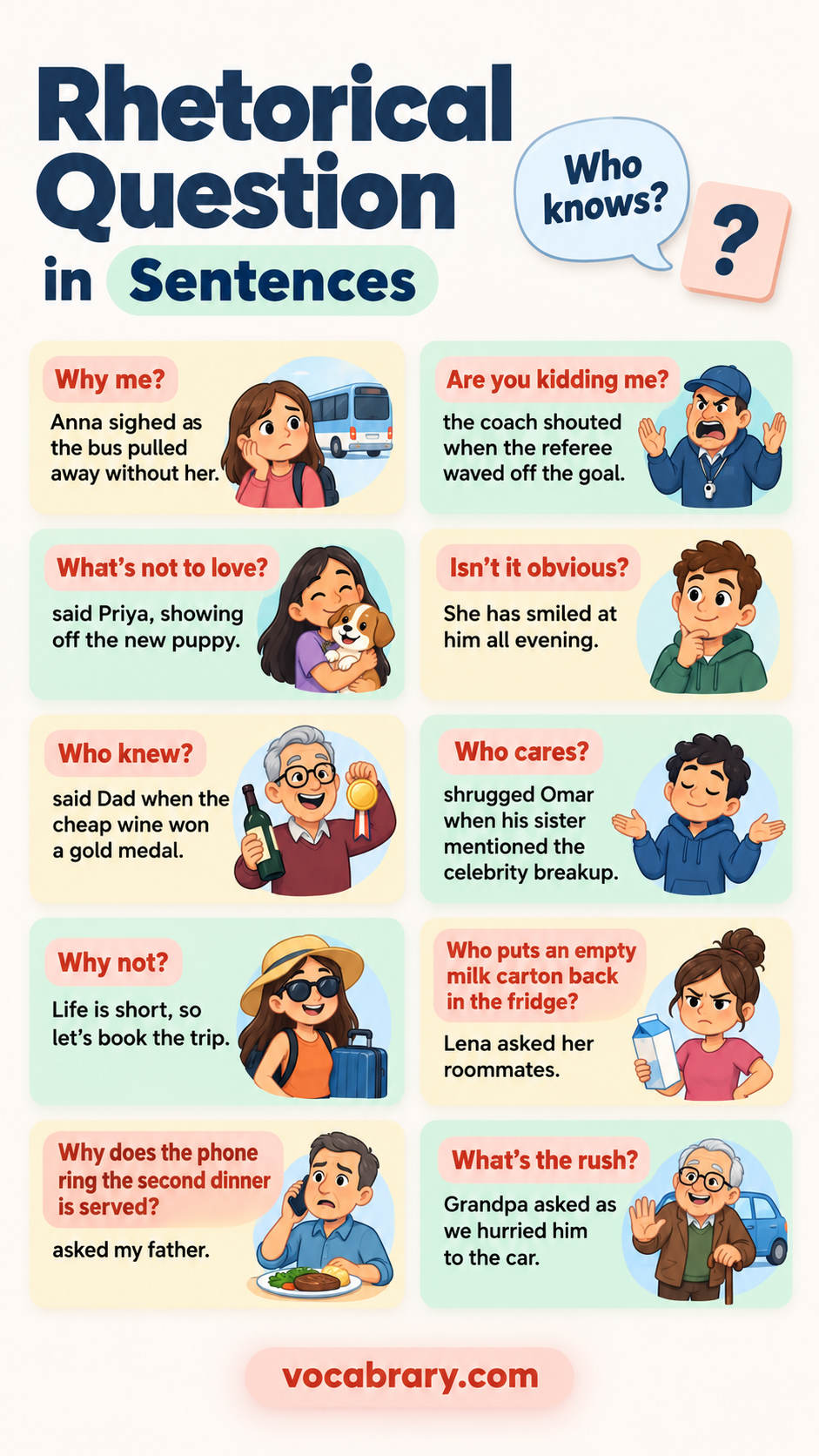
- "Why me?" Anna sighed as the bus pulled away without her.
- My brother saw the price of the festival tickets and muttered, "Who pays that much to stand in a muddy field?"
- "Are you kidding me?" the coach shouted when the referee waved off the goal.
- After losing his umbrella for the fourth time this month, Paul asked nobody in particular, "Why do I even bother?"
- The neighbors are throwing another party at 2 a.m., so who needs sleep anyway?
- Grandma looked at my messy bedroom and asked, "Were you born in a barn?"
- "What’s not to love?" said Priya, showing off the new puppy.
- When the quiz turned out harder than expected, Jake whispered, "Who writes these questions?"
- Tom orders the same burger every Friday, so when the waiter asked what he wanted, he said, "Do fish swim?"
- Isn’t it obvious? She has smiled at him all evening.
- Kim stared at the flooded basement and asked, "Why does this always happen to us?"
- What’s the purpose of ironing a shirt that you are going to wear under a sweater?
- "Who knew?" said Dad when the cheap wine won a gold medal.
- Offered dessert after a huge meal, Lucy replied, "Is that even a question?"
- Ben looked at the pile of homework and asked, "When will this ever end?"
- "Who cares?" shrugged Omar when his sister mentioned the celebrity breakup.
- Staring at the rain on her wedding morning, Rosa asked, "Why today of all days?"
- How hard is it to put the milk back in the fridge?
- "Did you really think I’d forget your birthday?" Mia asked, handing her friend a gift.
- Why not? Life is short, so let’s book the trip.
- After his team lost for the ninth straight week, my uncle asked, "What else is new?"
- The kids emptied the cookie jar in ten minutes, and Mom asked, "Did you leave any for the rest of us?"
Rhetorical Question Examples in Everyday Conversation
Roommates asking who put the empty milk carton back and drivers wondering why they left home in rush hour use rhetorical questions to complain, joke, or agree without starting a real debate.
- At the grocery store, the cashier looked at the long line and said, "Is everyone in town shopping today?"
- "Who puts an empty milk carton back in the fridge?" Lena asked her roommates.
- Stuck in traffic for the second hour, Mike asked, "Why did I think driving was faster?"
- My friend twirled in her new shoes and asked, "Aren’t they gorgeous?"
- "Do I look like a taxi service?" Dad asked when the kids wanted another ride to the mall.
- When the Wi-Fi dropped during the season finale, Sara groaned, "Seriously, right now?"
- At the office party, Jen whispered, "Who schedules a meeting at 4:55 on a Friday?"
- Carlos checked the price of a coffee at the airport and asked, "Is it made of gold?"
- "How many times do I have to say it?" Nora asked her husband about the wet towels on the bed.
- After a six-mile hike, Ahmed dropped onto the couch and said, "Is there anything better than a hot shower?"
- "Why does the phone ring the second dinner is served?" asked my father.
- My aunt tasted her sister’s soup and asked, "Who needs a restaurant when you cook like this?"
- "What’s the rush?" Grandpa asked as we hurried him to the car.
- Seeing the rain start an hour after he washed the car, Leo asked, "Why does this keep happening?"
- Who remembers to buy batteries before the remote dies?
- Pulling a moldy sandwich out of his son’s backpack, Victor asked, "Were you planning to grow a science project?"
- "Isn’t this weather perfect for a picnic?" Chen asked as the sun came out.
- When her sister borrowed her sweater again without asking, Kayla said, "Do you ever ask first?"
- In front of the broken vending machine, Jamal asked himself, "Why do I never learn?"
- "Who asked you?" snapped Tina when her cousin rated her haircut.
- On the first warm day of spring, the whole office sighed, "Why are we inside?"
Rhetorical Questions Parents and Teachers Ask
Parents asking "Do you think money grows on trees?" and teachers asking "Am I talking to myself?" use rhetorical questions to scold a child without waiting for an excuse.
- "How many times do I have to tell you to close the door?" Mom asked for the third time that week.
- Mr. Ellis looked at the silent class and asked, "Am I talking to myself?"
- "Do you think money grows on trees?" Dad replied when Zoe asked for new sneakers.
- "What time do you call this?" my mother asked when I came home at midnight.
- After finding gum under a desk, Ms. Ortiz asked the class, "Were you raised by wolves?"
- "If all your friends jumped off a bridge, would you jump too?" Grandpa asked.
- Pointing at the pencil drawings on the hallway wall, the principal asked, "Does this look like a sketchbook to you?"
- "Do I look like your maid?" Mom asked, pointing at the dirty laundry on the stairs.
- "Did I stutter?" Coach Rivera asked when nobody moved after the whistle.
- Our chemistry teacher saw half the class without goggles and asked, "Do you want to lose an eye?"
- "Who do you think you are?" Dad asked when my brother slammed his door.
- Mrs. Kim handed back the homework and asked, "Did anyone read the instructions?"
- "Are we going to have this conversation again?" my stepmom asked about my phone at dinner.
- When the twins fought over the tablet, their father asked, "Why do we even own nice gadgets?"
- "What did I just say?" Ms. Patel asked the boy who was still talking.
Funny Rhetorical Question Examples
Funny rhetorical questions such as why "abbreviated" is such a long word and why we park on driveways and drive on parkways point out the odd logic of English and of daily life.
- My nephew once asked, "Why is ‘abbreviated’ such a long word?"
- On the drive home, Luis wondered aloud, "Why do we park on driveways and drive on parkways?"
- "If a cow laughed, would milk come out of her nose?" joked the farmer’s daughter.
- Our English teacher loved puns and asked, "Why do noses run while feet smell?"
- At midnight, Hannah stood at the fridge and asked, "If I eat standing up, do the calories count?"
- "If you try to fail and succeed, which one did you do?" asked the debate club captain.
- Stuck on the highway, the commuter grumbled, "Why do they call it rush hour when nobody moves?"
- After the diet ended on day two, Frank asked, "Does carrot cake count as a vegetable?"
- "Why do I press harder on the remote when the batteries are dead?" laughed Maya.
- A bank teller once joked, "If money doesn’t grow on trees, why do banks have branches?"
- "Why is it called a building if it’s already built?" my little cousin asked with a grin.
- Watching his cat knock a glass off the counter, Raj asked, "Why do I pay for your food?"
- "Who decided that ‘phonetic’ should be spelled like that?" complained my spelling partner.
- Every week at the staff meeting, Greta asks, "Is it just me, or does Monday come twice a week?"
- According to Uncle Joe, the great mystery of travel is this: why do we pack suits in a garment bag and garments in a suitcase?
Sarcastic Rhetorical Question Examples
Sarcastic rhetorical questions like "Do you want a medal for that?" and "Oh, did you sleep well?" said to a late coworker mean the opposite of their polite words. More sarcasm example sentences show the same mocking edge.
- When Nate finally washed one plate, his sister asked, "Do you want a medal for that?"
- "Oh, did you sleep well?" the manager asked as Jess walked in an hour late.
- "Is it too much to ask for one quiet evening?" Paula asked as the neighbors started drilling.
- "Wow, how did you ever manage without me?" asked Sam after his roommate burned the rice again.
- "Should I roll out the red carpet too?" asked the receptionist when the client demanded a private elevator.
- "Aren’t you a ray of sunshine this morning?" Lisa asked her grumpy teenager.
- The printer jammed for the fifth time, and Greg asked, "Isn’t technology wonderful?"
- Mr. Grant greeted the student who arrived after lunch with "Oh, you made it, did you?"
- "Do you need a map to find the trash bin?" Kara asked her roommate.
- "What would we do without your advice?" said Rob after his cousin explained parallel parking for the tenth time.
- Dad called up the stairs, "Did you get lost in the fridge?" when Leo took twenty minutes to grab a drink.
- When the "express" train stopped at every station, one passenger asked, "What’s the slow train like, then?"
- "Is this a library or a zoo?" the librarian asked the shouting teenagers.
Types of Rhetorical Questions With Examples
Hypophora, epiplexis, and erotesis are the three rhetorical question types that rhetoric handbooks name most, and everyday speech adds questions with obvious answers and questions with no answer at all.
Hypophora (Anthypophora)
Hypophora, also called anthypophora, is a rhetorical question the speaker answers right away, as when a council member asks who pays for the stadium or a baker asks what makes good bread.
- "Who pays for the new stadium? You do, through a higher sales tax," the council member told the crowd.
- What do we want from this merger? We want lower costs and faster delivery.
- "Why did I become a nurse? Because a nurse held my hand when I was seven," Dana told the graduates.
- Is homework worth the stress? Only when it is short and meaningful, according to our school’s new policy.
- "What is the secret to a good loaf of bread? Time, and lots of it," the baker told her students.
- How did a tiny startup outsell the giants? It listened to customers the giants ignored.
- "Where did the money go? Straight into the manager’s vacation fund," the auditor revealed.
- Why should you vote on Tuesday? Because the park, the library, and the bus routes are all on the ballot.
- "What’s the best cure for jet lag? Sunlight and a long walk," the flight attendant advised.
- In his 1963 "I Have a Dream" speech, Martin Luther King Jr. repeated the question "When will you be satisfied?" and answered that marchers would never be satisfied while injustice continued.
- "So what did we learn this season? That teamwork wins games," Coach Diaz said at the banquet.
Epiplexis
Epiplexis is a rhetorical question asked to scold, to complain, or to express grief, as when a coach shouts "Where was the defense tonight?" or a mother at a funeral asks "Why him?"
- "How did you forget our anniversary again?" Mei asked her husband.
- "Where was the defense tonight?" the coach shouted in the locker room.
- At the funeral, his mother whispered, "Why him, and why so young?"
- "Have you no shame?" the judge asked the man who stole from the children’s charity.
- "Does nobody in this office read emails?" the director asked after the third missed deadline.
- "What were you thinking, driving in this storm?" her father asked at the hospital.
- "How long will you keep ignoring the leaking roof?" the tenant asked the landlord.
- At the Army-McCarthy hearings in 1954, lawyer Joseph Welch asked Senator Joseph McCarthy, "Have you no sense of decency?"
- "Why didn’t anyone call me?" Grandpa asked when he learned about the accident a week late.
- "Is this how you treat your friends?" Rachel asked after Tom skipped her party.
- "When will our leaders stop making excuses?" the protester shouted into the microphone.
Erotesis
Erotesis is a rhetorical question that strongly affirms or denies a claim, as when a captain asks "Shall we surrender after coming this far?" and every sailor hears a firm no.
- "Shall we surrender after coming this far?" the captain asked her exhausted crew.
- "Is there anyone here who wants dirtier air for their children?" the mayor asked.
- "Would any parent trade a child’s safety for a faster commute?" the road safety campaigner asked.
- Who would choose war if peace were an option?
- "Have we not paid enough already?" the farmers asked the tax office.
- At the town hall, a retired teacher asked, "Is honesty too much to expect from our leaders?"
- "Does anyone truly believe this plan will work?" the senator asked.
- "Are we really going to let one bad season define us?" the coach asked his players.
- "Isn’t every child worth a good school?" asked the union president.
- The pastor looked out at the congregation and asked, "Who among us has never made a mistake?"
Rhetorical Questions With Obvious Answers
"Is the Pope Catholic?", "Do bears like honey?", and "Does a duck swim?" come with answers so obvious that each question works as a strong yes.
- When I asked if he wanted free concert tickets, Dev said, "Is the Pope Catholic?"
- "Do bears like honey?" Mia replied when asked if her son wanted pancakes.
- Asked whether his retriever enjoyed the lake, Hugo laughed, "Does a duck swim?"
- "Is water wet?" Ellie asked when her friend wondered if the beach trip was a good plan.
- Our tour leader asked, "Is the Eiffel Tower in Paris?" when a tourist doubted the hotel’s location.
- "Does the sun rise in the east?" Grandpa asked when I wondered whether he still woke at five.
- Offered a second slice of her grandmother’s pie, Kira grinned, "Do birds fly?"
- "Is ice cold?" the chef asked when a new cook questioned the recipe.
- When his daughter asked if he was proud of her, Mr. Okafor asked, "Do you even have to ask?"
- "Do dogs bark?" said Nina when her neighbor asked whether the new puppy was noisy.
Rhetorical Questions With No Answer
"What is the meaning of life?" and "Where does the universe end?" have no agreed answer, so people ask them to provoke thought rather than to get a reply.
- Lying on the grass at night, Ella asked, "Where does the universe end?"
- "What is the meaning of life?" the philosophy professor asked on the first day of class.
- "Why do good people suffer?" asked the grieving widow.
- Martin wondered on his long commute, "What if I had taken the other job?"
- "Who decides what is beautiful?" the art critic asked in her weekly column.
- "If a tree falls in a forest and no one hears it, does it make a sound?"
- Flipping through old photos, Grandma asked, "Where did the years go?"
- "How do you put a price on a human life?" the lawyer asked the jury.
Persuasive Rhetorical Question Examples
Campaigners asking "Isn’t it time we acted?" and shelters asking "What if the lost dog were yours?" use persuasive rhetorical questions to lead an audience toward one answer.
- "Isn’t it time we acted on climate change?" the student asked the school board.
- "What if the lost dog were yours?" read the animal shelter’s flyer.
- The parents’ petition asked, "How much longer will we wait for safe crosswalks?"
- Do we really want our tax money spent on a golf course nobody uses?
- "Who benefits when the factory closes?" the union leader asked the crowd.
- "Would you drink the water from this river?" the environmental group asked on its poster.
- "Should a child have to walk three miles for safe drinking water?" the charity asked donors.
- At the rally, the speaker asked, "What will you tell your grandchildren you did?"
- "Are we a city that turns away the hungry?" the food bank director asked.
- "Why should women earn less for the same work?"
- "Is ten minutes of your time too much to save a life?" asked the blood drive volunteer.
- A letter to the editor asked, "How many more accidents will it take before the council installs a traffic light?"
- "Aren’t our teachers worth a fair wage?" chanted the crowd outside city hall.
- "Do you trust a company that hides its fees?" the consumer advocate asked viewers.
- In her campaign speech, the candidate asked, "If we don’t fix the roads, who will?"
Rhetorical Question Examples in Advertising
Slogans such as "Got Milk?" from 1993 and Wendy’s "Where’s the beef?" from 1984 are rhetorical question examples that make viewers answer in their heads, which keeps the brand in memory.
- The California Milk Processor Board launched "Got Milk?" in 1993, and nobody needed to answer it.
- In a 1984 Wendy’s commercial, actress Clara Peller demanded, "Where’s the beef?" to mock rivals’ small burgers.
- Dial soap ads of the 1960s and 1970s asked, "Aren’t you glad you use Dial?"
- Memorex cassette ads in the 1970s asked, "Is it live, or is it Memorex?"
- Capital One’s long-running slogan asks, "What’s in your wallet?"
- A gym billboard in December asked, "Why wait until January?"
- "Tired of paying too much for car insurance?" the radio ad asked.
- "Who says healthy food has to be boring?" read the cereal package.
- The café’s window sign asked, "Why settle for ordinary coffee?"
- "Isn’t your family worth the best?" asked the mattress commercial.
- "Ready for the vacation of a lifetime?" the travel agency’s email asked.
Rhetorical Question Examples at Work
A director asking who understands the clients better than the sales team and a colleague whispering about a meeting that was supposed to be an email use rhetorical questions to rally or vent.
- "Who understands these clients better than our own sales team?" the director asked at the kickoff.
- "Wasn’t this meeting supposed to be an email?" Priya whispered to her colleague.
- "Do we want to be the company that missed the next big trend?" the CEO asked investors.
- "Why reinvent the wheel?" Omar asked when the team proposed rebuilding the app from scratch.
- During the product review, the engineer asked, "What’s the worst that happens if we test it?"
- "Who reads the terms and conditions anyway?" joked the company lawyer.
- "Is anyone surprised the server crashed on launch day?" the IT lead asked.
- "Haven’t we all worked late on a project like this?" the manager asked the new hire.
- As the team debated the launch date for a third week, the founder asked, "If not now, when?"
- "Why is the printer always broken the day before a deadline?" sighed the office assistant.
Rhetorical Question Examples for Kids
Short questions like "Isn’t this puppy the cutest?" at the pet store and "Who ate all the cookies?" asked of a boy with chocolate on his face show kids the friendliest rhetorical questions.
- "Isn’t this puppy the cutest?" Lily asked at the pet store.
- "Who wants to go to bed early?" the babysitter asked, and every kid groaned.
- "Why is it always bedtime when the fun starts?" Jack asked his mom.
- "Isn’t the snow magical?" asked Ava, pressing her nose to the window.
- Dad looked at the boy with chocolate on his face and asked, "Who ate all the cookies?"
- When her brother called broccoli his favorite treat, Sofia laughed, "Is broccoli a dessert now?"
- "Do you think I was born yesterday?" asked Grandpa when Emma said the dog ate her homework.
- On Sunday night, Mateo sighed, "Why do Mondays come so fast?"
- Noah asked his classmates, "Isn’t recess the best part of the day?"
- Opening the back door, Mom asked, "Who wants to stay inside on a sunny day?"
- "Did you think the cat would share her bed?" Aunt Rose asked the crying toddler.
- Standing in front of the class with his fossil collection, Leo asked, "Are dinosaurs cool, or are dinosaurs cool?"
Rhetorical Question Examples for Students
Students asking "When will I ever use algebra?" in math class and "Why did I leave this until tonight?" before a deadline use rhetorical questions to vent the stress of school.
- "When will I ever use algebra in real life?" Marcus asked during math class.
- The night before the essay was due, Aisha asked herself, "Why did I leave this until tonight?"
- "Who schedules three exams on the same day?" grumbled the sophomores.
- "Is a B-minus the end of the world?" her tutor asked gently.
- In the middle of finals week, Pedro asked, "Why is the library printer broken again?"
- "Do I really need a fourth coffee?" Jada asked, already reaching for it.
- At 1 a.m., Ken told his roommate, "What’s one more chapter?"
- "Didn’t we cover this last week?" asked the professor when nobody answered.
- Packing up her dorm room, Chloe asked, "How is it already the end of the semester?"
- "Who reads the whole syllabus?" joked the teaching assistant on the first day.
Rhetorical Questions for Essay Hooks
Writers who open an essay with "What would you do with one extra hour a day?" or "Is a college degree still worth the debt?" prompt every reader to form a silent answer before the thesis arrives.
- Jonah’s essay on time management opened with "What would you do with one extra hour a day?"
- "Is social media making us lonelier?" began the essay that won the school writing contest.
- My essay on school uniforms began, "Does a blazer really make a student smarter?"
- "Who decides which books stay on a school library’s shelves?" opened Nia’s essay on censorship.
- The report on ocean pollution began with "How much plastic did you throw away today?"
- "What if the cure for cancer is hiding in a disappearing rainforest?" opened Lucas’s science essay.
- "Why do we still judge people by their handwriting?"
- Ryan began his essay on self-driving cars with "Would you trust a robot to drive your children to school?"
- "Is a college degree still worth the debt?" asked the first line of Maya’s economics paper.
- "What makes a hero?" asked the opening sentence of the seventh grader’s essay.
- "Have you ever wondered where your old phone ends up?" began the essay on electronic waste.
Rhetorical Questions in Argumentative Essays
Writers of argumentative essays ask "Should a child’s zip code decide the quality of their education?" or "What good is a law that nobody enforces?" to press a claim the reader already half accepts.
- Should a child’s zip code decide the quality of their education?
- If fast fashion is harmless, why are landfills full of barely worn clothes?
- Who gains when public parks are sold to developers? Certainly not the families who use them.
- How is it fair that a star athlete earns more in a week than a nurse earns in ten years?
- Critics call the four-day week lazy, but isn’t a rested worker a better worker?
- Do we honestly believe a ban will stop teenagers from vaping?
- What good is a law that nobody enforces?
- Supporters praise the new arena, yet why should taxpayers fund a stadium for a billionaire’s team?
Rhetorical Question Examples in Famous Speeches
Sojourner Truth’s "Ain’t I a Woman?" and Ronald Reagan’s "Are you better off than you were four years ago?" are famous speech lines in which the speaker lets the audience supply the answer.
- In the version of her 1851 Akron, Ohio, speech that Frances Gage published in 1863, Sojourner Truth repeats the question "Ain’t I a woman?"
- Frederick Douglass asked, "What, to the American slave, is your 4th of July?" in his 1852 speech in Rochester, New York.
- Patrick Henry asked the Virginia Convention in 1775 whether life was so dear, or peace so sweet, as to be bought at the price of chains and slavery.
- During his presidential debate with Jimmy Carter in 1980, Ronald Reagan asked voters, "Are you better off than you were four years ago?"
- At the end of the 1965 march from Selma to Montgomery, Martin Luther King Jr. asked "How long?" and answered, "Not long."
- Winston Churchill asked, "What is our aim?" in his first speech as prime minister in 1940 and answered that it was victory.
- Defending the moon program at Rice University in 1962, John F. Kennedy asked, "Why does Rice play Texas?"
- Before her 1873 trial for voting, Susan B. Anthony gave a speech across upstate New York titled "Is It a Crime for a Citizen of the United States to Vote?"
Rhetorical Question Examples in Literature
Shylock’s "Hath not a Jew eyes?", Juliet’s "What’s in a name?", and Scrooge’s "Are there no prisons?" are rhetorical question examples in literature in which one question reveals a character’s belief or pain.
Rhetorical Questions in Shakespeare
Shylock asking "If you prick us, do we not bleed?" and Juliet asking "What’s in a name?" show Shakespeare giving a character one question that argues a whole case.
- In The Merchant of Venice, Shylock asks, "If you prick us, do we not bleed?" to insist that Jews share the same humanity as Christians.
- Shylock opens the same speech in The Merchant of Venice with "Hath not a Jew eyes?"
- On her balcony in Romeo and Juliet, Juliet asks, "What’s in a name?" while arguing that Romeo’s family name should not keep them apart.
- Brutus asks the Roman crowd in Julius Caesar, "Who is here so base that would be a bondman?" and pauses for anyone offended.
- Mark Antony reminds the same crowd that Caesar refused a crown three times and asks, "Was this ambition?"
- Shakespeare’s Sonnet 18 opens with the question "Shall I compare thee to a summer’s day?"
- After murdering King Duncan, Macbeth asks whether all of great Neptune’s ocean will wash the blood from his hand.
Rhetorical Questions in Poems
Langston Hughes asking "What happens to a dream deferred?" and William Blake asking whether the maker of the Lamb also made the tiger show poets using questions that stay unanswered on purpose.
- Langston Hughes opens "Harlem" (1951) with "What happens to a dream deferred?" and follows it with a series of darker comparisons.
- In "The Tyger" (1794), William Blake asks the tiger, "Did he who made the Lamb make thee?"
- John Keats closes "Ode to a Nightingale" (1819) with the question "Do I wake or sleep?"
- Percy Bysshe Shelley ends "Ode to the West Wind" (1820) by asking whether spring is far behind once winter comes.
- William Carlos Williams asks in "Danse Russe," "Who shall say I am not the happy genius of my household?"
Rhetorical Questions in Plays and Novels
Faustus greeting Helen of Troy, Scrooge refusing to give to charity, and Alice wondering about a book without pictures show rhetorical questions in plays and novels.
- Faustus greets the spirit of Helen of Troy in Christopher Marlowe’s Doctor Faustus with "Was this the face that launched a thousand ships?"
- Asked for a donation in Charles Dickens’s A Christmas Carol (1843), Scrooge replies, "Are there no prisons?"
- Later in A Christmas Carol, the Ghost of Christmas Present throws "Are there no prisons?" back at Scrooge.
- Alice wonders in the opening paragraph of Lewis Carroll’s Alice’s Adventures in Wonderland (1865) what the use of a book is without pictures or conversations.
- Jane asks Rochester in Charlotte Brontë’s Jane Eyre (1847) whether he thinks she is soulless and heartless because she is poor and plain.
Rhetorical Questions in the Bible
Cain asking "Am I my brother’s keeper?" and Paul asking "O death, where is thy sting?" are rhetorical questions from the Bible that believers still quote today.
- Cain answers God’s question about Abel in Genesis 4:9 with "Am I my brother’s keeper?"
- God asks Job in Job 38:4, "Where wast thou when I laid the foundations of the earth?"
- Paul asks in 1 Corinthians 15:55, "O death, where is thy sting?"
- Jesus asks in Mark 8:36 what it profits a man to gain the whole world and lose his own soul.
- During the Sermon on the Mount in Matthew 6:27, Jesus asks whether anyone adds a single hour to life by worrying.
- Romans 8:31 has Paul asking who has any power against believers if God is on their side.
Rhetorical Question Examples in Pop Culture
Travis Bickle’s "You talkin’ to me?" and Marvin Gaye’s "What’s Going On" show rhetorical questions in film and music, where one line becomes a catchphrase or a protest.
Movies and TV
Maximus shouting "Are you not entertained?" in Gladiator and the Joker asking "Why so serious?" in The Dark Knight are movie questions that no character stops to answer.
- Robert De Niro’s Travis Bickle asks his own reflection in Taxi Driver (1976), "You talkin’ to me?"
- After a brutal fight in Gladiator (2000), Maximus shouts at the arena crowd, "Are you not entertained?"
- The Joker asks "Why so serious?" in The Dark Knight (2008).
- Harry Callahan tells a wounded robber in Dirty Harry (1971) to ask himself, "Do I feel lucky?"
- Regina George asks Janis in Mean Girls (2004), "Why are you so obsessed with me?"
- Jerry Seinfeld built stand-up bits on the opener "What’s the deal with…?" and never waited for a reply.
Songs
Marvin Gaye’s "What’s Going On" and Pete Seeger’s "Where Have All the Flowers Gone?" are protest songs built on title questions that the singers never answer directly.
- Marvin Gaye’s 1971 song "What’s Going On" poses its title as a question about war and violence without offering a tidy answer.
- Bob Dylan’s "Blowin’ in the Wind" (1963) asks a series of questions about war and freedom and names the wind as the answer.
- Tina Turner’s 1984 hit "What’s Love Got to Do with It" treats its title question as if the answer is nothing.
- Pete Seeger’s "Where Have All the Flowers Gone?" repeats its title question verse after verse as an antiwar lament.
- The Baha Men’s 2000 hit "Who Let the Dogs Out" repeats a question the song never answers.
- Band Aid’s 1984 charity single "Do They Know It’s Christmas?" asked British listeners to think about famine in Ethiopia.
Related
FAQs
A rhetorical question that the speaker answers right away is called hypophora, also known as anthypophora. Winston Churchill used it in 1940 when he asked what Britain’s aim was and then answered that it was victory. A pure rhetorical question, by contrast, leaves the answer unspoken.
Yes, a rhetorical question ends with a question mark in standard English, even though nobody is expected to reply. Writers who want an angry effect end one with an exclamation mark or an interrobang, but that is a stylistic choice. The question mark rules on englishan.com confirm the standard practice.
No, a rhetorical question is not meant to be answered aloud, because the speaker already knows the answer or believes none exists. The listener answers silently, and that silent answer is the effect the speaker wants. Replying "Yes" to "Do you think I’m made of money?" misses the speaker’s intent.
No, rhetorical questions are not bad in essays when one or two appear at a strong moment, such as the opening hook or the final paragraph. Teachers mark down essays that ask five questions in a row instead of making claims. Formal research papers limit them further, since an argument needs statements backed by evidence.
Yes, the rhetorical question counts as both a literary device and a rhetorical device. Poets and novelists use it to reveal a character’s feelings, as Shakespeare does with Juliet’s "What’s in a name?", while speakers use it to persuade a crowd.
Yes, most teachers classify the rhetorical question as a figure of speech, because the question means something other than its literal words. "Who doesn’t love pizza?" literally asks for a name but actually states that everyone loves pizza. Teachers group it with metaphor, hyperbole, and irony among the common figures of speech.
No, rhetorical questions are not rude by nature, and they sound rude only when they scold or mock, as in "What is wrong with you?" Friendly ones like "Isn’t this view amazing?" invite agreement and sound warm. The speaker’s intent and the setting decide whether the question sounds polite.
Some rhetorical questions are sarcastic, but many are sincere. "Do you want a medal?" said to a person who washed one dish is sarcastic, while "Isn’t life wonderful?" said on a sunny beach is heartfelt. Sarcastic ones overlap with verbal irony examples, where the speaker means the opposite of the words.
You know a question is rhetorical when the context makes the answer obvious or makes a reply pointless. Check whether the speaker pauses for an answer and whether anyone actually replies. A parent asking "What time do you call this?" at midnight wants an apology, not the time.
Rhetorical questions make a reader pause and answer silently, which draws the reader into the argument. That silent answer feels like the reader’s own conclusion, so the writer’s claim becomes more persuasive. They also add emotion, from anger to wonder.
People use rhetorical questions to persuade, to show emotion, to add humor, and to make listeners think. A campaigner asking "Isn’t it time we acted?" persuades, a tired parent asking "Why me?" vents, and a comedian asking why we park on driveways gets a laugh.
Synonyms for rhetorical question are erotema, erotesis, and the Latin term interrogatio, all names from classical rhetoric. In everyday English, people also say "a question asked for effect" or "a question that needs no answer."
Yes, Jesus used rhetorical questions throughout the Gospels. In Mark 8:36 he asks what it profits a man to gain the whole world and lose his own soul, and in Matthew 6:27 he asks whether worrying adds a single hour to anyone’s life.

Leave a Comment