
Juxtaposition is a literary device in which two unlike people, places, or images appear side by side so the reader compares them, as when a homeless man sleeps outside a luxury jewelry store. The most familiar juxtaposition examples in sentences set wealth beside poverty, youth beside age, or noise beside silence in one scene.
What Is Juxtaposition?
Juxtaposition is the deliberate placement of two contrasting people, objects, scenes, or moods close together, so the reader notices what separates them. Unlike antithesis, which demands opposite claims in matching grammar, juxtaposition needs only closeness, and the two halves need not be exact opposites.
At the wedding reception, the bride laughed on the dance floor while her grandmother wept quietly by the door.
Common Juxtaposition Examples in Sentences
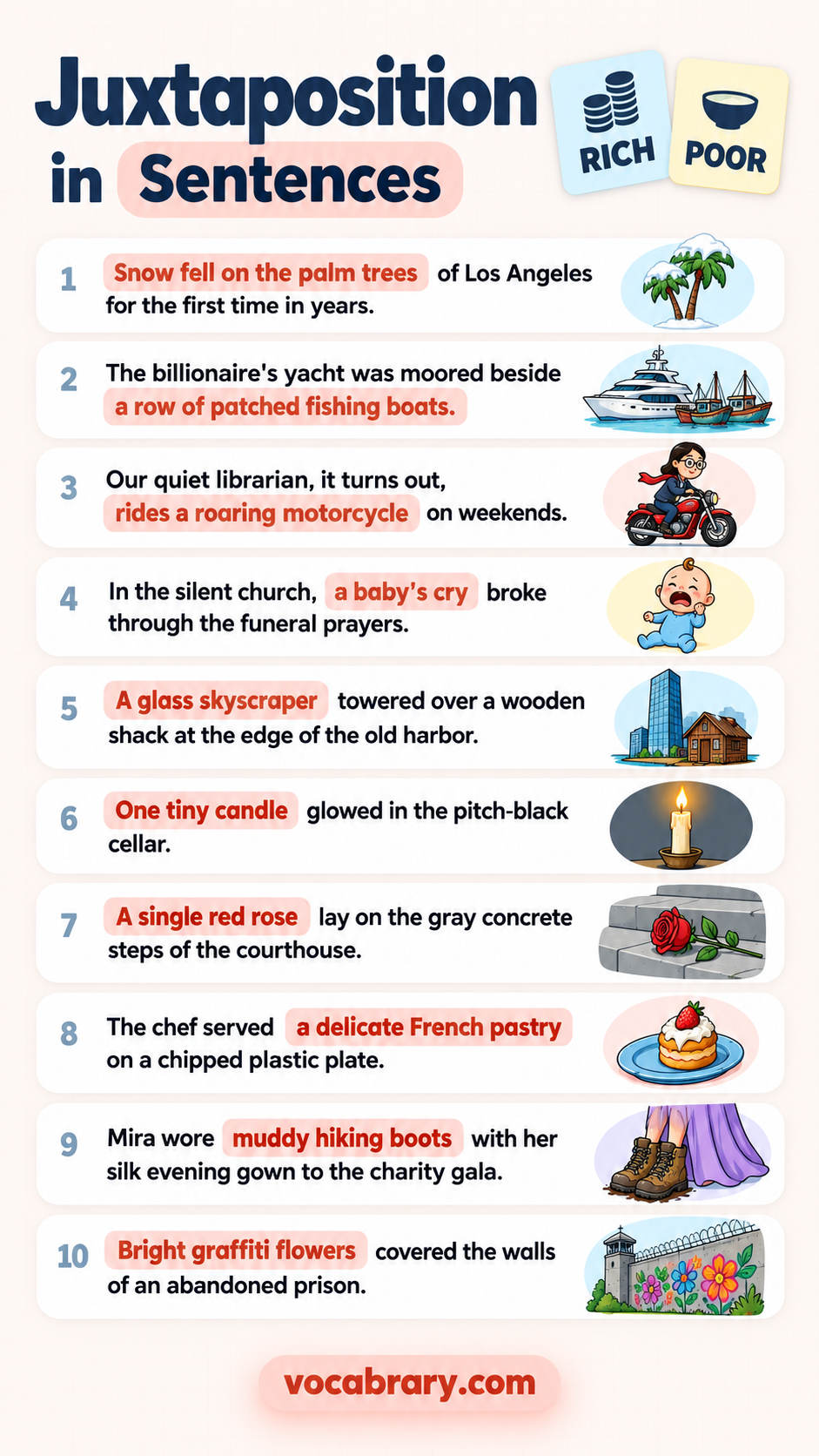
A beggar outside a jewelry store, a crying baby at a silent funeral, and a skyscraper beside a wooden shack are the textbook juxtaposition examples in sentences, where one image makes the other look sharper.
- A barefoot beggar asked for coins outside a jewelry store selling ten-thousand-dollar watches.
- In the silent church, a baby’s cry broke through the funeral prayers.
- A glass skyscraper towered over a wooden shack at the edge of the old harbor.
- Grandpa typed on his brand-new tablet while wearing the same cardigan he bought in 1979.
- One tiny candle glowed in the pitch-black cellar.
- At the marathon finish line, exhausted runners collapsed beside cheering children with balloons.
- Our new neighbor drives a gleaming red sports car but parks it outside a crumbling farmhouse.
- A single red rose lay on the gray concrete steps of the courthouse.
- Why did the toddler fall asleep so peacefully in the middle of the noisy stadium?
- Laughter from the party next door drifted into the room where Rosa was grieving her father.
- The chef served a delicate French pastry on a chipped plastic plate.
- Snow fell on the palm trees of Los Angeles for the first time in years.
- Mira wore muddy hiking boots with her silk evening gown to the charity gala.
- On the same street, a family ate a ten-course dinner while a stray dog searched the trash for scraps.
- A heavy-metal drummer spent his Sunday mornings knitting baby blankets for the hospital.
- Bright graffiti flowers covered the walls of an abandoned prison.
- The billionaire’s yacht was moored beside a row of patched fishing boats.
- Children played tag in the ruins of a bombed-out school.
- Our quiet librarian, it turns out, rides a roaring motorcycle on weekends.
- An ancient oak tree grew in the parking lot of a shiny new mall.
- The soldier’s letter home described the mud and gunfire of the trench beside memories of his mother’s garden.
- A hospital’s newborn ward is only one floor away from its intensive care ward.
- Tariq built a modern glass kitchen inside a four-hundred-year-old stone cottage.
- There was a smiling clown at the bus stop, and beside him a businessman frowning at his phone.
- Nobody expected a bright yellow tulip to bloom in the cracked sidewalk outside the factory.
Juxtaposition Examples in Everyday Life
Daily juxtaposition turns up in kitchens, offices, and school gates, as when a spotless new sofa meets a muddy dog or a tired nurse walks home past a crowd of partygoers.
- Dad’s spotless white sofa met our muddy golden retriever within an hour of delivery.
- At six in the morning, a tired night nurse walked home past a crowd of partygoers still dancing.
- My sister’s side of the bedroom is perfectly tidy, and mine looks like a hurricane went through it.
- On her first day, a nervous new intern shared an elevator with the calm, gray-haired CEO.
- The kitchen smelled of fresh cinnamon rolls and burnt toast at the same time.
- Leo spent three hours on a gourmet sauce and then served it over instant noodles.
- A toddler in a superhero cape held his mother’s hand in the long, silent queue at the tax office.
- Before the storm, the sky over the soccer field turned pitch black while the grass still glowed in the sunlight.
- Why does Grandma keep a smartphone right next to her wind-up alarm clock?
- A wedding party in bright saris posed for photos beside a group of mourners in black outside the same hall.
- Mateo runs a noisy daycare on the ground floor, and a meditation studio rents the flat upstairs.
- The gym had a vending machine full of candy bars right next to the scales.
- One sunny window seat was empty, while the rest of the café sat in shadow.
- Aiko wore a formal suit jacket over pajama bottoms for her video interview.
- A fire alarm shrieked in the middle of the school’s silent exam hall.
- At the airport gate, one couple was kissing goodbye and another was hugging after years apart.
- Our dentist’s waiting room offers free lollipops and chocolate bars.
- A rusty old bicycle was chained to a shiny electric car charger outside the office.
- Nobody in the family missed Uncle Ray’s loud jokes at the formal dinner for Grandma’s ninetieth birthday.
- Cold rain hit the windows while the fireplace crackled in the living room.
Juxtaposition Examples in Nature
Nature writers find their sharpest juxtaposition in deserts, volcanoes, and snowfields, such as a green oasis in golden sand or red lava meeting blue ocean water.
- A green oasis appeared in the middle of miles of golden sand.
- Red-hot lava hissed as it poured into the cold blue Pacific off the coast of Hawaii.
- Beside a huge, ancient redwood, a tiny hummingbird fed on wild honeysuckle.
- Snow covered the mountain peak while wildflowers bloomed in the valley.
- The calm lake reflected a raging forest fire on the far shore.
- A newborn fawn wobbled across the fallen trunk of a dead oak.
- After the wildfire, bright green shoots pushed up through the black ash.
- Soft moss grew on the sharp volcanic rock.
- In early spring, crocuses bloom through the last patches of snow.
- For one blinding second, a lightning bolt lit up the peaceful meadow.
- Have you ever seen a rainbow arch over a stormy gray sea?
- The lion slept a few meters from a grazing herd of zebras.
- Icy glaciers end in the same fjords where warm summer tourists swim.
- On the dry, cracked desert floor, a single cactus flower opened overnight.
- Under the full moon, the silver beach met the black water without a sound.
- Nothing about the gentle, sleepy volcano hinted at the eruption that buried Pompeii in AD 79.
Juxtaposition Examples in City Life
Luxury towers beside tent camps, rooftop gardens over traffic jams, and night-shift cleaners in empty banks show wealth and hardship side by side on the same city street.
- Luxury apartment towers look down on a tent camp under the highway bridge.
- A rooftop garden full of bees buzzed quietly over a six-lane traffic jam.
- At midnight, night-shift cleaners mopped the marble floors of an empty bank worth billions.
- A tiny corner bakery has survived for sixty years between two giant chain stores.
- Street musicians played a soft violin tune over the roar of the subway trains.
- In Times Square, flashing billboards light up a homeless man sleeping on cardboard.
- A fancy restaurant throws away trays of bread every night beside a line of hungry people at the shelter.
- In the heart of London, glass office towers surround a medieval church.
- Commuters in dark business suits rushed past a tourist in a bright Hawaiian shirt.
- Why is there a peaceful Japanese garden hidden behind the busiest train station in the city?
- Neon signs flickered over the dark, empty alley.
- At the red light, a horse-drawn carriage waited beside a humming electric bus.
- Every morning, fresh flowers arrive at the market next to piles of yesterday’s garbage bags.
- Children splashed in a fountain only steps away from a protest with police in riot gear.
- Central Park’s green meadows spread out inside a grid of concrete and steel.
- Not one of the rich shoppers on Fifth Avenue looked at the street vendor selling socks for a dollar.
Character Juxtaposition Examples
Twin sisters with opposite habits, a gentle giant beside a tiny boss, and a cheerful optimist paired with a gloomy roommate show how writers place two characters together so each one’s traits look stronger.
- Nina is loud and reckless, while her twin sister Nora never shouts or breaks a rule.
- Every day in the story, the gentle giant takes orders from a tiny, bad-tempered boss.
- Cheerful Maya shares a flat with Tom, who expects disaster every morning.
- Of the two brothers, Omar gives away his lunch money, and Sami counts every coin he owns.
- The young rookie cop trembled at the crime scene beside his calm, gray-haired partner.
- Our villain wears a spotless white suit, but the hero’s jacket is torn and bloodstained.
- Next to her fashionable cousin from Paris, shy farm girl Lucy felt invisible at the ball.
- The wise old teacher spoke slowly, while his impatient student interrupted every sentence.
- Who would ever picture the timid accountant and the famous stunt pilot as best friends?
- In the comic, a huge, grumpy bear is best friends with a tiny, hyperactive mouse.
- The honest farmer trusted everyone, but his smooth-talking neighbor trusted no one.
- Grandma Ruth plans every meal a week ahead, and her grandson Kai decides at midnight.
- In the fairy tale, the kind younger brother shares his bread, and the greedy older brother hides his.
- A brave little girl led the rescue while the tall, strong guards hid behind the gate.
- Surrounded by gold, the rich king envied the poor shepherd, who slept well every night.
- Our coach paired the fastest runner with the slowest walker.
- Nobody laughed at the clown’s jokes, yet everyone laughed at the serious mayor’s accidental slip.
Setting Juxtaposition Examples
Birdsong on the morning a war begins, a candlelit dinner during a storm, and a golden palace over a starving village are setting juxtapositions, where the place suggests one feeling and the event its opposite.
- Birds sang in the orchard on the morning the war began.
- Rain lashed the windows while the couple ate a candlelit dinner inside.
- A golden palace rose over a starving village in the valley.
- The film opens on a sunny family picnic and cuts to a dark, flooded basement.
- During the blackout, fireworks lit up the sky over the silent, dark hospital.
- Gentle piano music played in the hotel lobby while the flood crept up the steps outside.
- In the novel, the castle ballroom glitters on the same night the peasants burn the fields.
- Snow fell softly on the peaceful village as soldiers marched through its square.
- Is there anything stranger than a cheerful ice-cream truck driving through a deserted war zone?
- The children’s playground is fenced off next to the old cemetery.
- Warm lights glowed in the farmhouse while wolves howled in the frozen woods.
- This horror movie takes place in a bright, perfect suburb with a murderer next door.
- A summer wedding was held on the beach where the shipwreck victims had washed ashore a century earlier.
- Sunlight streamed into the prison cell through one narrow window.
- Kidnappers hid their captive in a cheerful pink cottage beside a busy school.
Juxtaposition Examples in Literature
Charles Dickens, William Shakespeare, and F. Scott Fitzgerald built whole scenes on juxtaposition, setting London beside Paris, love beside family hatred, and glittering mansions beside a gray wasteland.
Juxtaposition in Charles Dickens
Dickens opens A Tale of Two Cities (1859) with a chain of paired opposites, and in Great Expectations and A Christmas Carol he sets rich rooms beside poor ones and cold hearts beside warm ones.
- A Tale of Two Cities opens by calling its era "the best of times" and, in the same breath, the worst of times.
- Dickens goes on to pair an age of wisdom with an age of foolishness and a spring of hope with a winter of despair.
- Dickens’s novel moves between quiet, orderly London and Paris in revolution, the two cities of its title.
- Gentle Lucie Manette is set against Madame Defarge, who quietly knits the names of people she wants executed.
- Sydney Carton, a drunken, wasted lawyer, looks almost exactly like Charles Darnay, a principled nobleman, and dies in his place.
- In Great Expectations, Joe Gargery’s warm, humble forge is the opposite of Miss Havisham’s dark house, where every clock stopped at twenty to nine.
- Miss Havisham still wears her yellowed wedding dress decades after the groom abandoned her.
- A Christmas Carol moves from Scrooge’s cold, silent counting-house to Mr. Fezziwig’s noisy, joyful Christmas dance.
- The poor Cratchit family enjoy a small, happy Christmas dinner, while wealthy Scrooge has turned down his nephew’s invitation to dine.
- The starving workhouse boys of Oliver Twist receive thin gruel from a board of well-fed gentlemen.
Juxtaposition in Shakespeare
Romeo and Juliet, Macbeth, and Hamlet all place tender or comic moments right beside violence, so the audience feels both at once.
- In Romeo and Juliet, Romeo falls in love with Juliet at the Capulet feast while Tybalt demands a fight a few steps away.
- Juliet learns that her "only love" comes from her "only hate," the family her own family despises.
- From the dark orchard, Romeo compares Juliet at her window to the sun rising in the east.
- Friar Laurence notes that one small flower hides both poison and medicine.
- Mercutio keeps joking even as he dies from Tybalt’s sword.
- The Capulets’ wedding music and feast turn into funeral hymns when Juliet is found apparently dead.
- Right after King Duncan’s murder, Macbeth brings on a drunken porter’s comic speech.
- Lady Macbeth tells her husband to look like the innocent flower but be the serpent under it.
- Two gravediggers trade jokes in Hamlet while digging Ophelia’s grave.
- King Lear opens with Cordelia’s honest silence beside her sisters’ flattering speeches.
- The honest Othello trusts scheming Iago because everyone calls Iago "honest."
- In Henry IV, Part 1, Prince Hal plans to shine like "bright metal on a sullen ground" once his wild youth ends.
Juxtaposition in Novels
Mary Shelley, F. Scott Fitzgerald, and William Golding pair unlikely characters and settings in their novels, such as Gatsby’s parties beside the Valley of Ashes or Ralph’s conch beside Jack’s spears.
- In The Great Gatsby, Gatsby’s glittering mansion parties contrast with the gray, dusty Valley of Ashes.
- Hundreds of guests attend Gatsby’s parties, yet almost nobody comes to his funeral.
- Old-money East Egg faces new-money West Egg across the bay on Long Island.
- Mary Shelley’s Frankenstein has the creature speak with eloquence and learning despite his terrifying appearance.
- Dr. Jekyll, a respected physician, and Mr. Hyde, a brutal stranger, turn out to be the same man.
- In Lord of the Flies, Ralph’s conch and meetings compete with Jack’s painted hunters and spears.
- Golding ends the novel with a naval officer in a crisp white uniform looking at a crowd of filthy, painted boys.
- The island’s beautiful lagoon becomes the place of brutal killings.
- Boo Radley, the neighbor the children fear in To Kill a Mockingbird, turns out to be the man who rescues Jem and Scout from an attacker.
- Harper Lee places Scout’s innocent chatter in front of an angry mob outside the jail, and the mob leaves.
- John Steinbeck’s small, quick-thinking George wanders from ranch to ranch with huge, childlike Lennie in Of Mice and Men.
- At the end of Animal Farm, the animals look from pig to man and from man to pig and are unable to tell them apart.
- Emily Brontë’s wild, windswept Wuthering Heights faces the calm, refined Thrushcross Grange across the moors.
- Jane Austen sets sensible Elizabeth Bennet against her reckless youngest sister, Lydia, in Pride and Prejudice.
- Harry Potter sleeps in a cupboard under the stairs, while his cousin Dudley complains about getting only thirty-six birthday presents.
- Gulliver’s Travels makes Gulliver a giant among the tiny Lilliputians and later a tiny man among giants in Brobdingnag.
- Joseph Conrad’s Heart of Darkness describes a French warship firing its guns into the vast, silent African coast.
- Suzanne Collins sets the Capitol’s feasts and fashions against the hunger and coal dust of District 12 in The Hunger Games.
Juxtaposition Examples in Poetry
William Blake’s lamb and tiger, Ezra Pound’s crowded metro faces and wet petals, and Percy Shelley’s boastful king in an empty desert are poetry’s best-known juxtapositions, placing two images close so the reader compares them.
- William Blake paired the gentle lamb of Songs of Innocence with the fiery tiger of Songs of Experience.
- In "In a Station of the Metro," Ezra Pound sets faces in a crowded Paris station beside petals on a wet, black bough.
- Percy Shelley’s "Ozymandias" carves a king’s boast about his mighty works on a broken statue in an empty desert.
- Wilfred Owen’s "Dulce et Decorum Est" sets the old Latin motto about a sweet death for one’s country against a soldier choking on poison gas.
- Coleridge’s sailors in "The Rime of the Ancient Mariner" are surrounded by endless seawater yet have not one drop to drink.
- Robert Frost’s traveler admires woods "lovely, dark and deep" but remembers the promises he has to keep.
- Walt Whitman’s "O Captain! My Captain!" sets bells and cheering crowds beside the captain lying dead on the deck.
- Shakespeare’s Sonnet 130 places his mistress’s plain looks next to the sun, coral, and roses of ordinary love poems.
- T. S. Eliot’s "The Waste Land" opens with April lilacs growing out of dead land.
- In "The Love Song of J. Alfred Prufrock," Eliot compares a soft evening sky to a patient lying unconscious before surgery.
- John Keats sets the nightingale’s timeless song against a human world of illness, age, and death in "Ode to a Nightingale."
- Does any poem place innocence and terror closer together than Blake’s two companion books?
Juxtaposition Examples in Film and TV
Steven Spielberg’s beach crowds with a hidden shark beneath them, Francis Ford Coppola’s baptism cut against murders, and the red coat in Schindler’s List show how directors place two images together on screen.
- In Jaws (1975), happy swimmers splash at the beach while the shark glides toward them underwater.
- The Godfather (1972) cuts between Michael Corleone at his nephew’s baptism and the killings he has ordered against rival bosses.
- Steven Spielberg shot Schindler’s List in black and white but gave one little girl a red coat.
- The Wizard of Oz (1939) moves from sepia-toned Kansas to the bright Technicolor land of Oz.
- In Parasite (2019), a rainstorm floods the Kim family’s semi-basement home on the same night the wealthy Parks stay warm and dry in their hilltop house.
- Titanic (1997) cuts from a stiff first-class dinner to a wild Irish dance party in steerage.
- Colonel Kilgore in Apocalypse Now (1979) orders his men to go surfing in the middle of a violent battle.
- Grumpy old Carl and eager young scout Russell fly away together in Up (2009).
- Toy Story (1995) places Woody, an old-fashioned cowboy doll, beside Buzz Lightyear, a shiny new astronaut action figure.
- Joy and Sadness, two opposite emotions, travel side by side through Riley’s mind in Inside Out (2015).
- Breaking Bad turns mild chemistry teacher Walter White into a ruthless drug kingpin.
- In Shrek (2001), a smelly, grumpy ogre plays the hero, and the short, vain Lord Farquaad plays the villain.
- Handsome Gaston turns out to be the true monster of Beauty and the Beast (1991), while the Beast turns out to be gentle.
- Stranger Things places a cozy 1980s small town directly beside the dark, monster-filled Upside Down.
- Game of Thrones turned a joyful wedding feast into a massacre in the 2013 episode fans call the Red Wedding.
- Why do horror films love a child’s gentle lullaby playing over a scene of pure dread?
Juxtaposition Examples in Art and Photography
Marc Riboud’s flower facing bayonets, René Magritte’s night street under a daylight sky, and the Fearless Girl statue facing Wall Street’s bull are famous visual juxtapositions, where the viewer’s eye moves between two clashing images.
- Marc Riboud’s 1967 photograph shows a young protester offering a flower to a row of soldiers with bayonets.
- In 2017, the bronze Fearless Girl was placed facing the huge Charging Bull on Wall Street.
- René Magritte’s The Empire of Light paints a dark night street under a bright daytime sky.
- Salvador Dalí’s The Persistence of Memory (1931) drapes soft, melting clocks over a calm, sunlit shoreline.
- Marcel Duchamp sent an ordinary porcelain urinal to an art exhibition in 1917 and titled it Fountain.
- Andy Warhol hung pictures of Campbell’s soup cans on the walls of a fine art gallery.
- Caravaggio’s The Calling of Saint Matthew cuts a sharp beam of light across a dark tavern room.
- Banksy’s famous stencil shows a masked rioter throwing a bouquet of flowers instead of a firebomb.
- Duchamp drew a mustache and goatee on a postcard of the Mona Lisa in 1919.
- The photographer placed a newborn’s tiny hand inside her great-grandfather’s wrinkled palm.
- One red umbrella bobbed in a sea of black ones.
- One prize-winning photo showed a tiny hiker on the edge of an enormous glacier.
- For the magazine cover, the artist posed a ballerina in a pink tutu inside a greasy auto repair shop.
- Isn’t a bright green sprout in an old rusty pail the entire message of that poster?
Juxtaposition Examples in Advertising
Before-and-after photos, Apple’s relaxed Mac guy beside a stiff PC guy, and Betty White playing muddy football for Snickers are advertising juxtapositions, placing the product’s world next to the problem the brand claims to fix.
- Apple’s "Get a Mac" ads placed a relaxed young man in jeans beside a stiff, nervous man in a suit to compare two computers.
- A 2010 Snickers ad showed Betty White, then in her eighties, getting tackled in a rough game of backyard football.
- One detergent commercial showed a mud-covered football jersey next to the same jersey, bright white after one wash.
- The gym’s billboard put a tired, slouching "before" photo next to a smiling, confident "after" photo.
- In the ad for the new compact SUV, a tiny sports car was parked beside a monster truck.
- Our bakery’s poster shows a gray, rainy Monday street outside and a warm, golden croissant inside the window.
- One airline ad set a cramped, crying economy cabin against its quiet, roomy new seats.
- Last year a coffee brand filmed a sleepy office worker yawning and then the same worker sprinting up the stairs.
- Charity posters place a smiling child with safe drinking water beside a child drinking from a muddy river.
- Why do phone ads love to show a crowded, noisy subway next to a woman smiling in her noise-canceling headphones?
- The ice cream commercial shows a sweaty family on a scorching beach and then a frosty cone dripping with cold.
- A giant old television set next to a paper-thin new screen made up the electronics store’s entire campaign.
- Nobody forgets the insurance ad where a peaceful family picnic is interrupted by a falling tree.
Funny Juxtaposition Examples
A bodybuilder walking a tiny poodle, a knight in armor ordering a latte, and a grandmother winning a skateboard contest are funny juxtapositions, where the joke comes from two images that do not belong together.
- A huge, tattooed bodybuilder was walking a tiny pink poodle in a sweater.
- Standing in line at the café, a knight in full armor ordered an oat-milk latte.
- Seventy-eight-year-old Grandma June outscored a crowd of teenagers at the skateboard contest.
- Our cat ignores the expensive velvet bed we bought and sleeps in a soggy cardboard carton instead.
- Every zoo’s most formal guest, the tuxedoed penguin, waddles like a toddler.
- The CEO gave a serious speech about profits while wearing bunny slippers on the video call.
- Our neighbor’s tiny chihuahua barked furiously at a sleepy Great Dane twenty times its size.
- At the black-tie gala, the famous opera singer hummed along to a cartoon theme song.
- Why was there a rubber duck floating in the fancy hotel’s marble fountain?
- A bearded biker in a leather jacket sipped tea from a flowery china teacup.
- The toddler wore a fireman’s helmet, one rain boot, and a sparkly tutu to the grocery store.
- Dad’s gray suit clashed with his dinosaur tie.
- Not a single guest expected a mariachi band to show up at a silent meditation retreat.
- In the dealership parking lot, a goat perched on the roof of a brand-new sports car.
Juxtaposition Examples for Kids
Children notice juxtaposition in big and little or hot and cold, as when a tiny ant drags a crumb past a giant boot or an ice cube melts on a sunny sidewalk.
- A tiny ant dragged a crumb right past a giant muddy boot.
- An ice cube melted fast on the hot, sunny sidewalk.
- The puppy’s loud barking woke the sleeping baby.
- My big brother’s shoes look like boats next to my little sister’s sandals.
- A black cat curled up on a pile of fresh white snow.
- At the zoo, the tall giraffe bent down to look at the short turtle.
- One dark cloud floated across the bright blue sky.
- Mia ate a hot bowl of soup after building a snowman in the freezing yard.
- Is the smallest kitten really the boss of the biggest dog in the house?
- The old teddy bear with one eye sat beside the shiny new robot toy.
- Grandpa told a slow, sleepy story while the kids jumped on the trampoline.
- A bright yellow duckling swam next to a huge gray swan.
- Sweet strawberries and sour lemons filled the same fruit bowl.
- Our classroom was noisy at recess but silent during the reading test.
- Jake built a tall tower of wooden bricks right next to his baby sister’s tiny pile.
- Nobody noticed the quiet mouse hiding behind the loud, ticking clock.
Juxtaposition Examples for Students
Students meet juxtaposition in exam halls, cafeterias, and literature essays, as when an honor student shares a desk with the class clown or an essay notes how Golding sets Piggy’s glasses against the boys’ fire.
- The honor student shared a desk with the class clown for the whole semester.
- On report card day, one friend screamed with joy while the other stared silently at her grades.
- The quiet library is right next to the noisy cafeteria.
- In my essay, I argue that Golding juxtaposes Piggy’s thoughtful glasses with the boys’ out-of-control fire.
- Our history teacher showed a photo of a peaceful 1914 garden party and then a photo of the trenches a year later.
- Priya’s college application set her childhood on a rice farm beside her dream of studying robotics.
- Our school play paired a serious courtroom drama with a silly musical number in the second act.
- Why does Dickens juxtapose Joe’s warm forge with Miss Havisham’s dusty house, and what does Pip learn from both?
- Exam week stress filled the dorm, yet the campus garden was full of students laughing in the sun.
- My thesis statement notes that Fitzgerald sets the green light on Daisy’s dock against the gray dust of the Valley of Ashes.
- Last spring, the debate club placed its most soft-spoken member against the loudest speaker in the region.
- Freshmen with giant backpacks shuffled past seniors with nothing but a phone.
- A strong essay about Romeo and Juliet notices that the morning street brawl comes only hours before Romeo first meets Juliet.
- My art teacher asked us to paint a dark storm in one corner and a sunny meadow in the other.
Related
FAQs
Juxtaposition and antithesis differ in structure, because antithesis sets true opposites in matching grammar, while juxtaposition only places two unlike people, places, or images close together. "Man proposes, God disposes" is antithesis, but a beggar outside a luxury store is juxtaposition. More antithesis examples in sentences show the balanced, two-clause form.
No, juxtaposition and oxymoron are not the same thing, because an oxymoron fuses two opposite words into one short phrase, such as "deafening silence." Juxtaposition spreads the contrast across a sentence, a scene, or a whole story, like a wedding party beside a funeral procession. Englishan’s oxymoron examples show the two-word form.
Five widely cited examples of juxtaposition are the opening of A Tale of Two Cities, Romeo’s love beside Tybalt’s anger, and Gatsby’s parties beside the Valley of Ashes. The other two are the red coat in Schindler’s List and Marc Riboud’s photograph of a flower facing bayonets. Each one places two contrasting images close enough for the reader to compare them.
Juxtaposition and contrast are not the same, because contrast is the difference itself, while juxtaposition is the act of placing two unlike images side by side. A writer uses juxtaposition to produce contrast, and the contrast is what the reader notices. Contrast also comes from description alone, with no second image nearby.
Juxtaposition and paradox are different devices, because a paradox is a statement that contradicts itself yet reveals a truth, such as "less is more." Juxtaposition makes no contradictory claim and only places two unlike images near each other. More paradox examples in sentences show the self-contradicting form.
No, juxtaposition does not have to involve exact opposites, because two images that are merely different also count. Ezra Pound’s faces in a metro station and petals on a wet bough are not opposites, yet placing them together invites comparison. Juxtaposition also reveals similarity, as when two rival brothers turn out to share the same stubborn pride.
No, juxtaposition does not have to be in the same sentence, since writers place contrasting images in neighboring paragraphs, chapters, or film scenes. The porter’s comic speech in Macbeth comes right after Duncan’s murder, and The Godfather cuts between two separate locations. Closeness is what counts, so the reader compares the two halves.
Writers use juxtaposition to make one character, place, or moment look stronger by placing it beside something unlike it. Dickens pairs Sydney Carton’s wasted life with Charles Darnay’s principled one, and horror films play lullabies over scenes of dread to build unease. The device also creates humor, irony, and moral comparison.
Juxtaposition makes the reader compare two images and notice a difference that neither image shows alone. A beggar is sad on any street, but a beggar outside a jewelry store also raises questions about wealth and fairness. The effect is comic in a knight ordering a latte and shocking in the Red Wedding.
Juxtaposition is a literary device rather than a figure of speech, because it works through the arrangement of images, characters, and scenes rather than through one twist of language. Some school textbooks still group it with the figures of speech, since it also works inside single sentences.
No, juxtaposition is not limited to literature, because photographers, painters, filmmakers, and advertisers rely on it just as much as novelists do. Marc Riboud’s flower-and-bayonets photograph, Magritte’s The Empire of Light, and Apple’s "Get a Mac" ads are all visual juxtapositions. Englishan’s juxtaposition lesson explains its use in art and film.
The word juxtaposition is pronounced JUK-stuh-puh-ZISH-uhn, with the main stress on the fourth syllable. It comes from the Latin juxta, meaning "next to," and the word position.
Close synonyms for juxtaposition are contrast, comparison, proximity, and side-by-side placement, although each one matches only part of its meaning. Contrast names the difference, proximity names the closeness, and juxtaposition names both at once.

Leave a Comment