
Paradox is a figure of speech in which a statement sounds self-contradictory yet reveals a truth, as in the saying "Less is more." The most familiar paradox examples in sentences are everyday sayings about money, time, and knowledge that sound impossible at first and make sense on a second reading.
What Is Paradox?
Paradox is a claim whose two halves look as if they cancel each other out, even though the whole statement proves true in real experience. Unlike an oxymoron, which puts two opposite words side by side in a short phrase such as "deafening silence," a paradox makes a full claim that the listener has to work out.
The harder Nina tried to fall asleep, the more awake she felt.
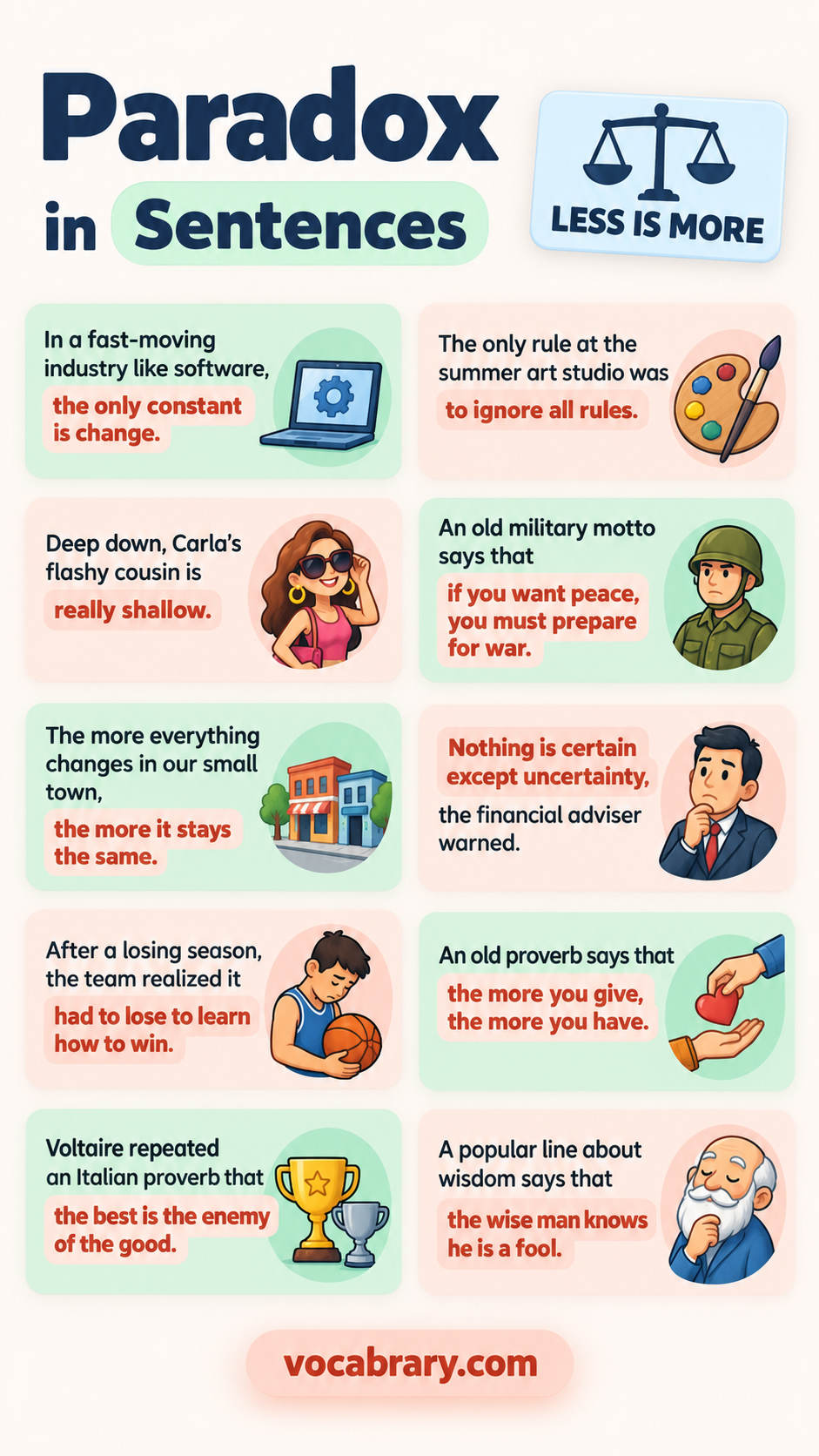
Common Paradox Examples in Sentences
"Less is more," "the only constant is change," and spending money to save money are the textbook paradox examples in sentences, where a claim that sounds impossible turns out to describe daily experience.
- The designer removed half the furniture from the hotel lobby because, in her view, less is more.
- In a fast-moving industry like software, the only constant is change.
- Buying quality boots cost Sam more this winter, but he knows you have to spend money to save money.
- "The more I learn, the less I know," Professor Adeyemi admitted in her final lecture.
- Coach Rivera told the rookies to slow down to go faster during the passing drills.
- Every philosophy student meets the old line linked to Socrates: I know that I know nothing.
- The only rule at the summer art studio was to ignore all rules.
- When the factory closed, one worker said the layoff was the beginning of the end and also a fresh start.
- Deep down, Carla’s flashy cousin is really shallow.
- An old military motto says that if you want peace, you must prepare for war.
- Standing on stage alone, the comedian claimed, "I’m a compulsive liar," and the audience wondered whether to believe him.
- Youth is wasted on the young, Grandpa sighed as his grandsons slept until noon on a sunny Saturday.
- The more everything changes in our small town, the more it stays the same.
- My music teacher insists that the silent pauses are the loudest part of a song.
- Nothing is certain except uncertainty, the financial adviser warned.
- Freedom comes with rules, and the strictest training gave the dancers the most freedom on stage.
- Why does the cheapest option end up costing the most almost every time?
- Courage is impossible without fear, since a person who feels no fear has nothing to overcome.
- After a year of saying yes to every invitation, Dana learned that the word "no" gave her more time for friends.
- Lena’s therapist told her that the best way to find happiness is to stop chasing it.
- After a losing season, the team realized it had to lose to learn how to win.
- Too many flavors at the ice cream shop left Omar unable to choose any of them, since more choice meant less satisfaction.
Famous Paradox Sayings and Quotes
"The only thing we have to fear is fear itself," "Less is more," and the Latin advice to hurry slowly are famous paradoxes that people still quote, because the contradiction makes the lesson memorable.
- In his first inaugural address in 1933, Franklin D. Roosevelt told Americans that the only thing we have to fear is fear itself.
- Architect Ludwig Mies van der Rohe adopted "less is more" as a motto, a phrase that first appeared in Robert Browning’s poem "Andrea del Sarto."
- The Roman emperor Augustus favored the Latin motto festina lente, which means "make haste slowly."
- An old proverb says that the more you give, the more you have.
- Heraclitus, the Greek thinker, taught that change is the only constant.
- Voltaire repeated an Italian proverb that the best is the enemy of the good.
- A well-known saying from the Tao Te Ching teaches that the soft overcomes the hard.
- "If you want something done, ask a busy person," the old saying goes.
- Baseball legend Yogi Berra is credited with saying of a restaurant, "Nobody goes there anymore; it’s too crowded."
- A popular line about wisdom says that the wise man knows he is a fool.
- "Never say never" is a warning that breaks its own rule.
- According to an old saying, the pen is mightier than the sword, even though a pen is the weaker object.
- Many teachers repeat the idea that the only true wisdom is knowing you know nothing.
- The proverb "Hurry slowly" exists in many languages, from Greek to Spanish.
- An old Chinese saying warns that a journey of a thousand miles begins with a single step, so the smallest act starts the biggest trip.
- "Always expect the unexpected," the trail leader told the hikers before the storm rolled in.
- "Save money by spending it," read the banner over the clearance sale.
- Musicians love the line that silence is part of the music, because every note needs a pause around it.
Short Paradox Examples
Short paradoxes such as "Deep down, he’s shallow," "Less is more," and "Act naturally" state a contradiction and its truth in ten words or fewer.
- Act naturally.
- Deep down, he’s shallow.
- Less is more.
- Go slow to go fast.
- Nobody is always somebody.
- Ignore this sentence.
- I’m a light sleeper who never wakes up.
- Some wins are losses.
- Doing nothing is hard work.
- The end is the beginning.
- Be spontaneous on schedule.
- The safest risk you ever take is not taking one.
- Too much freedom is a prison.
- Big savings cost a fortune.
- I am lost when found.
- Waiting is the fastest option.
Paradox Examples in Everyday Life
Traffic shortcuts that become the slowest route, cheap shoes that cost a fortune, and busy people who get more done are paradoxes of ordinary weeks at home and on the road.
- The navigation app sent every driver down the same side road, so the shortcut became the slowest route in town.
- Rosa replaced her shoes four times in a year, so the cheapest pair turned out to be the most expensive.
- The busier Kenji is, the more he gets done; on a free Sunday, he finishes nothing at all.
- To tidy the garage, Dad first had to make a much bigger mess.
- Looking back on the vacation, we realized that the more photos we took, the less we remembered of the trip itself.
- In a stadium of fifty thousand cheering fans, Mia felt completely alone.
- Doing nothing is exhausting, Luis discovered during his first week of retirement.
- Why does a messy desk help Priya find her files faster than a tidy one?
- Zoe sets more alarms every week, and the more she sets, the later she wakes up.
- My phone was supposed to save me time, yet the more apps I install, the less free time I have.
- Grandma says the best way to keep a friend is to let her go when she moves abroad.
- On moving day, Ana felt free and trapped at once as she signed a thirty-year mortgage.
- Resting more made the marathon runner faster than training every single day.
- A bigger fridge was meant to stop food waste, but more shelf room meant more forgotten leftovers.
- The quietest guest at the dinner party said the most with a single raised eyebrow.
- Our dog is so smart that he acts dumb whenever it is bath time.
Paradox Examples About Life, Love, Time, and Money
Losing yourself to find yourself, loving someone enough to let them go, and killing time that is killing you are paradoxes about the parts of life people argue about most.
Paradoxes About Life
Losing yourself to find yourself, living fully by remembering death, and growing stronger through weakness are paradoxes about life that philosophers and grandparents repeat in their own ways.
- Many people travel far from home only to find themselves by getting lost.
- Remembering that life is short makes Isabel enjoy every long afternoon.
- The only way to grow up is to stay curious like a child, the retired teacher said.
- Admitting her weakness to the team made Coach Harris stronger in their eyes.
- Failure is the first step to success, the inventor told the students who crowded around his workbench.
- The harder you try to control everything, the less control you have, Ravi learned during his first year as a parent.
- To be yourself, you must first become someone new, the career coach advised.
- Every ending is a beginning, Aunt Marta said at her farewell party.
- Nobody plans the best days of their life, since the best moments arrive unplanned.
- Old age made my grandfather young again, because he finally had time to play.
Paradoxes About Love and Friendship
Loving someone enough to let them go, hating the person you love, and feeling closest to a friend during an argument are paradoxes about love that songwriters and novelists use again and again.
- If you love someone, let them go, Hana’s mother told her before the long-distance move.
- Maya loves her little brother too much to agree with him on anything.
- The people we love most are the people we fight with most, Grandma said after the whole family argued over the turkey at Thanksgiving.
- Jamal realized he was never closer to Leo than during their worst argument.
- The more Sofia gave away her heart, the fuller it grew.
- To keep the friendship alive, Tom and Ben had to spend a year apart.
- She hated him because loving him took no effort at all.
- Nobody knows you better than the friend who never asks questions.
- A true friend tells you what you don’t want to hear because they want you happy.
- Absence made the couple closer than any date night ever did.
Paradoxes About Time
Killing time, having all the time in the world and none to spare, and slowing down to save time are paradoxes about the one resource nobody gets back.
- The more free time Dan has, the less he gets done.
- Slowing down saved the surgeon an hour in a six-hour operation.
- We were killing time while time was killing us, Grandpa joked on his ninetieth birthday.
- The days are long but the years are short, new parents tell each other at the playground.
- Retirement gave Joan all the time in the world and no time to spare.
- Waiting for the perfect moment is how the moment slips away.
- A long, boring afternoon feels endless while it lasts and brief in memory.
- Taking a break is the fastest way to finish a long essay.
- To make time for her friends during exam season, Ella scheduled free time in her calendar in bright red ink every Sunday night.
- Being early is being on time, the drill sergeant barked at the new recruits.
Paradoxes About Money
Spending money to make money, saving so much that the whole economy shrinks, and cheap purchases that cost more are paradoxes about money that economists and shoppers both know.
- You have to spend money to make money, the café owner said as she signed a lease for a second shop.
- Economists call it the paradox of thrift: when every family saves more in a recession, spending drops, incomes fall, and total savings shrink.
- William Stanley Jevons noticed in 1865 that more efficient steam engines led Britain to burn more coal, not less.
- The richest man in the village was the poorest in friends.
- Buying cheap is expensive, as Nate learned after his third broken vacuum cleaner.
- The less Karim spends on clothes, the better dressed he looks.
- A free phone ended up costing Priya more than any paid model once the contract fees arrived.
- Having more money gave Lucia less peace of mind.
- Nobody feels as poor as the lottery winner with a hundred new relatives asking for loans.
- Tom says the best investment he ever made was the money he gave away.
Paradox Examples at Work
Meetings about having fewer meetings, managers who lead by stepping back, and the Abilene paradox, where a team agrees to a plan nobody wanted, are workplace paradoxes most employees recognize.
- Our department held a two-hour meeting about having fewer meetings.
- Priya found that the best way to lead the team was to step back and let the engineers decide.
- Working fewer hours made Rina more productive than the eighty-hour weeks ever had.
- In the Abilene paradox, described by Jerry Harvey in 1974, a family drives to Abilene on a hot day even though nobody wanted to go.
- Last spring, the office hired a consultant to cut consulting costs.
- As Greg took on more tasks, he finished fewer of them.
- Our manager says the fastest way to finish a project is to plan it slowly.
- Nobody listens to the employee who talks the most in our Monday calls.
- The company needed experience to hire Ahmed, and Ahmed needed a job to get experience.
- To keep the best workers, the director encouraged them to apply for jobs elsewhere.
- The quiet intern was the loudest influence on the final design.
- A new software tool meant to save time added three hours of training every week.
- Admitting what she didn’t know made the new CEO more trusted.
- Would you believe the most successful product launch began with a failed prototype?
Paradox Examples at School
Students who study less and learn more, a teacher who teaches by asking questions, and a quiz on which the only right answer is "none" are paradoxes from classrooms and campuses.
- Marco studied less the night before the exam and scored higher than ever, because he finally slept.
- Mr. Okafor teaches best by not answering students’ questions and asking new ones instead.
- Every time Emma revised her essay, it became shorter and stronger.
- On the logic quiz, the only correct answer was that no answer was correct.
- Making mistakes in practice is how the chess club stops making them in tournaments.
- A strict "no rules" policy on the debate team led to the longest rulebook in school history.
- The quietest student in the class asked the loudest question of the semester.
- Teaching the lesson to her younger brother taught Aisha the lesson.
- The principal said that to be heard, the students had to stop shouting.
- Josh noticed that the harder he tried to remember the date, the faster it vanished.
- Failing the first test was the best result of Kim’s year, because it made her study.
- In art class, Ms. Lopez told us that a blank sheet is the hardest picture to draw.
- Nobody on the robotics team worked alone, yet each member finished the most work when left alone for an hour.
- Why does the shortest essay take the longest to write?
Funny Paradox Examples
A two-hour meeting on time management, a sign reading "Ignore this sign," and a man who will stop procrastinating tomorrow are funny paradoxes that make people laugh first and think second.
- The sign on the fence read, "Ignore this sign."
- I’ll stop procrastinating tomorrow, Jake promised for the fifth day in a row.
- My uncle says he’s an expert on everything except being an expert.
- I’m so good at doing nothing that I’m always busy.
- On the office fridge, a notice said, "Please don’t read this note."
- Our cat acts like she owns the house, and yet she refuses to leave the laundry basket.
- I’m humble and proud of it, Grandpa announced at dinner.
- A club for people who hate joining clubs has a two-year wait to get in.
- Last time I tried to be spontaneous, I planned it for a week.
- My brother wakes up early on Saturdays just to enjoy going back to sleep.
- Nobody is perfect, and I’m nobody, so my little sister claims she’s perfect.
- The laziest student in the dorm worked all night on a machine to do his homework for him.
- Our meeting on time management ran two hours over.
- "I always lie," announced the magician, and nobody knew what to believe.
Paradox Examples for Kids
Jam that comes every other day but never today, a girl who is too tired to fall asleep, and a hole that grows the more you take away are paradoxes children enjoy puzzling over.
- In Through the Looking-Glass by Lewis Carroll, the White Queen offers Alice jam every other day, but never today.
- Mia was too tired to fall asleep.
- The more Max tried to stop laughing, the harder he laughed.
- When I’m quiet, Mom notices me the most.
- Cut more holes in a sponge, and it soaks up more water.
- Nothing is impossible, so Ben tried to do nothing and discovered that it was impossible too.
- Lily said, "Please ignore me," and then waited for everyone to look at her.
- The faster Omar cleaned his room, the longer the job took, because he kept knocking over his toys.
- A hole gets bigger the more you take away from it.
- Our puppy is small but has the biggest bark on the street.
- Staying still on the seesaw is the hardest trick of all.
- Why does my little sister cry when she is happy?
Paradox Examples for Students
Cutting words to say more, research that leaves a thesis writer less certain, and answers that raise two new questions are paradoxes students meet in essays, study sessions, and exam weeks.
- The more research Hiro did for his thesis, the less certain he became.
- A good essay editor knows that cutting words makes an argument say more.
- Asking for help made Tara more independent by the end of the term.
- In college, Sara found that freedom from rules required more self-discipline than high school ever did.
- Every answer the class found raised two new questions.
- To write about everything is to write about nothing, the history professor warned.
- The longer Noah stared at the exam question, the less he understood it.
- Studying with music on helped Kofi concentrate by drowning out every other sound in the dorm.
- A first draft is the hardest part to write and the part nobody reads, the writing tutor said.
- Being wrong in class is the fastest way to learn what is right.
- Mei discovered that a deadline gave her more freedom than an open-ended assignment.
- Nobody learns to swim without getting wet.
Paradox Examples in Literature
Orwell’s equal animals who are not equal, Hamlet’s cruelty for the sake of kindness, and Donne’s death that dies are the paradoxes teachers quote most when they explain the device in poems, plays, and novels.
Paradox in Shakespeare
Hamlet being cruel only to be kind, the witches’ "fair is foul," and Juliet’s only love springing from her only hate show how Shakespeare puts a whole contradiction into a single line.
- In Hamlet, Hamlet tells his mother he must be cruel only to be kind after he scolds her in Act 3.
- Watching Hamlet’s strange behavior, Polonius admits that though this be madness, yet there is method in it.
- The three witches in Macbeth chant that "fair is foul, and foul is fair" in the opening scene.
- Juliet learns that Romeo is a Montague and cries that her only love sprang from her only hate.
- Touchstone in As You Like It says that the fool thinks he is wise, but the wise man knows himself to be a fool.
- Caesar tells Calpurnia in Julius Caesar that cowards die many times before their deaths, while the brave die only once.
- Blinded Gloucester in King Lear says he stumbled when he saw, meaning he misjudged his sons while he still had his sight.
Paradox in George Orwell
The "more equal" animals of Animal Farm and the Party slogans of Nineteen Eighty-Four are Orwell’s best-known paradoxes, and both show a government forcing people to accept a contradiction.
- In Animal Farm (1945), the pigs rewrite the barn wall to read that all animals are equal, but some animals are more equal than others.
- The first Party slogan in Nineteen Eighty-Four (1949) declares that war is peace.
- Oceania’s second slogan tells citizens that freedom is slavery.
- Party posters also claim that ignorance is strength.
- Orwell names the skill of believing two contradictory claims at once "doublethink."
- Within the same novel, the Ministry of Peace runs the war and the Ministry of Love runs the torture chambers.
Paradox in Oscar Wilde
Lord Darlington resisting everything except temptation and Lord Henry yielding to temptation to get rid of it are Wilde’s paradoxes, and each one reverses a moral rule for a laugh.
- In Lady Windermere’s Fan (1892), Lord Darlington says he resists everything except temptation.
- Lord Darlington also says that life is far too serious ever to talk seriously about.
- The same character defines a cynic as someone who knows the price of everything and the value of nothing.
- Dorian’s friend Lord Henry claims in The Picture of Dorian Gray (1890) that the only way to get rid of a temptation is to yield to it.
- Wilde ends the novel’s preface by declaring that all art is quite useless, a strange claim from an artist.
Paradox in Poetry
Donne’s "Death, thou shalt die," Wordsworth’s child who is father of the man, and Dickinson’s "divinest Sense" in madness are paradoxes from poems that students analyze for exams.
- John Donne ends Holy Sonnet 10, "Death, be not proud," by telling Death that "Death, thou shalt die."
- In Holy Sonnet 14, "Batter my heart," Donne’s speaker says he will never be free unless God imprisons him.
- William Wordsworth writes in "My Heart Leaps Up" (1802) that "The Child is father of the Man."
- Emily Dickinson opens one poem with the claim that "Much Madness is divinest Sense."
- Another Dickinson poem argues that success is counted sweetest by those who never succeed.
- Robert Frost’s "The Tuft of Flowers" ends with the thought that men work together whether they work together or apart.
- Richard Lovelace wrote from a jail cell in 1642 that stone walls do not a prison make.
- Milton ends his sonnet on his blindness with the thought that they also serve who only stand and wait.
Paradox in Novels and Plays
Heller’s Catch-22, Dickens’s best and worst of times, and a pirate apprentice who has had only five birthdays at twenty-one are paradoxes from famous novels and plays.
- In Catch-22 (1961) by Joseph Heller, any pilot who asks to stop flying combat missions proves he is sane, so he must keep flying.
- Doc Daneeka explains that Orr would be crazy to fly more missions and sane if he refused, but a sane man has to fly them.
- Charles Dickens opens A Tale of Two Cities (1859) by calling the era both the best of times and the worst of times.
- Lewis Carroll’s Red Queen in Through the Looking-Glass (1871) tells Alice that it takes all the running you have just to stay in the same place.
- Frederic in Gilbert and Sullivan’s The Pirates of Penzance (1879) is twenty-one years old but has had only five birthdays, because he was born on February 29.
Logical Paradox Examples
The liar paradox, Zeno’s tortoise race, and the Ship of Theseus are logical paradoxes, where careful reasoning from sensible starting claims leads to an answer that is impossible or unresolved.
Liar Paradox and Self-Reference
"This sentence is false," Epimenides the Cretan calling all Cretans liars, and Pinocchio predicting his own nose will grow are self-referring statements that are true only if they are false.
- This sentence is false.
- Epimenides, a Cretan, claimed that all Cretans are liars.
- Pinocchio says, "My nose will grow now," and his nose grows only if he is lying.
- Selma swore that everything she says is a lie, and that promise too.
- One side of Jourdain’s card says the sentence on the back is true, while the back says the sentence on the front is false.
- A notice on the brand-new chalkboard read "This board is empty," so the board was no longer empty.
- The school rule stated that every rule on the notice board is optional, this one too.
Zeno’s Paradoxes
Achilles losing a race to a tortoise, a runner who never crosses a room, and a flying arrow that never moves are Zeno of Elea’s paradoxes, meant to prove motion an illusion.
- In Zeno’s best-known paradox, swift Achilles never catches a tortoise with a head start, because the tortoise has always moved on by the time Achilles reaches its last position.
- To cross a room, you must first cross half of it, then half of what is left, and so on without end, so you never arrive.
- An arrow in flight is motionless at every single instant, so, Zeno argued, it never moves at all.
- Zeno of Elea offered these puzzles to defend his teacher Parmenides, who taught that all change and motion are illusions.
- Walking to the fridge by halves, Leo joked that by Zeno’s logic, he would never get his snack.
Ship of Theseus and Identity
The Ship of Theseus, a grandfather’s axe with a new head and handle, and a rock band with no original members are puzzles about whether an object stays the same once every part is new.
- Plutarch described how the Athenians replaced every rotting plank of the Ship of Theseus until nobody knew whether it was still the same ship.
- Thomas Hobbes added a twist: if someone rebuilds a second ship from the old planks, which one is the real Ship of Theseus?
- "This is my grandfather’s axe," the farmer said. "My father replaced the handle, and I replaced the head."
- The band still tours under its old name, although every original member left years ago.
- After replacing the engine, doors, and seats, Dev wondered whether he still owned the same car.
Other Famous Paradoxes
Russell’s barber, the heap of sand that never stops being a heap, and a room of twenty-three people with two birthdays in common are famous paradoxes from logic, philosophy, and probability.
- In the barber paradox, a village barber shaves everyone who does not shave himself, so nobody knows who shaves the barber.
- Bertrand Russell showed in 1901 that the set of all sets that do not contain themselves both does and does not contain itself.
- Remove one grain at a time, and the sorites paradox asks when a heap of sand stops being a heap.
- Philosophers use the omnipotence paradox to ask whether an all-powerful being is able to create a stone too heavy for it to lift.
- Karl Popper argued in 1945 that unlimited tolerance leads to the disappearance of tolerance, since the intolerant would destroy it.
- According to the birthday paradox, a room of just twenty-three people has a better than even chance that two of them share a birthday.
- Monty Hall’s game-show problem shows that switching doors wins the car two times out of three, even though the choice looks like a coin flip.
- Enrico Fermi’s famous question "Where is everybody?" names the Fermi paradox: the universe is vast and old, yet we find no sign of alien life.
- A judge tells a prisoner he will be hanged on a weekday next week as a surprise, and the prisoner reasons that no surprise hanging is possible, until it surprises him on Wednesday.
Time Travel Paradox Examples
The grandfather paradox, Marty McFly fading from a family photo, and a traveler who becomes his own parent are time travel paradoxes that science fiction writers and physicists debate.
- The grandfather paradox imagines a time traveler who stops his grandfather from meeting his grandmother, which prevents his own birth, so he never goes back in time.
- In Back to the Future (1985), Marty McFly interrupts his parents’ first meeting in 1955 and starts fading from a family photograph.
- The bootstrap paradox takes its name from Robert Heinlein’s 1941 story "By His Bootstraps," where a man’s future selves lead him into the very trip that creates them.
- Based on Heinlein’s "All You Zombies," the 2014 film Predestination reveals that the main character is both mother and father of the same person, who is also that character.
- John Connor sends Kyle Reese back in time in The Terminator (1984), and Reese becomes John’s father.
- Harry is saved by a mysterious Patronus in Harry Potter and the Prisoner of Azkaban and later realizes, after using the Time-Turner, that he cast it himself.
- In Interstellar (2014), Cooper discovers that he is the "ghost" sending messages to his young daughter Murph.
- Sally Sparrow, in the Doctor Who episode "Blink" (2007), gives the Doctor a transcript of a conversation that he then reads back to her years earlier, so nobody ever wrote it.
- If a time traveler hands Shakespeare printed copies of his own plays, nobody ever wrote Hamlet, yet the play exists.
- A scientist who goes back to stop the fire that inspired her career would never become a scientist, so she would never build the time machine.
Paradox Examples in the Bible
The last who will be first, strength found in weakness, and a life saved by losing it are Bible paradoxes that reverse ordinary views of power, wealth, and success.
- Jesus tells his followers in Matthew 20:16 that the last will be first, and the first last.
- Matthew 10:39 says that whoever loses his life for Jesus’s sake will find it, and whoever finds it will lose it.
- Paul writes in 2 Corinthians 12:10 that "when I am weak, then I am strong."
- Jesus says in Mark 10:43 that whoever wants to be great must be the servant of the rest.
- The Sermon on the Mount promises in Matthew 5:5 that the meek will inherit the earth, even though the meek own the least land and power of anyone.
- Luke 14:11 teaches that those who humble themselves will be exalted, while the proud will be humbled.
- In 1 Corinthians 3:18, Paul advises anyone who thinks himself wise to become a fool in order to become wise.
- Paul describes the apostles in 2 Corinthians 6:10 as having nothing, yet possessing everything.
- A grain of wheat, according to John 12:24, bears much fruit only after it dies in the ground.
- Acts 20:35 quotes Jesus as saying that it is more blessed to give than to receive.
- Romans 6:18 tells believers that they were set free by becoming slaves of righteousness.
- Proverbs 11:24 observes that one person gives freely and grows richer, while another refuses to give and ends up in want.
- In 1 Corinthians 1:25, Paul says that the foolishness of God is wiser than human wisdom.
Related
FAQs
A paradox and an oxymoron differ in length and purpose, because a paradox is a whole statement that sounds impossible but proves true, while an oxymoron joins two opposite words in one short phrase. "Less is more" is a paradox, and "deafening silence" is an oxymoron. More oxymoron examples show the two-word form, and antithesis examples show opposites set side by side without a contradiction.
Five common examples of paradox are "Less is more," "The only constant is change," "You have to spend money to make money," "I know that I know nothing," and "This sentence is false." The first four are everyday sayings with a hidden truth, while the last is a logical paradox with no answer.
The most famous paradox is the liar paradox, "This sentence is false," because the sentence is true only if it is false. Zeno’s paradox of Achilles and the tortoise, the Ship of Theseus, and Orwell’s "some animals are more equal than others" are almost as well known.
Catch-22 means a no-win situation in which the rule that offers a way out also blocks it, a term from Joseph Heller’s 1961 novel. In the book, a pilot who asks to stop flying because the missions are insane proves he is sane, so he has to keep flying. Today people use it for a job that requires experience when only a job gives experience.
A literary paradox and a logical paradox differ in whether the contradiction resolves. A literary paradox hides a truth that the reader works out, while a logical paradox leads from sensible premises to a result nobody has settled. Hamlet’s "cruel only to be kind" is literary, and "This sentence is false" is logical. The englishan.com lesson on paradox explains both kinds in more depth.
Yes, a literary paradox is true in the sense it intends, because the apparent contradiction disappears once you read it a second way. "The more you learn, the less you know" is true because learning reveals how much remains unknown. Logical paradoxes such as the liar paradox, by contrast, are neither clearly true nor clearly false.
The purpose of a paradox is to make the reader pause and think about an idea a second time. Writers use it to make a lesson memorable, to criticize a society, as Orwell does with "war is peace," or to express a spiritual truth, as in "the last will be first."
A well-known example of paradox in literature is the final commandment in George Orwell’s Animal Farm: all animals are equal, but some animals are more equal than others. Hamlet’s "I must be cruel only to be kind" and John Donne’s "Death, thou shalt die" are two other classic cases.
The predestination paradox is a time travel loop in which a traveler’s attempt to change the past causes the very event it was meant to prevent. In Harry Potter and the Prisoner of Azkaban, Harry is saved by a Patronus that he himself casts after traveling back in time.
Some paradoxes have answers and others remain open, depending on the type of paradox. Zeno’s paradoxes of motion found an answer in the mathematics of infinite series, and the birthday paradox has a proven answer in probability. Philosophers still disagree about the liar paradox and the Ship of Theseus.
Yes, paradoxes exist in nature, in the sense that real physical observations look impossible at first. Olbers’ paradox asks why the night sky is dark if the universe is full of stars, and the twin paradox of relativity describes an astronaut who returns younger than the twin who stayed home.

Leave a Comment