
An interrogative pronoun is a pronoun that introduces a question by replacing the unknown person, thing, or detail, as in Who left the door open?. Interrogative pronoun example sentences pair who, whom, whose, which, and what with direct and indirect questions across everyday, academic, and professional settings.
What Is an Interrogative Pronoun?
An interrogative pronoun takes the place of the missing noun in a question, so the speaker asks for a person, a possession, or a choice without naming it first. A relative pronoun shares the same five words but connects a clause to a known noun instead of asking anything, so who in Who called? is interrogative while who in the neighbor who called is relative.
Who / Whom / Whose / Which / What + verb phrase + ?
Who told you about the job opening at the bakery?
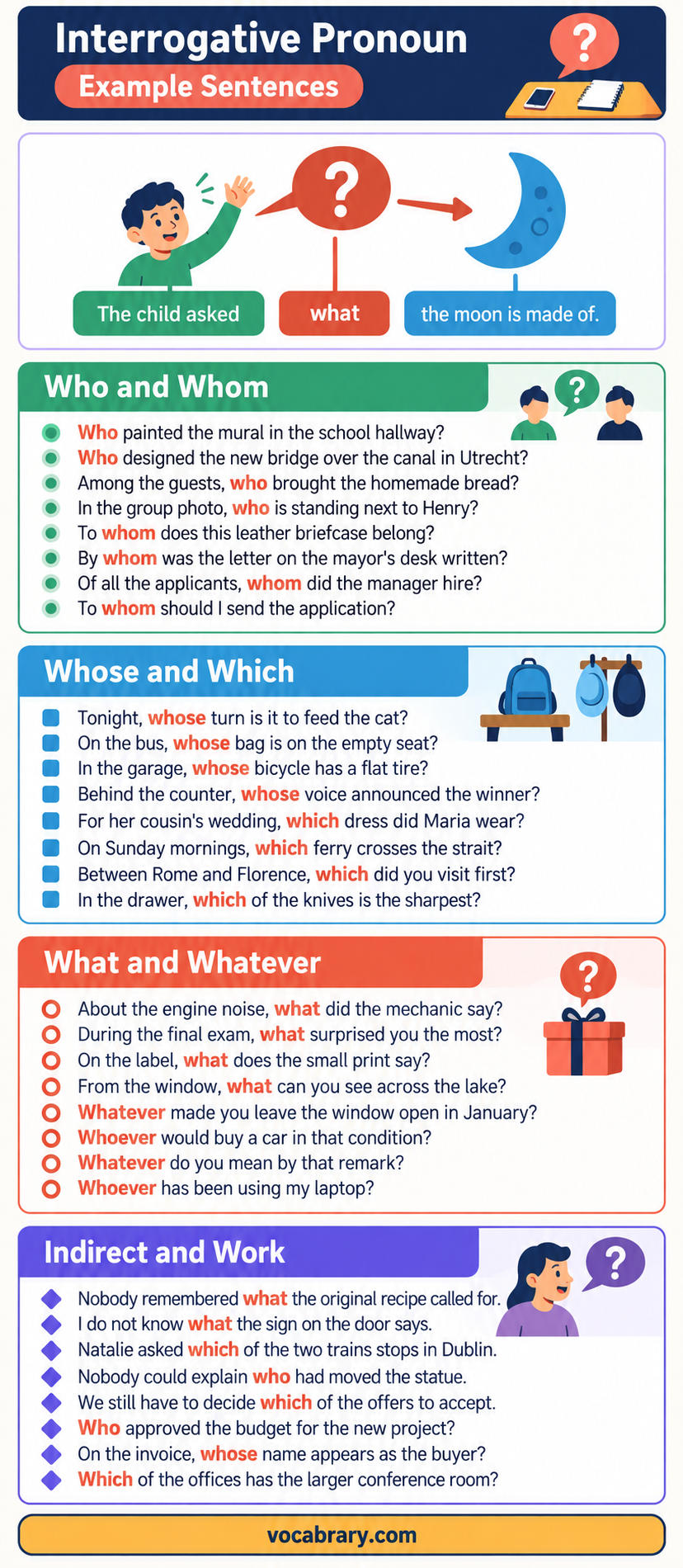
Common Interrogative Pronoun Example Sentences
A parent asking who left the gate open, a student wondering which loaf Nadia baked, and a traveler checking whose jacket hangs on the chair are the everyday queries these five pronouns open.
- Who painted the mural on the cafeteria wall?
- What fell off the bookshelf during the storm last night?
- Which of the two routes gets us to the airport faster?
- Whom did the principal call to the office after lunch?
- Whose jacket is hanging on the back of the kitchen chair?
- What did your brother study at the university in Oslo?
- Who scored the winning goal in the final minute of the match?
- Which suitcase is the one for the passenger in seat twelve?
- Whose handwriting is on the note taped to the refrigerator?
- Whom should we thank for the flowers on the front step?
- What stopped the train between Paddington and Reading?
- Who left the garden gate wide open this morning after the delivery from the florist arrived at the back door?
- Which loaf of bread did Nadia bake this morning?
- Whose dog has been barking since five o’clock?
- At the end of the lane, what does the sign say?
Five Interrogative Pronouns and Their Roles
Locking the door, believing a witness, and owning the boots by the fireplace are three different unknowns, and who, whom, and whose each replace one of them in the question. The pronouns which and what split the rest between a named set and a wide-open field, as more pronoun sentences show across all eight types.
| Interrogative pronoun | Asks about | Example sentence |
|---|---|---|
| Who | Person performing the action | Who locked the front door last night? |
| Whom | Person receiving the action | Whom did the jury believe during the trial? |
| Whom | Person after a preposition | To whom did you address the letter? |
| Whose | Ownership or possession | Whose boots are sitting by the fireplace? |
| Which | A selection from a known set | Which of the three films did you prefer? |
| What | An open identity or category | What caused the delay at the border? |
| Whoever | Any person without limit | Whoever arrives first will open the shop. |
| Whatever | Any thing without limit | Whatever you baked smells incredible from here. |
"Who" (Person Performing the Action)
At the autumn festival, at the workshop behind the bakery, and at a surprise party for Elif, the pronoun who asks for the person performing the deed.
- Who painted the mural in the school hallway?
- At the autumn festival, who won the poetry prize?
- Among your neighbors, who heard the alarm at midnight?
- Who designed the new bridge over the canal in Utrecht?
- In your family, who speaks more than two languages?
- Behind the bakery, who repairs the old clocks in that tiny workshop?
- In the final paragraph, who noticed the mistake before the printer did?
- Last Tuesday, who sent the parcel from Copenhagen?
- After practice, who is responsible for locking the gym doors?
- Before the guests arrived, who told Elif about the surprise?
- On Thursday evenings, who volunteers at the food bank downtown?
- For the school bake sale, who made the walnut bread?
- Since the renovation of the kitchen started three weeks ago, who has been feeding the stray cat that waits by our front step?
- During the staff meeting, who brought up the budget for next quarter?
"Whom" (Person Receiving the Action)
Hiring panels, rooftop dinner guests, and orchestra conductors receive the action rather than perform it, and whom marks that receiver role each time.
- Whom did the hiring panel select for the research fellowship?
- To whom does this leather briefcase belong?
- Whom did the detective question after the break-in on River Street?
- For whom did Rosa knit the green scarf last winter?
- During the second half, whom did the coach bench?
- By whom was the letter on the mayor’s desk written?
- In an emergency, whom should the receptionist notify first?
- After the ceremony, whom did Fatima thank at the town hall?
- With whom did your uncle travel to Marrakech last spring?
- From the shortlist of twelve candidates, whom did the orchestra pick as its new conductor?
- At the studio, whom has the director cast in the lead role?
- Before the trial, whom did the lawyer advise to remain silent?
"Whose" (Ownership and Possession)
Ownership is what whose replaces in a question, whether the owner left a bicycle at a lamppost, a coat with a torn lining, or keys under a park bench.
- Outside the library, whose bicycle is chained to the lamppost?
- Whose idea was it to move the meeting outdoors in November?
- On the coat rack by the back door, whose jacket has a torn lining near the left pocket and a missing button on the cuff?
- At the bakery, whose recipe did they use for the sourdough loaf?
- Under the bench in the park, whose keys were found yesterday?
- Tonight, whose turn is it to feed the cat?
- At the village fair, whose painting won first prize?
- During the meeting, whose phone kept buzzing on the conference table?
- Inside the pantry, whose handwriting is on the label of the oldest jar?
- In the relay race, whose team finished in under four minutes?
- From the answering machine, whose message do you hear playing back?
- Before the trip to Buenos Aires, whose passport had already expired?
"Which" (Selection From a Set)
Dresses for a wedding, songs at a winter concert, and puppies at a shelter are choices drawn from a limited set, and which asks the speaker to pick one.
- Which of these chairs did the carpenter restore last month?
- Which road leads to the lighthouse on the northern cliff?
- For her cousin’s wedding, which dress did Maria wear?
- Near the station, which hotel has a rooftop restaurant?
- Between the two candidates, which received more votes in the runoff?
- At the winter concert, which song did the choir perform last?
- With his grandmother, which language does Tariq practice every Sunday?
- Before seven o’clock, which train arrives at platform nine?
- On the reading list, which book did you finish first?
- From the shelter, which of the puppies did the family adopt?
- In the old quarter of Vienna, which museum has the largest and best-preserved collection of medieval armour?
- On Sunday mornings, which ferry crosses the strait?
- At the county baking contest, which pie did Grandma enter?
"What" (Open Inquiry)
A power outage across the neighborhood, a noise in an engine, and a crack in the foundation of an old mill are mysteries with no fixed set of answers, so what does the asking.
- What made the power go out across the entire neighborhood?
- Under the new regulation, what does the government require from small businesses?
- In the old attic, what did Kofi find inside the rusted toolbox?
- What brought you to this mountain village in the first place?
- From this corner, what is the fastest way to reach the hospital?
- About the engine noise, what did the mechanic say?
- Behind the school, what happened to the old oak tree last winter?
- In Tokyo, what does your sister do for a living?
- Along the stone foundation of the old mill on the north side of the village, what caused that deep crack?
- By the riverbank, what did the children collect after the rain?
- On the thermometer this morning, what does the reading show?
- During the final exam, what surprised you the most?
- For the field trip, what did Ahmed pack in his lunch?
Compound Interrogative Pronouns With "-ever"
A gate left open, a path to a hilltop, and a mural on an underpass are paired with whoever, whichever, and whatever to mean "no matter who, which, or what did it."
- Whatever you decide, the rest of the team will follow your lead.
- Whoever left the gate open needs to close it before dark.
- Whichever path you take will lead to the same hilltop.
- At the banquet, whatever they served smelled of cinnamon and cardamom.
- Next Saturday, whoever wins the raffle gets a weekend at the lakeside cabin.
- Of the two trains, whichever arrives first is the one we board.
- Along the garden fence, whatever Priya planted has started to bloom.
- On the underpass wall, whoever painted that mural deserves an award.
- For the pastry, whichever recipe you follow, make sure the butter is cold.
- In the dark basement of the old factory building, whatever the inspector found behind the boiler rattled him for days.
- At the front desk, whoever answered the phone gave us the wrong address.
- Near the stage, whichever seat is empty at the front will be mine.
Interrogative Pronouns in Indirect Questions
Teachers asking about a broken window, directors choosing a lead role, and hosts planning a farewell dinner report these questions without a question mark, and the interrogative pronoun stays in the reported version.
- The teacher asked who had broken the classroom window during recess.
- Nobody knows what caused the fire at the warehouse last July.
- Ravi wondered whom the director had chosen for the lead role.
- We need to find out whose car is blocking the driveway right now.
- She wanted to know which bus goes to the central market on Saturdays.
- The officer asked what the witness had seen near the loading dock.
- I still need to learn who approved the new budget for the department.
- Tell me whose idea it was to paint the front fence bright yellow.
- After the Tuesday lecture on extinction, students argued about which theory best explains the gaps in the fossil record.
- Hugo asked whom we should invite to the farewell dinner next Friday.
- Nobody remembered what the original recipe called for.
- Amina tried to discover who had left the note on her desk.
Interrogative Pronouns in Everyday Life
The kitchen, the dentist’s office, and the neighbor’s garden are the places where these five pronouns ask the daily questions that keep a household running.
- Who is picking the children up from football practice today?
- What did the plumber charge for fixing the kitchen tap?
- On this road, which supermarket sells fresh sourdough bread?
- Since yesterday, whose laundry has been sitting in the machine?
- About the broken boiler in the upstairs flat, whom did the landlord notify to come and take a look at it?
- On Saturdays, what time does the pharmacy on the corner close?
- Who volunteered to drive the donation boxes to the shelter?
- Last week, which neighbor returned the ladder we lent out?
- For tonight’s lamb stew, whose recipe did you follow?
- From the pipes upstairs, what is that strange noise?
- At the weekend picnic, who remembered to bring the camping stove?
- Before noon, which dentist on Park Road has open appointments?
Interrogative Pronoun Example Sentences for Kids
At the zoo, on the bus, and in the garden, a seven-year-old already knows the puzzle, so the interrogative pronoun is the only new word in each sentence.
- Who ate the last slice of birthday cake?
- At the zoo, what is your favorite animal?
- For the sky in your drawing, which crayon did you use?
- On the stairs, whose toy truck did someone leave?
- After lunch, who wants to play hide-and-seek outside?
- What did the teacher read to the class after recess?
- Between these two, which puppy is yours?
- On the refrigerator door, whose drawing is that one?
- Before boarding the bus, who forgot their lunchbox at home?
- In the garden behind the shed, what did you find buried under the big rock?
- Whose backpack was left on the playground bench after the bell rang at the end of recess?
Interrogative Pronoun Example Sentences for Students and Exams
Alexander Fleming’s penicillin, Chinua Achebe’s Things Fall Apart, and Newton’s laws of motion are exam questions from science, literature, and history, and every answer starts with the right part of speech.
- Who discovered penicillin at a London laboratory in 1928?
- Within literary criticism, what does the term "protagonist" mean?
- On the periodic table, which element has the atomic number 79?
- Whose theorem proves that the three sides of a right triangle follow the squared-sum rule?
- In Shakespeare’s Romeo and Juliet, whom does Romeo love before meeting Juliet?
- During photosynthesis, what triggers the reaction in green plants?
- Which ocean is the deepest on Earth?
- Whose laws of motion describe the link between force and acceleration?
- In 1958, who wrote the novel Things Fall Apart?
- By chemical formula, what do scientists write for table salt?
- Across our solar system, which planet has the largest number of known moons?
- From whom did the United States purchase the Louisiana Territory in 1803?
Interrogative Pronouns and Interrogative Adjectives in the Same Sentence
A coat without a size, a meeting without a decision, and a field trip without a car put the pronoun in one clause and the adjective in the other. The same word changes its grammar role mid-sentence.
- Which is your coat, and which size fits you best?
- At the meeting, what went wrong, and what decision did the board reach?
- For the field trip, who booked the bus, and whose car did the rest take?
- Inside the oven, what is baking, and what temperature did the recipe state?
- Which of the puppies is the oldest, and which breed are they?
- By the front door, whose is the red umbrella, and whose initials are on the handle?
- In the workshop, what did the carpenter build, and what wood did he use?
- From the finalists, which won the prize, and which category drew the most competitors?
- Late at night, who is calling, and what reason did they give?
- On the ground floor, what broke the window, and what repair will the landlord order?
- Among these jars, which is honey, and which label says organic?
- On the front door of the main hall, who left the note during the night, and whose handwriting do you recognize on it?
Related
- Parts of Speech Example Sentences
- Reciprocal Pronoun Example Sentences
- Intensive Pronoun Example Sentences
FAQs
An everyday example is "Who borrowed my umbrella this morning?" Another is "Whose car is parked in front of the garage?"
With "who", one example is "Before the storm, who warned the villagers?" Another is "In the kitchen, who left the oven on?"
One example is "At the airport, whom did Natalie wait for?" Another is "To whom should I send the application?"
With "whose", one example is "In the lost-and-found box, whose gloves are these?" Another is "Beside the fountain, whose dog is chasing the pigeons?"
One example is "On the menu, which of the soups is vegetarian?" Another is "In the parking lot, which of the cars is yours?"
With "what", one example is "In the basement, what is making that humming noise?" Another is "At the farm, what do the chickens eat?"
An emphatic example is "Whatever happened to the old movie theater on Elm Street?" Another is "Whoever could have sent this package without a return address?"
A reported example is "The detective asked who had entered the room through the window." Another is "Henry asked whose turn it was to drive."
An exam example is "Who painted the ceiling of the Sistine Chapel?" Another is "Which river flows through Paris?"
A workplace example is "Who approved the budget for the new project?" Another is "In the warehouse, what is stored behind the loading dock?"
Related: