
A pronoun is a word that replaces a noun or noun phrase the listener already knows, as in Priya met Tom, and she gave him a map. A pronoun inherits the job of the noun it replaces, so its form changes with that job: she is a subject, her an object, and hers a possession. Pronouns example sentences pair each form with its job in an everyday clause, from the personal she and her to the possessive hers and the reflexive herself.
What Is a Pronoun?
A pronoun stands in for a noun or a noun phrase that is already known, or for a person or an item that the speaker indicates without naming it. A noun names the item itself, so Maya is a noun and she is the pronoun that replaces it.
Antecedent noun + pronoun that refers back to it
Priya met Tom at noon, and she gave him the tickets.
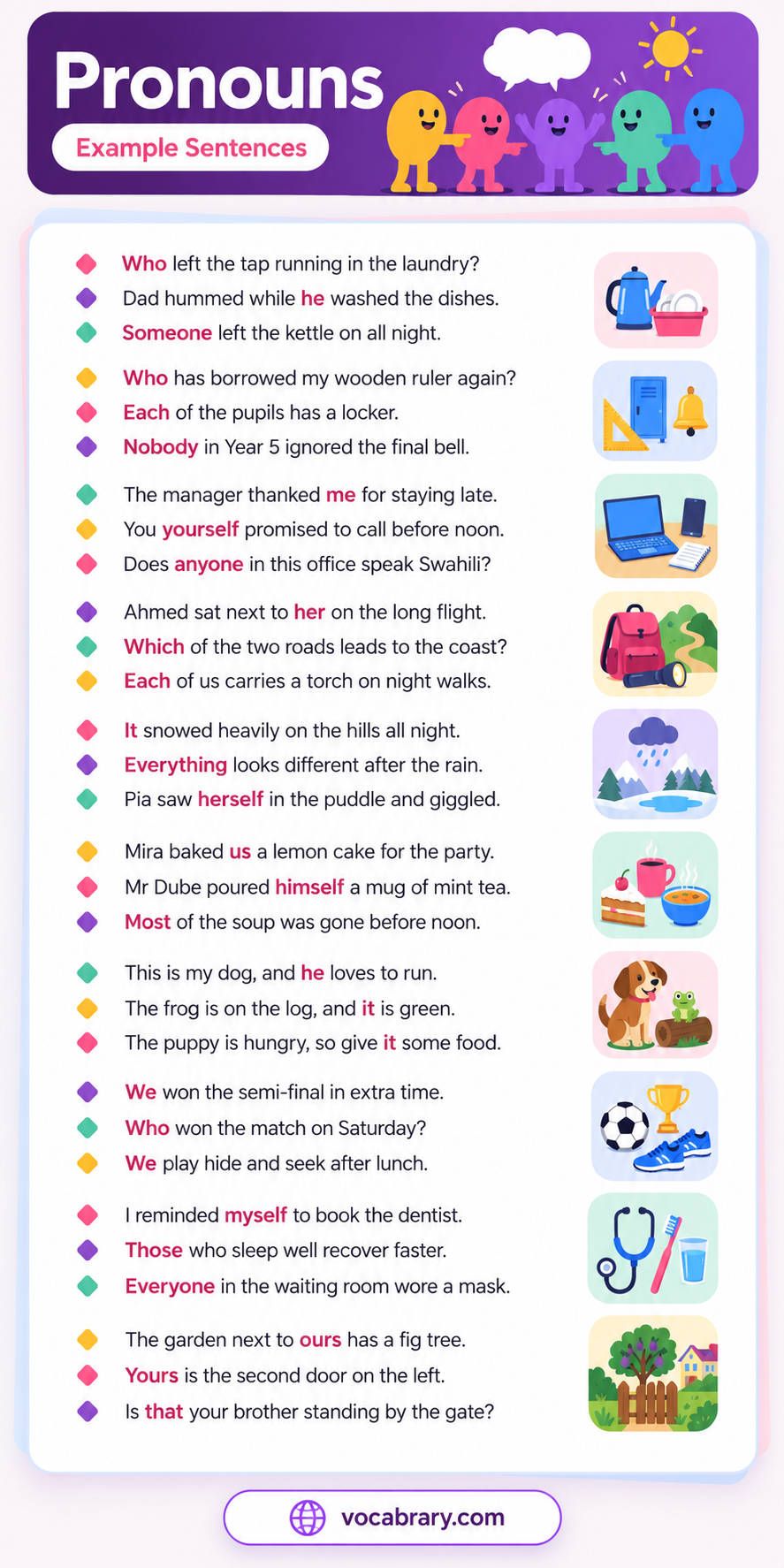
Pronouns Example Sentences for Everyday Use
She, they, mine, himself and someone replace nouns in the sentences that learners meet first. Each of these words refers to a person or an item without repeating the noun.
- She collected the parcel from the post office on Friday.
- Ravi told Amina that he would meet her outside the cinema.
- We painted the fence last weekend, and it still looks new.
- The red scooter is mine, but the blue one belongs to my brother.
- Nobody answered the door when the courier knocked twice.
- Mei burned herself on the hot kettle and ran to the sink.
- They moved to Nairobi after the school year ended.
- Who left the tap running in the laundry?
- This is the sweetest mango I have tasted all summer.
- Carlos lent me his umbrella because it was pouring.
- Everyone in the choir learned the new song by Friday.
- Lena wrote the letter herself instead of asking her cousin.
- The tallest player on the team, who is only fifteen, scored twice.
- The two sisters admire each other more than they admit.
Ten Pronoun Types With an Example Sentence Each
Personal, possessive, relative, reflexive, demonstrative, indefinite, interrogative, reciprocal, distributive and intensive pronouns each do a different job, as who and herself show. Grammar courses count ten types, and some fold distributive pronouns into the indefinite group.
| Type of pronoun | Job in the sentence | Example sentence |
|---|---|---|
| Personal | Names the speaker, the listener or the person spoken about | They invited us to the wedding in Goa. |
| Possessive | Shows who owns an item, with no noun after it | The red bag is hers. |
| Relative | Opens a clause that describes a noun | The woman who lives upstairs is a pilot. |
| Reflexive | Refers back to the subject of the same clause | Omar taught himself the guitar. |
| Demonstrative | Points to an item that is near or far | Those are my brother’s boots. |
| Indefinite | Refers to an unnamed person, item or amount | Someone left a coat in the lobby. |
| Interrogative | Opens a question | Who painted the mural? |
| Reciprocal | Shows two or more people acting on one another | The twins correct each other on the way to school. |
| Distributive | Refers to the members of a group one at a time | Each of the guests wore a name badge. |
| Intensive | Adds emphasis to a noun or pronoun already present | The principal herself welcomed us. |
Personal Pronouns in Example Sentences
I, you, he, she, it, we and they name the speaker, the listener or the person spoken about, and me, him, her, us and them are the matching object forms. The personal pronouns change form for person, number and case, and he, she and it also show gender.
- I left my notebook in the staff room this morning.
- Did you see the sunset over the bay last night?
- He repairs bicycles in a small workshop near the market.
- She presented the results to the board without notes.
- It snowed heavily on the hills all night.
- We boarded the night ferry to Piraeus at nine.
- They harvest olives from October to December.
- The manager thanked me for staying late.
- Kofi’s grandmother taught him how to play draughts.
- Priya sent her a long message from the airport.
- The usher gave us two seats near the aisle.
- Nobody believed them until the video appeared online.
- The cat is hungry, so feed it before you leave.
A personal pronoun differs from a possessive pronoun, because her in I called her names the person while hers in the coat is hers shows ownership.
Sentences With Mine, Yours and Theirs
Mine, yours, his, hers, ours and theirs stand for an owner and the owned item in one word, so no noun follows them. The possessive pronouns replace a phrase such as my seat or their house.
- The green umbrella is mine, and the black one is Tom’s.
- Is this phone yours, or did you find it?
- Those boots are hers, not his.
- The garden next to ours has a fig tree.
- Their train was late, but ours arrived on time.
- A friend of mine teaches geology in Cairo.
- Our team trained at dawn, and theirs trained at night.
- The final decision was hers alone.
- Yours is the second door on the left.
- Maria’s essay was longer than mine, yet it earned the lower mark.
- Neither ticket was ours, so we returned both.
- If your pen is dry, borrow mine.
- The patent for the invention is theirs.
A possessive pronoun differs from a possessive determiner, because mine stands alone while my must be followed by a noun.
Relative Pronoun Sentences With Who and Whose
A teacher who coaches chess, a bridge that crosses the Danube and a landlord whose car blocks the drive each need a clause to describe them. The relative pronouns such as who, that and whose open that clause and refer back to the noun in front of it.
- The teacher who coaches our chess club has won three national titles.
- This is the bridge that crosses the Danube at Budapest.
- Our landlord, whose car blocks the drive, never apologises.
- The candidate whom the panel interviewed first was Daniel.
- Nobody knows the singer whose voice opens the film.
- The novel, which won a prize in 2019, is now a television series.
- Everything that Grandma cooks tastes of cardamom.
- I met the engineer who designed the tunnel.
- The shop which sold me the lamp refunded my money.
- Jonas packed what he needed and caught the early ferry.
- The man to whom you spoke is my uncle.
- Whoever finishes first gets the last slice of cake.
- Students who revise daily rarely panic in exams.
A relative pronoun differs from an interrogative pronoun, because who in the girl who won joins a clause to a noun while who in Who won? opens a question.
Sentences With Himself, Herself and Themselves
Selim cutting himself, Karim teaching himself to swim and a kitten washing itself show a subject acting on itself. The reflexive pronouns end in -self or -selves and repeat the subject as the object.
- Selim nicked himself while slicing the onions.
- Karim taught himself to swim at the village pond.
- We treated ourselves to a week by the sea.
- The kitten washed itself in the sunny window.
- Please serve yourself a second bowl of soup.
- I reminded myself to book the dentist.
- The twins dressed themselves before the bus came.
- You ought to be proud of yourselves after that final.
- She gave herself ten minutes to finish the sketch.
- Careful, or you will hurt yourself on that ladder.
- The pilots congratulated themselves on a smooth landing.
- The heater turns itself off at midnight.
- Mr Dube poured himself a mug of mint tea.
A reflexive pronoun differs from an intensive pronoun, because herself in she cut herself is needed for the meaning while herself in the chef herself cooked adds emphasis and leaves the meaning complete without it.
Demonstrative Pronouns Example Sentences
Pointing at posters, naming a distant mountain and recalling long winters use this, that, these and those. The demonstrative pronouns stand alone with no noun after them and show whether the item is near or far, one or many.
- This is my cousin Leila, who just arrived from Tunis.
- That looks like the mountain we climbed last July.
- These are the posters for the school fair, not the concert.
- Those were the longest winters in the village’s history.
- Which pencils do you want, these or those?
- I bought two jackets, but this fits better.
- That was the loudest thunder I have heard in years.
- Add a little lemon, because this tastes flat without it.
- Those on the left belong to the visitors from Oslo.
- Is that your brother standing by the gate?
- These are expensive, but those are on sale today.
- That is exactly what the inspector said.
A demonstrative pronoun differs from a demonstrative determiner, because this in this is mine stands alone while this in this bag is mine stands before a noun.
Indefinite Pronoun Sentences With Someone and Nobody
Someone knocking, nobody replying, everything in a shop on sale and few passing the exam leave the person or amount unnamed. The indefinite pronouns such as someone, nobody and few refer to people, items or amounts without saying which.
- Someone left a black umbrella in the lobby.
- Nobody replied to the invitation from the mayor’s office.
- Everything in the shop is half price until Sunday.
- Few passed the driving test on the first attempt.
- Is there anything you would like from the market?
- Everyone cheered when the lights came back on.
- Several of the tourists missed the early bus.
- I looked for my glasses, but I found nothing on the shelf.
- Both of my sisters study medicine in Leeds.
- Many have tried the climb, yet only a handful have finished.
- Anybody with a ticket is welcome to enter through the east gate.
- Somebody must have taken the last slice of cake.
- Most of the soup was gone before noon.
- One of the drivers is late, but another is already here.
An indefinite pronoun differs from a distributive pronoun, because someone refers to an unnamed person while each refers to the members of a named group one at a time.
Interrogative Pronoun Sentences With Who, What and Which
Who borrowed the ladder, what is in the box and which of the two roads leads to the coast are questions opened by interrogative pronouns. The interrogative pronouns are who, whom, whose, which and what, and each is used to ask for the missing person or item.
- Who borrowed the ladder from the garage?
- What is inside the blue box?
- Which of the two roads leads to the coast?
- Whom did the council honour at the awards evening?
- Whose is the yellow scarf on the chair?
- What happened to the old clock tower?
- Who is calling at this hour?
- To whom should Karen send the refund request?
- Which is cheaper, the train or the coach?
- What did the inspector say about the roof?
- Who wrote the poem on the classroom wall?
- With whom did Ibrahim travel to Muscat?
An interrogative pronoun differs from a relative pronoun, because which in Which is cheaper? opens a question while which in the car which I sold describes a noun.
Each Other and One Another in Sentences
Two goalkeepers wishing each other luck and choir members supporting one another show people acting on one another. The reciprocal pronouns are each other and one another, and each pair of words shows an action in both directions between the people involved.
- The two goalkeepers shook hands and wished each other luck.
- Members of the choir support one another through every rehearsal.
- My parents write each other a note every morning.
- The neighbours greet one another at the gate each day.
- Rivals in the final respected each other after the match.
- Hana and Luis met each other at a conference in Lima.
- The villagers helped one another rebuild the bridge.
- The puppies chase each other around the yard.
- In the crowded carriage, strangers smiled at one another.
- Siblings who share a room learn to tolerate each other quickly.
A reciprocal pronoun differs from a reflexive pronoun, because they help each other shows each person helping the other while they help themselves shows each person helping that same person.
Each, Either and Neither Example Sentences
Each guest bringing a gift, either of two roads being open and neither of two answers being correct refer to the members of a group one at a time. The distributive pronouns are each, either and neither, and all three take a singular verb.
- Each of the guests brought a small gift.
- Either of the two roads leads to the harbour.
- Neither of the answers was correct.
- The twins are talented, and each has her own instrument.
- Take either of the seats near the window.
- Neither of my cousins lives in the capital.
- Each of the runners received a medal at the finish.
- I tried two keys, but neither fits the front door.
- Both rooms are free, so book either for the weekend.
- Each of us carries a torch on night walks.
- Neither of the printers has worked since the storm.
A distributive pronoun differs from a plural pronoun, because each refers to members one at a time and takes a singular verb, while both refers to them together and takes a plural verb.
Intensive Pronouns in Sentences for Emphasis
The principal herself greeting visitors, the engineers themselves checking a bridge and the film star himself signing posters add emphasis to a noun already named. The intensive pronouns end in -self or -selves, and the sentence keeps its meaning when they are removed.
- The principal herself welcomed the visitors at the gate.
- I myself painted every shelf in the nursery.
- The engineers themselves inspected the bridge before it reopened.
- The chef himself carried the dessert to our table.
- You yourself promised to call before noon.
- The film star himself signed posters for the queue outside.
- We ourselves cannot explain the delay.
- The mayor herself cut the ribbon at the new library.
- The village itself is tiny, but the valley around it is vast.
- The students themselves designed the garden behind the school.
- Dr Okafor himself answered the phone at midnight.
An intensive pronoun differs from a reflexive pronoun, because it adds emphasis to a noun and leaves the clause complete without it.
Examples of Pronouns in Different Sentence Positions
A pronoun fills the same positions as the noun it replaces. In He repaired the bicycle, The teacher thanked them and The parcel is for them, a pronoun works as the subject, the object and the object of a preposition.
Subject Pronoun Sentences
In an active statement, a subject pronoun comes before the verb, as in he repairs a bicycle and they grow olives. The subject forms are I, you, he, she, it, we and they.
- He repaired the bicycle in under ten minutes.
- They grow olives and lemons on the terraces.
- We have lived in Porto since 2015.
- She and Yusuf run a bakery in Amman.
- Last night I watched a documentary about whales.
- Every morning you water the plants before breakfast.
- Nobody knew the answer to the final question.
- Who won the match on Saturday?
- Those are the shoes I wanted.
Direct and Indirect Object Pronoun Sentences
A teacher thanking them, a baker handing her a loaf and a coach sending us a schedule show the pronoun after the verb. A direct object receives the action, an indirect object names who benefits from it, and both use object forms such as me, him, her, us and them.
- The teacher thanked them for the tidy classroom.
- The baker handed her a warm loaf of rye bread.
- The coach sent us the training schedule on Sunday.
- Luis called me from the station.
- Grandfather showed him the old photographs.
- Please give them a few minutes to settle in.
- The customs officer asked you a question about the luggage.
- Mira baked us a lemon cake for the party.
- Nobody saw it fall from the balcony.
Pronoun Complement Sentences After Be
The idea was hers, the plan was mine and the victory is theirs: a possessive pronoun after the verb be completes the clause. A complement renames or describes the subject.
- The idea was hers from the start.
- The error in the invoice was mine, so I paid.
- The last seat is yours if you want it.
- Victory at the regional final was theirs.
- The decision is ours until Friday.
- This is mine, and that is yours.
- The gold medal was his after a photo finish.
Preposition Plus Pronoun Sentences
With her, for them and between us show the pronoun as the object of a preposition. A preposition takes the object form, so me, him, her, us and them follow words such as to, for, with and from.
- Ahmed sat next to her on the long flight.
- The parcel is for them, not for us.
- Come with us to the market tomorrow.
- A letter arrived from him this morning.
- Between you and me, the film was too long.
- Everyone except me passed the practical test.
- The dog ran after it down the lane.
- Nobody sat beside them during the long lecture.
- We built the shelter without him.
Pronoun Case Sentences With Subject and Object Forms
I and me, she and her, and they and them show one pronoun in two cases. Case is the form a pronoun takes for its job in the clause: subject, object or possessive.
Subject and Object Forms in the Same Sentence
Calling a plumber who calls back, thanking a neighbour who thanks you in return and waving at a pilot who waves at us show both forms side by side. The subject form comes before the verb and the object form comes after it.
- I called the plumber, and he phoned me back within the hour.
- She thanked the neighbour, and he thanked her.
- They invited us, so we invited them to our wedding.
- He gave her the ticket, and she gave him a smile.
- If you lose the key, I will lend you mine.
- We waved at the pilot, and he waved back at us.
- The twins asked us to join them, so we agreed.
- Who invited you, and whom did you invite?
- Whoever wrote the note signed it with a star.
- It was she who found the missing key.
- They said they would call, but nobody called them back.
- I will help you if you help me.
Pronoun Case in Compound Subjects and Objects
Maya and I painting a classroom and a teacher praising Maya and me use a pronoun beside a noun. Remove the other person and the correct form is the one that fits alone: I painted and praised me.
- Maya and I painted the classroom walls.
- The teacher praised Maya and me for the project.
- He and she share an office at the university.
- Ravi invited them and Anna to the concert.
- My brother and she cook dinner on Fridays.
- We students are allowed to use the library at night.
- The coach spoke to us players after the match.
- Leila and he repaired the old boat together.
Comparison Sentences With Than and As
Taller than I am, more than she does and as fast as they do take the subject form in formal English, because a verb follows the pronoun. In casual speech the verb is dropped and the object form is used, as in taller than me.
- Dina is taller than I am.
- He earns more than she does.
- Aziz runs as fast as they do.
- My sister swims better than I do.
- Nobody was as surprised as we were.
- Her cousin sings better than he does.
Sentences Where Pronouns Match Their Antecedents
A pronoun agrees with its antecedent, the noun it replaces, in number, person and gender, so Maya is followed by she and the students by they. Collective nouns and indefinite pronouns need extra care because their form and their number do not always match.
- Maya forgot her passport, so she returned home before check-in.
- The students finished early, and they left the laboratory together.
- The company lost the contract, so it dismissed forty workers.
- My cousins live in Perth, and they visit us every December.
- Tariq met Fatima at the gate and gave her the spare keys.
- The old oak fell in the storm, and it blocked the whole lane.
- Ali and Sara won the quiz, and the host congratulated them.
- The committee reached a decision, and it announced the result at noon.
- Someone phoned during lunch, and they left no number.
- When the doctor arrived, she examined the child at once.
- The kittens are asleep, so please do not wake them.
- The lecture was long, but the students enjoyed it.
- Mr Patel runs the shop, and he opens it at six.
- A passenger lost a bag, and the clerk returned it to her.
Subject-Verb Agreement Sentences for Singular and Plural Pronouns
He walks, they walk, everyone is ready and both are late: a pronoun and its verb agree in number and person. Singular pronouns such as he and everyone take singular verbs, and plural pronouns such as they and both take plural verbs.
- He walks to the station, but they drive.
- I am ready, and you are late.
- Everyone is waiting in the courtyard.
- Both are available for an interview on Thursday.
- Nobody has finished the crossword puzzle yet.
- Each of the pupils has a locker.
- We were at the lake when the storm began.
- She doesn’t eat meat, but they do.
- Few are able to solve the riddle.
- Everything looks different after the rain.
- Who has the spare key to the gym?
- Something smells of cinnamon near the staircase.
Negative Sentences With Nobody, Nothing and None
Nobody answering, nothing in the fridge and neither of the cars starting are negative sentences where the pronoun expresses the negation. A negative pronoun such as none or nothing replaces not plus a positive one, and an ordinary pronoun stands beside not or never.
- Nobody picked up the receiver at the clinic desk.
- There was nothing in the fridge except two lemons.
- Neither of the cars started on the frozen morning.
- I do not remember anything about the meeting.
- She has never met them in person.
- None of the milk was left by noon.
- They did not tell us about the delay.
- No one noticed him slip out of the hall.
- We haven’t seen either of the twins today.
- That is not mine; it belongs to the visitor.
- He didn’t bring anything to the picnic except a blanket.
- Nothing about the plan surprised me.
Questions With Pronouns After the Auxiliary Verb
Did you lock the door, is this the bus and have they arrived are questions where a pronoun follows the auxiliary verb. Interrogative pronouns are used to ask for the missing person or item.
- Did you lock the back door before you left?
- Is this the bus to the airport?
- Have they arrived at the hotel yet?
- Will someone please open the window?
- Does anyone in this office speak Swahili?
- Can she swim across the lake by herself?
- Are those your sandals by the pool?
- Did he tell you about the meeting on Friday?
- Which is yours, this or that?
- Has everybody signed the visitors’ register yet?
- Why did they cancel it so suddenly?
- Where did you put mine yesterday?
Pronoun Use in Passive and Reported Sentences
In She was offered a scholarship and Tariq said that he had lost the receipt, the structure changes. In a passive sentence the receiver becomes the subject, and in reported speech a pronoun shifts person, as I becomes he or she.
- She was offered a scholarship by the university.
- They were told to wait outside the office.
- Tariq said that he had lost the receipt.
- Ahmed told his sister that he would collect the parcel.
- We were invited to the opening by the mayor.
- The nurse asked me whether I felt dizzy.
- It was written by a retired teacher from Lyon.
- The coach told them that they had played well.
- Nothing was said about the delay at the meeting.
- The inspector asked us who had locked the gate.
Pronoun Sentences for Everyday Settings
Home, school, work, travel, news, fiction, sports and health each use pronouns such as it and they to refer to the people and objects of that setting.
Sentences About Home and Household Routines
A father who hums while he washes dishes, a kettle that someone left on and a mirror that is hers show pronouns at home. Each pronoun refers to a person or an object in the house.
- Dad hummed while he washed the dishes.
- Someone left the kettle on all night.
- The mirror in the hall is hers, but the lamp is mine.
- Grandma lit the stove and warmed herself beside it.
- We watched the rain from the kitchen window.
School Day Sentences With Pronouns
Essays handed back to a class, pupils who help each other and a bell that nobody ignores show pronouns in a school day. They replace people and objects that pupils already know.
- Ms Bello marked the essays and handed them back on Friday.
- The pupils helped each other with the fractions.
- Nobody in Year 5 ignored the final bell.
- Who has borrowed my wooden ruler again?
- Our headmaster, who joined the school in 1998, retires in June.
Work and Office Sentences With Pronouns
A manager approving a report, everyone in a department receiving a bonus and a client whose firm sells solar panels show pronouns in an office. They replace staff, documents and companies that colleagues have already mentioned.
- The manager reviewed the report and approved it at once.
- Everyone in the department received a bonus.
- Our client, whose firm sells solar panels, called twice today.
- The accountant told us that she would send the invoice on Friday.
- This meeting is ours to lead, so prepare yourselves.
Travel Sentences With It, Which and Nobody
A ferry that left early, a passport returned at the gate and a rucksack that is hers show pronouns in travel sentences. Each pronoun replaces a vehicle, a document or a traveller named earlier.
- We missed the ferry because it left ten minutes early.
- The guard checked every passport and returned it with a nod.
- Which is the quickest way to the old town?
- Nobody at the hostel spoke English, so we used a map.
- The grey rucksack is mine, and the striped one is hers.
News Report Sentences With They and Nothing
A mayor saying she would resign, suspects who were taken to a station and a fire with no known cause show pronouns in a news report. They replace officials, groups and unknown causes.
- The mayor said she would resign if the vote failed.
- Police arrested two suspects, and they were taken to the station.
- Nothing is known about the cause of the fire.
- The minister, who has served since 2016, announced the plan.
- Many lost power during the storm.
Story and Fiction Sentences With Pronouns
A sailor muttering to himself, a guard asking who goes there and a treasure that is theirs no longer show how stories refer to characters with pronouns. Each pronoun refers to a character or an object in the story.
- She opened the door and found nothing but dust.
- The old sailor muttered to himself as the storm grew.
- “Who goes there?” the guard shouted into the dark.
- They never spoke of that night again.
- The treasure that the pirates buried was theirs no longer.
Sports Sentences With Each and Neither
A team that won in extra time, a striker who passed to Ana and finalists who had lost no set show pronouns in a match report. Each pronoun replaces a player or a side named earlier.
- We won the semi-final in extra time.
- The striker passed to Ana, and she scored from ten metres.
- Each of the swimmers touched the wall within a second of the others.
- Our coach told us that everyone would play a half.
- Neither of the finalists had lost a set all week.
Sentences About Health and Clinics
A nurse checking a patient, something in a soup causing a rash and those who sleep well recovering faster show pronouns in a clinic. Each pronoun replaces a person, a cause or a group of patients.
- The nurse checked Luis and said he was recovering.
- Something in the soup caused the rash.
- Doctors advise patients to look after themselves during flu season.
- Those who sleep well recover faster.
- Everyone in the waiting room wore a mask.
Pronouns Example Sentences for Kids
Puppies, kites, frogs and sandcastles appear in short sentences where he, she, it and we replace a name. Each line uses words that a young child already knows.
- I have a red kite and a green ball.
- She feeds the ducks in the park.
- We play hide and seek after lunch.
- They are climbing the big tree.
- The puppy is hungry, so give it some food.
- This is my dog, and he loves to run.
- Who is knocking on the door, Mummy?
- This is my hat, and that is yours.
- Mum made lunch, and she put an apple in my bag.
- Everyone clapped when Tom jumped over the puddle.
- Pia saw herself in the puddle and giggled.
- The frog is on the log, and it is green.
- Those are my shoes by the door.
- Sam and Lily help each other build the sandcastle.
Pronoun Sentences for Students
Whose, whom, one another and neither are pronouns found in exam essays and reading passages. Study-level sentences add subordinate clauses, formal forms and agreement choices.
- The committee reviewed the proposal, and it requested further evidence.
- Neither of the hypotheses survived testing, which surprised them.
- The author, whose earlier novels criticised the government, now writes children’s stories.
- The experiment produced results that nobody had predicted.
- Of the three proposals, each has merit, yet none solves the whole problem.
- She distinguished herself through consistent research and careful writing.
- Some of the evidence was destroyed, and what remained was inconclusive.
- The students praised one another during the peer review session.
- Anyone who has studied the treaty knows it was flawed.
- Both of the witnesses saw the accident, but neither could identify the driver.
- The professor herself conceded that the data were incomplete.
- Which of the two arguments is better supported by the evidence?
- The policy affects those whom the government intended to protect.
- The theory has critics, some of whom reject its premise entirely.
Pronouns in Short Paragraphs
A morning at a market, a school trip and a football final show pronouns in connected writing. Each text names its people first, so the personal pronouns refer back to names already given.
Nadia walked to the market early on Saturday. She bought bread from the baker, and he wrapped it in paper. Everyone in the queue greeted her, and nobody complained about the wait. By nine, she had filled the basket and treated herself to a pastry.
The Year 6 pupils visited the museum on Thursday. They met a guide who showed them a Roman coin. Each of the children drew a sketch, and those were pinned to the classroom wall. Nobody wanted to leave when the bell rang.
Our team reached the final after a long season. We trained twice a day, and it paid off in the second half. The captain scored, and the crowd cheered her. Everyone hugged one another at the whistle.
Hamza and Bilal share a flat in Lyon. They cook dinner for each other on Fridays. He makes the soup, and his friend bakes the bread. Both agree that the meal tastes better when they prepare it together.
A letter arrived at the farm on Monday. Mrs Okafor opened it and read it twice. Someone in the city wanted to buy the land, but she refused. Nothing in the offer persuaded her, and it went into the drawer.
Pronoun and Determiner Example Sentences Compared
My bag and mine, this book and this, each student and each show a pronoun and a determiner that share one form or one meaning. A determiner stands in front of a noun, while a pronoun stands alone in place of one.
| Feature | Pronoun | Determiner |
|---|---|---|
| Position | Stands alone as a subject, object or complement | Stands in front of a noun |
| Possessive example | The bag is mine. | My bag is heavy. |
| Demonstrative example | This is heavy. | This bag is heavy. |
| Distributive example | Each arrived on time. | Each student arrived on time. |
| Noun after it | None, because the pronoun replaces the noun | A noun, because the determiner introduces it |
| Forms | I, me, mine, hers, ours and theirs | My, her, our, their and the articles a, an and the |
FAQs
Q1. What are 10 examples of pronouns?
Examples of pronouns include I, she, they, mine, myself, this, who, someone, each and themselves. Every one of them replaces a noun or refers to a person or item without naming it. They come from different types: I, she and they are personal, mine is possessive, myself is reflexive, this is demonstrative, who is relative or interrogative, someone is indefinite, and each is distributive.
Q2. How many types of pronouns are there?
Pronouns fall into ten types in the pronouns example sentences: personal, possessive, relative, reflexive, demonstrative, indefinite, interrogative, reciprocal, distributive and intensive. Some grammar books merge intensive pronouns with reflexive pronouns because both end in -self or -selves, and others place distributive pronouns inside the indefinite group. The count therefore depends on the grammar book that a course follows.
Q3. What is the difference between a pronoun and a noun?
A pronoun and a noun differ in what they do: a noun names a person, place, object or idea, and a pronoun replaces a noun that is already known. In Omar fixed the radio, and he sold it, Omar and radio are nouns, while he and it are pronouns. Most pronouns depend on an antecedent, the noun that they replace.
Q4. What is the difference between a personal pronoun and a possessive pronoun?
A personal pronoun names the speaker, the listener or the person spoken about, while a possessive pronoun shows who owns an item. The word her in I saw her is a personal pronoun, and the word hers in the scarf is hers is a possessive pronoun. The possessive forms are mine, yours, his, hers, ours and theirs, and they stand alone with no noun after them.
Q5. What is pronoun-antecedent agreement?
Pronoun-antecedent agreement means that a pronoun matches the noun it replaces in number, person and gender. In The students finished early, and they left, the plural pronoun they matches the plural antecedent students. A singular antecedent such as Maya takes she, and a company treated as one unit takes it.
Q6. What is pronoun case?
Pronoun case is the form a pronoun takes for its job in the clause: subject, object or possessive. The words I, he and they are subject forms, me, him and them are object forms, and mine, his and theirs are possessive forms. A pronoun after a preposition takes the object form, as in with me and for them.
Q7. When do you use who and whom?
You use who for the subject of a verb and whom for the object of a verb or a preposition. In Who called you? the pronoun is the subject, and in Whom did you call? it is the object. Whom is a formal word, and in everyday speech most people use who in both positions.
Q8. What is the difference between a reflexive pronoun and an intensive pronoun?
A reflexive pronoun and an intensive pronoun share one form but do different jobs. A reflexive pronoun completes the verb by pointing back to the subject, as in Nadia cut herself, while an intensive pronoun adds emphasis, as in Nadia herself cut the ribbon. Removing an intensive pronoun leaves the meaning complete, but removing a reflexive pronoun does not.
Q9. How do you identify a pronoun in a sentence?
You identify a pronoun by asking whether the word replaces a noun or refers to a person or item without naming it. In Priya met Tom, and she gave him a map, the words she and him replace the names Priya and Tom. A second test is substitution, because a noun phrase fits in the place of the pronoun, as Priya fits in place of she.
Q10. Do indefinite pronouns take singular or plural verbs?
Indefinite pronouns take a singular verb, a plural verb or both, depending on the word. The pronouns everyone, nobody and something are singular, both, few, many and several are plural, and all, some and most follow the noun they stand for. So some of the soup is cold, but some of the biscuits are stale.
Q11. What is the difference between a possessive pronoun and a possessive adjective?
A possessive pronoun stands alone, while a possessive adjective stands in front of a noun. The word mine in the bag is mine is a pronoun, and the word my in my bag is heavy is a possessive adjective, which modern grammars call a possessive determiner. The pairs are my and mine, your and yours, her and hers, our and ours, and their and theirs.
Q12. What are demonstrative pronouns?
Demonstrative pronouns are the words this, that, these and those when they stand alone in place of a noun. The words this and these point to items that are near, and that and those point to items that are far. In Those are my boots, the pronoun replaces the noun phrase those boots and takes a plural verb.
Q13. Is singular they correct in formal writing?
Singular they is accepted in formal writing by major style manuals, including those of the APA and the Chicago Manual of Style. It refers to one person whose gender is unknown or irrelevant, as in Someone left a coat, and they will return for it. The verb stays plural, as in they are and they were.
Related
- Personal Pronouns Example Sentences
- Possessive Pronouns Example Sentences
- Relative Pronouns Example Sentences
- Reflexive Pronouns Example Sentences
- Demonstrative Pronouns Example Sentences
- Indefinite Pronouns Example Sentences
- Interrogative Pronouns Example Sentences
- Reciprocal Pronouns Example Sentences
- Distributive Pronouns Example Sentences
- Intensive Pronouns Example Sentences
- Parts of Speech Example Sentences
- Nouns Example Sentences
- Determiners Example Sentences

Leave a Comment