
An indefinite pronoun is a pronoun that refers to a person, an object, or an amount without identifying which one, unlike a personal pronoun, as in someone left the door open. Even so, the amount never determines the verb: everyone refers to a whole group yet agrees with is in everyone is ready, while both agrees with are. Indefinite pronoun example sentences carry that split into everyday speech, joining someone, nobody, and everyone to singular verbs and both and few to plural ones.
What Is an Indefinite Pronoun?
An indefinite pronoun stands for an unnamed or unspecified person, object, or quantity, so the speaker does not say exactly who or what. A distributive pronoun such as each, either, or neither refers to the members of a group one at a time, while an indefinite pronoun such as someone or both refers to unnamed people or amounts.
Indefinite pronoun + verb (singular or plural, depending on the word)
Someone in the hall is playing the piano.
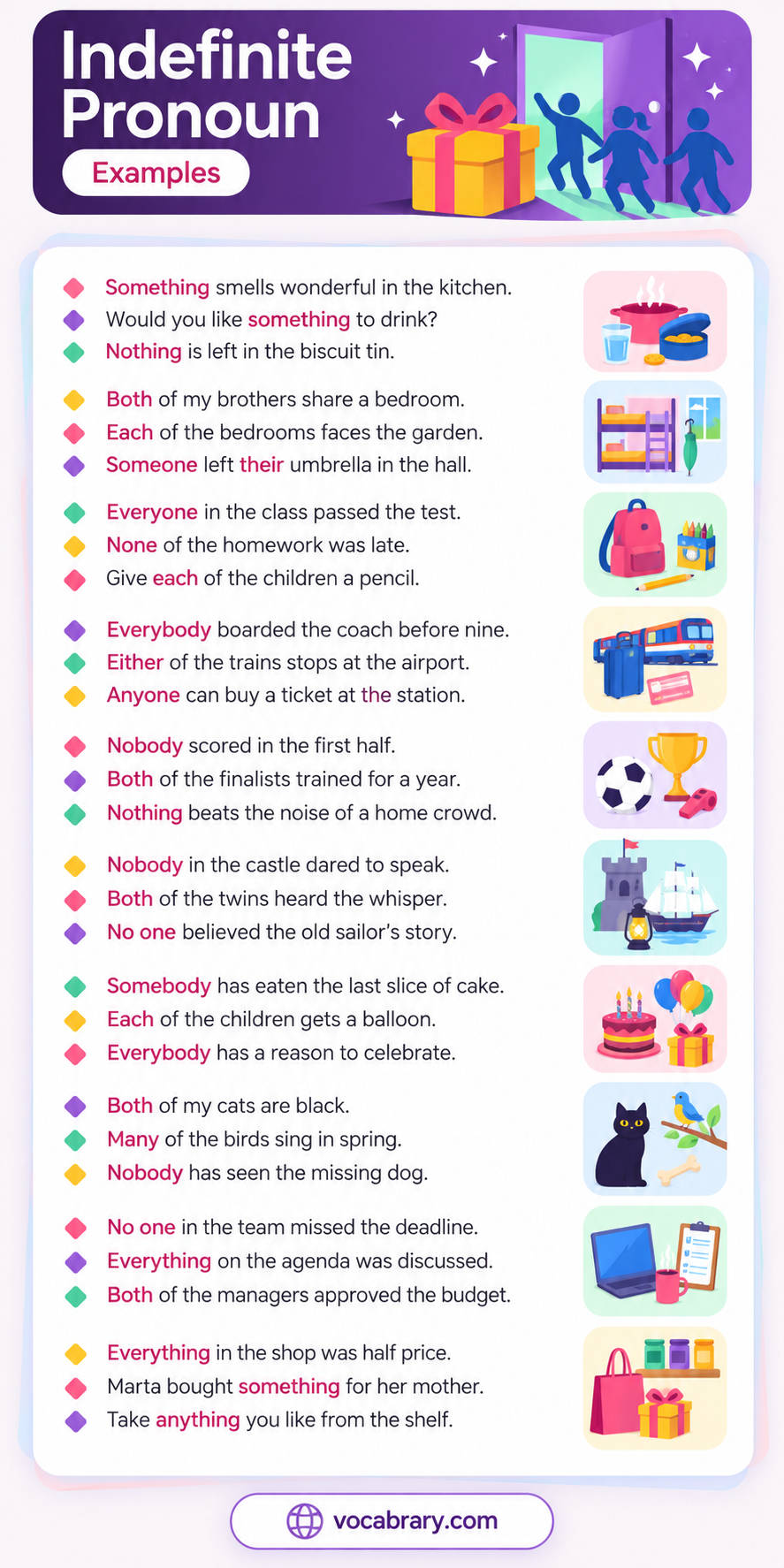
Indefinite Pronoun Example Sentences for Everyday Use
Someone left the door open and everyone in the class passed the test are typical models. In each one the pronoun refers to people or objects without naming them.
- Someone left the door open again.
- Everyone in the class passed the test.
- Nothing can replace a good night’s sleep.
- Both of my sisters live in Toronto.
- Few attended the meeting because of the storm.
- Anything is possible if you practise every day.
- Nobody answered the phone at the office.
- Many of the villagers walk to the market.
- Something smells wonderful in the kitchen.
- Each of the players received a medal.
- All of the tickets were sold in an hour.
- Several of the windows were broken during the storm.
- Somebody has eaten the last slice of cake.
- Neither of the answers is correct.
- Everything in the shop was half price.
- None of the money was recovered.
- Anybody who loves singing can join the school choir.
- Either of the roads leads to the coast.
- Some of the soup is still warm.
- No one knew the answer to the last question.
Singular, Plural and Variable Groups With Examples
Everyone and nobody take a singular verb, both and few take a plural verb, and all and some take the verb that matches the noun after of. Each indefinite pronoun on this page belongs to one of these three groups.
| Group | Indefinite pronouns | Verb form | Example sentence |
|---|---|---|---|
| Singular | Someone, anyone, everyone, no one, something, anything, everything, nothing, each, either, neither, one | Singular verb | Everyone is ready. |
| Plural | Both, few, many, several | Plural verb | Both are ready. |
| Singular or plural | All, some, any, none, more, most | The verb matches the noun after of | All of the cake is gone, and all of the guests are here. |
Someone, Somebody and Something Example Sentences
Someone and somebody refer to a person who is not named, and something refers to an unnamed object. Someone is knocking at the back door and something is burning in the oven show both uses.
- Someone is knocking at the back door.
- Somebody left a wallet on the bus.
- Something is burning in the oven.
- I need someone who speaks Spanish.
- Somebody stole my bicycle from the station.
- Rosa told me something surprising about her uncle.
- Someone must have taken the keys.
- Something about his story sounds false.
- There is something wrong with the engine.
- Someone called while you were out.
- Somebody in this room is humming.
- Something moved behind the heavy curtain in the dark room.
- Ibrahim found someone to repair the roof.
- Somebody will have to clean the kitchen.
Anyone, Anybody and Anything Example Sentences
Anyone and anybody refer to any person at all, and anything refers to any object at all, as in anyone can learn to swim and I will eat anything that Grandma cooks.
- Anyone can learn to swim with patience.
- Anybody who finishes early may leave.
- Anything is better than waiting in this rain.
- You can ask anyone in the village for directions.
- Anyone with a ticket may enter the hall.
- I will eat anything that Grandma cooks.
- Anybody would have done the same.
- If anyone calls, say that I am out.
- She would give anything to see the ocean again.
- Anything you buy today will arrive on Friday.
- Take anything you like from the shelf.
- Anybody over sixty gets a discount on Tuesdays.
- Ask anyone at the front desk for a map.
- Anyone who has lost a glove should visit the office.
Everyone, Everybody and Everything in Sentences
Everyone and everybody refer to all the people in a group, and everything refers to all the objects. Everyone at the table laughed and everything in the garden is covered in frost show both uses.
- Everyone at the table laughed at the joke.
- Everybody knows the answer to that question.
- Everything in the garden is covered in frost.
- Everyone in my family has a favourite song from childhood.
- Everybody was waiting for the train.
- Hamid packed everything into one small suitcase.
- Everything she cooked tasted of cinnamon.
- Everyone wants to be happy, though people choose different ways.
- Everybody brought something to eat to the picnic by the river.
- Mateo lost everything in the flood.
- Everyone clapped when the bride arrived.
- Everything seemed possible on the first day of spring.
- Everybody in the stadium stood up.
- Does everyone have a pen before the exam begins?
Sentences With Nobody, Nothing and None
No one and nobody refer to zero people, nothing refers to zero objects, and none refers to zero of a group, as in nobody heard the alarm and none of the money was found.
- Nobody heard the alarm because the music was so loud.
- No one has ever climbed that wall.
- Nothing happened after the long speech.
- Nothing is more precious than time.
- Nobody knows the way to the old mill.
- None of the luggage was found.
- No one came to the meeting.
- She said nothing about the missing letter.
- None of the milk is fresh.
- Nobody is perfect, and every writer needs an editor.
- There was nothing left in the fridge.
- No one in the village owns a car.
- Nothing else mattered to him that night.
- None of the cake was left.
All, Some and Most Sentences About Quantities
All, some, any, most, and more take a singular verb after an uncountable noun and a plural verb after a plural noun. All of the money was spent and all of the students were present show both.
- All of the money was spent on repairs.
- All of the students were present.
- Some of the coffee spilled on the table.
- Some of the guests arrived early.
- Most of the cake is gone.
- Most of the neighbours agree with the plan.
- Any of the doctors will see you today.
- More of the water evaporated overnight.
- I ate some and gave the rest to my brother.
- Most were happy with the result.
- All is well that ends well.
- Any of these tickets will work.
- Most of the paint was still wet.
Each, Either and Neither in Sentences
Each, either, and neither refer to the members of a group one at a time and take a singular verb, as in each of the boys carried a flag. The distributive pronoun example sentences cover the same three words in more detail.
- Each of the boys carried a flag.
- Either of the trains stops at the airport.
- Neither of the explanations is convincing.
- Each has a separate room with a window facing the garden.
- Either will do for the party.
- Neither of my parents speaks French.
- Give each of the children a pencil.
- Each of the contestants was nervous.
- Neither was available on Monday, so we booked Tuesday.
- You may take either of the two paths.
- Each of us has a different dream.
- Either is acceptable for the form, as long as you sign it.
- Neither of them called back after I left a message.
- Each is responsible for a separate task.
Both and Few, Many and Several in Sentences
Both, few, many, and several refer to more than one person or object and take a plural verb, as in both of my brothers play football and several of the students asked for extra time.
- Both of my brothers play football.
- Few know how the machine works.
- Many have tried, but nobody has succeeded.
- Several of the students asked for extra time.
- Both were late for the meeting.
- Many of the houses along the river were flooded.
- Few of the passengers noticed the delay.
- Several have already signed the petition.
- Ana invited ten friends, but few came.
- Both are correct, so the teacher gave full marks.
- Many agree that the road is dangerous.
- Several of the paintings are not for sale.
- Few have ever seen the northern lights from this village.
- I met both of them at the station.
Sentences With One for People in General
The pronoun one refers to any person in general and belongs to formal English, as in one should always read the contract and one never knows what tomorrow will bring.
- One should always read the contract before signing.
- One never knows what tomorrow will bring.
- One must respect the opinions of others.
- If one works hard, success follows.
- One cannot learn to swim by reading a book.
- One has to be patient with young children.
- One must be careful on icy roads.
- One can only admire her courage.
- One is expected to arrive on time for an interview.
- It is hard for one to say no.
Singular Indefinite Pronoun Sentences With Singular Verbs
Everyone, nobody, somebody, and each take a singular verb, even when they refer to many people, as in everyone is welcome at the open day and nobody was injured in the accident.
- Everyone is welcome at the open day.
- Nobody was injured in the accident.
- Somebody has left a bag on the platform.
- Each of the rooms has a balcony.
- Everything is ready for the guests.
- Nothing was missing from the museum.
- Anyone is free to leave at noon.
- Neither of the roads is safe in winter.
- No one is answering the bell.
- Either of the singers is a good choice.
- Something has changed in the village.
- Everybody has a reason to celebrate.
Plural Verb Sentences With Both and Few
Both, few, many, and several take a plural verb, as in both are ready for the exam and several are waiting outside the office.
- Both are ready for the exam.
- Few have visited the island since the storm.
- Many were disappointed by the delay.
- Several are waiting outside the office.
- Both of the cars were damaged.
- Few of the shops are open on Sundays.
- Many of the players are under twenty.
- Several have complained about the noise.
- Both have promised to attend the ceremony next Friday.
- Few understand the problem fully, even after reading the report.
- Many of the letters are still unopened.
- Several of the nurses work night shifts.
All, Some and None With Singular or Plural Verbs
All, some, most, any, and more take the verb that matches the noun after of, as in all of the bread is stale and all of the eggs are fresh. None takes either verb: a singular verb means not one, and a plural verb means not any.
- All of the bread is stale.
- All of the eggs are fresh.
- Some of the music was too loud.
- Some of the songs were in Spanish.
- Most of the paint is dry.
- Most of the paintings are portraits.
- None of the juice was wasted.
- None of the students were late.
- None of the students was late.
- Any of the juice is safe to drink.
- More of the forests are disappearing every year.
- More of the soup is on the stove.
Some Versus Any Example Sentences
Some is used in positive statements and offers, and any is used in negatives, questions, and if-clauses, as in I bought some of the cheese and I didn’t buy any of the cheese.
- I bought some of the cheese, but not all of it.
- I didn’t buy any of the cheese.
- Some of the visitors stayed late.
- I haven’t met any of the visitors.
- Would you like some more tea before you go home?
- Do you want any of these oranges from my garden?
- There is plenty of rice, so take some.
- There isn’t enough rice, so I cannot give you any.
- If you find any, please tell me.
- Some of us walked, and some took the bus.
Indefinite Pronouns in Negative Sentences
A negative verb takes an any- pronoun, as in I don’t know anyone in this town, and a negative pronoun such as nobody takes a positive verb, as in nobody has seen the missing dog. Both patterns contain one negative only.
- I don’t know anyone in this town.
- There isn’t anything in the fridge.
- She didn’t tell anybody about the surprise.
- Nobody has seen the missing dog.
- He didn’t find anything unusual in the report.
- We haven’t heard from anyone since Monday.
- Nothing was said about the cost.
- I can’t see anybody in the garden.
- They didn’t invite anyone from the old office.
- There wasn’t anything to eat at the station.
- No one has called me since Friday.
- Mehmet doesn’t need anything from the shop.
Questions With Indefinite Pronouns
A question about existence uses an any- pronoun, as in is there anyone at home? An offer or a request uses a some- pronoun, as in would you like something to drink?
- Is there anyone at home who can open the gate?
- Would you like something to drink?
- Did anybody see the accident outside the bakery this morning?
- Can I ask you something about the homework before class?
- Has everyone finished the exam, or do you need more time?
- Would someone open the window, please?
- Do you have anything to declare?
- Did you eat anything at the party?
- Is everything ready for the ceremony?
- Have any of you read the new novel?
- Are both of your parents coming?
- Does either of the shops sell stamps?
Singular They Sentences for Unknown Gender
The plural pronouns they, them, and their are accepted after someone, everyone, and nobody when the gender of the person is unknown. Someone left their umbrella in the hall and if anybody calls, tell them I will phone back show the pattern.
- Someone left their umbrella in the hall.
- Everyone should bring their own lunch.
- If anybody calls, tell them I will phone back.
- Nobody wants their work to be ignored.
- Each of the students must hand in their form today.
- Somebody forgot their phone on the desk.
- Everybody deserves a chance to speak their mind.
- Anyone who loses their ticket must pay again.
- No one likes their mistakes to be corrected in public.
- Someone is waiting outside, and I think they want to talk to you.
Possessive Sentences With Someone’s and Nobody’s
Someone’s, everybody’s, and nobody’s add an apostrophe and s to the singular pronoun, as in someone’s phone is ringing and that is nobody’s fault.
- Someone’s phone is ringing in the corridor.
- Everybody’s coat is on the rack by the door.
- That is nobody’s fault, because the rain delayed every train.
- Anyone’s guess is as good as mine.
- Somebody’s bag was left on the bus.
- It is everyone’s responsibility to keep the beach clean.
- One’s first day at school is hard to forget.
- No one’s name appeared on the list.
- Is this anybody’s pen, or should I take it to the office?
- We respected everyone’s right to speak.
Position of Indefinite Pronouns in a Sentence
An indefinite pronoun works as a subject, an object, or the object of a preposition, as in someone painted the fence, the teacher praised everyone, and she talked to everyone.
Subject Position Sentences
In Everybody cheered when the lights came on and Anything can happen in a football match, the pronoun comes before the verb and is the subject.
- Someone painted the fence overnight while the family slept.
- Nothing stopped the runners, not even the heavy rain.
- Everybody cheered when the lights came on.
- Few remember the old tram that once crossed the bridge.
- Several arrived late because the bus broke down.
- Each needs a clean towel and a fresh bar of soap.
- Nobody noticed the missing chair until the lesson started.
- Both speak fluent Polish and a little German.
- Anything can happen in a football match.
- Many are still waiting for their results.
Object Position Sentences
In They rescued everyone from the burning house and Marta bought something for her mother, the pronoun comes after the verb and receives the action.
- The teacher praised everyone equally after the long rehearsal.
- We found nothing in the attic.
- She invited several from the choir.
- He told no one about the plan.
- Did you see anybody near the shop?
- Marta bought something for her mother.
- They rescued everyone from the burning house.
- I admire many who volunteer at the shelter.
- The police questioned both at the station.
- Ravi will lend anyone a pen.
Sentences With Pronouns After Prepositions
In She talked to everyone at the party and We argued about nothing for an hour, the pronoun comes after a preposition and is the object of that preposition.
- She talked to everyone at the party.
- We argued about nothing for an hour.
- I am thinking of someone from my old school.
- The book is for anybody who loves maps.
- He relies on no one but himself.
- They shared the cake among several.
- The gift is for both of you.
- She is angry with someone at work.
- He walked past everybody without a word.
- This offer is open to all.
- We decided on something simple for the anniversary dinner.
- Nadia spoke well of each of them.
Something Different and Someone Else Sentences
An adjective follows an indefinite pronoun ending in -one, -body, or -thing, as in something different and someone interesting, and the word else follows it in the same way, as in someone else.
- Nadia wants to try something different.
- Anything valuable should stay in the safe.
- I met someone interesting on the train.
- Nothing new happened yesterday at the committee meeting.
- Is there anyone available on Sunday?
- Everything important is in this folder.
- We need somebody reliable for the night shift.
- Tomas ate something sweet before the exam.
- Nobody famous attended the wedding, which suited the shy couple.
- Does anything useful remain in the shed?
- Someone else will drive tomorrow because Dad has an early shift.
Reported Speech and Passive Sentences With Indefinite Pronouns
In reported speech the indefinite pronoun stays the same and the verb moves one tense back after a past reporting verb, as in she said that someone had broken the window. Passive sentences use the pronoun as the subject, as in nothing was done about the leaking roof.
Indefinite Pronouns in Reported Speech
He told me that nothing had changed and Maria asked whether anyone had found her keys show the pronoun staying the same while the verb moves back in time.
- She said that someone had broken the window.
- He told me that nothing had changed in the village.
- The manager announced that everyone would receive a bonus.
- Rita explained that nobody had seen the letter.
- They claimed that several had applied for the job.
- Maria asked whether anyone had found her keys.
- The guide said that both were closed on Mondays.
- The doctor warned that few recover without treatment.
Indefinite Pronouns in Passive Sentences
Everyone was invited to the opening ceremony and nobody was told about the change use the pronoun as the subject of a passive verb.
- Nothing was done about the leaking roof.
- Everyone was invited to the opening ceremony.
- Somebody was seen near the back gate.
- Nobody was told about the change.
- Several were rescued from the river.
- Everything was packed into the van before sunrise on Saturday.
- Many were surprised by the announcement.
- No one was blamed for the accident.
Sentences About Family Life at Home
A tap left running, a biscuit tin with nothing in it, and two brothers who share a bedroom appear in indefinite pronoun example sentences about family life. These cases share an unknown person or an unspecified amount in a house.
- Someone has left the tap running.
- Everything in the kitchen smells of garlic.
- Nobody wants to wash the dishes tonight.
- Both of my brothers share a bedroom.
- Mum cooked something special for Sunday lunch.
- Everyone in the house sleeps late at weekends.
- Nothing is left in the biscuit tin.
- Several of the chairs need new cushions.
- Anyone may borrow the ladder from the garage.
- Each of the bedrooms faces the garden.
Sentences About Classmates and School Projects
A finished class project, a certificate for every student, and a mark on the whiteboard are school cases in indefinite pronoun example sentences. These cases share an unknown pupil or an unspecified number of pupils.
- Everyone in Class 5 has finished the project.
- Nobody in my class forgot the homework today.
- Some of the pupils stay for football practice.
- Each of the students received a certificate.
- Many in the school choir study the violin.
- Anything you write in the exam must be your own.
- Few of them failed the mid-term test last week.
- Someone has drawn on the whiteboard.
- Both of the teachers praised the experiment.
- None of the homework was late.
Work Sentences About Meetings and Deadlines
A meeting attended by everybody, an invoice query from accounting, and a deadline that nobody missed are office cases for indefinite pronouns. These cases share an unknown colleague or an unspecified number of staff.
- Everybody in the office attended the meeting.
- Nothing can be signed before the manager returns.
- Someone from accounting called about the invoice.
- Several of the staff work from home.
- Few in the department knew about the merger.
- Anyone with a laptop may join the workshop.
- Each of the applicants sat a short test.
- No one in the team missed the deadline.
- Both of the managers approved the budget.
- Everything on the agenda was discussed.
Travel Sentences With Everybody and Someone
A coach that everybody boarded before nine and a seat taken by someone are travel cases for indefinite pronouns. These cases share an unknown traveller or an unspecified number of tourists.
- Everybody boarded the coach before nine.
- Nothing is more tiring than a delayed flight.
- Someone has taken my seat by the window.
- Many of the tourists photographed the old bridge.
- Few in the group spoke the local language.
- Both of our suitcases were lost at the airport.
- Anyone can buy a ticket at the station.
- Several of the trains were cancelled by the snow.
- Nobody at the border asked for our passports.
- Each of the hotels offers free breakfast.
News Report Sentences With Everyone and No One
A village that everyone left before the flood and a fire that no one claimed show indefinite pronouns in reports. These cases share an unknown person or an unspecified number of people.
- Everyone in the village was evacuated before the flood.
- Nothing has been decided about the new tax.
- Several were injured in the collision.
- Many have criticised the minister’s speech.
- No one has claimed responsibility for the fire.
- Both of the leaders will attend the summit.
- Someone leaked the report to a newspaper.
- Few expected the party to win the election.
- Everybody is talking about the result.
- None of the damage was covered by insurance.
Story Sentences With Someone and Something
Someone following Elena through the fog and something glowing at the bottom of a well show indefinite pronouns in stories. These cases share an unknown character or an unnamed object in the plot.
- Someone was following Elena through the fog.
- Nobody in the castle dared to speak.
- Everything vanished when the clock struck twelve.
- Both of the twins heard the whisper.
- Something glowed at the bottom of the well.
- Few have returned from the haunted forest.
- No one believed the old sailor’s story.
- Each of the knights carried a silver sword.
- Many whispered about the missing prince.
- Nothing moved in the empty hall.
Sports Sentences With Everyone and Nobody
A stadium where everyone stood for the anthem and a first half in which nobody scored show indefinite pronouns in matches. These cases share an unknown player or an unspecified number of fans.
- Everyone in the stadium stood for the anthem.
- Nobody scored in the first half.
- Both of the finalists trained for a year.
- Several of the players were injured.
- Few believed the underdogs would win.
- Each of the runners wore a numbered vest.
- Someone blew the whistle too early.
- Anyone can join the club on Saturday morning.
- Nothing beats the noise of a home crowd.
- Many of the fans waited outside in the rain.
Health Sentences With Everyone and Nobody
Eight hours of sleep that everyone needs and a ward where nobody was sleeping show indefinite pronouns in health writing. These cases share an unknown patient or an unspecified number of people.
- Everyone needs eight hours of sleep.
- Nothing is more valuable than good health.
- Someone should check the patient’s temperature.
- Few recover quickly from the flu without enough rest.
- Both of my grandparents walk daily.
- Anybody with a fever should stay at home.
- Many suffer from back pain after long flights.
- Nobody in the ward was sleeping.
- Each of the patients is checked twice a day.
- Several of the doctors speak Arabic.
Indefinite Pronoun Example Sentences for Kids
Indefinite pronoun example sentences for beginners are short, such as everyone likes pizza and nobody is at home. These words name people or objects without saying which ones.
- Everyone likes pizza.
- Nobody is at home.
- Someone is at the door.
- Nothing is in the box.
- Both of my cats are black.
- Everything is wet.
- I see something red.
- Each of the children gets a balloon.
- Anybody can play this game.
- Many of the birds sing in spring.
- Few of the children stay awake all night.
- Please give some to Dad.
Indefinite Pronoun Sentences for Students and Exams
Indefinite pronoun example sentences for exams are longer, such as nothing in the data supports the original hypothesis and several of the studies reached the same conclusion. They are written for essays, where the pronoun summarises evidence without naming every source.
- Everyone is entitled to a fair trial under the law.
- Nothing in the data supports the original hypothesis.
- Several of the studies reached the same conclusion.
- Few economists predicted the financial crisis before it began.
- Many argue that the reform came too late.
- Neither of the two theories explains the evidence.
- None of the evidence was conclusive.
- Something about the author’s argument remains unconvincing.
- Anyone who reads the report will notice the gaps.
- Both of the poems explore the theme of exile.
- Each of the chapters ends with a question.
- All of the sources agree on the date.
Short Paragraphs With Indefinite Pronouns
Four connected passages about a bridge, a kitchen, a festival, and a class letter use everyone, nobody, something, and each in running text.
Everyone in the village knew the old bridge was unsafe, but nobody repaired it. Several wrote letters, and few received an answer. Then something changed: someone found the money, and everything was ready by spring.
Maya checked the kitchen. Nothing was cooked, and nobody had set the table. Someone had left the window open, and everything smelled of rain. Both of her brothers were asleep.
At the festival, everybody brought something to share. Some brought bread, some brought fruit, and all of it disappeared before noon.
The teacher said that each of the students must write a letter. Neither of the twins had a pen, but anyone nearby offered one. Nobody finished late.
Indefinite and Distributive Pronoun Sentences Compared
Indefinite pronouns refer to unnamed people, objects, or amounts, while the distributive pronouns each, either, and neither refer to the members of a group one at a time. The distributive pronoun example sentences cover the second group.
| Feature | Indefinite pronoun | Distributive pronoun |
|---|---|---|
| Job in the sentence | Refers to unnamed people, objects, or amounts | Refers to the members of a group one at a time |
| Word forms | Someone, everyone, nothing, both, few, many, all, none | Each, either, neither (many grammars also count these as indefinite) |
| Verb form | Singular or plural, depending on the word | Singular in standard usage |
| Sample sentence | Everyone is ready. | Each is ready. |
| Second sample | Both are ready. | Neither is ready. |
FAQs
Q1. What are the indefinite pronouns in English?
The indefinite pronouns in English include someone, anyone, everyone, no one, something, anything, everything, nothing, all, some, any, none, each, either, neither, both, few, many, several, and one. These are the words used in indefinite pronoun example sentences, and each word refers to people, objects, or amounts without naming them. Words ending in -one and -body refer to people, and words ending in -thing refer to objects.
Q2. Is everyone singular or plural?
Everyone is singular, so it takes a singular verb, as in Everyone is ready. The word suggests many people, but it takes a singular verb because it names the group as a single unit. In everyday English, a following pronoun is their, as in Everyone brought their own lunch.
Q3. Do both, few, many, and several take a plural verb?
Both, few, many, and several take a plural verb, because each of them refers to more than one person or object. Both are ready and Several have complained show the pattern. The plural verb stays the same when of and a plural noun follow, as in Few of the shops are open.
Q4. Does none take a singular or a plural verb?
None takes a singular or a plural verb, and modern dictionaries accept both. A singular verb stresses not one, as in None of the cake was left, while a plural verb stresses not any, as in None of the students were late. Style guides differ, because some prefer the singular verb in formal writing and others accept the plural verb.
Q5. What is the difference between some and any?
Some and any differ in the sentence types they fit, because some is used in positive statements and offers while any is used in negatives and questions. I bought some of the cheese is positive, I didn’t buy any of the cheese is negative, and Would you like some? is an offer. Any also means no matter which in a positive sentence, as in Any of these will work.
Q6. Why do people say somebody left their umbrella?
The plural pronoun their is accepted after somebody and similar words when the gender of the person is unknown. Writers use it with someone, anyone, everyone, and nobody when the sex of the person is not known or does not matter. Singular they has been in use for centuries, and modern style guides accept it.
Q7. What is the difference between someone and anyone?
Someone and anyone both refer to a person who is not named, but someone is used in positive statements and anyone in negatives and questions. Someone called is positive, while I don’t know anyone here is negative and Is anyone home? is a question. Anyone also means any person at all in a positive sentence, as in Anyone can learn to swim.
Q8. What is the difference between everyone and every one?
Everyone and every one differ in meaning, because everyone means all people while every one means each single member of a named group. Everyone is welcome refers to people in general, and Every one of the students passed refers to a particular class. The two-word form is followed by of and a plural noun, as in the second example.
Q9. What is the difference between an indefinite pronoun and a distributive pronoun?
An indefinite pronoun refers to unnamed people, objects, or amounts, while a distributive pronoun refers to the members of a group one at a time. Each, either, and neither are distributive, although many grammars also count them as indefinite, and someone, everyone, both, and many are indefinite. The distributive pronoun example sentences cover the second group.
Q10. How do you make an indefinite pronoun possessive?
An indefinite pronoun becomes possessive by adding an apostrophe and s to the singular form, as in someone’s phone and everybody’s coat. The pronoun no one forms no one’s, and the pronoun one forms one’s. Plural pronouns such as both and few take of instead, as in the opinion of both.
Q11. Where does an adjective go with something or anyone?
An adjective follows the indefinite pronoun that it describes, so the correct forms are something sweet and someone interesting, not sweet something. The word else follows the pronoun in the same way, as in someone else. This pattern applies to every pronoun ending in -one, -body, or -thing.
Q12. How do you use one as an indefinite pronoun?
The pronoun one refers to any person in general and belongs to formal English, as in One should always read the contract. It takes a singular verb, its possessive is one’s, and its reflexive form is oneself. Everyday speech replaces it with you, as in You should always read the contract.

Leave a Comment