
A possessive pronoun is a pronoun that indicates the owner and replaces a noun phrase, unlike a possessive adjective such as my, as in this seat is mine. The form mine already contains the owned noun, so nothing follows it in this seat is mine, whereas my in this is my seat requires seat after it. That contrast between my and mine, her and hers, is the one possessive pronoun example sentences stress, with the pronoun closing the clause and the adjective always heading a noun phrase.
What Is a Possessive Pronoun?
A possessive pronoun names the owner and the owned item in one word, so mine means my seat once the seat has been mentioned. A possessive adjective such as my needs a noun after it, while a possessive pronoun is used without one.
My seat = mine; your seat = yours; her seat = hers; their seat = theirs
The red bag is hers, and the blue one is mine.
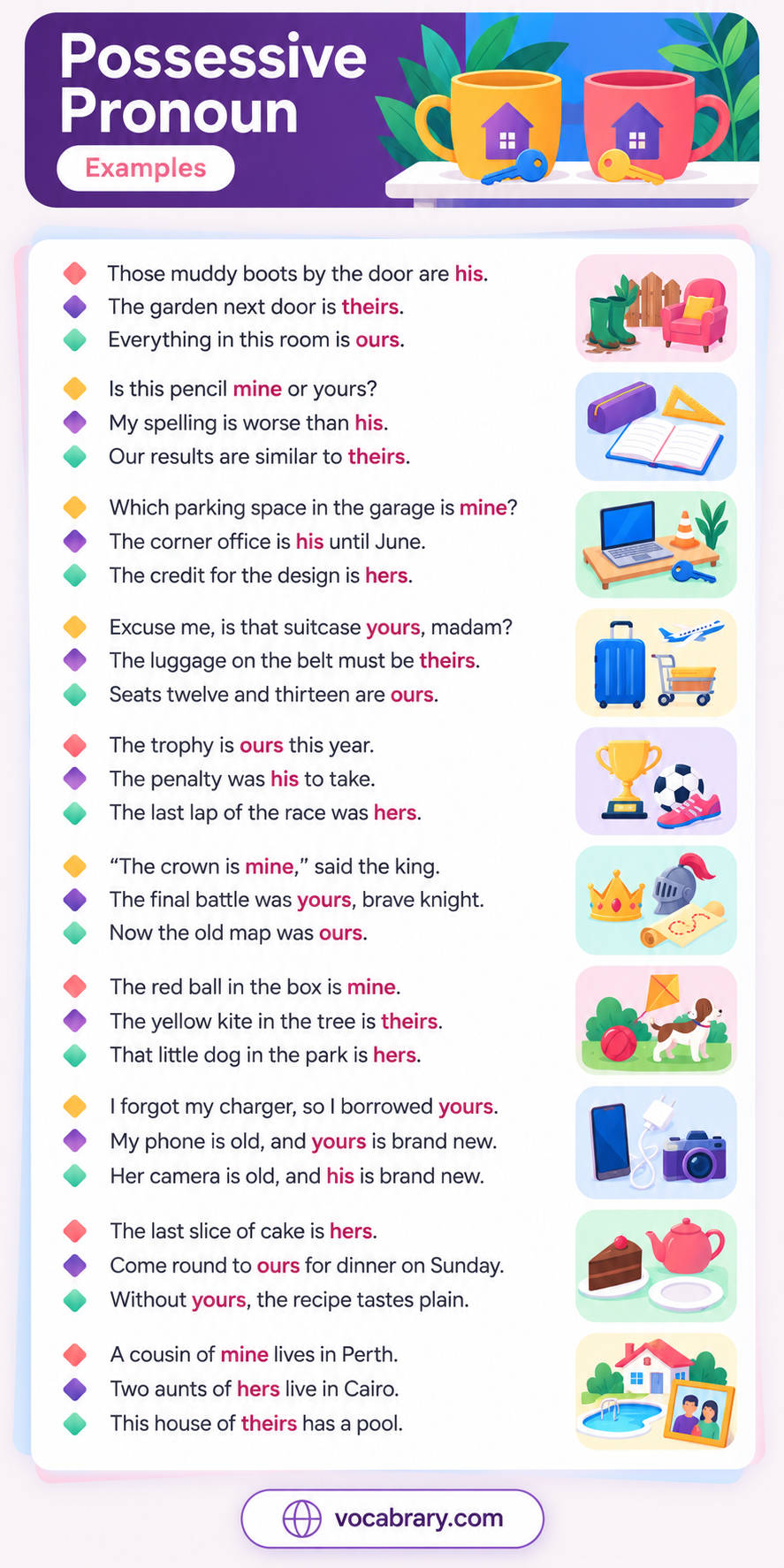
Common Possessive Pronoun Example Sentences
Mine, yours, hers, and theirs are possessive pronouns, and each one replaces a noun that the speaker has already named, such as a seat, a bicycle, or a house.
- This seat is mine, and that one is yours.
- The red bicycle by the gate is hers.
- Our house is small, but theirs has a garden.
- Is this umbrella on the chair yours?
- Those muddy boots by the door are his.
- The final decision was ours, not theirs.
- Your handwriting is neat, but mine is hard to read.
- The last slice of cake is hers.
- That phone on the desk is not mine.
- Their team won the cup, and ours reached the semi-final.
- Whose scarf is this? It is hers.
- A cousin of mine lives in Perth.
- The blue notebook is yours, and the green one is his.
- My coat is wet, so I borrowed yours.
- The idea was theirs, but the credit went to us.
- This table is ours until noon.
- Your answer is correct, and hers is nearly correct.
- Hers is the loudest voice in the choir.
- Everything in this room is ours.
- The garden next door is theirs.
- I found a pen, but it is not mine.
- Yours was the first name on the register.
- My sister’s flat is bigger than mine.
- Their flight leaves at six, and ours leaves at nine.
Possessive Pronoun Sentences for First, Second and Third Person
Mine is the first person singular, ours is the first person plural, and yours is the second person. His and hers are the third person singular, and theirs is the third person plural.
| Person | Possessive adjective | Possessive pronoun | Meaning |
|---|---|---|---|
| First person singular | My | Mine | Belonging to me |
| Second person | Your | Yours | Belonging to you |
| Third person, male | His | His | Belonging to him |
| Third person, female | Her | Hers | Belonging to her |
| First person plural | Our | Ours | Belonging to us |
| Third person plural | Their | Theirs | Belonging to them |
Mine in a Sentence
That umbrella is mine, and the decision was mine: the pronoun names the speaker as the owner without repeating the noun.
- That umbrella by the door is mine.
- Mine is the window seat on the left.
- Your plan is good, but mine is cheaper.
- A friend of mine teaches in Seoul.
- The decision was mine, and I explained it.
- Take your bag, and leave mine on the chair.
- Is this pencil mine or yours?
- The last turn in the game is mine.
- Her car is faster than mine.
- I recognised the handwriting at once because it was mine.
Yours in a Sentence
In is this scarf yours? and I borrowed yours, the pronoun names the listener as the owner, with the same form for one listener or for several.
- Is this scarf on the bench yours?
- Yours is the third door on the right.
- My answer was wrong, but yours was correct.
- The ticket in the drawer is yours.
- I forgot my charger, so I borrowed yours.
- Excuse me, is that suitcase yours, madam?
- The credit is yours, and so is the blame.
- A colleague of yours called this morning.
- My phone is old, and yours is brand new.
- Whose turn is it? It is yours.
His and Hers Example Sentences
The red jacket is his and the blue jacket is hers: his names a male owner, hers names a female owner, and neither takes an apostrophe.
- The red jacket on the hook is his.
- The blue jacket on the hook is hers.
- That seat is his until the end of the film.
- This chair is hers by right.
- My handwriting is worse than his.
- Your garden is bigger than hers.
- A cousin of his lives in Dublin.
- A neighbour of hers found the dog.
- His is the loudest alarm clock, and hers is the quietest.
- The idea was his, but the plan was hers.
- Is the umbrella his or hers?
- The final decision about the budget is hers.
Ours in a Sentence
The house on the corner is ours, and the decision was ours: the pronoun names the speaker together with at least one other person as the owner.
- The house on the corner is ours.
- Ours is the family with the blue door.
- Your team scored twice, but ours scored three goals.
- This victory after ten years is ours.
- The garden is small, but it is ours.
- A friend of ours runs the bakery.
- Their flat is bigger than ours.
- The decision was ours, and we paid for it.
- Is the next table by the window ours?
- That decision was never ours to make.
Theirs Example Sentences
The green car is theirs, and the victory was theirs: the pronoun names a group of owners who are neither the speaker nor the listener.
- The green car outside the bakery is theirs.
- Theirs is the last house before the farm.
- Our train leaves at nine, and theirs leaves at ten.
- The victory was theirs, and nobody argued.
- A neighbour of theirs called the police.
- Those suitcases near the lift are theirs.
- We painted our fence red, and they painted theirs blue.
- The idea was theirs, not ours.
- Is the yellow bus at the corner theirs?
- The choice is theirs to make.
Its and It’s Sentences Beside His and Hers
In the dog wagged its tail and the company changed its name, the word its comes before a noun, which makes it a possessive adjective. Its has no standalone form in standard English, so the standard set of possessive pronouns leaves it out, and it’s always means it is or it has.
- The cat guarded its bowl, and the dog guarded his.
- It’s late, but the last seat on the bus is still yours.
- The company changed its name, and the rival firm kept theirs.
- It’s been a long week, and the weekend is ours.
- The bird returned to its nest, and the hens stayed in theirs.
- It’s a pity that the shop lost its licence, but the bakery kept theirs.
- The oak lost its leaves in October, but the cherry trees kept theirs until November.
- The house is old, but its roof is newer than ours.
Possessive Adjective and Possessive Pronoun Sentence Pairs
My bag and mine, your bag and yours, and their house and theirs show the pairs. The possessive adjective comes before a noun, and the possessive pronoun replaces the adjective and the noun together.
My and Mine in Paired Sentences
My bag is on the chair, and the red scarf is mine too: the adjective needs the noun bag, and the pronoun needs no noun.
- My bag is on the chair, and the red scarf is mine too.
- That is my pencil, so please give it back because it is mine.
- My garden is small, but the apple tree is mine.
- I lost my keys, and the keys on the table are not mine.
- My name is on the cup, which makes the cup mine.
- Put my books on the shelf, because the rest are not mine.
- My brother has a bike, and the old one in the shed is mine.
Sentences With Your and Yours
Your coat and yours, and your turn and yours, are the pairs for the listener: the adjective is followed by a noun, and the pronoun is not.
- Your coat is on the hook, and the grey one is yours as well.
- Is that your umbrella, or is the black one yours?
- Your ticket is valid, and the one in my bag is not yours.
- Please bring your lunch, because the picnic basket is not yours.
- Your seat is near the door, and the front row is yours tomorrow.
- I like your idea, but the final plan is yours to decide.
- Your name is on the list, and the last place is yours.
His, Her and Hers Sentences
In his book and the book is his, the word his is the same in both roles, while her book becomes the book is hers when no noun follows.
- Her jacket is blue, and the green one is hers too.
- His bag is heavy, and the black suitcase is his as well.
- Her idea won the prize, and the credit is hers alone.
- I borrowed her pen, and the red one on the desk is hers.
- His shoes are muddy, and the clean pair by the door is his.
- Her turn comes next, and the final turn is hers.
- That is his phone, so the charger beside it is his too.
- Her room is tidy, and the study next to it is hers.
Our and Ours Sentences
Our house and ours, and our team and ours, pair the two forms for the speaker and others.
- Our house is old, and the garden behind it is ours.
- Our team trains at six, and the red pitch is ours this season.
- We lost our tickets, and the spare ones are not ours.
- Our flat is on the second floor, and the balcony is ours.
- This is our boat, so the blue oars are ours.
- Our turn is next, and the final song is ours.
- Our neighbours are kind, and the orchard beside them is ours.
Their and Theirs in Paired Sentences
Their house and theirs, and their idea and theirs, pair the two forms for a group of owners.
- Their car is new, and the bicycle beside it is theirs too.
- Their team won the cup, and the trophy is theirs.
- Their idea was bold, and the credit is theirs.
- We admired their garden, and the greenhouse is theirs as well.
- Their tickets are in the car, and the spare ones are theirs.
- Their class begins at nine, and the late bus is theirs.
- Their house is on the hill, and the field below it is theirs.
Sentences With a Possessive Pronoun as the Subject
A possessive pronoun is the subject when it stands before the verb and replaces a noun phrase that the speaker named earlier, as in your coat is wet, but mine is dry.
- Your coat is wet, but mine is dry.
- My seat is here, and yours is behind the pillar.
- Our parcels were posted together, but hers arrived first.
- Our dog is small, and theirs is enormous.
- His bike has a flat tyre, but mine works fine.
- Their room faces the street, but ours has a view of the sea.
- Her camera is old, and his is brand new.
- Your plan is cheap, and theirs costs a fortune.
- Your torch works well, but mine needs a new battery.
- Your essay is short, and hers is long.
- Their kitchen is modern, and ours is traditional.
- My bag is light, but yours looks heavy.
Examples of Possessive Pronouns as Objects
A possessive pronoun is the object when a verb takes the owned item as its object, as in Tara lent me hers.
- I forgot my pen, so Tara lent me hers.
- He took his coat and left mine on the hook.
- You bring your lunch, and we will bring ours.
- They sold their car and borrowed ours.
- She cleaned her room and then cleaned ours.
- I prefer yours to hers because it is lighter.
- Take my umbrella and give hers to Tom.
- Maria loves her job and envies ours.
- Nobody wanted our tickets, so we bought theirs.
- Forgive my error and correct yours.
- The inspector examined his passport and then examined mine.
- We watered our lawn, and they watered theirs.
Subject Complement Sentences After Be
A subject complement is the word after be that describes or renames the subject. A possessive pronoun in that position states who owns the subject, as in the blue bicycle is mine.
- The blue bicycle in the shed is mine.
- Those gloves on the radiator are hers.
- The victory in the final was theirs.
- That chair near the stove is ours.
- The responsibility for the delay is his.
- Which scarf on the shelf is yours?
- The final decision remains yours until Friday.
- This corner table will be ours.
- The prize became hers at last.
- The luggage on the belt must be theirs.
- The note in the accounts was his.
- Success is yours if you keep trying.
Sentences With Possessive Pronouns After Prepositions
A possessive pronoun follows a preposition such as with, of, to, at, or without, as in compared with yours and round at hers. In British English, a speaker says at ours or round to theirs to mean someone’s home.
- Compared with yours, my suitcase is tiny.
- Take care of yours, and I will look after mine.
- Is this seat next to hers?
- Instead of mine, use the one on the shelf.
- Come round to ours for dinner on Sunday.
- We stayed at theirs for two nights.
- Without yours, the recipe tastes plain.
- Tom parked in front of hers.
- Our results are similar to theirs.
- I am proud of ours and curious about theirs.
- Beside ours, the neighbours’ garden looks bare.
- My class is smaller than yours, and it finishes before hers.
Double Possessive Sentences Such as a Friend of Mine
A friend of mine and that idea of yours show the double possessive: in this construction the word of is followed by a possessive pronoun, not by a possessive adjective.
- A friend of mine coaches a swimming team.
- That idea of yours saved the project.
- A colleague of hers found the file.
- We visited a cousin of ours in Leeds.
- This house of theirs has a pool.
- Mr Evans is an old teacher of his.
- I borrowed a book of hers last week.
- It was a mistake of mine.
- Some friends of ours arrive tonight.
- That habit of yours annoys everybody.
- Is she a relative of theirs?
- A song of his reached the top ten.
- Two aunts of hers live in Cairo.
- A classmate of mine won the contest.
Comparison Sentences With Than and as
After than and as, a possessive pronoun replaces the second noun phrase in a comparison, as in your car is faster than mine and her essay is as long as yours. Possessive pronoun example sentences like these avoid repeating the noun.
- Your car is faster than mine.
- Her essay is as long as yours.
- Their garden is bigger than ours.
- My spelling is worse than his.
- Anna’s phone is newer than mine.
- Our tickets cost more than theirs.
- Your suitcase is as heavy as hers.
- His results were better than mine.
- Tom’s car is older than ours.
- My team is not as strong as yours.
Verb Agreement Sentences With Possessive Pronouns
The possessive pronoun keeps one form, but the verb agrees with the noun that the pronoun replaces: my knee is sore becomes mine is sore, and my knees are sore becomes mine are sore.
- Your shoes are muddy, and mine are clean.
- My bag is heavy, and yours is light.
- Their ideas were old, but ours were new.
- Her answer was correct, and his was nearly correct.
- Our tickets are in the car, and theirs are in the hotel.
- His brother is a pilot, and hers is a nurse.
- My knee hurts, but yours is fine.
- Our houses are old, and theirs are new.
- Her essays are long, and mine are short.
- Your plan is risky, and ours is safe.
Negative Sentences With Possessive Pronouns
A negative sentence keeps the same pronoun forms. The negative comes from not after the verb, as in that coat is not mine, or from no or nothing in the subject, as in no seat is ours.
- That heavy coat on the chair is not mine.
- The mistake in the invoice was not ours.
- Those leather gloves on the table are not his.
- The decision is not yours to make.
- This is not hers, so please put it back.
- Nothing in the garage is theirs.
- The idea of a surprise party was never mine.
- No seat in the front row is ours.
Whose Question Sentences and Possessive Pronoun Answers
The question word whose asks for the owner, and the answer is a possessive pronoun, as in whose is this? It is mine. Questions that expect yes or no keep the pronoun after the subject, as in is this seat yours?
- Whose is this umbrella? It is mine.
- Is this seat by the aisle yours?
- Whose is that jacket on the chair? It is hers.
- Are these keys ours or theirs?
- Which bag on the belt is his?
- Is the red car in the driveway theirs?
- Whose turn is it? It is mine.
- Is this book yours or hers?
- Are those seats in the third row ours?
- Whose are these gloves? They are his.
- Is the idea hers, or did Tom suggest it?
- Why is my name on the list, and where is yours?
Reported Speech and Passive Sentences With Possessive Pronouns
In reported speech the possessive pronoun changes when the reporter is not the original speaker, so the umbrella is mine is reported as she said that the umbrella was hers. In a passive sentence such as yours was chosen, the pronoun is the subject.
- She said that the umbrella was hers.
- He told us that the decision was theirs.
- The teacher asked whether the pen was yours.
- They claimed that the land was theirs.
- Our proposal was accepted, and theirs was rejected.
- Yours was chosen by the committee.
- Mine was repaired on Monday, and hers was replaced.
- His was praised by the judges.
Contrast Sentences With Mine and Yours, His and Hers
Mine and yours, his and hers, and ours and theirs are the pairs that sentences set against each other, and each pair names two different owners.
- Mine is red, and yours is green.
- His is large, and hers is small.
- Ours is the left house, and theirs is the right house.
- Yours is on the table, and mine is in the drawer.
- Hers is expensive, but his is cheap.
- Theirs is open, but ours is closed.
- Mine was late, and hers was early.
- His is the oldest, and ours is the newest.
- Yours is the first answer, and theirs is the last.
- Mine fits well, but his is too tight.
- Hers is round, and mine is square.
- Ours is quiet, but theirs is noisy.
Possessive Pronoun Sentences for Everyday Settings
Home, school, work, travel, news, fiction, sports, and health each use possessive pronouns to show who owns a mug, a desk, a seat, or a decision. Possessive pronoun example sentences for each setting name the objects that people share.
Sentences About Mugs, Bedrooms and Slippers at Home
At home, mine, ours, and his show who owns a blue mug, a big bedroom, or a pair of slippers.
- The blue mug is mine, and the white one is yours.
- The big bedroom is theirs, and the small one is ours.
- Do not touch that phone, because it is mine.
- Whose towel is on the floor? It is his.
- The kitchen is hers on Sundays, and the barbecue is his.
- Your slippers are by the door, and mine are under the bed.
School Sentences With Pencil Cases, Desks and Exams
A red pencil case, a second desk, and an exam belong to someone, and hers, ours, and theirs name that owner.
- The red pencil case is hers, and the green one is mine.
- Your essay was longer, but hers was more accurate.
- Is this homework yours or his?
- The second desk is ours, and the front desk is theirs.
- Our class won the quiz, and theirs came second.
- My exam is on Monday, and yours is on Tuesday.
Work Sentences About Desks, Reports and Parking Spaces
Yours, theirs, and mine show who owns a desk, a report, or a parking space at the office.
- That desk by the window is yours, and the one by the door is hers.
- Our report is ready, but theirs needs another week.
- The credit for the design is hers.
- Which parking space in the garage is mine?
- Your meeting is at ten, and ours is at noon.
- The corner office is his until June.
Travel Sentences With Suitcases, Seats and Flights
On a trip, ours, his, and yours show who owns a blue suitcase, a window seat, or a flight.
- That blue suitcase is ours, and the black one is theirs.
- My passport is in my bag, but hers is in the hotel safe.
- Seats twelve and thirteen are ours.
- Our flight is delayed, and yours has left.
- The window seat is his because he booked first.
- The room at the end of the corridor is yours.
News Report Sentences About Decisions, Votes and Faults
A news report uses theirs, ours, and his to show who is responsible for a decision, a vote, or a fault.
- The decision was theirs, said the minister.
- Our team lost the vote, and theirs won by two.
- The fault was his, according to the report.
- Six climbers were saved, and the credit for the rescue was theirs.
- The press called the victory hers.
- The proposal on the front page was ours.
Story Sentences With Swords, Crowns and Cottages
In stories, his, mine, and theirs show who owns a sword, a crown, or a cottage.
- The sword was his, and the shield was hers.
- “The crown is mine,” said the king.
- The cottage by the river was theirs for one summer.
- Now the old map was ours.
- She kept the secret, because it was hers.
- The final battle was yours, brave knight.
Sports Sentences About Goals, Trophies and Penalties
Sports reports use his, ours, and theirs to show who owns a goal, a trophy, or a penalty.
- The first goal was his, and the second was theirs.
- Our team trains at six, and theirs trains at eight.
- The trophy is ours this year.
- Is that racket yours or mine?
- The last lap of the race was hers.
- The penalty was his to take.
Health Sentences About Medicines and Appointments
Mine, hers, and yours show who owns a medicine, a temperature, or an appointment in health talk.
- That medicine is mine, and the white pills are his.
- Your temperature is normal, but hers is high.
- The appointment at nine is yours.
- The bed by the window in the ward is theirs.
- Our test results arrived, and theirs will come tomorrow.
- The red inhaler in the drawer is hers.
Possessive Pronoun Sentences for Kids
Mine, yours, his, hers, ours, and theirs name the toys, crayons, and snacks that children share and claim. Possessive pronoun example sentences for young learners stay short and name one owner.
- This is my toy, and that one is yours.
- The red ball in the box is mine.
- The blue ball in the box is yours.
- The chocolate cake on the table is ours.
- That little dog in the park is hers.
- The new bike by the fence is his.
- The yellow kite in the tree is theirs.
- Is this cup with the star yours?
- Give it back, because it is mine!
- Which crayon on the desk is yours?
- The big teddy on the bed is hers.
- These shoes near the door are ours.
Formal Possessive Pronoun Sentences for Students
Exam-level answers use possessive pronouns in formal comparisons and after of, as in a theory of hers and the responsibility is theirs. Exam-level possessive pronoun example sentences practise the form without the apostrophe.
- The responsibility for the error is theirs, not ours.
- Your hypothesis is plausible, but hers is better supported.
- The credit for the discovery was his alone.
- Of all the proposals, ours received the highest score.
- The design was theirs, and the funding was ours.
- A theory of hers challenged the established view.
- Their method is rigorous, and ours is cheaper.
- The copyright is yours, but the data is theirs.
- That conclusion of his deserves a second look.
- My argument is strong, but yours is stronger.
Possessive Pronouns in Short Paragraphs
Each of four short passages describes one scene, and the pronouns replace repeated nouns, so possessive pronoun example sentences read as running text.
Anna and Raj packed for the trip. The green suitcase is hers, and the grey one is his. Their tickets are in a folder, and ours are in my bag.
The two homes on our street look alike. Ours has a red door, and theirs has a blue one. My garden is small, but theirs is large, and a neighbour of theirs waters it.
My sister and I share a bedroom. The bed by the window is hers, and the one by the door is mine. Her books are on the shelf, and mine are in a box.
At the quiz, every team wrote its answer. Ours was short, and theirs was long. The prize went to Maria, because the judge said that hers was the most accurate.
Sentences Comparing Possessive Pronouns and Adjectives
Possessive pronouns such as mine and theirs differ from possessive adjectives such as my and their in position, in what follows them, and in the roles they fill.
| Feature | Possessive adjective | Possessive pronoun |
|---|---|---|
| Forms | My, your, his, her, its, our, their | Mine, yours, his, hers, ours, theirs |
| Followed by a noun | Yes | No |
| Replaces a noun phrase | No | Yes |
| Apostrophe | None | None |
| Role in the sentence | Modifies a noun | Subject, object, or complement |
| Example | This is my seat. | This seat is mine. |
FAQs
Q1. What are the possessive pronouns in English?
The possessive pronouns in English are mine, yours, his, hers, ours, and theirs. Each one replaces a noun phrase that names an owned item, so no noun follows it. Possessive pronoun example sentences use them in statements such as the red bag is hers.
Q2. What is the difference between possessive pronouns and possessive adjectives?
A possessive adjective is followed by a noun, while a possessive pronoun is used without one. The adjective forms are my, your, his, her, its, our, and their. The pronoun forms are mine, yours, his, hers, ours, and theirs, as in my bag and the bag is mine.
Q3. Is its a possessive pronoun?
The word its is a possessive adjective, because a noun follows it, as in the dog wagged its tail. Its has no standalone form in standard English, so the standard set of possessive pronouns leaves it out. The six standard possessive pronouns are mine, yours, his, hers, ours, and theirs.
Q4. Why do possessive pronouns have no apostrophe?
Possessive pronouns take no apostrophe because the possessive meaning is already built into the word. Hers, yours, ours, and theirs are complete forms, so the spellings her’s, your’s, our’s, and their’s are errors. The apostrophe is used in possessive nouns such as Tom’s and in contractions such as it’s.
Q5. What is the difference between its and it’s?
The word its shows possession, and the word it’s is a contraction of it is or it has. A writer says the bird returned to its nest and it’s been a long week. A quick test replaces the word with it is and checks that the sentence still makes sense.
Q6. Do you say a friend of mine or a friend of my?
A speaker says a friend of mine, because the word of is followed by a possessive pronoun in this double possessive. The same pattern applies to a cousin of hers, that idea of yours, and some friends of ours.
Q7. How do you answer the question whose is this?
The question whose is this is answered with a possessive pronoun, as in it is mine or it is hers. A speaker also names the owner with a possessive noun, as in it is Tom’s. The answer uses a pronoun when the owner is the speaker, the listener, or a person already mentioned.
Q8. Is his a possessive pronoun or a possessive adjective?
The word his is both, because the form is the same in each role. In his bag is heavy, the word his is a possessive adjective before a noun. In the black bag is his, the word his is a possessive pronoun with no noun after it.
Q9. Does a possessive pronoun come before a noun?
A possessive pronoun does not come before a noun, because it replaces the noun. A speaker says that is my bag with the adjective and that bag is mine with the pronoun. The pronoun mine stands alone, as in that bag is mine.
Q10. Does a possessive pronoun change for singular and plural owned items?
A possessive pronoun keeps one form for singular and plural items, but the verb agrees with the noun that the pronoun replaces. A speaker says my bag is heavy, and yours is light and my shoes are muddy, and yours are clean. The pronoun yours does not change.
Q11. Is a possessive pronoun ever the subject of a sentence?
A possessive pronoun is the subject of a sentence when it replaces a noun phrase that was named earlier. In your coat is wet, but mine is dry, the pronoun mine is the subject of the second clause. It also works as an object and as a subject complement.
Q12. What is the difference between a possessive pronoun and a personal pronoun?
A personal pronoun stands for a person or thing, while a possessive pronoun stands for an owned item and shows who owns it. The word her is a personal pronoun in I saw her, and hers is a possessive pronoun in the bag is hers.
Q13. What is the difference between a possessive pronoun and a possessive noun?
A possessive noun adds an apostrophe and -s to a noun, as in Tom’s bag, while a possessive pronoun is a separate word such as his or hers. A possessive noun is followed by the owned noun, and a possessive pronoun stands without it.

Leave a Comment