
A participial adjective is an adjective formed from the -ing or -ed form of a verb, as in a boring lesson and a broken window, and it describes a noun. The two endings of a feeling verb describe different participants: boring describes the cause of the feeling, while bored describes the person who has it. Because a speaker must decide which participant to describe, participial adjective example sentences pair bored with boring and tired with tiring.
What Is a Participial Adjective?
A participial adjective is a present participle (-ing) or a past participle (-ed, -en, or an irregular form) that describes a noun or pronoun. A participle inside a verb phrase, as in is running, forms a tense, while a participial adjective names a quality, as in running water.
Noun + linking verb + -ed or -ing adjective: with feeling verbs, the -ing form names the cause, and the -ed form names the person who feels
The tired students found the lesson boring.
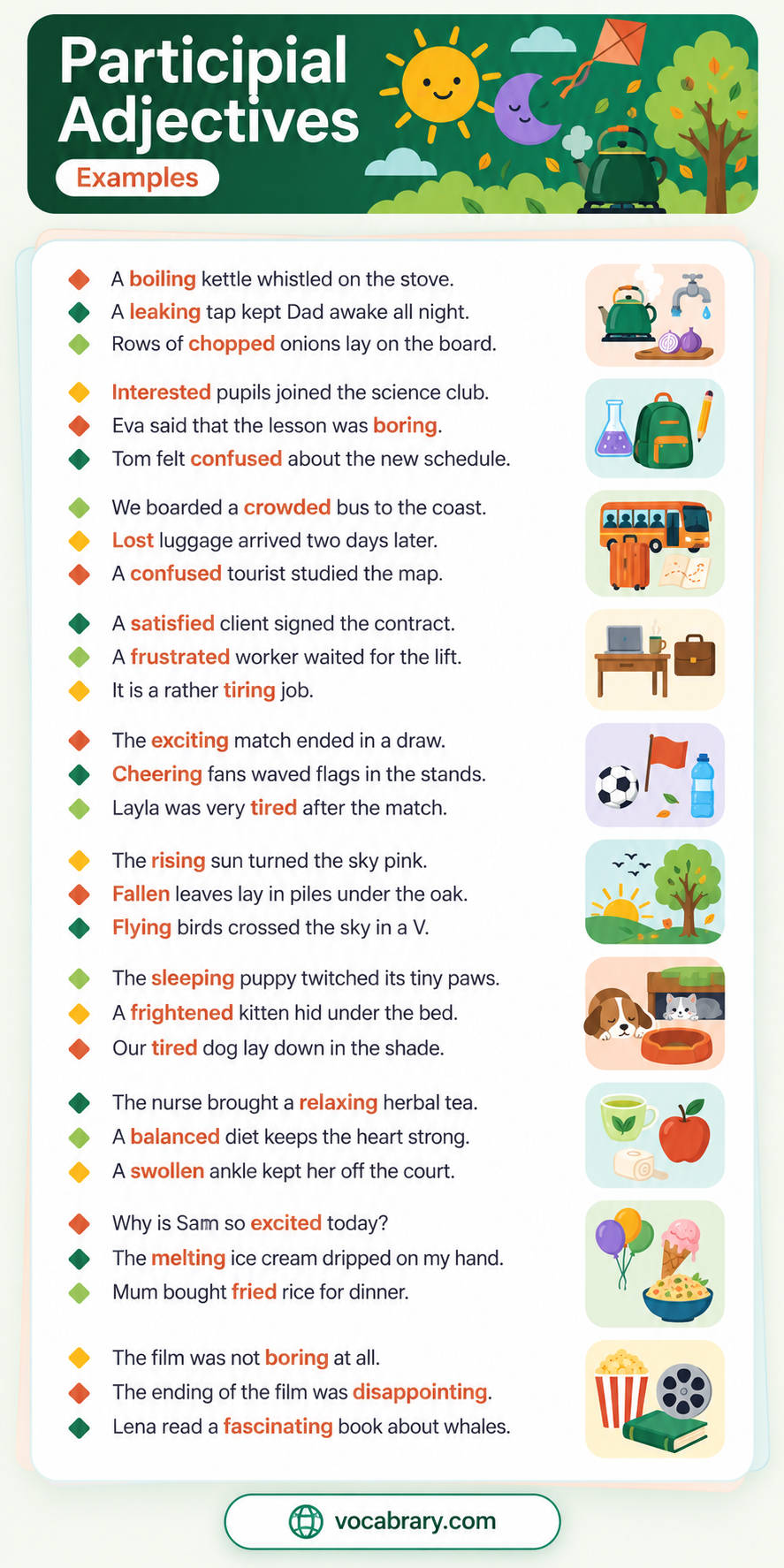
Common Participial Adjective Example Sentences
A boring lecture, a broken window, a frozen lake, and a confused tourist are typical cases, and each one turns a verb form into a word that describes a noun.
- The boring lecture made half the class yawn.
- Nadia felt tired after the long bus ride.
- A broken window let the cold air into the kitchen.
- The exciting match ended in a draw.
- Our teacher gave us surprising news about the trip.
- The frozen lake held the weight of four skaters.
- Karim was interested in the history of Cairo.
- Falling leaves covered the path to the school.
- The confused tourist asked a policeman for help.
- A crying baby woke the whole street.
- The closed shop opens again on Monday morning.
- Lena read a fascinating book about whales.
- A barking dog ran after the delivery van.
- The annoyed customer asked to see the manager.
- He wore a worn jacket with patched elbows.
- She wrapped the fallen apples in a cloth.
- The amazing view from the tower silenced the group.
- My grandmother keeps a written record of every recipe.
Participial Adjective Pairs in -ed and -ing Sentences
Bored and boring, tired and tiring, interested and interesting, excited and exciting, surprised and surprising, and confused and confusing each come from one verb. The -ing form describes the cause of a feeling, and the -ed form describes the person or animal that feels it.
| Verb | The -ing adjective names the cause | The -ed adjective names the person who feels |
|---|---|---|
| Bore | A boring film | A bored child |
| Tire | A tiring climb | A tired hiker |
| Interest | An interesting book | An interested reader |
| Excite | An exciting race | An excited crowd |
| Surprise | A surprising result | A surprised teacher |
| Confuse | A confusing map | A confused tourist |
| Annoy | An annoying noise | An annoyed neighbour |
| Worry | A worrying cough | A worried parent |
Bored and Boring in Sentences
A boring speech makes people bored: the -ing word names what causes the boredom, and the -ed word names whoever feels it.
- The speech was so boring that Arun checked his watch twice.
- The bored children drew pictures on their worksheets.
- A boring film can make a long evening feel endless.
- Mara finds long meetings boring and tries to avoid them.
- Nobody looked bored during the magic show.
- The textbook was boring, but the teacher made it lively.
- A bored cat stared out of the window all afternoon.
- Arun felt bored by the speech and left early.
Tired and Tiring in Sentences
A tiring climb leaves the hikers tired: the -ing word names the hard task, and the -ed word names the people who feel the effect.
- The tired runners dropped onto the grass.
- A tiring climb brought us to the mountain hut at noon.
- Grandpa looks tired after gardening all morning.
- Looking after twins is tiring, but Sara loves it.
- The tiring journey left Omar too weak to eat.
- Her tired eyes closed during the film.
- Night shifts are tiring for new nurses.
- A tired driver should stop and rest at the next station.
Sentences With Interested and Interesting
An interesting book makes a reader interested: the -ing word names what attracts attention, and the -ed word names the person whose attention is attracted.
- Jorge is interested in jazz and old records.
- The museum has an interesting collection of old maps.
- An interested audience asked many questions after the talk.
- Tomas found the documentary interesting and watched it twice.
- Are you interested in joining the chess club?
- The teacher told an interesting story about the first telephone.
- Few students looked interested in the lesson on tax law.
- That was the most interesting story I heard all week.
Excited and Exciting Sentences
An exciting race makes the crowd excited: the -ing word names the event that raises the feeling, and the -ed word names the people who feel it.
- The excited children ran to the gate of the zoo.
- We watched an exciting final in the rain.
- Lucia was excited about her first trip to Brazil.
- An exciting offer arrived in the post.
- The crowd grew excited as the band walked on stage.
- Skiing for the first time was exciting for the whole family.
- Nobody was more excited than Dev on the morning of his birthday.
- The exciting news spread through the village by noon.
Surprised and Surprising Example Sentences
A surprising result leaves the team surprised: the -ing word names the unexpected event, and the -ed word names the people who did not expect it.
- Hana looked surprised when she saw the cake.
- The surprising result shocked the research team.
- It is surprising that the bus left early.
- A surprised neighbour opened the door in his pyjamas.
- The ending of the novel was surprising and sad.
- We were surprised by the speed of the train.
- Her surprising talent for singing amazed the judges.
- Eli was not surprised at the news.
Confused and Confusing Sentences
A confusing map leaves a tourist confused: the -ing word names the unclear object, and the -ed word names the person who loses the way.
- The confusing map sent us down the wrong street.
- A confused passenger asked which platform to use.
- The instructions were confusing to everyone in the room.
- Rosa felt confused after the long, fast lecture.
- Bus timetables in the city are confusing for visitors.
- The confused puppy ran in circles around the garden.
- A confusing sign at the junction sent drivers the wrong way.
- Ben looked confused when the teacher asked the question.
More Pairs With Annoying and Frightening
Annoying and annoyed, disappointing and disappointed, embarrassing and embarrassed, and frightening and frightened follow the same pattern as the six pairs before them: -ing for the cause and -ed for the person who feels.
- The annoying buzz of the fridge kept Tia awake.
- Tia grew annoyed and unplugged the fridge.
- The disappointing score upset the home fans.
- The disappointed fans left before the final whistle.
- An embarrassing mistake in front of the class made Ali blush.
- Ali felt embarrassed about the mistake.
- The frightening noise came from the attic.
- A frightened kitten hid under the bed.
- A relaxing walk by the river calmed her nerves.
- Dad looked relaxed after a week at the lake.
- The shocking news made the headlines.
- She stood shocked in the doorway.
- The amazing acrobats flew across the tent.
- The amazed audience clapped for a full minute.
- Her worrying cough lasted three weeks.
- Mr Aziz was worried about the exam results.
Boring Film and Bored Children in One Sentence
A boring film beside bored children and an exciting race beside an excited crowd put both forms in a single sentence, so the cause and the feeling appear side by side.
- The boring film made the bored children restless.
- An exciting race left the excited crowd breathless.
- The confusing map made us confused about the way home.
- A surprising gift left Mum surprised and happy.
- The tiring hike left the tired hikers asleep by eight.
- The annoying noise made the annoyed neighbours complain.
- An embarrassing question made the embarrassed speaker pause.
- The frightening thunder sent the frightened dog under the bed.
- A disappointing result left the disappointed coach silent.
- The interesting lesson kept the interested students quiet.
- The shocking photograph left the shocked viewers speechless.
- A relaxing massage made the relaxed tourist smile.
Examples of Past Participle Adjectives
A broken window, fallen leaves, a written note, a closed door, and a frozen lake use a past participle to describe a noun. Regular verbs end in -ed, and irregular verbs end in forms such as -en or -t.
| Verb | Past participle | Phrase |
|---|---|---|
| Break | Broken | A broken window |
| Fall | Fallen | Fallen leaves |
| Write | Written | A written note |
| Close | Closed | A closed door |
| Freeze | Frozen | A frozen lake |
| Steal | Stolen | A stolen bicycle |
| Tear | Torn | A torn page |
| Bake | Baked | A baked potato |
Broken and Stolen Sentences With Passive Meaning
A broken window is a window that someone broke, and a stolen bicycle is a bicycle that someone stole, so the noun receives the action of the verb. The past participles of irregular verbs such as break and steal do not end in -ed.
- Glass from the broken window covered the kitchen floor.
- Hana read the written note twice.
- The closed door had a sign taped to it.
- Skaters crossed the frozen lake at sunrise.
- Police found the stolen bicycle behind the station.
- A torn page fell out of the old diary.
- Nasrin served a baked potato with melted cheese.
- The locked gate kept the visitors out.
- He bought a used car from a neighbour.
- She studied spoken English in a language lab.
- A cooked meal waited for them at home.
- The polished floor reflected the lamps.
- Mei admired the painted ceiling of the old church.
- Rows of chopped onions lay on the board.
Fallen and Retired Sentences From Verbs Without Objects
Fallen leaves are leaves that have fallen, and a retired teacher is a teacher who has retired. With verbs that take no object, the participle describes a completed change.
- Fallen leaves lay in piles under the oak.
- A retired teacher tutors children at the library.
- Maria wore faded jeans and a white shirt.
- The escaped prisoner was found in a barn.
- Divers explored a sunken ship off the coast.
- A vanished village lies under the lake.
- His withered hand held the old photograph.
- Dr Ali is a grown man, not a child.
- The wilted flowers drooped in the vase.
- The swollen river flooded the road.
Running, Falling and Growing Example Sentences
Running water, falling prices, and a growing city use the -ing form to describe a noun that does the action. Water runs, prices fall, and a city grows, so the participle names what the noun is doing.
- Running water is available in every room.
- Falling prices pleased the shoppers at the market.
- The growing city needs a new bridge.
- The rising sun turned the sky pink.
- A burning candle lit the table.
- Melting snow filled the stream every spring.
- Flying birds crossed the sky in a V.
- The sleeping baby did not hear the thunder.
- Shining stars covered the desert sky.
- The moving train rocked the sleeping passengers.
- The boiling water cracked the glass.
- A crying child stood at the school gate.
- The laughing children chased the barking puppy.
- Smiling faces greeted us at the airport.
- The ticking clock kept me awake.
- A leaking pipe flooded the cellar.
- The setting sun painted the walls orange.
- Dancing couples filled the hall until midnight.
- The winning team lifted the cup.
- A speeding car missed the cyclist by a metre.
Linking Verb Sentences With Tired, Worried and Frustrated
Is tired, looks worried, and became frustrated put the participle after a linking verb, where it describes the subject.
- I am tired of waiting for the bus.
- Ayesha looks worried about the exam this morning.
- The story sounds frightening to young children.
- They became frustrated after the third delay.
- The students seem confused about the homework.
- Dad got annoyed when the printer jammed.
- The beach felt relaxing after the noisy city.
- Karim stayed excited about the trip all week.
- The audience remained seated until the end.
- The ending of the film was disappointing.
- Grandpa grew tired during the long walk.
- The news sounded alarming to everyone.
- The road looked deserted at midnight.
- Mateo felt embarrassed at the party.
Sentences With Very, So and Other Intensifiers
Very tired and extremely boring take an intensifier, and that test marks a participle as an adjective. A participle inside a verb phrase takes very much instead, as in he was very much admired.
- Layla was very tired after the match.
- The lesson felt extremely boring today.
- Tom looked quite confused by the question.
- The film was so exciting that nobody moved.
- We were too tired to cook dinner.
- The very surprised goalkeeper dropped the ball.
- It is a rather tiring job.
- The twins were extremely excited about the party.
- The results of the test were truly amazing.
- Her speech was less boring than I expected.
Fixed Preposition Sentences With Interested in and Tired of
Interested in, excited about, tired of, and surprised by pair a participial adjective with a fixed preposition. Many of these adjectives take one or two fixed prepositions, so each pair is best learned as one unit.
- Selin is interested in modern art.
- We were excited about the school trip.
- Dad is tired of the noise next door.
- She was surprised by the size of the crowd.
- Tom felt confused about the new schedule.
- Mrs Lee is worried about her son’s exam.
- The class was bored with the same song.
- Hamid was disappointed in his results.
- Priya felt embarrassed about her loud laugh.
- We are satisfied with the new software.
- The children were frightened of the dark corridor.
- The coach was pleased with the effort of the team.
- Ola was shocked at the price of the tickets.
- The farmer was annoyed with the neighbour’s dog.
Participial Adjectives in Different Sentence Positions
A participial adjective stands before a noun, after a linking verb, after an object, or in a phrase after a noun, as a thrilling ride and left us exhausted show.
Examples of Participial Adjectives Before a Noun
An exhausted hiker and a thrilling ride put the participle directly before the noun it describes.
- The exhausted hikers collapsed at the campsite.
- A thrilling ride took us over the hills.
- Our disappointed coach left without a word.
- The fascinated boy stared at the tank.
- A charming cafe stands on the corner.
- The inspiring speech lifted the whole team.
- A satisfied customer left a glowing review.
- The exhausting shift ended at midnight.
Examples of Participial Adjectives After an Object
In left us exhausted and found the book fascinating, the participle follows the object and describes it.
- The long walk left us exhausted.
- Nazim found the book about whales fascinating.
- The teacher kept the class interested for the whole hour.
- Her words about the plan left me confused.
- The loud thunder left the dog frightened.
- We found the three-hour exam tiring.
- The clown kept the children amused for an hour.
- The news from the capital left everyone shocked.
Participial Phrase Sentences After a Noun
The woman standing by the door and a man dressed in black put a participle and its extra words after the noun, and the whole phrase works like one adjective.
- The woman standing by the door is my aunt.
- Students interested in art should visit the gallery on Friday.
- A man dressed in black followed us.
- The money saved last year paid for the trip.
- Passengers travelling to Lagos should go to gate four.
- The house built by my grandfather still stands.
Negative Sentences With Not Boring and Not Surprising
Not boring, not tired, and not surprising put a negative word before the participle, which denies that the quality or feeling fits the noun.
- The film was not boring at all.
- I am not tired yet, so let us walk.
- Zara did not seem interested in the offer.
- That result is not surprising to the coach.
- The students were not confused by the new rule.
- Nobody felt bored during the concert.
- The lecture was never exciting for me.
- He was not disappointed with the gift.
- The door is not broken; it is only stuck.
- It was not a tiring day, so we went for a swim.
- The directions were not confusing once we saw the map.
- She was not embarrassed by the mistake.
Question Sentences With Bored and Tiring
Questions such as are you bored and was the trip tiring put the linking verb first, and the participial adjective is the word the answer confirms or denies.
- Are you bored in this class?
- Was the trip to the coast tiring?
- Why is Sam so excited today?
- Is the film interesting enough to watch again?
- Were you surprised by the news?
- Which of these instructions are confusing?
- Who is tired after the long ride?
- Is the broken window covered by insurance?
- Have you seen the missing passenger?
- Is that boiling water safe to drink?
- How worried should I be about the storm?
- Are the frozen peas in the freezer?
Reported Speech and Passive Sentences With Participial Adjectives
In reported speech the participial adjective stays the same while the verb moves back in time, as in said the lesson was boring. A passive sentence such as was left broken has the participle after the verb.
- Eva said that the lesson was boring.
- Dev told us he felt exhausted after the hike.
- The nurse explained that the baby was tired.
- Mum admitted that she was worried about the storm.
- The guide said the old bridge was closed.
- Ravi complained that the instructions were confusing.
- The window was left broken for a week.
- The door was found locked by the guard.
- The children were left amused by the puppets.
- The room was kept closed during the repairs.
- The runners were reported exhausted after the race.
- The shop was found closed by the early customers.
Participial Adjective and Verb Participle Sentences Compared
In the window is broken the participle describes the window, and in the boys have broken the window the participle belongs to a verb phrase. The test with very separates them: an adjective takes it, and a verb participle does not.
| Feature | Participial adjective | Participle in a verb phrase |
|---|---|---|
| Job | Describes a noun or subject | Forms a tense or a passive |
| Test with very | Takes it, as in very tired | Does not take it, because the verb form in the boys have broken the window is not an adjective |
| Position | Before a noun or after a linking verb | After have or be |
| Example | The window is broken. | The boys have broken the window. |
- The glass is broken, and the boys have broken it with a ball.
- The running tap wasted water, while the boy was running to school.
- The road is closed today, and workers have closed it for repairs.
- The lesson was tiring, but it has not tired the teacher.
- The film was boring, and it has bored the children.
- The soup is cooked now, and Dad has cooked it for an hour.
- The crowd was excited, and the news has excited them.
- The sleeping baby did not move, while the nurse was sleeping in a chair.
- The stolen car was found, and thieves had stolen it at night.
- The shop looks closed, and the owner has closed it for repairs.
Home Sentences With Leaking, Worn and Tired
A leaking tap, a worn carpet, and a tired baby describe the objects and people of a household, where a participle names a condition or a state of feeling.
- A leaking tap kept Dad awake all night.
- The worn carpet in the hall needs replacing.
- Grandma shared baked apples with the visiting cousins.
- The tired baby fell asleep in the car seat.
- My brother’s broken guitar leans against the wall.
- Our frozen pipes burst in the coldest week of January.
- A boiling kettle whistled on the stove.
- The polished table shone in the evening light.
Sentences About Confused Students and Bored Classes
A confused student, an inspiring talk, and a bored class describe the people and events of a school day, where each participle names how a lesson or a task affects its audience.
- The confused students asked for the instructions again.
- Ms Evans gave an inspiring talk about space.
- The bored class stared at the clock.
- Rania handed in a written report on Friday.
- A surprised teacher found a frog in her desk.
- The test was tiring, but nobody complained.
- Interested pupils joined the science club.
- Ravi borrowed a used textbook from his cousin.
Work Sentences With Exhausted, Satisfied and Growing
An exhausted nurse, a satisfied client, and a growing company describe the people and organisations of a working day, where each participle names a state or a change.
- The exhausted nurse finished a double shift.
- A satisfied client signed the contract.
- The manager gave a disappointing report on sales.
- Retired engineers advise the new staff.
- The closed office reopens on Tuesday.
- Our growing company hired twelve new staff.
- A frustrated worker waited for the lift.
- The printed schedule hangs by the door.
Travel Sentences About Delayed Trains and Cancelled Flights
A delayed train, a cancelled flight, and a tiring trip describe the transport and the passengers of a trip, where each participle names what happened or how a traveller feels.
- The delayed train left the station an hour late.
- A confused tourist studied the map.
- We boarded a crowded bus to the coast.
- Exhausted passengers slept in the waiting hall.
- The cancelled flight left us stranded in Lisbon.
- A tiring journey took us across three countries.
- The amazed visitors photographed the temple.
- The hotel offered a relaxing spa.
- Lost luggage arrived two days later.
Participial Adjectives in News Headline Sentences
Rising prices, missing hikers, and a shocking report belong to headlines, where each participle names a change, an event, or a reaction in public life.
- Rising prices worried families across the country.
- The missing hikers were found alive.
- A shocking report revealed the scandal.
- Damaged roads delayed the rescue teams.
- The injured driver was taken to hospital.
- A growing crowd gathered outside the court.
- The elected mayor promised cheaper buses.
- Frightened residents left the flooded village.
Story Sentences With Haunted, Sleeping and Hidden
A haunted house, a sleeping princess, and a hidden treasure set the scene in stories, where each participle names a condition of a place or a character.
- The haunted house stood at the end of the lane.
- A frightened child hid behind the old wardrobe.
- The sleeping princess lay behind a wall of thorns.
- The lost traveller followed a flickering light through the woods.
- The wounded soldier limped toward the village.
- A terrified maid dropped the silver tray.
- The forgotten key lay under the crumbling step.
- The hidden treasure glittered in the cave.
Sports Sentences About Exhausted Strikers and Winning Goals
An exhausted striker, a thrilling final, and the winning goal describe the players and moments of a match, where each participle names a state or a result.
- The exhausted striker dropped to his knees.
- A thrilling final held the crowd to the last second.
- The winning goal came in extra time.
- A disappointed coach praised his team anyway.
- The injured goalkeeper left the pitch on a stretcher.
- Cheering fans waved flags in the stands.
- The defeated team shook hands with the winners.
- A tiring match in the heat left everyone drained.
Sentences About Worried Parents and Swollen Ankles
A worried parent, a swollen ankle, and boiled water belong to health talk, where each participle names a symptom, a feeling, or a method of treatment.
- The worried parents waited outside the ward.
- A swollen ankle kept her off the court.
- The nurse brought a relaxing herbal tea.
- A balanced diet keeps the heart strong.
- The exhausted patient slept through the afternoon.
- Boiled water is safe for the baby’s bottle.
- A sprained wrist needs rest for two weeks.
- The recovering patient walked to the garden.
Participial Adjective Sentences for Kids
A sleeping puppy, a broken toy, and a melting ice cream are the pets, toys, and treats that young children see, so these sentences use participial adjectives from a child’s own day.
- The sleeping puppy twitched its tiny paws.
- My broken toy needs a new wheel.
- The excited children clapped at the circus.
- Our tired dog lay down in the shade.
- The boiling soup smelled so good.
- I was scared of the dark room.
- The clown made a surprising noise.
- A bored boy kicked the stone.
- The melting ice cream dripped on my hand.
- Mum bought fried rice for dinner.
- Look at the flying kite over the hill!
- We found the hidden treasure in the sand.
Short Participial Adjective Sentences for Young Learners
Six and seven word lines about a tired child, a closed door, and a frozen lake give beginners a short pattern to copy and read aloud.
- I am tired after school today.
- The film was boring for the kids.
- She is excited about the party.
- The door is closed for lunch.
- My toy is broken and sad.
- A falling leaf landed on my shoe.
- The lake is frozen this winter.
- That story was exciting for everyone.
- The sleeping cat did not move.
- Dad looks worried about the rain.
Longer Participial Adjective Sentences for Students
Exam answers about a surprising result, a declining birth rate, and a convincing analysis need longer sentences, and these ten give secondary students a model for an essay or a report.
- The results of the experiment were surprising to the whole research team.
- Many readers find the novel’s fragmented structure confusing.
- The growing demand for energy puts pressure on power stations.
- Participants who felt stressed performed worse on the memory test.
- The declining birth rate worries the government.
- Critics described the final act as disappointing but memorable.
- The essay offers a convincing analysis of the poem.
- An educated voter reads several sources before an election.
- The concerned committee rejected the plan after a long debate.
- Rising sea levels threaten low-lying coastal cities.
Participial Adjectives in Short Paragraphs
Four short passages about a hard week, a science lesson, a train trip, and a kitchen use participial adjectives in running text, so learners meet the -ed and -ing forms in context.
Omar had a tiring week at the warehouse. By Friday he felt exhausted and bored with the same tasks. On Saturday he took a relaxing walk beside a frozen lake. The falling snow made the town quiet, and Omar finally felt relaxed.
The science lesson was surprising from the start. Ms Rao held up a broken clock and asked the confused students to repair it. The interested class worked in pairs for an hour. By the end, everyone felt satisfied, and the ticking clock worked again.
We boarded a crowded train at dawn. The delayed departure left the passengers annoyed, but the rising sun over the hills was amazing. A sleeping child leaned on my shoulder. When we arrived, the excited children ran to the beach.
Nina made soup from frozen peas and chopped onions. The boiling water filled the kitchen with steam. Her hungry brother stood at the door, tempted by the smell. The soup was satisfying after a tiring day.
FAQs
Q1. How do you tell the difference between -ed and -ing adjectives?
An -ing adjective describes the person, thing, or event that causes a feeling, as in a boring film, while an -ed adjective describes the person who feels it, as in a bored child. This contrast separates tiring from tired and exciting from excited in participial adjective example sentences.
Q2. Why do we say I am bored and not I am boring?
We say I am bored because the speaker feels the boredom, and the -ed form describes the person who feels. The sentence I am boring has a different meaning, because it says that the speaker makes other people bored. A person is boring only when that person causes the feeling in someone else.
Q3. Which participial adjectives are the most common in English?
Common participial adjectives in participial adjective example sentences include tired, bored, interested, excited, surprised, confused, worried, and broken. Their -ing partners, such as boring, interesting, exciting, surprising, and confusing, appear in the same sentences. Learners meet these pairs early because they describe feelings and everyday objects.
Q4. Are participial adjectives the same as participles?
Participial adjectives are not the same as participles, although they share the same form. A participle inside a verb phrase, as in has broken, forms a tense or a passive. A participial adjective, as in a broken window, describes a noun and takes words such as very.
Q5. What is a past participle adjective?
A past participle adjective is an adjective formed from the past participle of a verb, as in a broken window, fallen leaves, and a frozen lake. Regular verbs end in -ed, and irregular verbs take forms such as -en or -t. The adjective describes a noun that received the action or completed a change.
Q6. What is a present participle adjective?
A present participle adjective is an adjective formed from the -ing form of a verb, as in running water, falling prices, and a growing city. It describes a noun that is doing the action. Many present participle adjectives, such as boring and tiring, also name the cause of a feeling.
Q7. Can you use very before a participial adjective?
A participial adjective takes very before it, as in very tired, very excited, and very confusing. The test shows that the participle has become an adjective. A participle that forms part of a verb phrase takes very much instead.
Q8. How do you form a participial adjective from a verb?
You form a participial adjective by adding -ing to the verb for the present form or by using the past participle for the past form. Bore becomes boring and bored, and break becomes breaking and broken. Check irregular verbs in a dictionary, because their past participles do not end in -ed.
Q9. Where does a participial adjective go in a sentence?
A participial adjective goes before the noun it describes, as in a tired runner, or after a linking verb, as in the runner looks tired. It also follows an object, as in the walk left us exhausted. A participial phrase, as in the woman standing by the door, follows the noun.
Q10. Which prepositions follow participial adjectives?
Many participial adjectives are followed by one or two fixed prepositions in a sentence. Common pairs are interested in, excited about, tired of, surprised by, confused about, worried about, bored with, and disappointed in. Learn each adjective with its preposition as one unit.
Q11. Is tired a verb or an adjective?
The word tired is an adjective in the tired runner and she is tired, and it takes very in both. It is also the past participle of the verb tire, as in the long walk has tired her. The surrounding words show which job the word does.
Q12. What is the difference between a participial adjective and a descriptive adjective?
A participial adjective comes from a verb and ends in -ing or -ed, while a descriptive adjective is a quality word that has no verb form behind it. Boring and broken are participial, and tall and red are descriptive adjectives. Both kinds go before a noun or after a linking verb.
Q13. Is a broken window or a breaking window correct?
Both phrases are correct in English, but each one has its own meaning. A broken window has already broken and is damaged, and a breaking window is in the act of breaking right now. Choose the past participle for a finished result and the present participle for an action in progress.

Leave a Comment