
The order of adjectives is the sequence in which adjectives of different kinds precede one noun, fixed by kind and not by the speaker’s choice, as in a lovely old wooden chair. Since each position belongs to a kind rather than a word, old, an age adjective, precedes the material adjective wooden, and lovely, an opinion adjective, precedes both. Whatever adjectives a speaker adds, order of adjectives examples arrange them by that same ranking, with opinion words first and material words near the noun.
What Is the Order of Adjectives?
The order of adjectives is the sequence that native speakers follow when two or more adjectives of different kinds describe one noun. Coordinate adjectives, which take a comma or the word and, are not bound to this sequence, so either order is possible in a loud, annoying noise.
Determiner + number + opinion + size + age + shape + colour + origin + material + purpose + noun
She bought a lovely old round wooden table at the market.
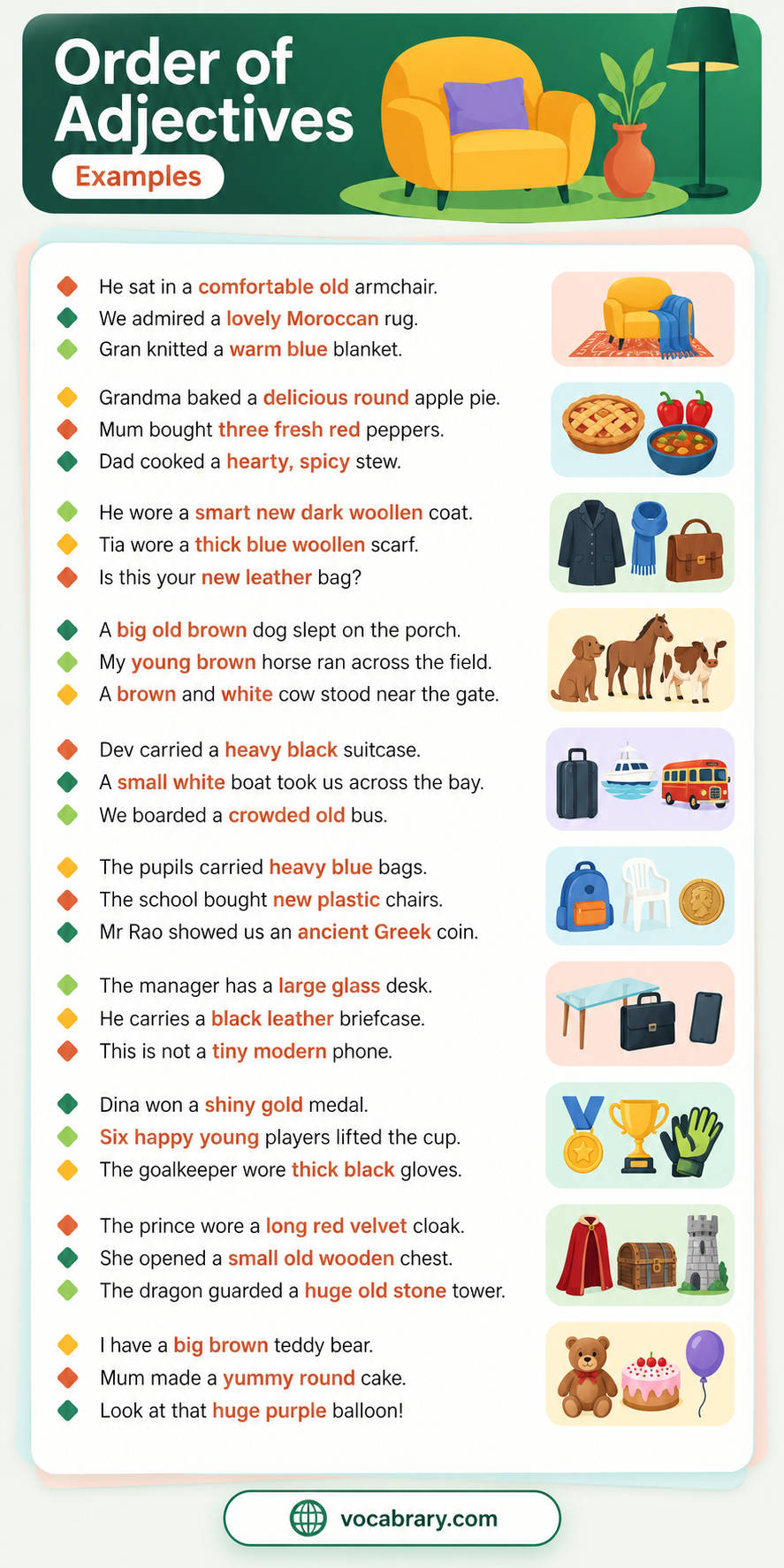
Common Order of Adjectives Examples
A lovely old wooden chest, a big red woollen jumper, and an ancient Greek vase are typical cases, and each one places the adjectives in the sequence that native speakers expect before the noun.
- She bought a lovely old wooden table at the market.
- Tariq wore a big red woollen jumper to the match.
- A small black cat slept on the windowsill.
- We stayed in a charming little Italian village.
- Grandma baked a delicious round apple pie.
- The museum owns an ancient Greek vase.
- Mia carried a heavy brown leather bag.
- Hiro found a beautiful antique Japanese fan.
- A tall young man held the door open.
- The chef served a delicious green Thai soup.
- Leila bought a long silk scarf.
- An enormous grey elephant walked past the car.
- They live in a new white stone house.
- She found a tiny silver key in the drawer.
- A friendly old woman sold us fresh red apples.
- The children drew a big yellow sun.
- I need a warm woollen blanket tonight.
- Pedro rides a fast red bicycle.
Table of the Order of Adjectives With Examples
Opinion comes first, then size, age, shape, colour, origin, material, and purpose, and the noun comes last. The first letters of the eight categories form the memory word OSASCOMP.
| Position | Category | Question it answers | Examples |
|---|---|---|---|
| First | Opinion | What does the speaker think? | Lovely, ugly, delicious |
| Second | Size | How big is it? | Tiny, huge, tall |
| Third | Age | How old is it? | Old, new, ancient |
| Fourth | Shape | What shape is it? | Round, square, flat |
| Fifth | Colour | What colour is it? | Red, green, silver |
| Sixth | Origin | Where is it from? | French, Brazilian, Roman |
| Seventh | Material | What is it made of? | Wooden, silk, iron |
| Eighth | Purpose | What is it for? | Sleeping, cooking, walking |
As a pattern, the closer an adjective stands to the noun, the more permanent the quality it names. A material such as wooden describes what a thing is made of, so it stands next to the noun, while an opinion such as lovely depends on the speaker and stands furthest away.
Sentences With Opinion Adjectives First
Lovely, ugly, delicious, and comfortable state the speaker’s judgment, and an opinion adjective stands before every fact adjective.
- A lovely old cottage stands by the river.
- Sara wore an ugly green sweater to the party.
- We ate a delicious hot meal after the hike.
- He sat in a comfortable old armchair.
- A terrible cold wind blew across the field.
- Nia bought a gorgeous red dress for the wedding.
Size Adjective Examples With Big and Small
Big, small, huge, and tall state how large a thing is, and a size adjective stands after an opinion and before age, shape, and colour.
- A big round clock hangs over the station.
- Ahmed carried a small brown parcel.
- The farmer owns a huge old barn.
- A tiny green frog sat on the leaf.
- We climbed a tall stone tower.
- She packed a large blue suitcase.
Old and New in Age Adjective Sentences
Old, new, young, and ancient state how long a thing has existed, and an age adjective stands after size and before shape and colour.
- An old red bus stopped at the corner.
- Tom lives in a new brick house.
- My young brown horse ran across the field.
- A modern glass building rises beside the park.
- She kept an antique silver spoon.
- A newborn white lamb stood in the field.
Round and Square Shape Adjective Sentences
Round, square, flat, and oval state the outline of a thing, and a shape adjective stands after age and before colour.
- Dad built a square wooden table.
- A round silver tray stood on the shelf.
- Children threw a flat grey stone across the lake.
- Mei bought an oval brass mirror.
- A long thin snake slid through the grass.
- A triangular red flag flew over the camp.
Colour Adjectives in Sentences With Red and Blue
Red, blue, yellow, and green name the hue of a thing, and a colour adjective stands after shape and before origin and material.
- She painted the old blue door.
- A bright red balloon floated above the crowd.
- Hana owns a small black umbrella.
- The baker uses a large white bowl.
- A long green snake hid in the reeds.
- He found a tiny yellow flower.
Ethiopian and Peruvian Origin Adjectives Before Nouns
Ethiopian, Peruvian, French, and Chinese name the place a thing comes from, and an origin adjective stands after colour and before material.
- Kofi drinks strong Ethiopian coffee every morning.
- The shop sells soft Peruvian wool.
- A famous French chef opened the restaurant.
- Dina collects old Chinese coins from the market.
- We admired a lovely Moroccan rug.
- A rich Swiss chocolate melted in the sun.
Material Adjective Examples With Wooden and Woollen
Woollen, silk, iron, and plastic name what a thing is made of, and a material adjective stands next to the noun or just before the purpose word.
- Grandpa wore a warm woollen hat.
- The cafe has small wooden tables.
- A short silk dress hung in the wardrobe.
- A heavy iron gate closed behind us.
- We drank from old glass bottles.
- The shop sells cheap plastic cups.
Purpose Adjectives With Sleeping and Cooking in Sentences
Sleeping, cooking, walking, and running name what a thing is for, and a purpose word forms a close unit with the noun that follows it.
- Pip packed a big sleeping bag for the camp.
- Dad bought a new cooking pot.
- She wore comfortable running shoes to the park.
- A large picnic basket sat on the grass.
- We bought a small gardening fork.
- Mum uses a sharp cutting knife.
- He packed his old walking boots.
Examples of the Order of Adjectives With Two Adjectives
A nice long walk, a big black dog, and a brown leather belt pair two adjectives from two different categories.
- A nice long walk cleared my head.
- Nadia has short curly hair and green eyes.
- A wonderful old song played on the radio.
- Omar owns a big black dog.
- They rented a cosy little flat.
- A beautiful silk scarf lay on the chair.
- The old Russian novel sat on the shelf.
- We drove a small blue van.
- He wore a brown leather belt.
- The new Italian restaurant opened on Monday.
- A round glass bowl held the fruit.
- Ines ordered a delicious Spanish omelette.
- A tall glass vase stood on the piano.
- They watched a funny old film.
- Alma carries a cheap plastic bag.
Sentences With Three Adjectives Before a Noun
A lovely old wooden bench, a long red silk dress, and a tiny old silver coin use three adjectives from three different categories. The sequence is the same, with the opinion first and the material last.
- A lovely old wooden bench stood by the pond.
- She wore a long red silk dress.
- We bought a big round wooden table.
- Ravi found a tiny old silver coin.
- The famous old French painter lived here.
- My grandmother has a beautiful old Turkish carpet.
- Parents avoid cheap new plastic toys.
- A big old brown dog slept on the porch.
- He drives a fast new German car.
- She carries a small red leather purse.
- We visited a charming old stone bridge.
- Tia wore a thick blue woollen scarf.
- An ugly old grey sofa filled the room.
- Mehmet bought a smart new blue suit.
- A huge ancient Egyptian statue stood in the hall.
- The artist chose a thin square wooden frame.
Four Adjectives in a Row in Example Sentences
Four adjectives before one noun are grammatical, and the sequence is the same, as in a lovely small old wooden boat. Long strings are hard to read, so writers split them across two sentences.
- She owns a lovely small old wooden boat.
- Grandpa gave me a beautiful old round gold watch.
- A charming tiny old stone cottage stood on the hill.
- We admired a magnificent huge ancient Roman arch.
- He wore a smart new dark woollen coat.
- Mum bought a gorgeous big red silk scarf.
- The museum displays a rare small ancient Greek statue.
- Farida found a lovely little round silver locket.
- A delicious thick red Mexican soup arrived.
- They sold their big old white Victorian house.
- Lena painted a tall thin blue ceramic vase.
- I love your long new black leather coat.
Sentences With Commas Between Adjectives
Coordinate adjectives, as in a loud, annoying noise, take a comma because each one describes the noun on its own. Cumulative adjectives, as in a small wooden box, take no comma because each one builds on the next.
| Test | Coordinate adjectives | Cumulative adjectives |
|---|---|---|
| Test with and | Accepts and: loud and annoying noise | Rejects and: a small wooden box |
| Test with reversed order | Reverses freely: annoying, loud noise | Keeps its order: a small wooden box |
| Punctuation | A comma separates them | No comma separates them |
| Example | A loud, annoying noise | A small wooden box |
Coordinate Adjective Sentences With a Comma
A loud, annoying noise and a cold, wet wind use two adjectives that describe the same noun on equal terms, so a comma separates them and the order changes freely.
- A loud, annoying noise woke the neighbours.
- It was a long, boring meeting.
- She told a funny, clever story.
- We walked down a dark, narrow street.
- The hot, dry summer ruined the crops.
- He gave a short, polite speech.
- Lina has a warm, friendly smile.
- A cold, wet wind swept across the bay.
- The tired, hungry children went to bed early.
- It was a bright, sunny morning.
- Dad cooked a hearty, spicy stew.
- A quiet, peaceful village lay beyond the hills.
Cumulative Adjective Sentences Without Commas
A small wooden box and a big white van use adjectives from different categories, so each one describes the group that follows it and no comma stands between them.
- She bought a small wooden box.
- We rented a big white van.
- A lovely old church stands in the square.
- He drives a new red car.
- Gran wears a thick woollen scarf.
- A tall young policeman waved us on.
- The shop sells fresh French bread.
- Nia owns a tiny grey kitten.
- They live in a large stone house.
- I like your warm blue jacket.
- Hamza has a short black beard.
- A huge green parrot sat on his shoulder.
Joining Adjectives With and in Example Sentences
The word and joins colours that describe different parts of one thing, as in a black and white dog, and it joins adjectives after a linking verb, as in the sky is dark and cloudy. Before a noun, adjectives of different kinds take no and.
Colour Pairs Joined by and in Sentences
A black and white dog and a red, white, and blue flag join colours with and, because each colour describes a different part of the same noun.
- Sam owns a black and white dog.
- She waved a red, white, and blue flag.
- A green and gold parrot sat on the branch.
- The tiles were blue and white in the old kitchen.
- Mia bought a red and yellow umbrella.
- A black and orange butterfly landed on the fence.
- The team wears green and white shirts.
- A brown and white cow stood near the gate.
Adjectives Joined by and After Linking Verbs
After a linking verb such as is, seems, or tastes, two or more adjectives are joined with and, as in the room was small, cold, and damp. The linking verb pattern is also covered in the descriptive adjective example sentences.
- The sky is dark and cloudy tonight.
- The room was small, cold, and damp.
- Our new teacher seems kind and patient.
- The soup tastes rich and creamy.
- Her voice sounded tired and thin.
- The water looked cold and deep.
- He felt nervous and excited before the match.
- The streets were empty and silent.
- The house smells old and dusty.
- The beach is long and sandy.
Numbers and Determiners Before Adjectives in Sentences
A determiner such as the, my, or those comes first, a number or ordinal comes next, and the adjectives come after both. The ordinal stands before the cardinal number, as in the first three streets and not the three first streets.
Ordinal and Cardinal Numbers Before Adjectives
The first three wide streets and the last two old bridges place the ordinal first, the cardinal number second, and the descriptive adjective last.
- The first three wide streets are closed today.
- The last two old bridges were rebuilt.
- Tara read the first two long chapters.
- The next four tall buildings belong to the university.
- Two small brown dogs followed the postman.
- Mum bought three fresh red peppers.
- We saw five tiny green frogs.
- Ali planted the first ten young trees.
- The second big grey cloud brought rain.
- Six happy young players lifted the cup.
- Our last three cold nights were the worst.
- The first few brave swimmers entered the sea.
Determiners and Possessives Before Adjectives
My two big brothers and those lovely red roses place the determiner first, before any number or adjective. A determiner is a word such as a, the, my, this, or some that introduces a noun.
- My two big brothers play football.
- Those lovely red roses are for Gran.
- Her new blue coat was a gift from Nasra.
- Some old French songs played on the radio.
- Our little white cottage has a thatched roof.
- That tall young guide knows every path.
- His expensive silver watch stopped yesterday.
- These small round tablets are for the headache.
- Every brave young soldier received a medal.
- Whose big yellow bag is on the floor?
Examples of the Order of Adjectives With Compound Nouns
A new coffee machine and a lovely old tea set place the adjectives before the whole compound noun, because coffee machine and tea set work as single nouns. The compound noun is covered in the compound noun example sentences.
- Dad bought a new coffee machine.
- A small garden shed stood behind the house.
- Mum keeps a lovely old tea set in the cabinet.
- She works at a big modern shopping centre.
- Nisha lost her expensive gold wedding ring.
- He drove a huge red fire engine.
- The long white bus stop stood at the corner.
- A heavy iron door handle came loose.
- We cleaned the dirty old kitchen floor.
- A cheap plastic water bottle leaked in my bag.
- Hana found her lost silver car key.
- The famous Italian ice cream shop opens at noon.
Sentences Where the Order of Adjectives Changes
The order of adjectives is a strong convention for neutral description, not a law of grammar. Coordinate adjectives such as dark and narrow swap freely. A contrast such as a small red car, not a big red one stresses one adjective, but a cumulative string such as a big wooden table keeps its fixed order.
- A dark, narrow street and a narrow, dark street describe the same place.
- A lovely, friendly neighbour and a friendly, lovely neighbour mean the same.
- A big round table fits six people around it.
- An old red barn stood beside the road.
- Ines wore a red leather jacket to the concert.
- The shop sells Swiss silk scarves.
- I wanted a small red car, not a big red one.
- Pick the red wooden chair, not the blue one.
- A nice cotton shirt costs little in this market.
- The ancient stone wall surrounds a lovely old garden.
Examples of the Order of Adjectives in Negative Sentences
Not a big old house and did not like the cold grey sky place a negative word before the whole string, and the adjectives keep the same order.
- It was not a big old house, just a small new flat.
- She did not buy the expensive silk scarf.
- That is not a lovely old painting; it is a copy.
- He never wore his old brown coat in summer.
- Nobody wanted the ugly plastic vase.
- They did not serve cheap frozen food.
- This is not a tiny modern phone.
- Tomas did not like the cold grey sky.
- There was no big red sign at the gate.
- Ravi did not choose the heavy wooden door.
Question Sentences With Adjectives Before the Noun
Questions such as did you buy the lovely blue dress and who owns that big brown horse keep the adjectives in the same sequence after the question word or the helping verb.
- Did you buy the lovely blue dress?
- Is this your new leather bag?
- Who owns that big brown horse?
- Which old wooden chair is yours?
- Where did you find this tiny silver key?
- Do you like my long red scarf?
- What is that huge green bird?
- Have you seen my small brown wallet?
- Was it a round glass table?
- Why did she choose the ugly orange curtains?
Reported Speech and Passive Sentences With Adjectives
In reported speech the adjectives stay in the same order, and the verb moves back one tense in a past report, as in said she wanted a small round mirror. A passive sentence keeps the same string of adjectives.
- Mia said she wanted a small round mirror.
- Dad told me he had lost his old leather wallet.
- The seller promised that the antique silver spoon was genuine.
- She explained that the big red bus was late.
- Ben announced that his new Italian boots were ready.
- A lovely old painting was sold at the auction.
- The small wooden boat was repaired by volunteers.
- A heavy iron gate was installed at the entrance.
- The tall glass tower was designed by a Danish firm.
- A rare old coin was found under the floor.
Sentences About Furniture and Fabrics at Home
A lovely big sofa, a round glass table, and a warm blue blanket describe the furniture and fabrics of a household, where the adjectives give an opinion, a size, a colour, or a material.
- We bought a lovely big sofa for the living room.
- Mum keeps a small silver bell on the shelf.
- Our old wooden staircase creaks at night.
- A round glass table stands in the kitchen.
- Gran knitted a warm blue blanket.
- We hung long white curtains in the bedroom.
- The new plastic bins are in the garage.
- A lovely old clock ticks in the hall.
- Dad bought a cheap metal shelf for the garage.
Sentences About School Equipment and Lessons
A big green board, heavy blue bags, and an ancient Greek coin describe the equipment and lessons of a school day, where the adjectives give a size, a colour, an origin, or a material.
- Ms Ito gave us a useful short worksheet.
- The class read an old Russian story.
- A big green board hangs behind the teacher.
- We have a lovely new library.
- The pupils carried heavy blue bags.
- Tia drew a small red heart on the card.
- A long wooden bench stands in the corridor.
- The school bought new plastic chairs.
- Mr Rao showed us an ancient Greek coin.
Office Sentences With Desks, Printers and Briefcases
A large glass desk, a fast new German printer, and a black leather briefcase describe the equipment of an office, where the adjectives give an opinion, a size, an age, an origin, or a material.
- The manager has a large glass desk.
- A smart new laptop arrived on Monday.
- Our office has a big round glass table.
- She keeps her papers in a small grey metal cabinet.
- The company bought a fast new German printer.
- He carries a black leather briefcase.
- A tall young clerk handled the queue.
- Our busy old warehouse is near the harbour.
- She signed the contract with a cheap blue pen.
Travel Sentences About Hotels, Bazaars and Roads
A charming little hotel and a famous old Turkish bazaar describe the places of a trip, where the adjectives give an opinion, a size, an age, or an origin.
- We stayed at a charming little hotel near the sea.
- A long, narrow road led to the village.
- Dev carried a heavy black suitcase.
- The old town has narrow stone streets.
- A famous old Turkish bazaar fills the square.
- We boarded a crowded old bus.
- A small white boat took us across the bay.
- The guide pointed to a beautiful ancient temple.
- They rented a cheap blue car.
Order of Adjectives in News Report Sentences
A huge old factory, a small black bag, and a rare ancient coin appear in reports, where the adjectives give an opinion, a size, an age, or a colour in the order reporters expect.
- A huge old factory burned down overnight.
- Police found a small black bag near the bridge.
- A famous young singer opened the festival.
- The mayor opened a long new tunnel.
- Rescuers pulled a tiny brown puppy from the flood.
- A rare ancient coin sold for a huge sum.
- The government built a big modern hospital in the north.
- A brave young boy saved the swimmer.
Fiction Sentences With Witches, Cloaks and Wolves
A wicked old witch, a long red velvet cloak, and a great grey wolf belong to stories, where the adjectives give an opinion, a size, an age, a colour, or a material.
- A wicked old witch lived in the forest.
- The prince wore a long red velvet cloak.
- A great grey wolf crept through the trees.
- She opened a small old wooden chest.
- Alice found a tiny golden key.
- A handsome young knight rode into the village.
- The dragon guarded a huge old stone tower.
- A lovely old French song drifted from the window.
Strikers, Medals and Flags in Match Sentences
A brilliant young striker and a shiny gold medal describe the players and prizes of a match, where the adjectives give an opinion, an age, a colour, or a material.
- Our team has a brilliant young striker.
- A big red flag waved in the stands.
- The coach wore a smart blue jacket.
- A fast young runner won the race.
- The fans carried huge white banners.
- The goalkeeper wore thick black gloves.
- A new leather football lay on the pitch.
- Dina won a shiny gold medal.
Doctors, Nurses and Needles in Clinic Sentences
A kind young nurse and a long thin needle describe the people and tools of a clinic, where the adjectives give an opinion, an age, or a shape.
- The doctor wore a white cotton coat.
- A kind young nurse took my temperature.
- Grandpa takes a small white tablet every morning.
- A long thin needle was used for the injection.
- The clinic has a lovely big waiting room.
- Mum drinks a warm herbal tea at night.
- She wore a soft white cotton bandage on her wrist.
- A cold, wet cloth cooled his forehead.
Order of Adjectives Examples for Kids
A big brown teddy bear, a tiny green frog, and new blue shoes are the toys, pets, and clothes that young children name, so these sentences use strings of two adjectives.
- I have a big brown teddy bear.
- Look at the tiny green frog!
- My dog has soft white fur.
- Mum made a yummy round cake.
- The little red car rolled down the hill.
- She drew a fat yellow sun.
- I love my new blue shoes.
- A fat grey cat sat on the wall.
- Dad bought a nice big pizza.
- The small white rabbit hopped away.
- Grandma gave me a lovely woollen hat.
- Look at that huge purple balloon!
Short Order of Adjectives Sentences for Young Learners
Six-word lines about a red plastic cup, a big old truck, and a tiny blue bird give beginners a short pattern to copy and read aloud.
- I have a red plastic cup.
- She owns a small white dog.
- Dad drives a big old truck.
- Look at the tiny blue bird.
- Mum has a long silk scarf.
- My bag is blue and heavy.
- It was a nice sunny day.
- He has a new black bike.
- We saw a huge grey whale.
- My coat is warm and soft.
Order of Adjectives Sentences for Students
Exam answers about a rare French manuscript, a severe economic crisis, and a lonely young Irish farmer need longer noun phrases, and these ten give secondary students a model for an essay or a report.
- The museum acquired a rare eighteenth-century French manuscript.
- Critics praised the elegant modern design of the building.
- The report describes a severe economic crisis.
- She wrote an insightful short essay on Victorian poetry.
- The scientists found a small ancient Roman settlement.
- A bold young author won the national prize.
- The poem describes a cold, grey northern sea.
- The committee approved a large new public library.
- They examined a fragile medieval leather book.
- The novel follows a lonely young Irish farmer.
Short Paragraphs Showing the Order of Adjectives
Four connected passages about a chest of keepsakes, a street market, a seaside cottage, and a box of clues use strings of adjectives in continuous writing, so learners meet the sequence in context.
Maria’s grandmother owns a lovely old wooden chest. Inside are a small silver brooch, a long red silk scarf, an ancient Greek coin, and a soft blue blanket. Maria loves the blanket most of all.
Our street market is full of colour. A friendly old man sells fresh red tomatoes. Next to him, a young woman sells cheap plastic toys and beautiful straw baskets.
We rented a charming little stone cottage by the sea. A long narrow path led to the beach, and a big round window faced the water. The kitchen had a lovely old oak table and four tall wooden chairs.
Leo opened the box carefully. Inside lay a tiny old silver key and a dusty brown paper map. He unfolded the map and read the first three short lines.
FAQs
Q1. How do you remember the order of adjectives in English?
You remember the order of adjectives with the word OSASCOMP, which stands for opinion, size, age, shape, colour, origin, material, and purpose. Each letter marks one category, and the noun follows the last adjective. A phrase such as a lovely old round wooden table follows the pattern from left to right.
Q2. Why do native speakers say a big red ball and not a red big ball?
Native speakers say a big red ball because size comes before colour in the sequence for adjectives of different kinds. The sequence is a convention that native speakers learn from usage, so a big red ball follows the sequence for size and colour. As a pattern, the closer an adjective stands to the noun, the more permanent its quality.
Q3. Where does an opinion adjective go among other adjectives?
An opinion adjective goes first in a string, before every fact adjective. In a lovely old wooden table, the word lovely states the speaker’s judgment, and old and wooden state facts. This is the first rule in the order of adjectives examples on this page.
Q4. Do you put a comma between adjectives before a noun?
A comma goes between coordinate adjectives, which describe the noun on equal terms, as in a loud, annoying noise. No comma goes between cumulative adjectives of different kinds, as in a small wooden box. A comma never stands between the last adjective and the noun.
Q5. What is the difference between coordinate and cumulative adjectives?
Coordinate adjectives each describe the noun alone, while cumulative adjectives build on one another. Two tests separate them: coordinate adjectives sound natural with and between them and in reversed order. A loud and annoying noise passes both tests, and a small and wooden box fails both.
Q6. How many adjectives can you use before a noun?
No rule fixes the number of adjectives before a noun, but four is the most that everyday writing uses, as in a lovely small old wooden boat. Strings of three or four adjectives are hard to read, so writers move extra detail to a second sentence. Speech uses one or two adjectives of different kinds.
Q7. Do you use and between adjectives?
You use and between adjectives after a linking verb, as in the sky is dark and cloudy. You also use it between two colours that describe one noun, as in a black and white dog. Before a noun, adjectives of different kinds take no and.
Q8. Where do numbers go in the order of adjectives?
Numbers go before the descriptive adjectives and after the determiner. The ordinal stands before the cardinal number, as in the first three wide streets and not the three first wide streets. Words such as the, my, and those come before any number, and predeterminers such as all and both come before those words.
Q9. Is the order of adjectives a strict rule?
The order of adjectives is a strong convention and not a strict law. Coordinate adjectives swap freely, and speakers stress an adjective for contrast, as in I wanted the red car, not the blue one. A cumulative string such as a big wooden table keeps the order that native speakers use.
Q10. How do adjectives work with compound nouns?
Adjectives work with a compound noun by standing before the whole compound, as in a new coffee machine. The words coffee machine form one noun, so the adjective describes the machine and not the coffee. An adjective does not split the compound noun.
Q11. Do adjectives after linking verbs follow the same order?
Adjectives after a linking verb do not follow the same order, because the sequence applies only to adjectives before a noun. After is, seems, or tastes, the adjectives are joined with and, as in the room was small, cold, and damp. The speaker chooses the order that fits the meaning, and the descriptive adjective example sentences show more of these patterns.
Q12. Where do material and purpose adjectives go?
Material and purpose adjectives go last, next to the noun. A material word such as wooden or silk names what the thing is made of, and a purpose word such as sleeping or cooking names what it is for. In a heavy brown leather walking boot, the purpose word stands closest to the noun.

Leave a Comment