
A compound adjective is an adjective built from two or more words that modify a single noun together, as in a well-known author. Compound adjective example sentences range from ice-cold lemonade to five-star hotels, and each pair locks two words into one hyphenated modifier.
What Is a Compound Adjective?
A compound adjective joins two or more words into one description that neither word delivers alone. A regular adjective uses one word such as "tall" or "red," while a compound adjective fuses at least two into a hyphenated modifier: "red-hot," "old-fashioned," "out-of-date."
word + word (hyphenated before a noun) = compound adjective
The bakery sold mouth-watering pastries every Saturday morning.
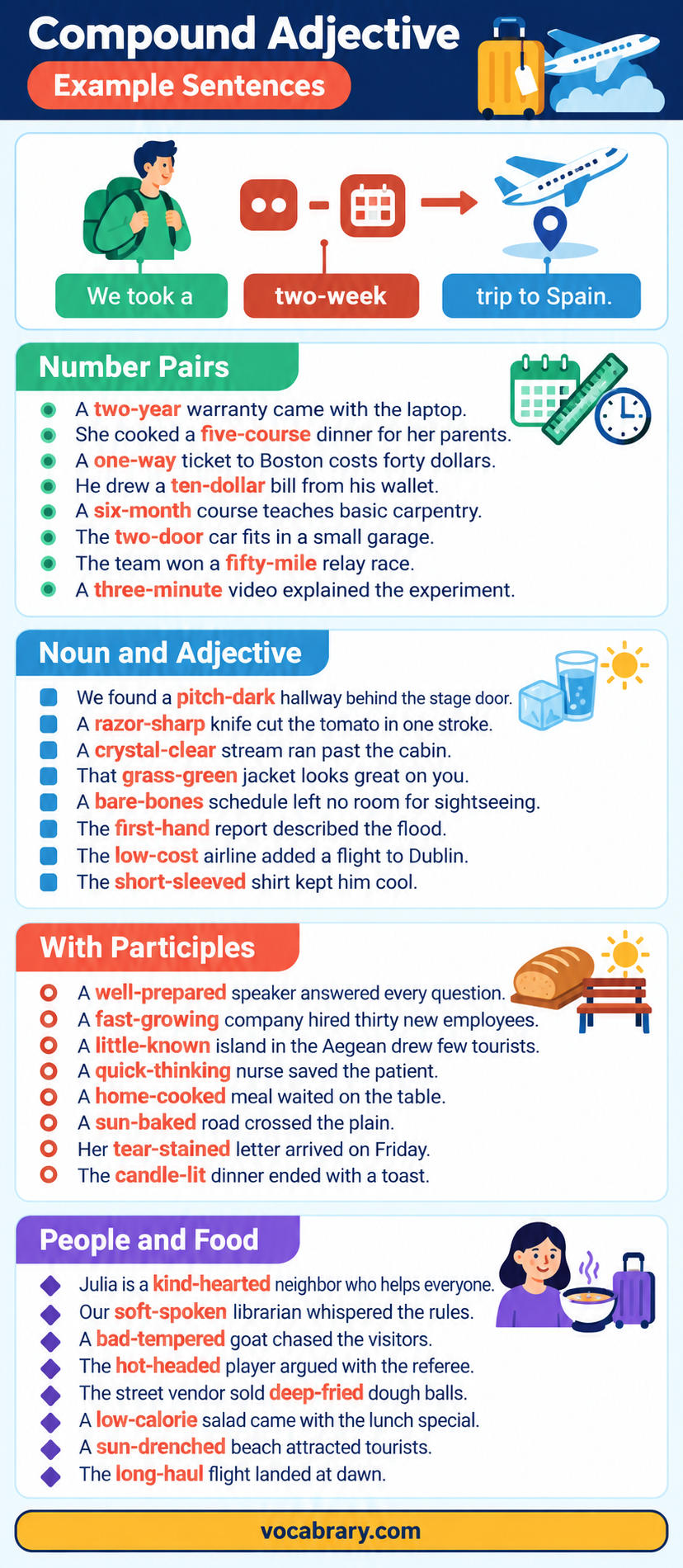
Common Compound Adjective Example Sentences
At the street market an ice-cold drink, at the dentist a last-minute appointment, and at the airport an up-to-date passport are the compound adjectives most speakers already use without thinking twice.
- At the street market, a vendor handed me an ice-cold bottle of water on a thirty-degree afternoon.
- Fatima made a last-minute decision to join the weekend hiking trip.
- Our teacher asked for an up-to-date bibliography before grading the final essay.
- A brand-new bicycle waited in the garage.
- That hotel charged extra for a king-size bed in the corner room.
- Across the square, a mouth-watering smell drifted from the bakery window.
- His old-fashioned pocket watch still kept perfect time after forty years.
- On Tuesday the clinic offered a walk-in appointment for flu vaccinations.
- We booked a round-trip flight to Lisbon and saved two hundred euros.
- Every contestant wore a tailor-made suit to the regional debate finals.
- Priya submitted a well-written proposal and received funding within a week.
- By noon the mechanic had replaced a worn-out brake pad on the rear wheel.
- Next to the runway, a high-speed train connects the airport to the city centre in twelve minutes.
- Nadia described the sunrise in a matter-of-fact manner that surprised her classmates.
- During surgery, the team performed a life-saving procedure on the injured cyclist.
- After the rainstorm, we dragged a heavy-duty extension cord from the garage to the garden.
Compound Adjective Patterns in Sentences
Three of the most recognizable compound adjective patterns are ice-cold (noun + adjective), full-time (adjective + noun), and five-star (number + noun), with adverb-participle and noun-participle pairs completing the set.
| Pattern | Example | Example sentence |
|---|---|---|
| Noun + Adjective | ice-cold | A waiter brought an ice-cold pitcher of lemonade to the patio. |
| Adjective + Noun | full-time | Daniela accepted a full-time position at the marine research lab. |
| Number + Noun | five-star | Travellers rated the seaside resort as a five-star destination. |
| Adverb + Past Participle | well-known | A well-known violinist performed at the charity gala on Friday evening. |
| Adverb + Present Participle | fast-moving | A fast-moving storm knocked out power to three neighbouring villages. |
| Noun + Past Participle | sun-dried | Gianluca added sun-dried tomatoes to the pasta before serving dinner. |
| Noun + Present Participle | breathtaking | Hikers reached a breathtaking viewpoint at the top of the valley trail. |
| Adjective + Participle | old-fashioned | My grandmother still writes old-fashioned letters by hand every Sunday. |
Noun + Adjective Compound Adjectives in Sentences
A bone-dry riverbed in Arizona, a sky-blue ceiling in a Roman chapel, and a rock-hard biscuit forgotten on a kitchen counter are places and objects where a noun sharpens an adjective into a vivid modifier.
- Our gardener cracked open the bone-dry soil with a pickaxe after three rainless weeks.
- Rosa painted the nursery ceiling a soft sky-blue shade that matched the curtains.
- After a night on the counter, the bread turned rock-hard and crumbled at the first touch.
- On the mountain road, the mechanic warned that the engine was running red-hot.
- A snow-white tablecloth covered the oak dining table at the anniversary dinner.
- Her toddler tugged at a skin-tight sleeve that she had bought one size too small.
- Every drink in the hospital cafeteria was sugar-free for the wellness programme.
- At the shallow end, the pool was only knee-deep for the youngest swimmers.
- Even after the price cut, that dirt-cheap fabric looked and felt expensive.
- We found a pitch-dark corridor behind the stage door.
- Wading through a waist-high stream, the hikers never stopped to remove their boots.
- Kenji placed a paper-thin slice of salmon on the seasoned rice.
- The deli’s newest sandwich featured a world-famous sourdough recipe from San Francisco passed down through three generations of bakers.
- Airport security required every passenger to use a hands-free device in the departure lounge.
Adjective + Noun Compound Adjectives in Sentences
Offices employ full-time workers, airports welcome last-minute travellers, and harbours launch deep-sea divers, and each compound pairs an adjective with a noun to name a role, a schedule, or a setting.
- At the factory, full-time employees receive dental insurance after ninety days.
- The family squeezed in a last-minute visit to the aquarium before the evening flight.
- A deep-sea expedition discovered three new species near the Atlantic ocean floor.
- Short-term parking at the train station costs four dollars for the first two hours.
- On the second floor, the museum displayed a long-distance radio used during the Second World War.
- Yuki enrolled in a part-time cooking course every Saturday morning near the harbour.
- Rescue workers built a large-scale shelter for the families displaced by the spring flood.
- Near the entrance, the theatre screened a first-class documentary about bird migration in the Arctic.
- Passengers boarded through a narrow-gauge railway tunnel carved into the mountainside.
- A bare-foot runner from Nairobi finished the race two minutes ahead of the field.
- That company moved to a high-rise office on the fourteenth floor of the tower.
- Campers pitched their tent on a flat-ground campsite beside the river.
- A cold-blooded reptile basked on the stone wall.
- In the lobby, the landlord installed a real-time energy meter for every tenant to read.
- By Thursday, the warehouse had switched to a wholesale pricing model for bulk orders.
Number + Noun Compound Adjectives in Sentences
Near a Tokyo campus, a three-bedroom apartment; in Boston, a twelve-week training programme; and over the river, a four-lane highway show that a number paired with a noun stays singular and takes a hyphen.
- Mr Alvarez signed the lease on a three-bedroom apartment near the university campus.
- For homework, the teacher assigned a ten-page report on renewable energy sources.
- Our family celebrated at a five-star restaurant overlooking the harbour at sunset.
- Because of a two-hour delay at Heathrow, we missed the connecting flight to Rome.
- The carpenter built a six-foot bookcase from reclaimed walnut planks.
- Athletes on the squad followed a twelve-week training programme before the national trials.
- Grandpa told a hundred-year-old story about the village well every Christmas Eve.
- Stretching from bank to bank, the bridge is a four-lane highway that crosses the river at its widest point.
- A nine-to-five schedule left no time for afternoon errands during the working week.
- In the rare-books room, the librarian shelved a first-edition copy of the novel behind the reference desk.
- On Saturday the bakery offered a three-course brunch for twelve euros per person.
- The nurse measured a ten-centimetre wound on the patient’s forearm before stitching.
- A twenty-storey tower is rising beside the old town hall on Market Street.
- From the studio came a two-part documentary about coral reef restoration in the Pacific.
Adverb + Participle Compound Adjectives in Sentences
At a gallery opening, well-dressed guests, on the highway a fast-moving storm, and after a drought a much-needed rain pair a non-ly adverb with a participle to build one modifier before the noun.
- At the gallery opening, well-dressed guests arrived with printed invitations in hand.
- A fast-moving wildfire forced three neighbourhoods to evacuate before midnight.
- Our teacher returned a well-written essay with only two minor corrections in the margin.
- Mr Torres ran a hard-working crew of grape pickers from dawn to dusk.
- A best-selling novel by the Korean author won three international literary awards and was translated into twenty-four languages within a single year.
- After retirement, Ernesto became a well-travelled lecturer on three continents.
- On the playground bench, the children left a half-eaten sandwich during recess.
- Housepainters recommended a long-lasting sealant for the exposed wooden deck.
- That senator introduced a far-reaching bill on vehicle emissions in the coastal zone.
- An ever-growing population is putting pressure on the city’s drinking water supply.
- Farmers along the coast welcomed the much-needed rain after eight dry weeks.
- Behind the community arts centre, a half-finished mural covered the east wall.
- For the Friday holiday departure, the airline sold over-priced tickets at the counter.
- Next door, our neighbours praised the well-mannered dog that never barked after nine at night.
- The biography exposed the worst-kept secret in the singer’s forty-year career.
- An ill-fitting jacket made the groom look uncomfortable in every wedding photograph.
Noun + Participle Compound Adjectives in Sentences
On a Roman pizza, sun-dried tomatoes, at a Kyoto workshop, handmade pottery, and in a grandmother’s notebook, time-tested recipes fuse a noun with a participle to name the method or the cause behind the description.
- At the trattoria, the chef served a salad topped with sun-dried tomatoes and crumbled feta cheese.
- Ayumi displayed her handmade ceramic bowls at the weekend craft fair in the park.
- A time-tested recipe for sourdough bread passed through four generations of bakers.
- Along the footpath, the storm left a row of wind-blown fences leaning toward the school.
- Conservators repaired a moth-eaten wool hanging dating from the fifteenth century.
- Children decorated hand-painted lanterns for the autumn harvest festival at school.
- On Saturday morning, the mechanic installed a custom-built exhaust system on the vintage motorcycle.
- An insurance adjuster inspected a storm-damaged roof after the Tuesday hailstorm.
- A blood-curdling scream echoed through the haunted house ride at the county fairground.
- The journalist published a record-breaking investigation into industrial water pollution that prompted two government agencies to revise their testing standards.
- That thought-provoking lecture on ocean plastic left the audience silent for a full minute.
- Beneath the glass-bottomed walkway, a jaw-dropping view of the canyon stretched into the distance.
- The company launched an energy-saving refrigerator that uses thirty percent less power.
- Lina baked a mouth-watering chocolate cake for the Friday office celebration.
Hyphenated and Unhyphenated Compound Adjectives in Sentences
Before a noun, a compound adjective takes a hyphen ("an ice-cold drink"), but after a linking verb the same pair drops it ("the drink was ice cold"). Each paired sentence shows the shift.
- We ordered an ice-cold smoothie from the cafe. / The smoothie was ice cold by the time we sat down.
- A well-known journalist covered the trial. / The journalist was well known for her investigative reports.
- At the checkout, the shop sold sugar-free gum. / Every flavour on that shelf was sugar free.
- On Monday the mechanic fixed a brand-new engine for the delivery van. / That engine was brand new and still under warranty.
- A good-looking candidate walked into the interview room. / Everyone agreed the candidate was good looking.
- Lena packed a light-blue dress for the Saturday wedding. / The dress she packed was light blue with white trim.
- The museum displayed a world-famous painting by the Dutch master. / That painting was world famous long before the restoration.
- Students sat for a two-hour exam on Friday morning. / The exam lasted two hours and ended at noon.
- The crew sailed on a state-of-the-art vessel across the strait. / Their vessel was state of the art and launched last spring.
- Yesterday a middle-aged man jogged past the fountain in the park. / The man who jogged past was middle aged and wore a red cap.
- Near the dairy aisle, the grocer stacked fat-free yoghurt on the top shelf. / Every tub of yoghurt on that shelf was fat free.
- Amira submitted a well-researched essay before the deadline. / Her essay was well researched and earned full marks from the panel.
Compound Adjective Example Sentences for Kids
At home, at school, and at the zoo, a seven-year-old already meets curly-haired dolls, chocolate-covered strawberries, and four-legged pets before learning the grammar name for them.
- My friend the curly-haired girl drew a picture of her cat on the whiteboard.
- Grandma served chocolate-covered strawberries after the birthday dinner.
- A four-legged puppy chased the ball across the backyard all morning.
- Our kind-hearted teacher gave everyone a gold sticker at the end of the week.
- We packed a home-made lunch for the school field trip on Thursday.
- The red-cheeked clown juggled three balls at the circus show.
- A long-haired rabbit lived in a cage beside the window in our classroom.
- My brother wore his bright-green raincoat to school on the rainy morning.
- In the garden, the two-storey treehouse had a rope ladder and a tiny flag on top.
- On sports day, bare-foot children raced across the freshly cut grass.
- That hard-boiled egg rolled off the plate and onto the kitchen floor.
- From the storybook, a one-eyed pirate searched for treasure on a sandy island.
- Before nap time, the librarian read a well-loved storybook to the whole class.
- After the art lesson, paint-splattered aprons hung on the hooks by the door.
- The zookeeper fed a sharp-toothed crocodile two fish before the morning tour.
Compound Adjective Example Sentences for Students
Across the campus, a well-organized thesis on a professor’s desk, a peer-reviewed journal in the library, and a time-limited exam in the lecture hall bring compound adjectives into academic writing and exam practice.
- Our professor returned a well-organized thesis with minor formatting corrections.
- A peer-reviewed study confirmed the findings of the original experiment.
- Students completed a time-limited essay under exam conditions in the main hall.
- In the lab, the supervisor required a step-by-step description of the titration procedure.
- A thought-provoking seminar on media ethics attracted students from four departments.
- The scholarship committee reviewed high-scoring applications from three different provinces.
- Sana presented a data-driven argument in her economics dissertation last semester.
- For the assignment, the tutor requested a two-thousand-word reflection on the summer placement.
- A cross-cultural research project paired students from Seoul with counterparts in Madrid.
- On Monday, the department published a long-awaited handbook on academic referencing and citation.
- Open-ended questions tested reasoning over recall.
- By Friday every student had submitted a double-spaced draft to the course portal.
- The supervisor praised a well-crafted abstract that summarised the entire study in one paragraph.
- Every multiple-choice test on cell biology opened the Tuesday morning lecture.
- During the Friday workshop on academic writing, the instructor distributed a ready-made template for research proposals and told the first-year students to adapt it for their own dissertations.
Compound Adjectives and Compound Nouns in the Same Sentence
Both sunflower as a compound noun and sun-dried as a compound adjective join two roots, and brand-new beside classroom and custom-built beside bookshelf repeat the same pairing across settings. More compound noun sentences explore the naming side.
- Brand-new posters covered the classroom walls before the first day of school.
- Nadia ordered a custom-built bookshelf that stretched across the living room wall.
- A high-speed railway connected the two cities in under ninety minutes.
- The full-time football coach trained the squad from September to the end of the season and travelled with them to every away match in the district.
- Time-consuming homework assignments left the students with no free evenings on weeknights.
- A last-minute birthday card arrived just one hour before the party started.
- The airport terminal displayed a round-trip fare to Madrid for the holiday weekend.
- Sun-dried tomatoes and fresh sunflower seeds added colour and crunch to the green salad.
- He tossed a worn-out toothbrush into the bin.
- Down the lane, a well-kept farmhouse stood at the end of a gravel road.
Sentences Rewritten With the Correct Compound Adjective
Adding -s to "three-years contract," dropping the hyphen from "well known author," and keeping the hyphen after "is" in "is well-known" are three errors a learner catches with a one-rule check.
- A well-known author signed the book at the fair ✅, wrong as A well known author signed the book at the fair ❌.
- HR offered a three-year contract to the new engineer ✅, wrong as HR offered a three-years contract to the new engineer ❌.
- She handed in a ten-page report on Monday morning ✅, wrong as She handed in a ten page report on Monday morning ❌.
- We stayed at a five-star hotel near the coast ✅, wrong as We stayed at a five-stars hotel near the coast ❌.
- Our high-speed train departed at noon ✅, wrong as Our high speed train departed at noon ❌.
- The author is well known for her travel writing ✅, wrong as The author is well-known for her travel writing ❌.
- Grandma wound the old-fashioned clock every Sunday ✅, wrong as Grandma wound the old fashioned clock every Sunday ❌.
- Both parties signed a six-month lease on the flat ✅, wrong as Both parties signed a six-months lease on the flat ❌.
- She got a full-time job ✅, wrong as She got a full time job ❌.
- The city unveiled a newly built bridge over the river ✅, wrong as The city unveiled a newly-built bridge over the river ❌.
Related
- Parts of Speech Example Sentences
- Comparative Adjective Example Sentences
- Predicate Adjective Example Sentences
FAQs
An everyday example is "A waiter brought an ice-cold pitcher of lemonade to the patio." Another is "My grandmother still writes old-fashioned letters by hand every Sunday."
With a noun and an adjective, one example is "A razor-sharp knife cut the tomato in one stroke." Another is "The ankle-deep snow slowed the hikers."
For an adjective and a noun, one example is "A small-town bakery won the regional prize." Another is "The low-cost airline added a flight to Dublin."
With a number, one example is "A two-year warranty came with the laptop." Another is "A six-month course teaches basic carpentry."
An adverb and participle example is "A fast-growing company hired thirty new employees." Another is "A quick-thinking nurse saved the patient."
With a noun and a participle, one example is "The hand-knitted sweater kept him warm." Another is "A fire-damaged barn stood beside the road."
For personality, one example is "My easy-going brother never argues." Another is "Our level-headed captain stayed calm in the storm."
On a menu, one example is "A slow-cooked stew simmered all afternoon." Another is "A pet-friendly hotel accepted our dog."
For kids, one example is "A long-eared bunny hopped across the lawn." Another is "Our sweet-natured puppy licked my face."
In school, one example is "The open-book exam allowed notes." Another is "The year-long course ends in June."
Related: