
A comparative adjective is an adjective form that measures one noun against another by adding -er or placing more before the base word, as in the left lane is wider than the right. These comparative adjective example sentences pair everyday adjectives such as taller, cheaper, and more beautiful with the nouns they compare.
What Is a Comparative Adjective?
A comparative adjective changes the base form of an adjective to show that one noun has more or less of a quality than another. A superlative adjective goes a step further and names the noun with the most or the least of that quality in a group of three or more.
Adjective + -er / more + adjective
The morning train is faster than the evening one.
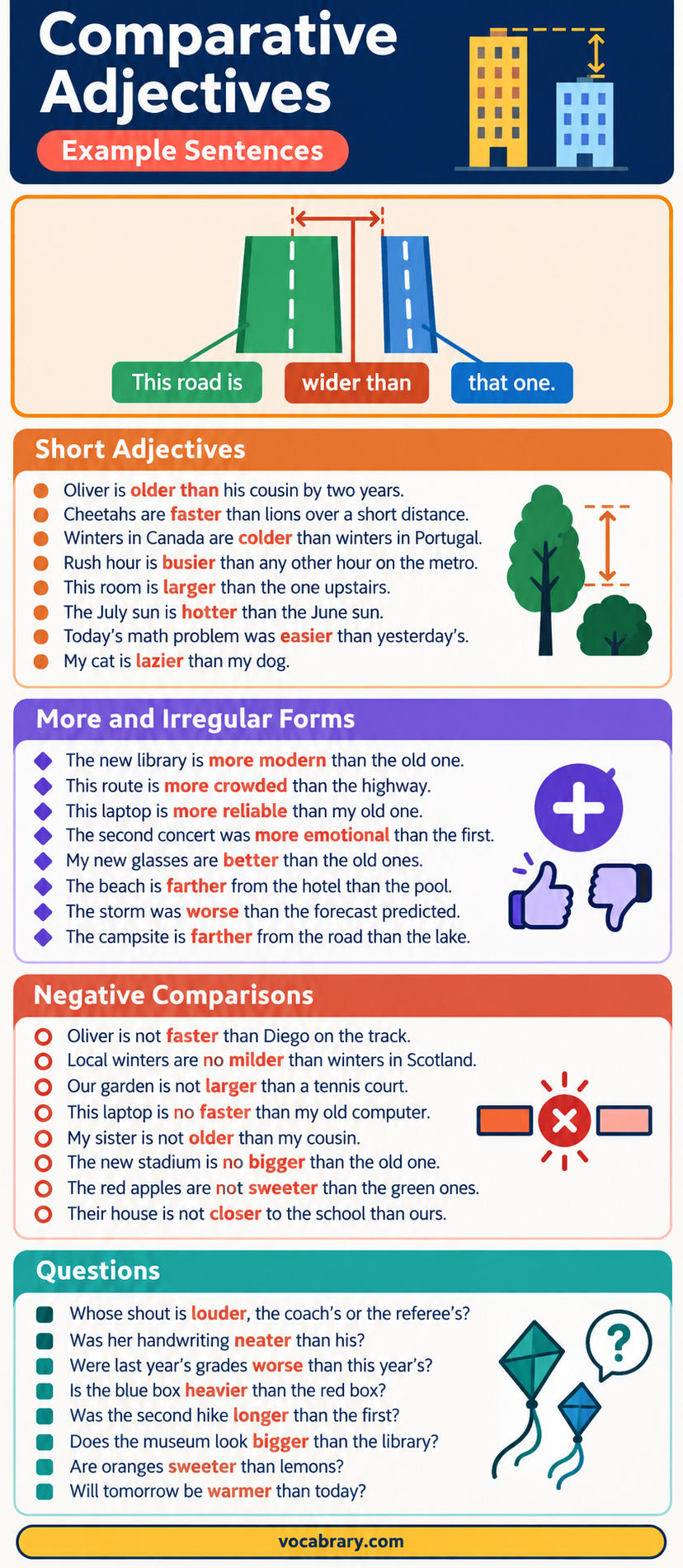
Common Comparative Adjective Example Sentences
A taller brother, a cheaper flight, and a colder morning are the comparatives that come up in everyday speech and in every grammar workbook.
- My brother is taller than I am by at least five centimetres.
- This flight to Madrid is cheaper than the one leaving tomorrow morning.
- December mornings are colder than October mornings in every northern city.
- Engineers built the new highway wider than the old country road by two full lanes.
- Ravi’s essay was longer than Priya’s by three whole paragraphs.
- Steel is stronger than wood for building a bridge.
- Lena is faster than every other swimmer in the regional championship.
- Elephants are heavier than horses by several thousand kilograms.
- Is the lake behind the cabin deeper than the pond behind the school?
- A silk scarf feels softer than a wool one against the skin.
- Our kitchen is brighter than the dining room because of the skylight.
- Tuesday’s exam was harder than Monday’s, and half the class finished late.
- Her new headphones are louder than the pair I bought last year.
- His apartment is smaller than hers, but the rent is twice as high.
- Marta’s cookbook is more popular than the last one she published.
- Dinosaurs at the science museum are more interesting than the wax statues across the street.
- A bicycle is slower than a car, but it costs nothing to run.
- Near the old mill the river is narrower than it is at the stone bridge two kilometres downstream.
Comparative Adjective Forms: Base, Comparative, and Superlative
Taller, more beautiful, and better each transform a different base adjective into a form that compares two nouns.
| Base adjective | Comparative | Superlative |
|---|---|---|
| Tall | Taller | Tallest |
| Fast | Faster | Fastest |
| Big | Bigger | Biggest |
| Happy | Happier | Happiest |
| Beautiful | More beautiful | Most beautiful |
| Expensive | More expensive | Most expensive |
| Comfortable | More comfortable | Most comfortable |
| Good | Better | Best |
| Bad | Worse | Worst |
| Far | Farther | Farthest |
Comparative Adjectives With -er in Sentences
Faster races, older buildings, and darker hallways all take the -er ending because their base adjectives have one syllable. Two-syllable adjectives ending in -y, such as happier and busier, swap the -y for -ier before the same ending.
- Omar is older than his cousin by two years.
- Cheetahs are faster than lions over a short distance.
- The corridor on the second floor looked darker than the one downstairs.
- Tokyo is larger than Osaka in both population and land size.
- A summer day is longer than a winter day in the northern hemisphere.
- Iron is harder than copper, and blacksmiths know the difference with every strike.
- Priya is younger than her lab partner by six months.
- Did the truck sound louder than the sedan on the highway at night?
- Fresh bread is softer than bread left on the counter for two days.
- The new office building is taller than the church steeple beside it.
- Winters in Canada are colder than winters in Portugal.
- Amara felt happier after she passed the driving test on her first attempt.
- Rush hour is busier than any other hour on the metro.
- Monday’s soup was thicker than Tuesday’s because the chef added extra potatoes.
- A gravel road is bumpier than a paved one, and every cyclist on the tour noticed the difference after the first kilometre.
- The shelf in the garage is higher than the one in the kitchen, and nobody under six feet reaches it without a stool.
Comparative Adjectives With More in Sentences
More expensive, more comfortable, and more dangerous place more before the base adjective because each base word has two or more syllables and does not end in -y.
- A silk dress is more expensive than a cotton one at every store on the high street.
- Our new sofa is more comfortable than the wooden bench by the window.
- Cycling without a helmet is more dangerous than cycling with one.
- Was Priya’s speech more persuasive than Omar’s at the debate last Friday?
- That documentary on penguins was more entertaining than the one about glaciers.
- Amara’s recipe is more nutritious than the fast-food meal her brother ordered.
- The library is more spacious than the old reading room at the back of the school.
- Laptops are more portable than desktop computers, and students bring one to every lecture.
- His second novel was more ambitious than his first, and the reviewers noticed.
- Learning two languages at once is more demanding than focusing on one at a time.
- Roses in June are more colourful than roses in February.
- Fresh juice is more refreshing than a fizzy drink on a hot afternoon.
- Her handwriting is more legible than mine, and the teacher never asks her to rewrite a word.
- A guided tour is more educational than a self-led walk through the ruins.
- The coastal road is more scenic than the motorway, but it winds through three villages and adds forty minutes to the drive.
Irregular Comparative Adjectives in Sentences
Better grades, worse weather, and farther distances break the -er and more rules entirely, because these adjectives change into new words instead of adding an ending.
- Priya is a better singer than her brother, who goes off pitch every time.
- Today’s weather is worse than yesterday’s, and the forecast says rain all week.
- Our supermarket is farther from the house than the corner shop.
- Was Omar’s second attempt at the recipe better than his first?
- Traffic on the ring road was worse than expected, and we arrived an hour late for the concert.
- Flights land at an airport further from the hotel than the train station is.
- A home-cooked meal is better than fast food for your health.
- Last winter was worse than the one before it, with three weeks of nonstop rain.
- Marathon runners train to push farther than they went the day before.
- Her better exam score came after three weeks of daily revision.
- Side effects of the old medicine were worse than the symptoms it treated.
- Ahmed walked further into the forest than his friends dared to go.
- Leyla’s better pronunciation impressed the language teacher on the first day.
- Flooding this year was worse than in any of the previous five, and hundreds of residents left their homes.
Comparative Adjectives in Negative Sentences
Not taller twins, no cheaper hotels, and no milder winters are denials of a comparison, where the negative word comes before the comparative form.
- She is not taller than her twin sister, despite what their mother believes.
- This hotel is no cheaper than the one we stayed at last summer.
- Her second draft was not better than the first, and the editor asked for a full rewrite.
- Omar is not faster than Diego on the track.
- Local winters are no milder than winters in Scotland.
- My salary is not higher than it was two years ago.
- New paint on the bedroom wall is not brighter than the old coat underneath.
- She is not more experienced than her colleague, but she got the promotion anyway.
- His explanation was no more convincing than his last one.
- Store-bought cake is no more delicious than the one I baked at home.
- Our garden is not larger than a tennis court.
- That excuse about the broken alarm was no more believable than the one he gave the teacher on Monday, and both of them earned a detention.
- The traffic today is not worse than the traffic yesterday.
Comparative Adjectives in Questions
Which bag is lighter, whose shout is louder, and is the new bridge longer are questions that place a comparative adjective after the verb.
- Which bag is lighter, the leather one or the canvas one?
- Whose shout is louder, the coach’s or the referee’s?
- Is the new bridge longer than the old one across the valley?
- Are summers in Athens hotter than summers in Rome?
- Was her handwriting neater than his?
- Did the cheaper ticket come with fewer benefits?
- Were last year’s grades worse than this year’s?
- Will the new motorway be wider than the current one?
- Has the garden become prettier since you planted those roses?
- Do you find the second chapter more interesting than the first?
- Does the express train arrive faster than the local one?
- Have the apartments on King Street become more expensive than the flats near the old station since the developers finished the new shopping centre?
- Is your cat friendlier than your dog with strangers at the door?
Comparative Adjectives in Everyday Life
A warmer coat on a cold morning, a shorter queue at the grocer’s, and a quieter street after midnight are the comparatives heard in daily routines.
- Dad grabbed a warmer coat before heading out into the snow.
- Tuesday’s queue at the grocer’s is shorter than Saturday’s.
- Our street is much quieter after midnight than it is during rush hour.
- A cotton pillowcase feels smoother than a linen one after a long wash.
- The new kettle boils water quicker than the old one by a full minute.
- Grandma’s house is nearer to the park than ours.
- Marta picked the lighter suitcase for the weekend trip.
- Is the wool blanket thicker than the fleece one in the cupboard?
- After sunset the porch is darker than the living room.
- Walking to the market is safer than cycling through the roundabout at rush hour.
- A fresh mango is sweeter than a green one picked too early.
- In spring the garden looks prettier than it does in late autumn.
- His old running shoes were sturdier than the new pair he bought online.
- A cup of chamomile tea is milder than a cup of black coffee.
- Rain made the path through the woods muddier than it was the morning before, and every walker came home with brown boots.
Comparative Adjectives at School and at Work
Teachers grading harder tests, students writing longer essays, and managers reviewing thicker reports put comparative adjectives to work before the day ends.
- Friday’s test was harder than the practice quiz from Wednesday.
- Priya’s essay was longer than the required word count by two hundred words.
- Deadlines for the science project are stricter than deadlines for the art assignment.
- Ravi earned a higher grade on the final exam than on the mid-term.
- Ahmed is smarter than half his classmates give him credit for.
- His research question for the thesis is broader than the professor expected.
- Did the new textbook feel thicker than the old edition?
- A senior colleague is more experienced than an intern on the first day.
- Her marketing campaign was more creative than anything the department had seen in two years.
- Working from home is more productive for some employees than sitting in an open-plan office.
- The lab report required a more detailed method write-up than the last one.
- Competition for the scholarship was more competitive this year than last.
- Our new branch office is closer to the train station than the old one.
- Our professor’s feedback on the second draft was more thorough than her notes on the first, and every paragraph had at least two comments.
Comparative Adjective Example Sentences for Kids
Bigger dogs, taller trees, and faster bikes are the comparatives a six-year-old already knows, and the -er or more ending turns two nouns into a race.
- My dog is bigger than your cat.
- Our oak tree in the park is taller than the one in the back garden.
- Sam’s bike is faster than mine because it has gears.
- A drum is louder than a flute in the school band.
- The snake at the zoo was longer than my arm.
- Chocolate ice cream is sweeter than vanilla, but I love both flavours.
- Stars look brighter on a night without clouds.
- Is summer hotter than spring where you live?
- Winter nights are colder than autumn nights, and we need thicker blankets.
- A kitten’s fur is softer than a puppy’s.
- My sister tells funnier jokes than my brother.
- Parrots are more colourful than sparrows.
- The elephant at the safari park is heavier than every other animal in the enclosure.
Comparative Adjective Example Sentences for Students
A more complex equation, a longer bibliography, and a stricter deadline are the comparatives that define academic life from secondary school through university.
- Algebra II is more complex than Algebra I, and the homework takes twice as long.
- Priya’s bibliography for the history essay is longer than the one for the geography project.
- University deadlines are stricter than secondary-school deadlines, and late submissions lose marks.
- Doctoral theses are broader in scope than master’s dissertations.
- Her argument in the debate was deeper than his because she quoted three published studies.
- The second draft of the lab report was more detailed than the first, with four new diagrams.
- Was your presentation more persuasive after you added the statistics?
- His translation of the poem was more accurate than the one printed in the anthology.
- Graduate-level reading is more advanced than undergraduate-level reading in the same department.
- Every essay prompt on the final exam was harder than the practice prompts from the semester.
- A peer-reviewed paper requires more thorough citations than an informal web essay.
- Students with higher attendance rates performed well ahead of those who skipped lectures.
- A stronger opening paragraph pulled the reader into her thesis from the first sentence, and the examiner praised it in his notes.
Comparative and Superlative Adjectives in the Same Sentence
Tall beside taller beside tallest, and good beside better beside best pair the three degrees of comparison in one sentence, so the shift from one degree to the next is visible. More superlative adjective example sentences show every adjective taken to its highest degree.
- A building is tall, a tower is taller, and a skyscraper is the tallest of all three.
- Priya runs fast, Ahmed runs faster, and Lena runs the fastest on the whole team.
- Melons are big, watermelons are bigger, and pumpkins at harvest are the biggest.
- One ticket was cheap, the next was cheaper, and the last was the cheapest of the batch.
- Omar felt happy after breakfast, happier at lunch, and the happiest when the scores arrived.
- Her cooking is good, her mother’s is better, and her grandmother’s is the best in the family.
- Monday’s weather was bad, Tuesday’s was worse, and Wednesday’s was the worst of the week.
- The shop is far, the station is farther, and the airport is the farthest from the house.
- Roses are beautiful, sunsets are more beautiful, and the northern lights are the most beautiful sight of all.
- A car is expensive, a yacht is more expensive, and a private jet is the most expensive of the three.
- Every hallway is dark, every cellar is darker, and an attic without a window is the darkest room in any house.
- Steel is strong, titanium is stronger, and diamond is the strongest material you will ever cut with.
Related
- Parts of Speech Example Sentences
- Demonstrative Adjective Example Sentences
- Predicate Adjective Example Sentences
FAQs
An everyday example is "The new phone is lighter than my old one." Another is "The second movie was funnier than the first."
With the "-er" ending, one example is "The new tablet is thinner than a magazine." Another is "The suitcase on the left is heavier than the one on the right."
For "more", one example is "The new library is more modern than the old one." Another is "Learning chess is more difficult than learning checkers."
An irregular example is "My new glasses are better than the old ones." Another is "The storm was worse than the forecast predicted."
A negative example is "The blue jacket is not warmer than the gray one." Another is "The hotel is no more comfortable than a tent."
One question is "Is the blue box heavier than the red box?" Another is "Are the new shoes more comfortable than the old ones?"
In daily life, one example is "The bus is cheaper than a taxi." Another is "The living room is warmer than the porch."
A nature example is "The desert is drier than the rainforest." Another is "Spring days are longer than winter days."
On the road, one example is "The express train is faster than the regular train." Another is "The window seat is quieter than the aisle seat."
For kids, one example is "The giraffe is taller than the zebra." Another is "A turtle is slower than a rabbit."
Related: