
A relative adverb is an adverb that introduces a relative clause and refers back to a noun of place, time, or reason, as in the house where I grew up. Where already means in which, so the clause after it needs no preposition, whereas a relative pronoun requires one: the house in which I grew up. Relative adverb example sentences join where, when, and why to nouns such as house, season, and reason, and each clause adds a fact about its noun without a preposition.
What Is a Relative Adverb?
A relative adverb joins a relative clause to a noun and shows place (where), time (when), or reason (why). A relative pronoun such as which or who stands for the noun itself and works as the subject or object of the clause, so the house which I bought uses a pronoun, as the relative pronoun sentences page shows.
Noun of place, time, or reason + relative adverb + subject + verb
This is the café where we met, and I remember the day when it opened.
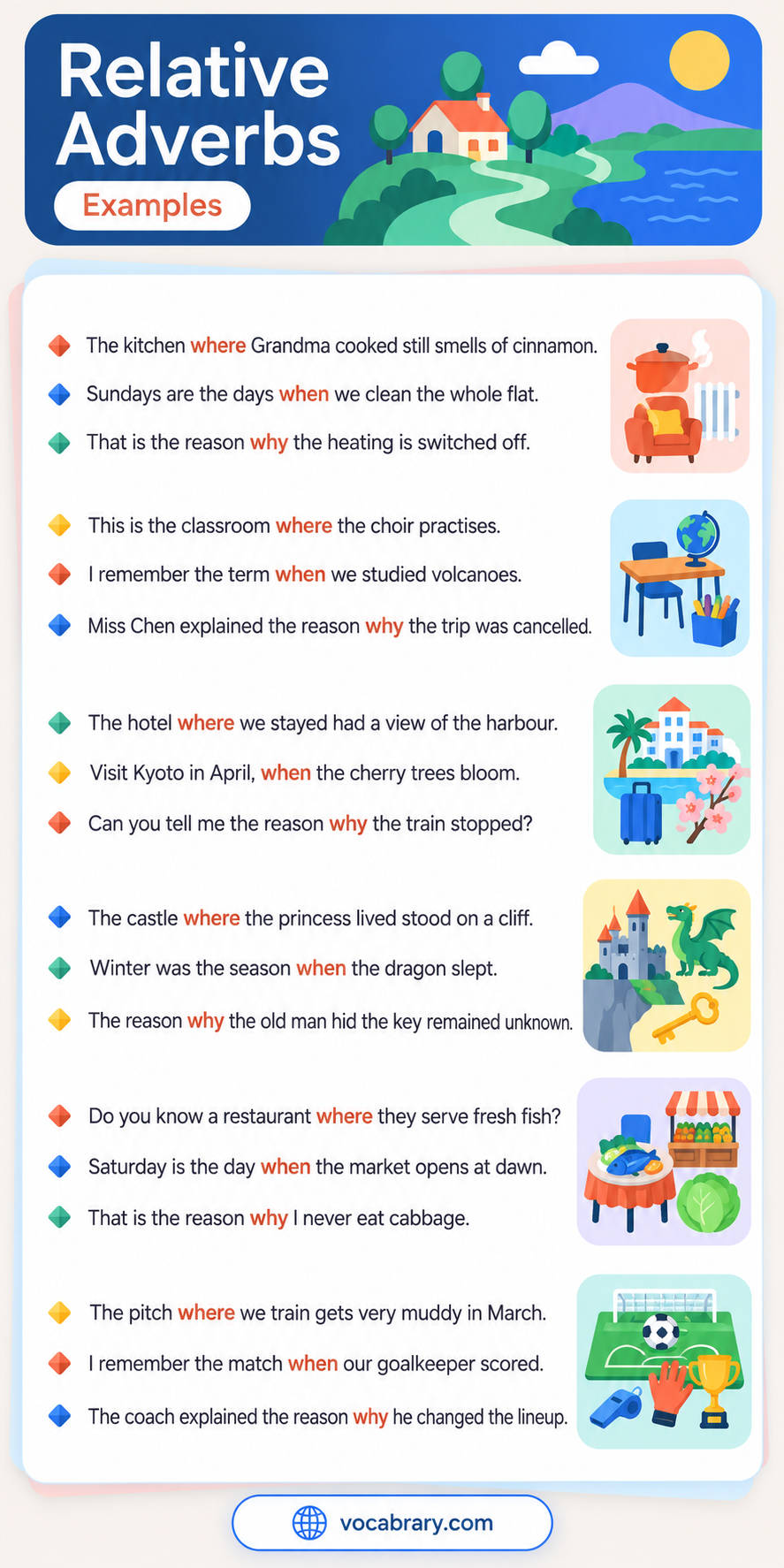
Common Relative Adverb Example Sentences
A house, a café, a season, and a reason are the nouns that begin typical relative adverb example sentences. In every case the relative adverb follows a noun and begins a clause that adds a fact about it.
- This is the house where I grew up.
- I remember the day when we first met.
- Nobody knows the reason why the shop closed.
- The café where we met has closed for good.
- Winter is the season when the lake freezes over.
- That is the reason why I never eat cabbage.
- Do you know a restaurant where they serve fresh fish?
- The year when Mum retired was the happiest of her life.
- Here is the park where the children play football.
- Tell me the reason why you left the party early.
- The hospital where my sister works is near the river.
- Saturday is the day when the market opens at dawn.
- We visited the village where my grandfather was born.
- There are days when the sea is perfectly calm.
- This is the room where the exams take place.
- She explained the reason why the trains were late.
- The town where I studied has a famous clock tower.
- January is the month when the city is quietest.
- The school where Nadia teaches is on Oak Street.
- I will never forget the night when the lights went out.
Examples of Where, When and Why After Nouns
Where follows a noun of place, when follows a noun of time, and why follows the noun reason. Each relative adverb also has a longer form made of a preposition plus which.
| Relative adverb | Refers to | Preposition plus which | Example sentence |
|---|---|---|---|
| Where | A place | In which, at which, to which | This is the school where I studied. |
| When | A time | In which, on which, at which | I remember the day when we met. |
| Why | The noun reason | For which | That is the reason why I called. |
Sentences With Where After Nouns of Place
Where follows house, school, city, country, and the word place, and the clause tells what happens or happened in that location.
Home and Building Sentences With Where
The flat where Rosa lives, the library where Ahmed studies, and the factory where a father worked are buildings that the clause with where describes.
- The flat where Rosa lives has a view of the harbour.
- The library where Ahmed studies closes at ten.
- That is the factory where my father worked for thirty years.
- The hotel where we stayed had a rooftop pool.
- Do you remember the bakery where we bought the cake?
- The stadium where the final was played holds eighty thousand fans.
- This is the church where my parents were married.
- The clinic where Dr Mehta works opens at seven.
- Here is the shop where I found my first guitar.
- The cinema where we saw the film is now a supermarket.
- The kitchen where Grandma cooked still smells of cinnamon.
- I walked past the school where I learned to read.
- The garage where Uncle Sam repairs bicycles is always open.
City, Country and Region Sentences With Where
Lisbon is the city where a brother studies, Iceland is a country where the sun barely sets, and a valley where a river begins are larger places that the clause with where describes.
- Lisbon is the city where my brother studies architecture.
- Kenya is the country where my aunt works as a vet.
- She moved to a region where winters are mild.
- Venice is a city where cars are not allowed.
- The valley where the river begins is covered in snow.
- This is the island where the ferry stops.
- Iceland is a country where the sun barely sets in June.
- The town where Mozart was born attracts many visitors.
- They live in a village where nobody locks their doors.
- Peru is a country where potatoes have grown for thousands of years.
- Rome is the city where I proposed to my wife.
- The coast where the whales swim is protected by law.
- The mountain pass where the road narrows is closed in winter.
Sentences With the Place Where
This is the place where we first met, a place where they sell excellent coffee, and a place where the children play safely all use the noun place, the most general antecedent of where.
- This is the place where we first met.
- I know a place where they sell excellent coffee.
- Is there a place where I can charge my phone?
- Show me the place where you hid the key.
- The place where the accident happened is now a garden.
- We need a place where the children can play safely.
- That is the place where the old oak tree stood.
- Find a place where the wind cannot reach us.
- Is this the place where the old market used to stand?
- Nobody could find a place where the signal was strong.
Sentences With When After Nouns of Time
When follows day, month, year, season, moment, and the word time, and the clause tells what happened at that point in time.
Day, Month and Year Sentences With When
The day when the war ended, Monday when the market opens late, and December when the nights are longest are periods that the clause with when describes.
- I remember the day when the war ended.
- Monday is the day when the market opens late.
- December is the month when the nights are longest.
- It was the year when the two Germanys reunited.
- It was the week when all the shops had sales.
- The afternoon when it snowed was the happiest of my childhood.
- Thursday is the day when the bin lorry comes.
- Do you remember the morning when we missed the ferry?
- She was born in the year when the bridge opened.
- Sunday is the day when the whole family cooks together.
- Wednesday is the day when the bakery sells half-price loaves.
- I remember the night when the river flooded the square.
- April is the month when the orchard blossoms.
Time, Moment and Season Sentences With When
Summer when the lake is warmest, moments when I miss my old school, and a time when few families owned a car are shorter or looser periods that the clause with when describes.
- Summer is the season when the lake is warmest.
- There are moments when I miss my old school.
- Now is the time when we must decide.
- It was a time when few families owned a car.
- Winter is the period when the museum is quiet.
- I know the moment when the idea began.
- Autumn is the time when the leaves turn red.
- The century when the printing press spread was a time of great change.
- He recalled the instant when the glass broke.
- There was a time when this street had no cars.
The Reason Why in a Sentence
Why follows the noun reason, as in the reason why the shop closed and the reason why Ravi left. The clause with why states the cause.
- That is the reason why the shop closed early.
- Nobody explained the reason why the flight was cancelled.
- Can you tell me the reason why you are smiling?
- The reason why Ravi left is still a secret.
- I understand the reason why you are upset.
- There is no reason why we should wait.
- She gave the reason why she missed the meeting.
- The reasons why bees are disappearing worry scientists.
- Is that the reason why you changed your plans?
- We discussed the reason why prices rise in winter.
- The police asked for the reason why the door was open.
- The main reason why I like autumn is the colour of the leaves.
- That’s the reason why Dad checks the weather every morning.
- Give me one good reason why I should believe you.
- She never learned the reason why her letter was returned.
That in Place of When and Why Example Sentences
The day that we met, the reason that he left, and the first time that I have visited Japan use that in place of when or why. That works in defining clauses only and is not used in place of where in standard English.
- I remember the day that we met.
- The reason that he left is still unknown.
- It was the year that the bridge opened.
- I can think of one reason that he stayed home.
- The moment that she walked in, everyone smiled.
- That is the reason that I called you.
- The night that the storm hit, we slept in the cellar.
- This is the first time that I have visited Japan.
- Every time that it rains, the street floods.
- The reason that she was late was the traffic.
- The week that the roof leaked was the coldest of the year.
- He explained the reason that the experiment failed.
- The day that Mum retired, we baked a cake.
- Is this the reason that you left your job?
Relative Clauses With When and Why Omitted
The day we first met, the reason he left, and the first time I have seen snow drop the relative adverb, and the meaning stays the same. The noun in bold is the one that the omitted word would follow.
- I remember the day we first met.
- That is the reason he left the company.
- The year Mum retired was the happiest of her life.
- Nobody knows the reason the bridge closed.
- Tell me the time you will arrive.
- It was the night the lights went out.
- I never found out the reason she stopped calling.
- The week we moved was the coldest of the winter.
- This is the first time I have seen snow.
- She explained the reason the experiment failed.
- Do you remember the morning we missed the ferry?
- There was a time nobody owned a phone.
Defining and Non-Defining Relative Adverb Sentences
A defining clause identifies which noun is meant and takes no commas, while a non-defining clause adds an extra fact about a noun that is already known and takes a comma.
| Feature | Defining clause | Non-defining clause |
|---|---|---|
| Commas | None | Before the clause, and after it when it ends inside a sentence |
| Job | Identifies the noun | Adds an extra fact |
| Antecedent | A common noun that needs identifying, as in the town | A noun that is already identified, as in Lisbon |
| That as a substitute | Allowed for when and why | Not allowed |
| Example sentence | The town where I grew up is small. | We flew to Lisbon, where my sister lives. |
Defining Clause Sentences Without Commas
The street where the accident happened, the room where we study, and the days when the staff meet need the clause to identify the noun, so no comma is used.
- The town where I grew up has a famous clock tower.
- Fridays are the days when the library stays open late.
- Show me the street where the accident happened.
- I need a quiet room where I can study.
- She remembered the winter when the river froze.
- This is the reason why the plan failed.
- We found a beach where nobody had left any rubbish.
- He misses the years when his children were small.
- The restaurant where we celebrated closed last month.
- Is there a shop near here where I can buy batteries?
- Mondays are the days when the staff meet.
- There is a reason why the door stays locked.
Non-Defining Clause Sentences With Commas
Lisbon, where my sister has lived, July, when the schools close, and Cork, where her father ran a bakery name a known place or time, so the extra clause takes a comma.
- We flew to Lisbon, where my sister has lived since 2015.
- In July, when the schools close, the town fills with tourists.
- Grandma grew up in Cork, where her father ran a bakery.
- The meeting is on Friday, when the manager returns from Oslo.
- We stayed at the Grand Hotel, where the breakfast was excellent.
- Visit Kyoto in April, when the cherry trees bloom.
- Mum took us to Kenya, where we saw lions for the first time.
- The festival starts in August, when the days are long.
- They moved to Toronto, where Ben found a job in a hospital.
- I will see you at noon, when the shop opens.
- Sunday, when the roads are empty, is the best day for cycling.
- The final was held in Cairo, where more than fifty thousand fans gathered.
- We stayed in Seville, where the evenings were warm and lively.
- The concert is on Saturday, when the weather should be dry.
Formal Sentences With Preposition Plus Which
The house in which I grew up, the day on which we met, and the reason for which he resigned say the same thing as where, when, and why, in a more formal style.
| Relative adverb | Preposition plus which | Example sentence |
|---|---|---|
| Where | In which, at which, to which, from which | The house in which I live is old. |
| When | On which, in which, at which | The day on which we met was a Tuesday. |
| Why | For which | The reason for which he resigned is private. |
- This is the house in which I grew up, and the garden where I played is still there.
- The day on which we met was a Tuesday, the same day when the bridge opened.
- The reason for which he resigned remains private, and the reason why I stayed is simple.
- The town from which she came is now a ghost town, but the valley where she played is green.
- The hall in which the concert took place is the hall where my parents first danced.
- The year in which the war ended is the year when my grandfather came home.
- The room to which the guests were led was freezing, but the room where we ate was warm.
- The moment at which the alarm rang was the moment when everyone stood up.
- The restaurant at which we booked a table is the place where we celebrated last year.
- There is no reason for which we should lose hope, and no reason why we should give up.
- The village in which my aunt lives has no shop, but the town where she works has three.
- The century in which the bridge was built is the century when the town doubled in size.
Sentences Comparing Relative Adverbs and Relative Pronouns
The house where I live and the house which I bought use different words because the clauses need different parts. The adverb replaces there, then, or for that reason, while the pronoun replaces it, him, or them and supplies a missing subject or object.
| Feature | Relative adverb | Relative pronoun |
|---|---|---|
| Replaced by | There, then, for that reason | It, him, her, them |
| Role in the clause | Place, time, or reason | Subject or object |
| Test sentence | I live there. | I bought it. |
| Example sentence | The house where I live is old. | The house which I bought is old. |
- The house where I live is older than the house which I bought.
- The café where we met is closed, and so is the café that we visited.
- The day when Tom arrived was a holiday, and the present which Tom chose was a book.
- The town where she works is small, and the town which she loves is smaller.
- The reason why he left is private, and the reason which he gave is private too.
- The park where we play is huge, and so is the park which the council built.
Relative Adverbs and Interrogative Adverbs Compared in Sentences
Where did you grow up? and the street where you grew up use the same word in different jobs. A relative adverb follows a noun, while an interrogative adverb opens a question, as the interrogative adverb sentences page explains.
- Where did you grow up, Tomas, and can you show me the street where you lived?
- When does the festival start this year, and is August the month when it begins?
- Why did the school close last week, and does anyone know the reason why it closed?
- Do you know where Hana lives, and have you seen the village where she grew up?
Negative Sentences With Where, When and Why
A place where nobody feels lonely, a day when nothing went wrong, and no reason why the shop should close show relative adverbs in negative sentences. The negative word stands in the main clause or inside the relative clause.
- This is a place where nobody ever feels lonely.
- It was a day when nothing went wrong.
- There is no reason why the shop should not open.
- We stayed in a town where no hotel had a free room.
- Mondays are not the days when the museum is busy.
- She never visited the village where her father was born.
- Avoid places where nobody speaks English.
- That is not the reason why I called you.
- I know no restaurant where children eat for free.
- There was never a time when they did not help us.
- This is not the street where the accident happened.
- Nobody remembers the year when the old school closed.
Question Sentences With Relative Adverbs
Is this the café where you met your husband? and do you remember the day when we went sailing? put a relative clause inside a question. The relative adverb still follows its noun.
- Is this the café where you met your husband?
- Do you remember the day when we went sailing?
- Can you tell me the reason why the train stopped?
- Is there a park where dogs can run freely?
- Was that the year when the river flooded?
- Do you know a shop where I can buy fresh figs?
- Is Friday the day when the museum is free?
- Which is the room where the meeting takes place?
- Did you visit the village where your grandmother was born?
- Is there a month when the lake is warm enough to swim?
Reported Speech and Passive Relative Adverb Sentences
She said that Lisbon was the city where she had met her husband and the room where the treaty was signed is now a museum show relative adverbs in reported speech and in passive clauses.
- She said that Lisbon was the city where she had met her husband.
- He told us that it was the day when his daughter was born.
- Tom explained the reason why he had left early.
- The guide said this was the place where the king had been crowned.
- Mina asked whether this was the room where the exam would be held.
- The house where the poet was born was restored last year.
- The village where the festival is held was chosen by a committee.
- The year when the bridge was built is recorded in the archive.
- The room where the treaty was signed is now a museum.
- The reason why the plan was rejected was never published.
- Ines told us that August was the month when her village held its festival.
- The report explained the reason why the factory had closed in June.
Position of the Relative Adverb Clause in Sentences
In relative adverb example sentences, the clause stands right after the noun it describes, whether that noun is the subject, the object, or the word after there is or this is.
Subject Noun Plus Relative Clause Examples
The village where my grandmother lives and the day when we arrived are subject noun phrases, and the clause comes between the head noun and the verb.
- The village where my grandmother lives has a market on Sundays.
- The day when we arrived was the hottest of the summer.
- The reason why he refused surprised everyone.
- The beach where we camped was almost empty.
- The year when the old bridge collapsed changed the town.
- The room where Dad works smells of wood.
- The hour when the shops close is the busiest.
- The garden where the children play is behind the school.
Object Noun Plus Relative Clause Examples
We love the village where my grandmother lives and everyone remembers the day when it snowed in May place the clause after the object, at the end of the sentence.
- We love the village where my grandmother lives.
- Everyone remembers the day when it snowed in May.
- Nobody understood the reason why he refused.
- Pablo found a beach where the water was warm.
- She hates the hour when the shops close.
- They sold the house where their children were born.
- I visited the garden where the old oak stands.
- Dina described the night when the lights failed.
Clauses After There Is and This Is
There is a shop on Elm Street where you can buy fresh bread and this is the spot where the treaty was signed use short opening frames before the noun.
- There is a shop on Elm Street where you can buy fresh bread.
- This is the spot where the treaty was signed.
- Here is the library where I study every weekend.
- That was the summer when we learned to swim.
- It is the moment when the story changes.
- There was a time when people wrote letters every week.
Everyday Sentences With Relative Adverbs
Kitchens, classrooms, offices, and hotels are daily settings in which relative adverbs refer to a place, a time, or a reason.
Home and Kitchen Sentences With Where and When
The kitchen where Mum bakes, the corner where the cat sleeps, the cupboard where the torches are kept, and the winter when the pipes froze show relative adverbs in household life.
- The kitchen where Mum bakes smells of vanilla.
- Sundays are the days when we clean the whole flat.
- This is the corner where the cat likes to sleep.
- The cupboard where we keep the torches is in the hall.
- I remember the winter when the pipes froze.
- That is the reason why the heating is switched off.
Classroom and School Sentences With Relative Adverbs
The hall where exams take place, the lab where experiments run, the day when art lessons start, and the reason why a trip was cancelled show relative adverbs in school life.
- The hall where the exams take place is freezing.
- Friday is the day when we have art lessons.
- Miss Chen explained the reason why the trip was cancelled.
- The lab where we do experiments has new microscopes.
- I remember the term when we studied volcanoes.
- This is the classroom where the choir practises.
Office and Work Sentences With Where and Why
The office where a colleague works, the week when a system crashed, the room where the board meets, and the factory where a career started show relative adverbs in working life.
- The office where I work overlooks a small park.
- The week when the system crashed was the worst of the year.
- Nobody knows the reason why sales fell in May.
- This is the room where the board meets every Monday.
- Fridays are the days when we finish early.
- The factory where Karim started his career closed last year.
Travel Sentences About Cities and Hotels
Paris where a couple spent a honeymoon, July when the beaches are busiest, the hotel where a family stayed, and the day when a border was crossed show relative adverbs in travel.
- Paris is the city where we spent our honeymoon.
- July is the month when the beaches are busiest.
- The hotel where we stayed had a view of the harbour.
- We found a bar where the music was live every night.
- The day when we crossed the border was long and tiring.
- Is there a station near here where I can buy tickets?
Relative Adverb Sentences for News, Stories and Clinics
Squares, castles, stadiums, and clinics are wider settings in which relative adverbs refer to a location, a period, or a cause.
News Report Sentences About Protests and Floods
The square where a protest began, the year when inflation peaked, the hospital where the injured were treated, and the valley where a flood struck show relative adverbs in news reports.
- The square where the protest began is now closed.
- The year when inflation peaked was a hard one for families.
- Officials gave the reason why the airport was shut.
- The hospital where the injured were treated is nearby.
- Tuesday is the day when the vote will be held.
- The valley where the flood struck lost its main road.
Fiction Sentences About Castles and Forests
The castle where a princess lived, the night when the moon turned red, the forest where no traveller returned, and the tower where a wizard worked show relative adverbs in stories.
- The castle where the princess lived stood on a cliff.
- It was the night when the moon turned red.
- The reason why the old man hid the key remained unknown.
- They entered the forest where no traveller had returned.
- Winter was the season when the dragon slept.
- The tower where the wizard worked was full of dusty books.
Sports Sentences About Stadiums and Finals
The stadium where the home side won the cup, Saturday when the final is played, the pitch where a team trains, and the track where a record fell show relative adverbs in sports reports.
- The stadium where the home side won the cup hosts concerts now.
- Saturday is the day when the final is played.
- The coach explained the reason why he changed the lineup.
- The pitch where we train gets very muddy in March.
- I remember the match when our goalkeeper scored.
- This is the track where Nina broke the record.
Health Sentences About Clinics and Wards
The clinic where a vaccination was given, the hours when a back hurts, the ward where a grandfather stayed, and the day when pain stopped show relative adverbs in health talk.
- The clinic where I had my vaccination opens at eight.
- Mornings are the hours when my back hurts most.
- The doctor explained the reason why the fever returned.
- The ward where my grandfather stayed has a garden.
- I remember the day when the pain stopped.
- The pharmacy where Mum buys her medicine is next door.
Relative Adverb Examples for Kids
Parks, ponds, toy boxes, and snowy days are the places and times that young learners describe first, and these relative adverb example sentences for kids keep each clause short.
- This is the park where I fly my kite.
- Saturday is the day when we go swimming.
- That is the reason why I wear a hat.
- The pond where the ducks swim is very small.
- I like the days when it snows.
- Here is the box where I keep my toys.
- Do you know the shop where Dad buys bread?
- My birthday is the day when I get a cake.
- The tree where the squirrel lives is old.
- Mum told me the reason why the sky is blue.
Short Relative Adverb Sentences for Young Learners
This is the school where I learn and I love the days when we play give beginners a short pattern with where, when, and why.
- This is the school where I learn.
- I love the days when we play.
- Here is the place where we sit.
- That is the reason why I smile.
- The park where we play is big.
- Show me the shop where you work.
- It was the day when I swam.
- This is the room where we eat.
Relative Adverb Examples for Students
Relative adverb example sentences for exams use where, when, and why in longer sentences, so these lines give secondary students models to adapt in essays.
- The town where the treaty was signed became a symbol of peace.
- The decade when mass literacy spread transformed political life.
- Historians continue to debate the reason why the empire collapsed.
- Switzerland is a country where four national languages coexist.
- The experiment was repeated in a laboratory where conditions were strictly controlled.
- She chose the university where her mother had studied.
- Scholars still disagree about the year when the law changed.
- The moment when the data contradicted the theory forced a rethink.
- Few can explain the reason why the manuscript was hidden.
- The region where the river delta forms supports millions of farmers.
- She studied in a city where several empires once met.
- The phase when the chromosomes separate is called anaphase.
Relative Adverbs in Short Paragraphs
Running text about a home village, a museum, a trip to Porto, and a garden shed uses where, when, and why, so learners meet relative adverbs inside continuous writing.
Amara returned to the village where she was born. It was the season when the mangoes ripened, and the market where her mother once sold fruit was full. She visited the school where she learned to read. The reason why she came home was simple: she missed the place.
The museum where I work opens at nine. Tuesday is the day when school groups visit, and the guide explains the reason why the old ship was saved. In the hall where the ship stands, children listen carefully.
We stayed in Porto, where my uncle owns a small hotel. July was the month when the city was liveliest, and the café where we ate breakfast was always full. I remember the morning when we climbed the tower.
Dad built a shed in the corner of the garden where the apple tree stands. The summer when he finished it was very dry. The reason why he built it was simple: he needed a room where he could repair bicycles in peace.
FAQs
Q1. What are the relative adverbs in English?
The relative adverbs in English are where, when, and why. Where refers to a place, when refers to a time, and why refers to the noun reason. That replaces when or why in some defining clauses, and the relative adverb example sentences on this page show each pattern.
Q2. What is the difference between a relative adverb and a relative pronoun?
A relative adverb replaces an expression of place, time, or reason, while a relative pronoun replaces a noun that is the subject or object of the clause. In the house where I live, the word where stands for in that house. In the house which I bought, the word which stands for the house itself.
Q3. When do you use where as a relative adverb?
You use where as a relative adverb after a noun of place, such as house, city, country, school, or the word place. The clause with where states what happens or happened in that location. A sentence such as the town where I studied has a clock tower follows this pattern.
Q4. When do you use when as a relative adverb?
You use when as a relative adverb after a noun of time, such as day, month, year, season, moment, or time. The clause with when states what happened at that point in time. A sentence such as I remember the day when we met follows this pattern.
Q5. Does why follow any noun?
The relative adverb why follows only the noun reason in standard English. A sentence such as that is the reason why the shop closed is correct, but the day why we met is not. For other nouns, a different relative adverb or a pronoun is needed.
Q6. Is “the reason why” correct, or should it be “the reason that”?
Both the reason why and the reason that are correct in a defining clause. The reason why he left is unknown and the reason that he left is unknown mean the same thing. A third form drops the word altogether, as in the reason he left is unknown.
Q7. Can you omit a relative adverb?
You omit when and why in a defining clause without changing the meaning, as in the day we met and the reason he left. Where stays in a defining clause, except that informal speech drops it after the word place, as in the place I live. A non-defining clause keeps its relative adverb in every case.
Q8. What is the difference between defining and non-defining clauses with relative adverbs?
A defining clause identifies the noun and takes no commas, while a non-defining clause adds an extra fact about a known noun and takes a comma. The town where I grew up is small is defining, and we flew to Lisbon, where my sister lives is non-defining. That replaces a relative adverb only in the defining type.
Q9. What replaces a relative adverb in formal writing?
A preposition plus which replaces a relative adverb in formal writing. The house in which I grew up means the same as the house where I grew up, and the day on which we met means the same as the day when we met. For the noun reason, the formal form is the reason for which.
Q10. What is the difference between relative adverbs and interrogative adverbs?
Relative adverbs follow a noun and begin a clause, while interrogative adverbs open a question. The word where asks for a place in where do you work, but it describes a noun in the office where I work. The interrogative adverb sentences page covers the question use.
Q11. What are relative adverbs for kids?
Relative adverbs for kids are the small words where, when, and why that join a short clause to a noun. Relative adverb example sentences for kids stay short, as in this is the park where I fly my kite. Many courses introduce where first and add when and why afterward.
Q12. How do you identify a relative adverb in a sentence?
You identify a relative adverb by checking whether there, then, or for that reason fits in its place inside the clause. In the house where I live, the clause becomes I live there, so where is a relative adverb. If the replacement is it, him, or them, the word is a relative pronoun instead.

Leave a Comment