
An adverb of place is an adverb that states the location of an action or the direction of its movement, as in the children are playing outside. In practice the verb decides which reading applies: upstairs is a location in the keys are upstairs and a direction in she walked upstairs. Because the verb carries that decision, adverbs of place example sentences pair each adverb with a verb of being and a verb of movement, so one adverb reads both ways.
What Is an Adverb of Place?
An adverb of place names the location or the direction of an action, and it answers the question where. A preposition needs a noun after it, so inside the house uses a preposition, while she went inside uses an adverb.
Subject + verb + (object) + adverb of place
The dog ran outside, but the cat stayed here.
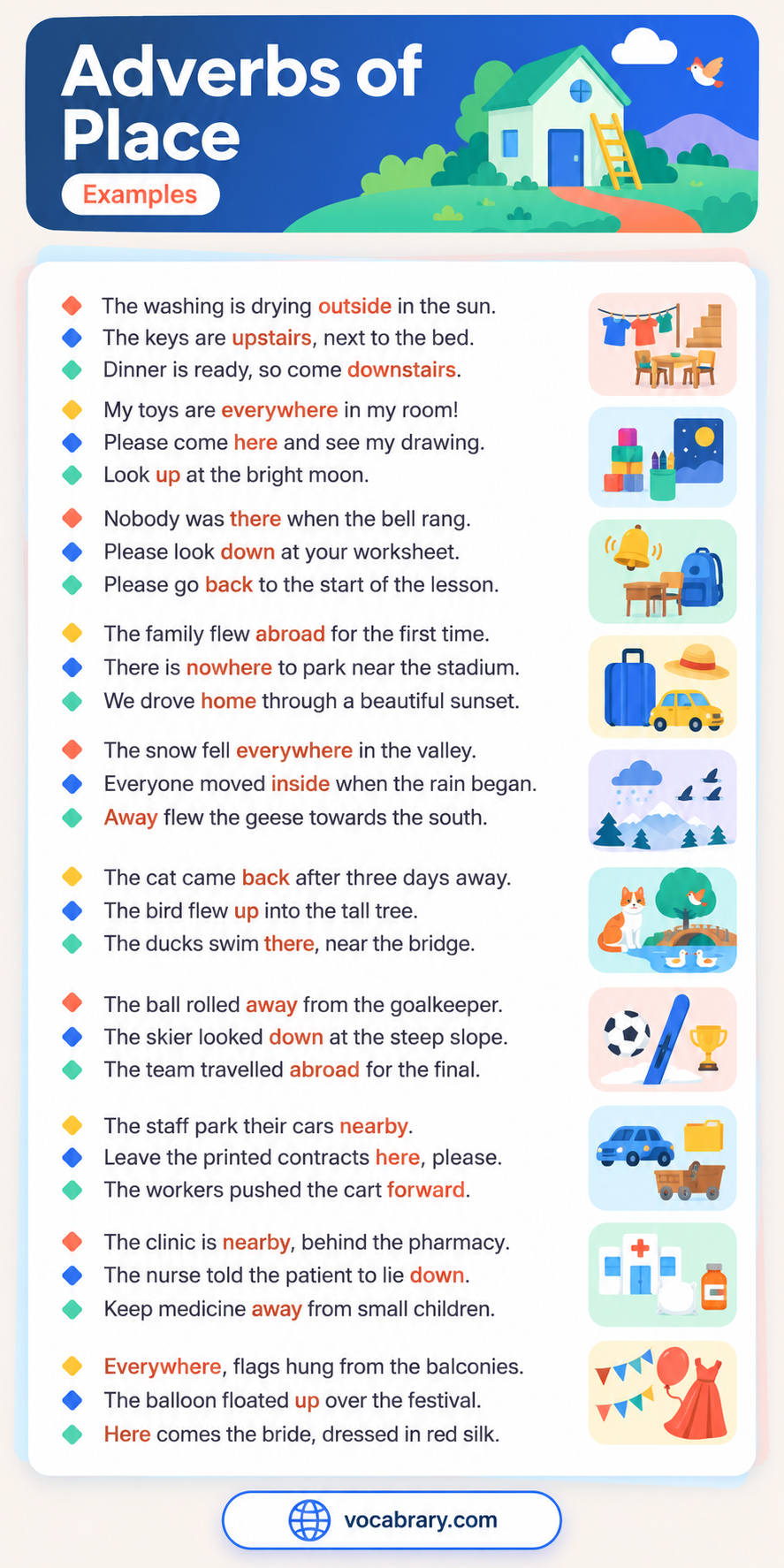
Adverbs of Place Example Sentences for Everyday Use
Here, there, outside, upstairs, nearby, and everywhere are the adverbs of place that learners study first. Each one answers the question where about an action such as playing, searching, living, or walking.
- The children are playing outside in the little yard.
- Please put your coats here by the door.
- My uncle lives abroad and visits us every summer.
- The keys are upstairs, next to the bed.
- Look around before you cross the road.
- There is a pharmacy nearby on Station Road.
- Amina walked home after the late class.
- The ball rolled away down the hill.
- Hugo searched everywhere for his missing phone charger.
- Come back soon, and bring your sister.
- Raj looked up and saw a hawk circling.
- The waiter is waiting downstairs with the menus.
- Let us go inside because it is cold.
- Nobody was there when the bell rang.
- The plane flew overhead at dawn.
- Move forward slowly, and keep your eyes on the white line.
- The kitten is hiding somewhere in the garden.
- Yuki sat down and opened her notebook.
- I cannot find my glasses anywhere.
- The path leads nowhere, so we turned around.
Here and There Example Sentences
Here refers to the place of the speaker, and there refers to a place away from the speaker, as in a name signed here or a fisherman over there.
- Please sign your name here at the bottom.
- The post office is there, on the corner.
- I have lived here since I was a child.
- Put the box there, next to the window.
- Tariq grew up in Lahore and still has friends there.
- Is the manager here today for the meeting?
- Come here, and look at this butterfly.
- The tourists stopped there to take photographs.
- Hold the ladder here, and I will climb.
- My grandmother was born here, in this very house.
- Over there, a fisherman mends his net.
- Sit here, beside me, and watch the parade.
- The lost wallet was there all the time.
- We moved to Oslo, and we have been happy here.
Sentences With Everywhere, Somewhere and Nowhere
Words built on every, some, any, and no give four ways to speak about place: all places, one unnamed place, any place at all, and no place. Nowhere is already negative in meaning.
| Adverb | Meaning | Sentence type | Example sentence |
|---|---|---|---|
| Everywhere | In all places | Positive and negative statements | Dust covered the furniture everywhere. |
| Somewhere | In one unnamed place | Positive statements and offers | I left my scarf somewhere on the train. |
| Anywhere | In any place | Negatives, questions, and open choices | We did not find a seat anywhere. |
| Nowhere | In no place | A positive verb with a negative meaning | The cat was nowhere to be found. |
- We looked everywhere for the missing remote control.
- Flags hung everywhere during the national holiday.
- Somewhere in the attic, an old suitcase is stored for you.
- Zoe left her gloves somewhere on the night train.
- Would you like to go somewhere quiet for lunch?
- Tomás has not seen his cousin anywhere today.
- You may sit anywhere you like in the front hall.
- Did you go anywhere interesting in the summer?
- There is nowhere to park near the stadium.
- The lost keys were nowhere to be found.
- Paper cups lay everywhere after the street party.
- The refugees had nowhere to sleep that night.
- Snow was falling everywhere across the northern valley.
- Is there anywhere to buy a sandwich at this hour?
- Pilar lives somewhere near the harbour in Valparaiso.
- My brother went nowhere during the long storm.
Inside and Outside, Upstairs and Downstairs in Sentences
Inside and outside name positions relative to the walls of a building, and upstairs and downstairs name its floors. These four adverbs describe where a person stays or where a person goes.
- The cat stayed inside during the thunderstorm.
- The pupils eat lunch outside when the weather is warm.
- Grandpa sleeps upstairs because the bedroom is quiet.
- The bathroom is downstairs, to the left of the kitchen.
- Please wait inside until the nurse calls your name.
- Aroha ran outside to greet her cousins.
- The twins are upstairs, doing their homework.
- We carried the sofa downstairs with great care.
- It is freezing outside, so wear your scarf.
- The tourists went inside to look at the paintings.
- My neighbour lives downstairs and plays the piano.
- Dinner is ready, so come downstairs.
- Leave your muddy boots outside before you come in.
- The baby sleeps upstairs in a little blue cot.
Nearby, Abroad and Away Example Sentences
Nearby, abroad, and away describe distance: a pharmacy close to home, a cousin in another country, and a beach ten kilometres off. Abroad is not used after in or to, as in live abroad.
- A tiny chemist’s shop is nearby, next to the baker.
- My cousin works abroad as a civil engineer.
- The beach is ten kilometres away.
- Karim studied abroad for two years.
- Is there a bank nearby that opens on Saturdays?
- The shepherd walked away into the mist.
- Mrs Ito travels abroad every spring.
- A small bakery is nearby, on Elm Street.
- Our neighbours moved away last summer.
- Many nurses from Kerala find work abroad.
- The thief ran away through the crowded market.
- We camped nearby and walked to the river each morning.
- Keep the matches away from the children.
- Amir is studying abroad and phones home on Sundays.
Up and Down, Forward and Backward Sentences
Up, down, around, forward, and backward describe direction of movement, as in a balloon floating up, a student sitting down, or a queue moving forward.
- Gabi looked up and saw a rainbow over the harbour.
- Clara sat down and unpacked her sandwiches.
- The tourists walked around and took photographs.
- The queue moved forward slowly in the heat.
- The skater leaned backward and then fell.
- Prices went up after the harvest failed.
- She turned around when someone called her name.
- The little boy stepped forward and sang.
- The toddler walked backward into the sofa.
- The balloon floated up over the festival.
- Please look down at your worksheet.
- A crowd gathered around to hear the street musician.
- The ship tipped forward in the heavy waves.
- He fell down and hurt his wrist on the steps.
- The speaker leaned forward to hear the question.
- The football rolled down to the bottom of the long hill.
Back and Home in Everyday Sentences
Back shows return to an earlier place, and home shows movement to a house or a country, as in a cat that came back or a nurse who arrived home. Home takes no to, as in walked home, while back is followed by to and a place in some sentences, as in come back to the office.
- Please come back to the office before five.
- Emeka walked home after the long rehearsal.
- The cat came back after three days away.
- We drove home through a beautiful sunset.
- Please go back to the start of the lesson.
- The nurse arrived home at midnight.
- Pedro will be back on Monday.
- The ferry brought the tourists back to the island.
- Thousands of workers travel home for the New Year.
- Take this book back to the library.
- Lena flew home from Sydney in October.
- She walked back to the village at dawn.
- My father works late, but he comes home for dinner.
- The soldiers marched home after the long war.
Examples of Adverbs of Place for Location and Direction
The same adverb of place describes where something is in one sentence and where something goes in another, so the type of verb shows the use: stay inside describes location and go inside describes direction.
Location Sentences After Be, Stay and Live
After verbs such as be, stay, live, and wait, an adverb of place states where a person or thing is, as in the keys are upstairs and we live abroad.
- The sleeping bags are upstairs, beside the wardrobe.
- My grandparents live abroad, in a village in Sicily.
- Please wait outside until the teacher is ready.
- The shop is two streets away.
- The children stayed inside all afternoon.
- Mei is here, but her sister is there.
- The meeting is being held downstairs in the main hall.
- A dentist works nearby, on the corner of Park Road.
- It is raining outside, and the road is flooded.
- The dog sleeps downstairs near the warm stove.
Direction Sentences After Go, Come and Walk
After verbs of motion such as go, come, walk, and run, an adverb of place states where the movement leads, as in she went upstairs and he ran away.
- Zara went upstairs to find her slippers.
- The boy ran away from the barking dog.
- Come here, and watch the ducks on the pond.
- Everyone moved inside when the rain began.
- The cyclists rode forward until they reached the bridge.
- Natasha walked outside and breathed the cold air.
- The tourists headed downstairs to the dining room.
- The cat jumped down from the high shelf.
- The family moved abroad in the spring.
- The audience looked up as the lights went out.
Same Word for Location and Direction in Sentences
Inside, outside, upstairs, abroad, here, and away each describe a location after one verb and a direction after another, so the type of verb shows the use.
| Adverb | Location (where something is) | Direction (where something goes) |
|---|---|---|
| Inside | The cat is inside. | The cat ran inside. |
| Outside | The ladder is outside. | Marta went outside. |
| Upstairs | The children are upstairs. | The children went upstairs. |
| Abroad | My uncle lives abroad. | She moved abroad. |
| Here | The book is here. | Come here. |
| Away | The shop is two streets away. | He walked away. |
Adverbs of Place in Different Sentence Positions
Adverbs of place go after the verb or after the object, and they open a sentence for emphasis. When place and time appear together, the standard order puts place first.
Sentences With the Adverb After the Verb
When the verb has no object, the adverb of place comes straight after it, as in the children are playing outside and the plane flew overhead.
- The twins are playing outside in the garden.
- A helicopter circled overhead after the storm.
- Sana waited nearby while the car was repaired.
- The snow fell everywhere in the valley.
- My cousins live abroad and send postcards.
- The prisoners were kept downstairs in a cold cellar.
- A small bird sat there, perfectly still.
- Tom is working upstairs today with the window open.
- The festival takes place outside, on the village green.
Sentences With the Adverb After the Object
When the verb has an object, the adverb of place comes after it, as in she put the bags downstairs and he carried the box outside. The adverb stands after the whole verb phrase, never between the verb and its object.
- Hana put the heavy bags downstairs.
- The porter carried the suitcase upstairs.
- Please leave your bicycles outside, against the fence.
- The boys kicked the ball away.
- Mr Roy left his umbrella there.
- Mum took the washing inside before the rain.
- Elias dropped the keys somewhere on the way.
- The workers pushed the cart forward.
- The waiter set the tray down.
Outside and Upstairs at the Start of a Sentence
An opening adverb of place stresses where something is or where it goes, as in outside, the snow was falling and upstairs, the baby was asleep.
- Outside, the snow was falling heavily.
- Upstairs, the baby was asleep in the blue cot.
- Everywhere, flags hung from the balconies.
- Nearby, a dog began to bark.
- Inside, the hall was warm and bright.
- Downstairs, the guests were laughing over dessert.
- Abroad, prices were much lower than at home.
- Here, the river is wide and deep.
- Somewhere in the distance, a bell was ringing.
Place Before Time in One Sentence
When place and time appear together, place comes before time, as in we met here yesterday and she waited outside for an hour.
- We met here yesterday, right under this tree.
- Kofi waited outside for an hour.
- The match took place nearby last Saturday.
- She was born abroad in 1998.
- They stayed upstairs until noon on Sunday.
- My friends arrived there this morning.
- The package was left downstairs earlier today.
- The children played outside until the streetlights came on.
Here Comes and There Goes Example Sentences
Here comes the bus and there goes my hat have the adverb of place first, then the verb, then the noun subject. A pronoun subject keeps the usual order, as in here he comes.
- Here comes the bus, so get your tickets ready!
- There goes my last chance to win.
- Here comes the bride, dressed in red silk.
- Up went the balloon into the evening sky.
- Down fell the rain on the dusty road.
- Away flew the geese towards the south.
- Out ran the children into the playground.
- There goes the last train to Leeds.
- Here he comes, and he looks furious.
- There she goes, running for the ferry.
- Off went the horses at the sound of the bell.
- Here are your tickets, madam, and your seat number.
- In came the waiters with trays of tea.
- There stood the old lighthouse, white against the sky.
Contrast Sentences for Adverbs of Place and Prepositions
An adverb of place stands alone, while a preposition of place needs a noun after it, so they waited inside uses an adverb and they waited inside the hall uses a preposition. Full lessons on prepositions of place and prepositions of movement cover the second type.
| Feature | Adverbs of place | Prepositions of place |
|---|---|---|
| Noun after the word | No noun follows | A noun or pronoun follows |
| Job | Describes a verb | Links a noun to another word |
| Example with inside | They waited inside. | They waited inside the hall. |
| Example with down | She sat down. | She walked down the road. |
| Question answered | Where does the action happen? | Where is the noun in relation to another noun? |
- Please wait inside, and then walk inside the hall when called.
- Leave the dog outside, and tie its lead to the post outside the gate.
- The tourists climbed up, while the guide stayed halfway up the stairs.
- The cat jumped down, and then it jumped down the wall.
- A boy looked around curiously while his mother searched around the room.
- The boys ran across, and then they ran across the field.
- The train passed by, and then it passed by the station.
- A taxi drove past, and then it drove past the school.
Examples of Adverbs of Place in Negative Sentences
Anywhere suits a negative sentence, as in I did not find the keys anywhere, while nowhere is already negative in meaning and takes a positive verb, as in the keys were nowhere to be found.
- I did not find my keys anywhere.
- Tomás did not go anywhere during the holiday.
- There is nowhere to sit in the waiting room.
- The children were not outside when the bell rang.
- My uncle does not live abroad any more.
- The manager is not here today.
- They could not find a hotel nearby.
- No one waited there after the shop closed.
- The old man did not walk anywhere without his stick.
- We had nowhere to hide from the rain.
- Yasmin has not been abroad since 2019.
- The bus does not go there on Sundays.
- Dad was not upstairs when the phone rang.
- There was nowhere for the lost puppy to go.
Common Adverbs of Place in Where Questions
Where asks about place, and the answer is an adverb of place such as here, upstairs, or abroad. Yes-or-no questions use anywhere, here, and there after the verb.
- Where is the nearest pharmacy open at night?
- Is anyone here who speaks Italian?
- Did you go anywhere special on your birthday?
- Is the manager upstairs with the visitors?
- Where did you leave your umbrella?
- Do your grandparents live abroad or in the city?
- Are the children outside in the cold again?
- Where are you going? I am going nowhere special.
- Is there a bakery nearby that sells fresh rolls?
- Have you looked everywhere for the passport?
- Where did the plane land in the storm?
- Will you be there at six?
- Did Suresh move away last year?
- Can we sit somewhere quiet for the interview?
Using Adverbs of Place in Reported and Passive Sentences
In reported speech, here becomes there and over here becomes over there when the speaker is no longer at the place, while upstairs and abroad stay the same. In passive sentences, the adverb of place follows the verb phrase.
| Direct speech | Reported speech | Example sentence |
|---|---|---|
| Here | There | Dara said the keys were there. |
| Over here | Over there | Lin said the tools were over there. |
| Down here | Down there | Mei said the boxes were down there. |
| Upstairs | Upstairs | Hira said the baby was upstairs. |
| Abroad | Abroad | Ravi said his sister lived abroad. |
- The tour guide said that the museum was nearby.
- Aiko said that the guests were waiting there.
- My mother told me that the children were upstairs.
- The pilot announced that the passengers should stay inside.
- Elena explained that she had looked everywhere.
- The shoes must be left outside, near the temple steps.
- The parcel was left downstairs by the courier.
- Wine is produced abroad and shipped to our shop.
- The wounded were carried inside by the volunteers.
- The meeting was held upstairs in the old library.
- The prisoners were taken away at dawn.
- Rubbish should be taken outside every evening.
Sentences About Home Life With Outside and Downstairs
A vacuum cleaner downstairs, washing outside, and a cat somewhere in the laundry make up household facts, so these adverbs of place example sentences show how an adverb of place marks each one.
- The vacuum cleaner is downstairs in the cupboard.
- The postman left the parcel outside, by the front door.
- The cat is hiding somewhere in the laundry basket.
- My brother is working upstairs in his room.
- Grandma keeps the biscuits there, on the top shelf.
- The washing is drying outside in the sun.
- Dad looked everywhere for his reading glasses.
- Dinner is on the table, so come inside.
Outside and There in School Sentences
Lining up outside, reading downstairs in the library, and putting bags there make up school routines, so these adverbs of place example sentences show how an adverb of place marks each one.
- The pupils line up outside each morning before the bell.
- Our library is downstairs, next to the office.
- Please put your bags there, beside the door.
- The art room is upstairs, beyond the library.
- The teacher asked the students to come forward.
- Ms Banerjee walked around and checked every desk.
- The younger children play outside at break time.
- The visiting author sat here, in the front row.
Work Sentences With Upstairs and Nearby
Meeting upstairs, parking nearby, and clients living abroad are workplace facts, and each one is placed by an adverb of place.
- Our meeting is upstairs in the conference room.
- The staff park their cars nearby.
- Many of our clients live abroad.
- The accountant works downstairs with the finance team.
- Leave the printed contracts here, please.
- The courier took the parcels away this morning.
- Mr Chen looked around before the audit began.
- The new intern sits there, next to the window.
Travel Sentences Using Abroad and Around
Flying abroad, walking around a market, and travelling home are travel moments, and each one is placed by an adverb of place.
- The family flew abroad for the first time.
- We walked around for an hour and bought spices in the old market.
- The bus stop is nearby, behind the cathedral.
- Passengers must wait inside until the gate opens.
- Our guide led us forward through the narrow alley.
- The tourists travelled home by overnight train.
- Rooms are available upstairs, and the lounge is downstairs.
- We looked everywhere for the hotel entrance.
Everywhere and Outside in News Report Sentences
Flooding everywhere, families moving away, and crowds gathering outside are news items, and each one is placed by an adverb of place.
- Floodwater covered the streets everywhere in the old town.
- Residents were told to stay inside during the storm.
- Hundreds of families moved away after the earthquake.
- Crowds gathered outside, in front of the parliament building.
- The minister travelled abroad for talks with the president.
- Rescue teams searched everywhere for survivors.
- Police stayed nearby throughout the demonstration.
- Journalists waited outside for the verdict.
Fiction Sentences With Upstairs and Forward
A ghost who climbs upstairs, a knight who rides forward, and a traveller who looks around are story moments, and each one is placed by an adverb of place.
- The ghost crept upstairs without a sound.
- The knight rode forward to meet the dragon.
- The traveller stepped into the empty inn and looked around.
- Somewhere in the dark forest, a wolf howled.
- The little mermaid swam up to the surface.
- Hansel and Gretel wandered away from the path.
- Snow White lived there with seven dwarfs in the cottage.
- The detective searched everywhere but found no clue.
Sentences About Sports With Forward and Away
A striker running forward, fans waiting outside, and a ball rolling away are sporting moments, and each one is placed by an adverb of place.
- The striker ran forward and shot at the goal.
- Fans waited outside for hours, hoping to see the players.
- The ball rolled away from the goalkeeper.
- The captain stayed back to defend the corner.
- The cyclists went up together and reached the top at noon.
- The coach shouted from nearby, and the players listened.
- The skier looked down at the steep slope.
- The team travelled abroad for the final.
Down and Nearby in Health Sentences
A patient who lies down, an ambulance that waits outside, and a clinic nearby are health moments, and each one is placed by an adverb of place.
- The nurse told the patient to lie down.
- An ambulance is waiting outside with its lights on.
- The doctor looked inside and checked the patient’s ear.
- The clinic is nearby, behind the pharmacy.
- Please sit here, and the doctor will see you shortly.
- After breakfast, Grandpa walks around and waters the garden.
- The children’s ward is upstairs, on the second floor.
- Keep medicine away from small children.
Adverbs of Place Sentences for Kids
Playing outside, going upstairs, and looking everywhere fill everyday moments for children, so these adverbs of place example sentences for kids use here, up, down, and away.
- Mum, I am playing outside with Sami.
- My shoes are upstairs, under the bed.
- We looked everywhere for the lost teddy bear.
- The puppy ran away from the big bubble.
- Please come here and see my drawing.
- The bird flew up into the tall tree.
- My grandma lives nearby, on our street.
- Sit down, and I will read you a story.
- The ball rolled down and stopped by the gate.
- Dad is inside, making pancakes for everyone.
Short Adverbs of Place Sentences for Young Learners
Here, there, up, and down give beginners short adverbs of place example sentences of six to eight words, and each one pairs a familiar action with one adverb.
- Please put your book here, Sam.
- The cat is sleeping upstairs now.
- Look up at the bright moon.
- The ducks swim there, near the bridge.
- Sit down, and eat your lunch.
- We play outside every sunny day.
- My toys are everywhere in my room!
- Come back, little puppy, come back!
Academic Adverbs of Place Sentences for Students
Formal writing uses adverbs of place such as abroad, elsewhere, and nearby to describe where research, trade, and events take place, so these examples suit essays and exam answers.
- Many graduates seek employment abroad after their studies.
- The same pattern is found elsewhere in the region.
- The museum stands nearby, and visitors reach it on foot.
- The author moved abroad in 1932 and wrote the novel there.
- Further research is needed elsewhere to confirm the results.
- Rainfall increased everywhere in the northern basin.
- The disease spread outward from the coast.
- The soldiers retreated eastward under heavy fire.
- The factory relocated abroad to reduce its costs.
- Temperatures fell inland, though not elsewhere.
Using Adverbs of Place in Short Paragraphs
A family move, a rainy afternoon, a lost cat, and a hotel stay supply four connected stretches of text in which adverbs of place appear in several positions.
We moved abroad last year. At first, we lived downstairs in a small flat, and our neighbours lived upstairs. Every morning, the children played outside. In the afternoon, we walked around and explored the old town, and in the evening we went home. Nobody wanted to go back.
It rained everywhere on Saturday. Mina stayed inside and read upstairs, while her brother played cards downstairs. A neighbour knocked, and she looked outside. Nobody was there. The rain stopped, and a rainbow appeared overhead.
Our cat went missing on Monday. We looked everywhere: upstairs, downstairs, and outside in the garden. Dad searched nearby, and Mum walked around the park. At last, we heard a small cry from somewhere above. The cat was up in the old apple tree.
The hotel was nearby, so we walked there. The receptionist asked us to wait inside. Our room was upstairs, and the restaurant was downstairs. Later, we sat outside on the terrace. The next morning, we went back to the station and travelled home.
FAQs
Q1. Which words are the most common adverbs of place?
The most common adverbs of place are here, there, everywhere, somewhere, anywhere, nowhere, inside, outside, upstairs, downstairs, nearby, abroad, away, back, and home. Each one answers the question where about an action. Direction words such as up, down, forward, and backward belong to the same type.
Q2. Where do adverbs of place go in a sentence?
Adverbs of place go after the verb when there is no object and after the object when there is one. In the children are playing outside, the adverb follows the verb, and in she put the bags downstairs, it follows the object. An adverb of place also opens a sentence for emphasis, as in outside, the snow was falling.
Q3. What is the difference between an adverb of place and a preposition of place?
An adverb of place stands alone and describes a verb, while a preposition of place needs a noun after it. They waited inside uses an adverb, and they waited inside the hall uses a preposition. The same word, such as inside or down, works as either type.
Q4. What is the difference between somewhere, anywhere, nowhere, and everywhere?
Somewhere names one unnamed place, anywhere names any place at all, nowhere names no place, and everywhere names all places. Anywhere suits negatives and questions, as in I did not find it anywhere. Nowhere is already negative in meaning, so the verb stays positive.
Q5. Why does here comes the bus put the verb before the subject?
In here comes the bus, the verb stands before the subject because a fronted adverb of place is followed by inversion when the subject is a noun. There goes my hat and up went the balloon follow the same pattern. A pronoun subject keeps the usual order, as in here he comes.
Q6. Does abroad take a preposition?
The word abroad is not used after in or to, because it is an adverb that means in or to another country. She lives abroad and he travelled abroad show the standard use, with no preposition before the adverb.
Q7. What is the difference between inside and in?
Inside is an adverb or a preposition that stresses the inner part of a place, while in is a preposition that needs a noun, though it is an adverb in come in. Please wait inside uses inside as an adverb. She is in the hall uses in with a noun, and inside the hall is also correct.
Q8. How do adverbs of place show location and direction?
Adverbs of place show location after verbs such as be, stay, and live, and they show direction after verbs of motion such as go, come, and run. The cat is inside describes location, and the cat ran inside describes direction. The type of verb shows which use applies.
Q9. Is away an adverb of place?
The word away is an adverb of place when it describes distance or movement from a place, as in the beach is ten kilometres away and he ran away. Away also forms phrasal verbs such as throw away and put away. In keep away from the fire, it joins the preposition from.
Q10. How do adverbs of place change in reported speech?
Adverbs of place change in reported speech when the speaker is no longer at the place. Here becomes there, over here becomes over there, and down here becomes down there. Adverbs such as upstairs, abroad, and nearby stay the same.
Q11. How are up and down used as adverbs of place?
Up and down are adverbs of place when no noun follows them, as in she looked up and he sat down. They describe the direction of a movement. When a noun follows, they become prepositions, as in she walked down the road.
Q12. In what order do adverbs of place and time appear?
Adverbs of place appear before adverbs of time when both share a sentence. We met here yesterday follows the pattern, with place first and time last. Manner comes before both, as in she sang beautifully at the concert yesterday.

Leave a Comment