
An adverb of degree is an adverb that modifies an adjective, another adverb, or a verb by stating its strength or extent, as in the soup was extremely hot. Each degree word fixes its own level, so one adjective changes meaning with the word beside it: very hot is high, too hot is excessive, and hot enough is adequate. Across very, too, and enough, adverbs of degree example sentences repeat one adjective, so the level fixed by each degree word is the only variable.
What Is an Adverb of Degree?
An adverb of degree states the strength or extent of a quality or an action, and it answers the question “to what extent?” An adverb of manner states the way an action is done, so she sang beautifully shows manner, while she sang very beautifully adds a degree word. More manner cases are on the adverbs of manner sentences page.
Adverb of degree + adjective or adverb; adjective or adverb + enough
The water was extremely cold, but Lina swam quite happily.
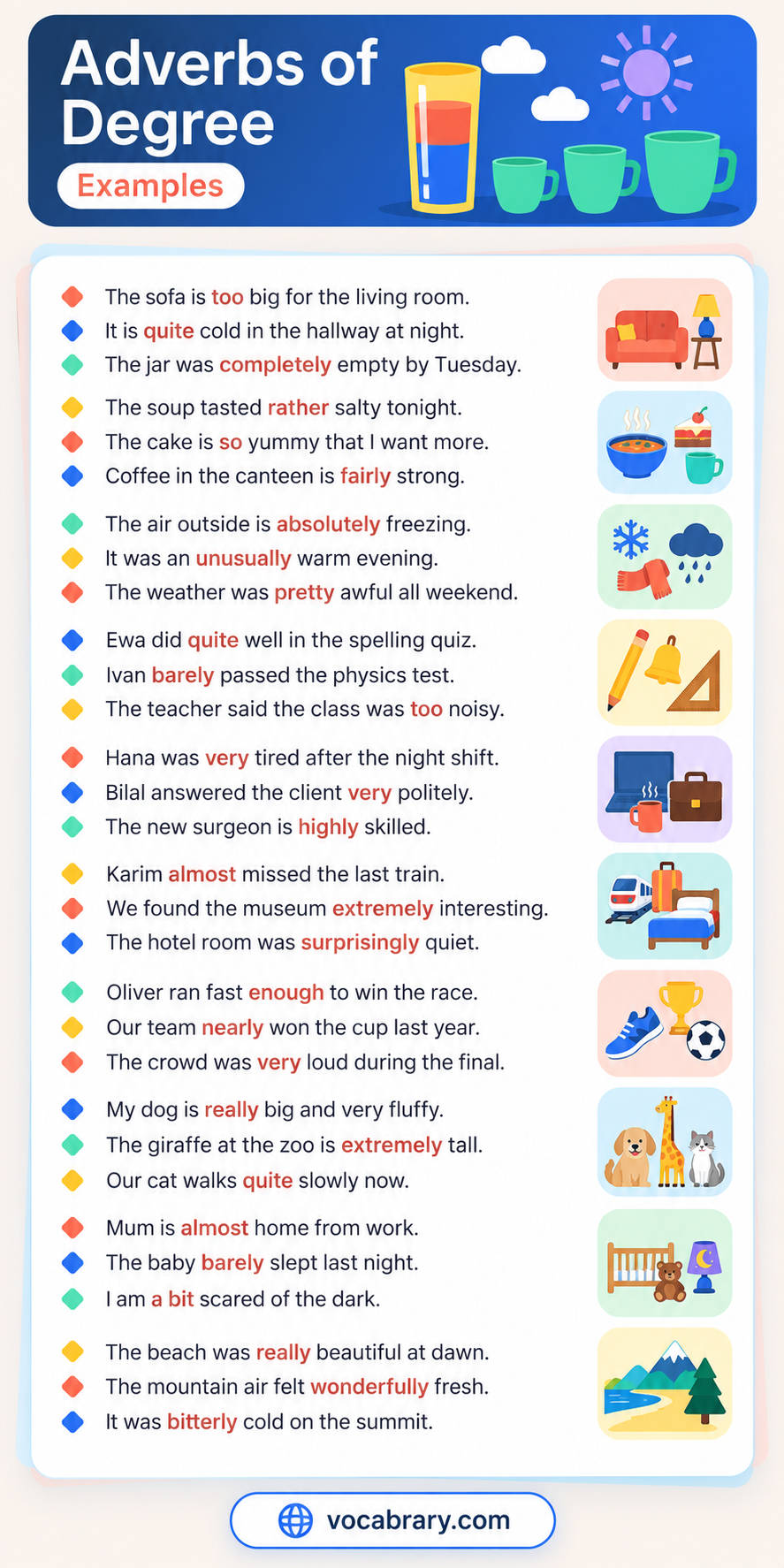
Adverbs of Degree Example Sentences for Everyday Use
Very tired, quite hot, too heavy, and absolutely delicious are the pairings that fill everyday adverbs of degree example sentences. In every case the adverb sets the strength of the word it modifies.
- Hana was very tired after the night shift.
- The soup is quite hot, so wait a minute before you taste it.
- This suitcase is too heavy for me to lift alone.
- The cake at Sofia’s birthday party tasted absolutely delicious.
- Dmitri speaks Russian extremely well for a child of nine.
- My younger brother is almost twelve years old.
- The bus was rather late this morning.
- Fatima is tall enough to reach the top shelf.
- We were completely lost after the second roundabout.
- The lake looked slightly green in the evening light.
- Joao plays the guitar really well.
- The exam was fairly short, so most students finished early.
- I totally forgot about the meeting.
- That film was so boring that half the audience left.
- She barely touched her dinner after the long flight.
- The road was pretty quiet at six o’clock.
- Our neighbour is incredibly generous with her time.
- Amir is a bit nervous about the interview.
- I hardly recognised my old school after the renovation.
- The mountain air felt wonderfully fresh.
Very and Extremely Example Sentences
Very cold water, an extremely patient teacher, and a really loud engine show common high-degree words. Each one raises a gradable adjective or adverb to a high level.
- The water in the lake was very cold, even in July.
- Ms Okafor is an extremely patient teacher.
- The engine made a really loud noise on the hill.
- Tomas finished the marathon very slowly but with a smile.
- It is extremely unlikely that the flight will leave on time.
- My grandmother is very proud of her garden.
- The children were really excited about the trip to the zoo.
- Priya answered extremely carefully because the question was tricky.
- The path up the hill is very steep.
- That café is really popular with students from the university.
- Lucas works very hard in the evenings.
- We found the museum extremely interesting.
- Aisha was terribly sorry about the mistake.
- The final exam was exceptionally difficult this year.
- Thank you very much for the lovely present.
Moderate Degree Sentences With Quite, Rather and Fairly
Quite, rather, fairly, and pretty state a moderate degree, and quite also means completely before an absolute adjective. The four words differ in tone.
| Adverb | Degree | Tone | Example sentence |
|---|---|---|---|
| Quite | Moderate, or complete before an absolute adjective | Neutral, mostly British | The room was quite warm. |
| Rather | Higher than expected | Formal, with a tone of surprise or complaint | The coffee was rather expensive. |
| Fairly | Moderate | Neutral | The first question was fairly short. |
| Pretty | Moderate to strong | Informal | The food here is pretty good. |
Quite in a Sentence
Quite warm, quite a long walk, quite right, and quite impossible show two uses. Before a gradable word quite means fairly, and before an absolute word such as right or impossible it means completely.
- The room was quite warm, so Leila opened a window.
- It was quite a long walk from the station to the hotel.
- You are quite right about the train times.
- The test was quite hard, but most pupils passed.
- I am quite sure that I locked the door.
- Chidi plays quite well for someone who started last year.
- Finding a parking space here is quite impossible on Saturdays.
- She is quite a talented photographer.
- Their new flat is quite small but very bright.
- It was quite dark when we left the cinema.
Rather in a Sentence
Rather expensive, rather cold, and rather a surprise show a degree higher than the speaker expected. Rather stands before adjectives and adverbs, and it also stands before a or an plus a noun.
- The coffee was rather expensive for a small café.
- It is rather cold for April in Madrid.
- Her answer came as rather a surprise to the committee.
- Yusuf drives rather fast on country roads.
- The talk was rather long, and several people left early.
- That is rather a good idea, Ines.
- The soup tasted rather salty tonight.
- Our teacher was rather annoyed about the missing homework.
- They arrived rather late for the concert.
Fairly and Pretty Example Sentences
Fairly quick, fairly large, pretty good, and pretty tired mark a medium degree, with fairly neutral in tone and pretty informal. Both words stand before an adjective or adverb, as in a fairly good idea.
- The first question was fairly quick to answer.
- Jamal learned the song fairly quickly.
- The food at the new restaurant is pretty good.
- Mika felt pretty tired after the long flight.
- We have a fairly large garden behind the house.
- It was a fairly good idea, but nobody had the money.
- The traffic moved pretty slowly near the bridge.
- Her essay is pretty impressive for a first draft.
- Our team played fairly well in the second half.
- The weather was pretty awful all weekend.
Too in a Sentence
Too heavy, too late, too tired to walk, and too hot to drink describe a level beyond what is acceptable or possible. Too stands before the adjective or adverb, and an infinitive with to names the result.
- The box is too heavy for Dina to carry upstairs.
- We arrived too late to see the opening act.
- Grandpa was too tired to walk to the market.
- Don’t speak too quickly, because I want to write every word.
- The tea is too hot to drink.
- You are too young to drive in this country.
- It is too cold for swimming today.
- Samuel ate too quickly at lunch and felt ill.
- The jacket is too small for Luis now.
- She spoke too softly for the back row to hear.
- The film was too frightening for the younger children.
- It is too early to call the doctor.
- Ahmed worked too hard last month and caught a cold.
- This coat is too expensive for my budget.
- The music was too loud for a quiet street.
Enough After Adjectives and Adverbs in Sentences
Tall enough, old enough, loudly enough, and warm enough show enough after the word it measures. Before a noun, enough works as a determiner instead, as in enough money.
- Dalia is tall enough to reach the top shelf without a stool.
- You are old enough to vote in the next election.
- Zoe did not speak loudly enough for the audience to hear.
- Is the water warm enough for a swim?
- The rope is strong enough to hold two climbers.
- Oliver ran fast enough to win the race.
- The room is big enough for twenty guests.
- She is experienced enough to lead the project.
- Our team did not train hard enough this season.
- Mateo wasn’t brave enough to ask the question.
- Is this ladder safe enough for you to climb?
- The stairs are wide enough for two people to pass.
- The bread was sweet enough without any honey.
- Nadia explained the rule slowly enough for everyone to follow.
Very Hot, Too Hot and Hot Enough Sentences
Very hot, too hot, and hot enough describe the same soup in three ways. Very measures a high degree, too adds a problem, and enough states that a needed level is reached.
| Word | Meaning | Position | Example sentence |
|---|---|---|---|
| Very | A high degree, with no result stated | Before the adjective or adverb | The tea is very hot. |
| Too | More than is acceptable or possible | Before the adjective or adverb | The tea is too hot to drink. |
| Enough | The needed level or more | After the adjective or adverb | The tea is hot enough for Grandpa. |
| Not enough | Less than the needed level | After the adjective or adverb | The tea is not hot enough. |
- The soup is very hot, but Rina enjoys it that way.
- The soup is too hot, so Rina must wait before eating.
- The soup is hot enough to warm everyone at the table.
- Marco drives very fast on the motorway.
- Marco drives too fast, and the police stopped him.
- Marco does not drive fast enough to catch the early ferry.
- The exam was very difficult, yet Julia passed.
- The exam was too difficult for the first-year pupils.
- It is very late, but the shop is still open.
- It is too late to book a table for tonight.
- It is not early enough to catch the first train.
Sentences With So and a That Clause
So tired, so quickly, so much, and so funny show so as a word of strong feeling. A that clause after so-plus-adjective states the result, and so is replaced by such before a noun phrase, as in such a day.
- Nina was so tired that she fell asleep on the bus.
- The soup smelled so good that everyone asked for more.
- Why are you walking so quickly?
- I am so sorry for the delay.
- The comedian was so funny that the whole hall laughed for a full minute.
- Thank you so much for your help with the move.
- Rahul spoke so softly that nobody heard him.
- It was so cold last night that the pond froze.
- Don’t worry so much about the exam.
- The mountains looked so beautiful in the morning mist!
- Our dog is so friendly that strangers stop to pet him.
- Elena was so pleased with the gift.
Almost and Nearly Example Sentences
Almost empty, nearly finished, almost every house, and nearly three hours show a degree just short of complete. Almost and nearly are close in meaning, but only almost combines with never and no, as in almost never.
- The tank is almost empty, so we should stop for petrol.
- Julia has nearly finished her thesis.
- Karim almost missed the last train.
- It took nearly three hours to cross the border.
- Almost every house on this street has a blue door.
- My grandmother almost never watches television.
- The twins are nearly the same height now.
- Helen almost dropped the tray when the lights went out.
- Nearly a thousand runners entered the race.
- The village is almost deserted in winter.
- Tom is almost certain that he left his keys on the table.
- We nearly forgot Dad’s birthday until Mum sent a message.
- Dinner is almost ready, so please wash your hands.
Sentences With Barely and Hardly
Barely audible, hardly any, hardly ever, and barely walk show a degree close to zero. Barely, hardly, and scarcely are already negative in meaning, so the sentence takes no additional not.
- The speaker was barely audible at the back of the hall.
- There was hardly any milk left in the fridge.
- Amara hardly ever eats meat, even at family dinners.
- I could barely walk after the marathon.
- We scarcely had time to unpack before the guests arrived.
- Ivan barely passed the physics test.
- She could hardly believe the good news.
- It was so dark that I could hardly see the path.
- The baby barely slept last night.
- Hardly anyone came to the meeting on Friday.
- Chen had barely sat down when the phone rang.
- Our new neighbours hardly speak to anyone.
Completely, Totally and Absolutely in Sentences
Absolutely wonderful, completely empty, completely identical, and utterly exhausted show a full degree. These adverbs pair with ungradable adjectives, which already name an extreme or an absolute state, and with verbs such as agree and forget.
- The view from the tower was absolutely wonderful.
- The stadium was completely empty by midnight.
- The two copies of the letter are completely identical.
- After the climb, Olivia felt utterly exhausted.
- I completely agree with your argument.
- The result is absolutely essential for the final report.
- Ravi totally forgot his sister’s birthday.
- The town was entirely destroyed by the flood.
- It is absolutely impossible to finish this by Friday.
- Maria was completely certain about the answer.
- That restaurant is absolutely freezing in winter.
- The audience was utterly silent during the final scene.
- I absolutely love this song, so please play it again.
- Mr Park was completely wrong about the date.
- The two reports are entirely separate.
- The cave was totally dark once the guide switched off his torch.
Low Degree Sentences With Slightly and a Bit
Slightly cold, a bit nervous, a little late, and slightly more expensive describe a low degree. Slightly is neutral, while a bit and a little are informal and mild.
- The tea is slightly cold, but I will drink it.
- Rosa felt a bit nervous before the audition.
- We are running a little late for dinner.
- This jacket is slightly more expensive than the red one.
- Could you speak a bit louder, please?
- The floor looks slightly crooked near the door.
- My brother is a bit taller than me now.
- Yuki was slightly annoyed by the delay.
- The soup needs a bit more salt.
- The train was slightly early for once.
- I am a little tired after the long drive.
- The photograph is slightly blurry on the left side.
Examples of Adverbs of Degree From Slightly to Completely
Fairly strong coffee, very strong tea, an almost full jar, and a completely empty jar show how the adverb sets the level on a scale of degree. The level ranges from weak through moderate and strong to complete.
| Level | Adverbs | Example sentence |
|---|---|---|
| Weak | Slightly, a bit, a little, barely, hardly | The pool was slightly cold. |
| Moderate | Fairly, quite, pretty, rather | The coffee is fairly strong. |
| Strong | Very, extremely, really, incredibly | The espresso is extremely strong. |
| Near complete | Almost, nearly | The jar is almost full. |
| Complete | Completely, totally, absolutely, utterly | The jar is completely full. |
| Excess | Too | The espresso was too strong for Ana. |
- The pool was slightly cold on the first morning of the course.
- Coffee in the canteen is fairly strong.
- Grandpa’s tea is very strong, and he drinks it black.
- The espresso at that café is extremely strong.
- The espresso at the station was too strong for Ana.
- The queue was barely moving at noon.
- Our seats were almost empty during the matinee.
- The jar was completely empty by Tuesday.
Highly, Deeply and Fully in Sentences
Highly recommended, deeply moved, fully aware, and bitterly cold are fixed pairings of an -ly adverb with one adjective. Many -ly degree adverbs go with only a few adjectives, so each pair is learned as a unit.
- The hotel is highly recommended by travellers.
- Mei was deeply moved by the letter.
- The managers are fully aware of the problem.
- It was bitterly cold on the summit.
- The queue at the post office moved painfully slowly.
- The beach is perfectly safe for young swimmers.
- The car came dangerously close to the wall.
- Seb was fiercely proud of his village.
- The answer to the riddle was blindingly obvious.
- We were hugely relieved when the rain stopped.
- Anna was desperately tired after the double shift.
- The new printer is seriously slow.
Examples of Adverbs of Degree With Gradable and Ungradable Adjectives
Very interesting and extremely talented pair with gradable adjectives, while absolutely delicious and completely impossible pair with ungradable ones. A gradable adjective has a scale, so good, better, and best exist, and an ungradable adjective names a limit.
| Type of adjective | Meaning | Adverbs that fit | Example sentence |
|---|---|---|---|
| Gradable | Has a scale of more and less | Very, extremely, quite, rather, fairly, slightly | The lecture was very interesting. |
| Ungradable | Names a limit or a category | Absolutely, completely, totally, entirely | The task was completely impossible. |
| Extreme | Names a very high degree | Absolutely, utterly, really | The weather was absolutely freezing. |
Very and Extremely With Gradable Adjectives
Very good, very old, extremely talented, and extremely difficult describe qualities that exist in more and less. Each adjective has a comparative form, which marks it as gradable.
- The lecture on volcanoes was very interesting.
- Giulia is extremely talented at drawing and painting.
- It was a very good idea to book early.
- The river is very wide near the harbour.
- Today’s homework in chemistry is extremely difficult.
- Their house on the hill is very old.
- My uncle from Nairobi is very tall.
- This puzzle is extremely hard for beginners.
- The garden looks very green after the rain.
Absolutely and Completely With Ungradable Adjectives
Absolutely delicious, completely impossible, totally free, and perfectly round name limits that have no more and less. These adjectives take absolutely, completely, totally, or perfectly as the degree adverb, as in absolutely delicious and completely impossible.
- The meal at the harbour café was absolutely delicious.
- It is completely impossible to park here.
- Their answer to the final question was completely incorrect.
- The performance by the youth orchestra was absolutely brilliant.
- The room was utterly silent when the results were read.
- The air outside is absolutely freezing.
- Entry to the gallery is totally free on Sundays.
- The diamond in the museum is absolutely enormous.
- A circle drawn with a compass is perfectly round.
Really and Quite With Both Adjective Types
Really good, really terrible, and quite possible show two adverbs that fit gradable and ungradable adjectives alike. Really adds emphasis in both cases, and quite shifts meaning with the type.
- The ending of the novel was really good.
- The ending of the film was really terrible.
- It is quite possible that the bus is late.
- The beach was really beautiful at dawn.
- The lunch at Grandma’s was really delicious.
- Sasha looked really exhausted after the trip.
Examples of Adverbs of Degree Modifying Adjectives, Adverbs and Verbs
Very tall, quite slowly, and completely forgot show a degree adverb changing an adjective, another adverb, and a verb in turn. Which adverbs of degree fit depends on the type of word modified.
Degree Adverbs Before Adjectives
Very tall, deeply sorry, and highly skilled are adjectives whose strength is set by a degree adverb placed directly in front.
- A very tall man waited at the gate.
- Mariam looked deeply sorry for the mistake.
- The new surgeon is highly skilled.
- We stayed in an extremely comfortable hotel.
- That was a remarkably quick answer.
- The students seemed greatly interested in the experiment.
- It was an unusually warm evening.
- The streets are especially crowded on market day.
- Diego gave a surprisingly honest reply.
- She is thoroughly prepared for the interview.
Degree Adverbs Before Other Adverbs
Quite slowly, very well, too early, and extremely carefully show one adverb changing the strength of another. The second adverb keeps its own meaning of manner, time, or place.
- Takumi types quite slowly, but he makes few errors.
- Maya sings very well for her age.
- You arrived too early for the ceremony.
- The surgeon worked extremely carefully through the long operation.
- The team played remarkably well after the interval.
- She answered the teacher’s question fairly quickly.
- The shop closes rather early on Sundays.
- The old kettle boiled surprisingly fast this morning.
- Dad drives really slowly in the rain.
- The children listened unusually quietly to the story.
- Walk a bit more slowly on the ice.
- The bus came almost immediately after we reached the stop.
Degree Adverbs Before Verbs
Completely forgot, greatly admires, nearly won, and really enjoyed show a degree adverb changing a verb. Only some degree adverbs fit here, because very and too never modify a verb directly.
- I completely forgot my password again this morning.
- Everyone in the village greatly admires her courage.
- Our team nearly won the cup last year.
- We really enjoyed the concert in the park.
- The news deeply shocked the whole village.
- Oscar strongly disagrees with the new plan.
- The storm badly damaged the roof.
- My sister totally understands why you were upset.
- I absolutely refuse to apologise for telling the truth.
- Yasmin hardly noticed the noise from the street.
- We fully support the headteacher’s decision.
- He almost cried when the song ended.
Adverbs of Degree in Different Sentence Positions
Very quiet, I really like, and like it very much show three places for adverbs of degree: before an adjective, before the main verb, and after the verb or its object. Enough is the exception, because it follows the word it measures.
Very Quiet and Quite Slowly Before the Adjective or Adverb
Very quiet and quite slowly show the first position, where the degree adverb stands directly before the word it changes.
- The library is very quiet in the morning.
- Our cat walks quite slowly now.
- Her voice was unusually soft during the speech.
- This bag is much too small for a week’s clothes.
- The sauce tastes slightly sweet because of the carrots.
- They live fairly close to the sea.
- The shop is pretty far from here.
- You are far too polite to complain about the service.
Really and Almost Before the Main Verb
I really like and Layla has almost finished show the middle position, which is before the main verb and after the first auxiliary verb.
- I really like your new haircut.
- Layla has almost finished the painting.
- The pupils strongly oppose the new timetable.
- Sven has totally changed since he moved to Oslo.
- The committee will fully investigate the complaint.
- I half expected the rain to stop.
- They had nearly reached the summit when the fog came in.
- She barely noticed the cold while she was running.
- My parents entirely agree with you.
Very Much and a Lot After the Verb or Object
Like your haircut very much, helped us a lot, and does not mind the noise at all show degree phrases that stand after the verb or after its object. Very much does not stand between a verb and a short object such as it.
- I like your new haircut very much.
- The neighbours helped us a lot during the move.
- Zara does not mind the noise at all.
- Thank you very much for the kind invitation.
- My grandfather loves the sea enormously.
- The ending of the book disappointed me greatly.
- I don’t enjoy horror films much.
- Ibrahim misses his old school terribly.
- Her harsh words hurt him deeply for many years.
- It rained a lot during our week in Wales.
- The children enjoyed the picnic immensely.
- Mum worries too much about the weather.
Using Adverbs of Degree Before Comparatives
Much harder, far shorter, slightly older, and even better show a degree adverb before a comparative adjective or adverb. Much, far, and a lot show a large difference, while slightly and a bit show a small one, and very is not used before a comparative adjective.
- Today’s test was much harder than yesterday’s.
- This route is far shorter than the main road.
- My brother is slightly older than I am.
- The second album is even better than the first.
- Gabriel runs a lot faster since he joined the club.
- The new phone is a bit lighter than the old one.
- Winters in Norway are far colder than winters in Spain.
- Her English is a great deal better than it was last year.
- Pablo arrived a little earlier than the others.
- The tomatoes taste much sweeter in August.
- The hotel is considerably cheaper in October.
Negative Sentences With Not Very, Not Quite and Not Enough
Negative adverbs of degree example sentences use not very, not quite, not enough, and not at all to weaken or deny a degree. Not very means a low degree, not quite means just short of complete, and not nearly means far less.
- The soup was not very hot, so Ilse added a pinch of chilli.
- Our flat is not big enough for a sofa and a piano.
- I have not quite finished the report.
- The tea wasn’t too hot to drink.
- He is not nearly as tall as his brother.
- She didn’t like the music at all.
- Sophie wasn’t very pleased with her result.
- The ground is not dry enough for football.
- I haven’t slept much since the baby was born.
- It isn’t that cold today, so leave your scarf at home.
- The bus isn’t completely full, so we can sit together.
- I don’t speak French very well.
- The museum was not particularly crowded.
- Their answer wasn’t entirely wrong, but it was incomplete.
Question Sentences With How Cold and How Much
How cold, how much, hot enough, and too tired are the degree words in direct questions. How asks about the degree itself, and the other adverbs keep their usual place before or after the adjective.
- How cold was the water in the lake?
- Is the soup hot enough for you?
- How much do you like the new teacher?
- Are you too tired to join us?
- Was the film really that bad?
- Did the tickets cost very much?
- Is this suitcase light enough to carry onto the plane?
- Do you really want to leave so early?
- How badly was the car damaged?
- Is she quite sure about the date?
- Why was the room so cold?
- Were the roads very icy this morning?
- How well does Tomas speak Italian?
Reported Speech and Passive Sentences With Extremely and Badly
Extremely difficult, almost ready, completely shattered, and badly damaged show degree adverbs inside reported speech and passive sentences. The adverb stays in the same position with the same meaning in both.
- Anita said that the exam had been extremely difficult.
- The guide told us that the cave was absolutely enormous.
- Tariq explained that he was a bit worried about the interview.
- The teacher said the class was too noisy.
- Mum told us the soup was almost ready.
- The window was completely shattered by the storm.
- The village was badly damaged by the flood.
- The report was thoroughly checked before publication.
- The bridge was partly rebuilt last year.
- All parents were fully informed about the trip.
Everyday Adverbs of Degree Sentences by Setting
Washing machines, spelling quizzes, office meetings, and long flights are the daily settings where adverbs of degree grade size, speed, and comfort.
Sentences About Home Life With Extremely and Absolutely
A noisy washing machine, a cold hallway, a leaking pipe, and an empty fridge are the household cases in this group. Each one takes a degree adverb to show how noisy, cold, or empty it is.
- The kitchen smells absolutely wonderful on Sunday mornings.
- Our washing machine is extremely noisy during the spin cycle.
- Dad was a bit worried about the leaking pipe.
- The sofa is too big for the living room.
- It is quite cold in the hallway at night.
- The fridge is completely empty on Thursdays.
Extremely and Fairly in School Sentences
A spelling quiz, a science project, a silent library, and a warm classroom are the school cases in this group. Each one uses a degree adverb to rate difficulty, progress, or comfort.
- The maths test was fairly short, but the last question was extremely hard.
- Miss Alvarez spoke very slowly so the new pupils could follow.
- The library is almost silent during exams.
- Our science project was completely finished by Thursday.
- Ewa did quite well in the spelling quiz.
- The classroom was far too warm to concentrate.
Work Sentences With Extremely and Rather
A long meeting, a busy manager, a useless printer, and a close deadline are the office cases in this group. Each one uses a degree adverb to rate time, effort, or workload.
- The meeting was rather long, and nobody had eaten lunch.
- Our manager is extremely busy until the end of the month.
- The printer in the office is totally useless today.
- Bilal answered the client very politely.
- The report is nearly ready for the director.
- Our deadline is too close for another round of changes at this stage.
Travel Sentences Using Pretty and Nearly
A crowded train, a late flight, a narrow road through the mountains, and a quiet hotel room are the travel cases in this group. Each one uses a degree adverb to rate a delay, a crowd, or a distance.
- The train was pretty crowded on Friday evening.
- Our flight to Lisbon was nearly two hours late.
- The hotel room was surprisingly quiet.
- The road through the mountains is extremely narrow.
- The museum is close enough to reach on foot.
- Lena was a little nervous before her first long flight.
Sentences by Wider Setting From News to Health
A close election, a deserted castle, a wet pitch, and a quick recovery are wider settings where adverbs of degree grade events and feelings.
Sentences About the News With Unusually and Deeply
A severe storm, a close election, a nearly finished bridge, and an unprepared town are typical news cases. Each one uses a degree adverb to grade size, speed, or concern.
- The storm was unusually severe for early September.
- The minister was deeply concerned about the flooding.
- The election result was extremely close.
- The new bridge is almost complete.
- Residents were totally unprepared for the power cut.
- Food prices rose considerably last year.
Terribly and Barely in Fiction Sentences
A silent house, a whispered voice, a certain detective, and a deserted castle are common story cases. Each one uses a degree adverb to set a mood before the action begins.
- The old house was terribly quiet after midnight.
- Her voice was barely a whisper.
- The detective was absolutely certain that the butler lied.
- The forest grew increasingly dark as the hikers climbed higher.
- Mira felt deeply afraid, but she kept walking.
- The castle on the cliff looked utterly deserted.
Sports Sentences With Extremely and Pretty
A fast striker, a loud final, an exhausted runner, and a wet pitch are the sports cases in this group. Each one uses a degree adverb to rate speed, noise, or effort.
- The striker was extremely fast on the left wing.
- The visitors played pretty well after the break.
- The match was almost over when Karim scored.
- The marathon runner was completely exhausted at the finish line.
- The crowd was very loud during the final.
- The pitch was far too wet for a fair game.
Sentences About Health With Slightly and Extremely
A dizzy patient, a gentle nurse, a mild cough, and a recovered grandfather are the health cases in this group. Each one uses a degree adverb to grade a symptom or a recovery.
- The patient felt slightly dizzy after the injection.
- The nurse was extremely gentle with the child.
- My grandfather is fully recovered from the operation.
- The cough was fairly mild, and it passed in two days.
- Doctors were quite surprised by the quick recovery.
- He was seriously ill last winter.
Degree and Manner Adverbs in One Sentence
In very quietly, the word very reports strength and quietly reports the way an action is done. Degree and manner adverbs appear together in one clause when a sentence needs both a strength and a way of acting.
| Feature | Adverb of degree | Adverb of manner |
|---|---|---|
| Question answered | To what extent? | How? |
| Words it modifies | Adjectives, adverbs, and verbs | Mostly verbs |
| Typical position | Before the word it changes | After the verb or its object |
| Example sentence | The tea is extremely hot. | Kofi drank the tea slowly. |
- Ravi answered politely, but he was rather nervous.
- The pianist played gracefully and unusually fast.
- Sana spoke quietly to the baby, who was almost asleep.
- The chef worked carefully, and the sauce was absolutely perfect.
- Omar ran quickly down the hill, but he was slightly late.
- The children sang happily, and the hall was completely full.
- Marta wrote neatly, so her notes were very easy to read.
- The old man walked slowly, and his dog looked quite tired.
Adverbs of Degree Sentences for Kids
Cold ice cream, a big dog, a heavy bag, and a tall giraffe are the everyday sights in adverbs of degree example sentences for kids. In each case a young learner says how much with one small word.
- The ice cream is very cold today.
- My dog is really big and very fluffy.
- Tom ran too fast and fell over.
- The cake is so yummy that I want more.
- I am a bit scared of the dark.
- The bag is too heavy for me.
- This game is really fun to play.
- Mum is almost home from work.
- The sun is very hot at noon.
- The giraffe at the zoo is extremely tall.
Short Adverbs of Degree Sentences for Young Learners
Short lines about a full cup, a sleepy puppy, and a steep hill let beginners repeat one pattern: subject, a form of be, degree word, adjective.
- The cup is almost full now.
- My puppy is very sleepy today.
- That hill is really steep, Dad.
- The tea is too hot for me.
- Our class is quite noisy today.
- This soup is so tasty, Gran.
- The box is a bit heavy.
- My shoes are completely wet after the walk.
Academic Adverbs of Degree Sentences for Students
Adverbs of degree example sentences for exams about a policy, a result, or an experiment need longer sentences with far more, hardly, sufficiently, and not nearly. Essays and reports use such phrases.
- The proposal was far more ambitious than the committee had expected.
- Hardly had the lecture begun when the projector failed.
- The essay is sufficiently detailed to earn a high mark.
- Her argument is by no means convincing.
- The results were considerably better than last year’s.
- The experiment was extremely carefully controlled by the research team.
- It was hardly surprising that the plan failed.
- The author is scarcely known outside her home country.
- The policy was partly successful, largely thanks to local support.
- The data are highly reliable, so the conclusion is virtually certain.
- He was too tired to argue with the referee.
- The sample was not nearly large enough to support the claim.
Using Adverbs of Degree in Short Paragraphs
Four connected passages about a driving test, a storm, a market, and a school trip use very, quite, almost, and completely, so learners read degree adverbs inside continuous writing.
Nadia woke up extremely early on the day of her driving test. She was a bit nervous, but the roads were quite empty, and she drove very carefully. The examiner was fairly strict, though he smiled at the end. Nadia was absolutely delighted when she passed.
The storm arrived almost without warning. Rain fell extremely hard, and the streets were completely flooded within an hour. The bus was too slow to reach the village, so the passengers walked home. By evening the wind had dropped, and the sky looked rather calm.
The market was unusually busy on Saturday. Mr Costa sold nearly all his tomatoes before ten o’clock, and his customers were very cheerful. The sun was pretty hot by noon, so he closed the stall slightly early. His daughter was so tired that she slept in the van.
Our school trip began rather badly, because the coach was almost an hour late. The museum was extremely crowded, and the guide spoke too quietly for the back row. After lunch the weather was quite warm, so we sat outside. Everyone was completely exhausted on the journey home.
FAQs
Q1. What are some common adverbs of degree?
Common adverbs of degree are very, extremely, quite, rather, fairly, pretty, too, enough, so, almost, nearly, barely, hardly, completely, totally, absolutely, slightly, and a bit. Each one states how strong or how complete a quality or action is, and adverbs of degree example sentences use every one of them. The full range of adverb types is covered in the adverb sentences hub.
Q2. What is the difference between an adverb of degree and an adverb of manner?
An adverb of degree states the strength of a quality or action, while an adverb of manner states the way an action is done. In Kofi drank the tea slowly, the word slowly shows manner, and in the tea was extremely hot, the word extremely shows degree. The adverbs of manner sentences page covers the second type in full.
Q3. Where do adverbs of degree go in a sentence?
Adverbs of degree stand before the adjective or adverb they modify, as in very tall and quite slowly. Before a main verb they stand after any auxiliary verb, as in she has almost finished. Enough is the exception, because it follows the adjective or adverb, as in tall enough.
Q4. What is the difference between too, very, and enough?
Very states a high degree, too states a degree beyond what is acceptable, and enough states that a needed level is reached. The sentence the tea is very hot gives no result, the tea is too hot to drink names a problem, and the tea is hot enough confirms a standard. Very and too stand before the adjective, while enough stands after it.
Q5. Does very modify a verb?
Very does not modify a verb directly. The usual form places very much after the verb and its object instead, as in I like it very much. A few verbs take very much before them, as in I very much enjoyed the film, but this pattern is formal.
Q6. What are gradable and ungradable adjectives?
A gradable adjective has a scale of more and less, so good, better, and best all exist. An ungradable adjective names a limit or a category, as with perfect, impossible, and freezing. Gradable adjectives take very and extremely, and ungradable adjectives take absolutely, completely, and totally.
Q7. What is the difference between quite and fairly?
Quite and fairly both state a medium degree, but quite has a second meaning that fairly lacks. Before an absolute adjective such as right or impossible, quite means completely. Fairly stays moderate and fits only gradable adjectives and adverbs.
Q8. Does enough go before or after the adjective?
Enough goes after an adjective or an adverb, as in old enough and loudly enough. Before a noun it works as a determiner, as in enough money. Enough keeps this position after the word it describes, as in tall enough and clearly enough.
Q9. What is the difference between almost and nearly?
Almost and nearly both mean not quite, and in most sentences either word fits. Almost combines with never and no, as in almost never, but nearly does not, and not nearly is the standard way to say far less. A sentence such as I nearly missed the bus means the same as I almost missed the bus.
Q10. Do hardly and barely take not?
Hardly and barely are not used with an extra not, because both words already have a negative meaning. The correct form is I hardly know him, and I don’t hardly know him is a double negative. Scarcely follows the same pattern.
Q11. What are adverbs of degree for kids?
Adverbs of degree example sentences for kids use small words such as very, too, so, and really that say how much. Short lines like the soup is very hot and the bag is too heavy teach the pattern. Many of them follow one order: subject, a form of be, degree word, adjective.
Q12. How do you identify an adverb of degree in a sentence?
You identify an adverb of degree by asking to what extent the word or action is true. In Hana was very tired, the answer to the question is very, so very is the adverb of degree. A second test is to drop the adverb: the sentence stays grammatical, but the strength of the adjective disappears.

Leave a Comment