
An adverb of frequency is an adverb that states how regularly an action recurs rather than when it is done, as in she always locks the door. That difference decides the word order: always precedes a main verb in she always locks but follows the verb be in she is always early. From always to never, adverbs of frequency example sentences meet both patterns, so each adverb stands ahead of an ordinary verb and behind be.
What Is an Adverb of Frequency?
An adverb of frequency states how many times an action is repeated or how regular a state is, either in a vague way, as with sometimes, or in a fixed way, as with twice a week. An adverb of time states when an action is done, so tomorrow and now are adverbs of time, while always and rarely are adverbs of frequency.
Subject + adverb of frequency + main verb, or subject + be + adverb of frequency
Our neighbour rarely parks on the street, but he is always polite.
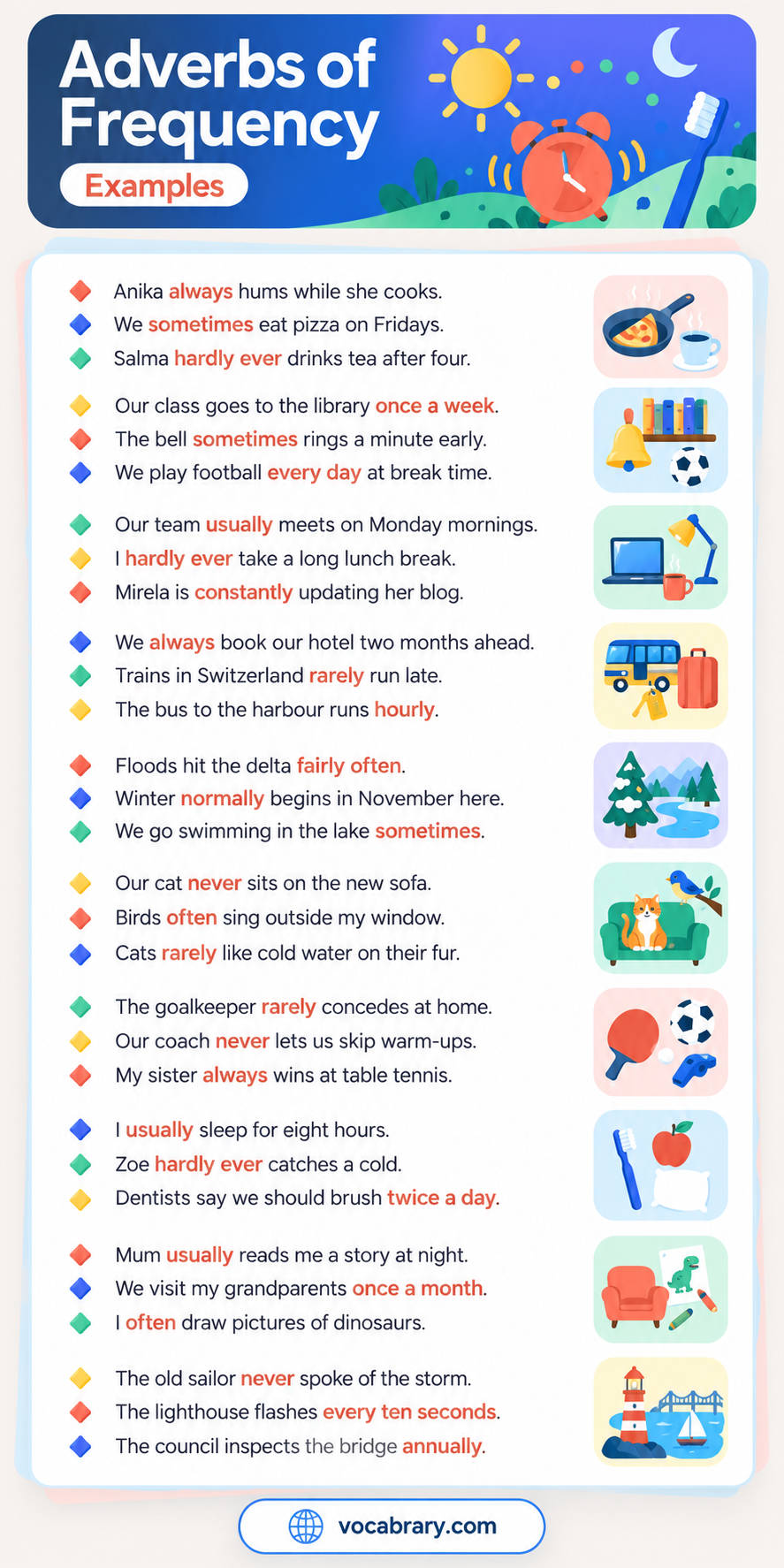
Adverbs of Frequency Example Sentences for Everyday Use
Always, usually, often, sometimes, rarely, and never are the adverbs of frequency that learners study first. Each one states how regularly an action is repeated, from every time to no time.
- Mei always brings a flask of green tea to the office.
- My brother usually walks to school with his cousins.
- We often eat dinner on the balcony in summer.
- Carlos sometimes forgets his umbrella, even in October.
- Grandpa rarely watches television before nine at night.
- The baker never opens the shop on Mondays.
- Our train normally leaves from platform four.
- Aisha frequently calls her sister in Nairobi on Sunday evenings.
- It seldom snows in Lisbon, so the children cheered at the first flakes.
- The neighbours occasionally borrow our ladder.
- Tomasz hardly ever drinks coffee after lunch.
- I always check the weather before a long bike ride.
- The bus is usually crowded at eight in the morning.
- Priya often reads on the train, and she finishes a novel every week.
- Lena sometimes sings in the shower, and her flatmates pretend not to hear.
- The river rarely floods in this part of the valley.
- Our teacher constantly reminds us to hand in homework on time.
- You are always welcome at our table.
- Hiro generally arrives ten minutes before the meeting starts.
- My aunt never forgets a birthday, not even the distant cousins.
Common Adverbs of Frequency on a Percentage Scale
Always at 100 percent, usually at about 90, sometimes at about 50, and never at 0 form a scale that ranks adverbs of frequency by strength. The percentages are rough guides, because speakers use these words loosely.
| Adverb | Approximate frequency | Example sentence |
|---|---|---|
| Always | 100 percent | The sun always rises in the east. |
| Almost always | 95 percent | Ines almost always wins at chess. |
| Usually | 90 percent | We usually eat at seven. |
| Normally, generally | 80 percent | Shops normally close at six in this town. |
| Often, frequently | 70 percent | Kofi often jogs before sunrise. |
| Sometimes | 50 percent | Zara sometimes takes the late ferry. |
| Occasionally | 30 percent | I occasionally treat myself to ice cream. |
| Seldom, rarely | 10 percent | My uncle rarely travels by plane. |
| Hardly ever | 5 percent | Olga hardly ever misses a class. |
| Never | 0 percent | Our dog never barks at the postman. |
- The first bus always runs on time, but the last bus is rarely punctual.
- Sana usually cooks at home and occasionally orders a takeaway.
- Winters here are often wet and seldom freezing.
- Our manager never shouts, and she always thanks the team after a hard week.
- In July, Seville is always hot and never cold.
- The café is normally full on Saturdays and hardly ever empty before noon.
- Jamal sometimes plays chess, but he never plays for money.
- A good pilot always double-checks the fuel and rarely relies on memory.
- I frequently miss the 7:15 bus, and I occasionally miss the 7:30 as well.
- The garden is usually quiet, yet it is sometimes full of children on Sundays.
Always and Constantly Example Sentences
Always marks every occasion, and constantly marks a repeated action with almost no gaps, as with a dripping tap or a barking dog. Both words belong at the top of the scale.
- The sun always sets in the west, whatever the season.
- Chloe always wears a red scarf on match days.
- My grandmother is always the first guest to arrive.
- Our dog constantly chases the shadows on the kitchen floor.
- Wei has always wanted to visit the glaciers of Iceland.
- The tap in the bathroom is constantly dripping, and the noise keeps me awake.
- Ibrahim always locks the shop before he walks to the mosque.
- Children constantly ask questions at that age.
- You should always read a contract before you sign it.
- His phone constantly buzzes with messages from the football group.
- Anika always hums while she cooks.
- Rain always makes the old road muddy.
- The committee constantly revises the timetable, and nobody knows the current version.
- We always say goodbye at the station gate.
Usually, Normally and Generally in Sentences
A teacher who usually arrives at eight, a bakery that normally opens at nine, and a road that generally floods in spring show habits with a few exceptions. These three adverbs describe routines that apply on most days.
- Our teacher usually arrives at eight, an hour before the first lesson.
- The bakery normally opens at nine, but it opens at seven on Saturdays.
- This road generally floods in spring when the snow melts.
- I usually take the stairs because the lift is slow.
- Farah normally drinks tea with milk and two sugars.
- Flights from Dubai are generally on time in winter.
- Tourists usually visit the old fort in the morning.
- We normally celebrate Eid with a big lunch at my aunt’s house.
- Ravi generally does his homework at the library.
- It is normally warm in Cairo by the end of April.
- My neighbour usually waters the plants after sunset.
- Banks in this town generally close at four in the afternoon.
- The children usually fall asleep before the end of the film.
- Jun normally cycles to the lab, but today she took a taxi.
Sentences With Often and Frequently
Often and frequently describe actions that repeat many times, such as weekly visits to a grandmother or storms every afternoon in a tropical city. The two words mean the same, though frequently is more formal.
- Dalia often jogs along the beach before the sun comes up.
- Storms frequently hit the coast of Vietnam in September.
- I visit my grandmother quite often, with a bag of oranges.
- Dr Mensah frequently publishes articles about malaria.
- The printer often jams when the paper is damp.
- Teenagers frequently change their favourite songs.
- Sofia often forgets where she parked the car.
- Trains between Osaka and Kyoto run frequently all day.
- My cousins often sleep over at our flat on Fridays.
- The museum is often crowded with school groups.
- Heavy snow frequently closes the mountain pass in January.
- We often walk home through the park when the weather is dry.
- Customers frequently ask for a discount at the market stalls.
- She is often the last person to leave the lab.
Sometimes and Occasionally Example Sentences
A colleague who sometimes works from home and a cousin who occasionally visits from Lagos show actions that repeat without a fixed pattern. On the percentage scale, sometimes stands higher than occasionally.
- Layla sometimes works from home on Wednesdays.
- My cousin occasionally visits us from Lagos.
- Sometimes the ferry is cancelled because of strong winds.
- We occasionally see deer behind the school fence.
- The old clock sometimes stops for an hour and then starts again.
- Occasionally, the village holds a market on the riverbank.
- Mateo sometimes walks to work and sometimes takes the tram.
- Heavy fog occasionally delays flights at the small airport.
- Sometimes my grandfather tells stories about his years at sea.
- She occasionally buys flowers for the front desk.
- It sometimes rains in the Sahara, but only for a few minutes.
- The team occasionally loses at home, though never to weaker sides.
- I sometimes wonder why the cat sleeps in the sink.
- Occasionally a rare bird lands on the roof of the observatory.
Sentences With Hardly Ever, Rarely and Seldom
Snow that rarely falls in Barcelona, a shy student who seldom speaks in class, and a clerk who hardly ever takes a day off show actions that almost never repeat. All three are negative in meaning, so a sentence with them takes no additional not.
- Snow rarely falls in Barcelona, so the children remember each flurry.
- Ngozi seldom speaks in class unless the teacher asks her a question.
- The clerk hardly ever takes a day off.
- We rarely eat meat at home.
- My grandfather seldom leaves the village these days.
- Ali hardly ever checks his messages during dinner.
- It rarely gets above ten degrees at the summit.
- The lake seldom freezes before the end of December.
- She rarely complains, even when the work is hard.
- Tourists seldom find this beach without a local guide.
- I hardly ever see my old classmates now that we live in different cities.
- Mistakes rarely go unnoticed in a printing shop.
- Petra seldom wears jewellery because she works with clay.
- The old well hardly ever runs dry, even in August.
Never in a Sentence
Never means at no time, and it stands at zero on the scale. A librarian who never raises her voice and a city where it never snows show a positive verb form giving a negative meaning without not.
- A good librarian never raises her voice.
- It never snows in Singapore, even in the coldest month.
- Diego has never been late for a flight.
- I never skip breakfast before an exam.
- Our cat never sits on the new sofa.
- Mina never tells anyone her password.
- The shop never closes during the festival week.
- You must never touch the wires near the machine.
- Hassan never eats peanuts because he is allergic.
- Divers never skip the safety check.
- She was never afraid of the dark as a child.
- My brother is never home before midnight on Fridays.
- Lucas never answers calls from unknown numbers.
- We will never forget the kindness of our hosts in Oaxaca.
Fixed Frequency Sentences With Once a Week and Every Day
Once a week, every day, and twice a month state an exact number of repetitions, unlike sometimes or rarely, and daily, weekly, and annually express the same meaning in a single word. These expressions stand at the end of a clause or, for emphasis, at the start.
- Hana swims twice a week at the community pool.
- The bins are collected every Thursday morning.
- We visit my grandparents once a month.
- Aziz takes the medicine three times a day.
- The school magazine is published weekly by the older students.
- Every day, the baker delivers fresh bread to the school canteen.
- Our company holds a staff meeting every other Monday.
- The festival returns once a year in late March.
- Sunita calls her parents in Pune every evening.
- The lighthouse flashes every ten seconds.
- Students sit a short quiz twice a month.
- The bus to the harbour runs hourly.
- My uncle changes the oil in his car every six months.
- The council inspects the bridge annually.
- Once a week, the neighbours meet to clean the courtyard.
- Marta practises the violin daily, even on holidays.
- The pharmacy restocks its shelves every second day.
- Rafael trains four times a week before the marathon.
- She mows the lawn once every two weeks.
Frequency Adverbs in Different Sentence Positions
Adverbs of frequency go before the main verb, after the verb be, and between an auxiliary and a main verb. A few of them also open or close a sentence.
Always and Rarely Before the Main Verb
The adverb goes before an ordinary verb in the present simple and the past simple, as in she always walks and they rarely complain. This position is standard for always, never, usually, and often.
- My sister always wins at table tennis.
- They rarely complain about the heat.
- The market usually opens before sunrise.
- Joaquin often reads under the covers with a torch.
- Fatima never drinks fizzy drinks at lunch.
- We sometimes hear owls from the kitchen window.
- The guide frequently pauses to point out birds.
- Lucy occasionally teaches the younger children to swim.
- The orchestra normally rehearses on Thursday evenings.
- You hardly ever see foxes in this part of town.
- Pedro seldom drives to work because of the traffic.
- The shopkeeper generally gives a free sweet to children.
- Wang Fei always double-checks the addresses before posting a parcel.
Always and Never After the Verb Be
After am, is, are, was, and were, the adverb comes after the verb, as in he is never late and they were always kind. The verb be is the exception to the before-the-verb pattern.
- He is never late for rehearsal.
- The soup is always hot when it reaches the table.
- They were always kind to the new students.
- I am usually awake before the alarm rings.
- The lake is rarely calm in the afternoon.
- Rosa is often the first to answer the teacher’s questions.
- You are sometimes too modest about your work.
- The streets were seldom quiet during the festival.
- My phone is hardly ever fully charged.
- The mountain is frequently hidden by cloud.
- Our manager is normally in the office by seven.
- We are occasionally short of volunteers on Saturdays.
- Mr Chen was never rude, even when customers shouted at him.
- The river is generally shallow near the old bridge.
Adverbs Between the Auxiliary and the Main Verb
With have, will, can, must, and other auxiliary verbs, the adverb comes after the auxiliary, as in I have never tried sushi and she will always remember.
- I have never tried sushi, but I would like to.
- She will always remember the day the river froze.
- Anna has often walked to the harbour before work.
- You should never leave a candle burning overnight.
- They are usually playing football at this hour.
- Ahmed would sometimes cycle forty kilometres on a Sunday.
- We must always check the labels before we cook.
- The shop has rarely been this busy in January.
- My parents have frequently visited Istanbul since 2015.
- You can always call me if the bus is late.
- The kids had never seen the sea until that trip.
- Dara will seldom miss a chance to dance.
- Tourists have occasionally lost their way in the old town.
- He has hardly ever missed a day of school.
- Mirela is constantly updating her blog.
Sometimes and Usually at the Start of a Sentence
Sometimes, usually, occasionally, and normally open a sentence to stress how regularly something is done, and a comma follows them in careful writing. Always and never open a sentence in commands, and never, seldom, rarely, and hardly ever open an inverted sentence.
- Sometimes, the bus arrives early, and I miss it anyway.
- Usually, Hiba finishes her report by noon.
- Occasionally, a stranger knocks on the door asking for directions.
- Normally, the pool is empty on weekday mornings.
- Frequently, the river bursts its banks in April.
- Often, my grandfather hums while he repairs the roof.
- Generally, the staff leave by five.
- Always lock the door when you leave the studio.
- Never open the box until the timer stops.
- Seldom does the mayor give interviews, and rarely does she answer questions.
- Hardly ever do we eat out on weekdays.
- Never have I seen such a quiet harbour.
Sometimes and Occasionally at the End of a Sentence
Sometimes, occasionally, and frequently close a sentence, and often closes one in questions, in negative sentences, or after very, quite, or so. Never does not close a sentence, and always closes one only in formal or poetic phrasing.
- We go swimming in the lake sometimes.
- My aunt visits us occasionally during the school holidays.
- They argue about money quite often.
- The printer jams very often, so we keep spare paper nearby.
- It rains in Bergen frequently, so everyone carries an umbrella.
- We do not see him often these days.
- I hear from my old teacher sometimes.
- Do you eat here often with your colleagues?
- Cyclists stop at this café so often that the owner knows their orders.
- She phones her brother from the train occasionally.
- Floods hit the delta fairly often.
- Does your sister call you often?
Examples of Adverbs of Frequency in Negative Sentences
Not always, not often, and not usually limit a statement to some occasions, as in I do not always agree and he does not often cook. Never, rarely, and hardly ever are already negative in meaning, so a sentence with them takes no additional not.
- I do not always agree with my brother, but I respect him.
- Sima does not often eat out on weekdays.
- We do not usually wake up before seven on holidays.
- The train does not always stop at the small stations.
- Jake does not normally wear a tie to the office.
- Students do not frequently change schools in this district.
- You do not always need a ticket to enter the garden.
- My neighbour never complains about the noise.
- Grandma rarely goes out after dark.
- We hardly ever argue about money.
- Natasha seldom forgets her keys when she leaves.
- Fruit does not usually ripen in the shade.
- The shop is not always open on Sundays.
- Children are not often allowed in the laboratory.
- Mount Fuji is not usually visible during the rainy season.
- Our team has never lost to them at home.
- I have not often seen such a clear sky over the city.
Question Sentences With How Often
How often asks about frequency, and the answer is an adverb of frequency or a phrase such as twice a week. In yes-or-no questions, ever, always, and usually come after the subject, and questions with ever ask about experience.
- How often do you visit your grandparents?
- How often does the ferry cross the bay?
- How often does your team practise on weekdays?
- Do you ever eat breakfast on the train?
- Does Lucia always walk to school?
- Is the museum usually crowded on Sundays?
- Are you often awake at midnight?
- How often do tourists climb to the top of the tower?
- Have you ever seen a whale?
- Do your cousins often come to your birthday parties?
- Is he ever on time for the morning meeting?
- How often is the newspaper delivered to your door?
- Do you usually drink tea or coffee in the morning?
- Does the shop normally close at midnight?
- I asked Ben how often he called his mother, and he said twice a week.
- Will you always remember our school days?
- Were they frequently late for class last term?
- How often should a child visit the dentist?
Using Adverbs of Frequency in Reported and Passive Sentences
After a past reporting verb, always and never keep their form while the verb moves back one tense, as in she said she always walked. In passive sentences, a single-word adverb goes between the auxiliary and the past participle, as in the gates are always locked, and a fixed phrase such as twice a year goes at the end.
- Mei said that she always took the early bus.
- He told us that he never ate fish.
- Our guide explained that the museum was usually quiet on Tuesdays.
- Dina said her brother often forgot his keys.
- The coach told us that we should always stretch before running.
- Grandpa said that it rarely rained in the village before June.
- My boss said that the printer was frequently out of paper.
- The teacher reported that Omar seldom missed a lesson.
- Sana explained that she sometimes worked late on Fridays.
- They said they hardly ever saw each other after the move.
- The gates are always locked at night.
- Letters are usually delivered before noon.
- The bridge is inspected twice a year.
- This road has often been closed by landslides.
- Fresh bread is never sold after closing time.
- The documents were rarely read by the board.
- The vaccines are always stored in a cold room.
- Children are frequently reminded to wear helmets.
- Passwords should be regularly changed by every user.
- Mistakes are occasionally found in the final proofs.
Examples of Adverbs of Frequency in Different Tenses
The present simple, past simple, present perfect, present continuous, and modal verbs all take adverbs of frequency, and the tense sets the time frame of the repetition.
Present Tense Sentences for Habits and Routines
Waking at six, closing for two weeks in August, and boiling water on a mountain are routines and facts stated in the present simple, with always, usually, and never marking how regular they are.
- Pablo always wakes at six, even on holidays.
- Our school usually closes for two weeks in August.
- The sun never sets in parts of Norway in midsummer.
- Water always boils at a lower temperature on a mountain.
- Karen often eats lunch at her desk.
- Salma hardly ever drinks tea after four.
- My parents sometimes watch old films on Friday nights.
- The ice cream van frequently parks outside the library.
- Winter normally begins in November here.
Past Tense Sentences for Past Habits
Baking bread on Sundays, swimming in a river before school, and leaving a back door unlocked are past habits, and always, never, and often show how regular each habit was.
- Grandma always baked bread on Sunday mornings.
- When I was young, we never locked the back door.
- Tariq often swam in the river before school.
- My father often carried me on his shoulders at the fair.
- We rarely had visitors in the old house.
- The village seldom had electricity before 1990.
- Mr Lee sometimes gave us extra time on tests.
- Our teacher always wore the same green cardigan.
- Elena frequently wrote letters to her cousin in Quito.
- In those days, trains hardly ever ran late.
Present Perfect Sentences With Never, Always and Often
Have and has take never, always, often, and rarely before the past participle to describe experience up to now, as in I have never flown and she has always lived by the sea.
- I have never flown in a helicopter.
- She has always lived near the sea.
- We have often discussed moving to Canada.
- Kabir has rarely missed a rehearsal this year.
- They have sometimes travelled together to visit relatives.
- Ayumi has hardly ever eaten meat.
- The company has frequently changed its logo.
- I have never seen anyone paint so quickly.
- Has she ever visited Morocco in the spring?
- Nobody in our family has ever crossed the ocean by ship.
Present Continuous Sentences With Always and Constantly
Always and constantly with the present continuous express a repeated action that the speaker finds annoying, surprising, or amusing, as in Tom is always losing his keys and the baby is always laughing.
- Tom is always losing his keys.
- My neighbour is constantly repairing his motorbike on the pavement.
- The baby is always laughing at the dog.
- You are always asking me for money!
- The children are forever hiding my slippers.
- Our landlord is continually raising the rent.
- They are always arguing about the thermostat.
- It is constantly raining in this town in autumn.
Modal Verb Sentences With Always and Never
Modal verbs such as should, must, and will take adverbs such as always and never between the modal and the main verb, as in sentences that give advice, rules, and promises.
- You should always wear a helmet on the bike path.
- Visitors must never feed the animals.
- I will always be grateful for your help.
- A pilot must always inform the tower before landing.
- We would sometimes stay on the beach until dark.
- You must never share your bank card details.
- They will often drop by without calling.
- Nobody should ever swim alone at night.
Sentences About Home Routines With Always and Usually
Watering tomatoes, washing dishes, and tidying a bedroom are household routines, so these adverbs of frequency example sentences use always, usually, and rarely to show how regular each one is.
- My mother always waters the tomatoes after sunset.
- We usually eat dinner together at half past seven.
- Dad rarely cooks, but he always washes the dishes.
- The washing machine sometimes stops in the middle of a cycle.
- Our cat never drinks from the bowl and prefers the tap.
- Grandpa often naps in the armchair after lunch.
- Zainab hardly ever watches television at home.
- The boiler occasionally makes a loud knocking noise.
- I normally tidy my room on Saturday mornings.
- Every night, my little brother asks for one more story.
Once a Week and Always in School Sentences
A quiz at the start of a lesson, a line outside the hall, and a visit to the library are school routines, and always, usually, and once a week mark how regular they are.
- Mr Okafor always begins the lesson with a short quiz.
- Students usually line up outside the hall before assembly.
- The bell sometimes rings a minute early.
- Ishaan rarely forgets his homework on Mondays.
- Our class goes to the library once a week.
- The canteen never runs out of rice on Fridays.
- Teachers frequently meet parents on the last day of term.
- Lena seldom raises her hand, but her answers are excellent.
- The headmistress occasionally joins the football practice.
- We often sing together before lessons begin.
Work Sentences With Usually and Normally
Reviewing figures, meeting on Monday mornings, and testing equipment on Fridays are workplace routines, and always, usually, and normally show how regular each one is.
- The accountant always reviews the figures twice.
- Our team usually meets on Monday mornings.
- The server sometimes crashes during busy hours.
- Ms Kim rarely leaves the office before six.
- Staff never park in front of the loading bay.
- The manager frequently reminds us about deadlines.
- Clients occasionally call after closing time.
- Nurses often work twelve-hour shifts at the weekend.
- I hardly ever take a long lunch break.
- Engineers normally test the equipment every Friday.
Travel Sentences Using Usually and Frequently
Ferries to Penang, trains in Switzerland, and a mountain road closed by snow are travel facts, and usually, rarely, and frequently show how regularly each one occurs.
- The ferry to Penang usually leaves at half past nine.
- We always book our hotel two months ahead.
- Trains in Switzerland rarely run late.
- Lara never checks a bag when she travels for work.
- The mountain road frequently closes after heavy snow.
- Tourists often queue for an hour at the main gate.
- Flights to Reykjavik sometimes arrive in the middle of the night.
- I occasionally take the night bus to save money.
- The airport shuttle runs every twenty minutes.
- Our guide always carries spare water for the group.
Frequently and Rarely in News Report Sentences
Inflation on a front page, earthquakes in a quiet region, and a central bank announcement at noon are news items, and frequently, rarely, and usually show how regular each one is.
- Inflation frequently dominates the front page in election years.
- Earthquakes rarely strike this region, officials say.
- The president seldom gives interviews to foreign press.
- Reporters always check a source twice before publishing.
- Storms often cut power to coastal towns in autumn.
- The central bank usually announces its decision at noon.
- Wildfires regularly threaten the hills outside Athens each summer.
- The council occasionally holds public meetings after dark.
- Strikes hardly ever last more than three days in this industry.
Fiction Sentences With Often and Constantly
Sherlock Holmes noticing a detail, Don Quixote fighting windmills, and Scrooge refusing coins are fictional habits, and always, constantly, and never show how regular each one is.
- In Austen’s novels, the heroines often misjudge their suitors at first.
- The old sailor never spoke of the storm.
- Sherlock Holmes always notices the smallest detail in the room.
- The ghost rarely appeared before midnight.
- In the fable, the tortoise never gave up.
- Don Quixote constantly mistakes windmills for giants.
- She seldom smiled in the long years after the war.
- The narrator sometimes addresses the reader directly.
- Scrooge never gave a penny to the poor before his change of heart.
- Anne Shirley often talks herself into trouble.
Sentences About Sports With Always and Usually
Pointing at the sky after a goal, training before sunrise, and drinking at every checkpoint are sporting habits, and always, usually, and frequently show how regular each one is.
- The striker always celebrates by pointing at the sky.
- Our coach never lets us skip warm-ups.
- Swimmers usually train in the pool before sunrise.
- The goalkeeper rarely concedes at home.
- Tennis players often change their grip during a rally.
- Sofia sometimes runs ten kilometres before breakfast.
- Marathon runners frequently drink at every checkpoint.
- Our school team hardly ever loses a penalty shootout.
- Cricket matches occasionally end in a draw.
- The captain always shakes hands with the referee.
Health Habit Sentences With Always and Never
Drinking water, sleeping eight hours, and brushing twice a day are health habits, and always, usually, and never show how regular each one is.
- Doctors always advise patients to drink water.
- I usually sleep for eight hours.
- Dr Rahman sometimes prescribes rest instead of medicine.
- Asthma attacks rarely strike me in summer.
- Nurses frequently check the temperature of patients.
- My grandfather never skips his morning walk.
- Dentists say we should brush twice a day.
- Headaches often follow a night without sleep.
- Zoe hardly ever catches a cold.
- The clinic is never busy before nine.
Adverbs of Frequency Sentences for Kids
These adverbs of frequency example sentences for kids cover brushing teeth, reading a bedtime story, and playing football at break, and always, never, and every day give each one a regular pattern.
- I always brush my teeth before bed.
- My dog never eats broccoli or carrots.
- We sometimes go to the park after school.
- Mum usually reads me a story at night.
- I often draw pictures of dinosaurs.
- Our teacher never shouts at the class.
- My sister rarely finishes her vegetables.
- It always rains on my birthday!
- We play football every day at break time.
- I hardly ever wake up before my alarm.
Short Adverbs of Frequency Sentences for Young Learners
Teddy bears, birds, goldfish, and warm socks give beginners short adverbs of frequency example sentences of six to eight words, and each one contains one adverb such as always, often, or never.
- I always sleep with my teddy bear.
- Birds often sing outside my window.
- Our goldfish never leaves the bowl.
- We sometimes eat pizza on Fridays.
- Dad usually drives us to school.
- Cats rarely like cold water on their fur.
- The sun always rises in the morning.
- Grandma often knits warm socks for us.
Academic Adverbs of Frequency Sentences for Students
Researchers who revise hypotheses, economists who disagree, and historians who compare sources need longer sentences. These adverbs of frequency example sentences for students use frequently, rarely, and seldom in the formal register of an essay.
- Researchers frequently revise their hypotheses as new data emerges.
- Economists rarely agree on a single explanation for inflation.
- Historians seldom rely on one source alone.
- Results from the pilot study invariably pointed in the same direction.
- Candidates who always plan their time tend to finish the paper early.
- The author seldom states her opinion openly and lets the characters speak instead.
- Rainfall in the region seldom exceeds two hundred millimetres a year.
- Governments occasionally reverse a policy within weeks of announcing it.
- Poorly written essays often lack a persuasive conclusion.
- Scientists constantly question accepted theories and test new ones.
- Students normally submit coursework through the online portal.
Using Adverbs of Frequency in Short Paragraphs
Saturday routines, a bakery owner, a quiet village, a football club, and a violinist are the five subjects of these short passages, and each passage uses usually, always, never, and sometimes in several positions.
I usually wake up at seven on Saturdays. I always make a cup of tea first, and I sometimes read the newspaper on the balcony. My brother rarely gets up before ten. We often cook lunch together, and in the afternoon we occasionally visit the market. I never stay up late on Saturday nights.
Mr Silva always opens his bakery at five. He is never late, and he rarely takes a holiday. Customers frequently arrive before the bread is ready, so they usually wait outside with a coffee. On Sundays he sometimes gives away the loaves from the day before.
Our village is seldom noisy. Cars hardly ever pass through the main street, and the church bell rarely rings except on feast days. Children often play in the square after school. In summer, a travelling cinema occasionally shows an old film on a white wall.
The football club trains three times a week. Coach Adebayo always starts with a long warm-up, and he never lets the players skip it. The goalkeepers usually practise last. Matches are normally played on Sundays, and they are sometimes postponed because of rain.
Anita rarely feels nervous before a concert, but she always checks her violin twice. She often practises for four hours a day. Her teacher is never satisfied with the first attempt, and Anita has never complained. After each performance, she usually walks home alone.
Frequency and Time Adverbs in the Same Sentence
Always and tomorrow are both single-word adverbs, but always states how many times an action is repeated and tomorrow states one moment. The two types differ in the question they answer, in position, and in the tenses they suit, and the adverbs of time page lists the time words.
| Feature | Adverbs of frequency | Adverbs of time |
|---|---|---|
| Question answered | How many times an action is repeated | When an action is done |
| Typical adverbs | Always, never, rarely, twice a week | Yesterday, now, soon, tonight |
| Standard position | Before the main verb or after be | At the end or the start of the sentence |
| Position with an auxiliary | Between the auxiliary and the main verb | After the verb phrase or at the start |
| Example | She never eats late. | She ate yesterday. |
| Tense fit | Habits in the present and the past | Every tense, with a fixed moment |
- Lena often visits her aunt, and she visited her yesterday.
- I always study in the library, and I will study there tomorrow as well.
- Omar seldom travels, but he flew to Doha last week.
- The post usually arrives at nine, and it arrived early today.
- We never eat out, so we cooked at home tonight.
- Zeynep sometimes stays late, and she stayed until midnight on Monday.
- The shop rarely closes before six, and it closed at five today.
- My parents often call on Sundays, and they called this morning.
FAQs
Q1. What are the main adverbs of frequency?
The main adverbs of frequency are always, usually, often, sometimes, rarely, and never, and each one marks a different level of repetition. Normally, frequently, occasionally, seldom, and hardly ever state levels between them. Phrases such as once a week and twice a month state an exact number instead.
Q2. Where do adverbs of frequency go in a sentence?
Adverbs of frequency go before the main verb, after the verb be, and between an auxiliary and a main verb. In she always walks, the adverb comes before walks. In she is always late, it comes after is, and in she has always walked, it comes after has.
Q3. What is the difference between adverbs of frequency and adverbs of time?
Adverbs of frequency state how many times an action is repeated, while adverbs of time state when an action is done. Always and rarely answer the first question, and yesterday and soon answer the second. The two types also differ in position, because frequency adverbs go in the middle of a clause in the standard pattern, and time adverbs go at the end or the start.
Q4. Can an adverb of frequency start a sentence?
Some adverbs of frequency start a sentence, namely sometimes, usually, occasionally, normally, and frequently. A comma follows the opening adverb in careful writing, as in Sometimes, the bus arrives early. Always opens a sentence in commands, and never opens a command or an inverted pattern such as never have I seen.
Q5. How do you use how often in a question?
How often opens a question about frequency, and an auxiliary verb or a form of be follows it, then the subject. In how often do you swim, the auxiliary do comes before the subject you. The answer is an adverb of frequency or a fixed phrase, such as rarely or three times a week.
Q6. What does hardly ever mean?
Hardly ever means almost never, and it describes an action that repeats only a few times. It is negative in meaning, so the verb stays positive, as in Olga hardly ever misses a class. Adding not or never produces a double negative.
Q7. Is never a negative word, and does it take not?
Never is a negative adverb, so the verb after it stays positive and takes no not. A sentence such as she never eats meat carries the negative meaning in never alone. The same holds for rarely, seldom, and hardly ever, which are each negative in meaning.
Q8. What is the difference between rarely and seldom?
Rarely and seldom have the same meaning, because both describe an action that repeats only a few times. Seldom is a little more formal and is found more in writing than in speech. Both take the middle position, as in the lake seldom freezes.
Q9. What percentage does each adverb of frequency show?
Adverbs of frequency have no exact percentage, but teachers use a rough scale to compare them. Always is 100 percent, usually is about 90, often is about 70, sometimes is about 50, rarely is about 10, and never is 0. Speakers vary in how they use the words in the middle of the scale.
Q10. What are adverbs of definite frequency?
Adverbs of definite frequency state an exact number of repetitions, as with daily, weekly, hourly, once a week, and three times a day. They differ from sometimes and rarely, which give no fixed number. Definite expressions stand at the end of a sentence and, for emphasis, at the start.
Q11. Do adverbs of frequency change in the past tense?
Adverbs of frequency keep the same form in the past tense, and only the verb changes. She always walks becomes she always walked, and they never lock the door becomes they never locked the door. In reported speech, the adverb stays as it was while the verb moves back one tense.
Q12. Is always used with the present continuous?
Always is used with the present continuous to express a repeated action that the speaker finds annoying, surprising, or amusing. Tom is always losing his keys expresses annoyance, and the baby is always laughing expresses amusement. Constantly, forever, and continually work in the same way.
Q13. Do adverbs of frequency take a comma?
Adverbs of frequency take a comma mainly when they open a sentence, as in Usually, Hiba finishes by noon. In the middle of a clause, no comma is needed, so Hiba usually finishes by noon is correct. At the end of a sentence, the adverb takes no comma unless the writer adds a pause.

Leave a Comment