
An adverb of time is an adverb that states the moment or period of an action, not how often it repeats, as in we met yesterday. Once a speaker picks the adverb, the tense follows: yesterday agrees with we met, tomorrow with we will meet, and already with we have met. In adverbs of time example sentences, the adverb comes first and the tense after it, so choosing yesterday or tomorrow already determines the verb form.
What Is an Adverb of Time?
An adverb of time names the moment, the stage, or the period in which something is done, and it answers the question when. An adverb of frequency answers how many times, so yesterday and soon are adverbs of time, while daily and never are adverbs of frequency.
Subject + verb + (object) + adverb of time, or adverb of time + subject + verb
We finished the report yesterday, and the client will call tomorrow.
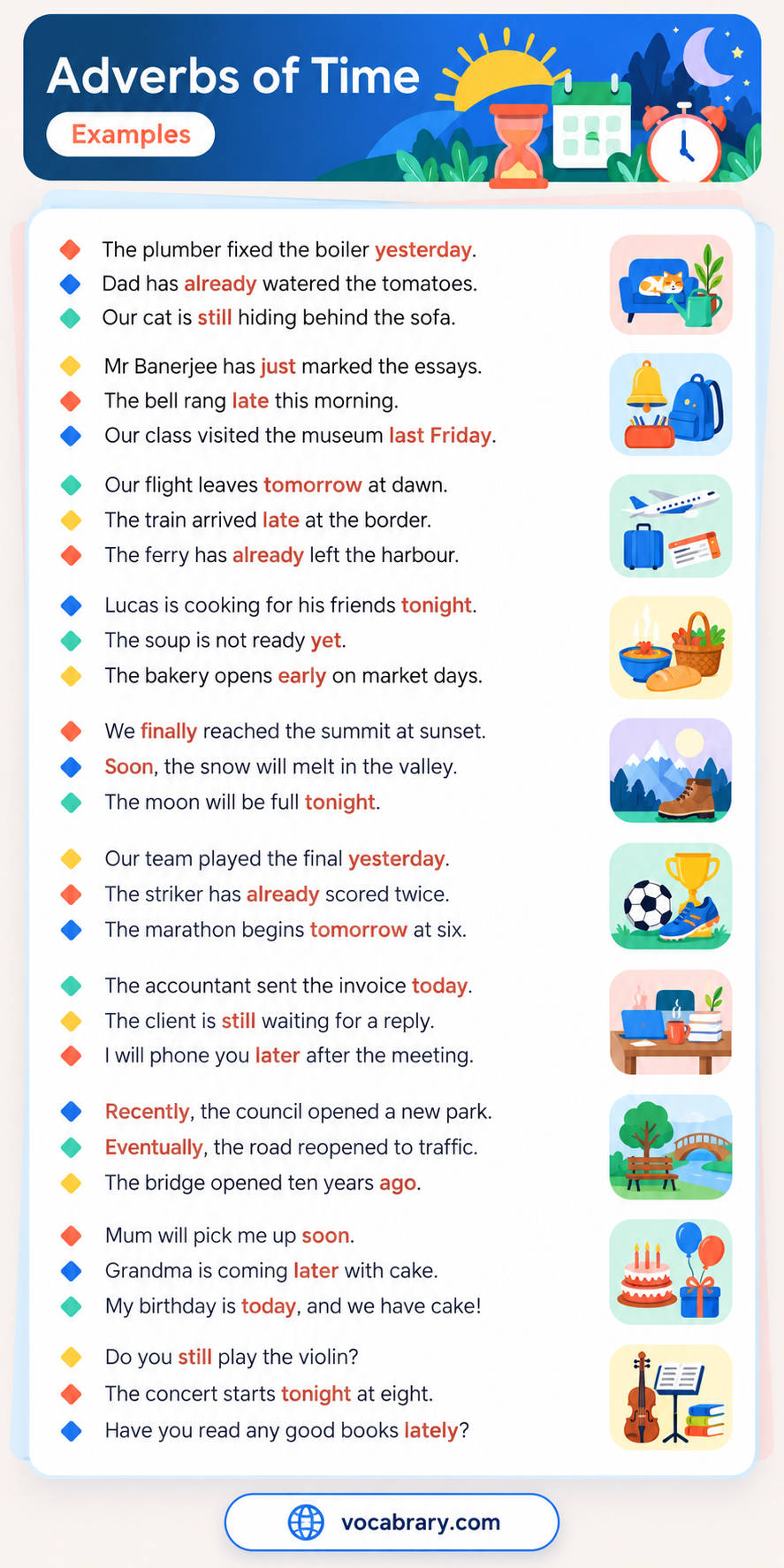
Adverbs of Time Example Sentences for Everyday Use
Now, today, yesterday, tomorrow, soon, and already are the adverbs of time that learners study first. Each one answers the question when about an action such as meeting, calling, finishing, or arriving.
- We met at the station yesterday.
- Please call me tomorrow, after the lunch break.
- The package arrived today, a day earlier than promised.
- Nina is studying in her room now.
- The film starts soon, so take your seats.
- Kwame has already finished his science project.
- Have the guests arrived yet at the hotel?
- My grandfather is still asleep in the garden chair.
- I have just spoken to the headteacher.
- Dr Silva moved to Lisbon recently.
- We will discuss the budget later.
- The bakery opens early on market days.
- The guests arrived late, and the soup was cold.
- Mina lived in Seoul then, long before the move.
- First we visited the museum, and afterwards we had lunch by the river.
- Eventually, the rain stopped, and the match began.
- Hana will join us tonight for the lantern festival.
- I have not seen Ahmed lately.
- She has been to Kyoto before, so she knows the way.
- The shop is closing now for the afternoon break.
Now, Then and Currently Example Sentences
Now, then, currently, and nowadays refer to the present moment or to a moment already named in the sentence. A student studying for an exam and a company that is hiring engineers are two cases.
- Aarav is studying for his exam now, so please whisper.
- Lucia worked in Busan then, and she walked to the office.
- The company is currently hiring two engineers.
- Nowadays, many people read the news on their phones.
- My brother is busy at the moment, so he will call back.
- We had no phones then, so we wrote letters.
- Our school is presently short of teachers.
- Mrs Ali lives in Dubai now, but she grew up in Karachi.
- I now understand why the teacher repeated the rule.
- Back then, the village had no road to the coast.
- The patient is currently resting in room twelve.
- Right now, the bridge is closed to heavy lorries.
Yesterday and Tomorrow, Today and Tonight in Sentences
Yesterday is the day before today, tonight is the evening of today, and tomorrow is the day after. These adverbs fix an action on the calendar, and they take no preposition.
- Our team won the semi-final yesterday.
- The market opens at seven today.
- Lucas is cooking for his friends tonight.
- The inspector arrives tomorrow morning for the safety check.
- Sofia lost her umbrella yesterday on the way home.
- It is raining today, so the match is cancelled.
- The moon will be full tonight.
- We are flying to Nairobi tomorrow.
- The results were published yesterday at noon.
- Today, the students present their projects to the whole school.
- Tomorrow, the weather will turn colder.
- My cousin called me yesterday after the concert.
- The builders finished the roof yesterday afternoon.
- Tonight, the choir sings at the cathedral.
Sentences With Soon, Later and Shortly
Soon and shortly refer to a moment in the near future, and later refers to a moment after the time in focus. A parade that starts soon, a train that arrives shortly, and a call made later are three cases.
- The parade starts soon, so please find a good spot.
- The board will review the budget later in the term.
- The train will arrive shortly at platform two.
- I will call you later when the meeting ends.
- Dinner will be ready soon, and the children are setting the table.
- The doctor will see you shortly.
- See you later, and thank you for lunch.
- The rain will stop soon, according to the forecast.
- Ravi will soon take his driving test.
- The speaker will join us shortly, so please stay seated.
- Two days later, the parcel finally reached Mumbai.
- The flowers will soon open in the garden.
Examples of Adverbs of Time With the Present Perfect
Already, yet, still, and just combine with the present perfect and the present simple, and each one reports the situation at a different moment. The four adverbs differ in meaning and in the type of sentence they suit.
| Adverb | Meaning | Sentence type | Example sentence |
|---|---|---|---|
| Already | Earlier than expected | Positive statements and surprised questions | The bus has already left. |
| Yet | Up to now | Negatives and questions | The bus has not left yet. |
| Still | Continuing without a change | Positive, negative, and question forms | The bus is still at the stop. |
| Just | A very short time ago | Positive statements and questions | The bus has just left. |
Sentences With Already for Finished Actions
Already marks an action done earlier than expected, as with a project finished, a bus gone, or homework handed in.
- Bukola has already repaired her bicycle.
- The bus has already left, so we must take a taxi.
- She has already handed in her homework.
- It is only nine, and the café is already full.
- Have you already read the whole book?
- My parents had already eaten when we arrived.
- The sun has already set, and the streets are quiet.
- I have already told you the answer twice.
- Gabriel has booked the hotel already.
- Is the train already at the platform?
Yet in Negative Sentences and Questions
Yet refers to an expected action up to now, so it suits negatives and questions, as in the bus has not left yet and have you finished yet.
- Have the neighbours arrived yet from the airport?
- Ayumi has not finished her essay yet.
- Has the post come yet this morning?
- I have not decided yet, so ask me tomorrow.
- The doctor has not seen the results yet.
- Have you booked your flight yet?
- The shop has not opened yet, though it is already ten.
- They have not announced the winner yet.
- The soup is not ready yet.
- Haven’t you tried the new bakery yet?
Sentences With Still for Continuing Actions
Still shows that a situation continues without a change, as with a grandfather asleep in a garden chair or a lecturer who is still speaking after two hours.
- Grandpa is still dozing on the veranda after lunch.
- The lecturer is still speaking after two hours.
- Is it still raining in Bergen?
- Ines still lives in the house where she was born.
- They still haven’t replied to my email.
- The soup is still hot, so be careful.
- Do you still play the violin?
- He still remembers the name of his first teacher.
- The bakery is still open at midnight.
- She is still waiting for the bus.
Just in a Sentence
Just with the present perfect reports an action finished a moment ago, as in I have just spoken to the headteacher and the film has just started.
- I have just emailed the head of the department.
- The film has just started, so we missed nothing.
- Dara has just left for the railway station.
- We have just finished lunch, thank you.
- The ambulance has just arrived at the gate.
- Tom has just realised that he forgot his keys.
- The postman has just delivered a parcel for you.
- My sister has just passed her driving test.
- It has just stopped raining, so let us go out.
- Hassan has just missed the last bus.
Recently and Lately Example Sentences
Recently and lately describe a period that extends back from the present, as with a teacher who retired or prices that have risen. Lately goes with the present perfect or the present perfect continuous, and the past simple is rare with it.
- Mrs Zhang recently retired after thirty years of teaching.
- I have not heard from my uncle lately.
- The shop recently changed its opening hours.
- Have you read any good books lately?
- The mayor recently announced a new library.
- Prices have risen lately, and families notice it.
- We recently adopted a puppy from the shelter.
- My cousin has been working very hard lately.
- The school was recently repainted in bright yellow.
- Have you heard from Elena recently?
Early and Late in Sentences
Early means before the expected time, and late means after it, as in a bakery that opens early or a guest who arrives late. Both words are adjectives as well as adverbs.
- The bus to the harbour leaves early on Sundays.
- The wedding guests arrived late, and the band had already left.
- We left early to avoid the traffic.
- The plane landed late because of the storm.
- Yusuf woke up early on the day of the match.
- Our train ran late by almost an hour.
- The roses bloomed early this spring.
- Maya went to bed late after the wedding.
- The shop closes early on Fridays in winter.
- The students handed in their essays late.
Sequence Sentences With Before, Afterwards and Eventually
Before, afterwards, eventually, and meanwhile show the order of actions, as in a museum visit followed by lunch or a rainstorm that stops after a long wait.
- Nadia had never tried sushi before.
- We toured the castle first, and afterwards we walked along the beach.
- Eventually, the storm passed, and the ferry resumed its route.
- We finished the exam, and the whole class cheered afterwards.
- I had never met him before, but he greeted me warmly.
- Meanwhile, the children were painting in the garden.
- The engineers fixed the fault eventually.
- Aziz packed his bag beforehand and slept early.
- We finally reached the summit at sunset.
- Previously, the shop sold only fruit.
- They talked for an hour, and then they said goodbye.
- Dinner was served, and afterwards the guests played cards.
Last Night, This Morning and Next Week Example Sentences
Last, this, and next combine with a time word to make an adverbial phrase, as in last night, this morning, and next week. Phrases with in, on, and at are covered on the page for prepositions of time.
- Ola phoned me last night from the airport.
- The decorators painted the hall this morning before the guests came.
- We are moving house next week.
- Olu graduated last year with a degree in physics.
- The exhibition opens next month in Prague.
- I saw the comet this evening from the balcony.
- The council repaired the road last summer.
- The festival begins next Saturday in the main square.
- Leila started her new job this week.
- They got married two years ago in a village near Pune.
- The match was cancelled the day before yesterday.
- Her flight leaves the day after tomorrow.
Time Adverbs in Different Sentence Positions
Adverbs of time go at the end of a sentence, at the start, or in the middle, and the middle position suits already, just, still, and soon. When several adverbs appear together, the standard order is manner, place, then time.
Tomorrow and Today at the End of a Sentence
The end of the sentence is the standard position for yesterday, tomorrow, today, tonight, later, and recently, as in we met yesterday and call me later.
- We met outside the cinema yesterday at noon.
- The parcel will arrive tomorrow before lunch.
- Luis will call his mother tonight.
- Wang Fei visited the old fort recently.
- Let us talk about it later.
- The manager spoke to the staff today.
- The bus left without us earlier.
- Parcels for this district will be delivered tomorrow because of the holiday.
- We will leave for the coast soon.
Yesterday and Today at the Start of a Sentence
An opening adverb of time sets the scene or contrasts one day with another, as in yesterday, we visited the market and tomorrow, the weather will change.
- Yesterday, we visited the market in the old town.
- Tomorrow, the temperature will fall to freezing.
- Today, the choir rehearses in the main hall.
- Recently, the council opened a new park.
- Later, the team celebrated with ice cream.
- Tonight, the fireworks begin over the harbour.
- Eventually, the road reopened to traffic.
- Soon, the snow will melt in the valley.
- Afterwards, Tomas wrote a short thank-you note.
Already, Just and Still in Mid-Sentence Position
Already, just, still, and soon go in the middle: after the verb be, before a main verb, and after the first auxiliary verb, as in she is still asleep and he has just left.
- She is still asleep after the long flight.
- He has just left for the airport.
- The students already know the answer.
- We will soon arrive in Kyoto.
- They have already finished the exam.
- Karen recently moved to Toronto with her family.
- The festival is now a national event.
- My brother still lives with our parents.
- The manager had just entered the room.
Time After Manner and Place in One Sentence
When manner, place, and time appear together, the usual order is manner, place, then time, as in she sang beautifully at the concert yesterday.
- She sang beautifully at the concert yesterday.
- He drove carefully to the airport this morning.
- The children played happily in the garden today.
- Our guide spoke clearly at the gate earlier.
- Mei worked quietly in the library last night.
- The band performed loudly in the square on Saturday.
- They arrived safely in Lima yesterday.
- Dad waited patiently at the station this morning.
Examples of Adverbs of Time With Different Tenses
The past simple, present perfect, present simple, past perfect, and future forms each take their own adverbs of time, and the choice of adverb depends on the tense.
Past Tense Sentences With Yesterday, Ago and Then
The past simple names a finished time, so it takes yesterday, last week, ago, and then, as in we met yesterday and he left two hours ago.
- Omar left for the airport two hours ago.
- The storm hit the coast last week.
- I saw her yesterday outside the library.
- We lived in Seville then, near the cathedral.
- Priya sold her bicycle last month.
- The bridge opened ten years ago.
- He called me earlier this afternoon.
- The team won the cup last season.
Present Perfect Sentences With Just, Already and Yet
The present perfect links the past to the present, so it takes just, already, yet, recently, and so far, but never a finished time such as yesterday.
- I have just finished my homework.
- They have already booked the tickets.
- She has not called me yet.
- We have recently repainted the kitchen.
- The shop has sold twenty copies so far.
- Have you ever been to Peru before?
- Rafael has lately become interested in birds.
- Nobody has answered the phone yet.
Present Tense Sentences With Now and Nowadays
The present simple and the present continuous take now, today, currently, and nowadays for situations in progress at the time of speaking.
- Nina is studying now, so please be quiet.
- Most students use tablets in class nowadays.
- The factory is currently hiring new workers.
- Our teacher is on holiday today.
- My neighbour is repairing his car at the moment.
- Tourists are crowding the square right now.
- She works in a bank these days.
- Jin is cooking dinner at present.
Past Perfect Sentences With Before and Already
The past perfect looks back from a past moment, so it takes already, before, by then, and just, as in they had already eaten when we arrived.
- Our hosts had already eaten when we arrived.
- We had been to that café before, so we knew the menu.
- The film had just begun when the lights failed.
- The train had left by then.
- She had already packed her bag before dawn.
- The pharmacist had just closed the till when the customer knocked.
- The match had already started when Karim reached the stadium.
- Jamal had just boarded the bus when the rain began.
Future Sentences With Tomorrow, Soon and Later
Future forms take tomorrow, soon, later, tonight, and next week, as in we will leave tomorrow and the doctor will see you shortly.
- Our cousins are flying to Accra tomorrow.
- The new library will open next week.
- I will phone you later after the meeting.
- The concert starts tonight at eight.
- The exam results will arrive soon by email.
- Mum is going to bake bread tomorrow.
- The students will sit the test next Monday.
- The bus will leave in a minute.
Examples of Adverbs of Time in Negative Sentences
Not yet shows that an expected action has not happened. No longer and not any more show that an earlier situation has ended, as in he no longer lives here.
- I have not finished the report yet.
- Grandpa no longer drives at night.
- The shop will not open today.
- She has not written to me lately.
- We do not live in Cairo any more.
- They have not arrived yet, so we shall wait.
- He never visited the old house again.
- The library is no longer open on Sundays.
- Nobody has seen the cat near the garden recently.
- I haven’t spoken to Anil recently.
- The bakery doesn’t deliver late at night.
- The builders have still not finished the roof.
- Our neighbours are not at home now.
- The factory does not make radios any longer.
Common Adverbs of Time in When Questions
When, what time, and how long ago ask about time, while yet, still, and already appear inside yes-or-no questions after the subject or at the end.
- When does the train leave for Prague?
- What time will the guests arrive tonight?
- How long ago did you move to Lagos?
- Have you finished your homework yet?
- Is it still snowing in the mountains?
- Did you already buy the tickets?
- When did the museum open to the public?
- Has Rita called you recently about the party?
- Will you be at home tomorrow?
- Are they leaving soon for the coast?
- When will the results be published?
- Did the parcel arrive early this week?
- Do you still go swimming on Saturdays?
- Was the concert yesterday or the day before?
- When is the next ferry to the island?
- Have you ever seen snow before?
Using Adverbs of Time in Reported Speech
In reported speech, now becomes then, yesterday becomes the day before, and tomorrow becomes the next day when the report is made at a later time. The verb moves back one tense as well in a past report, except when the statement is still true.
| Direct speech | Reported speech | Example sentence |
|---|---|---|
| Now | Then or at that time | Maya said she was busy then. |
| Today | That day | Pedro said the shop was closed that day. |
| Tonight | That night | Aisha said she would call that night. |
| Yesterday | The day before | Tom said he had met Lin the day before. |
| Tomorrow | The next day | Hira said she would travel the next day. |
| Last week | The week before | Kofi said the exam had been the week before. |
| Next week | The week after | Sara said the festival began the week after. |
| Ago | Before | Ravi said he had moved to Delhi two years before. |
- The caller said that her father was out at that time.
- The guide announced that the museum would close the next day.
- Elena told me that she had finished the day before.
- He explained that the train had left an hour before.
- The teacher said that the test would take place the week after.
- Our neighbour mentioned that she was travelling that evening.
- My manager said that the report was already on his desk.
- The witness stated that she had seen the man earlier that day.
Using Adverbs of Time in Passive Sentences
In a passive sentence, the adverb of time goes at the end of the clause or before the past participle, as in the report was finished yesterday and the bridge was recently repaired.
- The report was finished yesterday by the whole team.
- The old bridge was recently repaired.
- The winners will be announced tomorrow.
- The letter has already been posted.
- The museum was opened last year by the mayor.
- The results will be published soon.
- Your order has just been shipped.
- The windows were cleaned this morning.
- The tickets were sold yesterday in under an hour.
- The new rules will be introduced next month.
Sentences About Home Life With Tonight and Later
Cooking dinner tonight, cleaning the kitchen later, and a boiler repaired yesterday are household events, so these adverbs of time example sentences show how an adverb of time marks each one.
- Mum is cooking dinner tonight for the whole family.
- I will clean the kitchen later, after the football match.
- The plumber fixed the boiler yesterday.
- Dad has already watered the tomatoes.
- Our cat is still hiding behind the sofa.
- We recently bought a new dishwasher.
- The washing machine stopped this morning in the middle of a cycle.
- Grandma will visit us tomorrow with a basket of figs.
Early and Tomorrow in School Sentences
Handing in homework early, sitting a test tomorrow, and meeting the headteacher later are school events, so these adverbs of time example sentences show how an adverb of time marks each one.
- The students handed in their homework early.
- We have a science test tomorrow.
- Mr Banerjee has just marked the essays.
- The bell rang late this morning.
- Daniela will meet the headteacher later.
- Our class visited the museum last Friday.
- The younger pupils have already finished lunch.
- The school choir performed yesterday in front of the parents.
Work Sentences With Today and Tomorrow
Sending an invoice today, holding a meeting tomorrow, and signing a contract just now are workplace events, and each one is placed in time by an adverb of time.
- The accountant sent the invoice today.
- Our team meets tomorrow at ten.
- The manager has just signed the new contract.
- We recently hired two designers for the studio.
- The client is still waiting for a reply.
- I will finish the slides later this afternoon.
- The server crashed last night during the update.
- Staff have already left for the conference.
Travel Sentences Using Tomorrow and Late
A flight that leaves tomorrow, a train that arrived late, and a hotel booked yesterday are travel events, and each one is placed in time by an adverb of time.
- Our flight leaves tomorrow at dawn.
- The train arrived late at the border.
- Mehmet booked the hotel yesterday for all of us.
- The ferry has already left the harbour.
- We reached the village eventually, after dark.
- The tour guide will meet us soon in the lobby.
- Passengers boarded the plane early in the morning.
- Is the coach still waiting outside?
Yesterday and Last Night in News Report Sentences
A vote held yesterday, a storm that arrived last night, and talks that begin tomorrow are news items, and each one is placed in time by an adverb of time.
- Parliament voted on the budget yesterday.
- A storm hit the northern coast last night.
- The president will speak later today.
- Rescue teams have already reached the village.
- The company recently announced a record profit.
- Talks between the two governments begin tomorrow.
- The fire is still burning in the hills.
- Officials said they would publish the figures soon.
Fiction Sentences With Early and Too Late
A knight who rode out early, a ghost that vanished, and a letter that arrived too late are story events, and each one is placed in time by an adverb of time.
- The knight rode out early and reached the castle at noon.
- The ghost appeared in the corridor, and then it vanished.
- Mrs Bennet wrote immediately to her sister.
- The letter arrived too late to save the old miller.
- Once upon a time, a princess lived beside the river.
- Afterwards, the traveller never spoke of the forest.
- The detective had already solved the mystery before breakfast.
- Eventually, the stranger told the family his name.
Sentences About Sports With Yesterday and Still
A final played yesterday, a captain who is still training, and a game that starts soon are sporting events, and each one is placed in time by an adverb of time.
- Our team played the final yesterday.
- The captain is still training in the empty stadium.
- The match starts soon on the main pitch.
- The striker has already scored twice.
- The coach arrived late to the press conference.
- The marathon begins tomorrow at six.
- The champions lost recently to the youngest team.
- The goalkeeper has just left the field with an injury.
Shortly and Tomorrow in Health Sentences
A check-up tomorrow, a fever that has just ended, and a nurse who comes shortly are health events, and each one is placed in time by an adverb of time.
- The nurse will see you shortly in room four.
- Grandpa has a check-up tomorrow morning.
- Her fever has just ended after three days.
- The nurse took the patient’s temperature earlier.
- I have not slept well lately.
- The nurse had treated Grandpa before, so she knew his history.
- The swelling has already gone down.
- The patient is still recovering in the ward.
Adverbs of Time Sentences for Kids
Eating a meal, visiting the zoo, and brushing teeth are daily moments for children, so these adverbs of time example sentences for kids use now, today, soon, and tomorrow.
- It is time to eat now.
- We go to the zoo tomorrow.
- Mum will pick me up soon.
- I have just brushed my teeth.
- My birthday is today, and we have cake!
- I finished my drawing of the farm already.
- Grandma is coming later with cake.
- We played football yesterday in the park.
- The bus comes early on school days.
- I will tell you the secret tonight.
Short Adverbs of Time Sentences for Young Learners
Now, soon, today, and later give beginners short adverbs of time example sentences of six to eight words, and each one pairs a familiar action with one adverb.
- Please come inside now, children.
- The yellow bus will come soon.
- It is sunny today at the beach.
- We will eat our lunch later outside.
- Dad came home early today from work.
- My little sister is asleep now.
- The shop opens tomorrow at nine.
- I saw a big rainbow yesterday.
Academic Adverbs of Time Sentences for Students
Formal writing uses adverbs of time such as previously, subsequently, and currently to place research and events on a timeline, so these examples suit essays and exam answers.
- The author previously worked as a journalist in Cairo.
- The committee subsequently approved the revised budget.
- Researchers are currently testing a new vaccine.
- The treaty was signed shortly after the war ended.
- Unemployment has recently fallen in most regions.
- The experiment was repeated later by a second laboratory.
- The novel was originally published in 1925.
- The government has already raised taxes twice this decade.
- Initially, the students rejected the proposal.
- The city later became the capital of the new republic.
Adverbs of Time in Short Paragraphs
A morning routine, a hospital shift, a school trip, and a village festival supply four connected stretches of text in which adverbs of time appear in several positions.
I woke up early today because the bus leaves soon. I have already packed my bag, and I just finished breakfast. Tomorrow, I will be at the sea, but now I am still checking the tickets. My sister has not arrived yet.
Nurse Obi started her shift late last night. First, she checked the patients, and afterwards she wrote her notes. The doctor will arrive shortly. She is still working, and she has already drunk three cups of tea. Tomorrow, she will finally sleep.
Our class visited the zoo yesterday. We arrived early, and the keepers had just fed the lions. Later, we ate lunch beside the pond. Afterwards, we watched the elephants, and soon it was time to go home. Today, we are drawing the animals.
The village festival begins tomorrow. The bakers have already started work, and the musicians are still practising. Tonight, the streets will be quiet. Eventually, the whole village will gather in the square, and then the lanterns will be lit.
Time and Frequency Adverbs in One Sentence
Tomorrow states one moment, while always states how many times an action is repeated, so the two types answer different questions. A separate page covers adverbs of frequency in full.
| Feature | Adverbs of time | Adverbs of frequency |
|---|---|---|
| Question answered | When an action is done | How many times an action is repeated |
| Typical adverbs | Yesterday, now, soon, tonight | Always, never, rarely, twice a week |
| Standard position | At the end or the start of the sentence | Before the main verb or after be |
| Example | She called yesterday. | She never calls. |
| Tense fit | Every tense, with a fixed moment | Habits in the present and the past |
- Lena visited her aunt yesterday, and she often visits her at weekends.
- I will study in the library tomorrow, as I always do.
- Omar flew to Doha last week, though he seldom travels.
- The post arrived early today, but it usually comes at nine.
- We cooked at home tonight, since we never eat out on Mondays.
- Zeynep stayed late on Monday, and she sometimes stays late on Fridays.
- The shop closed at five today, and it rarely closes before six.
- My parents called this morning, and they often call on Sundays.
FAQs
Q1. Which words are the most common adverbs of time?
The most common adverbs of time are now, then, today, yesterday, tomorrow, tonight, soon, later, already, yet, still, and just. Each one answers the question when about an action. Phrases such as last night and next week work in the same way.
Q2. Where do adverbs of time go in a sentence?
Adverbs of time go at the end of a sentence, at the start, or in the middle. The end is the standard position, as in we met yesterday, and the start adds emphasis, as in yesterday, we met. In the middle, already, just, and still go after be, before a main verb, or after the first auxiliary.
Q3. What is the difference between already and yet?
Already reports an action done earlier than expected, while yet refers to an expected action up to now. The bus has already left is a positive statement. The bus has not left yet and has the bus left yet are a negative and a question.
Q4. When do you use still in a sentence?
You use still when a situation continues without a change, as in my grandfather is still asleep. Still goes after the verb be and before a main verb. In a negative sentence, it goes before the auxiliary, as in she still hasn’t called.
Q5. What is the difference between just and recently?
Just reports an action finished a moment ago, while recently reports an action within the last weeks or months. I have just spoken to the headteacher means a few minutes ago. Dr Silva recently moved to Lisbon covers a longer stretch of time.
Q6. What is the difference between adverbs of time and adverbs of frequency?
Adverbs of time state when an action is done, while adverbs of frequency state how many times it is repeated. Yesterday and soon are adverbs of time, and always and rarely are adverbs of frequency. In the standard position, adverbs of frequency go before the main verb, while adverbs of time go at the end or the start.
Q7. Do adverbs of time take a preposition?
The adverbs yesterday, today, tomorrow, and tonight take no preposition, so I will see you tomorrow is correct. Phrases built on a noun need a preposition, as in on Monday, in July, and at noon. The choice among in, on, and at is explained on the page for prepositions of time.
Q8. What is the difference between late and lately?
Late means after the expected time, as in the guests arrived late, while lately means recently, as in I have not seen him lately. The two words have different meanings: he came late to the party describes a time, while he has been busy lately describes a recent period.
Q9. How do adverbs of time change in reported speech?
Adverbs of time change in reported speech when the report is made at a later time. Now becomes then, today becomes that day, yesterday becomes the day before, and tomorrow becomes the next day. The verb moves back one tense as well in a past report, except when the statement is still true.
Q10. Do adverbs of time start a sentence?
Adverbs of time start a sentence when the writer wants to set the scene or contrast one moment with another. Yesterday, tomorrow, today, recently, later, and eventually open many sentences in stories and reports. A comma follows the opening adverb in careful writing.
Q11. What is the difference between eventually and finally?
Eventually shows that something happened after a long time or many events, as in eventually, the rain stopped. Finally marks the last item in a sequence or the end of a long wait, as in we finally reached the summit. The two words overlap, and finally adds a sense of relief.
Q12. In what order do adverbs of manner, place, and time appear?
Adverbs of manner, place, and time follow that order in the standard pattern when they share a sentence. She sang beautifully at the concert yesterday follows the pattern, with manner first, place second, and time last. A time adverb moves to the start for emphasis, as in yesterday, she sang beautifully at the concert.

Leave a Comment