
A subordinating conjunction is a word that attaches a dependent clause to a main clause, as in she stayed at home because the roads were icy. Most subordinating conjunction example sentences turn on because, although, if and when, since those four words mark a reason, a contrast, a condition and a time.
What Is a Subordinating Conjunction?
A subordinating conjunction opens a dependent clause and ties that clause to a main clause, naming the time, reason, contrast, condition, purpose, place or comparison between the two. Coordinating conjunctions such as and, but and or join two equal clauses, and correlative conjunctions work in pairs such as either … or, whereas a subordinating conjunction makes one clause depend on the other.
Subordinating conjunction + dependent clause, main clause
Nadia missed the train because the bus broke down.
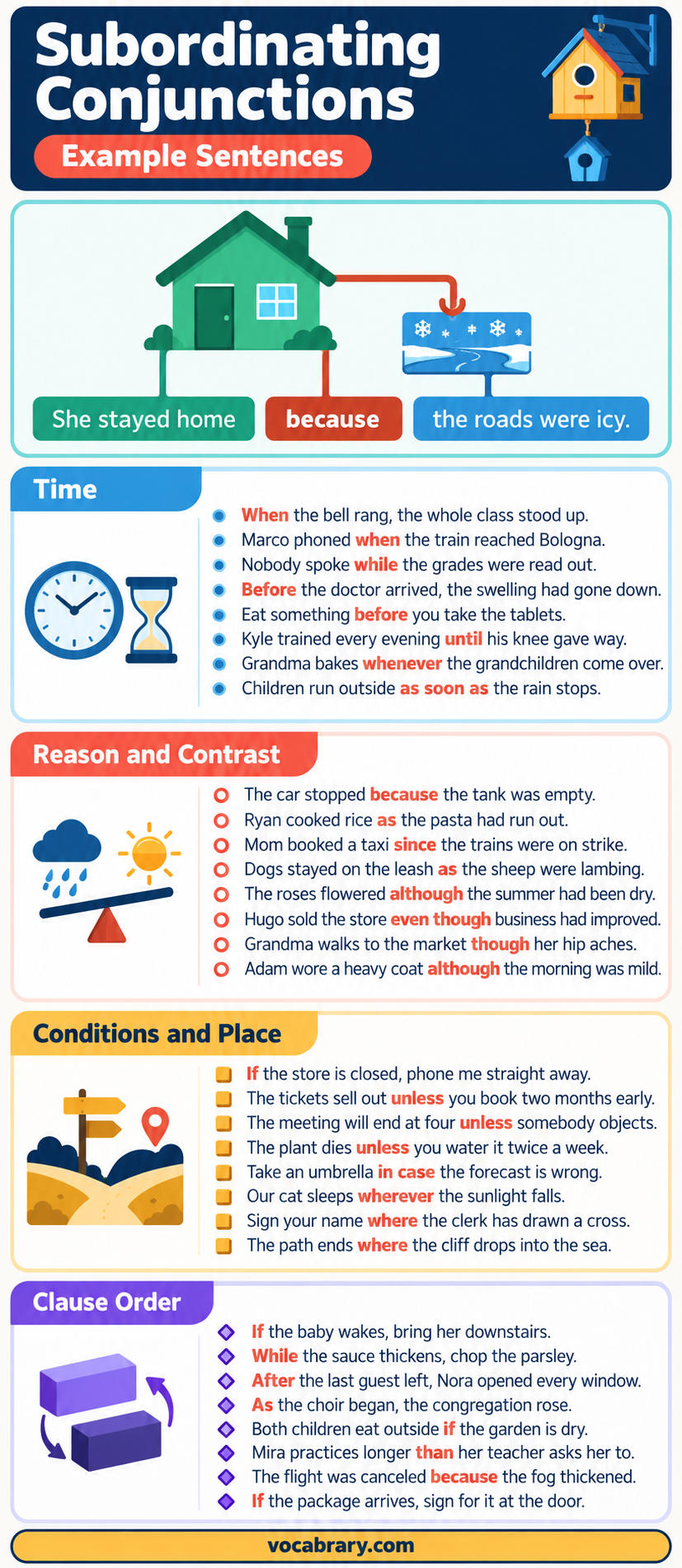
Common Subordinating Conjunction Examples in Sentences
A missed train after a broken bus, a match played in the rain, and homework due before dinner open the common subordinating conjunction example sentences, where one clause explains the other.
- Nadia missed the train because the bus broke down.
- Although the rain never stopped, the match went ahead.
- Finish your homework before dinner.
- Idris waited at the gate until his sister arrived.
- If the shop is closed, phone me straight away.
- Mira has played the violin since she turned six.
- Farah reads on the sofa while her brother cooks.
- When the bell rang, every child ran outside.
- The kitten hid under the bed whenever visitors came.
- Unless you book early, the tickets sell out.
- Tomas saved for a year so that the flight and the hotel were paid for in advance.
- After the film ended, nobody moved.
- Leave the parcel where your father will find it.
- Though she trained for months, Leila finished fourth.
- The dog barks as soon as the postman opens the gate.
- Since the road flooded, every lorry took the long route.
- My cousin speaks Portuguese better than I do.
- As the sun rose, the fishermen pushed off from the beach.
- Amara packed a torch in case the power failed.
- Even though the soup was cold, Sam ate every spoonful.
- Keep the receipt so that the shop will exchange the shirt.
- Once the eggs cool, peel them under running water.
- Hana sings whenever she washes the dishes.
- Whereas my brother enjoys crowds, I prefer a quiet street.
- The builders stopped work because the cement ran out.
- While the bread proved, Yusuf cleaned the whole kitchen.
- Pedro will lend you his notes provided that you return them on Friday.
- Before the doctor arrived, the swelling had already gone down.
- The goalkeeper dived as the whistle blew.
- As long as the river stays low, the ferry runs every hour.
Subordinating Conjunctions and the Relationships They Show
Because for a reason, although for a contrast, if for a condition, and when for a time make the nine conjunctions that open most dependent clauses. Each one names a different link between the two clauses.
| Conjunction | Relationship it shows | Example sentence |
|---|---|---|
| Because | A reason for the main clause | The flight was cancelled because the fog thickened. |
| Although | A contrast with the main clause | Although Ravi was tired, he finished the report. |
| If | A condition the main clause depends on | If the parcel arrives, sign for it. |
| When | The time of the main clause | Meera smiled when she saw the photograph. |
| Since | A reason, or a starting time | Since the lift is broken, take the stairs. |
| While | Two actions at the same time | Dad hummed while he painted the shed. |
| Until | The end point of the main clause | Wait here until the doors open. |
| Unless | A negative condition | Nobody enters unless the guard checks the pass. |
| So that | The purpose of the main clause | Lina wrote the address twice so that nobody would lose it. |
- The flight was cancelled because the fog thickened.
- Although Ravi was tired, he finished the report.
- If the parcel arrives, sign for it at the door.
- Meera smiled when she saw the old photograph of her grandmother.
- Since the lift is broken, everyone on the fifth floor takes the stairs.
- Dad hummed an old song from the radio while he painted the garden shed in the August heat.
- Wait here until the doors open.
- Nobody enters the workshop unless the guard checks the pass.
- Lina wrote the address twice so that nobody would lose it.
- Because the flour was damp, the biscuits never crisped.
- Tariq stayed calm although the crowd shouted at the referee.
- Unless the rain eases, the parade will start an hour late.
Subordinating Conjunctions of Time
Bells that ring, buses that arrive and kettles that boil set the moment for the main clause. When, while, before, after, until and as soon as each mark that moment differently.
Time Sentences With When, While, and As
A bell at the end of a lesson, a phone that rings during dinner, and a goal scored as the whistle sounds show three uses. When marks a single moment, while marks two actions together, and as marks one action starting inside another.
- When the bell rang, the whole class stood up.
- Ayesha reads her messages while the kettle boils.
- The lights failed as the singer walked onto the stage.
- While her parents slept, Noor finished the last chapter.
- Marco phoned when the train reached Bologna.
- Our baby wakes whenever a door slams.
- As the ferry left the harbour, gulls followed the wake.
- Nobody spoke while the marks were read out.
- When you reach the roundabout, take the second exit.
- The cat stretches as the morning sun warms the windowsill.
- Zoe practises her scales while her sister watches cartoons downstairs.
- Did the alarm ring when the smoke reached the ceiling?
- Rain began as the last runner crossed the finishing line.
- While the tide was out, the children collected shells along the flat sand and carried them home in a red pail.
- My grandfather whistles when he mends the fence.
- Dinner beeped in the oven as Nadia reached for the door handle.
Before, After, and Until in Time Sentences
Homework handed in before dinner, a house that empties after a storm, and a waiting room full until a doctor calls a name put the main clause earlier, later, or against the moment named.
- Before the doctor arrived, the swelling had gone down.
- Sanjay locks the gate after the last bus leaves.
- Wait in the corridor until your name is called.
- After the storm passed, the village checked every roof.
- Eat something before you take the tablets.
- The shop stays open until the last customer pays.
- Until the paint dries, keep the window shut.
- Ana sent the invoice after the delivery was signed for.
- Before anyone noticed, the puppy had eaten half the bread.
- Kofi trained every evening until his knee gave way.
- The lorry waited at the barrier after the crossing gates came down.
- Before the harvest starts, every machine is checked twice.
- Nobody left the hall until the head teacher finished speaking.
- Rosa wrote three drafts of the same paragraph before she was satisfied with the letter to the council.
- After the guests had gone, the kitchen was a disaster.
- The alarm rings until somebody presses the red switch.
As Soon As, Once, and Whenever in Time Sentences
A dog at the gate, eggs peeled once they cool, and a grandmother who bakes whenever her family visits mark an action that follows its trigger immediately, after a completed stage, or on every repeat.
- The dog barks as soon as the postman opens the gate.
- Once the eggs cool, peel them under running water.
- Grandma bakes whenever the grandchildren come over.
- As soon as the interview ended, Ibrahim phoned his mother.
- Karim texts his father whenever he lands safely.
- That rattle disappears once the engine warms up.
- Children run outside as soon as the rain stops.
- Whenever the river rises, the lower fields flood.
- Tell me as soon as the test scores come through.
- Once you have signed the form, hand it to the clerk at the desk.
- The alarm sounds whenever somebody opens the fire door.
- As soon as the lights went out, the audience fell silent.
- Malik packs his bag once the last lesson finishes.
- Whenever my aunt visits from Lagos, she brings a suitcase of presents for every cousin in the street.
Subordinating Conjunctions of Reason
Cement that runs out, a flooded road, a lift under repair and a cough that drags on each explain the main clause, and because, since and as introduce that explanation.
Because in Reason Sentences
Broken buses, damp flour, an empty fuel tank and a lost passport are the reasons that follow because, the one conjunction that answers why with no other meaning attached.
- Nadia missed the train because the bus broke down.
- Because the flour was damp, the biscuits never crisped.
- The car stopped because the tank was empty.
- Selim missed his flight because his passport had expired three weeks earlier.
- Every tomato plant died because nobody watered the beds all July.
- We ate in the kitchen because the dining room was freezing.
- Both teams argued for ten minutes because the referee blew early.
- Anika changed dentists because the old surgery moved across town.
- The concert was moved indoors because thunder was forecast.
- Nobody reached me all afternoon because my phone battery died.
- Sam wore two jumpers because the heating had failed again.
- Our journey took an extra hour because the bridge was closed.
- Did the meeting finish early because the manager was ill?
- Because she had trained through the winter, Julia won the county race.
- The bread tasted of smoke because the oven had burned the crust.
- Because the lock had rusted shut over the winter, Dad forced the shed door open with an iron bar.
Since and As in Reason Sentences
A broken lift, a flooded road, a landlord who never answers and a queue that never moves take since and as, which give a reason the listener already knows.
- Since the lift is broken, take the stairs to the fifth floor.
- Farhan walked home as the last bus had already gone.
- As nobody answered the door, the courier left the parcel next door.
- The teacher repeated the question since half the class was talking.
- Help your brother with his spelling since you have finished early.
- Ravi cooked rice as the pasta had run out.
- As the road past the mill was flooded, every lorry took the long route through Hexham and Corbridge.
- Mum booked a taxi since the trains were on strike.
- Since the landlord never replies to email, Layla wrote him a letter.
- The match was replayed as the floodlights had failed at half time.
- Sofia postponed the trip as her passport was at the embassy.
- A market trader kept the vegetables for us since we had no cash.
- Dogs stayed on the lead as the sheep were lambing.
- Nobody sleeps well in that flat since the kitchen tap drips all night.
Subordinating Conjunctions of Contrast
A team that trains hard and still loses, a warm coat worn in mild weather, and two brothers with opposite habits set one clause against the other. Although, though, even though and whereas mark that opposition.
Although, Though, and Even Though in Contrast Sentences
Months of training that end in fourth place, cold soup eaten to the last spoonful, and roses that flower after a dry summer take although, though and even though. Each one admits a fact and then states the surprise.
- Although Ravi was tired, he finished the whole report before midnight.
- Leila finished fourth though she had trained for months.
- Even though the soup was cold, Sam ate every spoonful.
- The roses flowered although the summer had been dry.
- Though the exam lasted three hours, nobody left the room early.
- Hiroshi sold the shop even though business had improved.
- Although the tickets cost a fortune, the stadium filled by seven.
- Grandma walks to the market though her hip aches.
- Even though two players were injured, the team held the lead.
- Nobody complained although the concert started ninety minutes late.
- Though the recipe called for cream, Yasmin used yoghurt instead.
- The dog slept through the fireworks even though the windows rattled.
- Although she speaks four languages, Petra teaches only Spanish.
- The stone bridge stood firm though the flood carried away both riverside paths and half the car park.
- Even though the shop had closed, the baker sold us the last two loaves.
- Ahmed wore a heavy coat although the morning was mild.
Whereas and While in Contrast Sentences
Two brothers with opposite tastes, a quiet village beside a loud city, and a sister who saves against one who spends take whereas and while. Both set two facts side by side.
- Whereas my brother enjoys crowds, I prefer a quiet street.
- Tomas saves every payslip while his twin spends the lot by Tuesday.
- While the north of the country floods each spring, the south stays dry.
- Priya writes in longhand whereas her colleagues type everything.
- The old factory employed eight hundred people whereas the new one needs only forty.
- Dogs need company while cats manage alone for hours.
- The first half was dull while the second produced five goals.
- Ana studied medicine whereas both her parents had trained as architects.
- Whereas the paper edition sells two thousand copies each Thursday, the website reaches nine million readers every month.
- Bread rises quickly in a warm kitchen while a cold room slows it down.
- While my aunt swims every morning, my uncle has never entered the sea.
- Monday brought sunshine whereas Tuesday drowned the whole festival in mud.
Subordinating Conjunctions of Condition
A shop that sells out without an early booking, a torch packed against a power cut, and a deposit returned on one condition depend on a clause that has not happened yet. If, unless, provided that, in case and as long as open those clauses.
If and Unless in Condition Sentences
Closed shops, sold-out tickets, a guard at a workshop door and a bus caught at half past seven pair if for a plain condition with unless, which means the same as if not.
- If the shop is closed, phone me straight away.
- The tickets sell out unless you book two months early.
- Unless the rain eases, the parade will start an hour late.
- Nadir will pass the test if he revises the verb tables tonight.
- Cream separates if you heat the sauce too long.
- Nobody enters the workshop unless the guard has checked the pass.
- The meeting will end at four unless somebody objects.
- Bilal walks to school if the weather is dry.
- That thermostat needs replacing if the fridge hums all night.
- The plant dies unless you water it twice a week.
- Unless the bridge reopens, the school bus goes round by the mill.
- Would you move to Oslo if the company paid for the flat?
- If the doorbell rings after nine, leave it.
- Rosa returns the deposit unless the tenant has damaged the furniture.
- Unless you label the jars, nobody will know which jam is which.
- If the first train is cancelled, the next one leaves at half past seven from platform four.
Provided That, In Case, and As Long As in Condition Sentences
Notes lent on one condition, a torch packed against a power cut, and a ferry that sails while the river stays low take provided that, in case and as long as. Each adds a limit to the main clause.
- Pedro will lend you his notes provided that you return them on Friday.
- Amara packed a torch in case the power failed.
- As long as the river stays low, the ferry runs every hour.
- Provided that the forms arrive by noon, the passport office will process them this week.
- Take an umbrella in case the forecast is wrong.
- The greenhouse keeps its heat as long as nobody touches the dial.
- The bank approves the loan provided that two neighbours sign as witnesses.
- In case the alarm fails, the night porter walks the corridors at three.
- Kemi keeps a spare inhaler in her bag in case the dust sets off her asthma.
- As long as you keep the receipt, the shop will exchange the boots.
- Our landlord allows a dog provided that the carpet survives the winter.
- In case the ferry is full, book a cabin on the morning sailing.
- Barley grew on that farm as long as her grandfather was alive.
- Write your name in ink on the brown envelope in case it ends up in the wrong pigeonhole downstairs.
Subordinating Conjunctions of Purpose and Result
An address written twice so nothing goes astray, a year of saving for one flight, and a wind strong enough to stop the ferries separate the aim from the outcome.
So That and In Order That in Purpose Sentences
An address copied twice, a lamp left burning for a late arrival, and money saved for a single trip take so that and in order that, which name the aim behind the main clause.
- Lina wrote the address twice so that nobody would lose it.
- Mum left the porch lamp on in order that we would find the house after dark.
- Keep the receipt so that the shop will exchange the shirt.
- So that the twins would sleep, their father hummed the same tune for an hour.
- Ibrahim labelled every cable so that the next engineer understands the wiring.
- The council widened the path in order that wheelchairs would pass the war memorial.
- Kofi rose at four so that he reached the market before the other traders.
- Speak slowly so that everybody hears.
- In order that no child walks home alone, two teachers wait at the crossing.
- Aisha wrote a shopping note so that she would forget nothing at the supermarket.
- The nurse dimmed the lights so that the baby would settle.
- So that the paint dries evenly, open both windows before you start.
So … That and Such … That in Result Sentences
A wind that stopped the ferries, a queue that swallowed an afternoon, and a cake too sweet for a table of children take so and such with that. Each one reports an outcome instead of an aim.
- The wind blew so hard across the sound that every ferry stayed in port until Thursday morning.
- It was such a long queue that Halima gave up and went home.
- Grandpa tells his stories so slowly that the children fall asleep first.
- Grandma’s cake was so sweet that nobody finished a second slice.
- Bilal ran so fast that the coach checked twice.
- It was such a cold night that the pipes froze in the roof.
- That film ended so abruptly that half the audience thought the reel had broken.
- Nadia spoke such good Italian that the waiter took her for a local.
- The lecture hall was so full that students took notes on the stairs.
- Rain fell so heavily that the drains overflowed into the car park.
- Yusuf was such a quiet child that teachers forgot to mark him present.
- Ana’s soup tasted so salty that she poured half of it away.
Subordinating Conjunctions of Place and Comparison
Parcels left where a father will find them, birds that follow a boat wherever it goes, and a cousin with better Portuguese turn on where, wherever, than and as … as.
Where and Wherever in Place Sentences
A parcel left by the door, campers who pitch a tent wherever the ground is flat, and a cat that follows sunlight put the main clause at the position the dependent clause names.
- Leave the parcel where your father will find it.
- The campers pitch their tent wherever the ground is flat.
- Where the old mill stood, the council built a library.
- Our cat sleeps wherever the sunlight falls.
- Sign your name where the clerk has drawn a cross.
- Wherever Nour goes, she posts a card to her grandmother.
- The path ends where the cliff drops into the sea.
- Where two rivers meet, the water runs brown for a mile.
- Plant the bulbs where the frost never reaches.
- Wherever the team played that season, the away crowd outnumbered the home supporters by three to one.
Than and As … As in Comparison Sentences
A cousin with better Portuguese, a brother taller by a head, and a walk that took longer than the map promised take than and as … as, which measure one clause against another.
- My cousin speaks Portuguese better than I do.
- Elena is as tall as her mother now.
- The walk took longer than the guidebook promised.
- Omar eats as quickly as his older brothers.
- Winter arrived earlier than the farmers had expected.
- Our second exam felt harder than the first one had.
- Nobody sings as loudly as the crowd at a cup final.
- Petra swims further than anyone else in the club.
- Their new flat costs twice as much as the old one.
- Bread from the bakery on Mill Lane tastes better than anything wrapped in plastic at the supermarket.
- Kwame finished the puzzle faster than his sister had managed.
- The path up the hill is as steep as a staircase.
The Dependent Clause First, With a Comma
Frozen pipes, a cancelled ferry, a sleeping baby and a locked gate open these sentences, and every dependent clause that comes first takes a comma before the main clause begins.
- Because the pipes had frozen, the whole street queued at the standpipe.
- Although the ferry was cancelled, Mateo reached the island by fishing boat.
- If the baby wakes, bring her downstairs.
- When the gate is locked, use the side entrance by the greenhouse.
- Since the printer jammed twice, Hana wrote the labels by hand.
- Unless the weather improves, Saturday’s fair moves into the sports hall.
- While the sauce thickens, chop the parsley.
- After the last guest left, Nour opened every window.
- Before you sign anything, read the small print carefully.
- Until the scores are confirmed, nobody will announce a winner.
- Whenever the tide turns, the fishing boats head for the harbour mouth.
- Though the museum is free, few people climb the hill to reach it.
- Once the cement sets, the builders will lay the top row of bricks.
- As the choir began, the congregation rose.
- Even though Karim had revised for weeks, the first question defeated him.
- Wherever she worked, from Hargeisa to the camps outside Nairobi, Dr Fadumo trained two local midwives.
The Main Clause First, Without a Comma
A cook who waits for the oven, a driver who slows at a level crossing, and a nurse who checks a chart show the other order, with no comma between the clauses.
- The oven beeps when the temperature reaches two hundred degrees.
- Sanjay slows down as he approaches the level crossing.
- Nurse Owusu checks the chart before she changes the dressing.
- The dough rises while the bowl warms near the radiator.
- Ali sold his motorbike because the insurance had doubled.
- Both children eat outside if the garden is dry.
- Keiko practised every evening until the melody sounded effortless.
- Nobody leaves the site unless the foreman signs the sheet.
- Our market smells of cinnamon whenever the bakery opens its doors.
- My grandfather laughed although the joke was older than he was.
- Postmen deliver twice a day where the village has no letterbox at the end of the lane.
- Mira practises longer than her teacher asks her to.
- The council planted oaks so that the new estate would have shade by 2040.
- Ferdinand answered in Dutch even though the question came in English.
- That lamp switches off once the room is empty for ten minutes.
- Rania took the job since the hospital was five minutes from her flat.
Subordinating Conjunction Sentences at Home and at School
Burnt toast, a washing machine that floods the hall, spelling tests and a lost gym kit give household and classroom sentences where one clause explains the other.
At Home
Burnt toast, a flooded hall, a cat at the fridge door and a doorbell at bedtime make the home sentences, each pairing a domestic event with its reason or its hour.
- Because the toaster sticks, the bread burns every morning.
- Dad mops the hall whenever the washing machine leaks.
- If the milk smells sour, pour it away.
- The cat waits by the fridge until somebody opens the door.
- When the doorbell rings at bedtime, nobody answers it.
- Mum irons while she watches the evening news.
- Although the sofa is twenty years old, nobody wants to replace it.
- Salma waters the balcony plants before the sun grows strong.
- Since the boiler was serviced in October, the radiators heat up within minutes of the timer clicking on.
- Put the bins out after the neighbours have parked.
- Unless somebody defrosts the chicken, dinner will be beans on toast.
- The lounge stays cold because the chimney draws badly.
At School
Spelling tests, a lost gym kit, a science lab that empties at the bell and a library crowded before an exam give the classroom sentences, where the clause names the rule.
- When the bell rings, every child lines up by the door.
- Mr Achebe repeats the question if the class is noisy.
- Because the projector failed, the lesson moved to the library.
- Ella lost marks although her handwriting had improved.
- Unless you bring your gym kit, you will watch from the bench.
- The science lab empties as soon as the last experiment finishes.
- Before the exam starts, put every phone in the tray.
- Yusuf reads under the stairs while his friends play football.
- Since the school added a breakfast club in September, attendance on Monday mornings has risen sharply.
- The head teacher waits at the gate until the last pupil arrives.
- Whenever a test is announced, the library is full by four o’clock.
- Nobody leaves the hall after the morning roll call has finished.
Subordinating Conjunction Sentences at Work and on the Road
Invoices signed before payday, a night shift that starts when the machines cool, delayed flights and a ferry that sails if the sea calms give office, factory and travel sentences.
At Work
Late invoices, a printer nobody fixes, a night shift that begins after the machines cool, and a meeting that ends at four give the workplace sentences. Each one ties an action to its condition.
- Because the invoice arrived late, accounts will pay it next month.
- Ines answers email before the phones start ringing.
- If the supplier misses Friday, the whole order slips a week.
- The night shift begins once the machines have cooled.
- Although the office moved to the third floor, the lift still stops at two.
- Karl books the meeting room whenever a client visits from Hamburg.
- Unless the safety notice is signed, no visitor enters the yard.
- Sales rose after the shop extended its opening hours.
- Since the new manager arrived from the Leeds office, every team meets at nine on Monday morning.
- Ndidi checks the stock figures while the till is quiet.
- When the fire drill sounds, staff leave by the rear stairwell.
- The warehouse stays open until the last van is loaded.
Travel
Delayed flights, a ferry that sails when the sea calms, a hire car returned before noon and a hostel booked in case of rain make the travel sentences, where timing decides everything.
- Because fog closed the runway, the flight left four hours late.
- Miguel books a window seat whenever the flight crosses the Alps.
- If the ferry sails at dawn, we will reach Corsica by lunchtime.
- Return the hire car before noon on Sunday.
- Although the hostel looked grim from the tram stop outside, the rooms were spotless and the coffee was free.
- Priya learned twenty Turkish phrases so that she would manage in the markets.
- When the coach stops at the border, keep your passport in your hand.
- The train slows as it enters the tunnel under the estuary.
- Unless the weather turns, the cable car runs every twenty minutes.
- Book the hostel in case the campsite floods again.
- Since the new motorway opened, the drive takes ninety minutes.
- Tourists crowd the old bridge until the last light goes.
Health, Weather, Money, and Sports Sentences
A cough that lasts a fortnight, snow that closes a pass, a rent rise, and a penalty in the last minute give four everyday settings where one clause explains, times or limits the other.
Health and Weather
A fortnight of coughing, a physiotherapist consulted after a fall, snow on a mountain pass and thunder over a festival field pair the health and weather sentences with the reason or moment behind them.
- Because the cough lasted a fortnight, Hakim finally saw a doctor.
- Take the tablets after you have eaten something.
- If the swelling spreads beyond the ankle, go straight to casualty.
- Grandad sleeps badly whenever the pollen count rises.
- Although the plaster came off in March, the wrist still aches.
- Snow closed the mountain pass before the ploughs reached the summit.
- When thunder rolled across the festival field, the stewards cleared the tents.
- The washing dried in an hour because the wind came off the sea.
- Unless the frost lifts by ten, the flight will be de-iced twice.
- Nasreen swims twenty lengths every morning so that her asthma stays under control through the winter.
- Since the heatwave began, the reservoir has dropped two metres.
- The physiotherapist strapped the knee until the ligament healed.
Money and Sports
A rent rise, a season ticket bought in January, a penalty in the last minute and a boxer who trains at dawn make the money and sport sentences. A condition or a reason decides each outcome.
- Because the rent rose again, Layla moved in with her sister.
- Save the receipts in case the tax office asks for them.
- If the pound weakens, the imported parts will cost more.
- Tobias bought a season ticket before the price went up in January.
- Although the club sold its best striker, the crowd numbers held firm.
- The referee awarded a penalty as the final whistle approached.
- When the swimmer touched the wall, the scoreboard showed a national record.
- Chidi pays into a workplace pension every month so that his sixties are comfortable and free of debt.
- Unless the sponsor renews, the rowing club will fold in June.
- The boxer trains at dawn because the gym is empty then.
- Since the marathon moved to October, the finishing times have improved.
- Nobody left the stadium until the trophy was lifted.
Subordinating Conjunctions in Stories
A locked attic, a lantern carried across a frozen field, a returning soldier and a village waiting for news give narrative sentences, where the clause supplies the cause.
- When the attic door finally opened, dust poured down the staircase.
- The old sailor never spoke of the wreck because two of his brothers had drowned.
- Although the village had waited nine winters for his return, nobody recognised the soldier who stopped at the gate.
- Yelena carried the lantern across the frozen field until the lights of the farm appeared.
- As the clock struck one, a horse crossed the square.
- The letter stayed unopened while the widow decided what she hoped it would say.
- Since the well had run dry, the family loaded the cart before sunrise.
- Adaeze followed the drumming wherever it led her through the market.
- If the storm broke before midnight, the fishermen would lose the whole fleet.
- A stranger paid in silver so that the innkeeper would ask him nothing.
- After the last train pulled out, the platform belonged to the foxes.
- Nobody entered the orchard unless the old woman invited them herself.
Sentence Fragments Rewritten With a Main Clause
A late bus, a broken heater and an unopened letter appear first as dependent clauses standing alone, then as full sentences once a main clause joins them. That join makes the difference.
- ❌ Because the bus was late. ✅ Because the bus was late, Omar missed the first lesson.
- ❌ Although she practised every day. ✅ Although she practised every day, Mina lost the final.
- ❌ When the heater broke. ✅ When the heater broke, the class moved to the library.
- ❌ If you finish early. ✅ If you finish early, help your partner with the map.
- ❌ Since the shop closed in March. ✅ Since the shop closed in March, the village has no bakery.
- ❌ Until the rain stopped. ✅ Nobody left the pavilion until the rain stopped.
- ❌ While the soup was heating. ✅ While the soup was heating, Ade laid the table.
- ❌ Unless the doctor phones back. ✅ Unless the doctor phones back, take the second tablet at six.
- ❌ After the guests had gone. ✅ After the guests had gone, the twins fell asleep on the rug.
- ❌ Before the museum opens. ✅ Before the museum opens, the guides check every room.
- ❌ So that nobody would be left out. ✅ Ruth printed a spare copy of the music so that nobody in the back row would be left out.
- ❌ Whenever the tide came in. ✅ Whenever the tide came in, the causeway disappeared.
Subordinating Conjunction Examples for Kids and Students
Bedtime, playtime, a lost sock and a spelling test suit younger writers, and essay sentences on rainfall, migration and reform suit exam candidates who need a complex sentence in every paragraph.
Sentences for Kids
A sleepy cat, a lost sock, a puddle by the school gate and a birthday cake give sentences a nine year old writes without help, each with one conjunction and one plain reason.
- Because the cat was sleepy, she curled up on my bed.
- Tom found his sock after he looked under the sofa.
- When it rains, the playground floods with puddles.
- We had cake because it was Grandad’s birthday.
- If you share the crayons, everybody paints something.
- The puppy hid until the thunder stopped.
- Although the bus was full, the driver let us on.
- Sara skipped home while her mum carried the shopping.
- Before we eat, we wash our hands.
- The frogs sing whenever the pond floods after a summer storm.
- Unless you hurry, the ice cream will melt all over the hot pavement outside the shop.
- My baby brother cries as soon as the vacuum cleaner starts.
Short Sentences for Young Learners
A bell, a nap, a snack and a puddle keep these lines to a handful of words, so a beginner meets one conjunction at a time.
- When the bell rings, we line up.
- My baby sleeps while we read.
- If it rains, we stay inside.
- Wash your hands before lunch.
- Because I was hungry, I ate an apple.
- We play after school.
- Although it was cold, we ran outside.
- The dog waits until I come home.
- Unless you are quick, the bus goes without you.
Sentences for Students and Exams
Rainfall measurements, coastal erosion, the Industrial Revolution and a set text on ambition give the complex sentences an examiner expects in an essay paragraph.
- Because rainfall measurements at the station began only in 1961, earlier droughts are estimated from harvest accounts.
- Coastal erosion accelerated after the sea defences at Happisburgh were abandoned.
- Although the Industrial Revolution raised average incomes, life expectancy in Manchester fell for two decades.
- Macbeth destroys himself because ambition overrules every loyalty he once held dear.
- If the sample size had been larger, the correlation would be stronger.
- Charles Dickens serialised his novels so that readers would buy the next instalment.
- While the first experiment measured temperature, the second recorded humidity as well.
- The treaty failed since neither government would reduce its tariffs.
- Unless the data are adjusted for inflation, the wage comparison misleads the reader.
- Pollination declines sharply wherever hedgerows are removed from arable land to make room for larger machines.
- Whereas Romantic poets celebrated wild country, Victorian novelists wrote about cities.
- The court ruled against the company because the contract had never been signed.
- When antibiotics were introduced in the 1940s, death rates from infection dropped quickly.
- Photosynthesis slows once the leaf loses water.
Subordinating Conjunctions in a Short Paragraph
A night nurse named Ifeoma, a ward that quietens after midnight, and a doctor who arrives when the shift ends make one paragraph where almost every sentence needs a dependent clause.
Ifeoma starts her shift at eight because the ward is busiest in the evening. While the day nurses hand over their notes, she checks every drip and chart. Although the corridor lights dim at eleven, nobody sleeps until the last round is finished. If a buzzer sounds twice, she runs. When the ward finally quietens after midnight, Ifeoma writes up her notes so that the morning team knows what happened. She stays at the desk until the doctor arrives at six. Unless somebody is admitted overnight, the last hour passes slowly. Since she took the job in 2019, Ifeoma has missed three Christmases, though she would not swap the work for any other.
Related
- Parts of Speech Example Sentences
- Coordinating Conjunction Example Sentences
- Correlative Conjunction Example Sentences
FAQs
One example is "Natalie missed the train because the bus broke down." Another is "Although the rain never stopped, the match went ahead."
For time, one example is "When the bell rang, the whole class stood up." Another is "Once the eggs cool, peel them under running water."
A reason example is "The car stopped because the tank was empty." Another is "Since the elevator is broken, take the stairs to the fifth floor."
With contrast, one example is "Even though the soup was cold, Sam ate every spoonful." Another is "Whereas my brother enjoys crowds, I prefer a quiet street."
A condition example is "Unless you book early, the tickets sell out." Another is "Take an umbrella in case the forecast is wrong."
To state a purpose, one example is "Speak slowly so that everybody hears." Another is "The nurse dimmed the lights so that the baby would settle."
When the dependent clause opens the sentence, one example is "If the baby wakes, bring her downstairs." Another is "As the choir began, the congregation rose."
For young children, one example is "Before we eat, we wash our hands." Another is "When it rains, the playground floods with puddles."
In an exam essay, one example is "Macbeth destroys himself because ambition overrules every loyalty he once held dear." Another is "The treaty failed since neither government would reduce its tariffs."
A workplace example is "Because the invoice arrived late, accounts will pay it next month." Another is "If the supplier misses Friday, the whole order slips a week."
Related:

Leave a Comment