
A correlative conjunction is a pair of joining words that work together to link two equal parts of a sentence, as in either Sunday or Monday. Most correlative conjunction example sentences run on five pairs, and each pair splits a choice, a refusal, or an addition across two matched halves.
What Is a Correlative Conjunction?
Correlative conjunctions arrive in fixed pairs, one half in front of each joined part, and the two joined parts must match in form: noun with noun, verb with verb, phrase with phrase. A coordinating conjunction such as and or but joins with a single word, while a subordinating conjunction such as because ties an unequal clause to a main one.
Either … or / Neither … nor / Both … and / Not only … but also / Whether … or
Farid not only repaired the bicycle but also repainted the mudguards.
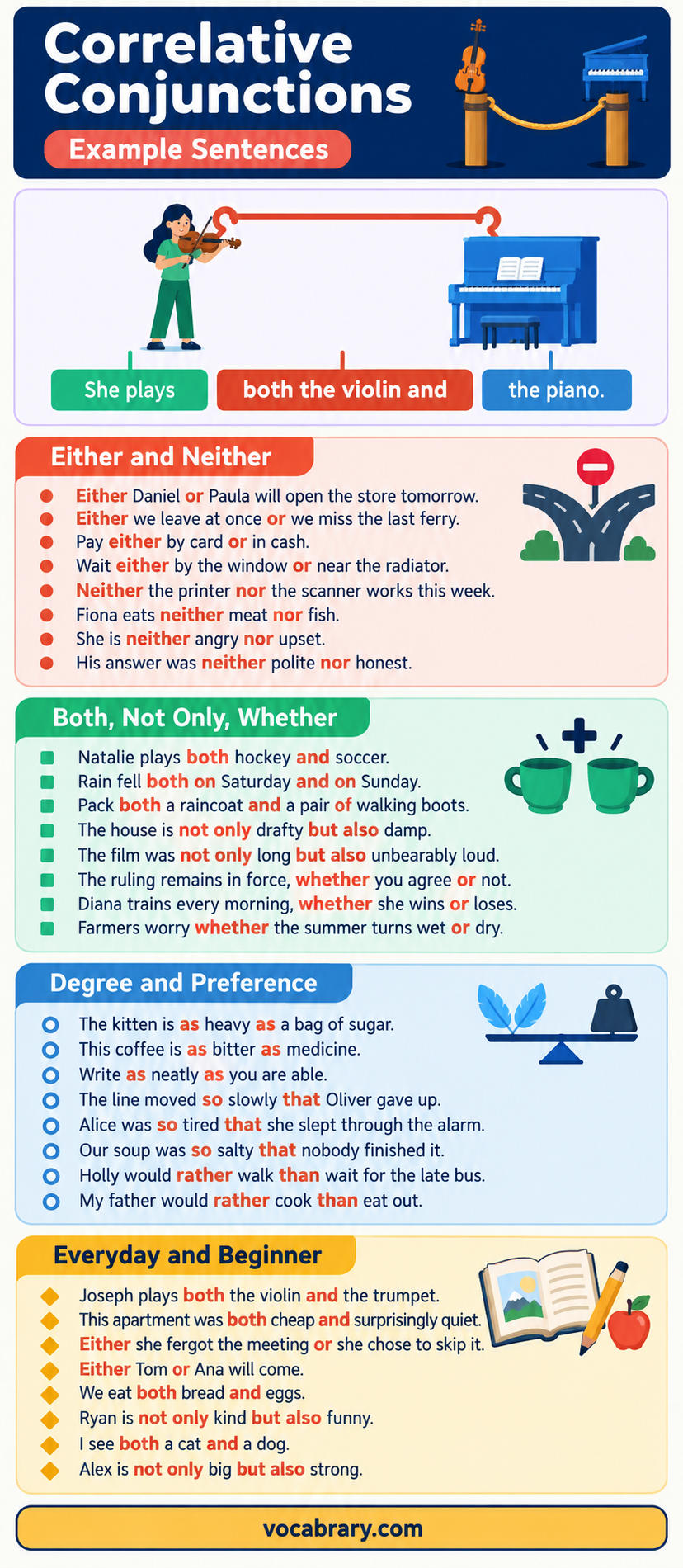
Common Correlative Conjunction Example Sentences
A delayed train, a broken printer, and a swimmer who won two races fill most correlative conjunction example sentences. Each pair marks off two parts of the sentence that answer the same question.
- Either Marta or her brother will collect the parcel this afternoon.
- Neither the printer nor the scanner worked on Monday morning.
- Yusuf plays both the violin and the trumpet.
- The show was not only long but also wonderfully strange.
- Tell me whether you want tea or coffee.
- Not only did the train arrive late, but it also left from the wrong platform.
- We ate both the soup and the bread before the main course.
- Either you apologise now or you explain yourself to the manager.
- Neither answer satisfied the examiner, nor did the third attempt.
- Ines won not only the freestyle race but also the backstroke.
- My grandmother speaks both Tamil and Sinhala at home.
- Whether it rains or stays dry, the market opens at six.
- Either the lock is broken or somebody changed the code.
- Neither of the twins wanted the window seat, nor did their cousin.
- The flat was both cheap and surprisingly quiet.
- Ravi ordered not only a starter but also two desserts.
- Whether by bus or on foot, Amara reaches the office before eight.
- Both the referee and the linesman missed the handball.
- Either she forgot the meeting or she chose to skip it.
- The film was neither funny nor frightening.
- Sofia studies not only at night but also on the train to work.
- We share both the rent and the grocery bill.
Eleven Correlative Conjunction Pairs With Example Sentences
A tram that stops before midnight, a kitten as heavy as a bag of sugar, and pipes that froze on a cold night each need a different correlative conjunction. Every pair needs both halves present, in the same order, every time.
| Pair | Job it does | Example sentence |
|---|---|---|
| Either … or | Offers two options and accepts one | Either the blue folder or the red one is yours. |
| Neither … nor | Rules out two options at once | Neither the bus nor the tram runs after midnight. |
| Both … and | Adds two parts that are equally true | Both the lift and the stairwell smell of paint. |
| Not only … but also | Adds a second fact with extra force | Priya not only cooked dinner but also washed every pan. |
| Whether … or | Names two outcomes that change nothing | Whether we drive or fly, the hotel costs the same. |
| As … as | Measures one thing against another | The kitten is as heavy as a bag of sugar. |
| Such … that | Names a degree and its consequence | It was such a cold night that the pipes froze. |
| So … that | Names an intensity and its consequence | The queue moved so slowly that Omar gave up. |
| No sooner … than | Marks one action right after another | No sooner had the bell rung than the corridor emptied. |
| Rather … than | Prefers one option over another | Hana would rather walk than wait for the late bus. |
| Scarcely … when | Marks a first action cut short | Scarcely had we sat down when the fire alarm sounded. |
Either … Or Example Sentences
An appointment on Tuesday or Thursday, a set of keys under a lamp, and a choice between the coast road and the motorway run through these either … or sentences. One of the two options stays open until somebody decides.
- Either Daniel or Priya will open the shop tomorrow.
- You take either the coast road or the motorway.
- The appointment falls either on Tuesday or on Thursday.
- Grandad keeps his keys either in the drawer or under the lamp.
- Either we leave at once or we miss the last ferry.
- Hannah wants either the green jacket or the grey one.
- Pay either by card or in cash.
- My aunt will arrive either tonight or early tomorrow morning.
- Either the alarm failed or nobody heard it ring.
- Wait either by the window or near the radiator.
- Ibrahim studies either medicine or dentistry in Istanbul.
- That parcel goes either to Lagos or to Accra.
- Our teacher marks the essays either on Friday evening or over the weekend, depending on how many arrive before the deadline.
- She answers the phone either in Portuguese or in Spanish.
- Take either the earlier flight from Rome or the overnight train that crosses the border before dawn.
- The dog sleeps either on the rug or at the foot of Lena’s bed.
- Somebody left either a glove or a striped scarf on the bench outside the library.
- Ask either the porter or the receptionist about the missing suitcase.
Neither … Nor Example Sentences
A printer that refuses to start, a hotel with no lift, and a referee who ignored two loud protests run through these neither … nor sentences. The pair rules out two options in one breath.
- Neither the printer nor the scanner works this week.
- Farah eats neither meat nor fish.
- Neither rain nor snow stops the postman on this route.
- The hotel had neither a lift nor a working shower.
- Tom answered neither the first letter nor the three reminders that followed it during the whole of March.
- Neither my parents nor my sister knew about the surprise party.
- Our old radio plays neither the news nor music since the storm.
- She is neither angry nor upset.
- That excuse convinced neither the coach nor the players waiting in the changing room.
- Lucia speaks neither German nor Dutch, although she reads both languages slowly.
- The soup tasted neither salty nor sweet.
- His answer was neither polite nor honest.
- We found neither the tickets nor the passports in the drawer beside Amira’s bed.
- Sadly, neither the manager nor the assistants were told about the change.
- Rashid wants neither sympathy nor advice.
- The film pleased neither the critics nor the audience on opening night in Dublin.
- Jana visits neither her uncle nor her cousins during the summer holidays in Kraków.
- In the end, neither shouting nor crying changed the referee’s decision.
Both … And Example Sentences
A surgeon who plays the cello, a storm that wrecked a greenhouse and a fence, and a grandmother who remembers two hard winters fill these both … and sentences. Each half of the pair stays equally true.
- Both the lift and the stairwell smell of fresh paint.
- Nadia plays both hockey and netball.
- The recipe needs both butter and olive oil.
- Both my brothers and my father work at the shipyard in Gdańsk.
- Rain fell both on Saturday and on Sunday.
- Tomás speaks both Portuguese and Galician without a trace of an accent.
- Both the referee and the linesman missed the second handball.
- Our museum opens both in the morning and in the late afternoon during August.
- Our landlord repainted both the kitchen and the narrow hallway before the new tenants arrived.
- She is both a surgeon and a part-time cellist.
- The storm damaged both the greenhouse and the fence at the end of the garden.
- Grandma remembers both the war years and the long winter of 1963.
- Pack both a raincoat and a pair of walking boots.
- That answer is both honest and brave.
- Last spring the council closed both the library and the swimming pool to save money.
- Hugo failed both the written paper and the oral exam, so he repeats the year.
Not Only … But Also Example Sentences
A runner who raised money for a hospice, a tour leader who switches between four languages, and a storm that stripped tiles from a roof run through these not only … but also sentences. The second half adds a fact with extra force.
- Priya not only cooked dinner but also washed every pan.
- Not only did the train arrive late, but it also left from the wrong platform.
- The house is not only draughty but also damp.
- Marcus not only finished the marathon but also raised four thousand pounds for the hospice.
- Not only does Lin teach chemistry, but she also runs the after-school club.
- That decision was not only unfair but also against the club’s own rules.
- Our tour leader spoke not only Swahili but also French, German, and a little Mandarin.
- Not only was the flat cheap, but it was also within walking distance of the station.
- Elena not only remembered my birthday but also baked the cake herself.
- The storm not only flooded the cellar but also tore three tiles from the roof.
- Reading aloud not only improves pronunciation but also builds the confidence a student needs before an oral exam in front of strangers.
- In the end, Samir not only apologised but also repaired the broken gate.
- Aunt Beatriz sells not only bread but also jam from her own orchard.
- The film was not only long but also unbearably loud.
- Swimming not only eases back pain but also strengthens the shoulders.
- Dad not only forgot the tickets but also left the car unlocked outside the station.
Whether … Or Example Sentences
A market that opens at six in any weather, a concert with two rumoured start times, and a family argument about Crete run through these whether … or sentences. Both outcomes lead to the same end.
- Whether it rains or stays dry, the market opens at six.
- Tell me whether you want tea or coffee.
- Whether by tram or on foot, Kofi reaches the office before eight.
- The ruling remains in force, whether you agree or not.
- Nobody knows whether the concert starts at seven or at half past eight.
- Dilara trains every morning, whether she wins or loses.
- Ask the porter whether the lift works or stays out of order.
- Write your answer on the form, whether it is yes or no.
- Farmers worry whether the summer turns wet or dry.
- I have to decide whether to accept the job in Oslo or stay near my parents.
- The referee checks whether the ball crossed the line or stopped short.
- Her parents argue every August about whether to drive to the coast or fly to Crete.
- Call me tonight, whether the news is good or bad.
- Lucia sings well, whether the hall is full or almost empty.
Less Common Correlative Pairs in Everyday Sentences
A second-hand piano that cost as much as a small car, a night so cold that the pipes froze, and a bell that emptied a corridor come from the rarer pairs. Each one still needs both halves to finish the thought.
As … As Example Sentences
A kitten weighed against a bag of sugar, a choir singer nobody out-sings, and a night train compared with a hotel room fill these as … as sentences. The pair measures one thing against another.
- The kitten is as heavy as a bag of sugar.
- Marco runs as fast as his older brother.
- This coffee is as bitter as medicine.
- Our new flat is as cold as the old one in winter.
- Nobody in the choir sings as loudly as Grace.
- That exam was as hard as everyone had feared for weeks.
- Write as neatly as you are able.
- Their old dog walks as slowly as his owner, and the two stop at every corner.
- Bring as much bread as the basket takes.
- Selma is as tall as her mother now.
- That second-hand piano cost as much as a small car, which is why Dad refused to buy it.
- The night train is as comfortable as a hotel room, though the breakfast is worse.
Such … That Example Sentences
Noisy chickens, bright yellow wedding shoes, and an almond cake worth a seven o’clock queue run through these such … that sentences. The first half names a degree and the second half names its consequence.
- It was such a cold night that the pipes froze.
- Nadia told such a long story that two guests fell asleep.
- The bakery makes such good almond cake that people queue from seven.
- He gave such a weak excuse that everybody laughed.
- We had such heavy rain in June that the football pitch stayed closed until the middle of August.
- Anwar drives with such care that his passengers relax at once.
- That was such a dull lecture that half the hall left early.
- The parcel arrived in such poor condition that the shop sent a replacement.
- Our neighbour keeps such noisy chickens that nobody on the street sleeps past five.
- Yasmin wore such bright yellow shoes that everyone at the wedding noticed her.
So … That Example Sentences
Handwriting that needed a magnifier, laughter that brought the neighbours to the wall, and a grandfather who crosses ice at a crawl run through these so … that sentences. An intensity in the first half forces the outcome in the second.
- The queue moved so slowly that Omar gave up.
- Her handwriting is so small that the examiner needed a magnifier.
- We laughed so hard that the neighbours knocked on the wall.
- Ben spoke so quietly that nobody at the far end heard a word.
- A gale blew so fiercely that two trees came down across the lane.
- My phone battery drained so quickly that I bought a new one that week.
- Aisha was so tired that she slept through the alarm.
- That film ended so abruptly that the audience sat in silence for a moment.
- Our soup was so salty that nobody finished it.
- Grandpa walks so carefully on the ice that a short trip to the shop takes half an hour.
No Sooner … Than and Scarcely … When Example Sentences
An umbrella opened just as the rain stopped, a landlord who raised the rent within a day, and passengers reaching for their phones on the runway run through these sentences. Both pairs press one action hard against the next.
- No sooner had the bell rung than the corridor emptied.
- Ali had no sooner opened his umbrella than the rain stopped.
- Scarcely had we sat down when the fire alarm sounded.
- The plane had scarcely landed when the passengers switched on their phones.
- No sooner had Mum left the kitchen than the cat jumped onto the table.
- We had scarcely started the film when the power went out across the whole street and every window went dark.
- Dario had no sooner paid the deposit than the landlord raised the rent by fifty euros.
- The ink had scarcely dried when the contract was challenged in court.
- Our train had no sooner pulled away than somebody noticed the missing suitcase.
- Hana had scarcely finished her exam when she began worrying about the next one.
- Grandad has no sooner settled in his chair than he falls asleep.
- Rafael had scarcely unpacked when his phone rang with news of another trip.
Rather … Than Example Sentences
A cat that prefers a warm windowsill, a grandson who swallows an argument, and a family that pays for a taxi uphill run through these rather … than sentences. The pair puts one option in front of the other.
- Hana would rather walk than wait for the late bus.
- I would rather read in the garden than watch another quiz show.
- My father would rather cook than eat out.
- Selin would rather tell the truth than invent a polite excuse.
- We would rather pay for the taxi than drag the suitcases up the hill in the heat.
- The cat would rather sleep on the warm windowsill than on her new bed.
- Karim would rather lose the argument than upset his grandmother.
- Children would rather play outside than endure a long family lunch.
- Kwame chose the slow coastal road rather than the motorway.
- Nadia paid in cash rather than use a card she had already emptied.
Verb Agreement With the Nearer Noun
After either … or and neither … nor, the verb agrees with whichever noun is closest to it. A coach with his players, twins with their mother, and a manager with three assistants each switch the verb when the two halves swap places.
- Neither the coach nor the players were ready when the whistle blew.
- Neither the players nor the coach was ready when the whistle blew.
- Either the twins or their mother collects them at four.
- Either their mother or the twins collect them at four.
- Every morning either Rosa or her flatmates cook breakfast.
- On Sundays either her flatmates or Rosa cooks breakfast.
- Apparently neither the manager nor the assistants know the new door code.
- Strangely, neither the assistants nor the manager knows the new door code.
- Right now either the letters or the parcel is still at the depot.
- Tonight either my cousins or my uncle drives us to the airport.
- So far neither the witnesses nor the driver has changed the account each of them gave on Tuesday.
- In this school neither the pupils nor the head teacher wears a uniform.
- Most weeks either Dad or my sisters water the plants on the balcony.
- At weekends either my sisters or Dad waters the plants on the balcony.
Parallel Structure Shown Through Matched Pairs
Each half of a correlative pair takes the same type of word or phrase: a noun answers a noun, an infinitive answers an infinitive, a prepositional phrase answers a prepositional phrase. A cyclist who trains at dawn, a shop that sells bread and jam, and a dog that ignores both strangers and the postman keep that match.
- Lina both trains at dawn and races at dusk.
- The shop sells not only bread but also jam.
- Either in March or in April the roof needs new tiles.
- Tariq wants neither to argue nor to apologise.
- We go either by ferry or by plane.
- The tutor praised both her handwriting and her spelling.
- Marisol is not only a chemist but also a keen gardener.
- Whether at home or at the office, Ade answers within the hour.
- Dogs here neither bark at strangers nor chase the postman.
- Grandma cleaned both the windows and the kitchen tiles before the guests arrived.
- Riya would rather cycle to work in the rain than crawl through traffic for a whole hour.
- Not only did he read the contract, but he also questioned two clauses.
- That decision was either brave or reckless.
- My brother eats neither quickly nor quietly.
Sentences Rewritten With the Correct Correlative Conjunction
A singer who also dances, a job weighed against travel abroad, and a pair of twins collected at four turn up in these rewritten sentences. Each wrong version breaks the match between the two halves, and each correction restores it.
- ❌ She not only sings but also she dances. ✅ She not only sings but also dances.
- ❌ Karim either wants the job or to travel. ✅ Karim either wants the job or plans to travel.
- ❌ Neither the food was hot nor fresh. ✅ The food was neither hot nor fresh.
- ❌ We both visited the castle and the harbour. ✅ We visited both the castle and the harbour.
- ❌ He is not only lazy but also he is rude. ✅ He is not only lazy but also rude.
- ❌ Either you apologise or leaving now. ✅ Either you apologise or you leave now.
- ❌ The film was not only boring but too long also. ✅ The film was not only boring but also far too long.
- ❌ Neither Maya or her sister phoned. ✅ Neither Maya nor her sister phoned.
- ❌ Either the twins or their mother collect the parcel. ✅ Either the twins or their mother collects the parcel.
- ❌ She would rather to walk than driving. ✅ She would rather walk than drive.
- ❌ Both Ana as well as Luis play the guitar. ✅ Both Ana and Luis play the guitar.
- ❌ Whether you come or not coming, tell me tonight. ✅ Tell me tonight whether you come or not.
Correlative Conjunctions at Home and at School
A leaking washing machine, a spare set of keys under a plant pot, a broken projector, and attendance marked on Monday morning give the pairs their everyday work. Home and classroom sentences use the same five pairs as formal writing.
At Home
A dishwasher that leaks, a cat with two favourite sleeping places, and a boiler nobody praises fill these household sentences. Each one splits a choice or a complaint across two halves.
- Either the dishwasher or the washing machine leaks every Friday.
- Mum cooks both the rice and the lentils in one pot.
- Neither the front door nor the back gate locks properly.
- Dad not only mowed the lawn but also trimmed the hedge along the drive.
- We keep the spare keys either under the plant pot or with the neighbours.
- Whether the heating works or not, the hallway stays cold.
- My sister leaves neither her shoes nor her coat by the door.
- Grandpa reads both the morning paper and two library novels each week.
- Somebody has to decide whether we paint the room green or leave it white.
- The cat sleeps either on the sofa or in the airing cupboard.
- On Saturdays Rania not only cleans the whole flat but also cooks enough food for the rest of the week.
- That old boiler is neither quiet nor efficient.
At School
Attendance marked by one of two teachers, a projector that refused to start, and an essay prize won alongside a Japanese lunch order fill these classroom sentences. Every pair joins two equal halves of school life.
- Either Mr Okafor or Mrs Silva marks the attendance on Mondays.
- The library lends both textbooks and novels to sixth formers.
- Neither the projector nor the laptop worked during the geography lesson.
- Ines not only passed the physics paper but also topped the year.
- Pupils write either in the hall or in the sports centre for exams.
- Whether you write in pen or in pencil, label every diagram.
- Our head teacher praised both the choir and the debating team.
- Homework is due either on Wednesday or by Friday lunchtime at the latest.
- Neither shouting in corridors nor running on the stairs is allowed.
- Rafa asked whether the trip costs thirty euros or forty.
- The new timetable suits neither the teachers nor the pupils who travel by bus.
- Last term Amira not only won the essay prize but also learned enough Japanese to order lunch in Osaka.
Correlative Conjunctions at Work and on a Shopping Trip
An invoice queried by two departments, a holiday rota, a butcher open on Sunday, and a rug bought after an hour of hesitation give the pairs their commercial work. Office and market sentences use the same five pairs as any exam paper.
At Work
A finance team that argues with the auditors, a lift that failed on Monday, and an apprentice trainer who writes safety notes fill these workplace sentences. Each pair joins two halves of one working day.
- Either the finance team or the auditors will query that invoice.
- Our manager not only approved the budget but also added two extra staff.
- Neither the lift nor the air conditioning worked on Monday.
- Staff park either in the yard or on the side street behind the depot.
- Whether the client signs today or next week, the design stays the same.
- Priya handles both payroll and the holiday rota.
- The meeting was neither short nor productive.
- Either you send the report tonight or you explain the delay yourself.
- New starters learn both the till system and the stock software in their first fortnight.
- Ahmed not only trains the apprentices but also writes the safety notes for the whole workshop.
- Nobody knows whether the office moves to Leeds or closes altogether.
- My contract offers neither sick pay nor overtime.
Shopping
A bakery open on Sunday, a jacket that fails in every weather, and garden furniture beside the groceries in July fill these shopping sentences. The pairs mark a choice a customer has to make.
- Either the bakery or the butcher stays open on Sunday.
- Aunt Rosa buys both the flour and the yeast at the covered market.
- Neither shop accepts cash, nor does the café on the corner.
- Bring either a canvas bag or a rucksack for the vegetables.
- The supermarket sells not only groceries but also cheap garden furniture in July.
- Whether you pay now or on delivery, the price stays at ninety euros.
- That jacket is neither waterproof nor warm.
- Lena spent an hour choosing either the blue rug or the striped one, then bought both.
- Our corner shop opens both early and late.
- Customers queue either at the till or at the service desk near the entrance.
Correlative Conjunctions in Travel and Sport
A night train to Zagreb, a lost boarding pass, a free kick given to one of two players, and a frozen Saturday pitch put the pairs on the road and on the field. Travel and sport sentences keep the same matched halves.
Travel
A ferry with two sailing times, a passport missing from a bag, and a hostel bed weighed against a room over a bakery fill these travel sentences. Each pair sets two arrangements side by side.
- Either the coach or the night train reaches Zagreb before dawn.
- Passengers take neither liquids nor sharp objects through security.
- Whether you land in Nice or in Marseille, the bus to the village runs hourly.
- Our hotel offered both breakfast and a lift to the airport.
- Sam packed not only a phrasebook but also a paper map of the island.
- The ferry sails either at six or at half past eleven.
- Neither my passport nor my boarding pass was in the bag.
- Tourists queue both at the cathedral and at the castle gate every morning in August.
- Ask the driver whether the last bus leaves at ten or at midnight.
- That road is neither wide nor well lit.
- In Lisbon we walked not only through Alfama but also up every hill between the river and the castle.
- Keiko booked either a hostel bed or a room over a bakery in Porto.
Sport
A free kick, a lost semi-final, rowers training after dark, and a climber nobody calls reckless fill these sporting sentences. The pairs join two halves of a result or a training week.
- Either Salah or the substitute will take the free kick.
- Our team lost both the semi-final and the play-off.
- Neither the goalkeeper nor the defenders reached the cross.
- Rowers train not only at dawn but also after dark in winter.
- Whether the pitch is wet or frozen, Saturday’s match goes ahead.
- Marta swims either eighty lengths or a hundred each morning.
- The referee warned both captains before the second half.
- That climber is neither reckless nor slow.
- Ade not only won the hurdles but also finished first in the relay.
- Coaches ask whether a player trains harder or simply recovers better than the rest of the squad.
Correlative Conjunctions in Food Sentences
Rice weighed against couscous, a picnic that lost its bread and cheese, and mango with sticky rice on a Bangkok street fill these food sentences. Each pair splits a menu decision into two halves.
- Either rice or couscous goes with the stew.
- My uncle cooks both the fish and the potatoes over charcoal.
- Neither the bread nor the cheese survived the picnic.
- Dessert is not only sweet but also heavy with almonds.
- Whether you want it hot or mild, the curry takes the same forty minutes.
- Yasmin drinks either mint tea or black coffee after dinner.
- The soup needs both more salt and a squeeze of lemon.
- Grandma’s cake was neither dry nor too rich, so nobody refused a second slice at the table.
- Order either the grilled aubergine or the lamb, because both arrive with warm flatbread.
- Street vendors in Bangkok sell not only noodles but also mango with sticky rice.
Correlative Conjunctions in Stories
A miller who misses a stranger at his gate, a youngest sister with a riddle of her own, and a blacksmith facing a dragon fill these story sentences. Narrative writing uses the pairs to keep two possibilities open at once.
- Neither the miller nor his daughter noticed the stranger at the gate.
- An old sailor spoke not only of storms but also of a harbour nobody had charted.
- Either the map was wrong or somebody had moved the standing stones.
- Anya chose neither the gold ring nor the silver one.
- Whether the wolf watched them or had wandered off, the children kept walking.
- Their host offered both a bed and a warm meal to the traveller.
- Morning found the castle neither guarded nor locked.
- Not only did the youngest sister answer the riddle, but she also asked one in return.
- Rain fell either as a warning or as a stroke of bad luck, and the caravan halted.
- The blacksmith would rather face the dragon than lose his brother.
A Short Story Told With Correlative Pairs
A harbour master and a lighthouse keeper awake all night, a green light beyond the rocks, and a village counting its boats at dawn run through one paragraph. Every sentence in it joins two halves with a pair.
That night neither the harbour master nor the lighthouse keeper slept. The wind rose so quickly that the last fishing boats turned back before nine. Elsa watched from the cliff, whether out of worry or out of habit her neighbours never asked. Either the radio had failed or the crew had chosen silence. No sooner had the rain eased than a green light blinked twice beyond the rocks. The keeper not only answered the signal but also woke every house along the quay. By dawn both boats and crews were counted, and the village went back to its bread and its gossip.
Correlative Conjunction Sentences for Students
A question paper with a choice between three and four, a ban on calculators and dictionaries, and an essay that blames a treaty for a war fill these study sentences. Exam writing uses the pairs to set two claims side by side.
- Candidates answer either question three or question four.
- Neither calculators nor dictionaries are permitted in the hall.
- The essay argues not only that the treaty failed but also that it caused the second war.
- Both the lab work and the written test count towards the final grade.
- Revise either the poetry set text or the drama play before Thursday.
- Whether you quote the source or paraphrase it, name the author.
- Students who cite neither dates nor authors lose marks in history papers.
- Tutorials run both on Tuesday afternoons and on Thursday mornings.
- The professor asked whether the data supported the claim or contradicted it.
- Not only must you show the method, but you must also label every axis.
- Marks fall either for weak structure or for careless spelling, and rarely for short answers.
- Good notes are neither long nor decorative.
Short Correlative Conjunction Sentences for Beginners and Young Learners
Tea and juice, wet shoes and socks, a cat that is neither black nor white, and a pond with no fish and no frogs give beginners their first paired sentences. Short halves make the match between the two parts visible at a glance.
For Beginners
Tea beside juice, a room that avoids both extremes, and a boy praised twice in one sentence fill these beginner sentences. Every pair joins two short halves of the same kind.
- Either Tom or Ana will come.
- I like both tea and juice.
- The cat is neither black nor white.
- We eat both bread and eggs.
- Either red or blue is fine.
- She wants neither soup nor salad.
- Ravi is not only kind but also funny.
- Tell me whether you are ready or not.
- Both my shoes and my socks are wet.
- Sam plays either football or tennis after school on Friday afternoons.
- The room is neither big nor small.
- My mother speaks both Urdu and English when she talks to my grandmother on the phone.
Short Sentences for Young Learners
A cat and a dog seen together, peas and carrots left on a plate, and a brother who sings at breakfast and in the bath fill these sentences for young children. Each pair has six to twelve words in total.
- I see both a cat and a dog.
- Either Mum or Dad reads to me.
- My bag is neither red nor green.
- We have both apples and pears.
- Whether it rains or not, we play.
- Ali is not only big but also strong.
- Pick either the ball or the kite.
- The pond has neither fish nor frogs.
- Nan gave me both a book and a pen.
- Either now or later is fine.
- Sara likes neither peas nor carrots on her plate at dinner time.
- My little brother sings both at breakfast and in the bath every single morning.
Related
- Parts of Speech Example Sentences
- Coordinating Conjunction Example Sentences
- Subordinating Conjunction Example Sentences
FAQs
One example is "Either Marta or her brother will collect the package this afternoon." Another is "Neither the printer nor the scanner worked on Monday morning."
To offer a choice, one example is "You take either the coast road or the highway." Another is "Pay either by card or in cash."
A refusal example is "Fiona eats neither meat nor fish." Another is "The soup tasted neither salty nor sweet."
With a shared fact, one example is "The recipe needs both butter and olive oil." Another is "That answer is both honest and brave."
An emphatic example is "The film was not only long but also unbearably loud." Another is "Swimming not only eases back pain but also strengthens the shoulders."
With an open outcome, one example is "Call me tonight, whether the news is good or bad." Another is "Lucia sings well, whether the hall is full or almost empty."
In school, one example is "Candidates answer either question three or question four." Another is "Neither calculators nor dictionaries are permitted in the hall."
On a trip, one example is "Neither my passport nor my boarding pass was in the bag." Another is "The ferry sails either at six or at half past eleven."
A result example is "Our soup was so salty that nobody finished it." Another is "We laughed so hard that the neighbors knocked on the wall."
For beginners, one example is "I like both tea and juice." Another is "The cat is neither black nor white."
Related: