
A, an, and the are articles, determiners placed before a noun to signal whether it is new, known, or general, as in I bought a pen, and the pen works. When a speaker repeats a noun already introduced, the replaces a: a pen introduces the noun and the pen refers back to it. Sentences with a an the follow that switch in everyday English, where an hour and the moon depend on sound or on one known noun.
What Is an Article?
An article is a determiner placed before a noun to mark it as new, known, or general. English has the indefinite articles a and an, the definite article the, and the zero article, which is the absence of any word before the noun. A demonstrative such as this shows nearness or distance, while an article marks only whether the noun is new or known.
a + consonant sound | an + vowel sound | the + any noun | no word + general plural or uncountable noun
She adopted a dog, and the dog now sleeps in an old basket.
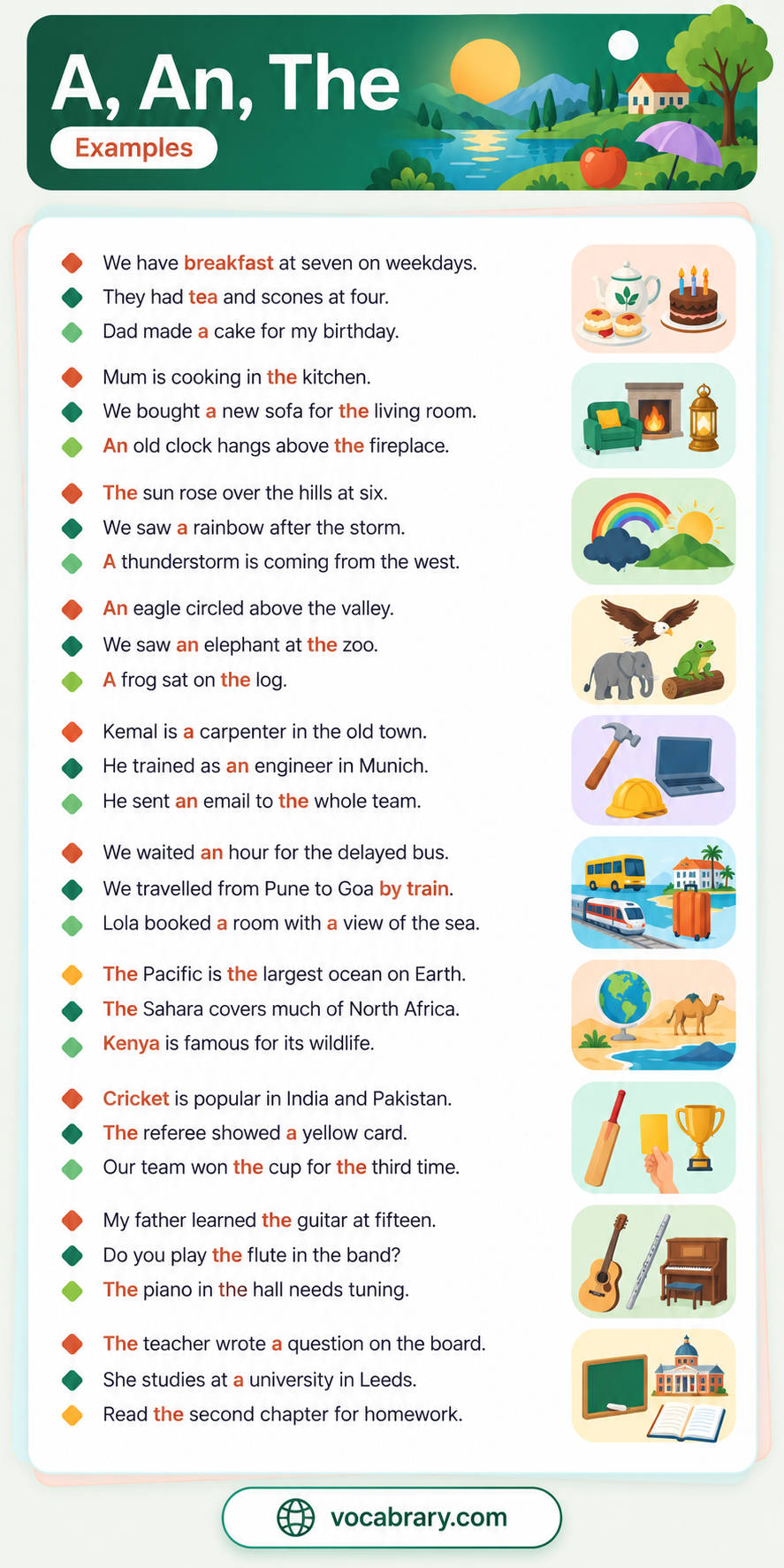
Sentences With a an the in Everyday English
A puppy, an hour, the moon, and the Nile show four choices: a new noun, a measure of time, a unique object, and a named river.
- She adopted a puppy from the shelter last week.
- The puppy sleeps in an old basket by the stove.
- We waited for an hour outside the station.
- The moon looked huge above the Nile that night.
- Mateo works as a pharmacist in the city centre.
- A university in Seoul offered her a scholarship.
- Dogs need exercise every day to stay fit.
- I would like an orange and a glass of water, please.
- The children in the garden are my cousins.
- We play tennis at the club on Saturdays.
- The tallest building in town is a hotel.
- He plays the guitar in a local band.
- Life is full of surprises for those who travel.
- The Pacific is the largest ocean on Earth.
- The poor deserve better housing in every city.
- Priya had breakfast at seven and lunch at one.
- Open the window, please, because it is hot in here.
- An honest answer is better than a clever excuse.
- She visits her grandmother twice a week.
- Water boils at one hundred degrees Celsius.
A and an Sentences by Consonant and Vowel Sound
A bicycle, a green door, an apple, and an old coat show the sound rule: a goes before a consonant sound, and an goes before a vowel sound.
A Before a Consonant Sound in Example Sentences
A bicycle and a green door begin with consonant sounds, so a is the form.
- Tom rode a bicycle to the lake.
- A green door marks the entrance to the bakery.
- Nina bought a newspaper at the corner shop.
- A tall man waited by the gate.
- We saw a rainbow after the storm.
- A small boat drifted past the pier.
- Dad made a cake for my birthday.
- There is a dentist on the second floor.
An Before a Vowel Sound in Example Sentences
An apple, an envelope, and an orange scarf begin with vowel sounds, so an is the form.
- Zainab ate an apricot on the platform.
- Dad found an envelope under the mat.
- An elephant crossed the road near the camp.
- She wore an orange scarf to the match.
- We need an extra chair for Grandpa.
- An eagle circled above the valley.
- Kofi has an appointment with the optician.
- I would love an ice cream with strawberry sauce.
A and an Sentences Chosen by Sound, Not Spelling
An hour and a university show that the first sound of the next word decides the form, so some words with a vowel letter take a and some words with a consonant letter take an.
An Before a Silent H in a Sentence
An hour, an honest man, an heir, and an honour all begin with a silent h, so the first sound is a vowel and an is correct.
- We waited an hour for the delayed bus.
- An honest review helped the restaurant improve.
- The prince was an heir to a small kingdom.
- It is an honour to meet you.
- Rosa gave an honest account of the accident.
- An hour of practice each day improves any skill.
- He was an honourable man who kept every promise.
- The film lasts an hour and forty minutes.
A Before Vowel Letters With a Consonant Sound
A university, a European, and a unicorn begin with the sound /j/ or /w/, which count as consonants, so a is correct even though the first letter is a vowel.
- She studies at a university in Leeds.
- Hamid is a European citizen living in Lisbon.
- The shop made a one-time offer to students.
- A unicorn stood in the middle of the painting.
- The hammer is a useful tool in any workshop.
- Each nurse wears a uniform with her name on it.
- A union representative spoke at the meeting.
- The ticket costs a euro at the machine.
A or an Before Letters, Acronyms and Numbers
An MBA, an SMS, and an 80-year-old begin with vowel sounds when spoken, while a UFO and a five-minute break begin with consonant sounds, so the spoken form decides.
- Ines earned an MBA from a school in Barcelona.
- I received an SMS from the bank this morning.
- A UFO was reported over the village that night.
- The doctor ordered an X-ray of her left wrist.
- An FBI agent spoke to the students.
- A UN official visited the refugee camp.
- Kenji adopted an eight-year-old dog from the shelter.
- Grandpa is an 80-year-old marathon runner.
- We took a five-minute break after the second lesson.
- He built a one-room cabin by the lake.
- An 11-year-old girl won the chess tournament.
Singular Countable Noun Sentences With Articles and Without
A chair and an idea each name one item that is counted, which is why a and an stand before a singular countable noun and not directly before a plural or uncountable noun.
- A chair stood in the middle of the empty room.
- Sana had an idea for the school fair.
- I need a pen to sign the form.
- There is an envelope for you on the desk.
- A bee landed on the edge of my cup.
- He asked for a second chance.
- A thunderstorm is coming from the west.
- Ayo wrote a letter to her uncle in Lagos.
- Our neighbour keeps a parrot in a large cage.
- We found an island with a tiny beach.
Job Title Sentences With a and an
Carpenter, electrician, and vet are job titles that take a or an when they follow be, become, or work as, because the noun names one member of a profession.
- Kemal is a carpenter in the old town.
- My aunt works as an electrician for the railway.
- Sophie wants to become a vet.
- Her mother is a nurse at the city hospital.
- He trained as an engineer in Munich.
- Amara was a teacher for thirty years.
- As a parent, I worry about screen time.
- Her brother is an architect in Seoul.
- Her cousin became a chef in Naples.
- Priya has been an actress since she was twelve.
Twice a Day and Kilometres an Hour Example Sentences
Twice a day, ninety kilometres an hour, and two euros a kilo use a or an to mean per, so the phrase states a rate of frequency, speed, or price.
- Take one tablet twice a day with water.
- The train travels at ninety kilometres an hour.
- Mina visits her grandmother once a week.
- Tomatoes cost two euros a kilo at the market.
- He earns twelve pounds an hour at the cafe.
- We practise three times a month with the band.
- The ticket costs twenty dollars a person.
- She jogs five kilometres a day before breakfast.
- Fabric sells for six pounds a metre in this shop.
- Employees work forty hours a week.
Fixed Phrases With Half an Hour and a Dozen
Half an hour, such a cold night, and a dozen eggs are fixed phrases in which a or an follows another word or states a round number.
- We walked for half an hour before lunch.
- What a lovely garden you have!
- It was such a cold night that the lake froze.
- Lucy bought a dozen eggs and a loaf of bread.
- A hundred people attended the ceremony.
- Once upon a time, a king lived beside a lake.
- He left in a hurry and forgot his keys.
- Let me have a look at your drawing.
- As a rule, the shop closes at six.
- I will be back in a couple of minutes.
- They waited for a while under the bridge.
- It was quite a surprise to see him there.
- Take a seat, and I will be with you shortly.
First Mention and Second Mention Sentences
A boy and then the boy, a lamp and then the lamp show the order of mention: a or an introduces a noun, and the names it again once the listener knows it.
- I met a boy at the bus stop. The boy was carrying a violin.
- She bought a lamp and a rug. The lamp was too bright for the room.
- We rented a cottage in Wales. The cottage had a view of the sea.
- Dad found an old watch in the attic. The watch still worked perfectly.
- Ibrahim ordered a pizza. The pizza arrived in twenty minutes.
- There was a cat on our roof. The cat jumped down when we called.
- Mira wrote a poem for her mother. The poem made her cry.
- A man knocked at the door. The man wanted to sell us an encyclopedia.
- Our teacher showed us a map. The map was drawn in 1850.
- Tomas cooked an omelette for lunch. The omelette was too salty.
Known Noun Sentences With the Door and the Kitchen
The door, the kitchen, and the girl in the red coat name nouns that the listener identifies, because they are in sight, because both speakers know them, or because a phrase narrows the choice.
- Please close the door, because there is a draught.
- Mum is cooking in the kitchen.
- The girl in the red coat is my cousin.
- Did you feed the cat this morning?
- We met at the station near the market.
- The book that you lent me was fascinating.
- The teacher asked us to open our notebooks.
- Who broke the window in the hall?
- She put the keys on the table by the door.
- The shop on the corner sells fresh figs.
Unique Noun Sentences With the Sun and the Moon
The sun, the moon, the equator, and the internet each name a single item in the speaker’s world, so the is used without a first mention.
- The sun rose over the hills at six.
- Astronauts first walked on the moon in 1969.
- The sky turned pink before sunset.
- Quito lies close to the equator.
- Many students search the internet for homework help.
- The government announced a new tax on sugar.
- Pilots see the horizon from the cockpit.
- The Earth takes 365 days to circle the Sun.
- Hikers check the weather in the mountains before leaving.
- The president of the club resigned yesterday.
- The police arrived within five minutes.
Superlative and Ordinal Number Examples
The highest mountain, the best soup, the third floor, and the only person each identify one item by rank or position, so the is used before a superlative, an ordinal, or the word only.
Superlative Sentences With the Highest and the Best
The highest, the most patient, and the youngest rank one item over all others in its group, and the stands before the superlative form.
- Everest is the highest mountain in the world.
- Ana is the most patient teacher I know.
- This is the best soup I have ever tasted.
- The shortest route to the lake runs through the forest.
- Of the three brothers, Idris is the youngest.
- That was the worst storm in fifty years.
- She gave the most generous gift at the party.
- Lagos is the largest city in Nigeria.
Ordinal, Only and Same Sentences With the
The third floor, the only person, the same hotel, and the next train identify one item by its position or its sameness, so the is used.
- Ravi lives on the third floor.
- It was the first time she had flown.
- Read the second chapter for homework.
- He was the only person who spoke Greek.
- We caught the next train to Prague.
- They stayed at the same hotel as last year.
- She finished the last page at midnight.
- The fifth of May is a public holiday.
Geographical Names With the and Without the in Sentences
The Pacific, the Alps, the Maldives, and the UK take the, while Kenya and Lake Victoria do not, and three sets of names explain the pattern.
Ocean, River and Sea Sentences With the
The Pacific, the Nile, and the Red Sea are bodies of water, and every ocean, river, and sea name takes the.
- Ships cross the Pacific in about three weeks.
- The Nile flows north into the Mediterranean.
- We swam in the Red Sea during our holiday.
- The Amazon carries more water than any other river.
- The Thames runs through the centre of London.
- Sailors crossed the Atlantic in a small wooden boat.
- The Suez Canal connects the Red Sea to the Mediterranean.
- The Ganges is sacred to millions of people.
Mountain Range, Desert and Island Group Examples
The Alps, the Sahara, and the Maldives name groups of peaks, a desert, and a chain of islands, and all of them take the.
- Hikers cross the Alps in the summer.
- The Sahara covers much of North Africa.
- Tourists travel to the Maldives for their clear water.
- The Himalayas contain the highest peaks on Earth.
- The Gobi Desert stretches across Mongolia and northern China.
- The Andes run along the western edge of South America.
- We sailed around the Canary Islands for a week.
- The Rockies are covered with snow until June.
Countries With and Without the in Sentences
The Netherlands, the UK, and the United States take the because the name is plural or contains a word such as kingdom. Brazil, France, and Kenya take no word, and the Gambia is a rare exception.
- Maria is from the Netherlands, near Rotterdam.
- The United Kingdom has four nations.
- He works for a software company in the UK.
- The Philippines has more than seven thousand islands.
- Kenya is famous for its wildlife.
- The Gambia lies on both banks of a river.
- She has lived in the United Arab Emirates for six years.
- Brazil has won the World Cup five times.
- Prague is the capital of the Czech Republic.
- France produces hundreds of kinds of cheese.
- The United States has fifty states.
Play the Piano and Learn the Violin Sentences
The violin, the piano, and the drums take the after play, learn, and practise, as in play the violin. Rock and jazz players also say play guitar, and both forms are accepted.
- Naomi plays the violin in the school orchestra.
- My father learned the guitar at fifteen.
- The piano in the hall needs tuning.
- He practises the drums in the garage on Sundays.
- Do you play the flute in the band?
- She has played the cello since she was seven.
- Jazz musicians play the saxophone late at night.
- Dev owns a violin that belonged to his grandfather.
Group Sentences With the Poor and the Elderly
The poor, the elderly, and the Dutch name whole groups of people, and these phrases take a plural verb.
- The poor need more affordable housing.
- Free bus passes are offered to the elderly in our town.
- The injured were taken to the nearest hospital.
- Cycling is a national habit among the Dutch.
- In some countries, the rich pay higher taxes.
- Registration is open to the unemployed at the new centre.
- Volunteers bring meals to the homeless every Friday.
- The young learn languages quickly with new apps.
- Braille lets the blind read with their fingertips.
- Each year the French celebrate Bastille Day on 14 July.
- A nurse visited the sick every day.
Zero Article Sentences for Plural and Uncountable Nouns
Dogs, water, and honesty take no word when the meaning is general, because no particular dog, glass of water, or act of honesty is in view.
- Dogs bark loudly when strangers approach the house.
- Honesty is a quality that employers admire.
- Children learn faster when they play.
- Rice is the main food in many Asian countries.
- Time passes quickly when you are busy.
- Books open doors to other worlds.
- Coffee keeps me awake at night.
- Teachers deserve better pay and smaller classes.
- Music brings people together at festivals.
- Rain falls on most days in tropical forests.
- Cats sleep for most of the day.
- Friendship grows slowly and needs care.
No Article Sentences for Four Noun Groups
Breakfast, Portuguese, football, and biology take no word in a general sense, and the or a is added when a phrase or an adjective makes the noun specific.
Meals Without an Article in Sentences
Breakfast, lunch, and dinner take no word as ordinary meals, while a light lunch and the dinner at Alma’s restaurant take a or the because an adjective or phrase adds detail.
- We have breakfast at seven on weekdays.
- Dinner is ready, so please wash your hands.
- Selim skipped lunch because of the meeting.
- What shall we cook for supper tonight?
- After breakfast, the children walked to school.
- They had tea and scones at four.
- We had a light lunch near the harbour.
- The dinner at Alma’s restaurant was unforgettable.
Language Sentences Without an Article
Portuguese, Arabic, and Swahili take no word when they name a language, though the French language adds the because of the noun language.
- Maria speaks Portuguese and Spanish at home.
- Learning Arabic takes patience and daily practice.
- He teaches English in a school in Kyoto.
- Swahili is spoken in Kenya and Tanzania.
- She translated the poem from French.
- The French language has many words of Latin origin.
Sports Sentences Without an Article
Football, cricket, and chess take no word after play or as a subject, because the name of the game works as an uncountable noun.
- Omar plays football every Saturday morning.
- Cricket is popular in India and Pakistan.
- My sister does yoga before work.
- They watch tennis on television all summer.
- Lena started swimming at the age of four.
- Chess teaches patience to young players.
Academic Subject Sentences Without an Article
Biology, mathematics, and history take no word as school subjects, though the history of Rome and the physics exam take the because a phrase narrows the noun.
- Rahul studies biology at university in Delhi.
- Mathematics is her favourite subject at school.
- She teaches history to Year 9.
- He is excellent at geography and loves maps.
- The history of Rome fills several shelves in the library.
- The physics exam starts at nine.
Names of Cities, Lakes and Streets With No Article
Cairo, Lake Victoria, Mount Kilimanjaro, and Oxford Street take no word, because each names one place with a proper name rather than a group, though the University of Oxford takes the because of the of-phrase.
- Japan has many active volcanoes along its coast.
- Aisha was born in Cairo and grew up in Dubai.
- We climbed Mount Kilimanjaro in six days.
- Lake Victoria is the largest lake in Africa.
- They live on Oxford Street, near the station.
- Our flight leaves from Heathrow Airport at noon.
- Asia is the largest continent on Earth.
- Hawaii attracts surfers from many countries.
- She studies at the University of Oxford.
- Central Park is crowded on sunny Sundays.
Sentences for Travelling by Bus, Train and Air
By bus, by train, and by air state a means of travel with no word after by, though the same vehicle takes the after take, as in take the bus.
- Lena goes to work by bus.
- We travelled from Pune to Goa by train.
- They sent the parcel by air.
- Many tourists arrive by sea in July.
- I prefer to travel by car in the countryside.
- Hana crossed the river by boat.
- The goods came by road from Mombasa.
- They went to the market on foot.
- We took the night bus to the coast.
- Zoe took a taxi from the airport.
British and American English Sentences With Hospital and School
British English uses hospital with no word for a patient, while American English uses the hospital, and school, church, and work take no word in both varieties.
British English Sentences for Hospital and University
Hospital, university, and prison take no word in British English when the sentence is about the purpose of the place rather than the building.
- My grandmother is in hospital after a fall.
- He was taken to hospital by ambulance.
- She is at university in Manchester.
- Her brother spent six months in prison.
- After the accident, Idris stayed in hospital for a week.
- Her cousin goes to university in Manchester.
- Visitors leave flowers at the hospital reception.
- Ruth has been in hospital since Monday.
American English Sentences for the Hospital and College
In American English, in the hospital takes the, while in college and in jail take no word, and the hospital phrase is one difference from British usage.
- My uncle is in the hospital after a bicycle accident.
- The injured driver was taken to the hospital by helicopter.
- Her sister is in college in Ohio.
- The suspect spent a night in jail.
- After the surgery, Omar stayed in the hospital for ten days.
- Her cousin goes to college in Texas.
- The hospital on Main Street opened in 1952.
- Mira has been in the hospital since Tuesday.
School, Church and Work Sentences in Both Varieties
School, church, work, bed, and home take no word when they state a purpose, while the school and the church name the building.
- The children are at school until three.
- Dad goes to church every Sunday morning.
- Mira stayed at home because of the rain.
- He is still at work and will call later.
- The baby is in bed by seven.
- Parents visited the school to meet the head teacher.
- We walked past the church on the hill.
- He went to bed early because of a headache.
Articles in Subject, Object and Prepositional Positions
An article stands inside a noun phrase, and that phrase fills a noun position such as the subject, the object, the object of a preposition, or the complement after a linking verb.
Subject Position Sentences With Articles
A letter, the chef, and an old oak tree begin the sentence as the subject, and the verb agrees with the noun that follows.
- A letter arrived from the council this morning.
- The chef tasted the sauce before serving it.
- An old oak tree shades the village square.
- The guests left before midnight on Saturday.
- A bell rang at the end of the lesson.
- The storm damaged several roofs in the village.
Object Position Sentences With Articles
The window, a cake, and an apartment follow a transitive verb and name what the subject opens, bakes, or books.
- Hamza opened the window and breathed deeply.
- She baked a cake for her neighbour.
- We booked an apartment near the beach.
- The boy kicked the ball over the fence.
- They painted the walls yellow last summer.
- Zoe found a wallet on the pavement.
Prepositional Phrase Sentences With Articles
Under the sofa, for a taxi, and in an old house show a preposition followed by a noun phrase that begins with a, an, or the.
- The cat hid under the sofa.
- We waited for a taxi outside the hotel.
- She lives in an old house by the river.
- He walked into the room without a sound.
- They talked about the film all evening.
- A bird sat on a branch above the stream.
Complement Sentences After Linking Verbs
A pilot, the manager of the bank, and an excellent swimmer follow be or become and rename the subject.
- Sunil became a pilot after ten years of study.
- That building was the old post office.
- Maya is an excellent swimmer for her age.
- Paris remains the capital of fashion.
- Mr Osei was the manager of the bank for twenty years.
- This is a very old map.
Question and Negative Sentences With Articles
Questions and negatives keep the article in front of its noun, so a chemist, the new film, and a single cloud follow the same rules as in statements.
Question Sentences With Articles and Their Nouns
Is there a chemist?, have you seen the film?, and did you bring an umbrella? ask about a new item, a known item, and a second new item.
- Is there a chemist near the station?
- Have you seen the new film at the cinema?
- Did you bring an umbrella for the walk?
- Where did you put the scissors?
- Who is the woman in the green dress?
- Do you have a pen that I could borrow?
- Is the museum open on Mondays?
- What is the capital of Australia?
Negative Sentences With Articles and Their Nouns
There isn’t a single cloud and I didn’t see the sign deny one item, either a new item with a or a known item with the.
- There isn’t a single cloud in the sky.
- I didn’t see the sign at the junction.
- He doesn’t have a car in the city.
- She did not eat an egg this morning.
- We don’t have the tickets yet.
- It wasn’t a difficult exam for most pupils.
- They haven’t found the key to the shed.
- Nobody noticed the mistake until Friday.
Reported Speech and Passive Sentences With Articles
Said that the bus had left and a bridge built by a company show the article unchanged when a sentence is reported or turned into the passive.
Reported Speech Sentences Showing Articles
After said, told, and explained, the article stays where it was in the original statement, though the verb moves back one tense in a past report.
- Karim said that the bus had left already.
- She told me she had seen a fox in the garden.
- The guide explained that the castle was built in 1250.
- Maria asked whether the shop sold an adaptor.
- He said he was an only child.
- The teacher announced that the trip was cancelled.
Passive Voice Sentences Showing Articles
In a passive sentence, a noun phrase such as the bridge, a new road, or an award is the subject, and the agent follows after by.
- The bridge was built by a Spanish company.
- A new road is being planned by the council.
- The letter was written in an old script.
- An award was given to the youngest pupil.
- The thieves were caught by a passing police officer.
- The documents were signed in the presence of two witnesses.
Sentences With Articles Across Eight Everyday Settings
Homes, schools, offices, journeys, newsrooms, stories, stadiums, and clinics each use their own nouns with articles, and sentences with a an the cover all eight.
Home Sentences With Articles for Household Items
A pot of tea, a new sofa, and an old clock are household items that take a or an at first mention and the afterward.
- The kettle is boiling, so make a pot of tea.
- We bought a new sofa for the living room.
- An old clock hangs above the fireplace.
- Mum keeps the spare key under a flowerpot.
- Please turn off the lights before you leave.
- A cat sleeps on the warm windowsill every afternoon.
School Sentences With Articles for Classroom Items
A question on the board, an exercise book, and a dictionary from the library are school items introduced with a, an, or the.
- The teacher wrote a question on the board.
- Each pupil needs an exercise book and a ruler.
- The headmaster gave a speech at the assembly.
- Ali borrowed a dictionary from the library.
- An inspector visited the school on Tuesday.
- The bell rang, and the students rushed outside.
Office Sentences With Articles for Meetings and Emails
A meeting with the director, an email to the team, and a contract with an Italian firm are office items that take a, an, or the.
- Sana attended a meeting with the director.
- The printer needs a new cartridge.
- He sent an email to the whole team.
- A colleague covered the morning shift.
- They signed a contract with an Italian firm.
- The company opened an office in Nairobi.
Travel Sentences With Articles for Trains and Hotels
The early train, a room with a view, and an hour of delay are travel items that take a, an, or the.
- We caught the early train to Edinburgh.
- Lola booked a room with a view of the sea.
- The flight to Doha was delayed by an hour.
- A porter carried the suitcases up the stairs.
- Tourists queued to enter the cathedral.
- Kamal asked a passer-by for directions to the station.
News Report Sentences About Fires and Courts
A fire at the old market, an earthquake in a region, and a new bridge are news items introduced with a, an, or the.
- A fire destroyed the old market on Sunday.
- The minister resigned after a scandal.
- An earthquake shook the region early yesterday.
- The police arrested a man near the harbour.
- A new bridge will open to the public next month.
- The court heard an appeal on Wednesday.
Story Sentences About Knights and Dragons
A woodcutter, an old man by the fire, and a dragon at the gate are story characters introduced with a or an and then named with the.
- Once upon a time, a woodcutter lived near the forest.
- The knight lifted a lantern and entered the cave.
- An old man sat by the fire and told a story.
- The wind howled around the tower all night.
- She found a key hidden in the hollow trunk.
- A dragon guarded the gate of the castle.
Sports Sentences About Goals and Cups
A goal in the final minute, a yellow card, and the cup for the third time are sports events that take a, an, or the.
- The striker scored a goal in the final minute.
- A young swimmer broke the national record.
- The referee showed a yellow card.
- Our team won the cup for the third time.
- An injury kept the captain out of the match.
- The crowd cheered when a runner crossed the line.
Health Sentences About Doctors and Medicine
An antibiotic for the infection, a glass of water, and a headache are health items that take a, an, or the.
- The doctor prescribed an antibiotic for the infection.
- Drink a glass of water after the run.
- A nurse took the patient’s temperature.
- Eat an apple and a handful of nuts as a snack.
- The dentist found a small hole in a back tooth.
- Lena has a headache, so she lies in a dark room.
Article Sentences for Kids
Sentences with a an the for kids use a dog, a cat, an apple, and the sun, nouns that primary pupils see every day.
Sentences for Young Children With Articles
A dog, a cat, an apple, and the sun are nouns that children see and touch, so these sentences keep a, an, and the in short, direct statements.
- I have a dog and a cat.
- The sun is bright and hot today.
- She eats an apple at lunch.
- We saw an elephant at the zoo.
- Dad drives a big red truck.
- The baby sleeps in a small bed.
- I see a bird in the tree.
- Mum bakes a cake on Sunday.
- The moon is high in the sky.
- He has an ice cream in his hand.
- Look at the rainbow after the rain!
- May I have a cookie and a glass of milk?
Short Sentences With Articles for Young Learners
Short lines about a cat, a frog, an owl, and the bus give beginners a pattern to copy and read aloud.
- The cat sat on a mat.
- I have an orange and a pear.
- A frog sat on the log.
- We saw an owl at night.
- The bus is at the gate.
- She has a red hat today.
- An ant is on the leaf.
- He drew a star and a sun.
Student Sentences With Articles for Essays and Reports
Sentences with a an the for exams come from essays and reports, and these twelve give secondary students models about a study, a committee, and the French Revolution.
- The study examined a sample of two hundred teenagers.
- An increase in prices led to a fall in demand.
- The committee reached a unanimous decision after an hour of debate.
- Researchers described the results as an unexpected breakthrough.
- The French Revolution changed the structure of European politics.
- A balanced diet reduces the risk of heart disease.
- Climate change is a global problem that affects the poor most severely.
- The author uses an unreliable narrator to question the truth.
- The essay needs a stronger conclusion and an accurate title.
- Nobody has proved the theory, though a few experts support it.
- An analysis of the data shows a steady rise in temperature.
- The government plans to invest in the railways.
Short Paragraphs That Use a, an and the
These five short passages about a cottage, a market, a bridge, a clinic, and a garden use sentences with a an the in connected writing. A new noun is introduced with a or an and named again with the.
We rented a cottage in the hills of Wales. The cottage had an old stove and a view of the valley. Every morning the sun lit the kitchen. On the last day, we left a note for the owner.
Nadia opened a stall at the Sunday market. The stall sold a few jars of honey and an assortment of candles. By noon the honey was gone. She wrote a list for the next week.
A stone bridge crosses the river near our village. The bridge was built by an engineer from Prague. Children cross the bridge on the way to school. In the spring, a festival fills the street beside it.
Marcus visited a clinic with an earache. The nurse took his temperature, and a doctor looked at the ear. She prescribed an antibiotic. After an hour, he left with a prescription in his hand.
Grandma has a small garden behind the house. The garden has an apple tree and a row of beans. She waters the beans twice a day. In the autumn, she gives the neighbours a basket of apples.
Table of Sentences With Articles and No Word
The choice depends on four facts: whether the noun is new or known, singular or plural, countable or uncountable, and part of a fixed set such as rivers or sports.
| Situation | Choice | Example |
|---|---|---|
| New singular countable noun | A or an | She found a coin. |
| Noun mentioned already | The | The coin was old. |
| Unique thing | The | The sun is hot. |
| Superlative or ordinal | The | He is the tallest boy. |
| General plural noun | No word | Dogs bark. |
| General uncountable noun | No word | Water boils. |
| Meals, languages, sports | No word | We play tennis. |
| Rate or price per unit | A or an | She runs twice a day. |
| Adjective for a group | The | The poor need help. |
| Rivers, oceans, ranges | The | The Alps are high. |
| Most countries and cities | No word | Peru borders Brazil. |
A and an vs the in Paired Sentences
A and an introduce a noun that is new or not specific, while the marks a noun that both speaker and listener know. Both stand before the noun, but only the combines with plural and uncountable nouns.
| Feature | A or an | The |
|---|---|---|
| Meaning | New or not specific noun | Specific noun known to both speakers |
| Noun types | Singular countable nouns only | Singular, plural, and uncountable nouns |
| Sound rule | A before a consonant sound, an before a vowel sound | The, said as /ðə/ before a consonant sound and /ði/ before a vowel sound |
| Position in a text | First mention | Later mentions |
| Plural form | None, so plural nouns take some or no word | The same form, as in the books |
| Example | I bought a book. | I read the book. |
FAQs
Q1. When do you use a and an in a sentence?
Sentences with a an the use a and an before a singular countable noun when the noun is new or not specific. She bought a laptop introduces one laptop, and he found an umbrella introduces one umbrella the listener has not met yet. Plural and uncountable nouns take some or no word instead.
Q2. How do you choose between a and an?
You choose between a and an by the first sound of the next word, not by its first letter. A goes before a consonant sound, as in a bicycle and a university, and an goes before a vowel sound, as in an apple and an hour. Saying the word aloud shows which sound comes first.
Q3. Why do we say an hour but a university?
We say an hour but a university because the first sound decides the form. The word hour begins with a vowel sound, since the h is silent, while university begins with the sound /j/, which counts as a consonant. The same pattern applies to an honest man and a European city.
Q4. When do you use the instead of a?
You use the instead of a when the listener knows which noun is meant. The noun is known because it was mentioned before, because it is unique, as in the sun, or because a phrase narrows it, as in the girl in the red coat. Superlatives and ordinal numbers also take the, as in the best and the first.
Q5. How do a and the work when a noun is mentioned twice?
A and the work in sequence: a marks the first mention, and the marks every later mention. In I bought a lamp, and the lamp is blue, the first lamp is new to the listener and the second is known. The pattern repeats for each new noun in a text, and sentences with a an the follow it in stories and reports.
Q6. When do English sentences use no article at all?
English sentences use no word before the noun for general plural nouns, general uncountable nouns, meals, languages, sports, and academic subjects. Examples are dogs bark, water boils, we had lunch, and she speaks Italian. Most countries and cities also take no word, as in Peru and Nairobi.
Q7. Do uncountable nouns take a or an?
Uncountable nouns do not take a or an in their uncountable sense, because those words count one item. Nouns such as information, advice, luggage, and furniture take some or a phrase such as a piece of instead. Writers say some advice or a piece of advice, never an advice.
Q8. Which countries take the?
Countries take the when the name is plural or contains a word such as republic, kingdom, states, or emirates. The Netherlands, the Philippines, the United Kingdom, and the United States are standard examples. Most other countries, such as France, Kenya, and Japan, take no word.
Q9. Do rivers, oceans, and mountains take the?
Rivers, oceans, seas, deserts, and mountain ranges take the, as in the Nile, the Pacific, the Sahara, and the Alps. Single mountains and lakes take no word, as in Mount Fuji and Lake Victoria. Island groups take the, so the Maldives is correct, while a single island such as Bali stands alone.
Q10. Why do we say play the piano but play football?
We say play the piano but play football because musical instruments take the and sports take no word. The standard forms are she plays the violin and he plays tennis. Rock and jazz players also say play guitar, and both forms are accepted.
Q11. Is it in hospital or in the hospital?
British English uses in hospital for a patient and in the hospital for a visit to the building, while American English uses in the hospital for both. A British speaker says she is in hospital with a broken leg, and an American speaker says she is in the hospital with a broken leg. School works the same way in both varieties, with at school for a student and at the school for a visitor.
Q12. Why do we say twice a day and not twice the day?
We say twice a day because a means per in expressions of frequency, speed, and price. The same pattern gives three times a week, ninety kilometres an hour, and two euros a kilo. The word the does not fit these phrases.
Q13. How does the work with adjectives such as poor and rich?
The word the combines with adjectives such as poor, rich, and elderly to name whole groups of people. The poor need help means that poor people need help, and the verb is plural. Nationality adjectives such as Dutch, French, and British follow the same pattern, so the Dutch are cyclists means Dutch people.

Leave a Comment