
A causative verb is a verb with which a subject causes another person to act instead of acting directly, as in she had the plumber fix the sink. The verb expresses the relationship between the subject and that person: made him wait forces, let him wait permits, had him wait arranges, and got him to wait persuades. Each relationship calls for its own form of the second verb, and causative verb example sentences follow that form, fix after had and to fix after got.
What Is a Causative Verb?
A causative verb describes a situation in which the subject causes someone else to do an action, or causes an action to be done. It differs from an ordinary transitive verb, in which the subject performs the action itself.
Subject + have, make, or let + object + base verb; subject + get + object + to + base verb; subject + have or get + object + past participle
Ana had her car repaired, and the mechanic let her watch.
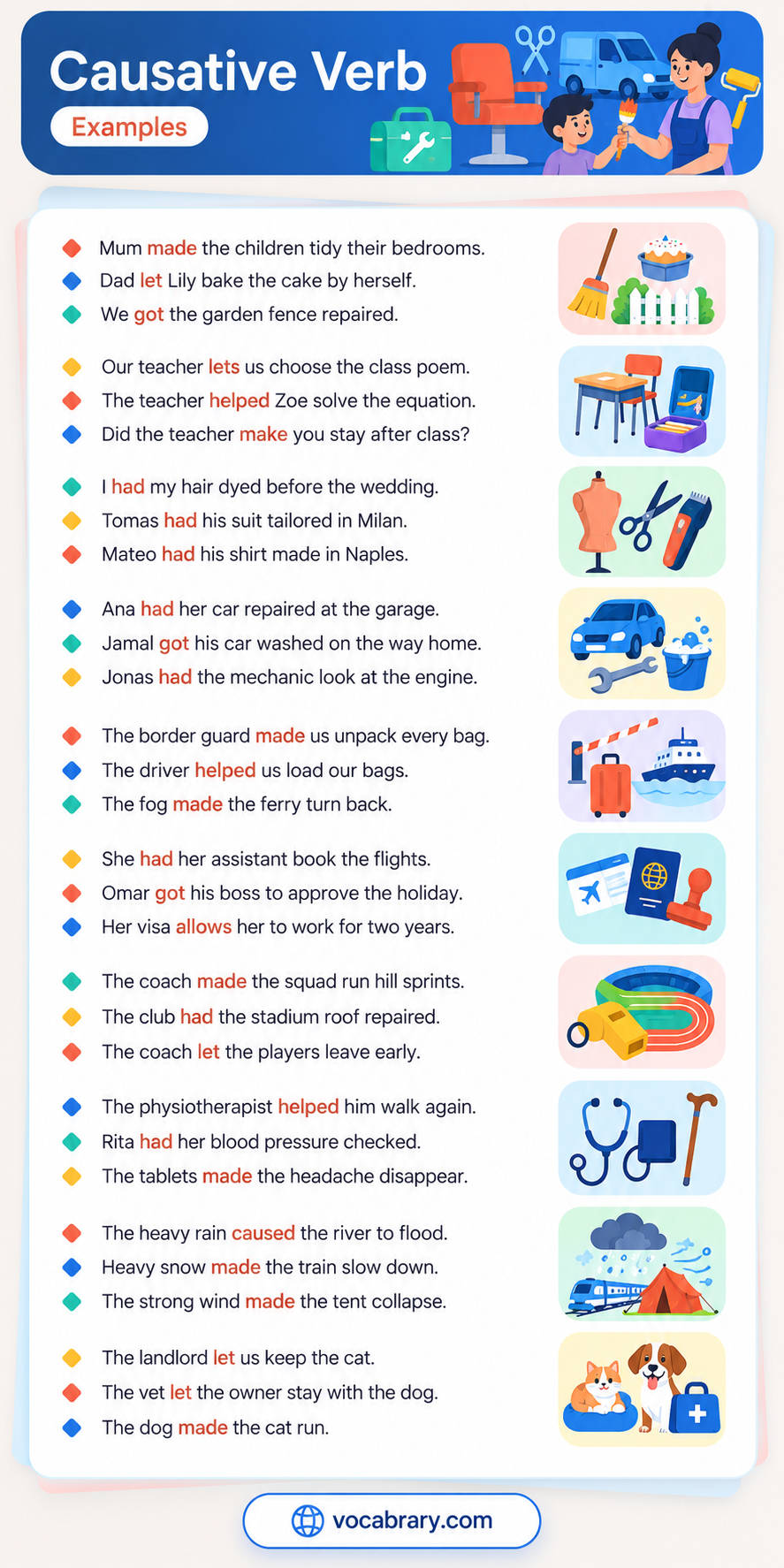
Causative Verb Example Sentences for Everyday Use
A manager who has a clerk send a letter, a tutor who makes pupils redo an exercise, and an uncle who lets a boy ride a tractor each involve another person’s action. The subject is involved by ordering, arranging, or permitting that action.
- The manager had the clerk send the letter before noon.
- The tutor made the pupils redo the exercise.
- His uncle let him ride the tractor.
- Ibrahim got his cousin to help with the move.
- Zoe had her hair trimmed on Saturday.
- Bruno helped his brother carry the groceries.
- The trainer made the swimmers repeat the drill.
- Lucia got the carpet cleaned before winter.
- Grandma let the twins lick the spoon.
- The hotel had its lobby repainted over the summer.
- Yusuf got his neighbour to feed the cat.
- The heavy rain made the river overflow.
- Ravi had the technician check the wiring.
- The old farmer let the children pick pears from his orchard.
- Aiko got her licence renewed in two days.
- The sad ending made everyone cry.
- Mateo had his shirt made in Naples.
- The nurse helped the patient sit up.
- Our teacher lets us choose the class poem.
- Camila had the plumber fix the leaking tap.
- A hurricane forced the village to evacuate.
- The new rule allows staff to take a long lunch.
- Kofi got his bicycle fixed at a shop near the station.
- The loud thunder made the baby wake up.
- The school has the pupils clean their classrooms on Fridays.
Example Sentences for Six Causative Verb Patterns
Six patterns cover most causative sentences: have, get, make, let, help, and the form with a past participle. A manager who has a clerk send a letter and a driver who has a car repaired show two of them.
| Verb | Pattern | Example sentence |
|---|---|---|
| Have | Have + person + base verb | The manager had the clerk send the letter. |
| Get | Get + person + to + base verb | Mina got her cousin to help. |
| Make | Make + person + base verb | The coach made the team run. |
| Let | Let + person + base verb | Dad let me drive. |
| Help | Help + person + base verb or to + base verb | Sam helped me carry the box. |
| Have or get | Have or get + thing + past participle | I had my car repaired. |
Have Someone Do Something Example Sentences
The pattern have plus a person plus the base form, the verb without to, shows that the subject arranges for someone to act. A captain who has the crew lower the sails and a diner who has a waiter bring a second menu arrange the task for someone else.
- The captain had the crew lower the sails.
- Diego had the waiter bring a second menu.
- She had her assistant book the flights.
- The headteacher had the caretaker lock the gates.
- We had the electrician check the sockets.
- Ayesha had her brother carry the boxes upstairs.
- The director had the actors repeat the scene.
- I had my friend read the application before I sent it.
- The mayor had the clerk prepare a short speech.
- Jonas had the mechanic look at the engine.
- The editor had the writer shorten the article.
- Our boss had everyone sign the card.
- Leila had the guide explain the route twice.
- The shop had a driver deliver the sofa on Monday.
- He had his lawyer read the contract.
- The principal had the students wait in the hall.
Sentences With Get Someone to Do Something
The pattern get plus a person plus to plus the base form shows that the subject persuades or convinces someone to act. A girl who gets her cousin to drive a van and a customer who gets a shop to refund a coat both rely on persuasion.
- Mina got her cousin to drive the van on Saturday.
- Fatima got her neighbour to water the plants.
- I got the shop to refund the damaged coat.
- Omar got his boss to approve the holiday.
- Nadia got her little brother to tidy his room.
- The mayor got the council to build a new bridge.
- Samir got his friends to join the club.
- She got the plumber to come on Sunday.
- Wei got the landlord to fix the heating.
- The teacher got the pupils to plant trees behind the school.
- Thandi got her father to teach her chess.
- Kenji got the bank to extend his loan.
- I got my sister to lend me her camera.
- The coach got the players to practise on Sundays.
- Zara got the museum to open early for her group.
- Ingrid got her manager to listen to her idea.
Make Someone Do Something in Sentences
The pattern make plus a person plus the base form shows force, duty, or a cause that produces a reaction. A coach who makes players run and a joke that makes a room laugh show the two uses.
- The coach made the players run ten laps.
- The teacher made the students redraw the diagram.
- The sad film made the whole cinema fall silent.
- Her mother made her apologise to the neighbour.
- The loud noise made the dog bark.
- The customs officer made us open every suitcase.
- His joke made the whole room laugh.
- The rain made the match stop for an hour.
- Dad made me wear a helmet on the bicycle.
- The smell of burning toast made Rosa run to the kitchen.
- The long queue made several customers leave.
- The teacher makes us read aloud on Fridays.
- Heavy snow made the train slow down.
- The manager made Aiko redo the whole report.
- Her story made me think about my own childhood.
- The strong wind made the tent collapse.
Let Someone Do Something Sentences for Permission
The pattern let plus a person plus the base form shows permission. A father who lets a daughter drive and a teacher who lets students choose seats allow the action to happen.
- Dad let me drive his old truck.
- Her mother let her stay up late on Friday.
- My grandfather let the children ride his donkey.
- Our teacher lets us choose our own seats.
- The guard let the visitors park in the courtyard.
- Ana’s parents let her choose her own school.
- The coach let the players leave early.
- Mrs Okafor let her neighbour borrow the ladder.
- The librarian let the children read in the corner.
- The manager lets staff go home early on Fridays.
- Hassan let his brother use the computer for an hour.
- The landlord let us keep the cat.
- The vet let the owner stay with the dog.
- My aunt let me taste the soup before dinner.
Help Sentences With and Without To
Help is followed by a person and either the base form or to plus the base form, with no change in meaning. Hassan helped his sister paint the fence and Ayesha helped me to understand the chart use the two forms.
Sentences With Help and the Base Verb
The base form after help is the shorter choice. A girl who helps her grandmother cook and a teacher who helps a pupil solve an equation use it.
- Hassan helped his sister paint the fence.
- The porter helped the passenger lift the suitcase.
- My neighbour helped me fix the fence.
- Priya helps her grandmother cook on Sundays.
- Tomas helped the tourists find the station.
- The teacher helped Zoe solve the equation.
- A stranger helped us push the car.
- Kofi helped his uncle paint the barn.
Help With a Noun and Help To Sentences
Help also takes to plus the base form, as in help me to understand, and help with plus a noun, as in help me with my homework. The three patterns give almost the same meaning.
- Ayesha helped me to understand the chart.
- The new software helps teachers to mark faster.
- Mum helped the children to dress for the party.
- Lena helped me with my homework.
- Dan helped his father with the shopping.
- Chidi helped the old man to cross the road.
- The guide helped us with our bags.
- A good map helps hikers to find the path.
Have Something Done Sentences for Services
The pattern have plus a thing plus the past participle shows that a service is arranged and someone else does the work. Hair dyed before a wedding and a car repaired at a garage are the best-known cases.
- I had my hair dyed before the wedding.
- Ana had her car repaired at the garage.
- Tomas had his suit tailored in Milan.
- We had the windows cleaned before the party.
- Dalia had her teeth checked in March.
- The family had a new kitchen installed last year.
- Mr Haddad had his shoes polished at the station.
- Rosa had her photograph taken for her passport.
- They had the piano tuned before the concert.
- Omar has his oil changed every six months.
- I had my eyes tested yesterday.
- Mei had a portrait painted of her grandmother.
- The company had a website built by a local designer.
- She had the invitation printed on thick paper.
- My brother had his bicycle serviced before the race.
- The council had the old tree removed.
Informal Sentences With Get Something Done
The pattern get plus a thing plus the past participle has the same meaning as have, and it is more informal. A phone repaired in an hour and a dress altered for a wedding are typical cases.
- Priya got her visa approved in a week.
- Kofi got his laptop fixed at a shop in the mall.
- We got the roof repaired before winter.
- Nadia got her dress altered for the wedding.
- Jamal got his car washed on the way home.
- I got my phone repaired in an hour.
- They got the walls painted in a bright yellow.
- Elena got her winter coat dry-cleaned before the trip.
- Wei got the keys copied at the hardware shop.
- The students got their projects checked by the teacher.
- Mum got the sofa delivered on Tuesday.
- I got my bike fixed before the trip.
- Hana got the tickets booked by her assistant.
- We got the heating checked in October.
Sentences About Bad Events With Have Something Done
Have plus a past participle also reports something bad that happens to the subject, with no arrangement at all. A stolen bicycle and a broken window are experiences, not services.
- She had her bicycle stolen outside the library.
- Tom had his wallet taken on the crowded train.
- The family had their windows broken in the storm.
- Mr Ali had his car towed from the loading bay.
- Samira had her phone stolen at the festival.
- The shop had its sign damaged by the wind.
- We had our luggage lost on the flight to Athens.
- Rita had her handbag snatched near the market.
- The farmer had half his crop destroyed by frost.
- Luis had his house broken into while he was away.
Other Causative Verbs Followed by To and the Base Verb
Force, allow, cause, and enable also work as causative verbs, and each is followed by an object and to plus the base form. A storm that forces an airline to cancel flights and a school that allows students to use phones show the pattern.
Force and Require Sentences
Force and require express pressure or duty from outside, and the person under pressure is the object. A storm that forces an airline to cancel flights and a law that requires drivers to carry a licence show the pattern.
- The storm forced the airline to cancel all flights.
- The flood forced hundreds of families to leave.
- The law requires drivers to carry a licence.
- Hunger forced the villagers to walk to the city.
- The judge required the witness to answer.
- The strike forced the factory to close for a week.
- Her injury forced Aisha to miss the final.
Allow and Permit in Sentences
Allow and permit express permission, and they are followed by to plus the base form, unlike let. A school that allows students to use phones and a park that permits dogs on leads show the pattern.
- The school allows students to use phones at lunch.
- The park permits visitors to bring dogs on leads.
- The new rule allows staff to bring dogs to work.
- The ticket allows visitors to enter the museum twice.
- The council permitted the shop to open on Sundays.
- Her visa allows her to work for two years.
- The doctor allowed the patient to eat solid food.
Cause and Enable Sentences
Cause and enable express a result that follows from an event or a tool. Heavy rain that causes a river to flood and software that enables users to edit photos show the pattern.
- The heavy rain caused the river to flood.
- The new software enables users to edit photos.
- The delay caused several passengers to miss their flights.
- A strong signal enables the phone to load maps quickly.
- The fire caused the roof to collapse.
- The grant enabled the school to buy new computers.
- The cold weather caused the pipes to freeze.
Passive Sentences With Be Made To and Be Allowed To
Make is followed by the base form in the active and by to plus the base form in the passive. The teacher made the students rewrite the essay becomes the students were made to rewrite the essay, while let is not normally used in the passive, and be allowed to takes its place.
- The students were made to rewrite the essay.
- I was made to wait outside in the cold.
- The prisoners were made to work in the fields.
- He was made to apologise to the neighbour.
- The children were made to clean the classroom.
- Tom was made to repay the money.
- The staff were forced to leave the building.
- Several families were forced to leave their homes.
- She was allowed to stay at the party until midnight.
- Children under twelve were allowed to enter free.
- The pupils were required to wear a uniform.
- Tourists were permitted to enter the castle.
- The patient was helped to stand.
- Karim was made to write the invitation again.
Examples of Causative Verbs in Negative Sentences
A negative causative sentence uses not, never, or a negative subject such as nobody with the first verb and keeps the same pattern after it. A school that does not let students leave early and a coach who does not make players stay late show the forms.
- I won’t let him borrow my car.
- The coach didn’t make the players stay late.
- We didn’t have the roof repaired this year.
- Nobody made me sign the form.
- The school does not let students leave early.
- She never lets her children stay up past ten.
- My parents didn’t get me to practise the piano.
- Dan hasn’t had his eyes tested for years.
- The manager would not let the staff leave before five.
- The doctor didn’t make the patient stay overnight.
- Rosa never had her hair coloured.
- They have not got the walls painted yet.
Question Sentences With Did You Have and Who Made
A causative question uses an auxiliary verb such as do, did, will, or have, or a question word, and the object and the second verb follow in the same order as in a statement. Who made you wait, did you have the technician check the wiring, and where did you have your suit made are typical questions.
- Who made you wait so long?
- Did you have the technician check the wiring?
- Where did you have your suit made?
- Will she let him borrow the car?
- How often do you get your hair cut?
- Why did the coach make the players run?
- Can you help me carry this?
- Have you had the locks changed?
- Did your parents let you travel alone?
- Who got the bank to extend the loan?
- Does your school allow students to use phones?
- What made the baby cry so loudly during the concert?
- Where did Tomas get his bicycle repaired?
- Did the teacher make you stay after class?
Sentences With Causative Verbs in Different Tenses
A causative verb takes every tense, and the second verb stays in the same form as in the present. I am having my house painted, she has had her hair cut, and they will get the car serviced show three tenses.
- I am having my house painted this week.
- She has had her hair cut.
- They will get the car serviced next week.
- We had been having the kitchen redone for months.
- My parents are letting me drive to the coast.
- The manager was making everyone stay late.
- He had his tooth pulled last Tuesday.
- Mei is getting her flat painted in May.
- The teacher has made the class rewrite the essay twice.
- We will have the sofa delivered on Friday.
- Ravi was having his photograph taken when the rain began.
- She will let her sister borrow the dress.
Reported Speech Sentences With Causative Verbs
Reported speech keeps the causative pattern, and a past reporting verb shifts the tense one step back, as in she said she would have the plumber check the pipes. A verb already in the past tense keeps its form, as in he explained that his mother made him wear a helmet.
- She said she would have the plumber check the pipes.
- He explained that his mother made him wear a helmet.
- Priya said her parents let her choose her own subjects.
- The mechanic told me I should get the brakes checked.
- Omar said he had had his phone repaired.
- The manager said she had had the report checked twice.
- Tom told us that he had had his bike serviced.
- The teacher said she would make us repeat the test.
- Ayesha explained that the landlord had let them keep the cat.
- Jamal said he had got his car washed on the way home.
Sentences About Chores and Services at Home
A homeowner who has a carpet cleaned, a mother who makes a child tidy a bedroom, and a father who lets a daughter bake show causes in the home. The subject arranges, orders, or permits the task.
- We had the carpet cleaned before the guests arrived.
- Mum made the children tidy their bedrooms.
- Dad let Lily bake the cake by herself.
- The family had a new boiler installed.
- Grandma got the neighbour to carry the shopping.
- My brother helped me hang the curtains.
- We got the garden fence repaired.
- Mum had the electrician fix the broken light.
- The noise from the street made us close the windows.
- Dad let the cat sleep on the sofa.
Sentences About Orders and Permissions at School
A teacher who makes pupils redraw a map, a headteacher who lets pupils leave early, and a school that has the caretaker lock the gates show causes at school. The subject gives the order or the permission.
- The teacher made the pupils redraw the map.
- The headteacher let the pupils leave early on the last day.
- The school has the caretaker lock the gates at six.
- Our teacher got the class to sing in French.
- The librarian helped the children find the right book.
- The head of year had every student sign the form.
- The art teacher let us paint the corridor wall.
- The examiner made the candidates leave their bags outside.
- The school had all the desks replaced in August.
- Mr Ibrahim got the older pupils to mentor the younger ones.
Work Sentences About Delegating and Permitting Tasks
A director who has a secretary send an invoice, a boss who lets staff work from home, and a company that has its offices painted show causes at work. The subject delegates or permits a task.
- The director had the secretary send the invoice.
- The boss lets the staff work from home on Fridays.
- The company had its offices painted over the summer.
- Ingrid got the supplier to reduce the price.
- The director made the team redo the presentation.
- Our firm has an accountant check the figures each month.
- The new software enables staff to share files quickly.
- The supervisor helped the new employee learn the system.
- The client got the designer to change the logo.
- The company had its computers upgraded in March.
Travel Sentences With Delivered Suitcases and Forced Landings
A traveller who has a suitcase delivered, an attendant who lets tourists enter a castle, and a storm that forces a plane to land show causes on a trip. The subject arranges, permits, or forces a step in the trip.
- We had our suitcases delivered to the hotel.
- The attendant let the tourists enter the castle.
- The storm forced the pilot to land at another airport.
- The border guard made us unpack every bag.
- The agent got the airline to refund our tickets.
- Kenji had his passport photographs taken at the station.
- The driver helped us load our bags.
- The airline allowed passengers to change their seats.
- The fog made the ferry turn back.
- We got the hotel to hold our luggage for the day.
News Report Sentences About Laws and Wildfires
A government that makes companies publish figures, a court that lets a family appeal, and a wildfire that forces families to flee appear in daily reports. The subject is the cause behind a public event.
- The government made the companies publish their figures.
- The court let the family appeal the decision.
- The wildfire forced hundreds of families to flee.
- The new law requires shops to display prices.
- The mayor had the damaged bridge closed.
- The scandal caused the minister to resign.
- Police made the protesters leave the square.
- The council allowed residents to vote by post.
- Heavy snow made the airport close for a day.
- The agency had the report published online.
Story Sentences About Witches and Wizards
A witch who makes a prince sleep, a king who lets a stranger enter, and a wizard who has a servant guard a door show causes in a story. The subject controls another character.
- The witch made the prince sleep for a hundred years.
- The king let the stranger enter the castle.
- The wizard had his servant guard the door.
- The dragon forced the villagers to hide in the cellar.
- The fairy helped Cinderella dress for the ball.
- The queen had the thief brought to the throne room.
- A strange sound made Elias turn around.
- The old woman got the boy to carry her basket.
- The storm caused the ship to sink.
- The captain let the sailors rest for the night.
Sports Sentences About Coaches and Referees
A coach who makes a squad run hill sprints, a referee who lets play continue, and a club that has a stadium repaired show causes in sport. The subject gives the order or the permission.
- The coach made the squad run hill sprints.
- The referee let play continue after the foul.
- The club had the stadium roof repaired.
- The captain got the team to wear black armbands.
- The trainer helped the runner stretch before the race.
- The wet pitch made the players slip in the first minute.
- The federation allowed the athlete to compete again.
- The coach had the goalkeeper practise penalties.
- The injury forced Jamal to leave the pitch.
- The manager got the board to sign a new striker.
Health Sentences About Doctors and Patients
A doctor who has a nurse take a sample, a patient who has her blood pressure checked, and a pill that makes a headache disappear show causes in health. The subject arranges or permits a treatment.
- The doctor had the nurse take a blood sample.
- Rita had her blood pressure checked.
- The tablets made the headache disappear.
- The surgeon let the patient go home after two days.
- The physiotherapist helped him walk again.
- I got my ankle X-rayed last month.
- The cold weather made her cough worse.
- Malik had his tonsils removed in June.
- The doctor made the patient rest for a week.
- Nadia got her vaccination booked online.
Causative Verb Example Sentences for Kids
Young learners read causative verbs in everyday cases such as a mother making a child eat peas and a father letting a boy ride a bike. The subject is the person who decides.
- Mum makes me eat my peas.
- Dad lets me ride my bike.
- I help Mum bake the cake.
- The teacher lets us play outside.
- Tom has his hair cut.
- Grandpa made me laugh.
- My sister got me to share my toy.
- The clown made the baby smile.
- Lily had her shoes cleaned.
- Dad helped me tie my laces.
- Mum lets me stay up late on Friday.
- The dog made the cat run.
Causative Verb Example Sentences for Students
Exam-level sentences place a causative verb in a longer clause with a passive, a result, or a formal verb such as enable. Writers use these patterns to describe a cause, a permission, or a service.
- The new policy enabled small firms to compete in the market.
- The committee had the proposal revised before the vote.
- The author makes the reader question the narrator.
- The drought forced farmers to sell their cattle.
- The treaty allowed both countries to trade freely.
- The experiment caused the temperature to rise sharply.
- Critics made the director reshoot the final scene.
- The company had its accounts audited by an outside firm.
- Public pressure got the government to change the law.
- The reform let teachers design their own lessons.
- The library helped students to find sources quickly.
- The author had the main character leave the village.
Causative Verbs in Short Paragraphs
A day at the salon, a week at school, a house repair, a football practice, and a garden afternoon use causative verbs for orders, permissions, and services.
Ana had her hair cut on Saturday. The stylist let her choose the colour, and a friend helped her pick a style. Afterwards she got her nails done and had her photograph taken. The whole afternoon made her feel new.
The teacher made the class rewrite the essay. She let them work in pairs and had the best pair read aloud. A few pupils got their parents to check the spelling. By Friday the headteacher had the finished essays displayed in the hall.
The roof leaked, so we had a builder inspect it. He made us move the furniture and got his team to cover the floor. A neighbour helped us carry the boxes. By evening we had the roof repaired.
The coach made the team run in the rain. He let the injured players rest and had the physio check their legs. A cold wind forced everyone to wear coats. After practice he got the captain to thank the volunteers.
My grandfather lets me help in his garden. He has me water the roses and makes me wear a hat. Sometimes he gets my cousin to bring lemonade. The sun causes the flowers to open by noon.
Causative Sentences Compared With Transitive Sentences
A causative sentence shows that someone else performs the action, while an ordinary transitive sentence shows that the subject performs it. More transitive verb example sentences show the ordinary pattern.
| Feature | Causative sentence | Ordinary transitive sentence |
|---|---|---|
| Who performs the action | Another person or thing. | The subject. |
| Pattern | Have, get, make, let, or help + object + verb. | Verb + object. |
| Example with a haircut | She had the barber cut her hair. | She cut her hair. |
| Example with an essay | The teacher made the class rewrite the essay. | The class rewrote the essay. |
| Example with a service | I had my car repaired. | I repaired my car. |
FAQs
Q1. How do you form a causative sentence?
You form a causative sentence with have, get, make, let, or help, followed by an object and a second verb. Have, make, and let take the base form, get takes to plus the base form, and have or get plus a thing takes the past participle. She had the barber cut her hair and she had her hair cut are two examples.
Q2. What is the difference between have someone do and get someone to do?
Have someone do something shows that the subject arranges the task through authority or a paid service, while get someone to do something shows that the subject persuades the person. I had the mechanic check the brakes is a service. I got my brother to check the brakes is a favour won by asking.
Q3. What is the difference between make and let?
Make shows force or a cause, while let shows permission. The coach made the players run means they had no choice, and the coach let the players leave means he allowed it. Both are followed by the base form without to.
Q4. Is help a causative verb?
Help is a causative verb in the broad sense, because the subject assists someone to do something. It is followed by the base form or by to plus the base form, as in she helped me carry the bags and she helped me to carry the bags. Help with plus a noun also exists, as in help me with my homework.
Q5. What does have something done mean?
Have something done means that the subject arranges for someone else to do the work, or that something happens to the subject. I had my hair cut describes a service at a salon. She had her bicycle stolen describes an unwanted event.
Q6. Why is the past participle used in I had my hair cut?
The past participle is used because the hair is the thing that is cut, and the sentence has a passive meaning. The pattern have plus a thing plus a past participle shows that someone else did the cutting. Cut is irregular, so its base form and its past participle look identical in that sentence.
Q7. Does make have a passive voice?
Make has a passive voice, and the passive adds to before the base form. The teacher made the students rewrite the essay becomes the students were made to rewrite the essay. The active form has no to.
Q8. Does let have a passive voice?
Let has no ordinary passive voice, so be allowed to is used instead. She was allowed to stay up late is the usual passive meaning of her mother let her stay up late. The active form of let keeps the base form without to.
Q9. What are other causative verbs besides have, get, make, and let?
Force, allow, cause, enable, require, permit, and persuade also work as causative verbs. Each is followed by an object and to plus the base form, as in the storm forced the airline to cancel the flights. These verbs are more formal than have, get, make, and let.
Q10. Is have a helping verb in causative sentences?
Have is a main verb in causative sentences, not a helping verb, because it expresses arranging or causing. In I have eaten, the word have forms the present perfect with eaten and is a helping verb. See helping verb example sentences for that pattern.
Q11. Are causative verbs used in the continuous tenses?
Causative verbs are used in the continuous tenses, as in I am having my house painted and my parents are letting me drive. The second verb stays in the same form as in the present. The pattern works in the past, present, and future.
Q12. Is a causative verb the same as a transitive verb?
A causative verb is a special type of transitive verb, because it takes an object and a second verb. Ordinary transitive verbs, as in she cut her hair, have the subject perform the action. For ordinary objects, see transitive verb example sentences.

Leave a Comment